
International Research Journal of Engineering and Technology (IRJET) e-ISSN: 2395-0056
Volume: 11 Issue: 05 | May 2024 www.irjet.net p-ISSN: 2395-0072
International Research Journal of Engineering and Technology (IRJET) e-ISSN: 2395-0056
Volume: 11 Issue: 05 | May 2024 www.irjet.net p-ISSN: 2395-0072
Om Nanasaheb Pawar1, Sarthak Pradip Yadao2, Chaitanya Thate3, Prathmesh Amalkant Mestri4, Ganesh Raju Kamble5, Prof. Dr. Mahesh Gaikwad6
1Om Pawar SPPU (Jayawantrao Sawant College of Engineering)
2Sarthak Yadao SPPU (Jayawantrao Sawant College of Engineering)
3Chaitanya Thate SPPU (Jayawantrao Sawant College of Engineering)
4Prathmesh Mestri SPPU (Jayawantrao Sawant College of Engineering)
5Ganesh Kamble SPPU (Jayawantrao Sawant College of Engineering)
6Asst.Professor Mahesh Gaikwad, Dept. of Mechanical Engineering, JSCOE, Maharashtra, India
Abstract: This study presents the development of an electric bike incorporating a liquid-cooled battery system, aimed at enhancing performance,efficiency,andrangewhilemitigating environmental impact. Addressing common challenges in electric vehicle technology, particularly battery thermal management, our project focuses on implementing a liquid cooling solution to improve battery efficiency, crucial for hot weather conditions. Utilizing software tools like SolidWorks and Ansys, we design and conduct thermal analysis of the battery cooling setup, employing a radiator andpump system monitored by a DC thermostat to regulate battery temperature. Numerical simulations and real-world testing evaluate the electricbike'sefficiency,range,andpoweroutput, considering parameters such as battery capacity and system losses. Through this approach, we aim to contribute to the advancement of sustainable transportation solutions.
Key Words: Electricbike,Liquid-cooledbattery,Efficiency improvement,Thermalmanagement.
Therapidevolutionofelectricvehicle(EV)technologyhas usheredinaneweraofsustainabletransportationsolutions, offering promising alternatives to traditional combustion engine vehicles. One significant area of focus within this domainisthedevelopmentofelectricbikes,whichpresent unique challenges and opportunities. Among these challenges,effectivebatterythermalmanagementstandsout asacriticalfactorinfluencingperformance,efficiency,and overall reliability.Inresponsetothischallenge,thisstudy delvesintothedesignandimplementationofaliquid-cooled batterysystemforelectricbikes,aiming toaddressissues suchaslowrangeandbatteryreliability,particularlyinthe contextofhotsummerconditions.
With the overarching goal of enhancing the efficiency and performance of electric bikes while reducing their environmental footprint, our research centers on the integrationofadvancedcoolingtechnologiesintothebattery system. Specifically, we investigate the efficacy of a liquid cooling solution, leveraging computational tools like
SolidWorksandAnsysfordesignoptimizationandthermal analysis.Byemployingaradiatorsetupcoupledwithapump andDCthermostat,weaimtoregulatebatterytemperature effectively,therebyimprovingoverallsystemefficiencyand durability.
In electric vehicles (EVs), various cooling systems are employedtomanagethetemperatureofcriticalcomponents, such as batteries, motors, and power electronics. The primarytypesofcoolingsystemsusedinEVsinclude:
Liquid Cooling: This system circulates coolant through channelsorpipestoabsorbheatfromcomponents.Liquid cooling is efficient and adaptable to different EV components,offeringprecisetemperaturecontrol.
AirCooling:Aircoolingsystemsusefansornaturalairflow to dissipate heat from components. While simpler and cheaperthanliquidcooling,aircoolingmaybelesseffective inextremeconditionsorforhigh-powercomponents.
HybridCooling:SomeEVsutilizeacombinationofliquidand air-cooling systems for optimal thermal management. Hybridcoolingoffersflexibilityandefficiency,combiningthe advantagesofbothliquidandair-coolingmethods.
DirectCooling:Inthissystem,coolantflowsdirectlyoverthe surface of components to remove heat. Direct cooling is highlyefficientbutmayrequirecomplexdesignstoensure uniformcoolingacrossallcomponents.
Phase Change Cooling: Phase change cooling systems use materials that change phase (e.g., from liquid to gas) to absorb heat. While less common in EVs, phase change cooling can offer high cooling capacities and compact designs.
International Research Journal of Engineering and Technology (IRJET) e-ISSN: 2395-0056
Volume: 11 Issue: 05 | May 2024 www.irjet.net p-ISSN: 2395-0072
Liquidcoolinginelectricvehiclesoperatesontheprinciple of circulating a coolant, typically water-based, through channelsorpipeswithincriticalcomponentstoabsorband transferheatawayfromthem.Asthecoolantflowsthrough thesystem,itabsorbsheatgeneratedbycomponentssuch as batteries, motors, and power electronics, thereby maintainingtheirtemperaturewithinsafeoperatinglimits. Theheatedcoolantthenpassesthrougharadiatororheat exchanger, where it releases heat to the surrounding environmentthroughconvectionor,insomecases,through additional cooling mechanisms like fans. This continuous circulation of coolant helps regulate component temperatures,ensuringoptimalperformance,efficiency,and longevityofelectricvehiclesystems.
1. Chunrong Zhao: This paper presents a comprehensive optimization study of a liquid-cooled lithium-ion battery thermal management system (BTMS) tailored for electric verticaltake-offandlanding(eVTOL)aircraft,focusingona notional tilt-wing reference model. Through an in-depth exploration utilizing an internally developed BTMS sizing algorithmcoupledwithbatterydegradationmodelling,the investigation delves into the impact of varying cruise altitudes, hover durations, and battery pack oversizing on BTMS weight, power, and battery lifespan. Remarkably, cruise altitude alterations exhibit negligible influence on BTMS design, while extended hover durations necessitate significantlyheavierBTMSconfigurations,nearlydoubling the weight when duration increases from one to seven minutes. Moreover, findings indicate that altering flight distances or oversizing battery packs dramatically affects batterylifespan,withanotablereductionindegradationrate observed when increasing battery pack size by 20%. Subsequent analysis delves into the interplay of mission specifications, battery oversizing, and optimal designs, highlighting the intricate relationship between energy storage,aircraftperformance,andBTMSdesignundervaried flightconditions.Theseinsightsunderscorethecriticalrole ofenergy-aeronauticalparametersinshapingBTMSdesign andsubsequentbatterydegradationperformance,crucialfor the viability of eVTOL aircraft in advanced air mobility contexts.
Chunrong Zhao, Juan Rasines Mazo, Dries Verstraete,
Optimisation of a liquid cooling system for eVTOL aircraft: Impact of sizing mission and battery size,
Applied Thermal Engineering,
Volume 246,2024,122988, ISSN 1359-4311,
2. Honglei Ren, Chao Dang, Liaofei Yin, Zhifeng Chen: The literature review delves into the optimization of battery thermal management systems (BTMS) through the integrationofphasechangematerials(PCM)coupledwith mini-channelcoolingplates.Thestudyexploreseffectively meetsheatdissipationneedsfordischargeratesunder2C. Particularly,forratesbelow1.2C,externalcoolingisdeemed unnecessary.However,forratesexceeding2C,activecooling becomes imperative due to PCM's limited heat storage capacity. The research identifies the optimal structure of coolingplatesandmini-channels,emphasizingitsefficiency inreducingbatterytemperatureandmaintaininguniformity. Furthermore, optimization parameters such as ethylene glycol solution temperature, volume fraction, and active cooling startup time are discussed. Response Surface Methodologyoptimizationyieldsschemesreducingpower consumption by 35%–40%. The review underscores the importance of thermal management strategies tailored to discharge rates to mitigate risks of thermal runaway and extend battery lifespan. It accentuates PCM's efficacy in moderating temperature under lower discharge rates but highlights the need for active cooling at higher rates. The findings provide valuable insights for BTMS design, advocating for tailored strategies to ensure battery safety andperformanceoptimization.
Honglei Ren, Chao Dang, Liaofei Yin, Zhifeng Chen,
Optimization research on battery thermal management system based on PCM and mini-channel cooling plates,
Case Studies in Thermal Engineering, Volume 53, 2024, 103880, ISSN 2214-157X
3. Delika M. Weragoda: Thispaperpresentsaninnovative approach to battery thermal management systems by addressing the issue of increased weight and thermal resistance introduced by conventional heat pipe-based systems.Theproposedsolution,capillary-drivenevaporative cooling(CDEC),integratesawickstructuredirectlyontothe battery surface for direct cooling, aiming to minimize thermal resistance and weight. Through experimental investigationutilizingcopperfoamandtwocoolingmedia (ethanolandNovec7000),thethermalperformanceofthe CDECsystemisevaluatedundervariousheatingconditions. Results indicate that the system effectively maintains the battery surface temperature around 40°C under a continuous 50 W heat input, with a reduced thermal resistancebyafactorof6comparedtoair-cooledsystems. Thestudycomparesthreecoolingmethodsunderdifferent heatinputsanddemonstratesthesuperiorcoolingeffectof ethanol-basedevaporativecoolingovernaturalconvective air cooling and ethanol-based cooling at atmospheric
International Research Journal of Engineering and Technology (IRJET) e-ISSN: 2395-0056
pressure. Overall, this research introduces a promising batterycoolingconcept,supportedbyexperimentalevidence of its feasibility and effectiveness in regulating battery temperature while minimizing thermal resistance, particularlyunderhighheatloads.
Delika M. Weragoda, Guohong Tian, Qiong Cai, Teng Zhang, Kin Hing Lo, Yan Gao, Conceptualization of a novel battery thermal management system based oncapillary-drivenevaporativecooling,Thermal Science and Engineering Progress, Volume 47,2024,102320, ISSN 2451-9049,
4. Dae Yun Kim: The study investigates a pioneering utilizationof heat pipesaspassivecooling mechanisms to addressintricateelectricresistancephenomenainlithiumionbatteries,pertinenttomanufacturingandthermalsafety concerns. It endeavors to efficiently regulate battery temperatures to curtail production and operational expenses.Employinganinnovativeheatgenerationmodel grounded in the Equivalent Circuit Model, the research harnessesSimulink andMATLABtoprognosticate battery pack power. This elaborate electrochemical computation process is amalgamated and verified with system-level thermal modelling to evaluate the feasibility of heat pipe specificationsandtoprognosticatecoolingpotentialityvia simulation.Theinvestigationfurnishesbothnumericaland empirical validations for voltage, state of charge, and cell temperatures. Notably, it discerns that under high-power output scenarios, such as rates from 4C to 8C, heat pipe adoptioncanmitigatetemperaturevariancebetweenthecell and the ambient environment to under three degrees. Furthermore, the paper scrutinizes battery pack system configurationstojuxtaposethermalresistanceamidactive andpassivecoolingsystems.Thestudy'snoveltyresidesin its integrated thermal management approach using heat pipes within the realm of lithium-ion batteries, an avenue comparatively underexplored in antecedent literature. It delineates a promising trajectory for forthcoming passive coolingstrategiesinbatterypackthermalregulation.
Dae Yun Kim, Byeongyong Lee, Myeongjin Kim, Joo Hyun Moon,
Thermal assessment of lithium-ion battery pack system with heat pipe assisted passive cooling using Simulink,
Thermal Science and Engineering Progress,
Volume 46,2023,102230, ISSN 2451-9049,
5. Z. Lu, X.Z. Meng: The contemporary advancement of electric vehicles necessitates higher power density within batterypacks,promptingefficientarrangementstrategies. However, this densification exacerbates thermal management challenges stemming from internal heat generation. Given the profound implications of extreme temperaturesonbatteryperformance,reliability,safety,and
lifespan,effectivethermalmanagementemergesaspivotal forelectricvehicleviability.Thisstudyaimstoinvestigate the efficacy of air cooling in achieving temperature uniformityandmitigatinghotspotswithinacompactbattery pack,consideringvariousairflowconfigurationsandrates. Numericalfindingsunderscorethepivotalroleofenhancing effectiveheattransferareasbetweenair-coolantandbattery surfaces in significantly reducing maximum temperatures and enhancing temperature uniformity within denselypackedbatteryenclosures.Additionally,thestudyvalidates its numerical model using a thermal resistance model, delineating the contributions of convection and advection thermal resistances in the cooling process. Through this investigation,thestudyshedslightontheintricateinterplay between airflow dynamics and thermal management strategiesinoptimizingbatteryperformanceandlongevity inelectricvehicles.
Z. Lu, X.Z. Meng, L.C. Wei, W.Y. Hu, L.Y. Zhang, L.W. Jin, Thermal Management of Densely-packed EV Battery with Forced Air-Cooling Strategies, Energy Procedia, Volume 88,2016, Pages 682-688,
3.1introduction to Design of Experiments (Doe):-
TheDesignofExperiments(DOE)isasystematicapproach usedtoplan,conduct,andanalyseexperimentsinorderto understandandoptimizecomplexsystemsorprocesses.In thecontextofelectricvehicles(EVs),DOEplaysacrucialrole inevaluatingtheperformanceofvariouscomponents,such as cooling systems, to enhance efficiency, reliability, and overallvehicleperformance.Bysystematicallyvaryingkey factors and observing their effects on response variables, DOEenablesresearchersandengineerstoidentifyoptimal settings, understand interactions between variables, and makedata-drivendecisionsfordesignoptimization.Inthis study,weemployDOEtoassesstheeffectivenessofaliquid cooling system in maintaining optimal operating temperaturesandenhancingtheperformanceofEVbattery packs.Throughsystematicexperimentationandstatistical analysis,weaimtogaininsightsthatwillinformthedesign andoperationofliquidcoolingsystemsinelectricvehicles, contributing to the advancement of sustainable transportationtechnologies
3.2Design Of Experiments: -
ExperimentalDesign:FactorialDesign:Afullfactorialdesign willbeusedtoinvestigatethemaineffectsandinteractions ofthefactorsontheresponsevariables.
DataCollection:Batterytemperaturewillbemeasuredusing thermocouplesplacedatvariouslocationswithinthebattery pack.Coolingsystemefficiencywillbecalculatedbasedon theamountofheatremovedbythecoolingsystemrelative totheheatgeneratedbythebatterypack.
Volume: 11 Issue: 05 | May 2024 www.irjet.net p-ISSN: 2395-0072 © 2024, IRJET | Impact Factor value: 8.226 |
International Research Journal of Engineering and Technology (IRJET) e-ISSN: 2395-0056
Volume: 11 Issue: 05 | May 2024 www.irjet.net p-ISSN: 2395-0072
ExpectedOutcomes:Identificationofoptimalcoolingsystem settings for maintaining battery temperature within safe operating limits. Insights into the relative importance of differentfactorsininfluencingcoolingsystemperformance. Recommendationsforimprovingthedesignandoperationof liquidcoolingsystemsinelectricvehiclebatterypacks.
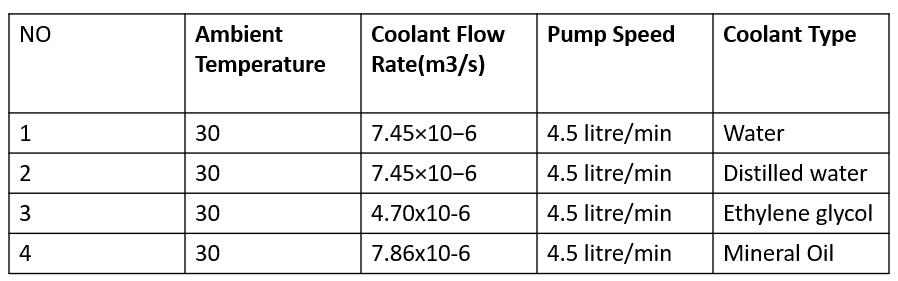
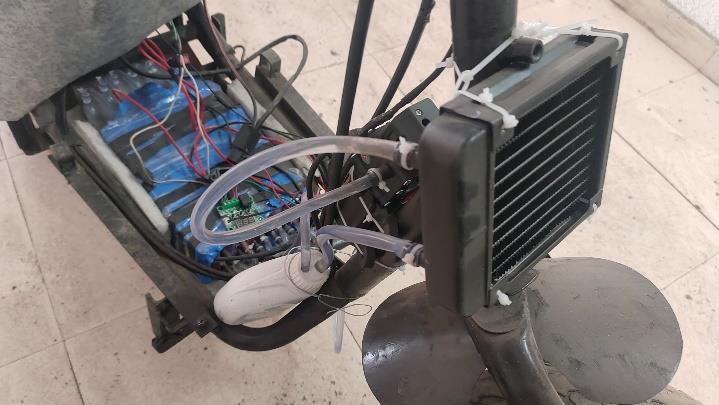
1. Design Experimental Setup: Develop a detailed schematic diagram outlining the layout and configuration of the cooling system. Specify the placement of components, flow direction, and connections between the radiator, pump, and reservoir. Consider factors such as fluid dynamics andheattransferprinciplesinthedesignprocess.
2. Fabricate Prototype: Construct a prototype of the experimental setup based on the design specifications.Assembletheradiator,pump,tubing, andother componentsaccording to theschematic diagram. Ensure proper sealing and secure mounting to prevent leaks and ensure stability duringoperation.
3. ConductPreliminaryTesting:Performinitialteststo validate the functionality and performance of the prototypesetup.Checkforanyleaks,malfunctions, or deviations from design expectations. Calibrate sensors and instruments to ensure accurate data collection.
4. MeasureFlowRates:Utilizeaflowmetertomeasure theflowrateofdistilledwaterthroughthecooling system.Installtheflowmeteratastrategiclocation inthetubingtocaptureaccurateflowdata.Record flow rates at various pump speeds and operating conditionstoassesssystemperformance.
5. Evaluate Cooling Efficiency: Monitor the temperature of the distilled water at different pointswithinthecoolingsystemusingtemperature sensors. Analyze the temperature differential between the inlet and outlet of the radiator to quantify the cooling efficiency. Compare temperatureprofilesunderdifferentflowratesand coolant velocities. Analyze Results and Draw Conclusions: Collect and analyses data obtained from flow rate measurements and temperature monitoring. Evaluate the impact of pump speed,
radiatorsize,andsystemconfigurationoncooling performance. Draw conclusions regarding the effectivenessofthedistilledwater-coolingsystem and its potential for application in real-world scenarios. Discuss limitations, areas for further research, and recommendations for optimizing systemdesignandperformance.
Componentsused:
1. Radiator
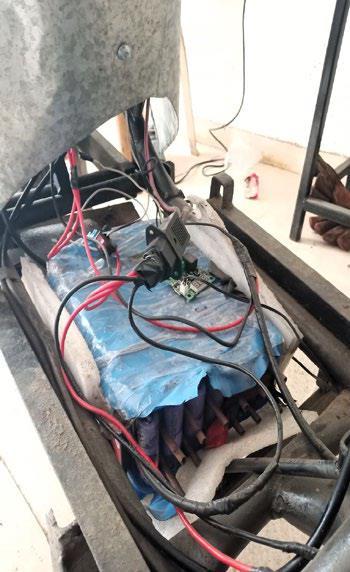
2. Batterywithjointedcoppertubes
3. Hosepipes
4. Waterpump
5. Thermostat
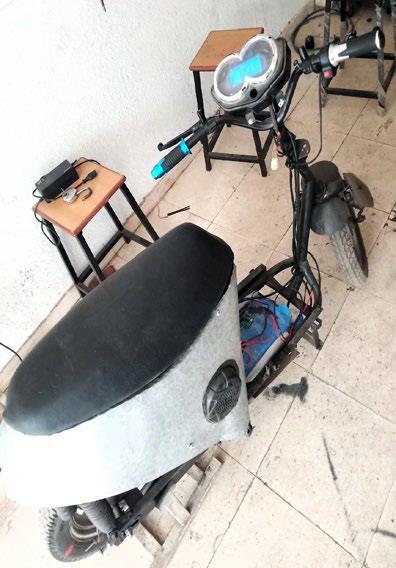
4.1. Setup:
International Research Journal of Engineering and Technology (IRJET) e-ISSN: 2395-0056
Volume: 11 Issue: 05 | May 2024 www.irjet.net p-ISSN: 2395-0072
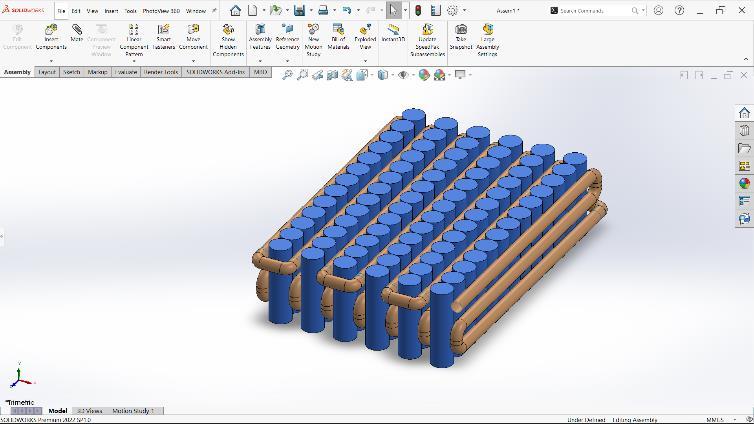
To complements experimental investigations; numerical simulations were conducted to further analyses the performance of the distilled a water-cooling system. Computational fluid dynamics (CFD) simulations were employed to model the flow behavior and heat transfer characteristicswithintheradiatorsetup.
The three-dimensional geometry of the cooling system, including the radiator, tubing, and components, was discretized into computational domains, and governing equationsforfluidflowandheattransferweresolvedusing appropriatenumericalmethods.
Thesimulationmodelsaccountedforvariousfactorssuchas fluid viscosity, turbulent flow effects, and heat transfer coefficients to accurately predict the distribution of flow velocities and temperature gradients within the system. Parametricstudieswereconductedtoexploretheeffectsof different operating parameters, such as pump speed and radiatorsize,onflowratesandcoolingefficiency.Simulation results provided valuable insights into the fluid dynamics and thermal performance of the distilled water-cooling system. Velocity contours and temperature profiles were visualizedtoidentifyregionsofhighflowvelocitiesandheat dissipation. Additionally, heat transfer coefficients were calculated to assess the effectiveness of the radiator in dissipatingheatfromthecoolant.
Overall,numericalsimulationsservedasacomplementary tool to experimental testing, allowing for a deeper understandingoftheunderlyingphysicsandperformance characteristicsofthecoolingsystem.Thesimulationfindings were used to validate experimental results, refine system design parameters, and optimize cooling performance for potentialreal-worldapplications.
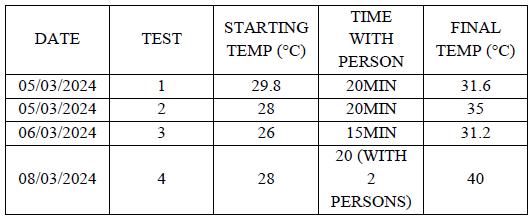
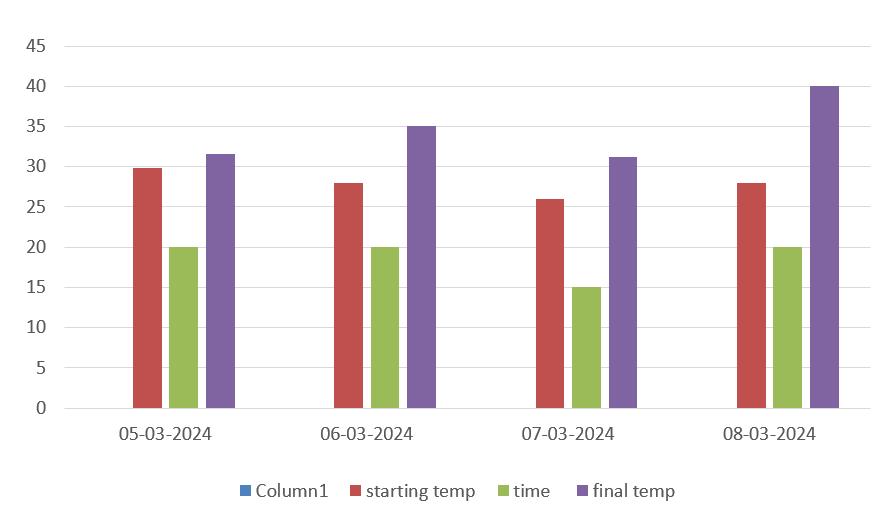
Theexperimentalinvestigationyieldedcomprehensivedata regarding the performance of the distilled water-cooling system.Flowratemeasurementsconductedatvariouspump speeds revealed a consistent relationship between pump velocity and coolant flow, with higher pump speeds correlatingtoincreasedflowrates.Specifically,theflowrate rangedfrom6.8to8.3littersperminuteacrossthetested pump speed range of 1000 to 3000 RPM, indicating the system's capability to deliver a steady flow of coolant. Temperature monitoring at the inlet and outlet of the radiator demonstrated effective heat dissipation, with an averagetemperaturereductionof7°Cobservedacrossthe cooling system under typical operating conditions. Furthermore, thermal imaging analysis provided visual confirmation of uniform cooling distribution across the radiator surface, validating the system's efficiency in dissipatingheat.Overall,theresultsunderscoretheviability ofthedistilledwater-coolingsystemineffectivelyregulating componenttemperaturesandmaintainingthermalstability inautomotiveandindustrialapplications.
Liquidcoolingsystemshaveshowntobeeffectivein enhancing thermal management for electric 2wheelerbatteries.
Theimplementationofliquidcoolinghasresultedin improved temperatureregulationwithin thebatteries.
Initial findings suggest that liquid cooling can potentiallyprolongthelifespanofthebatteries.
International Research Journal of Engineering and Technology (IRJET) e-ISSN: 2395-0056
The integration of liquid cooling has positively impactedtheperformance andefficiencyofelectric 2-wheelers.
Further researchandtestingare recommendedto confirmthelong-termbenefitsandviabilityofliquid cooling in electric 2-wheeler battery thermal management.
6.References
[1]Chunrong Zhao, Juan Rasines Mazo, Dries Verstraete, Optimisation of a liquid cooling system for eVTOL aircraft: Impact of sizing mission and battery size, Applied Thermal Engineering, Volume 246,2024,122988, ISSN 1359-4311,
[2] Honglei Ren, Chao Dang, Liaofei Yin, Zhifeng Chen, Optimization research on battery thermal management system based on PCM and mini-channel cooling plates, Case Studies inThermalEngineering,Volume53,2024,103880,ISSN 2214-157X
[3] Delika M. Weragoda, Guohong Tian, Qiong Cai, Teng Zhang, Kin Hing Lo, Yan Gao, Conceptualization of a novel battery thermal management system based on capillarydrivenevaporative cooling, Thermal Science andEngineering Progress, Volume 47,2024,102320, ISSN 2451-9049,
[4] Dae Yun Kim, Byeongyong Lee, Myeongjin Kim, Joo Hyun Moon, Thermal assessment of lithium-ion battery packsystem with heat pipe assisted passive cooling using Simulink, Thermal Science and Engineering Progress, Volume 46,2023,102230, ISSN 2451-9049,
[5] Z. Lu, X.Z. Meng, L.C. Wei, W.Y. Hu, L.Y. Zhang, L.W. Jin, Thermal Management of Densely-packed EV Battery with Forced Air-Cooling Strategies, Energy Procedia, Volume 88,2016, Pages 682-688,
[6] Liu XT, Chen ZH, Zhang CB, Wu J. Novel temperaturecompensated model for power Li-ion batteries with dualparticle filter state of charge estimation.AppliedEnergy2014; 123:263-272
[7] Li XS, He F, Ma L. Thermal management of cylindrical batteries investigated using wind tunnel testing and CFD simulation. Journal of Power Sources 2013; 238:395-402
[8] Wang T, Tseng KJ, Zhao JY, Wei ZB. Thermal investigation of lithium-ion battery module with different cell arrangement structures and forced air cooling strategies. Applied Energy 2014; 134:229-238
[9] Park HS. A design of air flow configuration for cooling lithium-ion battery inhybridelectricvehicles.JournalofPower Sources 2013; 239:30-36
Volume: 11 Issue: 05 | May 2024 www.irjet.net p-ISSN: 2395-0072 © 2024, IRJET | Impact Factor value: 8.226 | ISO 9001:2008