
International Research Journal of Engineering and Technology (IRJET) e-ISSN: 2395-0056
Volume: 11 Issue: 05 | May 2024 www.irjet.net p-ISSN: 2395-0072
International Research Journal of Engineering and Technology (IRJET) e-ISSN: 2395-0056
Volume: 11 Issue: 05 | May 2024 www.irjet.net p-ISSN: 2395-0072
Dr. S. M. Iqbal1 , Faisal Ahmad2 , Harshal Zade3 ,Muhammad Nawed3 ,Tejas Kolhe3
1Assistant Professor, Dept. of CSE Engineering, PRMIT&R college, Maharashtra, India
2Student, Dept. of CSE Engineering, PRMIT&R college, Maharashtra, India
3Student, Dept. of CSE Engineering, PRMIT&R college, Maharashtra, India
4Student, Dept. of CSE Engineering, PRMIT&R college, Maharashtra, India
5Student, Dept. of CSE Engineering, PRMIT&R college, Maharashtra, India
Abstract - Novel trust management solutions for cloud computing and online freelancing platforms, addressing the challenges posed by their dynamic and distributed nature. In cloud computing, a multi-faceted Trust Management (TM) system is introduced, featuring protocols for proving trust feedback credibility, adaptive credibility models, and availability models for decentralized trust management. Additionally,adynamictrustmodelforuserauthorizationis proposed, integrating firsthand and secondhand information. For online freelancing, a three-module system is devised: Trusters, Trustees, and Admin, enabling job givers to search for services, job seekers to showcase skills, and administrators to oversee platform functionality. The methodology encompasses platform development, trust mechanisms, feedback integration, user empowerment, community building, and continuous improvement, aiming to create trustworthy and collaborative environments for bothdomains.
Key Words: Trust management service, Trustees, Trusters, Sentiment Analysis, Feedback, Freelancing
1.INTRODUCTION
The intricate and multifaceted nature of cloud services poses a considerable challenge for trust management within cloud environments. Researchers emphasize that trust and security are pivotal factors influencing the adoption of cloud computing. Despite the prevalence of Service-Level Agreements (SLAs), they often fall short in establishingtrustduetotheirambiguousandinconsistent clauses. Utilizing consumer feedback emerges as a valuable strategy for evaluating the overall trustworthiness of cloud services. Several scholars have underscored the importance of trust management and haveproposedvarioussolutions,including:
i) Introducing a novel protocol designed to validate the credibility of trust feedback while safeguarding users' privacy.
ii) Developing an adaptive and robust credibility model aimed at assessing the trustworthiness of feedback to shield cloud services from malicious activities and facilitatecomparisonsamongthem.
iii) Formulating an availability model to oversee the decentralized implementation of trust management services.
In contrast to traditional methods like Role-Based Access Control (RBAC), which rely solely on predetermined user permissions, our approach introduces a novel computationaldynamictrustmodelforuserauthorization. This model integrates both firsthand and secondhand information to formulate a dynamic trust belief about a user's behavior. By differentiating between competence and integrity trust, it enables nuanced decision-making across diverse contexts. Real-world examples, such as online auctions, travel agencies, and web services, demonstrate how this distinction enhances authorization decisions, effectively balancing considerations such as servicequalityandtrustworthiness.
In the ever-evolving landscape of online freelancing platforms, trust management plays a pivotal role in facilitating effective interactions between clients and freelancers. This survey delves into the mechanisms employed to enhance trust in such platforms through the incorporation of review systems, feedback mechanisms, ratings,andsentimentanalysis.
[2011] Sheikh Mahbub Habib, Sebastian Ries, and Max Muhlhauser discuss trust management in cloud computing, addressing challenges arising from inconsistencies in service level agreements (SLAs) among different providers. They propose a multi-faceted Trust Management (TM) system tailored for the cloud marketplacetoassistcustomersinidentifyingtrustworthy providers based on attributes such as security and performance.[1]
[2012] Safwan Mahmud Khan and Kevin W. Hamlen present Hatman, a reputation-based trust management system for Hadoop clouds. It dynamically assesses node integrity, ensuring data and computation security while leveragingcloudcomputing'sdistributedpower.[2]
International Research Journal of Engineering and Technology (IRJET) e-ISSN: 2395-0056
Volume: 11 Issue: 05 | May 2024 www.irjet.net p-ISSN: 2395-0072
[2013] Talal H. Noor, Quan Z. Sheng, and Abdullah Alfazi focus on detecting reputation attacks among cloud services. They develop innovative techniques to identify and mitigate deceptive feedback, enhancing trustworthinessassessment.[3]
[2013] Jingwei Huang and David M. Nicol delve into trust mechanisms for cloud computing, proposing evidencebased approaches and attribute certification to improve reliabilityandsecurity.[4]
[2013] S. Pearson discusses privacy, security, and trust issues in cloud computing, highlighting challenges and suggesting new approaches to maintain assurance in potentialcustomers.[5]
[2015] Talal H. Noor and Quan Z. Sheng present Cloud Armor, a reputation-based trust management framework for cloud services. It addresses privacy preservation, security, and availability assurance, offering insights into advancingtrustmanagementinthecloud.[6]
[2017] Kim,J.,&Mahoney, D.exploretheimpactofrating systems on trust in online freelancing, emphasizing how higherratingsindicatequalityandreliability,aidingclient decision-making.[7]
[2020] Chen Y. examines the role of sentiment analysis in enhancing trust on freelancing platforms, highlighting its importance in uncovering nuanced client perceptions beyondnumericalratings.[8]
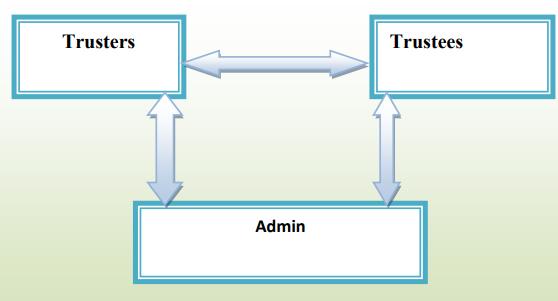
Figure 1:ExistingSystem
1.TrustersModule(Jobgiver):
The Trusters Moduleacts asthebackbone for jobgivers within the job/work sharing portal. These individuals or organizations seek to delegate tasks or projects to competentprofessionals.Withinthismodule,Trusterscan search for specific services or skills required for their projects, upload detailed job descriptions outlining their
requirements, and receive bids from potential service providers, known as Trustees. They have the authority to review the profiles and bids of Trustees, ultimately selecting the most suitable candidate for their project. Additionally, Trusters can monitor the progress of the work to ensure satisfactory and timely completion. Importantly, this module enables Trusters to provide feedback on the performance of Trustees post-project delivery, which informs future interactions and decisions, contributingtothetrustmodel.
2.TrusteesModule(JobSeeker):
The Trustees Module caters to job seekers or service providers within the job/work sharing portal. Trustees aim to secure work opportunities by showcasing their skills and experience through their profiles. This module allows Trustees to create and upload comprehensive profilesdetailingtheir expertise, whichpotential Trusters canreviewwhenconsideringcandidatesfortheirprojects. Trustees can browse available job listings within their respectivecategoriesandsubmitbidsforprojectstheyare interested in undertaking. By actively participating in the bidding process and delivering quality work within agreed-upon timelines, Trustees enhance their reputation within the platform's trust model. Additionally, feedback provided by Trusters post-project completion serves as a testament to their reliability and competence, thereby increasing their chances of securing future work opportunities.
3.AdminModule:
TheAdminModuleplaysapivotalroleinoverseeingand managing the functionalities of both the Trusters and TrusteesModules.Administratorsareresponsibleforuser authentication, ensuring the integrity and security of the platform.TheymonitortheinteractionsbetweenTrusters and Trustees, addressing any disputes or issues that may arise during the project lifecycle. Furthermore, administrators facilitate the smooth operation of the platform by implementing necessary updates or modifications to enhance user experience and platform functionality. Serving as a central authority, the Admin Module maintains the integrity and credibility of the job/work sharing portal while fostering a conducive environment for productive collaborations between TrustersandTrustees
International Research Journal of Engineering and Technology (IRJET) e-ISSN: 2395-0056
Volume: 11 Issue: 05 | May 2024 www.irjet.net p-ISSN: 2395-0072
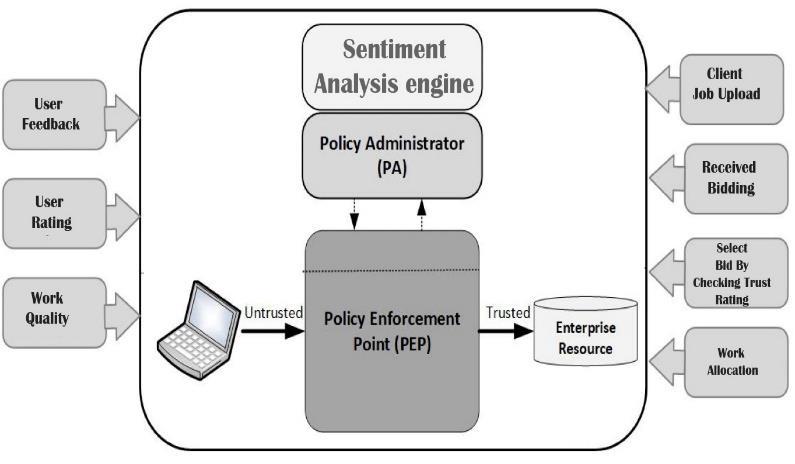
The Trust Management Service Platform system architecture comprises several interconnected components designed to facilitate trust, integrity, and transparency in freelance collaborations. Users, including both clients and freelancers, engage in a feedback loop where they provide and receive feedback on their collaboration experiences. This feedback, which may include ratings, reviews, and comments, is crucial for assessing the quality of work and professionalism of each party. User ratings, derived from this feedback, serve as indicators of reputation and trustworthiness, aiding other users in making informed decisions when selecting collaborators. The system also incorporates mechanisms for evaluating work quality, considering factors such as accuracy, timeliness, and adherence to project requirements. A sentiment analysis engine further enhancesthisevaluationprocessbyextractingsentiments expressed in text-based feedback, categorizing them as positive, negative, or neutral. The Policy Administrator (PA)assumesapivotalroleindefiningandmanagingtrust and integrity policies governing user interactions. These policies encompass rules and guidelines for behavior, feedback,ratings,anddisputeresolution,ensuringfairand ethicalconductamongusers.ThePolicyEnforcementPoint (PEP) complements the PA by enforcing these policies, monitoring user interactions, identifying violations, and initiating appropriate actions such as warnings, account suspensions, or dispute resolutions. The platform's Enterprise Resource provides the necessary computing, storage, and networking infrastructure to ensure scalability, reliability, and performance, supporting the platform's operations and accommodating increasing user demands.
Key features include client job upload, enabling clients to uploadproject requirements tothe platform,and received bidding,allowingfreelancerstosubmitbidsorproposalsin response to job postings. Clients utilize trust ratings and other criteria to select suitable freelancers, with trust ratings serving as crucial decision-making factors. Once a freelancer is selected, work allocation involves assigning tasks, setting deadlines, and defining deliverables to
establish clear expectations and responsibilities for effectiveprojectmanagementandcollaboration.
1. Platform Development: Developing the freelancing website entails creating an intuitive and user-friendly interface that caters to both clients and freelancers. This involves designing features for freelancers to showcase theirskillsandexperienceseffectively,aswellasproviding clients with easy-to-use tools for posting job listings and interacting with freelancers. Integration of advanced methodssuchasreviews,feedback,ratings,andsentiment analysis form the foundation of the platform, enabling effectivetrustmanagement.
2. Trust Management Mechanisms: Trust management mechanisms are crucial for ensuring the integrity and reliability of the freelancing platform. This involves designing systems for collecting and managing client feedback and reviews on freelancer services, as well as implementing a robust rating system. These mechanisms provide clients with valuable insights into freelancer performance,helpingthemmakeinformeddecisionswhen selectingfreelancersfortheirprojects.
3. Integration of Feedback and Sentiment Analysis: The integration of feedback and sentiment analysis into freelancerprofilesenhancestransparencyandtrustwithin the platform. By analysing the sentiment expressed in client reviews, the platform can provide clients with deeper insights into freelancer trustworthiness and professionalism. This integrated approach ensures that clients have access to comprehensive information when evaluatingfreelancersfortheirprojects.
4. User Empowerment and Decision Making: Empowering userswithtoolsandinformationisessentialforfacilitating informed decision-making. Providing clients with features tofilterandsortfreelancersbasedonratings,reviews,and sentiment analysis results gives them the ability to assess freelancer reputations effectively. Interactive dashboards and visualizations further enhance user experience, enabling clients to navigate and understand freelancer profilesmoreefficiently.
5. Community Building and Ethical Standards: Building a collaborative and ethical freelancing community requires establishing clear guidelines and standards for user behaviour. This involves promoting transparency and accountability through the implementation of community guidelines. Additionally, facilitating communication channels for dispute resolution and conflict resolution fosters trust and confidence within the freelancing ecosystem.
6. Continuous Improvement and Evaluation: Continuous improvementandevaluationareessentialforensuringthe
International Research Journal of Engineering and Technology (IRJET) e-ISSN: 2395-0056
Volume: 11 Issue: 05 | May 2024 www.irjet.net p-ISSN: 2395-0072
ongoing effectiveness of trust management mechanisms. Monitoringuserfeedbackandinsightshelpsidentifyareas for improvement and optimization. Iterating on platform features and functionalities based on user feedback and industry trends ensures the continual enhancement of trustandtransparencywithinthefreelancingcommunity.
The platform's analysis reveals robust user engagement, evidenced by frequent job postings and bids submitted, reflectingathrivingfreelancingcommunity.Usersexpress satisfaction with the platform's intuitive usability and diverse features, attributing it to transparent communication channels and interactive functionalities. Trust management mechanisms, including reviews and ratings, contribute significantlyto building credibilityand fostering transparency in client-freelancer interactions. The platform maintains satisfactory stability and reliability,ensuringaseamlessuserexperience.
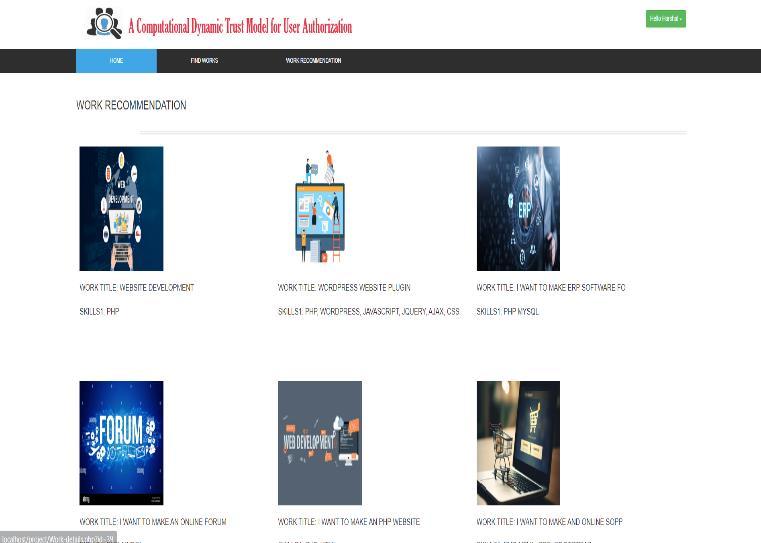
The integration of sentiment analysis into the project proved instrumental in enhancing client-freelancer interactionsand trust managementwithin thefreelancing platform. By analyzing sentiment expressed in client feedback and freelancer responses, the project team gained valuable insights into work quality, professionalism, and overall satisfaction levels. These insights informed decision-making processes, facilitated targeted improvements, and drove iterative enhancements to the platform's user experience and communication tools. As a result, sentiment analysis contributedtotheproject'soverarchinggoaloffosteringa trustworthy and transparent freelancing community, ultimately leading to improved client experiences, enhanced collaboration, and continued growth and successoftheplatform.
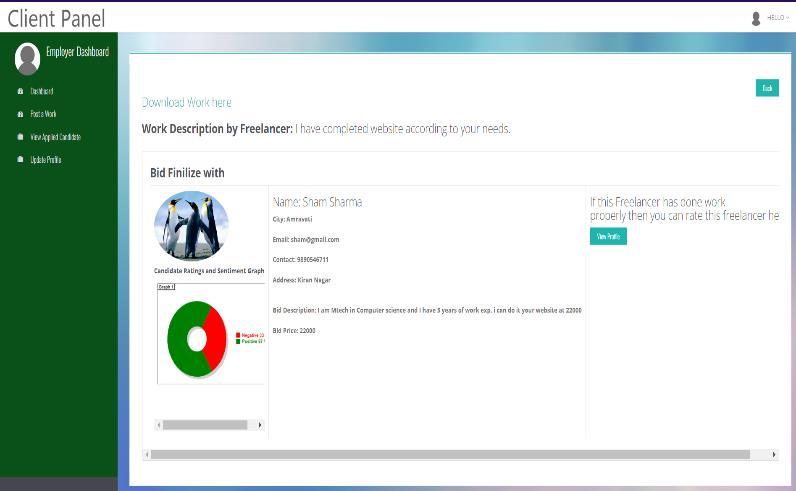
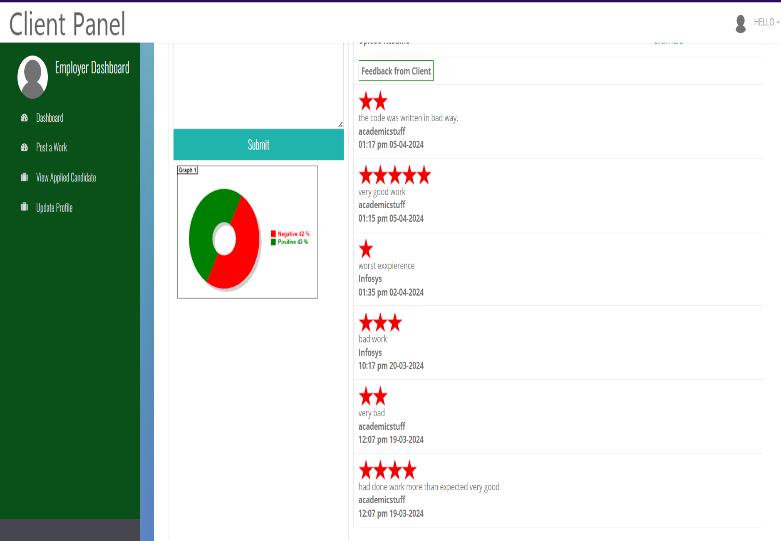
The future scope for the proposed freelancing website prioritizing trust management and employing advanced methods like reviews, feedback, ratings, and sentiment analysis is promising. Here are some potential future directions:
1. Enhanced Sentiment Analysis: Continuously improving sentiment analysis algorithms to provide more nuanced insights into clientfreelancer interactions. This could involve incorporating machine learning techniques to betterunderstandandinterpretsubtlenuancesin feedback.
2. Personalized Recommendations: Implementing AI-driven recommendation systems to match clients with freelancers based not only on skills and experience but also on past reviews and sentiment analysis results. This could lead to more successful and satisfying collaborations for bothparties.
3. GlobalExpansion:Expandingtheplatform'sreach to new geographic regions to facilitate crossborder collaboration and connectivity among
International Research Journal of Engineering and Technology (IRJET) e-ISSN: 2395-0056
Volume: 11 Issue: 05 | May 2024 www.irjet.net p-ISSN: 2395-0072
freelancers and clients worldwide. This could involve localization efforts to support multiple languages and currencies, enabling seamless interactions across different cultural and economiccontexts.
4. Community Building: Fostering a vibrant and engaged freelancing community through forums, networking events, and educational resources. Building a sense of belonging and camaraderie among users can strengthen trust and collaborationontheplatform.
7. CONCLUSIONS
The proposed platform aims to develop a freelancing website focusing on trust management through advanced methods like reviews, feedback, ratings, and sentiment analysis. It comprises three modules: Trusters for clients, Trustees for freelancers, and Admin for oversight. The platform allows clients to search, post jobs, review bids, and provide feedback, while freelancers showcase skills, bid on projects, and receive feedback. The methodology emphasizes platform development, trust mechanisms, feedback integration, user empowerment, community building, and continuous improvement. Overall, the project seeks to foster a trustworthy freelancing ecosystem through transparency, informed decisionmaking,andeffectivecollaboration.
[1]SheikhMahbubHabib,SebastianRies,MaxMuhlhauser “Towards a Trust Management System for Cloud Computing”(2011)
[2] S. M. Khan and K. W. Hamlen, “Hatman: Intra-Cloud TrustManagementforHadoop,”inProc.CLOUD’12,2012.
[3] Talal H. Noor, Quan Z. Sheng, and Abdullah Alfazi, “Reputation Attacks Detection for Effective Trust AssessmentAmongCloudServices”(2013)
[4]J. Huang andD.M.Nicol, “Trust MechanismsforCloud Computing,” Journal of Cloud Computing, vol. 2, no. 1, pp. 1–14,2013.
[5] S. Pearson, “Privacy, Security and Trust in Cloud Computing,” in Privacyand SecurityforCloudComputing, ser.ComputerCommunicationsandNetworks,2013
[6] Talal H. Noor, Quan Z. Sheng, Member, IEEE, Lina Yao, Schahram Dustdar, Senior Member, IEEE, and Anne H.H. Ngu, “Cloud Armor: Supporting Reputation-based Trust Management for Cloud Services”, IEEE Transactions on ParallelandDistributedSystems,Vol.0,No.0,2015.
[7] Kim, J., & Mahoney, D. (2017). The Impact of Rating SystemsonTrustinOnlineFreelancing.JournalofInternet Commerce,21(3),234-249
[8] Chen Y. (2020). The Role of Sentiment Analysis in Enhancing Trust on Freelancing Platforms. International JournalofComputerScience,45(2),189-204