
International Research Journal of Engineering and Technology (IRJET) e-ISSN: 2395-0056
Volume: 11 Issue: 05 | May 2024 www.irjet.net p-ISSN: 2395-0072
International Research Journal of Engineering and Technology (IRJET) e-ISSN: 2395-0056
Volume: 11 Issue: 05 | May 2024 www.irjet.net p-ISSN: 2395-0072
Munibul Haque1 , Md Imtiyaz2
1B.Tech. Mechanical Engineering (Evening) Scholar, School of Mechanical Engineering, Lingaya’s Vidyapeeth, Faridabad, Haryana, India
2B.Tech. Mechanical Engineering (Evening) Scholar, School of Mechanical Engineering, Lingaya’s Vidyapeeth, Faridabad, Haryana, India ***
Abstract – Additive manufacturing is a rapidly evolving manufacturing technology bringing numerous and wide opportunitiesforthedesignteaminvolvedintheprocessby creating intricate and customized products with saving labor,time,andotherexpenses.InnovativeAMmethodsand numerouspracticalapplicationsinaerospace,automotive, medical,energy,andotherindustrieshavebeendeveloped andcommercializedthroughextensiveresearchoverthelast two decades. One embraced industry among others that benefited from the advances of AM is the healthcare industry. This paper focuses on addressing the challenges andopportunitiesinAdditivemanufacturingforhealthcare. AlthoughthereareadvancedpossibilitiesinAM,thereare alsonumerousissuesneededtobeovercome.Thepaperis based upon the current state of the art review and study visits. The purpose of this work has been to identify the opportunities and limitations associated with additive manufacturing in healthcare applications and to highlight theidentifiedresearchneeds.
Keywords: Additivemanufacturing,healthcareapplications, 3Dprinting,Testingmaterialsetc.
Themostadvancedtechnology,additivemanufacturing(AM) is used for manufacturing intricate geometries and structuresbybuildinglayer-upon-layerutilizing3Dmodel data[1].Incontrasttotraditionalsubtractivetechnologies, which produce components by removing material from a bigger raw part, AM techniques fabricate components by addingamaterialsinglelayeratatime.Sincethepartisbuilt basedonthecross-sectionofthegeometryofthepart,AM significant lowers material waste, shortens the manufacturingtime,andremovestherequirementforthe majority of manual procedures that require a skill. For instance,itisreportedthatbyadoptingAMmethodsrather thanconventionalmachining,rawmaterialwastageinthe metalindustrywasdecreasedbyupto40%[2]. Thoughthe technologyisreferredtoasadditivemanufacturingduetoits currentroleasamethodoffabricationoffunctionalparts, thetechnology,inothercontexts,isalsoreferredtoas3D printing, rapid prototyping and manufacturing, digital fabrication(manufacturing),layermanufacturing,desktop manufacturing, on-demand manufacturing, direct manufacturing,andsolidfreefrommanufacturing,whichare all the terms used to describe additive manufacturing.
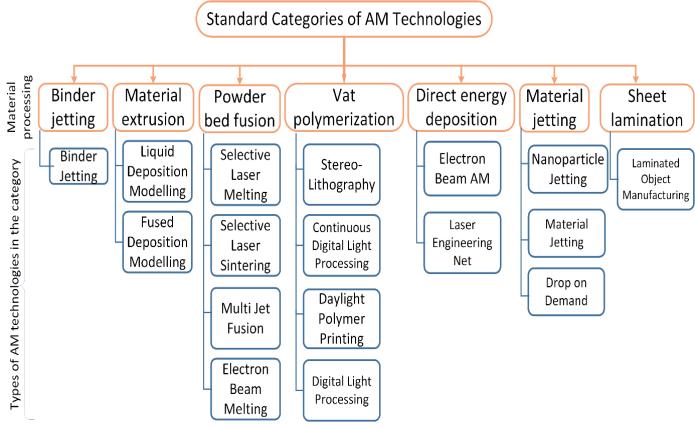
Becausenocuttingtoolsareused,thefabricationprocessis alsocommonlyreferredtoasthetoollessprocess[3].Other techniqueslikelaserforming(Incrementalsheetforming) aresimilarlyusedinthecustomizationofmedicalproducts to build structures layer by layer but they cannot be considered as AM techniques as they add the form rather than the material. By adding materials without deleting them,AMmaximizesmaterialsavings. Sincetheinceptionof theStereolithographyapparatus(SLA)based3Dprintingin the1980sasatoolofrapidprototyping,manyothervariants of the technology emerged based on the source of power (electronbeam,laser,etc.),thematerialtype(ceramic,metal, andplastic),andtheconfigurationorstateofthefeedstock (filament, resin, powder, bar). The American Society for Testing and Materials (ASTM) committee ASTM F42AdditiveManufacturing[4]hascategorizedAMtechniques into seven broad groupsas illustratedinFigure 1. further illustratesthematerialprocessingtechniqueusedtodeposit theprintinglayersineachofthestandardizedcategories.
AmongtheearlierusersoftheinnovativesolutionsthatAM provides, we find the aerospace industry, the automotive industry, the energysector, andthe medical sector. In the lastmentioned,inparticular,manybreakthroughshavebeen occurred in the medical field using the design freedom it provides.Amongothers,AMhasadvancedandcontinuesto immenselyadvancemedicalapplications, withbioprinting cardiovascularapplications,suchas3D-printedheartvalves, beingthecurrentfocusofthismethod[5-7].Whilethebasic principlesofadditivemanufacturinghaven'tchanged,there
International Research Journal of Engineering and Technology (IRJET) e-ISSN: 2395-0056
Volume: 11 Issue: 05 | May 2024 www.irjet.net p-ISSN: 2395-0072
are now more resources available to explore these technologies,whichwillleadtonewmedicalapplications[8,
9].Despitenewopportunitiesthatthetechnologyopensin particularinthefieldofmedicineandbiomechanics,issues such as incomplete vascular networks in manufactured grafts (physical organ models), the need for a big multispecialist team, restrictions in layer height of generated models,and (medical)bioethical concernsaboutusing 3D printeddevicesinhumansarestillresearchandapplication challenges.
Thisarticlepresentsanoverviewstudyoftheopportunities and challenges faced when additive manufacturing technology is implemented with a particular focus on its trendsofapplicationinthemedicalsector.Thecoreaimof thereviewistoexplorethepotentialareasoffutureresearch on the application of topology optimized design and predictionofmaterialbehaviorformedicaldevicesthatcan befabricatedusingAMtechnology.InSection2,anoverview of the key process step and the application of additive manufacturing in the aerospace and the automotive industry, which the authors assume to exceed that of the medicalsector,arepresented.Section4focusesontheAM applications, processes, technologies, etc. from the perspective of the interest in the healthcare sector. The concepts and research work presented in this section are furtherexploredanddiscussedinSection5wherethefocus is on highlighting the current challenges facing the widespreadapplicationofthistechnologyinthehealthcare sector. Finally, Section 6 briefly presents the conclusions withdrawnbasedonthestudy.
2. Key processing steps and applications of AM technology
As stated earlier, the novelty of AM technology lies in its abilitytotransform3Dmodeldataindigitalformdirectlyto a3Dphysicalobject.Thisprocessisquitecommontoalmost all of the available technologies, though the way these processingstepsareexecutedusingdifferentmechanisms basedontheenergyused,thematerialbeingprocessed,and thestateofthematerial.Thisgeneralstepisillustratedin Figurei2
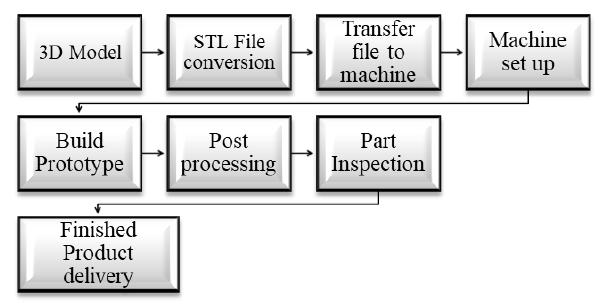
EmployingtheprocessingstepsillustratedinFigure2,the development of novel, advanced additive manufacturing techniques has accelerated significantly, resulting in an increasing number of industry applications. AM is particularly well suited to manufacturing low volumes of goods, especially for components with complex geometry, whencomparedtosubtractivemanufacturing.Customized implants for hip and knee prostheses are one example of how AM methods can be used to increase customization. Additivemanufacturingiswidelybeingusedandexploredin energy, marine, aerospace, automotive, and medical industries,aswellasindustrialspareparts.
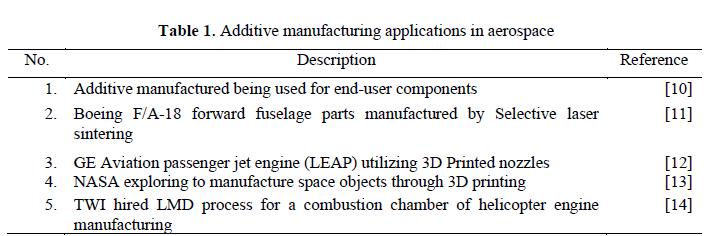
Aerospace: Aerospaceinnovationhasalwaysattemptedto reduce the cost and weight of components whilst maintaining the highest safety standards. Typically, aerospace components have complex structures and are built of advanced materials such as nickel superalloys, titanium alloys, and ultra-high-temperature ceramics that arecostly,difficult,andtime-consumingformanufacturing. ThismakesAMsuitableforAerospaceapplications.These potentials of AM technology in the aerospace industry, particularly in enabling fabrication of topology optimized components leading to less weight has attracted recent research environment. Table 1 summarizes a few of the reportedresearchworks
Automotive: Theautomotivebusinessreliesonnewproduct development, yet this can be an incredibly expensive and time-consumingactivity.Becauseofitsabilitytoshortenthe developmentcycleandlowermanufacturingandproduction costs,AMhasbecomeakeytoolintheautomobileindustry's designandimplementationofautomobileparts.Inaddition to the production of limited quantities of luxury or highperformanceautomobileparts,thedesignfreedommakesit idealfortheproductionofgearboxesanddriveshafts[15]. Structuralcompositessuchasturbochargerturbines,engine valves are other examples of additive manufactured automotiveparts[16].FurtherbenefitsofadoptingAMfor automobilepartsincludeshorterproductdevelopmentand manufacturing times leading to lower total costs [17]. However, some significant challenges of AM in the automotive industry are reported including (i) - thermal stresses generated in additive manufactured components, which influence their performance and repeatability [18], (ii)-thesurfacefinishandthedimensionalaccuracy[19], (iii)unsuitabilityforlargevolumeproductionofparts[20].
International Research Journal of Engineering and Technology (IRJET) e-ISSN: 2395-0056
Volume: 11 Issue: 05 | May 2024 www.irjet.net p-ISSN: 2395-0072
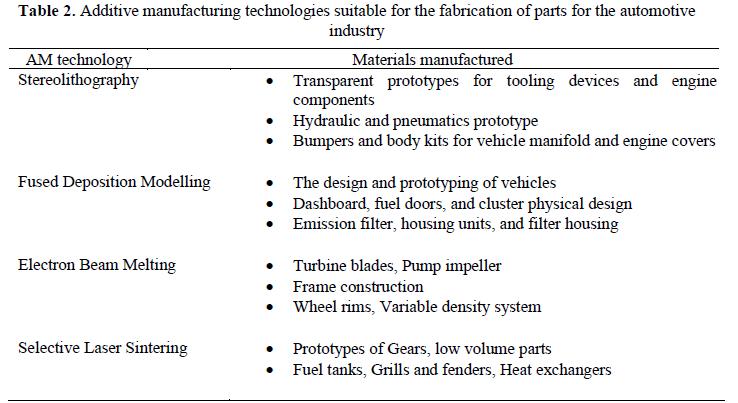
Table 2 summarizes some of the additive manufacturing technologies and their application in the automotive industry[21].
ThemedicalfieldwasthefirsttoimplementAMtechnology due to the flexibility it provides through design freedom. Thisinterestemanatesfromthefactthatcreatingapartwith AMproceduresjustrequiresits3Ddigitalmodel,whichis notdemandingwiththeadventofthedigitalerawearein.
AnewanalysisbyGrandViewResearch,Inc.,indicatesthat theworldwidehealthcareadditivemanufacturingindustryis estimated to be worth USD 6.4 billion by 2028 and to increaseatacompoundannualgrowthrate(CAGR)of21.8 percentfrom2021to2028.Theuseofadvancedtechnology; availability of a vast range of materials such as plastics, metals, and polymers; design flexibility, the ability to produce complex geometries, including honeycomb structureandcoolingchannelsarethepropellersofadditive manufacturing market rise in medical applications. Furthermore, the growing elderly population implies that there exists an increased need for orthopedic surgeries including knee and hip implants for replacement. Additionally, increased use of dental implants in combination with an increasing demand for prosthetics is anothersignificantdriverprojectedtoleadthemarket.With theabove-mentionedtechnological,economical,andsocietal conditions,thissectionwillexplorethehealthcare-related applications, benefits, and methods (processes) of realizationofadditivemanufacturing.
Five broad categories of application of additive manufacturinginmedicinecanbeidentified,asillustrated iin Figure3
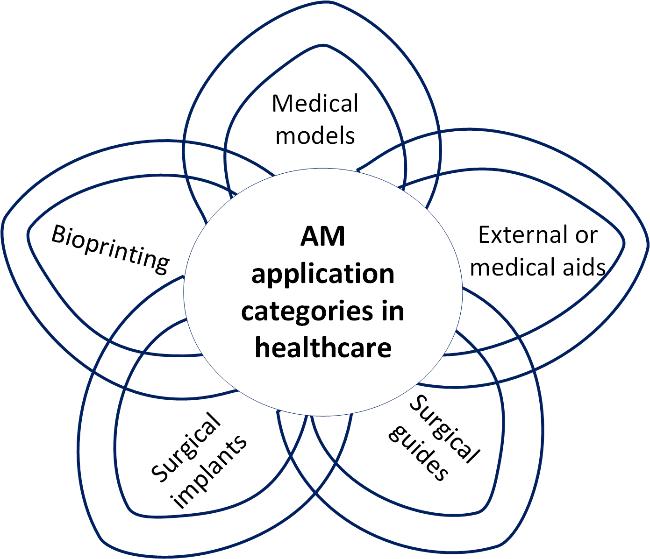
Figure 3. ApplicationsofAMHealthcare
Bio printing: 3DBioprintingwaspatentedin2003anditis utilized for printing organs and tissues. The threedimensionaltissue-likestructurescanbeformedbylayering cellsonabiocompatiblescaffoldanddistributingthemlayerby-layer. In this procedure, cells are delivered to a biocompatible scaffold through the use of a 3D printer to build tissues that resemble three-dimensional structures The cells then can be developed through the matrix or scaffold,whichcanbeprintedusinga3Dprintingtechnology such as fused deposition modeling (FDM). One powerful elementofthetechnologyiscreatingpersonalizeddesigns from the geometry of the patient that is acquired through medicalimagingor3Dscanning.Particularattentionmaybe neededthattheproceduremustbesterile,orpartsmustbe sterilizableafterprinting.Moreover,cellgrowthinvitroor in vivo may be required prior to final application. Vitro models in 3D bioprinting enable researchers to better understand the interactions between cells and the environments. Observing cellular interactions could bring freshinsightsinavarietyoffields,includingcancerresearch.
Researchers have also indicated an effective approach to print scaffold that retains the microstructure while also increasing repeatability. Though bioprinting is based on scaffolds,ithassignificantissues,suchascelldegradation withtimeandlowcell-to-cellinteractions.Ozbolatproposed theideaofprintingcellswithoutascaffold,whichcouldbe extremely useful in the future of tissue engineering and regenerativemedicine.Itmaypotentiallybepossibletouse living bioprinted liver tissue and heart valves for investigationandmedicationdevelopmentpurposesinthe future.
Medical aids: Orthoses, prostheses, and splints are all examples of medical aids. AM may supply a customized devicetoaidinhealingandensurethatdamagerepairisas precise as possible. External to the body, additivemanufactured parts can be combined with everyday appliances to allow for better personalization. As the traditional methods for making prosthetic sockets were
International Research Journal of Engineering and Technology (IRJET) e-ISSN: 2395-0056
Volume: 11 Issue: 05 | May 2024 www.irjet.net p-ISSN: 2395-0072
time-consuming, taking two to three days to produce one socket, additive manufacturing can improve this process. The study reported in shows that the time required is decreasedtolessthanfourhourswhenAMtechnologiesare employed. Another case is the therapy of dental malocclusion using AM to create a mold for one or more transparent and removable prostheses. Additionally, this classincludesnoninvasivepositioningguidelines,suchasan auriculartemplateforcraniofacialimplantposition
Medical Models: Pre-and post-operative training and education are mostly based on medical models. Using medical models, anatomical objects can be rebuilt with a higherlevelofdetailsandaccuracy,andhencesimulationfor bettersurgicalplanningandimagingusingmedicalimaging and reverse engineering (RE. For intricate surgical operations, models can also be utilized for the communication of personnel, training of students, and counselingofpatientsandfamilies.Differentaspectsofthe models, such as material properties, anatomical accuracy, and haptic response, are crucial depending on the requirements. In surgical teaching models, a real haptic reactionofboneisespeciallydesirable.
External Aids (tools): AM can help to produce patientspecifictoolsthatwillassistwithefficiencyandenableand increase the effectiveness of medical operations, and in addition, it can aid in drug production. This category includes the manufacture of operation-specific equipment suchascustom-fitsurgicalguidesandpreforms.Aprototype ofamandiblefracturereductioninstrumentisanexampleof asurgicaltool.Oralappliances,whicharecreatedentirelyby AMareotherexamplesofthisclassofapplication.Devicesin this class come in touch with body fluids, mucous membranes, or tissues for a short period, and are thus intended for temporary or short-term usage. They are intrusive but not implantable. The material must be sterilizable,andthesurfacerequirementsvarybyuse.Most oftheseproductsareinvasivesurgical.
Implants: Thepossibilityofprovidingcustomizedimplants with improved clinical and cosmetic outcomes and biocompatibility materials with high mechanical qualities withtheuseofAM,combinedwithmedicalimagingandRE, offersgreatpromise.Tissuecompatibilityrequirementsare strict, and approval processes are lengthy. Membrane properties may impact cell adhesion. Recent research has lookedatembeddingmaterialsinsideimplants,forexample, asamedicinedeliverymechanism.Incustomizedimplants, AM is a good choice since the typical procedure requires capturingapatient'sanatomysuchasmedicalmodels.Itis then used as a design reference to allow patient-specific fitting.
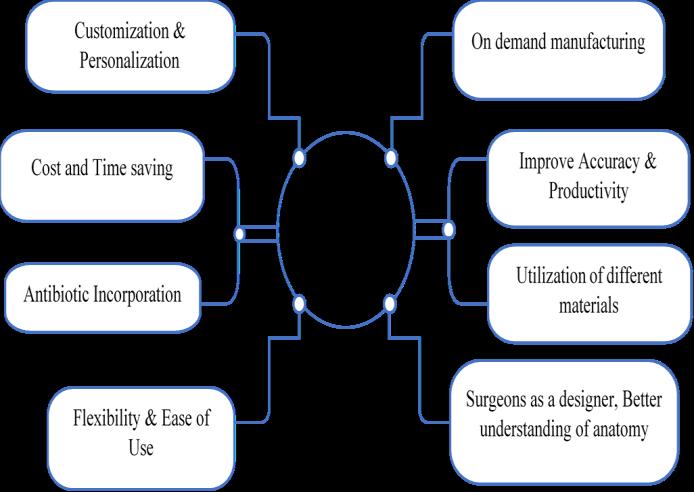
Given that every patient is unique, AM offers a significant perspective for use in medical applications that are personalizedandcustomized.Asexplainedabove,tissueand organ fabrication, anatomical models, development of customized prosthetics and implants, medication dosage forms discovery, and administration is among the most applied biomedical uses of additive manufacturing. It also enables substantial customization based on the unique patientdataandrequirements.Thistechnologyalsoensures thattheimplantisperfectlyfittedandsavesbothtimeand cost. Figure 4 depicts the benefits of AM in healthcare applications.
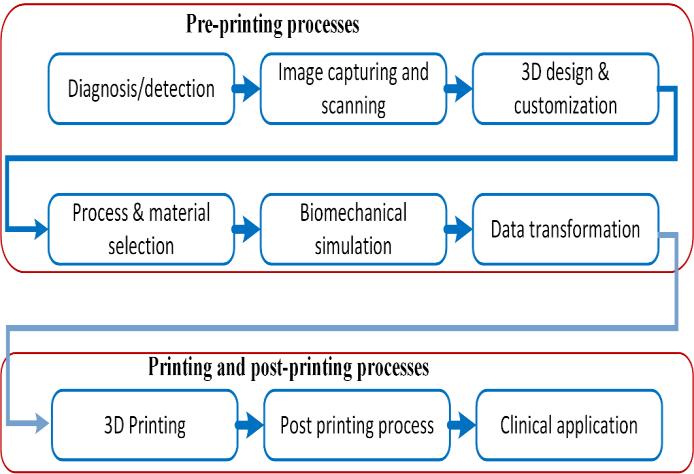
A common procedure for personalized (unique) medical devices begins with capturing images or digitizing the patient'sgeometry.Typically,magneticresonanceimaging (MRI) and computed tomography (CT) are employed to capturemodeldata.Ultrasound,laserscanning,andpositron emissiontomographyarejustafewoftheothertechniques that are utilized to acquire patient data. Digital print files createdfrom2DradiographicimagessuchasCTscans,MRI, andX-rayscanbecustomizedanatomically,medically,and structurally.Thus,specificpatientvirtualmodelsarecreated inthree-dimensional(3D)partsusingspecializedsoftware 3DCAD[3].Oncethevirtualmodelisprepared,thedatais then translated to a Standard Triangulate Language (STL) formatorthelatestadditivemanufacturingfileformatfor rapidprototypingmachines.ThetypicalprocessflowofAM inhealthisseeninFigure5.
International Research Journal of Engineering and Technology (IRJET) e-ISSN: 2395-0056
Volume: 11 Issue: 05 | May 2024 www.irjet.net p-ISSN: 2395-0072
According to the forecast for the year, 2021 to 2028, the majorhealthcareadditivemanufacturingtechnologyoutlook willbestereolithography,electronbeammelting,deposition modeling,lasersintering,laminatedobjectmanufacturing, jettingtechnology.Table3showsanoverviewofdifferent methodsofAMusedmostlyinhealthcareapplications.
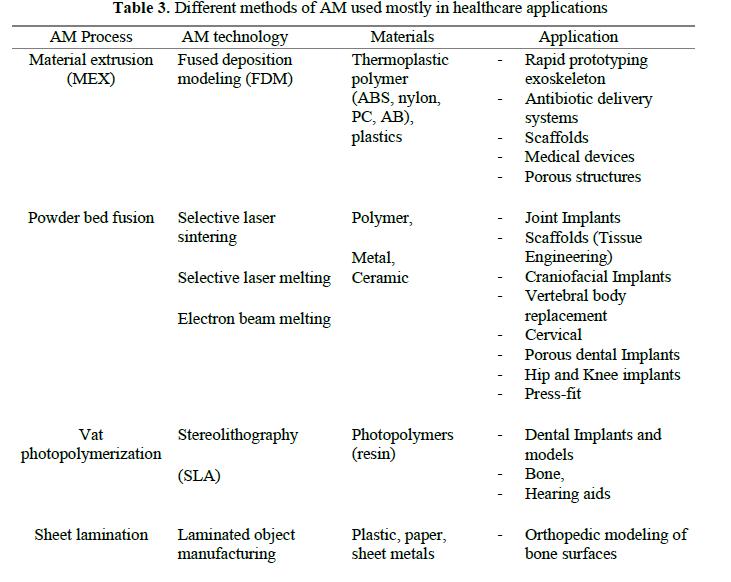
Though it is in its early stages, AM can create realistic teaching or training models, pharmacological or pathophysiological experimental models, personalized medicalequipment,anddevices,aswellasbioartificialtissue or organ grafts for use, for instance in implantology. Generally, the purpose of 3D printing in healthcare applicationsistoenablephysicianstoservemorepatients withoutsacrificingresults.
Theliteraturestudyshowsthatthereisasignificantamount of untapped potential that can be realized through bio
printingandotheremergingtechnologies,includingtohelp insolvingtheorgandonorshortage.Torealizethispotential, scalability and affordability are the forefront challenges whilealsoutilizinginnovativeprintmethodologies.Demand for faster printers with higher resolution than what is currently available is the key constraint that needs to be overcome. Instead of optimizing a single manufacturing process for the manufacture of a fully functional organ, it maybemorebeneficialtointegrateproceduresthatimitate the natural organ's structural heterogeneity, structural tissuehierarchy,andfunctionality.
Prostheticminitissuesthatcanbeusedtotesttheresponse of therapeutic and/or toxic pharmaceuticals as well as predict these responses while potentially decreasing the costsofdrugdiscoveryandallowingmorediscoverytooccur through the use of bio-printed organs is the most likely applicationfor bio-printed organstoappearshortly. Even though file formats are being processed and different advancementsareunderwaytoimprovethemedicalimaging thatenablesthetransferofmedicalimagedataintheformof MRI,CTscan,andotherformstoausableformatforusein 3Dprintingmachines,itisstillchallengingaseverypatientis unique and need unique treatment. In general, medical imagingconsistsofthreemainsteps:(1)imageacquisition, (2)image post-processing, and (3)3D printing. PostprocessingconvertsDICOMimagesintoSTLfiles,whichare madeupofthinlayersrangingfrom0.5mmto2mmthick. Thus, sending the file to the printer to print. The DICOM imagemaybecleartothedoctorbutnottothepatient.3D printingcanovercomethislimitation.
Making a model from a 3D printer's DICOM image has limitationsincludingerrorsintroducedduringthestep-bystepdevelopmentofthe3Dmodel.Theseinaccuraciescause the CAD data to deviate from the real 3D model. It is demonstrated the inconsistencies in data transfer and created a 3D model. The size of both the model and the softwareusedtodeterminetheerrors.Theprinterusedalso contributes to the inaccuracies. Polyjet is reported to be moreaccuratethanSLSand3Dinkjetprinters.Inaddition, the achievable surface finish can also dictate the type of technologytobeused.Forinstance,SLAisrecommendedfor anexcellentsurfacepolish,whileFDMisifcostisanissue, andarelativelyaccuratemodelmaybeemployed.
Multi-materialprintingisanotherissueinAMforhealthcare. Currently, printing 3D models with different materials (multi-material) are possible with some AM technologies. Thebenefitofprintingmultilateralisthatamodelcannow contain different portions representing bone, organs, and softtissue,givingsurgeonsanddoctorsabettergraspofhow apatient'sbodywillfeelwhenutilizingamodelforsurgery oreducation.
Further challenges are related to material structural strength.Duetothelayer-by-layernatureoftheAMprocess, final products are known to have high strength in the X
International Research Journal of Engineering and Technology (IRJET) e-ISSN: 2395-0056
Volume: 11 Issue: 05 | May 2024 www.irjet.net p-ISSN: 2395-0072
(length)andY(width)planesbutarefearedtolacksimilar strength in the Z plane (depth). While the layer-by-layer methodhasdemonstratedsufficientstrengthforavarietyof applications,concernspersistthatAMproductsmaybeless structurally sound than those produced through conventionalmanufacturing.Moreover,limitationsofspeed and size, lack of standards, unavailability of enough expertise,lackofawarenessabouttherisksassociatedwith each application, etc. can be mentioned as some of the existing challenges in the wider application of this technology.
Regardlessoftheabove-mentionedchallenges,AMwill be crucialinthefutureofhealthcarepractice,anditwillchange thewaymedicalmodelsaremade.Amongothers,animplant madewiththistechnologycanreplacetraditional scaffold fabrication processes. The models help the surgical and physicianteamsplanbettersurgery.Itcanquicklyproduce complexgeometryandcustomfittingsandimplants.Thisis required for the creation of diverse medical devices and surgical training models provided that further research overcomestheexistingapplicationchallenges.
AbriefoverviewoftheroleandchallengesofAMtechnology forhealthcareapplicationispresentedinthisarticle.Asthis isanactivelyresearchedarea,thereviewpresentedinthis article is far short of a detailed review. As a matured technology,itiseasytoobservethat3Dprintingisagame changing technology in various spheres of healthcare and hasshowntobeanextremelybeneficialtechnologyuptothe pointofwidespreaduse.Itgivessufficientreasontoenvision aworldinwhichonecanjustpushabuttonandamachine will automatically print out medication and products for patients, as well as customized goods according to each person'sdemands.Someday,onewillbeabletogetanew bodily part produced on demand. More progress is being made,althoughitwillstilltakesometime.
Futureworkinthisdirectionwillinvolveconductingamore detailed literature review and develop methods and mechanismsthatcanadvancetheapplication.Amongothers, thefocuswillbedoneonthesmoothconversionofmedical image data to a file format compatible with 3D printing, predictingmaterialbehaviorinmulti-materialprinting,and effectivetopologyoptimizationofmedicaldevices.
[1] Parandoush P and Lin D 2017 A review on additive manufacturingofpolymer-fibercomposites, Compos.Struct 182,36-53.
[2] Hollister S J and Bergman T L 2004 Biomedical applications of integrated additive/subtractive manufacturing. Additive/SubtractiveManufacturingResearch andDevelopmentinEurope 1001,55.
[3] Javaid M and Haleem A 2018 Additive manufacturing applications in medical cases: A literature-based review, AlexandriaJ.Med. 54(4),411-22.
[4] Bandyopadhyay A, Zhang Y and Bose S 2020 Recent developmentsinmetaladditivemanufacturing, Curr.Opin. Chem.Eng 28,96-104.
[5]JainA,MathurT,PandianN,andSelahiA2020 Organ-ona-chip and 3D printing as preclinical models for medical researchandpractice,in PrecisionMedicineforInvestigators, PractitionersandProviders,Elsevier Chapter9,83-95.
[6]ChenZ,LiZ,LiJ,LiuCh,LaoChetal.20193Dprintingof ceramics:Areview, J.Eur.Ceram.Soc. 39(4),661-87.
[7]MohanD,TeongZK,BakirAN,SajabMS,andKaco H 2020 Extending cellulose-based polymers application in additive manufacturing technology: A review of recent approaches,Polymers 12(9),1876.
[8]JockuschJandÖzcanM2020Additivemanufacturingof dentalpolymers:Anoverviewonprocesses,materialsand applications,Dent.Mater.J. 39(3),345–54.
[9] Ghomi E R, Khosravi F, Neisiany R E, Singh S, and Ramakrishna S 2020 Future of additive manufacturing in healthcare,Curr.Opin.Biomed.Eng 17,100255.
[10] Hiemenz J 2013 Additive Manufacturing Trends in Aerospace:Leadingtheway, WhitePaper,03-13.
[11] Azam F I, Rani M A, Razak H A, Ali S, Aliyu A 2021 Additive Manufacturing Processes, Challenges and Applications:AReview.ProgressinEngineeringTechnology III,93-111.
[12] Kellner T 2014 Fit to print: new plant will assemble world’s first passenger jet engine with 3D printed fuel nozzles,next-genmaterials GEreports
[13] Harbaugh J 2015 Space Station 3-D Printer Builds Ratchet Wrench To Complete First Phas, NASA.https://www.nasa.gov/mission_pages/station/resear ch/news/3Dratchet_wrench(accessedOctober16,2021).
[14] Hauser C 2014 Case Study: Laser powder metal deposition manufacturing of complex real Parts. https://docplayer.net/48458850-Case-study-laser-powdermetal-depositionmanufacturing-of-complex-real-parts, (accessedonSeptember20,2021).
[15] GGuo N and Leu M 2013 Additive manufacturing: technology, applications and research needs, Front. Mech. Eng. 8(3),215-43.
[16]CooperD,ThornbyJ,BlundellN,HenrysR2015Design andmanufactureofhighperformancehollowenginevalves byadditivelayermanufacturing, Mater.Des. 69,44-55.
International Research Journal of Engineering and Technology (IRJET) e-ISSN: 2395-0056
Volume: 11 Issue: 05 | May 2024 www.irjet.net p-ISSN: 2395-0072
[17] Liu R, Wang Z, Sparks T, Liou F, and Newkirk J 2017 Aerospace applications of laser additive manufacturing, LaserAdditiveManufacturing (Elsevier)351-71
[18]GaoW,ZhangY,RamanujanD,RamaniK,etal2015The status,challenges,andfutureofadditivemanufacturingin engineering, Comput.-AidedDes. 69,65-89.
[19] Gupta N, Weber C, and Newsome S, 2012 Additive manufacturing: status and opportunities. Science and TechnologyPolicyInstitute,Washington
[20]YakoutM,ElbestawiM.andVeldhuisSC2018Areview ofmetaladditivemanufacturingtechnologiesin SolidState Phenomena. 278,1-14.
[21] FutureBridge, 2019 Additive Manufacturing in the Automotive Industry https://www.futurebridge.com/blog/additivemanufacturing-in-the-automotive-industry/, (accessed on September20,2021).
[22] Jinoop A, Paul C P, Mishra S K, and Bindra K S 2019
Laser Additive Manufacturing using directed energy deposition of Inconel-718 wall structures with tailored characteristics, Vacuum. 166,270-78.
[23]SongM,WangM,LouX,RebakRB,andWasGS2019
Radiationdamageandirradiation-assistedstresscorrosion crackingofadditivelymanufactured316Lstainlesssteels, J. Nucl.Mater 513,33-44.
[24] Bourell D L, Leu M C, Guo N, and Alayavalli K 2011 Graphite-basedindirectlasersinteredfuelcellbipolarplates containingcarbonfiberadditions,CIRPann. 60(1),275-78.