
International Research Journal of Engineering and Technology (IRJET) e-ISSN: 2395-0056
Volume: 11 Issue: 05 | May 2024 www.irjet.net
p-ISSN: 2395-0072

International Research Journal of Engineering and Technology (IRJET) e-ISSN: 2395-0056
Volume: 11 Issue: 05 | May 2024 www.irjet.net
p-ISSN: 2395-0072
Dr. D. Koteswara Rao1 , Khandavilli Venkata Sri Rama Manohar2 , B. Sowmya3
Bandarupalli V. S. M. Bharadwaj4 , Yeluru Govindu Sai Sanjay5
1Professor, Head of the Department of Civil Engineering and OSD to the Hon’ble Vice Chancellor JNTUK, Kakinada, Andhra Pradesh, India
2,3,4,5 Undergraduate Students, Department of Civil Engineering, University College of Engineering (A), JNTUK, Kakinada, Andhra Pradesh, India
Abstract - The technology used in road construction continually evolves to accommodate changing vehicular patterns, construction materials, and subgrade conditions. A significant portion of pavement failures is often linked to poor subgrade conditions, with expansive soil subgrades presenting particularly challenging issues. These soils are prone to swelling and shrinking, leading to cracks, especially during the dry seasons or years, which are termed verticals. The extensive damage caused to highwaysbuiltover expansive soil subgrades results in substantial financial losses worldwide, reaching millions of dollars. IncountrieslikeIndia, where expansive soils are widespread, rerouting highways to avoid these materials is nearly impossible. From recent studies, it is observed that, solid waste materials such as rice husk ash, fly ash, waste tire rubber chips, etc., are used for this intended purpose. Hence, by using industrial by-products viz., Steel slag as an admixture in such problematic soils is economical and beneficial. In the present study, an attempt has been taken to use the steel slag as an admixture on improving the strength characteristics of expansive soil to suite it as a sub grade for flexible pavements
Key Words: Expansive Soil, Steel Slag, Liquid Limit, Plasticity Index, Optimum Moisture Content, Maximum Dry Density, California Bearing Ratio, Flexible Pavement.
Expansive soils are characterized by significant changesinvolumeduetofluctuationsinsoilmoisture.The foundations laid on expansive soil beds facing significant damagesbecauseofswellingandshrinkagephenomena of expansive soil due to the variation in temperatures. Typically, pavements on expansive subgrade soils exhibit early signs of distress, leading to pavement failures. Expansive soils often possess unfavorable engineering properties, such as low bearing capacity, instability, and excessive swelling, posing significant challenges to civil engineeringstructures,especiallyincaseofpavementsub grades and foundations A Numerous researchers have conducted extensive studies to address these issues for
developing remedial measures to control the failures in pavements laid on expansive soil subgrades. The Soil stabilizationemergesasapracticalsolutionamongvarious methodstomitigatetheproblemsassociatedwithexpansive soils, offering an effective means of improving soil properties.
Comprising a significant portion of clay-sized particles, this soil exhibits a color spectrum ranging from black to chestnut brown. On an average, expansive soils coverapproximately20%oftotallandareainIndia.These soils are conducive to dry farming and support the cultivation of crops such as cotton, rice, jowar, wheat, cereals, and vegetables, owing to their high moisture retentioncapacity.
In semi-arid regions, over the past few decades, noticeable damages caused by the swelling and shrinking actionofexpansivesoilshavebeenobserved,leadingtothe cracking and disintegration of channels, reservoir linings, pavements, building foundations, water lines, irrigation systems,sewerlines,andslab-on-gradestructures.
Onemethodusedforstabilizingtheexpansivesoils involves the application of chemical additives, including lime, cement, and fly ash. This technique has proven successful in numerous projects, mitigating swelling, reducing soil plasticity, improving soil workability, and enhancing soil strength. Lime stabilization involves three main processes: water absorption and chemical binding duringthehydrationofunslakedlime(CaO)intoslakedlime (Ca(OH)2), pozzolanic reactions between lime and clay minerals to bolster mechanical strength, and cation exchange between the additive and clay particles (Dr.D.S.V.PrasadandT.Yaminidevi(2018))
Oneofthemethodsoftreatmentofexpansivesoiltomake themfitfortheconstructionpurposesiscalledstabilization. AccordingtoPetry(2002),assortmentofstabilizerscanbe groupedinto:
By-product stabilizers (Quarry dust, Fly Ash, Slag, Phosphor-gypsum,etc.)
International Research Journal of Engineering and Technology (IRJET) e-ISSN: 2395-0056
Volume: 11 Issue: 05 | May 2024 www.irjet.net
Traditionalstabilizers(Cement,Lime,etc.)
Non-traditional stabilizers (Polymer, Enzymes, etc.)[11].
Lots of geo-environmental problems are a result of industrial by- products whose disposal as fills in disposal sitesadjacenttotheindustriesdemandlargechunksofland, whichcanotherwisebeutilizedforconstruction,growingof vegetation, etc. Various attempts have been taken by differentresearchersandorganizationstoutilizethesebyproductsincivilengineeringapplications.
TheSteelslag,aby-productofsteelmanufacturing, emerges during the extraction of molten steel from impuritiesinsteel-makingfurnaces.Thisslagexistsinitially as a molten liquid blend and constitutes a complex amalgamationofsilicatesandoxidesthatsolidifyoncooling
Currently,thevastmajorityofsteelismanufactured inintegratedsteelplantsemployingvariationsofthebasic oxygenprocess,orinspecializedsteelplantsknownasminimills,utilizingtheelectricarcfurnaceprocess.Theobsolete openhearthfurnaceprocessisnolongerinuse.
Diversegradesofsteelcanbemanufactured,andthe characteristics of the steel slag can vary significantly with each grade. The classification of steel grades are high, medium, and low which are contingent upon the carbon contentofthesteel.Thesteelsofhighgradepossesselevated carboncontent.Todiminishcarbonlevelsinthesteel,higher oxygenlevelsarenecessaryinthesteelmakingprocess.
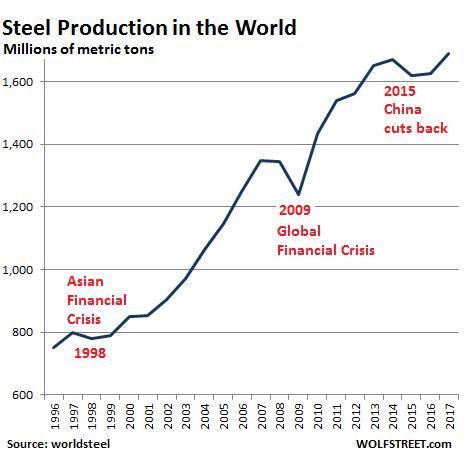
Productionofsteelslagfrom1996to2017 worldwide
Source:http://ghovexx.blogspot.com/2018/06/whodominates-global-steel-production.html
2395-0072
TheExpansivesoilusedinthepresentinvestigationwas collected from Amalapuram, East Godavari District, A.P, India.Thisexpansivesoilwascollectedatadepth of1.0m fromthegroundlevel.Thetestswerecarriedoutonthesoil asperISCodesofpractice.
Theobjectivesofthepresentexperimentalstudyare, Toascertainthecharacteristicsofexpansivesoil.
To assess the effectiveness of Steel slag as an admixture in improving the performance of expansivesoil.
To evaluate the performance of the treated expansivesoilasasubgradeforflexiblepavements
Table-1: Properties of Expansive Soil
2.1 Magdi Mohamed Eltayeb Zumrawi et al. (2017) investigated and found that the use of steel slag in stabilizationofexpansivesoilinSudanishighlyeconomical and sustainable than cement stabilization. The study also statesthatwithincreaseinsteelslagcontent,LiquidLimit decreases,Plasticlimitslightlyincreases,Differential Free Swell Decreases, Unconfined Compressive Strength (UCS) valueincreases.
International Research Journal of Engineering and Technology (IRJET) e-ISSN: 2395-0056
Volume: 11 Issue: 05 | May 2024 www.irjet.net p-ISSN: 2395-0072
2.2 Jun Wu et al. (2019) publishedonthemodificationof expansive soil by waste steel slag and its applications in highways.Ontheotherhand,steelproductionhasavariety of environmental consequences, including air pollution, wastewatercontaminants,hazardouswaste,andsolidwaste.
Steel slag is well known for polluting fertile soils, surface waters, and groundwater when exposed to natural weatheringconditions.Largequantitiesofsteelslag,abyproductofthemetallurgicalindustryproducedduringsteel manufacturingprocesses,aredumpedlargelybecauseofthe difficultyinvolvedinrecycling.Atypicalexpansivesoilwas sampledfromHefeicityinChinaatadepthnotlessthan1.0 m under the ground surface. The soil was sealed in a polythenebagtoavoidmoisturelossduringtransportation. Thephysicalpropertiesofthesteelslagobtainedfromthe processingfactoryatJiaxingcity,China.Thebasicphysical properties of the treated soils including Free swell ratio, Californiabearingratio,Unconfined,consistencylimits,and microstructure were evaluated to understand the engineeringbehaviorandmicrostructuralmechanism.
[AASS-the optimum adjusted and activated steel slag (containing 28.6% slag, 57.1% lime, 9.5% metakaolin and 4.8%Na2SO4)]
2.3 Umar Farook Ali et al. (2019) shows major volume changes due to change in the moisture content. When the soilisdry,theyshrinkandlargecrackisformed.Thissoil containsmineralssuchasmontmorillonitethatiscapableof absorbingwater.TheycollectedexpansivesoilatPOONDI. The soil was used in experimental program and it was classifiedasInorganicclayofhighplasticity(CH).SteelSlag was collected in industrial waste from “KOVAI RAJA TMT BARS”Coimbatore.Steelfurnaceslagtypicallyformsavery angular,durableaggregatethatmakesitidealforuseinthe transportationindustry.Theycollectedsoilsampleandoven driedfor24hrsandpulverizedit.Afterthattheyconducted tests namely consistency limits, compaction proctor, unconfined,freeswellandspecificgravity.Theyconducted tests for different contents of soil and steel slag (0%,2%,4%,6%,8%).ThevalueofUCCisincreasedaddinga steelslaginpercentageof4%steelslag.Furtherincreasing the percentage, the UCC value is to be decreased. The cohesion goes on decreasing and the angle of internal frictiongoesonincreasingwiththeincreaseinpercentageof addition of steel slag. The index properties of liquid limit, shrinkagelimit,plasticlimitandswellingindexisdecreased byaddingasteelslag.
2.4 Worku Firomsa Kabeta et al. (2023) publishedabout stabilizing expansivesoilusingsteel slag.The presence of montmorillonite clay minerals in expansive soils makes themproblematicinnaturehasahightendencytovolume changeuponachangeinmoisturecontent,whichisknown as swelling potential. The steel industry is considered essential for a country like Ethiopia, which aspires to
undergoarapidprocessofindustrializationandeconomic transformation.Steelslagfromthisindustrywasaffecting the surrounding environment, and there was a need to minimize this waste by recycling for sustainable development. The suitability of steel slag in stabilizing expansivesoilfoundinEthiopia,specificallyinJimmatown. The soil sample is taken from a depth of 1.5 m below the ground surface and kept in bags to maintain their natural moisture content. The steel slag used in this study was producedinEthiopiabytheEthiopianSteelCompany.The soilusedintheexperimentshasafreeswelltestof104.6%, indicatingthatitisexpansiveinahighrange.Thetypeofsoil ishighlyexpansiveclay.Thisstudyconcludesthatsteelslag isa cost-effectivematerial forimprovingsoilgeotechnical properties and a viable option for reducing the environmentalimpactofsteelslagwaste.
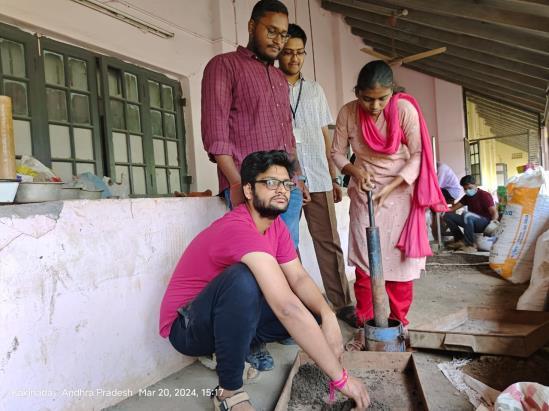
DifferentTestswereconductedinthelaboratoryon the Expansive soil to study the behavior of expansive soil whenitistreatedwithdifferentpercentagesofSteelSlag.
The Index and engineering properties were calculated for theuntreatedexpansivesoilandexpansivesoiltreatedwith percentagevariationofsteelslagasperIScodesofpractice.
Theliquidlimitisdefinedasthemoisturecontentat which the soil changes from the liquid state to the plastic state,whichcorrespondsto25blowsappliedinastandard liquid limit apparatus just to close a groove of standard dimensions cut in the sample by the grooving tool by a specifiedamount.
Theliquidlimitisdeterminedaccordingtothespecifications outlinedinIS:2720(part5)-1980.
Theplasticlimitisthemoisturecontentatwhicha soil, when rolled into a thread of the smallest diameter possible,beginstocrumbleandreachesadiameterof3mm. Theplasticlimit(WP)isrepresentedasawholenumberby averaging the moisture contents at which this crumpling occurs.
The maximum dry density (MDD) and Optimum MoistureContent(OMC)ofthesoilaredeterminedthrough compaction tests, following the procedure outlined in the Indianstandardcodesofpractice IS:2720(PartVIII)-1983.
International Research Journal of Engineering and Technology (IRJET) e-ISSN: 2395-0056
Volume: 11 Issue: 05 | May 2024 www.irjet.net
California Bearing Ratio (CBR) Test
The California Bearing Ratio (CBR) serves as a measure of the shearing resistance of a material under controlled density and moisture conditions. A loadpenetrationcurveisplottedforeachspecimenonanatural scale.Fromthesecurves,theCBRvaluesarecalculatedfor 2.5mmand5.0mmdepthsofpenetration.
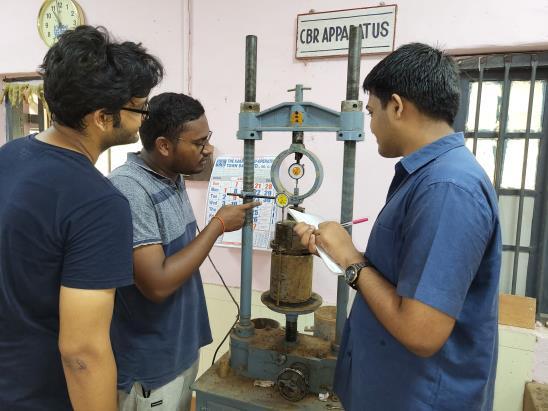
Table.2 present the mix proportions for the stabilizationofexpansivesoilwithpercentagevariationof steelslag.
Table-2: Mix Proportions for testing
S.NO Mix Proportions
1 ExpansiveSoil
2 90%ExpansiveSoil+10%SteelSlag
3 85%ExpansiveSoil+15%SteelSlag
4 80%ExpansiveSoil+20%SteelSlag
5 75%ExpansiveSoil+25%SteelSlag
Table-3: OMC and MDD values of untreated and treated expansive soil
Table3showthattheOMCvaluesdecreasesfrom 24.65%to17.54%onadditionofsteelslagfrom0%to25%. TheMDDvaluesofthetreatedexpansivesoilwasobserved tobeincreasedfrom1.649g/ccto1.83g/cconadditionof Steelslagfrom10%to20%anddecreasedto1.75g/ccon furtheradditionof25%steelslag.
Theoptimummixproportionisobservedby 80% Expansive Soil +20% Steel Slag.
Table-4: CBR Test Results for different mix proportions
Table-4showsthatCBRisincreasedfrom1.34%to 8.07%afteraddingSteelslagfrom0%to20%anddecreased to6.27%ofadding25%steelslag.
The optimum mix proportion is given by 80% ExpansiveSoilwith20%SteelSlag.
International Research Journal of Engineering and Technology (IRJET) e-ISSN: 2395-0056
Volume: 11 Issue: 05 | May 2024 www.irjet.net
Table-5: Consistency Limits Results for optimum mix proportion
S.NO Mix Proportion Liquid Limit (%) Plastic Limit (%) Plasticity Index (%)
1. 100%ES 70 30 40
2. 80%ES+20%SS 44 32 12
Table-5showstheconsistencylimitsofuntreated soilalongwithoptimummixproportion.Whentheoptimum admixtureproportionisadded,theLiquidLimitdecreased from70%to44%,PlasticLimitdecreasesfrom30%to32%. PlasticityIndexisdecreasedfrom40%to12%
AccordingtoIndianStandardSoilclassification,the soilsampleisclassifiedasHighlyCompressibleClay(CH).
Discussion:
AsperIRC-37:2012codesofpractice,thesubgrade soil should possess the minimum CBR value of 8%. In the present investigation, the expansive soil treated with an optimumof20%SteelSlaghasexhibitedtheCBRvalueof 8.07%. Hence this treated expansive soil is suitable as subgradeforflexiblepavements.
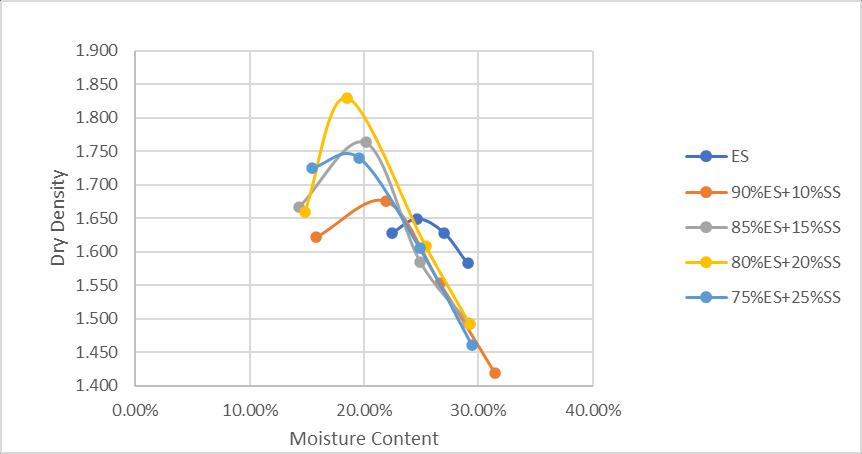
Chart-1: Variation of compaction test results with steel slag content (%)
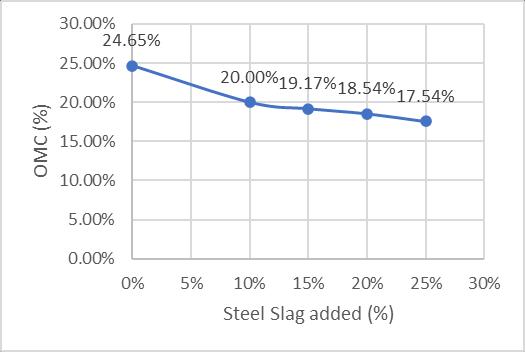
Chart-2: Variation of Optimum Moisture Content with Steel Slag content (%)
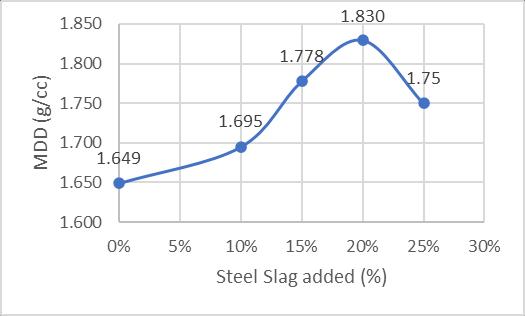
Chart-3: Variation of Maximum Dry Density with Steel Slag Content (%)
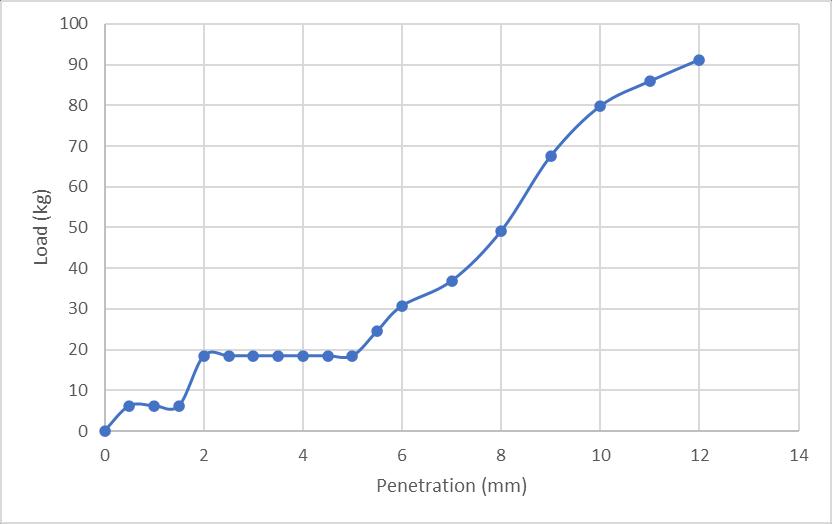
Chart-4: Relation between Load and Penetration for soil without admixtures
International Research Journal of Engineering and Technology (IRJET) e-ISSN: 2395-0056
Volume: 11 Issue: 05 | May 2024 www.irjet.net p-ISSN: 2395-0072
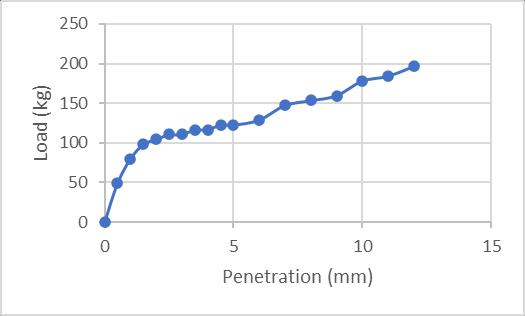
Chart-5: Relation between Load and Penetration for soil with optimum steel slag content (20%)
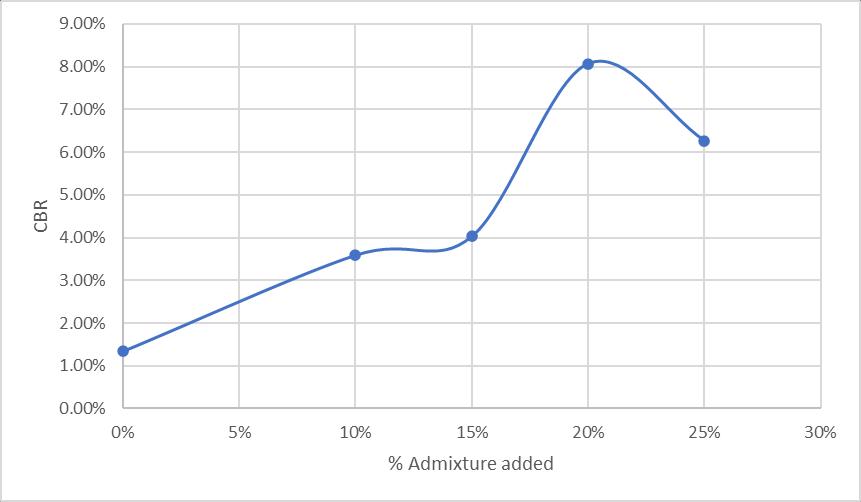
Chart-6: Variation of CBR values with percentage variation of Steel Slag (%).
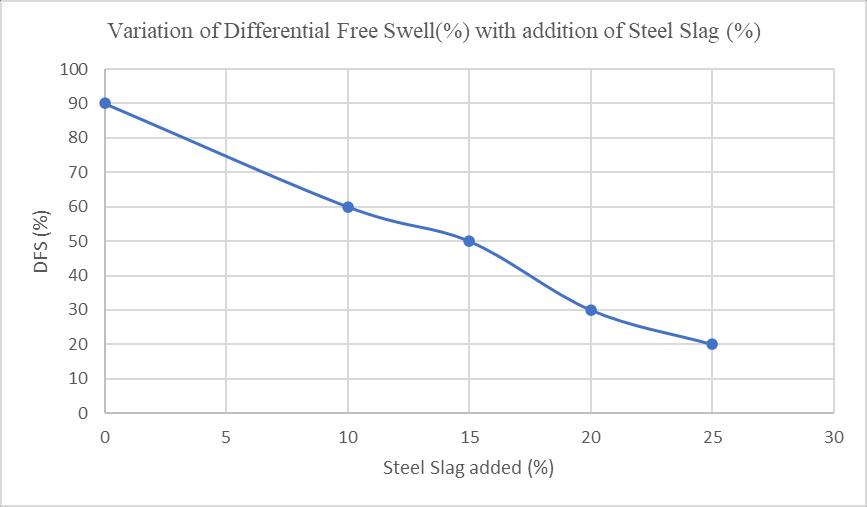
Chart-7: Variation of Differential Free Swell with percentage variation of steel slag (%)
Table-6: COMPOSITE TABLE OF RESULTS COMPARING UNTREATED EXPANSIVE SOIL TO EXPANSIVE SOIL TREATED WITH 20% STEEL SLAG
Compaction Properties
5. CONCLUSIONS
Conclusions of the various laboratory test results were presented.
It is observed from the laboratory results that the Liquid Limit of the Expansive soil has been decreasedby37.14%onadditionof20%SteelSlag asanoptimumwhencomparedwiththeuntreated expansivesoil.
TheplasticityIndexoftheExpansivesoilhasbeen improvedby70%ontreatingexpansivesoilwith 20%SteelSlagwhencomparedwiththeuntreated expansivesoil.
The DFS values of treated expansive soil has been improved by 72.72% when compared with the untreatedexpansivesoil
The Optimum Moisture Content (OMC) has decreased by 3.89% on treating the expansive soil with20%SteelSlagwhencomparedwithuntreated expansivesoil.
International Research Journal of Engineering and Technology (IRJET) e-ISSN: 2395-0056
Volume: 11 Issue: 05 | May 2024 www.irjet.net p-ISSN: 2395-0072
TheMaximumDryDensity(MDD)hasincreasedby 0.202g/ccontreatingtheexpansivesoilwith20% SteelSlagwhencomparedwithuntreatedexpansive soil.
ItisnoticedthattheCBRvalueoftheexpansivesoil hasbeenimprovedby 8379 %ontreatingit with 20% Steel Slag when compared with untreated expansivesoil
Furtherlaboratoryinvestigationscanbecarriedout withtheadditionofvariouschemicalssuchasFeCl3, MgCl2, CaCl2 with expansive soils along with Steel Slagtoimprovestrengthcharacteristics.
Further Laboratory investigations can be carried out by the addition of various other industrial wastes that are locally available and compare the characteristics with the characteristics obtained withsteelslag.
Field tests are performed to confirm the authenticity of the laboratory test results in the field.
Laboratory cyclic plate load test should be conducted to know the performance of the expansive soil as sub-grade of flexible pavements undercyclicpressures.
LaboratoryCyclicplateloadtestcanbeconducted by using Geotextiles as Reinforcement and separator.
[1] Mohanty, S.K., Pradhan, P.K. and Mohanty, C.R., 2017. Stabilization of expansive soil using industrial wastes. Geomechanicsandengineering,12(1),pp.111-125.
[2] Ashango, A.A. and Patra, N.R., 2016. Behavior of expansivesoiltreatedwithsteelslag,ricehuskash,and lime. Journal of Materials in Civil Engineering, 28(7), p.06016008.
[3]Wu,J.,Liu,Q.,Deng,Y.,Yu,X.,Feng,Q.andYan,C.,2019. Expansive soil modified by waste steel slag and its application in subbase layer of highways. Soils and foundations,59(4),pp.955-965.
[4]Abdalqadir,Z.K.,Salih,N.B.andSalih,S.J.H.,2020.Using steelslagforstabilizingclayeysoilinSulaimaniCity-Iraq. JournalofEngineering,26(7),pp.145-157.
[5] Rajakumaran, K., 2015. An experimental analysis on stabilizationofexpansivesoilwithsteelslagandflyash.
International journal of advances in engineering & technology,7(6),p.1745.
[6]Alemshet,D.,Fayissa,B.,Geremew,A.andChala,G.,2023. Ameliorationeffectofflyashandpowderedgroundsteel slag for improving expansive subgrade soil. Journal of Engineering,2023.
[7]Zumrawi,M.M.E.andBabikir,A.A.A.A.,2017.Laboratory study of steel slag used for stabilizing expansive soil. UniversityOfKhartoumEngineeringJournal,6(2).
[8] Kabeta, W.F. and Lemma, H., 2023. Modeling the application of steel slag in stabilizing expansive soil. ModelingEarthSystemsandEnvironment,9(4),pp.40234030.
[9]Wu,J.,Liu,Q.,Deng,Y.andFeng,Q.,2019.Engineering Performance and Its Mechanism of Expansive Soils Modified by Adjusted and Activated Steel-Slag. In Proceedings of the 8th International Congress on Environmental Geotechnics Volume 1: Towards a SustainableGeoenvironment8th(pp.304-310).Springer Singapore.
[10] AM, U.F.A., Athipathy, M., Clement, M. and Krishnakumar, P., EXPERIMENTAL STUDY ON STABILIZATIONOFEXPANSIVESOILUSINGSTEELSLAG ANDFLYASH.
[11]IrshadAhmadLone,Er.NavdeepSingh,"Stablisationof Expansive Soil using Fly Ash", International Journal of Creative Research Thoughts (IJCRT), ISSN:2320-2882, Volume.11,Issue6,pp.f952-f962,June2023,Availableat :http://www.ijcrt.org/papers/IJCRT2306684.pdf
BIOGRAPHIES:


NAME:DR.DKOTESWARARAO Qualification:B.Tech,M.Tech (G.T.E),C.C.A&D.T.W,Ph.D, ProfessoratJNTUK,KAKINADA
Name:Mr.KVSRMANOHAR Qualification:B.Tech(Civil)U.G. StudentatJNTUK,KAKINADA
International Research Journal of Engineering and Technology (IRJET) e-ISSN: 2395-0056
Volume: 11 Issue: 05 | May 2024 www.irjet.net p-ISSN: 2395-0072



Name:Ms BSOWMYA
Qualification:B.Tech(Civil)U.G. StudentatJNTUK,KAKINADA
Name:Mr.YGSAISANJAY
Qualification:B.Tech(Civil)U.G. StudentatJNTUK,KAKINADA
Name:Mr.BVSMBHARADWAJ
Qualification:B.Tech(Civil)U.G. StudentatJNTUK,KAKINADA