
International Research Journal of Engineering and Technology (IRJET) e-ISSN: 2395-0056
Volume: 11 Issue: 05 | May 2024 www.irjet.net p-ISSN: 2395-0072
International Research Journal of Engineering and Technology (IRJET) e-ISSN: 2395-0056
Volume: 11 Issue: 05 | May 2024 www.irjet.net p-ISSN: 2395-0072
Sridhar Kumar H R1 , Nithin S G2 , Ganashree K3 , Narendra4 , Siddaraju p5
Department of EI Engineering, Dr Ambedkar institute of technology Bengaluru , Karnataka ,India
Abstract –
This paper proposes an automated control system for facilitatingTwoWayVehicletoVehicle(V2V)communication using IoT technology. With the rapid advancement of autonomous vehicles and smart transportation systems, effectivecommunicationbetweenvehicleshasbecomecrucial for ensuring safety, efficiency, and traffic management. Traditional methods of V2V communication often rely on predefined protocols and manual interventions, leading to limitations in adaptability and scalability.
In this study, we present a novel approach leveraging IoT devices installed in vehicles to enable seamless and dynamic communication between vehicles on the road. The proposed system utilizes a combination of sensors, actuators, and communication modules integrated into vehicles, allowing them to exchange real-time data such as location, speed, direction, and the status of the vehicle. Through intelligent algorithms, the system can analyze incoming data streams, identify potential hazards or traffic conditions, and autonomouslymakedecisionstooptimizevehiclemovements andenhance overalltrafficflowandincreasethe intelligence of the autonomous vehicles
Key Words ,Internet of things(IOT), vehicle to vehicle (V2V)
1.INTRODUCTION
ThisprojectfocusesonimplementingaVehicle-to-Vehicle (V2V)communicationsystemusingInternetofThings(IoT) technology. The objective is to enhance road safety and efficiency by enabling real-time data exchange between vehicles.Utilizingsensorsandcommunicationmodules,the systemfacilitatesthesharingofinformationsuchasspeed, location, and road conditions among nearby vehicles. The collected data is processed centrally, allowing for the generation of alerts and warnings to improve driver awarenessandpreemptivelyaddresspotentialhazards.This V2Vcommunicationframeworkaimstocreateaconnected andresponsiveautomotiveecosystem,contributingtosafer andmoreintelligenttransportationnetwork.Usingtwo-way vehicle-to-vehicle (2WV2V) communication, a vehicle can detectthepositionandmovementofothervehiclesuptoa quarterofakilometeraway.Inarealworldwherevehicles areequippedwithasimpleantenna,acomputerchipandGPS (Global Positioning System) Technology, your vehicle will
know where the other vehicles are, additionally other vehicleswillKnowwhereyouaretoowhetheritisinblind spots,stoppedaheadonthehighwaybuthiddenfromview, around a blind corner or blocked by other vehicles. The vehicles can anticipate and react to changing driving situations and then instantly warn the drivers with emergencywarningmessages.Ifthedriverdoesn’trespond to the alerts message, the vehicle can bring itself to a safe stop,avoidingacollision.
Theexistingroadinfrastructurefaceschallengesrelatedto road safety, traffic congestion, and timely communication between vehicles. Lack of real-time data exchange among vehicleshinderstheabilitytoproactivelyaddresspotential hazards and optimize traffic flow. This project addresses these issues by implementing a Vehicle-to-Vehicle (V2V) communication system using Internet of Things (IoT) technology.Theaimistoovercomethecurrentlimitationsin inter-vehicle communication, fostering a safer and more efficienttransportationenvironment.Bydevelopingarobust V2V framework, the project seeks to mitigate accidents, reduce traffic congestion, and enhance overall road safety throughimprovedcommunicationandcollaborationamong vehicles.
Fig1.1.1shows, Adrivershouldconstantlykeepan eyeonvehiclesclosesttoher/hislocationinordertoavoid collisions.Unfortunately,thedriveroftendoesnotseeclosest vehicles due to obstacles (other vehicles, trees, buildings, etc.).Inthispaper,weintroduceanoveltypeofquerycalleda continuous range k nearest neighbor (CRNN) query in vehicularad-hocnetworks,andproposeaschemeforquery processing.Themainobjectiveofthisprocessingistoavoid the collision between the two vehicles when the driver shouldnotabletocontrolthevehicle.i.e.Whendrivershould get disable to control the vehicle then this system should provide the proper response to the system for collision avoidance. The aim of our project is to avoid the collision betweentwoormorevehiclesonroadforthesafetypurpose using this system. Following objectives can be achieved throughthisproposedwork.
International Research Journal of Engineering and Technology (IRJET) e-ISSN: 2395-0056
Volume: 11 Issue: 05 | May 2024 www.irjet.net p-ISSN: 2395-0072
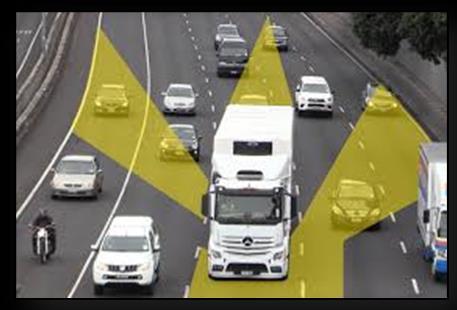
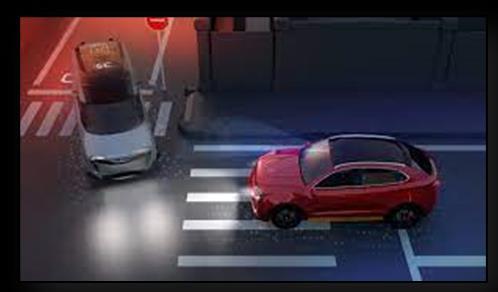
The main objectives of Vehicle-to-Vehicle (V2V) communication are aimed at enhancing road safety, improvingtrafficefficiency,andcontributingtotheoverall advancement of transportation systems. Here are the key objectivesofV2Vcommunication:
I. Improve road safety by enabling vehicles to exchange information about their speed, position, anddirection,allowingforreal-timewarningsand collisionavoidancemaneuvers.
II. Minimize the number and severity of traffic accidents through early detection and warning systems that alert drivers to potential dangers. Facilitate quicker and more efficient emergency response by allowing emergency vehicles to communicate with other vehicles on the road and receivepriorityaccess.
III. Provideacommunicationframework essential for the safe and efficient operation of autonomous vehiclesbyallowingthemtoshareinformationwith othervehiclesontheroad.
IV. Providevaluabledatafortransportationplannersby collecting information on traffic patterns , congestion, and road conditions. This data can be
usedtooptimizeroadinfrastructureplanningand design.
V. Facilitate vehicle platooning, where groups of vehiclestravelcloselytogetheratconsistentspeeds, leading to improved fuel efficiency and reduced emissions.
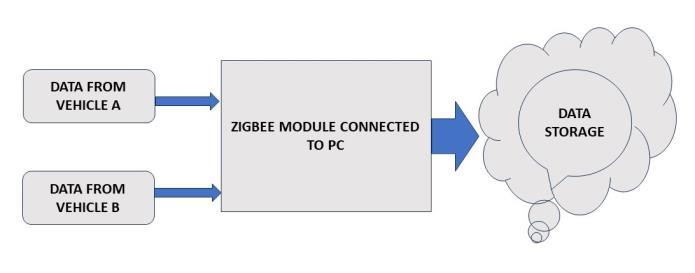
The automated control for two-way vehicle to vehicle communicationsystemconsistsoftwoblockdiagramthefirst blockdiagramisforthevehicleAandvehicleBthesecond block diagram is to store the data for future analysis (investigationpurpose).
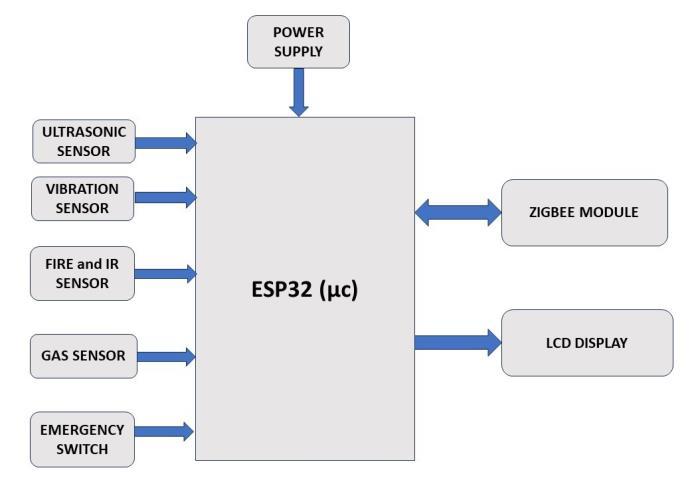
The above Block diagram 1 is for the vehicles in order to exchange the information between the vehicles. The block diagramconsistsofvarioustypeofsensorsinordermeasure some of the parameter’s and to measure the status of the vehicleandithastheZigbeemodule fordataexchangingthe LCDdisplayisusedinordertodisplaytherealtimestatusof the vehicle, buzzer is used to indicate the emergency situation. The microcontroller(esp32) is used to perform several operation depending upon the certain condition (sensorinput)andthemicrocontroller(esp32)outputwillbe given to the output devices. The power supply is used to powerupthecircuit
Research
Volume: 11 Issue: 05 | May 2024 www.irjet.net p-ISSN: 2395-0072
The above block diagram is to acquire the transmitted(exchanged)informationfromvehiclesanditwill bestoredinthedatabaseforthefurtherdataanalysis.The Zigbeemoduleisusedtoacquirethedatafromthevehicles wirelessly.TheZigbeemoduleisconnectedtoPC.
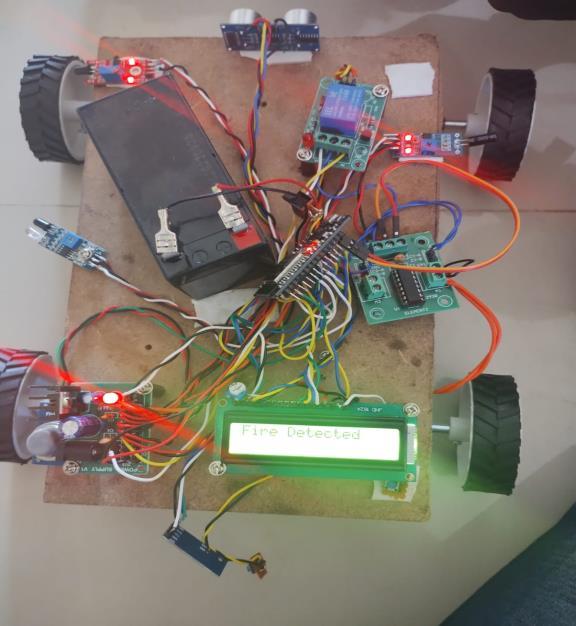
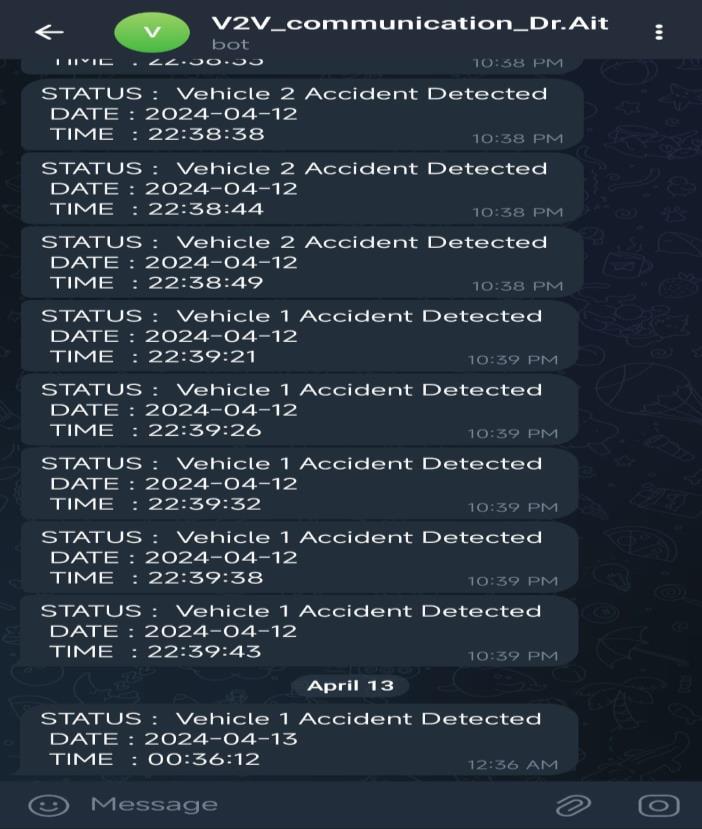
Implementing automated control for two-way vehicle-tovehicle communication using IoT can enhance road safety andtrafficefficiency.ByleveragingIoTdevicesinstalledin vehicles,real-timedataexchangecanoccur,allowingvehicles tocommunicatewitheachotheraboutroadconditions,traffic congestion,andpotentialhazards.Thisinformationenables automatedsystemstomakesplit-seconddecisions,suchas adjustingspeedorroute,topreventaccidentsandoptimize traffic flow. Overall, this technology has the potential to revolutionize transportation by making it safer, more efficient,andmoresustainable. Fig 4.1 showstheprototype of the vehicles which is enabled with communicating technology using IOT. Fig 4.2 shows the data which has exchanged between the vehicles are been stored for the futureanalysisandinvestigationpurposes. Fig 4.3 Itshows theaccidentdetectedtextmessagethathasbeensenttothe ownersofthevehicles.
Overall,automatedcontrolfortwo-wayV2Vcommunication using IoT technology holds immense potential to revolutionize transportation systems, making them safer, moreefficient,andmoresustainable.However,widespread adoptionwouldrequirecollaborationbetweenautomotive manufacturers, policymakers, and technology providersto address technical challenges, regulatory issues, and public acceptance.

In this study, we have presented an automated control system for Two Way Vehicle to Vehicle (V2V) communicationusingInternetofThings(IoT)technology. The system aims to enhance traffic safety, efficiency, and managementthroughseamlesscommunicationandadaptive decision-makingamongvehiclesontheroad.
International Research Journal of Engineering and Technology (IRJET) e-ISSN: 2395-0056
Volume: 11 Issue: 05 | May 2024 www.irjet.net p-ISSN: 2395-0072
Inconclusion,itholdsgreatpromisefor revolutionizing the future of transportation systems. By harnessingthepowerofIoTtechnologytoenableseamless communication and intelligent decision-making among vehicles,wecancreatesafer,moreefficient,andsustainable transportationnetworksforthebenefitofsocietyasawhole.
1. Tech,C.(2019,March13).WhatisVehicletoVehicle ORV2VCommunicationTechnology?RetrievedJune 06,2020,fromhttps://carbiketech.com/vehicle-tovehicle-v2vcommunication/
2. L. Liang, H. Ye, and G. Y. Li, "Toward intelligent vehicularnetworks:Amachinelearningframework," IEEE Internet of Things Journal, vol. 6, no. 1, pp. 124-135,2018.
3. Dirk Wohlschlaeger, I. (2015, August 07). What's Next?V2V(Vehicle-to-Vehicle)Communicationwith Connected Cars. Retrieved June 06, 2020, from https://www.wired.com/insights/2014/09/connect ed-cars/
4. L. Liang, H. Ye, and G. Y. Li, "Toward intelligent vehicularnetworks:Amachinelearningframework," IEEEInternetofThingsJournal,vol.6,no.1,pp.124135,2018.
5. M.Al-Ramahi,Y.-L.Chang,O.F.El-Gayar,andJ.Liu, "Predictingbigmoversbasedononlinestockforum sentiment analysis," in Americas Conference on InformationSystems(AMCIS2015),2015:AIS.
6. Heremobility.(2020,June,15).VehicleToVehicleComm unication.https://mobility.here.com/learn/smarttransportation/vehicle-vehicle
7. JinlingHu,YanShi,YingPeng,JiayiFang,RuiZhao, andLiZhao."Vehicle to-everything(V2X)services supported by LTE-based systems and 5G." IEEE Communications Standards Magazine 1, no. 2 (2017):70-76
8. L. A. Tawalbeh, A. Basalamah, R. Mehmood and H. Tawalbeh,"GreenerandSmarterPhonesforFuture Cities: Characterizing the Impact of GPS Signal Strength on Power Consumption," in IEEE Access, vol. 4, pp. 858-868, 2016, Doi: 10.1109/ACCESS.2016.2532745
9. M.Al-Ramahi,Y.-L.Chang,O.F.El-Gayar,andJ.Liu, "Predictingbigmoversbasedononlinestockforum sentiment analysis," in Americas Conference on InformationSystems(AMCIS2015),2015:AIS
10. Hartenstein,H.;Laberteaux,K.P.(2008)."Atutorial survey on vehicular ad hoc networks". IEEE Communications Magazine. 46 (6): 164–171. doi:10.1109/MCOM.2008.4539481.ISSN0163-6804. S2CID3160950
2024, IRJET | Impact Factor value: 8.226 |