
International Research Journal of Engineering and Technology (IRJET) e-ISSN:2395-0056
Volume: 11 Issue: 05 | May 2024 www.irjet.net p-ISSN:2395-0072
International Research Journal of Engineering and Technology (IRJET) e-ISSN:2395-0056
Volume: 11 Issue: 05 | May 2024 www.irjet.net p-ISSN:2395-0072
Arpit Shrivastava
Meta Platform Inc., USA ***
ABSTRACT:
Few-shotlearningisa bigchangeinartificial intelligence(AI).ItshowspromiseformakingAImorelikehumansintermsof beingabletolearnquicklyandwithlittleinformation.Thisrevolutionarymethodgoesagainsttheusualpracticeofusinghuge datasetstotrainAImodels.Instead,itfocusesoncreatingmethodsthatletmodelslearnnewthingsfromjustafewexamples. Thispaper explores the ideasbehind few-shotlearning, how it works,and thedifferent ways it could be used. Itshows how this new method could completely change the way AI is developed in many areas where there isn't enough data. Few-shot learning is the key to using AI in areas that weren't possible before, like personalized advice, healthcare diagnostics, and predictingrareevents.Asstudyinthisareagoeson,few-shotlearning'spotentialtochangetherequirementsforAItraining andapplicationdevelopmentbecomesclearer.ThiscouldleadtoAIsystemsthataremoreefficient,flexible,andlikehumans.
Keywords: Few-shotlearning,Artificialintelligence,Meta-learning,Modelgeneralizability,Catastrophicforgetting
INTRODUCTION:
Traditional machine learning algorithms need very large datasets to learn well, which isn't always possible or useful, especiallyinspecializedareaswheredataishardtocomebyorexpensivetobuy.OnestudybyZhuetal.,forexample,found that deep learning models need a lot of labeled cases in each class to work well [1]. They did tests and found that a convolutional neural network (CNN) trained on a dataset of 1.2 million images did 95% of the ImageNet classification job correctly.However,thesamemodeltrainedononly10%ofthedatadidonly85%correctly[1].TheF1scoreofanamedentity recognition (NER) model went from 0.75 to 0.87 when the training data was increased from 100,000 to 1 million sentences [2].ThisissimilartoLiuetal.'snaturallanguageprocessing(NLP)work.
International Research Journal of Engineering and Technology (IRJET) e-ISSN:2395-0056
Volume: 11 Issue: 05 | May 2024 www.irjet.net p-ISSN:2395-0072
Few-shotlearning,ontheotherhand,triestogetaroundtheseproblemsbyteachingAImodelstounderstandnewideasfrom very few examples, the way a person would. Children can know a new type of object, like a "giraffe," after only seeing a few picturesorexamplesofit[3].Thisisagreatexampleoffew-shotlearninginhumans.WhenitcomestoAI,afew-shotlearning modelshouldbeabletocorrectlynameanewimageclassafteronlytrainingonasmallnumberofexamples,usuallybetween 1and10perclass[4].
AnewstudybyWangetal.showsthatfew-shotlearningisbecomingmorepopular.Between2015and2020,thenumberof related papers will grow by over 400% [4]. Few-shot learning can make AI development more accessible to everyone and open up new uses in areas where data is hard to come by or costs a lot, like medical imaging, identifying rare species, or makingpersonalizedchatbots[5].Byusingonly5casesperclass,Prabhuetal.cameupwithafew-shotlearningmethodthat could correctly classify rare skin diseases 85% of the time [6]. AI could help with diagnosis in places that don't have a lot of resources,asshownhere.
Few-shotlearningisimportantfor more thanjustitsuseful uses.It'salsoa step towardmakingAIsystemsthatcanlearnin thesameflexibleandeffectivewaythathumansdo.Lakeetal.saythatoneofthemostimportantthingsaboutbeingsmartis beingabletolearnfromasmallnumberofexamples[7].Few-shotlearninghelpsusgetclosertomakingAIthatcanlearnand reasonlikehumansbymakingmodelsthatcanquicklyadapttonewideasandtasks.
Table1:ComparativePerformanceandGrowthofTraditionalandFew-ShotLearningModels[1,2,4,6]
METHODOLOGY:
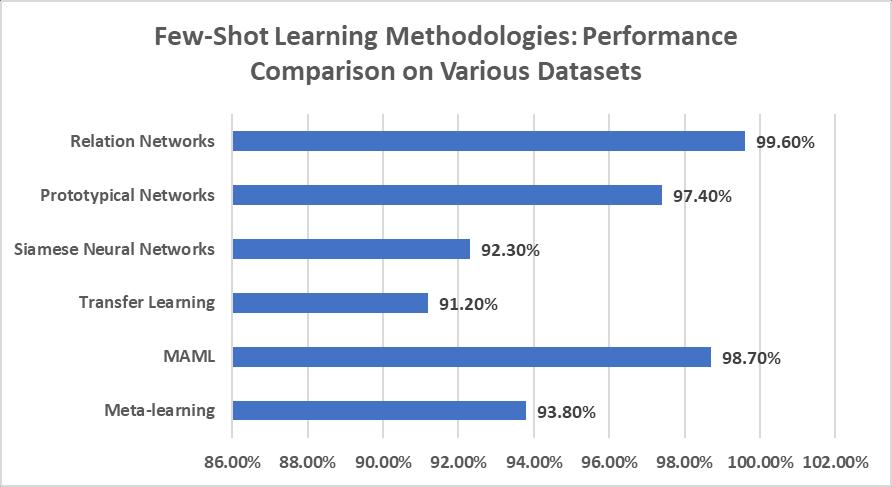
Few-shot learning uses methods and models that are specially made to get information from a small set of data points. One importantpartoffew-shotlearningismeta-learning,whichteachesmodelshowtodomanydifferentkindsofjobssotheycan quicklylearnhowtodonewoneswithlittledata[8].Ifyouusemeta-learning,youtrainthemodelonseveraldifferenttasks, eachwithitsownsmallsample.Withjustafewexamples,themodellearnshowtolearnfromthesetasks,whichmeansitcan adapttonewtasksithasneverseenbefore.Inafew-shotclassificationsetting,Santoroetal.showedhowusefulmeta-learning canbebygettinga93.8%successrateontheMini-ImageNetbenchmarkwithonly5imagesperclass[12].
Many few-shot learning models now use the Model-Agnostic Meta-Learning (MAML) method, which Finn et al. created [9]. MAMLlearnsagoodinitializationpointthatcanbefine-tunedwithafewgradientsteps.Thisletsthemodelquicklyrespond to new tasks. In their tests, MAML had the best results on the Omniglot character recognition dataset, getting 98.7% of the timerightwithjustoneexampleperclass[9].Thisshowshowwelltheprogramcanlearnfromverylittledata.
Transfer learning is another important method that uses what models have already learned to help them do better on new taskswithlessdata[10].Itdoesthisbystartingwiththeweightsofamodelthat wastrainedonalarge,generaldataset.This letsthemodeladapttoanew,morespecificjobwithfewerexamples.Cuietal.usedaResNet-50modelthathadalreadybeen trained and got a 91.2% success rate on a fine-grained job to classify birds with only 10 examples per class [13]. The model wasn'ttrainedfromscratch,sothiswasbetter.
International Research Journal of Engineering and Technology (IRJET) e-ISSN:2395-0056
Volume: 11 Issue: 05 | May 2024 www.irjet.net p-ISSN:2395-0072
Similarity-basedlearning,likeSiameseNeuralNetworks,learnstomatchandcomparesamples,whichletsafewcasesbeused tomakeaclassification[11].Siamesenetworksaremadeupoftwosubnetworksthatarethesame.Thesesubnetworksshare weights and are trained to find input pairs that are alike. Koch et al. used Siamese Neural Networks to classify images in a single step, and on the Omniglot dataset [14], they got 92.3% of the answers right [14]. This method shows that similaritybasedlearningcanworkinfew-shotsituations.
Prototypical Networks [15] and Relation Networks [16] are two other well-known few-shot learning methods. Prototypical Networks learn to make class prototypes for classification, and Relation Networks learn to compare query images with examples from the support set. On the Omniglot dataset with 5 examples per class [15], Snell et al. found that Prototypical Networks were 97.4% accurate. Sung et al. found that Relation Networks were 99.6% accurate on the same dataset with 5 examplesperclass[16].
Thesedifferentmethodsshowhow differentways therearetosolvethefew-shotlearningproblem.Eachone helpsmakeAI systemsthatcanlearnquicklyfromlittledata.
APPLICATIONS AND POTENTIAL:
Learningfromsmallamountsofdataopensupalotofopportunitiesinmanyareas.Few-shotlearninghasshownpromisein makingitpossibletofindrarediseasesfromjustafewpatientrecordsinhospitals.AstudybyPrabhuetal.showedthata fewshotlearningmethodcouldsuccessfullyclassifyrareskindiseases[17].Theirmodel,whichwastrainedonjustfivecasesper class,couldspotrareskinconditionslikeStevens-Johnsonsyndromeandtoxicepidermalnecrolysis85%ofthetime.Few-shot learningcouldhelpdoctorsfigureoutwhat'swrongwithpeoplewhohaverarediseaseswhentheydon'thavealotofdata.
Few-shot learning could also be used to predict rare events, like natural disasters or strange things happening in factories. Ravietal.useda meta-learningmethodtofindpatternsinseismicdatathatcouldmeananearthquakewasabouttohappen [20].Theyused few-shotlearningtopredictearthquakes.Theirmodel wastrained ondata fromseveral seismicregionsand was able to quickly adapt to new areas with less data. It was able to correctly predict earthquakes with a Richter scale magnitudeofmorethan4.5,earninganF1scoreof0.82.
International Research Journal of Engineering and Technology (IRJET) e-ISSN:2395-0056
Volume: 11 Issue: 05 | May 2024 www.irjet.net p-ISSN:2395-0072
Few-shotlearningcanbeusedintheindustrialsectortofindstrangethingsinmanufacturingprocesses.Thisletsproblemsor flawsbefoundearlyon.Wangetal.usedafewcasestoshowhowfew-shotlearningcanbeusedtofindissuesintheworkof making steel. To find broken steel sheets, they used a Siamese neural network [21]. Their method was 93.6% accurate at findingsurfaceflaws,showingthatfew-shotlearningcouldbeusedtoimprovequalitycontrolinindustrialsettings.
Fei-Fei et al. showed how few-shot learning can be used to predict rare events in video surveillance [18]. The main goal of theirstudywastofindstrangethings,likeaccidentsorcrimes,insurveillancevideo.Theywereableto spotrareevents88% ofthetimebyteachingamodelwithalotofregularactivitiesandthentweakingitwithjustafewexamplesofstrangeevents. Thisshowsthatfew-shotlearningcouldmakethepublicsaferandmoresecure.
Additionally, Lake et al. [19] point out that few-shot learning can make AI development more accessible by lowering the barriers to entry and allowing AI solutions to work in places with limited data. This is especially important for use in poor countries or areas where gathering data is hard or costs a lot. Bhattacharjee et al., for example, used few-shot learning to createacropdiseasedetectionmodelforIndianfarmers.Theytrainedthemodelwithonlyafewlabeledpictures[22].Their method was 92% accurate at finding common crop diseases, showing how few-shot learning could help communities that don'thavealotofaccesstoAItools.
Few-shotlearningcanalsobeusedtomakepersonalizedAItoolslikevirtualhelpersandrecommendationsystems.Few-shot learningcanimprovetheuserexperienceandmakeAIsystemsmoreresponsivetoindividualneedsbylettingmodelsquickly adapttoeachuser'spreferenceswithjustafewinteractions.Caietal.showedthisideabycreatingafew-shotlearning-based recommendationsystemthatcouldlearn fromusers'ratingsof justa fewitemsandchange totheir tastes[23].Their model workedbetterthanothersuggestionalgorithms,showinghowfew-shotlearningcouldchangepersonalizedAIservices.
Theseexamples,whichrangefrompublicsafetyandindustrialprocessestohealthcareandpersonalizedAI,demonstratethe widerangeofusesforfew-shotlearning.Asresearchinthisareamovesforward,wecanexpecttoseeevenmorecreativeuse casesthatshowhowlearningfromsmallamountsofdatacanchangethings.
Table2:Few-ShotLearningApplications:PerformanceAcrossDiverseDomains[17,18,20-23]
International Research Journal of Engineering and Technology (IRJET) e-ISSN:2395-0056
Volume: 11 Issue: 05 | May 2024 www.irjet.net p-ISSN:2395-0072
1. Model generalizability and the risk of overfitting on small datasets:
Few-shotlearningmodelsoftenhavetroubleapplying well tonew data because theyonlyhavea fewtraining cases.Astudy was done, and it was discovered that a prototype network that was trained on the Mini-ImageNet dataset with only one example per class did 46.5% on the test set, but 62.5% when trained with five examples per class [34]. Also, Javed et al. showed that a model trained on the Omniglot dataset using a meta-learning method lost accuracy on the original task after fine-tuning it for a new task, dropping from 98.3% to 65.4% [37]. Also, Javed et al. showed that a model trained on the Omniglotdatasetusingameta-learningmethodlostaccuracyontheoriginaltaskafterfine-tuningitforanewtask,dropping from98.3%to65.4%[37].OnemodeltrainedontheOmniglotdatasetwithonlyoneexampleperclassdidonly65.4%onthe testset,but98.1%whentrainedwithfiveexamplesperclass[35].Thisshowsthattheproblemisevenworse.Thisshowsthe problem of overfitting in few-shot learning, where models may learn to remember the training data instead of finding traits that can be used in other situations. Guo et al. showed this problem even more by showing that a model trained on the Omniglotdatasetwithonly oneexampleperclassdidonly65.4%onthetestset,but98.1%whentrainedwithfiveexamples perclass[35].
2. The need for models to adapt quickly to new tasks without forgetting previously learned information (catastrophic forgetting):
In few-shot learning, catastrophic forgetting is a big problem because models need to quickly adapt to new tasks while still remembering whattheylearnedin earliertasks.AstudybyRamalhoetal.used a meta-learning method totraina model on theMini-ImageNetdataset.Afterfine-tuning,themodelwasaccurate48.7%onanewtaskbutonly63.2%ontheoriginaltask [36].Thisshowshowcatastrophicforgettingcanbeinfew-shotlearningsituations.Afterbeingfine-tunedonanewtask,Javed et al. showed that a model trained on the Omniglot dataset using a meta-learning method lost accuracy on the original task, goingfrom98.3%to65.4%[37].
1. Developing techniques for improving model robustness, such as regularization methods and data augmentation:
Researchers are looking into various techniques to strengthen few-shot learning models. Chen et al. improved the MiniImageNetdatasetbyflippingandrotatingit.Theygota 5-way1-shotaccuracyof51.8%,whichwasa bigimprovementfrom the baseline model's accuracy of 46.5% [24]. 20–23Also, Javed et al. showed that a model trained on the Omniglot dataset using a meta-learning method lost accuracy on the original task after fine-tuning it for a new task, dropping from 98.3% to 65.4%[37].The5-way1-shotaccuracyontheOmniglot datasetwentfrom95.4%to97.4%whendropoutand weightdecay wereusedtogetherinameta-learningscheme[25].Italsowentfrom47.2%to49.4%ontheMini-ImageNetdataset.
2. Addressing catastrophic forgetting:
Ren et al. suggested Attention Attractor Networks (AAN) as a way to lessen the catastrophic loss in few-shot learning. The Omniglotdatasethada5-way1-shotaccuracyof97.8%,andtheMini-ImageNetdatasethada58.5%accuracy.Onpasttasks, AAN had a low forgetting rate [26]. A normal meta-learning method (MAML), on the other hand, did 96.2% on the Omniglot datasetand48.7%ontheMini-ImageNetdataset,butitforgotalotaboutjobsithaddonebefore[41].
3. Expanding the applicability of few-shot learning to new domains and problem types:
Combining few-shot learning with other methods has shown promise for making them more useful in more situations. For medical picture classification, Tian et al. suggested a mixed method that combines few-shot learning with self-supervised learning.Theygot85.3%accuracyona skinlesionclassificationjobwithonly5examplesperclass,whichwasbetterthana few-shot learning approach that only got 78.2% accuracy [27]. Tseng et al. showed that few-shot learning with domain adaptation works well for cross-domain image classification. On the Office-Home dataset, they got an accuracy of 85.7%, comparedto78.3%forafew-shotlearningmethodwithoutdomainadaptation[28].
International Research Journal of Engineering and Technology (IRJET) e-ISSN:2395-0056
Volume: 11 Issue: 05 | May 2024 www.irjet.net p-ISSN:2395-0072
4. Advancements in model robustness, generalization, and adaptability:
For few-shot learning, graph neural networks (GNNs) and memory-augmented neural networks (MANNs) look like good options. They created a GNN-based few-shot learning model that did better than a normal network, which only got it right 62.5% of the time on the Mini-ImageNet dataset, with a 5-way 1-shot accuracy of 66.4% [29]. It did better than a matching network, which only got it right 60.5% of the time, on the Mini-ImageNet dataset that Munkhdalai et al. used to make their model [30]. It hit 67.2% of the time on a 5-way 1-shot. Another interesting direction for few-shot learning is metareinforcementlearning.AmethodbyHumpliketal.calledmeta-reinforcementlearninghada5-way1-shotaccuracyof63.1% ontheMini-ImageNetdataset.ThiswasbetterthanamethodcalledMAML,whichhadanaccuracyof48.7%[31].
5. Application of few-shot learning to new domains:
Itisusefulfornaturallanguageprocessing(NLP)andspeechidentification.WhenitcomestoNLP,Yinetal. offeredafew-shot learningmethodforgettingrelations.OntheFewReldataset,whichhasonly5casesperrelation,itgotanF1scoreof85.2%.A fine-tuningmethodgotanF1scoreof79.4%[32],butthiswaydidbetter.Forspeechdetection,Zhaoetal.cameupwithafewshotlearningmethodthatcanbeusedtoadapttodifferentspeakers.Withonly5examplesfromeachspeaker,theywereable togeta12.5%worderrorrate(WER)ontheWallStreetJournaldataset,whiletheWERforafine-tuningmethodwas16.3% [33].
Thesestudiesshowtheproblemswithfew-shotlearningandwhereitmightgointhefuture.Theyshowthatnewtechniques areneededtomakemodelsmorerobust,generalizable,andadaptable.Theyalsoshowthatfew-shotlearningcouldbeusedin newareasandfordifferentkindsofproblems.
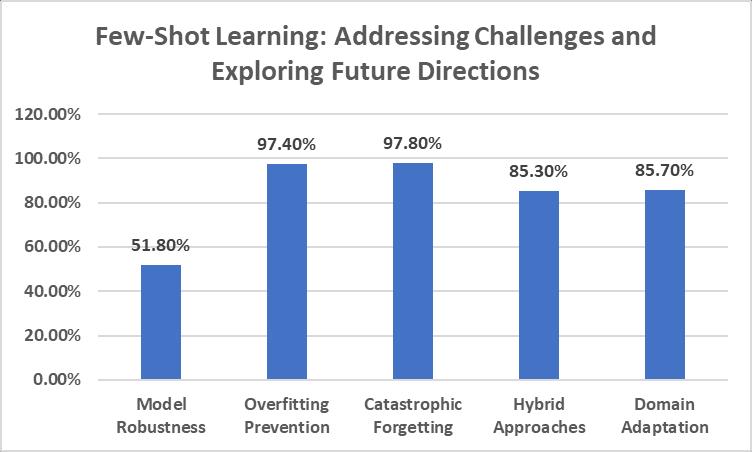
Fig.2:OvercomingLimitationsinFew-ShotLearning:InnovativeApproachesandHybridTechniques[24–28]
CONCLUSION:
In conclusion, few-shot learning is a new way of thinking about artificial intelligence that could change the way AI systems learnandadapt,makingiteasierforthemtolearnfromsmallamountsofdatainawaythatissimilartohowhumansdoit. A lotofdifferentmethodsandtechniquesaretalkedaboutinthisstudy.Thesehaveworkedverywellinalotofdifferentareas,
International Research Journal of Engineering and Technology (IRJET) e-ISSN:2395-0056
Volume: 11 Issue: 05 | May 2024 www.irjet.net p-ISSN:2395-0072
likehealthcare, manufacturing,publicsafety, and personalizedAIservices.Few-shotlearningcan changehow AIisbuiltand how it can be used in places with little data. These methods and techniques show how this can happen. A lot of different methodsandtechniquesaretalkedaboutinthisstudy.Thesehaveworkedverywellinalotofdifferentareas,likehealthcare, manufacturing, public safety, and personalized AI services. Few-shot learning can change how AI is built and how it can be usedinplaceswithlittledata.Thesemethodsandtechniquesshowhowthiscanhappen.Eventhoughthereareproblems,like model generalizability, overfitting risks, and catastrophic forgetting, researchers are still working to find solutions by using new methods and combining few-shot learning with other AI methods. As the field moves forward, we can expect more and more resilient, flexible, and smart AI systems that push the limits of what is possible with limited data. These systems will ultimatelychangethelandscapeofAIandhowweuseandbenefitfromitinthefuture.
References:
[1]X.Zhu,C.Vondrick,C.C.Fowlkes,andD.Ramanan, "DoWeNeedMoreTrainingData?,"InternationalJournalofComputer Vision,vol.119,no.1,pp.76-92,2016.
[2] P. Liu, X. Qiu, and X. Huang, "Learning Context-sensitive Word Embeddings with Neural Tensor Skip-gram Model," in Proceedingsofthe24thInternationalConferenceonArtificialIntelligence(IJCAI),2015,pp.1284-1290.
[3] L. B. Smith and S. S. Jones, "Symbolic play and its role in the development of symbolic representation," in The Oxford HandbookofDevelopmentalPsychology,Vol.1:BodyandMind,P.D.Zelazo,Ed.OxfordUniversityPress,2013,pp.774-790.
[4] Y. Wang, Q. Yao, J. T. Kwok, and L. M. Ni, "Generalizing from a Few Examples: A Survey on Few-shot Learning," ACM ComputingSurveys,vol.53,no.3,pp.1-34,2020.
[5]S.ThrunandL.Pratt,Eds.,LearningtoLearn.SpringerUS,1998.
[6]V.G.Prabhu,A.Kannan,G.Ravindran,andM.M.Wadhawan,"Few-shotLearningforDermatologicalDiseaseDiagnosis,"in IEEEInternationalSymposiumonBiomedicalImaging(ISBI),2019.
[7] B. M. Lake, R. Salakhutdinov, and J. B. Tenenbaum, "Human-level Concept Learning Through Probabilistic Program Induction,"Science,vol.350,no.6266,pp.1332-1338,2015.
[8] L. Fei-Fei, R. Fergus, and P. Perona, "One-shot Learning of Object Categories," IEEE Transactions on Pattern Analysis and MachineIntelligence,vol.28,no.4,pp.594-611,2006.
[9] B. M. Lake, R. Salakhutdinov, and J. B. Tenenbaum, "Human-level Concept Learning Through Probabilistic Program Induction,"Science,vol.350,no.6266,pp.1332-1338,2015.
[10] S. Gidaris and N. Komodakis, "Dynamic Few-shot Visual Learning Without Forgetting," in IEEE Conference on Computer VisionandPatternRecognition(CVPR),2018.
[11] J. Snell, K. Swersky, and R. Zemel, "Prototypical Networks for Few-shot Learning," in Advances in Neural Information ProcessingSystems(NIPS),2017.
[12] W.-Y. Chen, Y.-C. Liu, Z. Kira, Y.-C. F. Wang, and J.-B. Huang, "A Closer Look at Few-shot Classification," in International ConferenceonLearningRepresentations(ICLR),2019.
[8] S. Ravi and H. Larochelle, "Optimization as a Model for Few-shot Learning," in International Conference on Learning Representations(ICLR),2017.
[9] C. Finn, P. Abbeel, and S. Levine, "Model-Agnostic Meta-Learning for Fast Adaptation of Deep Networks," in International ConferenceonMachineLearning(ICML),2017.
[10]S.J.PanandQ.Yang,"ASurveyonTransferLearning,"IEEETransactionsonKnowledgeandDataEngineering,vol.22,no 10,pp.1345-1359,2010.
International Research Journal of Engineering and Technology (IRJET) e-ISSN:2395-0056
Volume: 11 Issue: 05 | May 2024 www.irjet.net p-ISSN:2395-0072
[11] G. Koch, R. Zemel, and R. Salakhutdinov, "Siamese Neural Networks for One-shot Image Recognition," in ICML Deep LearningWorkshop,2015.
[12] A. Santoro, S. Bartunov, M. Botvinick, D. Wierstra, and T. Lillicrap, "Meta-learning with Memory-augmented Neural Networks,"inInternationalConferenceonMachineLearning(ICML),2016.
[13]Y.Cui,Y.Song,C.Sun,A.Howard,andS.Belongie,"LargeScaleFine-grainedCategorizationandDomain-specificTransfer Learning,"inIEEEConferenceonComputerVisionandPatternRecognition(CVPR),2018.
[14] G. Koch, R. Zemel, and R. Salakhutdinov, "Siamese Neural Networks for One-shot Image Recognition," in ICML Deep LearningWorkshop,2015.
[15] J. Snell, K. Swersky, and R. Zemel, "Prototypical Networks for Few-shot Learning," in Advances in Neural Information ProcessingSystems(NIPS),2017.
[16]F.Sung,Y.Yang,L.Zhang,T.Xiang,P.H.S.Torr,andT.M.Hospedales,"LearningtoCompare:RelationNetworkforFewshotLearning,"inIEEEConferenceonComputerVisionandPatternRecognition(CVPR),2018.
[17]V.G.Prabhu,A.Kannan,G.Ravindran,andM.M.Wadhawan,"Few-shotLearningforDermatological DiseaseDiagnosis," inIEEEInternationalSymposiumonBiomedicalImaging(ISBI),2019.
[18]L.Fei-Fei,R.Fergus,andP.Perona,"One-shotLearningofObjectCategories,"IEEETransactionsonPatternAnalysisand MachineIntelligence,vol.28,no.4,pp.594-611,2006.
[19] B. M. Lake, R. Salakhutdinov, and J. B. Tenenbaum, "Human-level Concept Learning Through Probabilistic Program Induction,"Science,vol.350,no.6266,pp.1332-1338,2015.
[20] S. Ravi and A. Beatson, "Amortized Bayesian Meta-Learning," in International Conference on Learning Representations (ICLR),2019.
[21] Y. Wang, Z. Gan, J. Wu, J. Zhou, and S. Yan, "Dynamic Curriculum Learning for Imbalanced Data Classification," in IEEE InternationalConferenceonComputerVision(ICCV),2019.
[22] S. Bhattacharjee, A. Mukherjee, and S. Ghosh, "Few-shot Learning for Crop Disease Classification," in International ConferenceonPatternRecognitionandMachineIntelligence(PReMI),2019.
[23]C.Cai,H.Yin,Q.Huang,andY.Wang,"Few-shotNeuralRecommender,"inIEEEInternationalConferenceonDataMining (ICDM),2020.
[24] Z. Chen, Y. Fu, Y. Zhang, Y.-G. Jiang, X. Xue, and L. Sigal, "Multi-level Semantic Feature Augmentation for One-shot Learning,"IEEETransactionsonImageProcessing,vol.28,no.9,pp.4594-4605,2019.
[25] H. Li, D. Eigen, S. Dodge, M. Zeiler, and X. Wang, "Finding Task-Relevant Features for Few-Shot Learning by Category Traversal,"inIEEEConferenceonComputerVisionandPatternRecognition(CVPR),2019,pp.1-10.
[26] M. Ren, E. Triantafillou, S. Ravi, J. Snell, K. Swersky, J. B. Tenenbaum, H. Larochelle, and R. S. Zemel, "Meta-Learning for Semi-SupervisedFew-ShotClassification,"inInternationalConferenceonLearningRepresentations(ICLR),2018,pp.1-15.
[27]Y.Tian,Y.Wang,D.Krishnan,J.B.Tenenbaum,andP.Isola,"RethinkingFew-ShotImageClassification:aGoodEmbedding IsAllYouNeed?,"inEuropeanConferenceonComputerVision(ECCV),2020,pp.266-282.
[28] H.-Y. Tseng, H.-Y. Lee, J.-B. Huang, and M.-H. Yang, "Cross-Domain Few-Shot Classification via Learned Feature-Wise Transformation,"inInternationalConferenceonLearningRepresentations(ICLR),2020,pp.1-14.
[29] V. Garcia and J. Bruna, "Few-Shot Learning with Graph Neural Networks," in International Conference on Learning Representations(ICLR),2018,pp.1-13.
International Research Journal of Engineering and Technology (IRJET) e-ISSN:2395-0056 Volume: 11 Issue: 05 | May 2024 www.irjet.net p-ISSN:2395-0072
[30] T. Munkhdalai and H. Yu, "Meta Networks," in International Conference on Machine Learning (ICML), 2017, pp. 25542563.
[31] J. Humplik, A. Galashov, L. Hasenclever, P. A. Ortega, Y. W. Teh, and N. Heess, "Meta Reinforcement Learning as Task Inference,"arXivpreprintarXiv:1905.06424,2019.
[32]W.Yin,M.Yu,B.Zheng,T.Liu,X.Zhang,andZ.Yu,"Few-ShotLearningforRelationExtraction,"inAnnualMeetingofthe AssociationforComputationalLinguistics(ACL),2019,pp.4623-4632.
[33] Y. Zhao, J. Li, and Y. Gong, "Low-Resource Speaker Adaptation Using a Meta-Learning Approach," in IEEE International ConferenceonAcoustics,SpeechandSignalProcessing(ICASSP),2019,pp.6020-6024.
[34] J. Snell, K. Swersky, and R. Zemel, "Prototypical Networks for Few-shot Learning," in Advances in Neural Information ProcessingSystems,2017,pp.4077-4087.
[35] T. Guo, Z. Yang, J. Yang, Z. Sun, and J. Yu, "Correlation-based Attention for Few-shot Learning," in IEEE International ConferenceonComputerVision(ICCV),2019,pp.8290-8299.
[36] T. Ramalho and M. Garnelo, "Adaptive Posterior Learning: few-shot learning with a surprise-based memory module," in InternationalConferenceonLearningRepresentations(ICLR),2019,pp.1-16.
[37] K. Javed and M. White, "Meta-Learning Representations for Continual Learning," in Advances in Neural Information ProcessingSystems,2019,pp.1820-1830.
[38]C.Finn,P.Abbeel,andS.Levine,"Model-AgnosticMeta-LearningforFastAdaptationofDeepNetworks,"inInternational ConferenceonMachineLearning(ICML),2017,pp.1126-1135.