
International Research Journal of Engineering and Technology (IRJET) e-ISSN:2395-0056
Volume: 11 Issue: 05 | May 2024 www.irjet.net p-ISSN:2395-0072
International Research Journal of Engineering and Technology (IRJET) e-ISSN:2395-0056
Volume: 11 Issue: 05 | May 2024 www.irjet.net p-ISSN:2395-0072
Rijo Varghese1 Tara Leander2
1M.tech student, Dept. of Civil Engineering, Marian Engineering College, Kerala, India
2AssistantProfessor,Dept.ofCivilEngineering,MarianEngineeringCollege,Kerala,India
Abstract- Soil bearing capacity is an essential measure for construction purposes. Geogrid reinforced soil system is commonly used for improving properties. It helps in improving tensile strength. In this study, chopped carbon fiber(CCF) is used to improve the bearing capacity of the soil. These components create a reinforcing network within the soil, by increasing its internal friction and cohesion. This results in improving shear strength and bearing capacity. Carbon fiber isstronger than other geogrids like steel fibers. 0.5, 1,1.5, 2, 2.5, 3% of carbon fiber is initially used. Through direct shear test optimum measure of shear strength is calculated. Then bearing capacity calculation is done with optimum shear strength of carbon fiber along with welded wiremesh(WWM)onplateload.
KeyWords: Bearing capacity, Plate load test, direct shear test,
CCF,WWM.
Bearing capacity is one of the most important factors that we consider while construction of a building. In old times bearingcapacity is not calculated for the construction of the building. But in modern Times building Constructions done inweakestsoilalso.Newmethodsofstabilizationonthesoil are adopted for the construction. Pile foundations are also used to transferload from the building at the greater death on soil in the case of weakest soil. Basically there are many tests for calculating bearing capacity including plate load test. Basically carbonfiber is a fiber which is stronger than Steelfibers.PowderCarbonfiberisusedforanalysis.
Soil is taken from mannanthala region. Along with the soil carbon fiber welded wire mesh is placed for the analysis. Bearingcapacityofsoil variesaccordingtothesoiltype like silt, sand, clay and also varies due to material properties. Plate load tests are basically used for finding bearing capacity and settlement analysis. Dial gauge reading is measured in plate load test. Polyacryloriniye process is mainly used for majority of carbon fiber preparation. Cohesion and angle of internal friction can easily obtained fromdirectsheartest.
Cui H et.al (2018) studied on effect of carbon fiber and nano silica on shear properties of silty soil and the mechanisms. Thematerials used are siltysoil, carbonfiber andnanosilica.1%,2%,3%ofcarboncontentand1%,2%, 3% of nano silica was used. Direct shear test was used for the analysis. Test is conducted for each percentage of carbon fiber and nano silica separately. Maximum shear strength obtained at carbon fiber of 2%, with carbon fiber onlyused. Maximumshearstrengthobtainedatnanosilica of3%, withnano silica only used. Cohesion of sample with 2%carbonfiberand3%ofnanosilicashowsanincreaseof 15%.
Akbar A et.al (2021) studied on plate load tests for investigation of the load settlement behavior of shallow foundation on bitumen coated geogrid reinforced soil bed. Soft soil and geosynthetics used for the analysis. Different gradesofgeogrids,widthofreinforcement(1.5Band4.5B), number of reinforcing layers and varying end conditions areused for the analysis. 1m x 1m x 1m steel tank is used. Whileincreasing layer of geogrids, vertical displacement is increased. Plate load test is used for the analysis. It is founded that bearing capacity of geogrid reinforced clay increased. Looped layout is more effective and optimum width is4.5B for the analysis. Settlement reduction factor alsoincreased.
ConsoliN.Cet.al(2003)studiedonthetopicplateloadtest on fiberreinforced soil. Confining pressure,fiberis varied for the test. Plate load test, triaxial test are used for the analysis. From the observations Axial strain is larger than 20% from the initial case. Poly propylene fiber influence friction angle. Friction angle of compacted sandy soil and compacted fiber reinforced sandy soil are 30° and 31°.Cohesion intercept at failure of compacted sandy soil and compacted fiber reinforced sandy soil are 23KN/m² and 127 KN/m².Addition of polypropylene fiber improves strengthofsoil.
Bao X. et .al (2021) studied on the topic experimental investigation on mechanical properties of clay soil
International Research Journal of Engineering and Technology (IRJET) e-ISSN:2395-0056
Volume: 11 Issue: 05 | May 2024 www.irjet.net p-ISSN:2395-0072
reinforced with carbon fiber. Clay soil, carbon fiber are used for the analysis. 1%, 2%.3% wt carbon fiber and carbon fiber length 3mm, 6mm, 9m are prepared and used.Directshear and UCC test is done. Normal pressure of 100,200,300 and 400Kpa is used in direct shear test. Whilestudying on soil, shear strength began to decrease afteradding 2% of carbon fiber. Cohesion of reinforced soil specimens with 3, 6 and 9mm increased. Specimen of 6mmcarbonfibergiveshighestshearstrength.
Mehrjardi G.T et. al (2017) studied on the topic Scale effect on the behavior of geogrid reinforced soil under repeated loads. Geosythetics, sand and gravel are materials used. Fourdifferent soil grain sizes, 2 different geogridaperturesizes(20x20mmand25x25mm),three different loading plate sizes are varied for the analysis.. Plate load test is done for the analysis. Plate diameters used are 80,120,150. It is observed that Geogrid reinforced willincrease bearing capacityupto6.35times. As the loading plate is enlarged, cyclic bearing capacity will be increased. The optimum nominal aperture size shouldbeabout4timesthemediumgrainsize.
KhalajOet.al(2015)studiedonthetopicImprovementof pavement foundation response with multi-layers of geocell reinforcement: Cyclic plate load test. Geocell reinforcement,wellgradedsandareusedfortheanalysis. Loading and unloading cycles and vertical spacing between geocell layers has been varied for the test. Then plate load test is done. Observations indicate that use of four layers of geocell reduces the total and residual plastic settlements. The resilient settlement is increased by145%
3.1 SOIL
The soil used in this study was excavated 2m below the ground level. The soil was collected from Mannanthala region, Trivandrum. Basic soil properties are shown in Table
Table–1:Propertiesofsoil

-1. Particle size distribution curve is analysed in detail. According to the IS specifications, the obtained soil is poorly graded sand. Particle size distribution curve is showninchart1. Particle

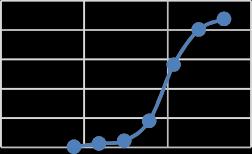

chart-1:Particlesizedistributioncurve
3.2 Chopped carbon fiber (CCF)
Carbon fiber, renowned for its exceptional mechanical properties such as high tensile strength, stiffness, and resistance to corrosion and fatigue, is a lightweight material widely utilized across diverse industries. Its applicationsspan from aerospace and sports equipment to automotive and rotor blade manufacturing. Properties areshownintable-2andfigureisshowninchart-2
Table–2:PropertiesofCCF
International Research Journal of Engineering and Technology (IRJET) e-ISSN:2395-0056
Volume: 11 Issue: 05 | May 2024 www.irjet.net p-ISSN:2395-0072
Mild steel is the material used as welded wire mesh. Totally 4 welded wire meshes are used. The vertical distance between each layer is kept constant as 0.25B and the top distance from the top layer of the sand to top layer ofwelded wire mesh is varied by (U/B) ratio as 0.25, 0.5,0.75,1. Properties of welded wire mesh are shown in the diagram. Properties are shown in table 3 figure shown inchart3.
Table–3:PropertiesofWWM
Material
3.4 Experimental Set Up
Basicallyweallknowplateloadisusedtofindbearing capacity and settlement. Here we have 50cm x 50cm tank and plate of thickness 10cmx10cm and figure is showninchart4.
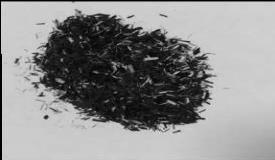
chart – 2 :chopped carbon fiber, Source - Construction andbuildingmaterials , DOI:https://doi.org/10.1016/j.conbuildmat.2018.08.18 1,CCFistakenfrompoojaelastomersfromexperimental analysis.
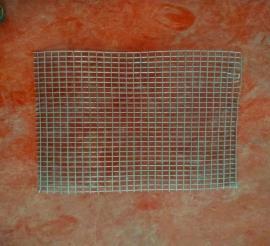
chart – 3: Welded wire mesh, (material collected from KSM tube and steel, Thiruvananthapuram for the analysis)
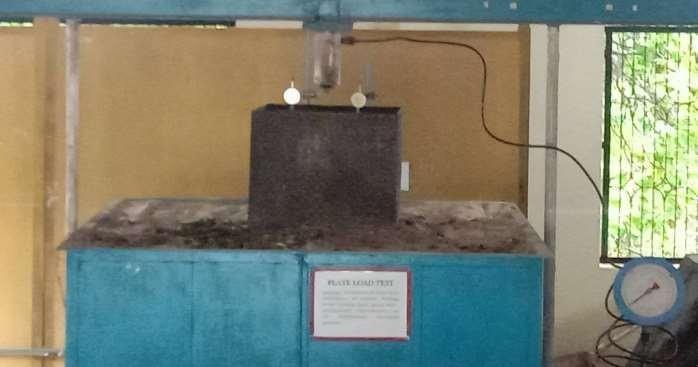
chart–4:Plateloadsetup
4.1EXPERIMENTAL RESULTS AND DISCUSSION
4.1.1 Dry density of CCF content
Drydensityanalysisisinitiallydonewithvaryingcontent of CCF from 0.5 to3%.maximum dry density was observed at 2% of CCF at 1.39g/cc. chart- 5 shows dry densityvariation.
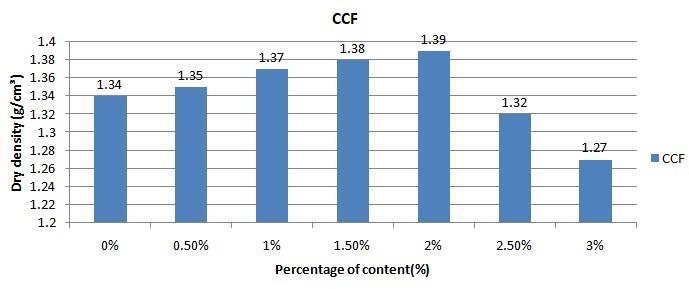
chart–5:drydensityvariation
4.1.2 shear strength
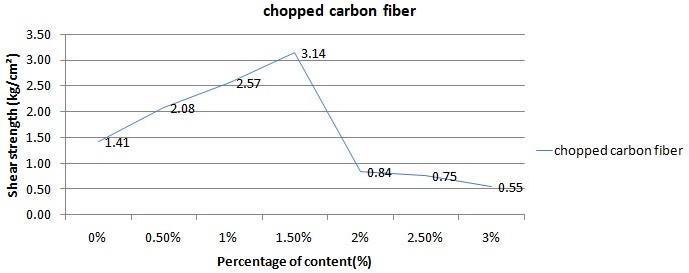
chart–6:ShearstrengthvariationofdifferentCCF
International Research Journal of Engineering and Technology (IRJET) e-ISSN:2395-0056
Volume: 11 Issue: 05 | May 2024 www.irjet.net p-ISSN:2395-0072
4.1.3 Unreinforced case
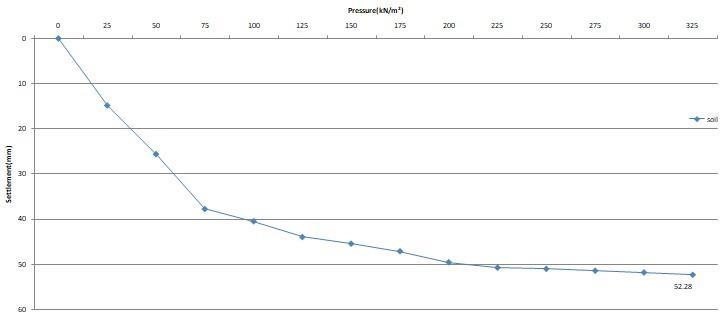
chart – 7: pressure vs settlement graph of unreinforced case
Initiallybearingcapacityofunreinforcedsandisanalysed. It indicates a bearing capacity of 325kN/m². It has a settlement of 52.29mm. chart - 7 Shows Pressure Vs SettlementOfUnreinforcedCase.
4.1.4 Soil + WWM
Soilis placedwithwelded wiremeshis placedalong with it.Then (U/B) ratio is varied by0.25, 0.5, 0.75, 1.Then the results are compared. The analysis indicates that CCF mixed on soil with WWM at (U/B) ratio of 0.5 gives maximum bearing capacity and lesser settlement comparedtoother(U/M)ratio.Chart8showspressurevs settlementcurveforsoilwithWWM.
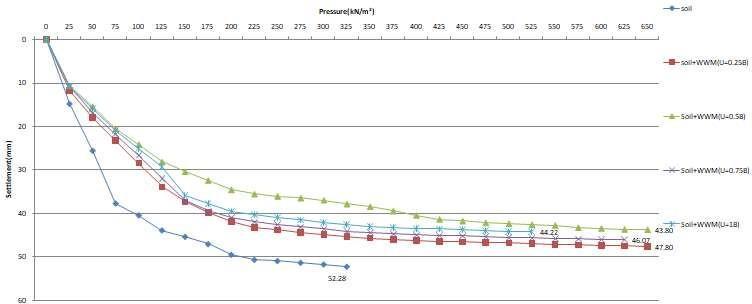
Chart-8showsresultofsoilwithWWM.
4.1.5 Soil + CCF + WWM
Soil is mixed with CCF and welded wire mesh is placed alongwithit.Then(U/B)ratioisvariedby0.25, 0.5,0.75, 1.Thenthe results are compared. The analysis indicates that CCF mixed on soil with WWM at (U/B) ratio of 0.25 gives maximum bearing capacity and lesser settlement compared to other (U/M) ratio. Chart - 9 shows soil with CCFandWWM.
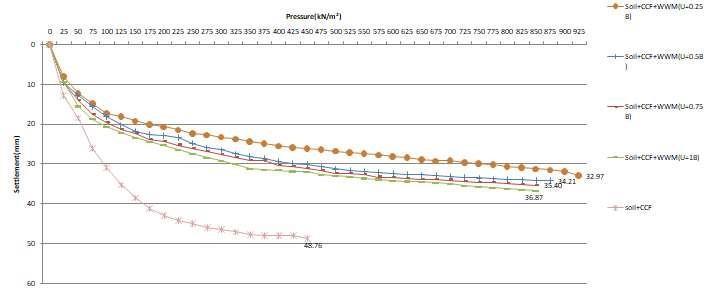
chart – 9: pressure vs settlement curve of soil+ CCF + WWM
Basically carbon fiber has fatigue resistance. So it can takemoreloading.Excessiveoffibercontentwillleadsto fiberclustering.
From the overall analysis, soil +CCF +WWM with (U/B) ratio at 0.25 gives maximum bearing capacity and lesser settlement.
[1] DongB.,TangW.,BaoX.,JinZ.,CuiH.(2018),“Effectof carbon fiber and nano silica on shear properties of siltysoilandthemechanisms”,Construction and building materials, DOI:https://doi.org/10.1016/j.conbuildmat.2018.08.18 1
[2] Akbar A., Bhat J.A., Mir B.A.(2021), “Plate load tests for investigation of the load settlement behavior of shallow foundation on bitumen coated geogrid reinforced soil bed ”, Innovative infrastructure solutions , DOI: https://doi.org/10.1007/s41062020-003976R.Nicole,“Titleofpaperwithonlyfirstwordcapitalized,” J.NameStand.Abbrev.,inpress.
[3] ConsoliN.C.,CasagrandeM.D.T.,PriettoP.D.M.,Thome A.(2003), “Pate load test on fiber reinforced soil ”, Journal of geotechnical andgeoenvironmental engineering ,DOI: https://doi.org/10.1061/(ASCE)10900241(2003)129:10(951)
[4] Bao X., Huang Y.,Jin Z., Xiao X., Tang W., Cui H., Chen X.(2021),“Experimentalinvestigationonmechanical properties of clay soil reinforced with carbon fiber ”,
International Research Journal of Engineering and Technology (IRJET) e-ISSN:2395-0056
Volume: 11 Issue: 05 | May 2024 www.irjet.net p-ISSN:2395-0072
Construction and building materials,DOI:https://doi.org/10.1061/j.conbuildmat.2 021.122517
[5] Mehrjardi G.T., Khazaei M. (2017), “Scale effect on the behavior of geogrid reinforced soil under repeated loads”, Geotextiles and geomembranes, DOI: https://doi.org/10.1016/j.geotexmem.2017.08.02
[6] Khalaj O.,TafreshiS.N.M,Mask B., Dawson A. (2015), “Improvement of pavement foundation response with multi-layersofgeocellreinforcement:Cyclicplateload test”, Geomechanics and engineering , DOI: http://dx.doi.org/10.12989/gae.2015.9.3.373.