
International Research Journal of Engineering and Technology (IRJET) e-ISSN: 2395-0056
Volume: 11 Issue: 05 | May 2024 www.irjet.net p-ISSN: 2395-0072
International Research Journal of Engineering and Technology (IRJET) e-ISSN: 2395-0056
Volume: 11 Issue: 05 | May 2024 www.irjet.net p-ISSN: 2395-0072
Likhitha M1 , L Govindaraju2
1Post graduate student, Dept. of civil engineering, UVCE Bangalore University, Bengaluru
2Professor, Dept. of Civil Engineering, UVCE Bangalore University, Bengaluru
Abstract - This study presents a comprehensive numerical investigation into the settlement behavior of multi-storey buildings with basements situated above unlined rectangular tunnels within stratified soil. The analysis encompasses configurations with 3 bay building directly positioned a top the tunnel as well as those with an offset varying from 5m to 20m at 5m intervals. Employing the finite element software PLAXIS-2D, both static and dynamic analyses are conducted, with the dynamic analysis incorporating the time history of the 2001 Bhuj earthquake. The results indicate that the settlement behavior of the buildings can be successfully analyzed using the finite element method. This study provides valuable insights into the settlement behavior of buildings above unlined tunnels and offers implications for design and analysis considerations in similar geotechnical contexts. The findings suggest that the presence of an unlined tunnel can significantly impact the settlement behavior of buildings
Key Words: Stratified Soil, Unlined tunnel, Time history analysis, Finite element analysis (FEM), PLAXIS-2D
In the Metropolitan cities due to lack of land for the infrastructure improvement/ development like the roadways,railways,sewerlines,communicationcablesetc., are going underground. If the buildings or any other structuresbuiltabovetheseundergroundstructurewillhave impactonthestabilityofthestructures.Foundationplaysa very impotent role in carrying the load from the super structuretosubstructure.Thesubstructureisnothingbut theunderlyingsoil.Theloadreceivedfromthefoundationis distributedtowideareabelowthefoundation.Thesoilisan elastic medium which is good at taking the compression load.ThebelowsoilmayfailduetotwoCriteria’seitherit may fails due to excessive settlement or bearing capacity failure. The existence of underlying voids has a negative impactontheultimatebearingcapacityandthesettlement behaviourofshallowfoundations.
In the present study, a multi-storey building resting above a rectangularunlined tunnel ina stratifiedsoil was analyzed using a finite element-based numerical analysis geotechnical software, PLAXIS 2D, with the primary objectivesofinvestigatingthesettlementbehaviorofa3-bay building under static loading, analyzing its settlement behavior under dynamic loading using the 2001 Bhuj
earthquake data. Assessing the settlement impact of the building'soffsetrangingfrom0to20metersfromthetunnel centerline,anddeterminingtheaccelerationatthetopand bottomofthebuildingresultingfromthedynamicloads.
PLAXISisafiniteelementpackagethathasbeendeveloped specificallyfortheanalysisofdeformation,stabilityandflow in geotechnical engineering projects. The program is designed to simulate the behavior of soil, rock, and other geomaterialsundervariousloadingconditions,makingitan indispensabletoolforengineersandresearchersworkingin thefieldofgeotechnicalengineering.AtthecoreofPLAXIS 2Disitsabilitytomodelthecomplex,non-linearbehaviorof geomaterials.Thesoftwareincorporatesa comprehensive library of advanced soil and rock constitutive models, includingtheMohr-Coulomb,HardeningSoil,andSoftSoil models, among others. These constitutive models enable userstoaccuratelyrepresentthestress-strainrelationships, consolidation, and other fundamental properties of the materials being analyzed, ensuring the reliability and accuracyofthesimulationresults.
Themodel comprisesfourlayersofsoil,extendingfrom0 meterstoadepthof100.1meters.Atadepthof60.8meters, there is a rectangular unlined tunnel measuring 13.65 metersinwidthand12.27metersindepth.Thebuilding's height ranges from 15 to 30 meters for 2-bay building configuration. The basement height varies, with floor tofloorheightsof2metersand3metersrespectively.Eachbay hasawidthof5metersasrepresentedinthefigure(1).
Thesoilcomprisesfourdistinctlayers,eachwithspecified propertiesasoutlinedinTable-1.Forthebuildingmaterials, plate elements are utilized for the basement and the remainder of the structure, with properties detailed in Table-2. Additionally, columns within the building are represented to separate bays node to node, with their propertiesspecifiedinTable-3
International Research Journal of Engineering and Technology (IRJET) e-ISSN: 2395-0056
Volume: 11 Issue: 05 | May 2024 www.irjet.net
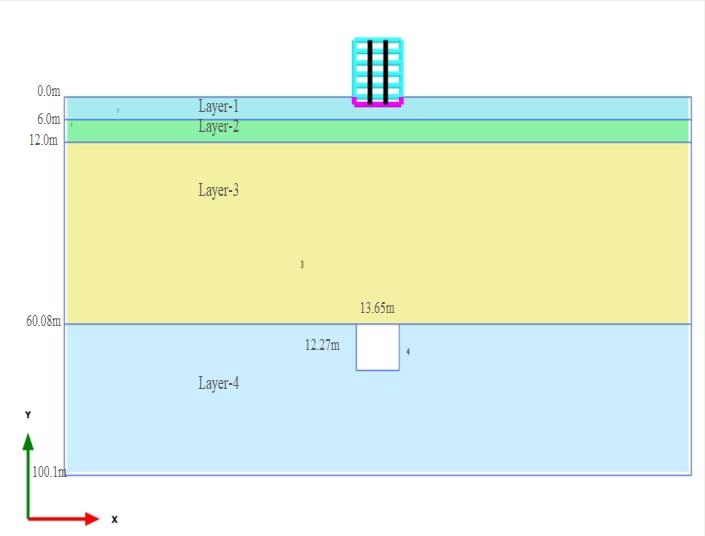
Fig-1: Soilprofile
Table -1: Soilproperties
e
φ'
ν
Table -2: Nodetonodeanchorparametersusedinthe model.
Table -3: Plateparametersusedinthemodel
(nu)
The3baybuildingisanalyzedforvariouscasesbyvarying thefollowingparameters.
1. Height of the building: 15m to 30m [Basement(B)+ground floor (GF)+4 Floors to Basement(B)+groundfloor(GF)+9Floors].
2. Offsetfromthetunnelcenterline:0mto20mwith5m interval.
Plaxis2Dversion23isusedforthesimulationofthe3bay buildingrestingabovetherectangularunlinedtunnel.The building was analysed for both the static and dynamic condition. Numerical modelling is carried out taking the plane strain state of stresses. The 15-node triangular element with finer mesh density is used for the finite elementdiscretization.Thein-situsoilissimulatedasMohrcoulomb(MC)materialforthestaticanddynamicanalysis. For dynamic analysis, strong motion record of Bhuj earthquakerespectivelyisused.Theplateelementisused for the basement and rest of the building. Nodes to node anchorsareusedtosimulatethecolumns,whichbifurcates the building into 3 bay. The analysis is carried out in the sequenceindicatedbelow.
1. Startinganewproject.
2. Creating soil stratigraphy and tunnel using the geometrylinefeatureandtunnelfeaturerespectively, asshownbelow.
3. Definingstandardearthquakeboundaries.
4. Createthebuildingusingtheplatefeature,asshown below.
5. Creatingandassigningofmaterialdatasetsforsoilfor eachlayer(MCmodel).
6. CreatingandassigningofmaterialdatasetsforPlates.
7. Creating and assigning of material data sets for anchors. Prescribe the displacement using Bhuj earthquakedata(occurredonJanuary26,2001,inthe Gujarat region of India, with a magnitude of 7.7 and peakaccelerationis9.8m/s²)ReferFigure(2).
International Research Journal of Engineering and Technology (IRJET) e-ISSN: 2395-0056
Volume: 11 Issue: 05 | May 2024 www.irjet.net p-ISSN: 2395-0072
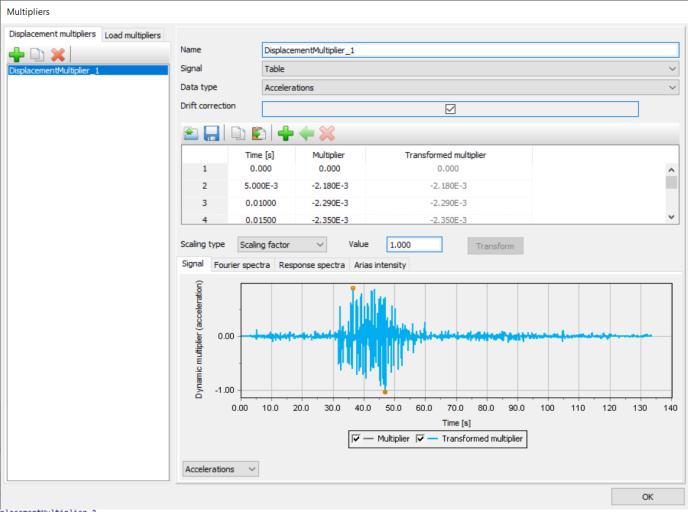
generatedinPlaxis-2D.
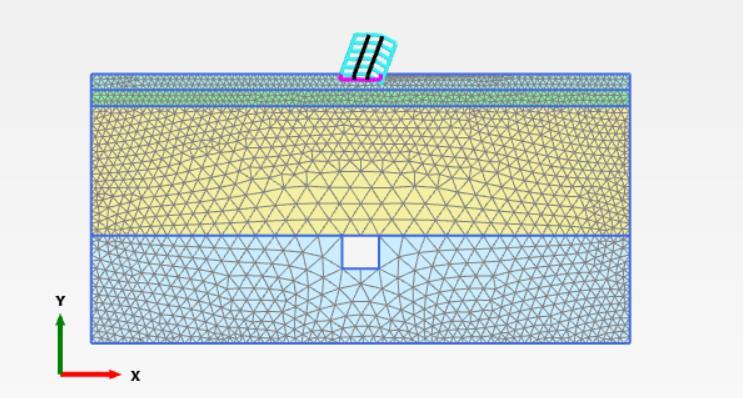
8. Finemeshgenerationforthemodel.
9. Thecalculationconsistsoffourphases;thefirstphaseis theinitialphaseconsistsofsoilmodel.Thesecondphase is tunnel phase, in this phase the tunnel is activated Third phase is activation of building and the fourth phaseisactivationofdynamiccomponent
2.2 Output
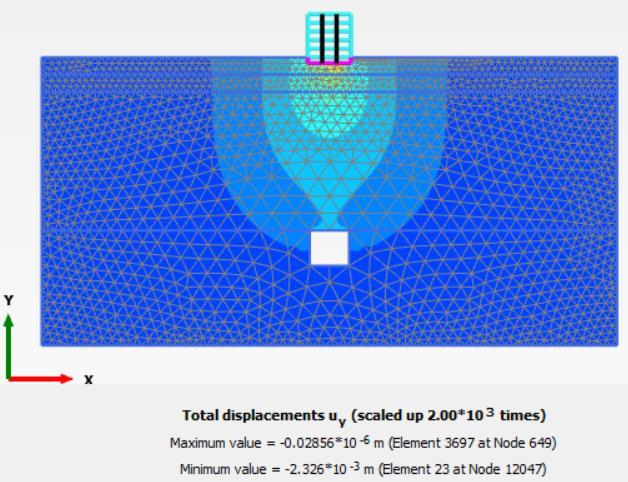
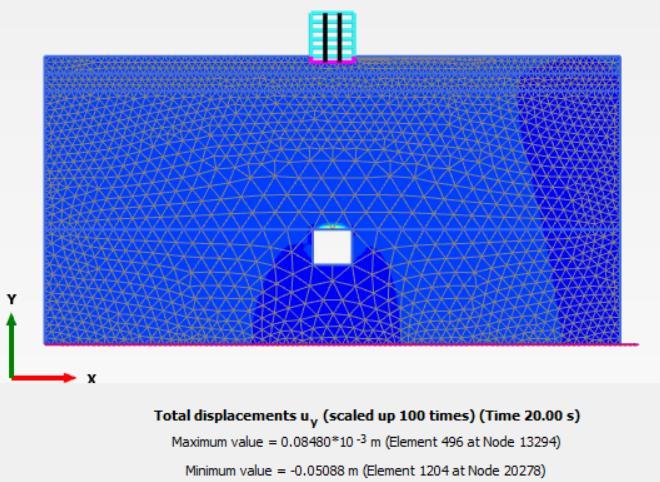
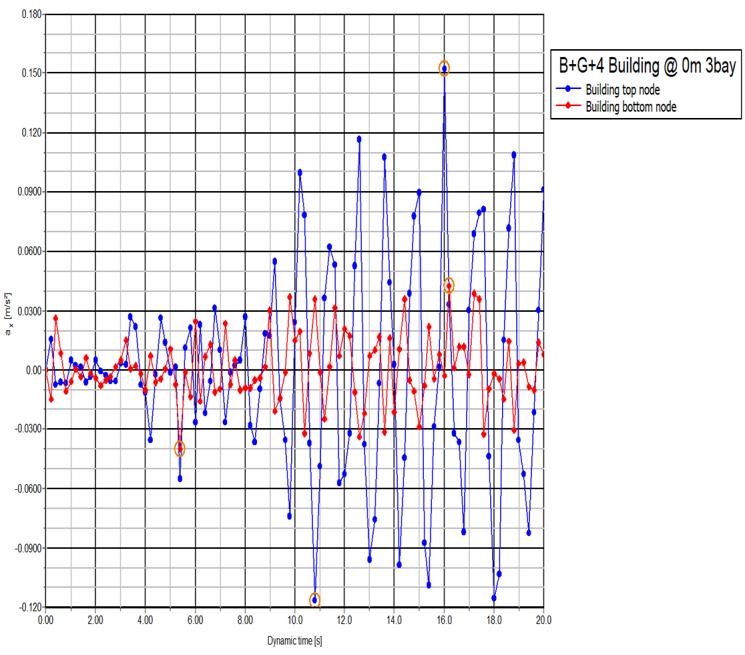
Figure[3]showsthedeformedmesh,themagnifiedimageof how the soil body deforms after the analysis. Figure [4] showsthetotaldisplacementofthe3baybuildinginstatic loadingcondition.Figure5showsthetotaldisplacementof the 3 bay building in dynamic loading condition. Figure 6 showstheAcceleration(ax)vsDynamictimegraph.
2.3 Result and discussion
Inthepresentstudythemulti-storeybuildingrestingabove therectangularunlinedtunnelinastratifiedsoilisanalyzed using numerical analysis with PLAXIS 2D, a geotechnical softwarebasedonfiniteelementmethods.Thesoilprofileis accuratelymodeled,andpropertiesareassignedtoboththe
International Research Journal of Engineering and Technology (IRJET) e-ISSN: 2395-0056
Volume: 11 Issue: 05 | May 2024 www.irjet.net p-ISSN: 2395-0072
soilandotherstructuralelements.Eachbayofthebuilding, whetherina 3-bayconfiguration,measures5meters.The basementhasadepthof2meters,whilethefloor-to-floor heightis3meters.Variousscenariosareexploredbyaltering the building'slocation.All casesare examinedunder both staticanddynamicconditions.Understaticconditions,the total vertical displacement of the building is measured. In dynamic conditions, time history is defined within the program,andforcesresultingfromdynamicaccelerationare calculated.
The following are the results drawn from the numerical analysis.
Table 4: Settlementof3-BayBuildingdirectlyresting abovethetunnel.
3-Bay Building directly resting above the tunnel
Levels
30m, respectively. These values fall well within the limits specifiedbyIS1904(1986).Indynamicloadingconditions, the total vertical displacement varies from 50.88mm to 23.69mm for buildings with heights of 15m to 30m, respectively. The maximum acceleration at the top of the building is recorded for the configuration B+G+7, with a valueof0.164m/sec².Similarly,themaximumacceleration at the bottom of the building is observed for the configurationB+G+7,measuring0.078m/sec².Theanalysis concludes that the total vertical displacement is higher under dynamic loading conditions compared to static loading conditions. Additionally, it is noted that the accelerationatthetopofthebuildingsurpassesthatatthe bottomofthestructure.
Table 5: Settlementof3-BayBuildingresting5mfromthe tunnelcenterline.
3-Bay Building resting 5m away from the tunnel centerline.
Levels Settlemen tinStatic Loading (mm) Settlemen tin dynamic loading (mm) Accelerati onatthe bottomof the building (m/sec2) Accelerat ionatthe topofthe building (m/sec2)
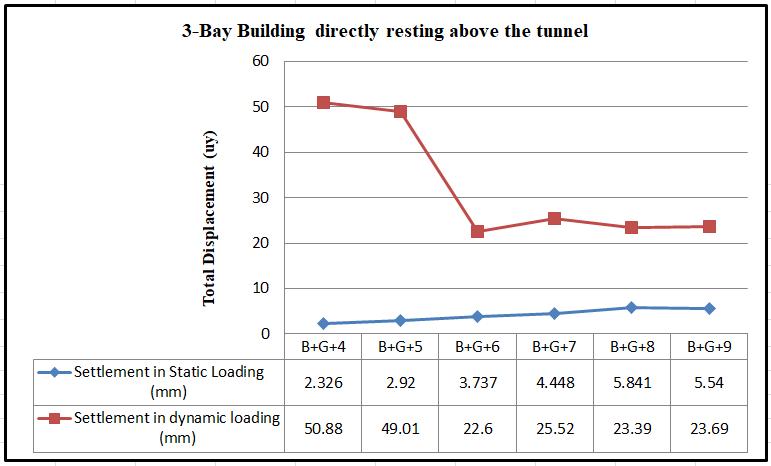
Chart-1: BuildingHeightvsMaximumHorizontal displacementof3-BayBuildingdirectlyrestingabovethe tunnel.
Fromtheanalysisresults,itisnotedthatthetotalvertical displacement under static loading conditions ranges from 2.326mmto5.540mmforbuildingswithheightsof15mto
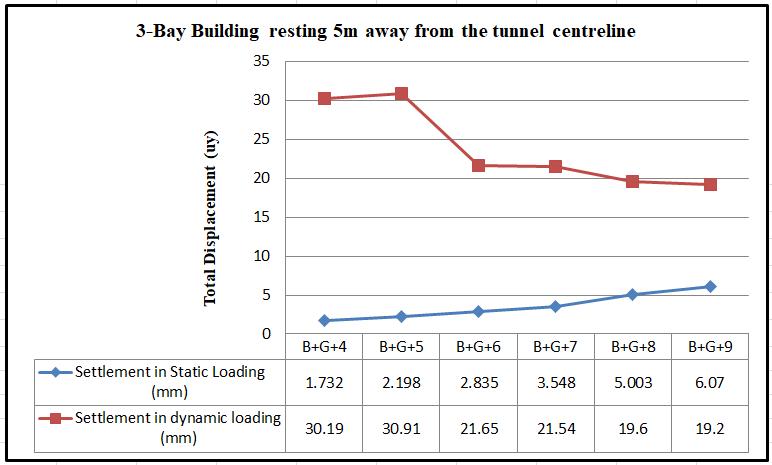
Chart-2: BuildingHeightvsMaximumHorizontal displacementof3-BayBuildingresting5mfromthetunnel centerline
International Research Journal of Engineering and Technology (IRJET) e-ISSN: 2395-0056
Volume: 11 Issue: 05 | May 2024 www.irjet.net p-ISSN: 2395-0072
Table 6: Settlementof3-BayBuildingresting10mfrom thetunnelcenterline.
3-Bay Building resting 10m away from the tunnel centerline.
Levels Settlement inStatic Loading (mm) Settlement in dynamic loading (mm) Acceleration atthe bottomof thebuilding (m/sec2)
atthetopof thebuilding (m/sec2)
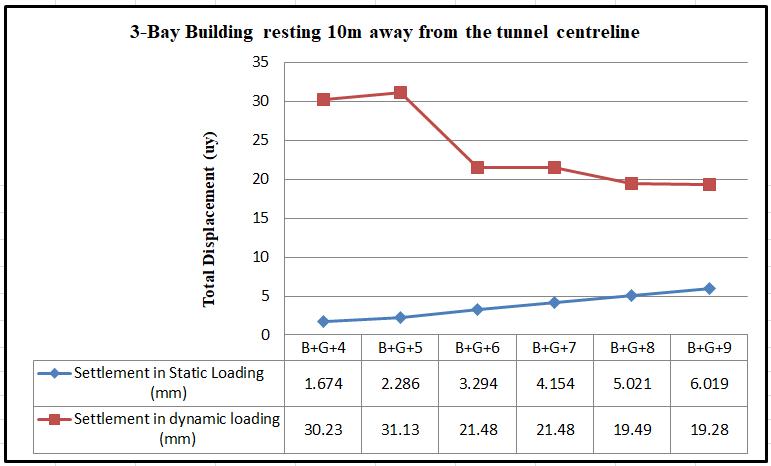
Chart-3: BuildingHeightvsMaximumHorizontal displacementof3-BayBuildingresting10mfromthe tunnelcenterline
Table 7: Settlementof3-BayBuildingresting15mfrom thetunnelcenterline.
3-Bay Building resting 15m away from the tunnel centerline.
Levels Settlemen tinStatic Loading (mm) Settlemen tin dynamic loading (mm)
Accelerati onatthe bottomof the building (m/sec2)
Acceleratio natthetop ofthe building (m/sec2) B+G+4
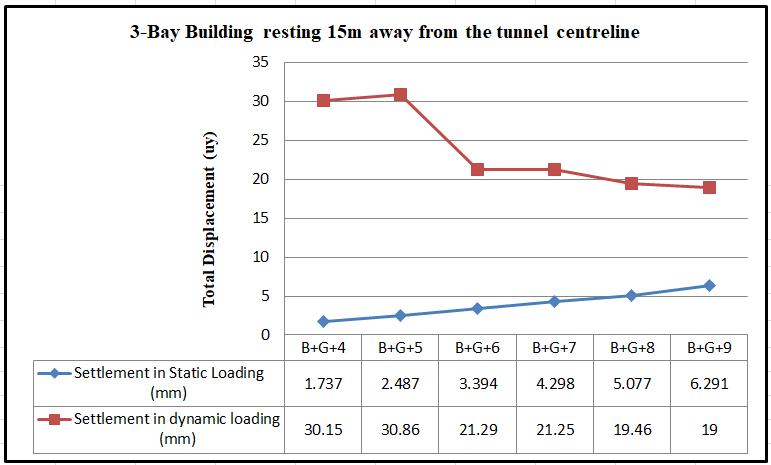
Chart-4: BuildingHeightvsMaximumHorizontal displacementof3-BayBuildingresting15mfromthe tunnelcenterline
Table 8: Settlementof3-BayBuildingresting20mfrom thetunnelcenterline.
3-Bay Building resting 20m away from the tunnel centerline.
Levels Settleme ntin Static Loading (mm) Settlemen tin dynamic loading (mm)
Acceleratio natthe bottomof thebuilding (m/sec2)
Acceleratio natthetop ofthe building (m/sec2)
0.173
B+G+6 3.488 18.52 0.056 0.107
B+G+7 4.392 18.56 0.053 0.099 B+G+8
International Research Journal of Engineering and Technology (IRJET) e-ISSN: 2395-0056
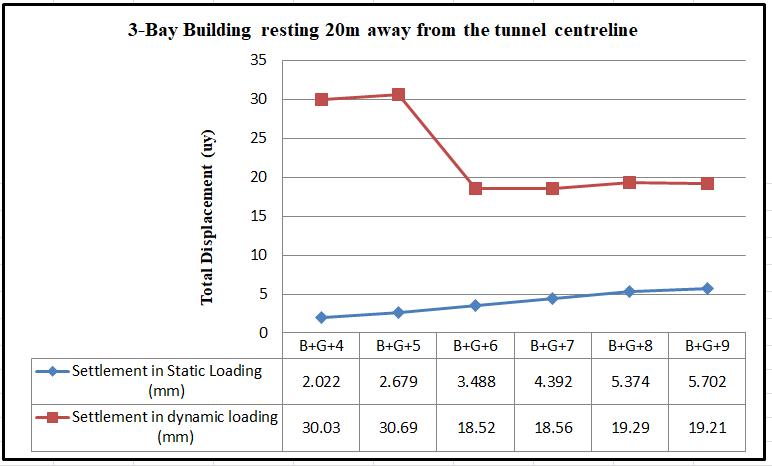
Chart-5: BuildingHeightvsMaximumHorizontal displacementof3-BayBuildingresting20mfromthe tunnelcenterline.
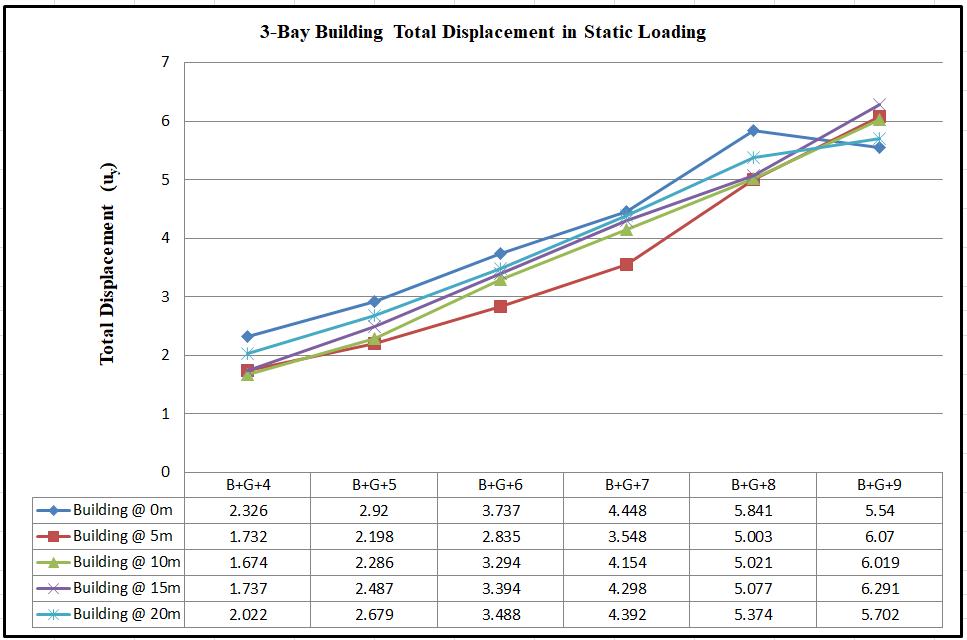
Chart-6: Buildingoffsetdistancefromtunnelcenterlinevs MaximumHorizontaldisplacementof3-BayBuildingin staticloading.
The 3-Bay Building Total Displacement in Static Loading chart (6), several insights can be gleaned. The total displacement of the building is depicted across various configurationsandbuildingheights.Theresultsillustratea clear pattern of increasing total displacement with the building's height, indicating a direct relationship between thetwofactors.Asthebuildingheightprogressesfrom1.674 to6.291fordifferentconfigurations,thetotaldisplacement alsoescalatesaccordingly.Moreover,specificconfigurations, suchasB+G+9,exhibitnotablyhighertotal displacements compared to others, emphasizing the influence of both
Volume: 11 Issue: 05 | May 2024 www.irjet.net p-ISSN: 2395-0072 © 2024, IRJET | Impact Factor value: 8.226 | ISO 9001:2008 Certified Journal | Page2331
building configuration and height on the overall displacementunderstaticloadingconditions.
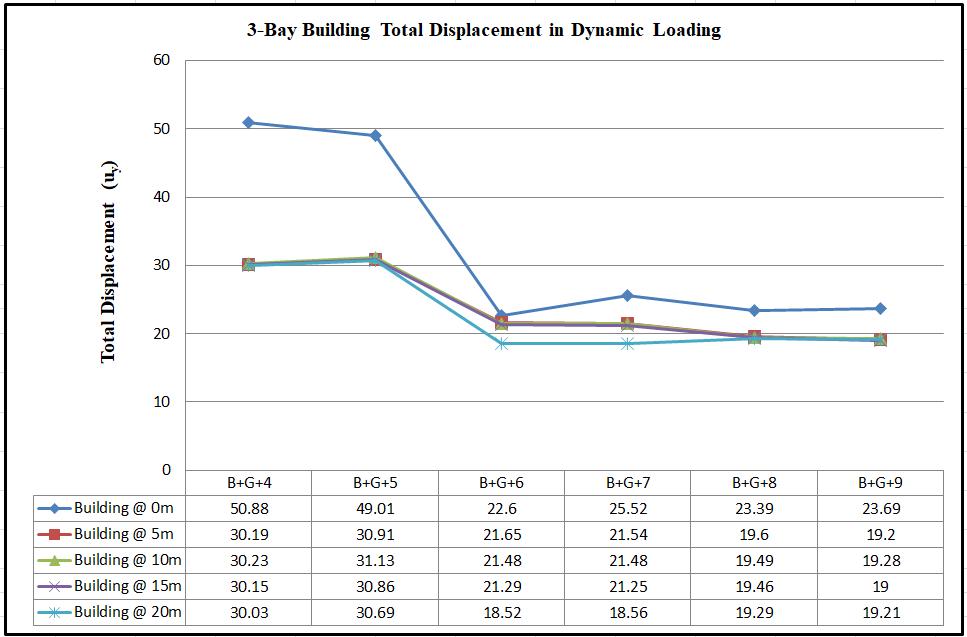
Chart-7: Buildingoffsetdistancefromtunnelcenterlinevs MaximumHorizontaldisplacementof3-BayBuildingin dynamicloading.
The3-BayBuildingTotalDisplacementinDynamicLoading chart (7), several observations can be made. The total displacement of the building under dynamic loading conditions is depicted across different configurations and building heights. The results show varying levels of total displacement, with fluctuations observed for different building locations and configurations. Notably, the total displacementvaluesdifferfromthoseunderstaticloading conditions,indicatingtheimpactofdynamicforcesonthe building's structural behavior. This suggests that the total displacement under dynamic loading conditions is influenced by factors such as building height and configuration, with certain configurations showing higher totaldisplacementsthanothers.
Basedonthedetailedparametricanalysisofperformanceof multi-storeybuildingrestingabovetherectangularunlined tunnel in stratified soil, the following conclusions can be drawn.
1. In static loading analysis of the 3bay building, as the heightofthebuildingincreasesfrom15mto30m,the settlementalsoincreasessignificantly.Thisisbecause theweightofthebuildingcausesmoresettlementonthe foundation as the height increases, leading to higher settlements.
International Research Journal of Engineering and Technology (IRJET) e-ISSN: 2395-0056
Volume: 11 Issue: 05 | May 2024 www.irjet.net p-ISSN: 2395-0072
2. Indynamicloadinganalysis,astheheightofthebuilding increasesfrom15mto30m,thesettlementisdecreasing in both 3 bay building. This phenomenon can be attributedtothedampingeffectsanddynamicresponse of the building structure, which may counteract the settlementincreaseobservedinstaticanalysis.
3. Theinvestigationintotheimpactofbuildingoffsetfrom the tunnel on settlement behaviour under both static anddynamicloadingconditionsrevealsthattheoffsetof the building does not exert a significant influence on settlement.
4. Thedifferenceinaccelerationbetweenthebottomand topofthebuildingcanbeexplainedbyvariousfactors such as structural stiffness, foundation and soil conditions,anddynamicloads.Theloweraccelerationat thebottomindicatesthatthefoundationabsorbssome ofthedynamicforcesbeforetheyreachthetopofthe building,resultinginahigheraccelerationatthetop.
5. Underdynamicloadingconditions,itisobservedthat; there is a distinct and abrupt decrease in settlement observedinthecaseof6-storybuildings(comprisingof a basement, ground floor, and 6 additional stories) acrossallcasesstudied.
1. Amit Srivastava, Chaitanya R. Goyal & Abhishek Raghuvanshi (2013) “Load Settlement Response of Footing Placed over Buried Flexible Pipe through a Model Plate Load Test”. International Journal of Geomechanics,Vol.13,477-481.©ASCE.
2. AzamG,HsiehW,andWangMC(1991)“Performanceof stripfootingonstratifiedsoildepositwithvoid”.Journal Of Geotechnical Engineering. Vol.117, No. 5, ©ASCE, PaperNo.25805.
3. Aniruddha Sengupta, Raj Banerjee and Srijit Bandyopadhyay(2018)“EstimationofSettlementand VibrationontheSurfaceDuetotheConstructionofEastWest Metro Tunnels in Kolkata, India” Engineering Challenges for Sustainable Underground Use, Sustainable Civil Infrastructures, DOI 10.1007/978-3319-61636-0_7
4. BadieAandWangC(1984)“Stabilityofspreadfooting abovevoidinclay”.JournalofGeotechnicalEngineering. Vol.110,©ASCE,PaperNo.19260.
5. BausRLandWangMC(1983) “Bearingcapacity of strip footing above void” Journal of Geotechnical Engineering. Vol.109, ©ASCE, ISSN 07339410/83/0001-0001/$01.00.Proc.No.17603.
6. Daniel W. Wilson Andrew J. Abbo, Scott W. Sloan & Andrei V. Lyamin (2014) “Undrained stability of dual square tunnels”. Journal of Acta Geotechnica. Vol.10 ©springer.
7. Haizuo Zhou, Gang Zheng, Xiaopei He, Xiaomin Xu, TianqiZhang&XinyuYang(2018)“Bearingcapacityof stripfootingsonc–ɸsoilswithsquarevoids”.Journalof ActaGeotechnica. Vol.13:747–755©Springer.
8. HamidAlielahi,MohammadAdampira(2016)“Effectof twin-paralleltunnelsonseismicgroundresponsedueto verticallyin-planewaves”.InternationalJournalofRock Mechanics & Mining Sciences. Vol. 85:67-83. https://doi.org/10.1080/16874048.2021.1907962
9. Heba Kamal, Manar Hussein and Adel Akl( 2021) “Parametricstudyoftwintunnelunderseismicloadsfor CairoMetro LineNo. 4”. HRBCJournal. Vol. 17:137156.https://doi.org/10.1080/16874048.2021.1907962
10. HiteshMBangad(2020) “settlement analysis of machine foundation by using plaxis 2D” International ResearchJournalofEngineeringandTechnology(IRJET) Vol07.
11. M.JaoandM.C.Wang(1998)“StabilityofStripFootings aboveConcrete-LinedSoftGroundTunnels”Tunnelling andUndergroundSpaceTechnology,Vol.13,No.4.pp. 427-434.
12. Joon Kyu Lee, Sangseom Jeong , Junyoung Ko (2015) “Effect of load inclination on the undrained bearing capacity of surface spread footings above voids” Computers and Geotechnics. Vol 66 www.elsevier.com/locate/compgeo
13. MakotoKiyosumi,OsamuKusakabeMasatoshiOhuchi andFangLePeng(2007)“YieldingPressureofSpread FootingaboveMultipleVoids”.JournalOfGeotechnical And Geoenvironmental Engineering Vol.133: 15221531.©ASCE.
14. Makotokiyosumi,OsamuKusakabe,&MasatoshiOhuchi (2011)“Modeltestsandanalysesofbearingcapacityof strip footing on stiff ground with voids”. Journal Of Geotechnical And Geoenvironmental Engineering. Vol.137:363-375.©ASCE.
15. Monica Malhotra, Amit Srivastava, and Sajjaf Jawaid (2019)“Reliabilityanalysisofshallowfoundationinthe vicinity of the existing buried conduit”. International Journal of Geomechanics and Geoengineering. Vol.15, No.2, 149-158. https://doi.org/10.1080/17486025.2019.1632497
16. QiushiLiua,ZhiqingLiub,YiguoXuea,c,GuandaZhanga, XinLid,BinghuaZhoua,HuiminGongaandZhiqiangLia
International Research Journal of Engineering and Technology (IRJET) e-ISSN: 2395-0056
Volume: 11 Issue: 05 | May 2024 www.irjet.net p-ISSN: 2395-0072
(2023)“Deformationfeaturesandfailuremechanismof subsea shield tunnels with different burial depths crossing fault-zone” Marine georesources & geotechnology https://doi.org/10.1080/1064119X.2023.2214132
17. YapengNiua,YongliXiea,HongguangZhanga,Xiabing Yuea,YingguangHanaandZhinanHu(2022)“Studyon bearingcharacteristicsofmarinesubsoilforsemi-rigid immersed tunnel” Marine georesources & geotechnology. VOL. 40, NO. 10, 1171–1183 https://doi.org/10.1080/1064119X.2021.1974621
© 2024, IRJET | Impact Factor value: 8.226 | ISO 9001:2008