

p-ISSN:2395-0072

p-ISSN:2395-0072
Karthika Satheesh G1 , Magi N S
2
1M. Tech Student, Department of Civil Engineering, Marian Engineering College, Trivandrum, India
2Assistant Professor, Department of Civil Engineering, Marian Engineering College, Trivandrum, India
Abstract - The growing prevalence of problematic soils presents significant challenges in construction. Geosyntheticsplayapivotalroleinimprovingsoilproperties, particularly in enhancing the bearing capacity of structures built on sandy terrain. This research looks into the bearing characteristics of sand when reinforced with Geogrid tubes filled with Coconut Shell Chips (CSC). Experimental analyses were conducted to evaluate the enhancement in bearing capacity achieved by sand installed with Coir Geogrid Tubes (CGT)filledwithCoconutShellChips(CSC).Laboratoryplate load tests were carried out to study bearing capacity behavior and settlement reduction in the soil. The study investigates how varying the vertical distance between the surface and the first layer of geosynthetic of geogrid tubes, impacts sand behavior through experimentation. It examines the bearing capacity effect of CSC-filled CGT with diameter2cmatdifferentu/Bratiosof0.5,0.75and1,where B is the footing width. The potential of using coir geogrid in reinforcement form is studied.
Key Words: Bearing capacity, Plate load test, Coir, Geogridtubes,Coconutshellchips.
Civilengineersfacedauntingtaskswhenconstructingover weak soils, as these soils are prone to problems like differential settlements, low shear strengths, and high compressibility. Coir, a 100% organic fiber derived naturally from coconut husks, is a renewable resource sourcedfromthecoconuttree.Whenemployedingridsor mats, various factors such as the grid's aperture size, the thickness and shape of rib cross-sections, as well as the strength of knots, become significant. Numerous studies have explored the modification and enhancement of soil reinforcement properties and their shapes. The form of reinforcement plays a crucial role in design, as the same quantity of reinforcement can yield different beneficial effects. Geosynthetics can be transformed into tubular elements for reinforcement purposes. Crushed coconut shells are well-suited as soil stabilizers due to their durability, high toughness, and abrasion resistance. This suitabilityarisesfromthecoconutshell'sexcellentweather

resistance, making it suitable for construction materials. However,itlackseconomicvalue,anditsdisposalprocess iscostly,leadingtopotentialenvironmentalproblems. Shear strength characteristics of coir mat in sand wasstudiedbySridharetal.[6]in2014.Directsheartests weredoneoncoirmatreinforcedsand.Sizeopeningofcoir matwasvariedanditwasfoundthat,themaximumvalue ofangleofinternalfrictionwasobservedcorrespondingto smaller size of opening. The study also showed that, with increase in size of opening, value of angle of internal friction decreased due to reduction in interlocking effect. Lal et al. [4] in 2017 conducted a study to determine the effectofreinforcementformonbehaviorofcoirgeotextile reinforcedsand.Coir inthe form ofgeotextileandgeocell wasusedandplateloadtests[2]wereconducted.Results showed that the use of coir in geocell form enhanced the performance of sand more. For the same amount of reinforcementused,coirgeocelloffershigherperformance characteristicscomparedto planarforms.Al-Subariet al. [1]in2020performedastudytounderstandtheeffectof reinforcementofdifferentmaterialonthebearingcapacity of sand. It was observed that inclusion of coir showed higherbearingcapacityanditalsoimprovedfrictionangle by2˚comparedtosteelandpolypropylenereinforcement.
In a series of CBR tests, Jelani et al. [3] (2023) looked in the effect of varying percentage of crushed coconutshellinsiltysand.Accordingtothestudy,thesoil sample with 10% of crushed coconut shell recorded considerable increase in CBR of 2.3 times compared to unreinforced sample. Comparison study between the bearingcapacitiesofstripfootingonsoilslopereinforced byplanarandtubularformofbraidandgeogridelements wasconductedbySatvatietal.[5]intheyear2016.From the study, it was observed that the increase in bearing capacityratio(BCR)ofsoilslopewithbraidreinforcement fromplanartotubularwas39%andtheBCRincreasefor reinforcement with geogrid from planar to tubular was 53%.
The present research focuseson the behaviorofsoil with and without reinforcement. Coir geogrid was fabricated into tubes, Coir Geogrid Tubes (CGT) and Coconut Shell Chips (CSC) was used as the infill material. Effect of CSC infilledCGTbyvaryingu/Bratiosonthebearingcapacity ofsandisstudiedinthispaper.

2.1. Soil
Thesoilusedinthisstudywasexcavated1.5mbelowthe ground level. The soil was collected from Menamkulam, Trivandrum.Thepropertiesofthesoilaresummarizedin Table 1. The values of coefficient of curvature and uniformitycoefficientwereobtainedfromtheparticlesize distribution curve (Fig.1). After testing the soil, it was found that the collected sample was Poorly Graded Sand (SP)accordingtoISSpecifications.
Table – 1: Propertiesofsoil

cm2) 0.19
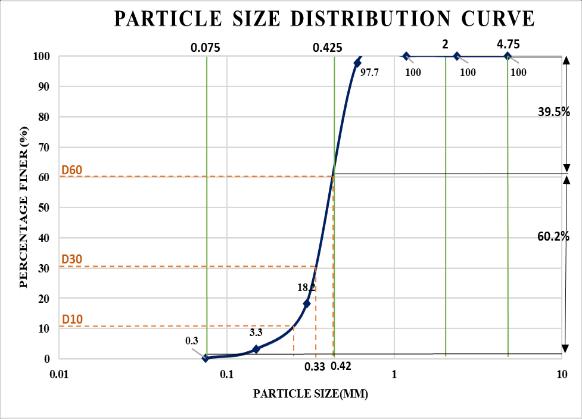
Fig - 1: Particlesizedistributioncurve
2.2.
Coir geogrid was collected from National Coir Mills, Alappuzha.Coirgeogridwasfabricatedintotubesandused asreinforcement.Propertiesofcoirgeogrid(Table2)was
obtained from National Coir Research and Management Institute,Trivandrum.
Table – 2: PropertiesofCoirGeogrid
Crushed coconut in the form of chips was collected from Easy and Fresh, Anayara, Trivandrum. The properties of coconutshellwerestudiedandthevaluesaretabulatedin Table3.
Table – 3: PropertiesofCSC
2.4. Experimental Set Up
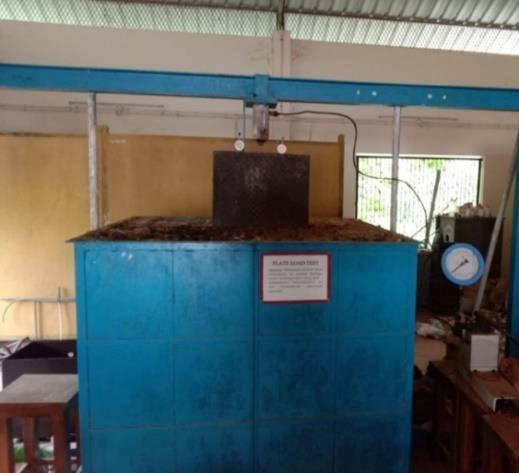
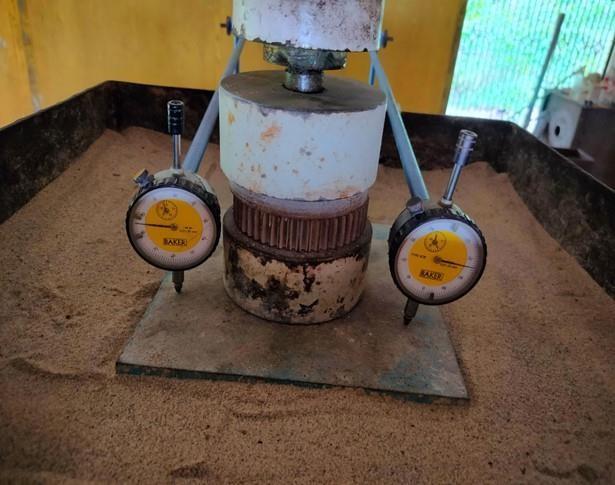
Theexperimentalsetupforthisresearchincludesaloading frame, a test tank, a hydraulic jack, and additional instrumentsforloadandsettlementmeasurement(Fig2). In this study, a test tank measuring 50x50x50 cm and a plateofsize20x20cmwereutilized,withtheloadingplate having a thickness of 10mm. Manual application of load wascarriedout,withobservationsofsettlementrecorded for each load increment, and subsequent settlement calculationswereperformed.Furthermore,aprovingring and deflection gauges were arranged to apply load and determinesettlement.
3.EXPERIMENTAL PPROGRAM
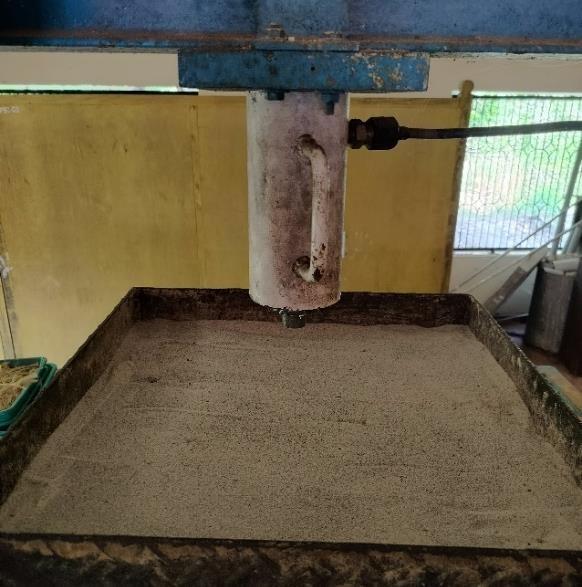
The necessary materials were gathered for the study.Thetesttankwasfilledwiththeappropriateamount of sand. The loading plate was positioned centrally, and load application to the sample was facilitated using the loading frame. Throughout the loading process, the settlementofthesamplewasmonitoredusingadialgauge with a precision of 0.01mm. Load was applied at a consistent strain rate of 1.2 mm/min. Initially, a test was conducted on unreinforced sand (Fig 3) followed by an analysisoftheload-settlementbehaviorofsandreinforced with 2cm diameter CGT infilled with CSC, at varying u/B ratios of 0.5, 0.75, and 1. The horizontal spacing between tubulargeogridswasmaintainedconstanttoensureequal areaofreinforcementsbetweentubularandplanarforms. Thus, a single layer comprised 8 reinforcements with a center-to-centerspacingequivalenttoπD.Soilisthenfilled uptothetopsurfaceandloadingsetupisplacedasshown inFig4.
4.1. Unreinforced sand
PlateLoadTestwascarriedoutfollowingtheISprocedure to analyze the load settlement characteristics of CGT infilled CSC under various placement depths. Two dial gauges were positioned on the footing plate, positioned oppositeeachother,torecordthereadings.
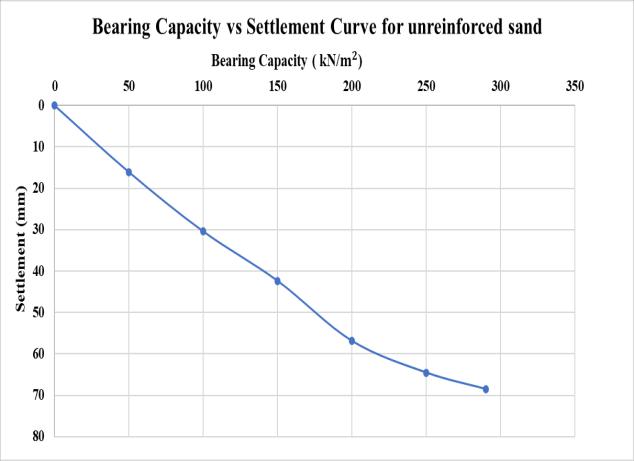
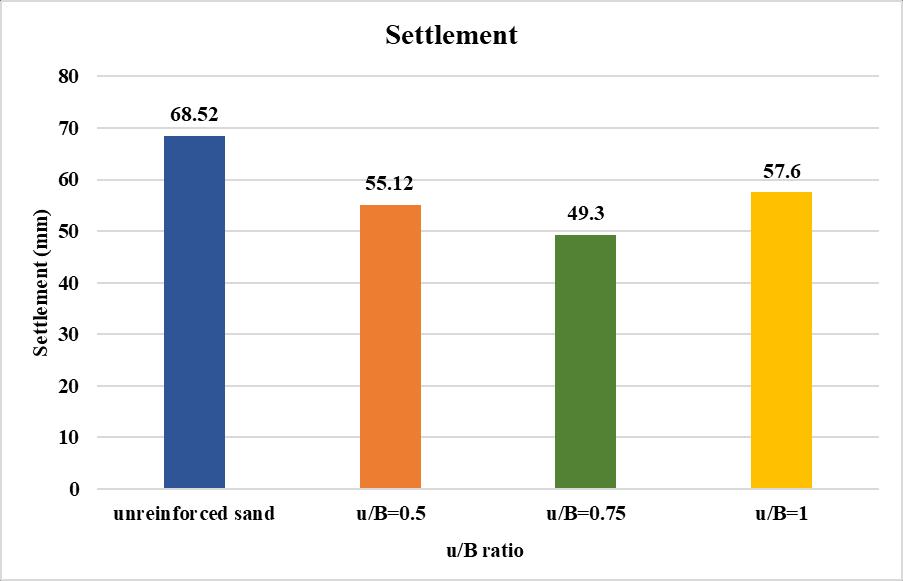
The bearing capacity settlement graph of sand without reinforcement is shown in Fig 5. The maximum bearing capacity of sand was found as 290 kN/m2 and the maximumsettlementwasobtainedas68.52mm.
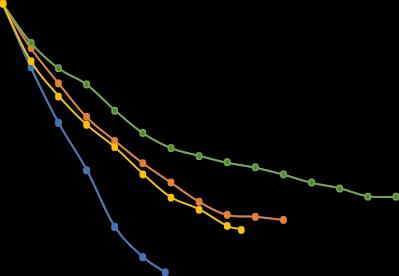
The settlement and load-bearing capacity of CSC infilled CGT in sand were investigated. CSC infilled CGT with diameters of 2 cm and varying u/B ratio of 0.5, 0.75 and1weretested.Fig6illustratesthechangesinthe
settlement and bearing capacity. Analysis of the graphs revealedthatmaximumbearingcapacitywasobtainedfor CSCinfilledCGTatu/B=0.75andminimumsettlementwas alsoobservedatthiscase.


p-ISSN:2395-0072 Volume: 11 Issue: 05 | May 2024
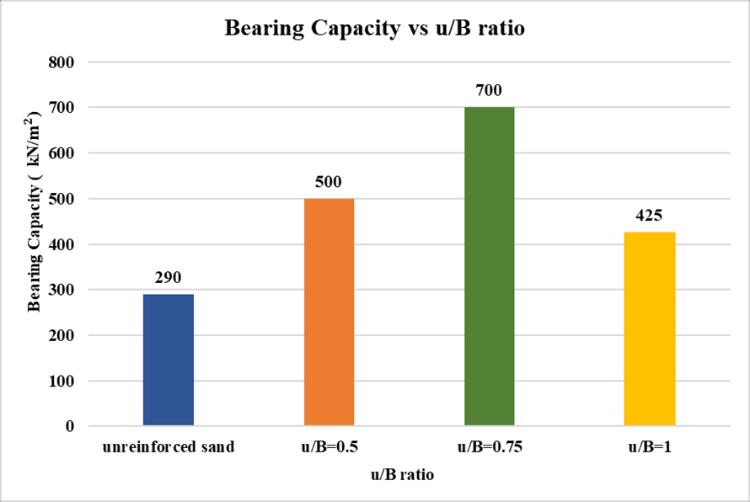
Fig7and8showsthecomparisonofbearingcapacityand settlementfordifferentu/Bratiosrespectively.Theresults show a considerable reduction in bearing capacity and increaseinsettlementwhenCGTwasplacedatu/B=1.The studyalsoshowstheimprovedeffectinstrengthofsoilby utilizingreinforcementindifferentformandshape.
The study investigates the impact of coconut shell chips infilled coir geogrid tubes on soil behavior. Bearing capacity and settlement values were calculated. Several observationsweredrawnfromthestudy:
Unreinforced sand exhibits lower bearing capacity compared to sand with coconut shell chips infilled coir geogridtubes.
Sand reinforced with CSC infilled CGT showed bearing capacity improvement of 1.4 times and 28% settlement reduction when placed at u/B = 0.75 compared to unreinforcedsand.
A reduction in bearing capacity was observed in case of CSC infilled CGT at u/B = 1 due to occurrence of lateral displacementofreinforcement.
Strengthofsoilimprovedwiththeinclusionofgeogridin tubular reinforcement form and beneficial disposal of coconut shell waste was achieved by using it as infill in coirgeogridtubes.
[1]Al-Subari,L.,HanafiM.andEkinci,A.,(2020),“Effectof geosyntheticreinforcementonthebearingcapacityofstrip footingonsandysoil”,SNAppliedSciences,vol.2,pp.1-11.
[2]IS:1888(1982)Methodofloadtestsonsoils,Bureauof IndianStandards,NewDelhi,India.
[3] Jelani J., Othman M., Suif Z., Ahmad N., (2023), “Preliminary investigation of CBR value utilizing crushed coconut shell as additive in silty sand”, Journal of EngineeringScienceandTechnology,18(1),pp.123-131.
[4] Lal D., Sankar N., Chandrakaran S., (2017), “Effect of reinforcement form on the behavior of coir geotextile reinforced sand beds”, Soils and Foundations, 57(2), pp.227-236.
[5]SatvatiS.,RowshanzamirM.andHejaziS.M.,(2016),“A comparisonbetweenthebearingcapacitiesofstripfooting onsoilslopereinforcedbyplanarandtubularformofbraid and geogrid elements”, Proceedings of the 3rd PanAmericanConferenceonGeosynthetics,23.
Volume: 11 Issue: 05 | May 2024 www.irjet.net
International Research Journal of Engineering and Technology (IRJET) e-ISSN:2395-0056 p-ISSN:2395-0072
[6] Sridhar R., Kumar P.M.T., (2014), “Study on shear strength characteristics of coir mat reinforced sand”, International Journal of Research in Engineering and Technology,3(6),pp.115-119.