
International Research Journal of Engineering and Technology (IRJET) e-ISSN:2395-0056
Volume: 11 Issue: 05 | May 2024 www.irjet.net p-ISSN:2395-0072
International Research Journal of Engineering and Technology (IRJET) e-ISSN:2395-0056
Volume: 11 Issue: 05 | May 2024 www.irjet.net p-ISSN:2395-0072
Helen Thomas1 , Revathy VS2
1MTech student, Department of Civil Engineering, Marian Engineering College, Kazhakuttom, Kerala, India
2Assistant Professor, Department of Civil Engineering, Marian Engineering College, Kazhakuttom, Kerala, India ***
Abstract - The stability of earthen structures like dams, embankments, and levees depends on the soil's resistance to piping, a process where water flow creates subsurface erosion paths leading to potential failure. This study investigates the performance evaluation of jute fibers and organic matter in enhancing the piping resistance of the soil. Experimental analyses were conducted to determine the optimal composition of soil stabilizers, focusing on varying lengths and concentrationsofjutefibersinconjunctionwithorganicmatter. The soil sampleswere prepared with organic matter content varying from 0% to 20% and jute fiber of length 50mm at concentrations ranging from 0.5% to 1.0% to the dry weight of the soil. The key parameters measured included the seepage rate, piping resistance, and critical hydraulic gradient. The results indicated a significant improvement in the piping resistance with the inclusion of jute fibers and organic matter. The optimum combination was found to be 10% organic matter and 50mm length jute fiber at a concentration of 0.75%. This specific mix demonstrated the highest increase in the critical hydraulic gradient and the longest time to piping initiation, suggesting enhanced soil cohesion and structural integrity.
Keywords: Piping failure, Jute fiber, Organic soil, 1D pipingtest
1.INTRODUCTION
Soil erosion and instability pose significant challenges in geotechnical engineering, impacting infrastructure development and agricultural productivity. Among various forms of soil erosion, piping subsurface erosion caused by the removal of soil particles by percolating water represents a critical problem, often leading to the formation of underground channels and the eventual collapse of the soil structure. This phenomenon can compromise the stability of embankments, dams, and levees, making it imperative to explore effective soil reinforcement strategies. A significant incident related to piping failure occurred during the floods inKeralainAugust2018,whichledtomajorseepageissuesin the Thenmala Dam and the Chimony Dam in Thrissur. Traditional methods for enhancing soil stability have primarily relied on synthetic materials and mechanical interventions. However, growing environmental concerns and the push for sustainable engineering solutions have
spurred interest in natural and biodegradable alternatives. In this context, jute fibers, a natural and abundant resource, and organic matter have emerged as promising candidates for soil reinforcement. Jute fibers, knownfortheirtensilestrengthand biodegradability, can enhance soil cohesion and resistance to erosion, while organic matter can improve soil structure and water retentionproperties.
Recentstudies([1][2],[3])haveshownthatorganic materialscanreducetheseverityofpipingerosioninsoil. The authors found that soil organic carbon and light fractionorganiccarbon,representingthelabileportionof organicmattercontent,playedkeyrolesinincreasingsoil aggregate stability and reducing aggregate disintegration during splash erosion events. Also, various researchers havestudiedtheefficiencyofusingfiberreinforcementin improving the piping resistance of soil using laboratory experiments. Estabragh et al. [4] in 2017 indicated that the inclusion of fibers reduced the seepage velocity, increased the piping resistance, and increased the critical hydraulic gradient hence, considerably delaying theamountofpiping.Coghlanetal.[3]2014utilizedboth natural and synthetic fibers, as well as additives such as cement, lime, and ash. The research found that natural fibersyieldedbetterresultscomparedtosyntheticones.In particular,jutefibersdemonstratedthebestadhesionwith thesoilmix.
The study will involve a series of laboratory experiments to assess the impact of varying concentrations of jute fibers and organic matter on the soil's physical and hydraulic properties. Key performance metrics will include piping resistance, seepage velocity variation, and the critical hydraulicgradientatwhichpipinginitiates.
To better understand how organic matter and fiber reinforcement can lower seepage velocity and increase soil piping resistance, a laboratory experiment was carried out. Investigations were conducted on the piping behaviorofspecimensofunreinforcedsoilandspecimens reinforcedwithjutefibersandorganicsoil,compactedina speciallydesignedone-dimensionalpipingsetup.
International Research Journal of Engineering and
Volume: 11 Issue: 05 | May 2024 www.irjet.net
2.1.1 Soil
Soil was collected from the Thenmala dam regionintheKollamdistrict.Thesampleiscollected fromadepthof1.5m.Laboratorytestswerecarried out to obtain the properties of soil. Properties are describedinTable
Table - 1: Propertiesofsoil
Jutefiberofanaveragelengthanddiameterof50mm and0.5mmwereused.
Table 3 -Propertiesofjutefiber
2.1.2 Organic soil
Table 2: PropertiesofOrganicsoil

The piping test was initially conducted on soil without fibers at the optimum moisture content (OMC) and maximumdrydensity.Theexperimentalsetupconsisted of a 40 cm diameter and 100 cm height tank with a graduated scale for measuring the water level. The soil specimen mold had a diameter of 10 cm and a height of 11.7 cm. Sand passing through a 2.36 mm sieve and retainedona 75 µmsieve,along withorganicsoilpassing through a1.18mmsieve,was used.The required weight ofsoilforthespecifieddensitywas mixedwithwateron aglassplate.Organicsoilofaspecific weight wasevenly spread over the sand and thoroughly mixed. The soil mixture was then filled in the cylindrical mold in about three equal layers, with each layer being statically compacted. The mold was connected to the water tank, and water was allowed to flow upwards through the samplewhilethedischargewascollectedinameasuring jar.The experiment involved monitoring the discharge under various heads, and it continued by increasing the flow head until soil piping failure occurred. The experiments were conducted for plain sand, sand mixed with different organic contents (5%, 10%, 15%, 20% of thedryweightofsand),andfiberlength50mmwith0.5%, 0.75%, and 1% of the dry weight of sand. The experiment setup is shown in Figurebelow.
International Research Journal of Engineering and Technology (IRJET) e-ISSN:2395-0056
Volume: 11 Issue: 05 | May 2024 www.irjet.net p-ISSN:2395-0072
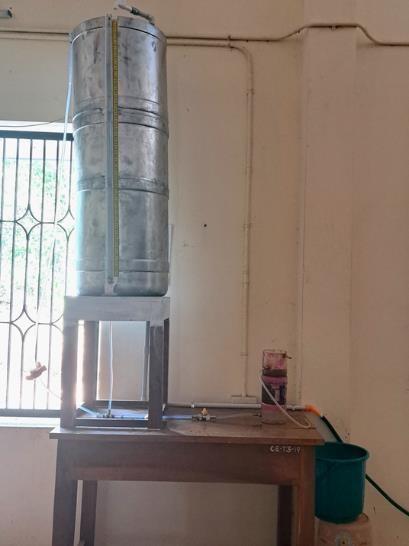
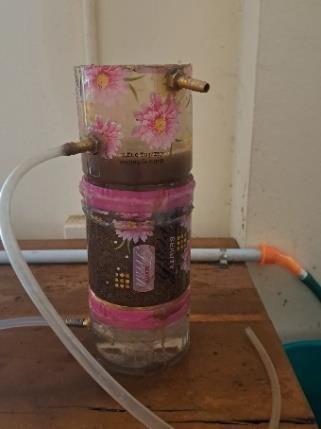
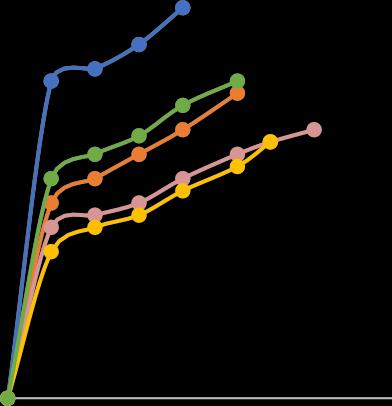
Fig2and3showthevariationofahydraulicgradientwith seepage velocity for unreinforced soil samples in comparisonwiththatforsamplesreinforcedwithorganic contentsof5,10,15,and20%,and50mmjutefiberlength atvaryingcontents(0.5,0.75,and1%).


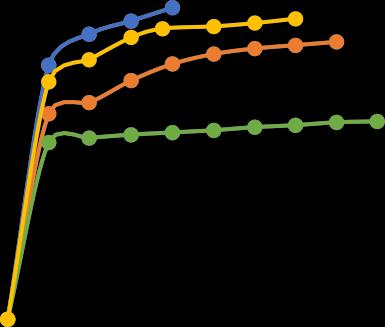




Fig4and5showthevariationofpiping resistancewith fiber contents for unreinforced soil samples in comparison with that for samples reinforced with organic contents of 5,10,15, and 20%, and 50mm jute fiberlengthatvaryingcontents(0.5,0.75,and1%).








International Research Journal of Engineering and Technology (IRJET) e-ISSN:2395-0056
Volume: 11 Issue: 05 | May 2024 www.irjet.net p-ISSN:2395-0072



The experimental data, as illustrated in Fig. 2, shows thatseepage velocity varies with both the hydraulic gradient and organic content. Specifically, as the hydraulic gradient increases, seepage velocity also increases.However,theinclusionoforganicsoilat5% and 10% concentrations reduces seepage velocity, thereby enhancing piping resistance. The addition of organic soil improves the critical hydraulic gradient. This improvement is observed up to an organic soil content of10%. Beyond this threshold, at 15% and 20% organic content, the hydraulic head and piping resistancedecrease.
To investigate the effect of jute fiber content on seepage velocity and piping resistance, experiments were carried out with 50mm length jute fiber with varying fiber content of 0.50, 0.75, and 1.0 % of dry weightofsand.Thevariation of seepage velocity with hydraulic gradient for various fiber content is shown in Fig.3. Seepage steadily increases as the gradient is increased. For 50mm the seepage velocity decreased with the increase in fiber content particularly in 0.75% fiber content. And contributed to the increase inpipingresistance.
During the laboratory tests, soil sample specimens were reinforced with organic soil and jute fibers of different dosages and lengths to study the effect of fiber reinforcementonpipingresistanceandseepage velocity.Themainconclusionsareasfollows:
1. The addition of organic content to soil samples has led to a decrease in seepage velocity and an increase in piping resistance at 10% organic content. Organic soil, which is
International Research Journal of Engineering and Technology (IRJET) e-ISSN:2395-0056
Volume: 11 Issue: 05 | May 2024 www.irjet.net p-ISSN:2395-0072
recognized for its greater cohesion and water retention properties that has played a key role in enhancing the soil's resistance to piping. The organicmatterhascontributed to improved soil structure and reduced permeability. which collectivelyreducedtheriskofpiping.
2. The inclusion of fibers in soil reduced the
lifting of soil particles and the extent of piping when water flowed in the upward direction through the soil. The specimens displayed a clear initiation of piping failure.The observed improvement in resistancecan be attributed to the addition of jutefibers, which substantially bolstered the soil's resilience against piping. These fibers served as reinforcements within the soil matrix, decreasing its vulnerability to internal erosion by enhancing the cohesionand interlockingofsoilparticles.
1] Adams, B. T., Xiao, M., & Wright, A. (2013). “Erosion mechanisms of organic soil and bio abatement of piping erosion of sand”, Journal of Geotechnical and Geoenvironmental Engineering,Vol139(8),pp1360-1368.
2] AlRawi,O.,Assaf,E.M.N.,&Rawashdeh,T.(2017). “Effect of organic content on the engineering properties of Jordanian clayey soils”, IJCIET, 8, pp 1018-1026.
3] Coghlan, S. (2014). “Bonding in fiber-reinforced earthenconstruction materials.”,MengDissertation, DurhamUniversity,UK.
4] Estabragh, A. R., Soltannajad, K., & Javadi, A. A. (2014). “Improving piping resistance using randomly distributed fibers”, Geotextiles and Geomembranes,Vol42(1),pp15-24.
5]Smith,D.J.,Snead,M.,&Thompson,T.M.(2022).“Soil amended with organic matter increases fluvial erosion resistance of cohesive streambank soil”, Journal of Geophysical Research: Bio geosciences, Vol127(6)
6]Yang, K. H., Adilehou, W. M., Jian, S. T., & Wei, S. B. (2017).“Hydraulicresponseoffiber-reinforcedsand subjecttoseepage”,GeosyntheticsInternational, Vol 24(5), pp 491-507.