
International Research Journal of Engineering and Technology (IRJET) e-ISSN: 2395-0056
Volume: 11 Issue: 05 | May 2024 www.irjet.net p-ISSN: 2395-0072
International Research Journal of Engineering and Technology (IRJET) e-ISSN: 2395-0056
Volume: 11 Issue: 05 | May 2024 www.irjet.net p-ISSN: 2395-0072
S.Thirumalairajan
1 , Adhithya 2 , Jaipprakesh 3, Kumaravel 4, Sanjay 5
1Lecturer, Dept. of Mechatronics, PSG Polytechnic College, Tamil Nadu, India 2345Student Scholar, Dept. of Mechatronics, PSG Polytechnic College, Tamil Nadu, India ***
Abstract - This project, “Design and Development of a Pickand-PlaceCollaborative Robot,” aims to address the increasing demand for efficient and reliable automation solutions by creating a compact, user-friendly, and cost-effective robotic arm for educational purposes. The focus is on developing an InternetofThings(IoT)-basedpick-and-placeroboticarmthat integrates both electronic and electrical engineering principles. Utilizing the Arduino microcontroller and the ESP8266modulefromMicrochipTechnology,theprojectseeks to control all robotic activities with precision. The designed robot is capable of performing tasks that are either challenging or hazardous for humans, thereby expanding the scopeofautomationinvariousfields.Thiscollaborativerobot not only demonstrates the potential of robotics in simplifying complex tasks but also serves as an educational tool to enhance learning and understanding of robotics and IoT technologies. By prioritizing compactness, usability, and affordability, the project aims to make advanced robotic solutionsaccessibleforeducationalinstitutionsandhobbyists, fostering innovation and practical knowledge in the field of robotics.
Key Words: Collaborative Robot, IoT Based, Robotics, Automation, Worker safety, Efficiency, Arduino, ESP8266, Pick-and-place mechanism.
In today’s rapidly evolving technological landscape, the demand for efficient and reliable automation solutions is greater than ever. Among these advancements, pick-andplacecollaborativerobotshaveemergedasvitalcomponents of modern industry. These mechanical systems are specificallydesignedtotransferobjectsfromonelocationto another with precision and efficiency. Structurally, they resemble human arms, consisting of multiple segments connectedbyjointsandequippedwithmotors,sensors,and grippers.This configuration allowsthem to perform tasks withalevelofaccuracyandcontrolthatisdifficulttoachieve manually. The operation of pick-and-place collaborative robotsisguidedbyvariousinputmethods,suchascomputer interfaces or remote controls, enabling them to execute movements in a controlled manner. The grippers of these roboticarmsaredesignedtosecurelygraspobjects,allowing therobottomovethemtodifferentlocationsreliably.This functionality makes them indispensable in industries like
manufacturing, logistics, and assembly lines, where they automaterepetitivetasksandcontributetosignificanttime savings and reductions in human error. The versatility of pick-and-placerobotsisevidentintheirabilitytohandlea wide range of objects, from small, delicate components to larger, more cumbersome items. Their implementation in industrialprocessesenhancesproductivityandoperational efficiency, showcasing their potential to revolutionize traditionalworkflows.Astechnologycontinuestoadvance, thedesignanddevelopmentoftheserobotsarefocusedon making them more compact, user-friendly, and costeffective, thereby extending their accessibility and applications across various fields. This project aims to contributetothisongoinginnovationbydevelopinganIoTbasedpick-and-placeroboticarmforeducationalpurposes, leveraging the Arduino microcontroller and the ESP8266 moduletoachieveahighlevelofcontrolandfunctionality.
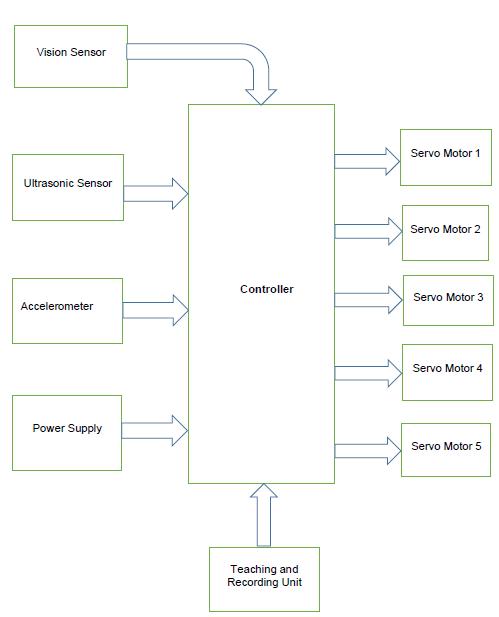


Fig -1: Block Diagram
2. Hardware
2.1 ESP8266
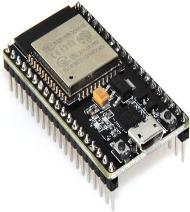
NodeMCUisbuiltonthematureESP8266technologytotake advantageoftheabundantresourcesavailableontheweb. NodeMCUhasESP-12-basedserialWi-Fiintegratedonboard
International Research Journal of Engineering and Technology (IRJET) e-ISSN: 2395-0056
Volume: 11 Issue: 05 | May 2024 www.irjet.net p-ISSN: 2395-0072
toprovideGPIO,PWM,ADC,I2C,and1-WIREresources.It also has a built-in USB-TTL serial with super-reliable industrial-grade CH340 for superior stability on all supported platforms. This module is one of the cheapest availableWi-Fimodulesonthemarket.V3,orVersion3,is thelatestversionofthismodule.Thistutorial,however,will facilitateconnectingalltheversionsofESP8266NodeMCU, i.e.,V1,V2,orV3.
2.1.2 Specifications
Microcontroller Tensilica 32-bit RISC CPU XtensaLX106
Operating Voltage 3.3V
Input Voltage 7-12V
Digital I/O Pins (DIO) 16
Analog Input Pins (ADC) 1
Flash Memory 4MB
SRAM 64KHZ
Clock Speed 80MHZ
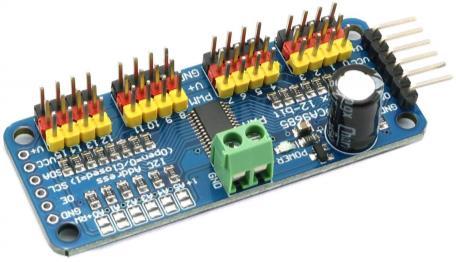
PCA9685 servo driver for controlling a pick and place robot arm offers a convenient and efficient way to managemultipleservomotors.ThePCA9685isa16-channel, 12-bit PWM (Pulse Width Modulation) servo driver. It's commonly used to control servo motors, LEDs, and other devices that require precise timing. Each channel of the PCA9685cangenerateaPWMsignalindependently,making it suitable for controlling multiple servo motors simultaneously.
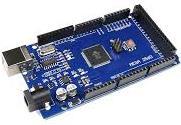
TheArduinoMegaisamicrocontrollerboardbasedonthe ATmega2560.Ithas54digitalinput/outputpins(ofwhich 15canbeusedasPWMoutputs),16analoginputs,4UARTs (hardwareserialports),a16MHzcrystal oscillator,aUSB connection,apowerjack,anICSPheader,andaresetbutton. It'soneofthemostpowerfulboardsintheArduinofamily, suitableforprojectsrequiringalargenumberofinputsand outputs or more complex processing tasks. With its extensivecapabilities,it'softenchosenforprojectsinvolving robotics, automation, and data acquisition. The Arduino Megaisahighlyversatilemicrocontrollerboardrenowned for its expansive array of input/output (I/O) capabilities, making it an ideal choice for projects demanding a rich assortment of sensors, actuators, and communication interfaces. Powered by the ATmega2560 microcontroller chip,itboastsarobustarchitecturefeaturing54digitalI/O pins, of which 15 are capable of producing Pulse Width Modulation(PWM)signals,facilitatingnuancedcontrolover motors, LEDs, and servos. Additionally, the Mega incorporates 16 analog input channels, enabling precise measurementofphysicalphenomenasuchastemperature, lightintensity,andvoltagelevels.
GaneshUL,et.al.Showedtheusageofmechanical drainage cleaner to replace the manual work required for drainage cleaning system. Drainage pipes are very dirty. Sometimesitisharmfultohumanlifewhileitisneededfor cleaningdrainagesystems.Toovercomethisproblem,they implementedamechanicalsemi-automaticdrainagewater
International Research Journal of Engineering and Technology (IRJET) e-ISSN: 2395-0056
Volume: 11 Issue: 05 | May 2024 www.irjet.net p-ISSN: 2395-0072
cleaner,andthewaterflowisefficientbecauseoftheregular filtration of waste with the help of that project. Different kindsofenvironmentalhazardsarereducedwiththehelpof adrainagesystemmachine.
ElangovanK.,etal.revieweddrainagecleaningto replace manual work with an automated system because manual cleaning systems are harmful for human life and cleaningtime.Toovercomethisproblem,theyimplemented an“automaticdrainagewaterpumpmonitoringandcontrol system using PLC and SCADA." PLC and SCADA were designed. In this project, we will use an efficient way to controlthedisposalofwasteregularly.
NDUBUISI C. Daniels et al. showed the drainage system cleaner machine used to remove garbage and sewage automatically,whichhelpedtoprotecttheenvironmentfrom different kinds of environmental hazards. The drainage system cleaner has three major parts, which are the propeller,thecleaner,andthepan,allofwhichmakeupfor itseffectivefunctioning.
Prof.S.D.Anapetal.showedblockageisthemajor cause of pollution and flooding in metro cities. They have designed thedrainage blockagedetectionsystemtoavoid suchproblems.Thesystemprovidesmonitoringofdrainage conditionsandinformsauthoritiesoftheseconditions.This design presets an implementation of a wireless sensor networkforthemonitoringofdrainagesystemsusingaGSM system.Todetectblockageandmonitorit,JuhaLatvalaetal. aimtofindoutwhethersystematicimprovementofdrainage canproducesignificantsavingsinrailnetworkmaintenance.
Indesigningmachinecomponents,itisnecessarytohavea good knowledge of many subjects such as Mathematics, engineering mechanics, strength of materials, theory of machines,andEngineeringDrawing.Machinesarealwaysthe same, they have combination of linkages, gears,and other mechanicsandbywhichwemakeacompletemechanismto achieveacertaintask.
1. Selecting Robotic Arm Type: Thechoiceofroboticarm type depends on various factors such as the application, workspaceconstraints,payloadrequirements,anddesired precision.Forinstance,iftheapplicationrequireshigh-speed andprecisemovementswithinasmallworkspace,aSCARA or delta robot might be suitable. Conversely, for tasks requiringalargerworkspaceandflexibilityinmovement,an articulatedorCartesianrobotmightbepreferred.
2. Linkage Design: Thelinkagedesigninvolvesdetermining thenumberofjointsandtheirarrangementtoachievethe desiredrangeofmotion.Thistypicallyincludesjointssuch as revolute (rotational) or prismatic (linear). Using CAD software, engineers can simulate the movement of the
robotic arm to optimize the design for factors like reach, speed,andworkspaceutilization.
3. Actuators and Motors: The selection of actuators or motorsdependsonthespecificrequirementsofeachjoint, including torque, speed, and precision. Servo motors are commonly used for their precise control and feedback capabilities,whilesteppermotorsofferprecisepositioning but may lack the same level of feedback. Factors such as powerconsumption,size,andcostalsoinfluencethechoice ofactuators.
4. End Effector: Theendeffector,orgripper,iscrucialfor the pick and place operation. The design of the gripper dependsontheobjectsbeinghandled,theirsize,shape,and weight.Forexample,aroboticarmusedinmanufacturing may require a gripper with interchangeable fingers or suctioncupstohandledifferenttypesofpartsefficiently.The gripper design should also consider factors like gripping force,compliance,andreleasemechanism.
5. Frame and Base: Theframeandbaseprovidestructural support for the robotic arm and must be designed to withstand the loads and stresses experienced during operation. Engineers need to consider factors such as materialselection,stiffness,andvibrationdampingtoensure smooth and accurate movement. Additionally, the base should be stable and securely anchored to the working surfacetopreventtippingorinstability.
6. Mechanical Interfaces: Mechanical interfaces are required for mounting sensors, cameras, and other accessories used for IoT functionality. These interfaces should be designed to accommodate the specific requirements of each component while ensuring proper alignment and accessibility for maintenance. Cable managementsystemscanhelporganizeandprotectwiring, reducing the risk of interference or damage during operation.
7. Safety Features: Safetyfeaturesareessentialtoprotect boththeroboticarmanditssurroundingsfromaccidentsor damage.Limitswitchescanbeusedtodefinesafeoperating limitsforeachjoint,whileemergencystopbuttonsprovidea quick way to halt operation in case of an emergency. Collision detection sensors can prevent collisions with obstacles or other objects in the workspace, reducing the riskofdamageorinjury.
ThemethodologyfordevelopingtheIoT-Basedpickand placecollaborativerobotinvolvesasystematicapproachthat encompassesseveralkeyphases,includingresearch,design, development, testing, and implementation. Below is a detailedmethodologyoutliningthestepsinvolved:
Volume: 11 Issue: 05 | May 2024 www.irjet.net p-ISSN: 2395-0072
1. Research and Requirements Gathering: Conducta thorough literature review to understand existing technologies, methodologies, and best practices related to pick and place collaborative robot, Internet of Things, robotics,andautomation.Identifyand analyze thespecific requirementsandchallengesassociatedwithpickandplace operation,includingsafetyconcerns,environmentalfactors, and cleaning efficiency metrics. Define clear project objectives and scope based on the research findings and stakeholderinput.
2. Design Phase: Developdetaileddesignspecifications for the pick and place collaborative robot, including mechanical,electrical,andsoftwarecomponents.Designthe mechanicalstructureoftherobot,includingthebaseofthe robot, robotic arm, and gripper mechanism, ensuring compatibilitywithmotorintegrationandsmoothmovement and payload requirements. Design the electrical system, specifying components such as motors, actuators, microcontrollers,controllerandpowersupplyunits.Design thesoftwarearchitecture,outliningalgorithmsandcontrol strategiesforautonomousoperation.
3. DevelopmentPhase:Constructaphysicalprototypeof thepickandplacecollaborativerobot basedonthedesign specifications, integrating mechanical, electrical, and software components. Develop the pick and place collaborativerobotusingPLAmaterial,3-Dprinttheparts using Raptor Lmg Mk 2 3-D printer, develop software interfacesfordataacquisitionandprocessing.Implementthe robotic arm mechanism and pick-and-place functionality, includingteachfunctionalgorithmstorepeattheprocess
4. Testing and Validation: Conduct comprehensive functionaltestingofthepickandplacecollaborativerobotto verify its performance and functionality according to the designspecifications.Evaluatetheperformanceoftherobot in simulated and real-world industrial environments, assessingfactorssuchaspickandplaceoperationaccuracy, teach function, maximum payload testing, and maximum wireless communication radius. Perform safety testing to ensure compliance with safety standards and regulations, particularly regarding worker safety and environmental protection. Iterate on the design and software algorithms basedontestingfeedbacktooptimizetheperformanceand reliability of the robot, Deployment and Maintenance. Developplansfordeployingthepickandplacecollaborative robot in real-world industries, including deployment logistics,operationalprocedures,andusertraining.Establish proceduresforongoingmaintenance,troubleshooting,and softwareupdatestoensurethecontinuedfunctionalityand effectiveness of the robot in long-term operation. Monitor and evaluate the performance of the deployed robot, collectingfeedbackfromusersandstakeholderstoidentify areasforimprovementandrefinement.
5.1 Software Requirements:
5.1.1 Robot Arm Controller Application:
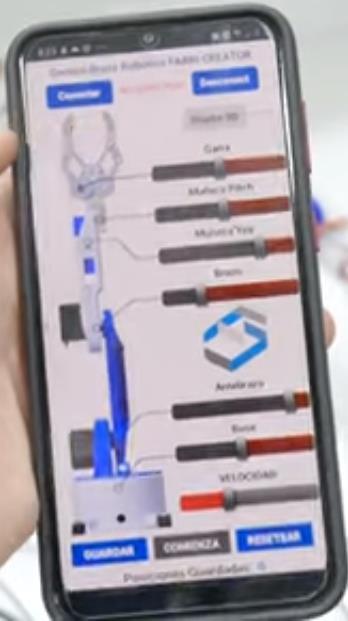
The Robot Arm Controller is a platform for building IoT applicationswithoutcomplexcoding.Itallowsyoutocreatea user interface for your IoT devices and provides a way to remotely monitor and control their usage in the system. RobotArmControllercanbeutilizedtocreateauser-friendly mobileapplicationinterfaceforuserstosetupeachcontrol ofthemotor,startandstoptheprocess,andteachfunction wirelesslyfromanydistance.
5.1.2 Arduino IDE
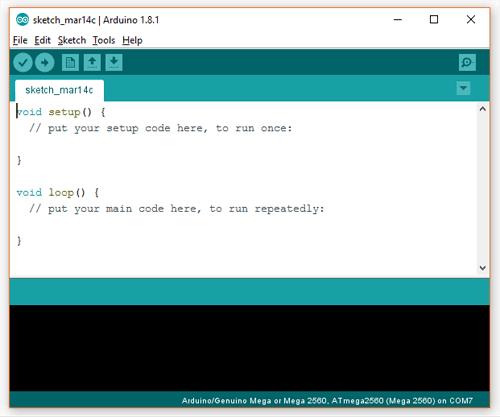
TheArduinoIntegratedDevelopmentEnvironment(IDE)isa softwareplatformusedtowriteanduploadcodetoArduino boards. It provides a user-friendly interface for writing, compiling,anduploadingcodetoyourArduinoboard.The IDEsupportsasimplifiedversionoftheC++programming language, making it accessible for beginners while still powerfulenoughformoreadvancedusers.
International Research Journal of Engineering and Technology (IRJET) e-ISSN: 2395-0056
Volume: 11 Issue: 05 | May 2024 www.irjet.net p-ISSN: 2395-0072
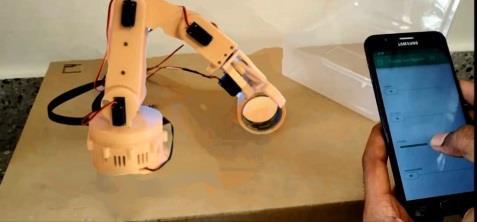
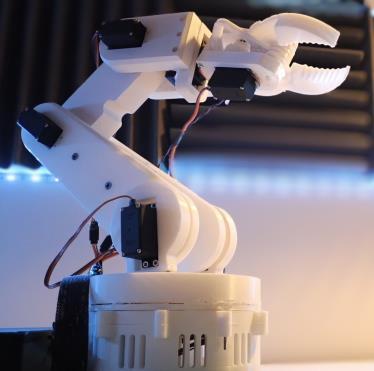
Anovelroboticarmwhichisrobustandlightwithsixdegrees of freedom and can be re-programmed for various applications has been developed. This robotic arm uses Arduinocontrollerandisespeciallydevelopedforpickand placeapplications.Thedesigniscompactandcheapandhas beenprovenpracticallyalso.Howeverthepresentpaperhas discussedonlythemodellingaspectoftherobotandvarious partsoftheassembly.Theexperimentsareconductedonthe
pick and place robot and the results obtained were very satisfactory.Motorswithhighertorqueratingscanusedto powerthejointssoastoensurethattheroboticarmremains inpositionevenwhenelectriccurrentisnotsuppliedtothe motors. Object detection and collision avoidance can implementbyaddingproximitysensorstotheroboticarm.
1. Interactive Pick and Place Robot Control using ImageProcessingMethodbyMr.RaskarD.S.1,Prof. Mrs.Belagali.
2. AutomaticMaterialHandlingSystemUsingPick& Place Robotic Arm & Image Processing by Mr. DeepakLRajnori,A.SBhide.
3. DesignandFabricationofPickandPlaceRobotto BeUsedinLibraryAnushaRonanki.Vol.4,Issue6, June2015
4. Design Analysis of a Remote Controlled “Pick and Place”RoboticVehicleB.O.Omijeh,RUhunmwangho andMEhikhamenle.Volume10,Issue5(May2014)
5. RatheeshRajan“FoundationStudiesforanAlternate ApproachtoMotionPlanningofDynamicSystems” M.S.E.,theUniversityofTexasatAustin,2001.
6. S. Ananth, P. Vijayakumar, K. Guruprasath and V. Kalaiyarasan, Design and Fabrication of Material Handling Robot for Multi Station. International JournalofMechanicalEngineeringandTechnology, 8(3),2017,pp.142–148.
7. Patil,C.,Sachan,S.,Singh,R.K.,Ranjan,K.,&Kumar, V.(2009).SelfandMutuallearninginRoboticArm, based on Cognitive systems. West Bengal: Indian InstituteofTechnologyKharagpur.