
COMBINED EFFECT OF STEEL FIBERS AND GROUND GRANULATED BLAST FURNACE SLAG ON CLAYEY SOIL
Gokul Nath G S1 Rani V2
1M.Tech. Student 2Associate Professor 1,2Department of Civil Engineering 1,2Marian Engineering College, Trivandrum, India
Abstract - An important practical part of geotechnical engineering is the technical improvement of soil. Soil stabilization is a well-known method for the treatment of problematic soils. Its advantages over soil replacement include low cost and fast implementation. To improve the strength and stiffness various cementitious materials are adopted. The stabilizers include Portland cement, lime, quartz, fly ash, and GGBS. In the last few decades, green materials and their applications in the civil engineering infrastructure have been gaining significant attention Unfortunately, these mixtures do not perform well under tensile load because soil-cement materials are brittle. Ground granulated blast furnace slag (GGBFS) is a byproduct of the manufacture of iron. GGBS material is also used as a substitute for cement in concrete mixtures and in soil stabilization. The Fiber inclusion in expansive clays shows significant enhancement in swell-shrink behaviour and in the prevention of tensile cracks in soil. The study aims to find the combined effect of steel Fibers and Ground Granulated Blast Furnace Slag (GGBS) on clayey soil. The effect of variation in the percentage content of steel fiber (0.5%, 0.75%, 1%) and different bend angles of steel fibers (90,120,150,180 degrees) and percentage of GGBS was experimentally investigated. The strength of the soil is tested at the 7th, 14th and 28th day using the Unconfined Compressive Strength Test (UCS) and Split tensile strength (STS) test. It was found that 30% GGBS content was the optimum content for the soil and as the fiber content and curing period increase the UCS and STS also increase. UCS and STS of Soil-GGBS-Steel fiber mix with Steel fiber having 120 degrees show maximum Strength compared with other fiber bend angles.
Keywords: SteelFiber,GGBS,Splittensilestrength
1. INTRODUCTION
Ground improvement is a widely used technique for enhancing soil conditions. Soil stabilization involves modifyingthephysicalandchemicalpropertiesofsoil to increaseitsstrength,durability,andoverallperformance. Soil stabilization aims to render the soil suitable for construction,especiallyinregionswherethenaturalsoil may not possess the required engineering characteristics. Various techniques are used for soil stabilization, including the incorporation of stabilizing
agents such as lime, cement, fly ash, or ground granulated blast furnace slag (GGBS). These agents alter the soil's properties, enhancing its stability, reducing its susceptibility to erosion, and improving its load-bearing capacity. Soil stabilization is frequently employed in the construction of roads, embankments, foundations, and other civil engineering projects to ensure the long-term integrityofstructuresbuiltonorwiththestabilizedsoil. Ground granulated blast furnace slag (GGBS), a byproduct of the blast furnace, is mainly composed of silicateandaluminosilicate compoundsformedfromthe molten calcium extracted during the furnace process. Industrial production generates approximately ten to twenty megatons of GGBS each year. Failure to properly utilize or dispose of this significant amount of GGBS can resultinenvironmentalpollutionanddegradation.GGBS serves as an effective soil stabilizing agent, improving soil characteristics. Its properties are similar to those of cement,makingGGBSapopularalternativetotraditional cement in modern applications. Being a by-product furtheraddstoitsappeal.
Soilexhibitsinherentweaknessintensionbutpossesses significant strength in compression, a fundamental characteristic influencing its behaviour in engineering applications. Similar to steel reinforcement in concrete, the addition of fibers offers tensile reinforcement to the soil, mitigating its inherent weakness and enhancing overall stability. In non-cementitious soils, strength is provided by the interaction between the soil and fiber surfaces.Incementitioussoils,thecohesivepropertiesof cementitious materials combined with surface fiber interactionsplayaroleinsoilstrength.Integratingfibers into soil systems yields numerous advantages, including thereductionoftensilecrackdevelopment,minimization ofsoildeformations,andenhancementofshearstrength and bearing capacity. By strategically placing fibers within the soil matrix, the material gains resistance against tensile loads, thereby improving its overall structural integrity and performance. This study aims to analyse the combined effect of steel fibers and GGBS on soilstrengthcharacteristics.
Unconfined compressive strength characteristics of GGBSandlime wasstudiedbyPaietal. [1]in2019.UCS andCBRweredoneondifferentproportionsofGGBSand
International Research Journal of Engineering and Technology (IRJET) e-ISSN:2395-0056
Volume: 11 Issue: 05 | May 2024 www.irjet.net p-ISSN:2395-0072
limecontentanditwasfoundthat,theUCSvalueofsoil–binder mixes increased with higher binder content. The soil-GGBS-lime mix demonstrated greater strength compared to the soil-GGBS mix. Additionally, the CBR value of the soil-GGBS-lime mix was higher than that of thesoil-GGBSmix.
CompactioncharacteristicsandindexpropertiesofGGBS on clayey soil were studied by Anand et al. [1] in 2018 Varying proportions of GGBS content were studied and hefoundoutthat AstheGGBSdosage percentage insoil increased, the maximum dry density value also increased. For clayey soil mixed with 16% GGBS, the liquid limit was 46%, the plastic limit was 30%, and the plasticityindexwas16%.Nooluetal.[3]in2018studied thedurabilityofGGBS-stabilizedblackcottonsoil.Itwas found out that durability results for GGBS-based geopolymers showed a reduction in strength of about 10%afterundergoing12wettinganddryingcycles.
Kalhor et al. [3] in the year 2008 studied the effect of metal fibersonclayeysoils. Varying percentages offiber content and fiber length were studied and it was found that the use of metal Fibers caused an increase in the axial strength of clay soil and the peak point of axial strengthisobservedat120bendanglesoffiber.Praveen et al. [3] in 2020 studied the improvement of CBR value for steel fibre-reinforced soil admixed with fly ash and cement. It was observed that the steel fiber reinforcement and cement modification of marginal soil can enhance its CBR value. Cement modification can transform marginal soil into non-plastic soil, leading to improved grain structure. When marginal soil is mixed with both cement and fly ash, there is a significant reduction in the plasticity index compared to untreated marginal soil. Alkali activation of clayey soil using GGBS andNaOH wasstudiedby Steffi etal intheyear2020.it was found that for a higher alkali-to-binder ratio (A/B) typically results in increased compressive strength and UnconfinedCompressiveStrength(UCS)ofstabilizedsoil tends to rise with higher percentages of GGBS. The compressive strength of the soil also increases as the curingperiodisextended.
2. MATERIALS AND EXPERIMENTAL SETUP
2.1. Soil
The soil used in this study was excavated 2m below the ground level. The soil was collected from Thonnakal, Thiruvananthapuram district. The properties of soil are summarizedinTable1.Aftertestingthesoil,itwasfound that the collected soil sample was Low plasticity clay (CL)accordingtoISSpecifications.
2.2. GGBS
Table – 1: Propertiesofsoil
GGBS is collected from Astra Chemicals, Chennai. The propertiesofGGBSareshowninTable2.
Table – 2: PropertiesofGGBS
2.3. Steel Fiber
Steel fiber is collected from the local market in Trivandrum.ThepropertiesofGGBSisshowninTable3.
Table – 3: PropertiesofSteelfiber
2.4. Sodium Hydroxide
Sodium hydroxide pellets, also known as Caustic Soda, was purchased from Trivandrum Scientific Supplies PrivateLimited,Trivandrum.1MolarNaOHsolutionwas usedinthestudy.
International Research Journal of Engineering and Technology (IRJET) e-ISSN:2395-0056
Volume: 11 Issue: 05 | May 2024 www.irjet.net p-ISSN:2395-0072
3. EXPERIMENTAL PROGRAM
For the present study, the required materials were collected.1MNaOHsolutionispreparedbydilutingitin the required amount of water. The soil sample is mixed withvaryingGGBScontent(20%,30%,40%ofdryweight ofsoil)and1MNaOHsolutionin0.6admixturetobinder ratio (A/B). Mix the sample uniformly and place it in a UCS mould of diameter 3.8cm and height 7.2cm in 3 layers. The cylindrical specimen is then air-cured for 7, 14 and 28 days and then tested for the Unconfined Compressive Strength (UCS) test to find the optimum GGBScontent.
To find the UCS and Split tensile strength (STS) for varying fiber content on soil-GGBS-Steel fiber mix. The optimum GGBS content found was mixed with the requiredsoilcontentand1MNaOHsolutionatoptimum moisture content and maximum dry density. Then varying steel fiber content of 0.5%, 0.75%and 1% is mixeduniformlywiththesoil-GGBSmix.AndfilltheUCS mouldandaircurefor7,14and28days.Aftertheendof the curing period, the sample prepared is tested for the Unconfined compressive strength test and split tensile strengthtest.
To conduct the split tensile test, cylindrical specimens with a diameter of 3.8 cm and a length of 7.2 cm were prepared at the optimum moisture content and maximum dry density, following the same procedure used for unconfined compression tests. The soaked specimenswereplacedhorizontallybetweenthebearing blocks of the compression testing machine, which was adjusted to a strain rate of 1.00 mm/min. Mild steel strips, approximately 5 mm thick, 5 mm wide, and 50 mm long, were curved at the contact surface and placed ontheupperandlowerbearingelementsofthecylinder to ensure uniform bearing pressure. The split tensile strengthisobtainedbythefollowingequation:
Splittensilestrength= 2�� ������,
where P=failureload;L=thicknessorlengthofspecimen; and d=diameterofthespecimen
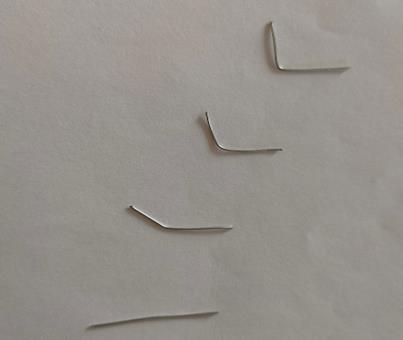
The UCS and split tensile strength for different bend angles of steel fiber that is for 90,120,150 and 180 degreeisalsotestedforsoil-GGBS-Steelfibermix(Fig-1). For that 0.75% of steel fiber of different bend angles is mixedintotheSoil-GGBSmix.
4. RESULTS AND DISCUSSION
The unconfined compressive strength test and Split tensile strength tests were carried out following the IS proceduretoanalysethesoil-GGBS-Steelfibermix.
The Unconfined compressive strength of soil-GGBS mix havingvaryingGGBScontentfordifferentcuringperiods is shown in Fig 2. Unconfined Compressive 28th day Strength oftheClayeysoil for20%,30%and40%GGBS are 284.78kPa, 630.58kPa and 355.97kPa respectively. UCS value increases at 30% GGBS content and then it decreases at 40% GGBS content. Therefore 30% GGBS content is taken as the optimum GGBS content for this soil. The addition of GGBS to the soil increases the unconfinedcompressionstrengthoverthecuringperiod, demonstratingthetime-dependentreactivityoftheslag.
vs GGBS content
7 Days
14 Days
28 Days
Fig- 2: Unconfinedcompressivestrengthofsoil-GGBS mixhavingvaryingGGBScontent
The concentration of the sodium hydroxide (NaOH) solution significantly influences the physical and mechanical properties of soil-stabilization-based geopolymers.Thissolutioncontainshydroxideions(OH-
Fig – 1: Steelfibersbendat90,120,150and180degrees.
) and sodium ions (Na+), which trigger the reaction between the internal silicate (Si) and aluminate (Al) components,startingthedissolvingprocess.
The results for Unconfined compressive strength and Split tensile strength of soil-GGBS- steel Fiber mix are showninFig.3andFig.4 For0.5%,0.75%,and1%steel fiber on Soil-GGBS mixed soil the UCS were 630.58kPa, 1769.7kPa and 2603.7kPa respectively and split tensile strength were 124.1kPa, 156.34kPa and 236.5kPa respectively after 28 days of curing. It shows that as the fiber content and curing period increase the UCS and Split tensile strength of the Soil-GGBS -Steel fiber mix increases.
The Variation of UCS and STS of soil with different bend angles ofsteel fiber (0.75%),for soil mixed with30%of GGBS for different curing periods is shown in Fig. 5 and Fig.6.ThesoilmixturecontainsFiberwitha bendangle of 120 shows maximum UCS and STS value followed by 150 bend angle and 90 bend angle shows the least strength compared to others. This shows that the fiber bendanglealsoinfluencesthestrengthoftheSoil-GGBSSteel fiber mix. This indicates that the maximum bond between the Soil-GGBS mix and steel fiber occurs at a 120° bendangle of the fiber.Thesefindingssuggest that the Soil-GGBS-Steel fiber blend could potentially replace OPC for soil stabilization applications, such as deep mixing for ground improvement, which could lower the costsofbothsoilstabilizationandlandfilling.
soil
periods.
30%ofGGBSfor differentcuringperiods.
Fig- 3: Unconfinedcompressivestrengthof
-GGBSsteelFibermixforvaryingfibercontentfordifferent curing
Fig- 4: Variationofsplit-tensilestrength(STS)ofsoil withvarying%ofsteelfiber,forsoilmixedwith30%of GGBSfordifferentcuringperiods.
Fig– 5: VariationofUCSofsoilmixwithdifferentbend anglesofsteelfiber,forsoilmixedwith
Fig– 6: VariationofSplitTensilestrengthofthesoilmix withdifferentfiberbendanglesfordifferentcuring periods
International Research Journal of Engineering and Technology (IRJET) e-ISSN:2395-0056
Volume: 11 Issue: 05 | May 2024 www.irjet.net p-ISSN:2395-0072
5. CONCLUSIONS
The study has been conducted to assess the potential of the combined effect of GGBFS and Steel fiber for the stabilizationofthesoil.Unconfinedcompressivestrength and Split tensile strength were tested. Several observationsweredrawnfromthestudy:
30%GGBScontenthasbeenfoundoutastheoptimum contentforthesoil.
Beyond the optimum content, GGBS content increases UCSofthesoildecreases.
As the fiber content increases the UCS and STS of the soil-GGBS-Steelfibermixincreases.
For different bend angles of steel fibers, 120 bend angleshowsmaximumUCSandSTS.
Asthe curing period increasesthe strengthof the soilGGBS-Steelfibermixalsoincreases.
REFERENCES
[1] Anand I., Singh A., (2023), “An experimental investigation to study the effect of GGBS addition on the index properties of clayey soil”, Journal of Data AcquisitionandProcessingVol.38(3)2023
[2] Gokul V., Steffi D.A., Kaviya R., Harni C.V., Dharani S.M.A.,(2021),“AlkaliactivationofclayeysoilusingGGBS and NaOH”, Materials Today: Proceedings, 43, pp.17071713.
[3] Kalhor A., (2008), “Effect of Metal Fibers on Clayey Soils”, Electronic journal for geotechnical engineering 13(3),pp.1-13
[4]PaiR.R.,PatelS.,(2019),“EffectofGGBSandLimeon theStrengthCharacteristicsofBlackCottonSoil”,Ground Improvement Techniques and Geosynthetics, Vol. 2, pp. 319–328SpringerSingapore
[5] Praveen G. V., Kurre P., Chandrabai T., (2020), “ImprovementofCalifornia BearingRatio(CBR)valueof SteelFiberreinforcedCementmodifiedMarginalSoilfor pavement subgrade admixed with Fly Ash”, Materials Today:Proceedings39(1),pp.639-642
[6] Noolu, V., Rao M. G., Reddy B., & Chavali, R. V. P., (2021), “Strength and durability characteristics of GGBS geopolymerstabilizedblackcottonsoil”,MaterialsToday: Proceedings,Vol.43,pp.2373–2376.