
International Research Journal of Engineering and Technology (IRJET) e-ISSN: 2395-0056
Volume: 11 Issue: 05 | May 2024 www.irjet.net p-ISSN: 2395-0072
International Research Journal of Engineering and Technology (IRJET) e-ISSN: 2395-0056
Volume: 11 Issue: 05 | May 2024 www.irjet.net p-ISSN: 2395-0072
Mohd Sameer Malik1 , Lalit Kumar2
1B.Tech. Mechanical Engineering (Evening) Scholar, School of Mechanical Engineering, Lingaya’s Vidyapeeth, Faridabad, Haryana, India
2B.Tech. Mechanical Engineering (Evening) Scholar, School of Mechanical Engineering, Lingaya’s Vidyapeeth, Faridabad, Haryana, India ***
Abstract – 4D printing has emerged as a transformative technology in the field of biomedical engineering, offering thepotentialfordynamic,stimuli-responsivestructureswith applications in tissue engineering, drug delivery, medical devices, and diagnostics. This review paper provides a comprehensive analysis of the advancements, challenges, and future directions of 4D printing in biomedical engineering.Wediscussthedevelopmentofsmartmaterials, including stimuli-responsive polymers, shape-memory materials, and bio-inks, as well as the various fabrication techniques employed, such as direct-write assembly, stereolithography, and multi-material jetting. Despite the promising advances, several challenges persist, including materiallimitationsrelatedtobiocompatibility,mechanical properties,anddegradationrates;fabricationcomplexities arisingfromtheintegrationofmultiplematerials,resolution and accuracy, and scalability; and regulatory and ethical considerations surrounding safety and efficacy. As we explorethefuturedirectionsfor4Dprinting,weemphasise theneedformaterialinnovations,fabricationadvancements, andemergingapplicationssuchas personalised medicine, nanomedicine,andbioelectronicdevices.Interdisciplinary research and collaboration between material science, biology,engineering,regulatoryagencies,andindustryare essential for overcoming challenges and realising the full potential of 4D printing in the biomedical engineering landscape.
Keywords: 4D printing; biocompatibility; biomedical engineering;fabricationtechniques;smartmaterials.
The advent of 3D printing technology has transformed variousfields,includingbiomedicalengineering,byallowing thefabricationofcomplexstructureswithhighprecisionand accuracy[1].Overtheyears,3Dprintinghasbeenemployed to create patient-specific implants, prosthetics, and even living tissue constructs for regenerative medicine [2–5]. However, these static structures lack the dynamic functionality needed to mimic the behaviour of living systems. The emergence of 4D printing, a technology that combines3Dprintingwithsmartmaterialsthatcanchange shape or properties over time in response to external stimuli,hasopenednewpossibilitiesforcreatingdynamic structuresinbiomedicalengineering.4Dprintingtechnology
incorporates stimuli-responsive materials, such as shapememorypolymers,hydrogels,andbio-inks,intotheprinting processtocreatestructurescapableoftransformingunder specificconditions,suchaschangesintemperature,pH,or moisture[6,7].Thesedynamicmaterialsenablethedesignof advanced biomedical devices that can adapt to the physiologicalenvironment,leadingtoimprovedtherapeutic outcomesandpatient-specifictreatments.
3D printing, also known as additive manufacturing, has become an indispensable tool in the field of biomedical engineering over the past few decades. This technology allows for the creation of three-dimensional objects by depositingmaterialslayer-by-layerbasedonadigitalmodel [8,9].Theversatilityof3Dprintinghasledtoitswidespread adoptioninvariousbiomedicalapplications,frompatientspecificimplantsandprostheticstotissueengineeringand drug delivery systems. One significant application of 3D printing in biomedical engineering is the fabrication of patient-specificimplantsandprosthetics[10].
4Dprintingisanadvancedformofadditivemanufacturing thatcombinestheprinciplesof3Dprintingwiththeuseof smart materials that are capable of changing their shape, properties,orfunctionalityovertimeinresponsetoexternal stimuli[15].Theterm“4D”referstothefourthdimension, whichistime,emphasisingthedynamicbehaviourofthese printed structures. By incorporating stimuli-responsive materials,suchasshape-memorypolymers,hydrogels,and bio-ink , 4D printing technology enables the creation of dynamic structures that can adapt to their environment, offeringnewpossibilitiesforbiomedicalapplications.
Thesignificanceof4Dprintinginbiomedicalengineeringlies initspotentialtotransform variousaspectsofhealthcare, includingtissueengineering,drugdeliverysystems,medical devices,anddiagnostics.Thedynamicnatureof4D-printed structuresallowsforthedevelopmentofmoresophisticated andadaptivedevicesthatcanmimicthecomplexbehaviour of living systems, ultimately improving therapeutic outcomes and enabling patient-specific treatments. For
International Research Journal of Engineering and Technology (IRJET) e-ISSN: 2395-0056
Volume: 11 Issue: 05 | May 2024 www.irjet.net p-ISSN: 2395-0072
instance,intissueengineeringandregenerativemedicine, 4Dprintingcanbeusedtocreateconstructsthattransform into the desired shape or structure upon implantation, facilitating better integration with the surrounding tissue andpromotingcellgrowthanddifferentiation.
Figure1showsanoverviewof4Dprinting.whichincludes the stages of material selection, design, fabrication, and activation.Thematerialselectionstageinvolveschoosingthe appropriatestimuli-responsivematerialsthatcanundergo controlledshapetransformations.
.
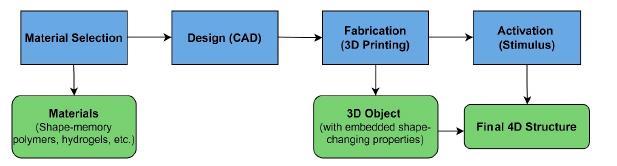
Figure1:Anoverviewofthe4Dprintingprocess
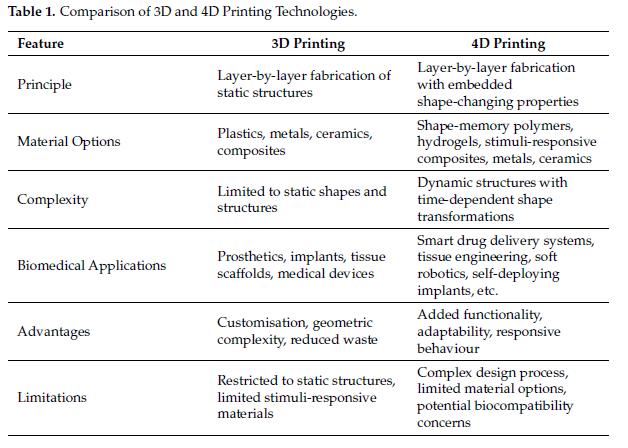
Table 1 compares the key features, advantages, and limitationsof3Dand4Dprintingtechnologiesinthecontext ofbiomedicalengineering.Overall,theadventof4Dprinting technologyholdssignificantpromiseforadvancingthefield ofbiomedicalengineeringbyenablingthedevelopmentof dynamic,stimuli-responsivestructuresthatbetterreplicate thecomplexityoflivingsystemsandaddressunmetclinical needs
Theprimaryobjectiveofthisreviewpaperistoprovidea comprehensive and up-to date overview of the advancements,challenges,andfuturedirectionsinthefield of4Dprintingforbiomedicalengineeringapplications.As4D printing technology continues to evolve, it is crucial for researchers, engineers, and clinicians to understand its implications,opportunities,andlimitationsinthebiomedical field.
Overthelastfewyears,advancementsin4Dprintinghave significantlyimpactedthefieldofbiomedicalapplications. Thisinnovativetechnologyhasthepotentialtoreshapethe biomedicalsector,offeringpromisingsolutionsforvarious challenges.Inthefollowingsections,wewilldiscussvarious materialsandmanufacturingprocessesemployedfor4D printing. We will then discuss an array of biomedical applicationsfor4Dprinting.
Materialsandmanufacturingtechniquesfor4Dprintingare essential for achieving the desired shape-shifting and functionality in printed objects. In 4D printing, smart materials are utilised due to their ability to change properties under specific environmental conditions or stimuli.Advancedmanufacturingtechniquesfor4Dprinting enable the precise fabrication of complex, multi-material structureswithtailoredresponsestospecificstimuli.These techniqueshaveevolvedtomeettheuniquerequirementsof 4Dprinting,includingtheabilitytointegratesmartmaterials and achieve high-resolution features. A brief overview of these materials and techniques can be found in the subsequentsections.
The development of smart materials that can respond to external stimuli is a critical aspect of 4D printing in biomedicalengineering.Thesematerialsenablethecreation ofdynamicstructurescapableoftransformingtheirshapeor properties in response to changes in the environment. Incorporatingsmartmaterialsinto4Dprintingprocesses allows researchers to create dynamic structures with transformativepotentialacrossthehealthcarefield.Shapememory polymers (SMPs) are one example of smart materialsusedin4Dprinting.SMPscantransitionbetweena deformedstateandtheiroriginalshapeuponexposuretoa specificstimulus,suchasheatorlight.Thispropertyenables the fabrication of 4D-printed structures that change their shapeor configuration whensubjected to the appropriate trigger.Forinstance,anSMP-based4D-printedscaffoldcan adapt its shape to better fit the tracheal structure when exposed to body heat, potentially improving the effectivenessandprecisionoftrachealrepairprocedures.
Various fabrication techniques have been adapted for 4D printing,witheachmethodofferingspecificadvantagesand limitationsdependingonthematerialsusedandthedesired application.Belowarethetypicalmanufacturingprocesses usedfor4Dprinting.FusedDepositionModelling(FDM)isa
International Research Journal of Engineering and Technology (IRJET) e-ISSN: 2395-0056
Volume: 11 Issue: 05 | May 2024 www.irjet.net p-ISSN: 2395-0072
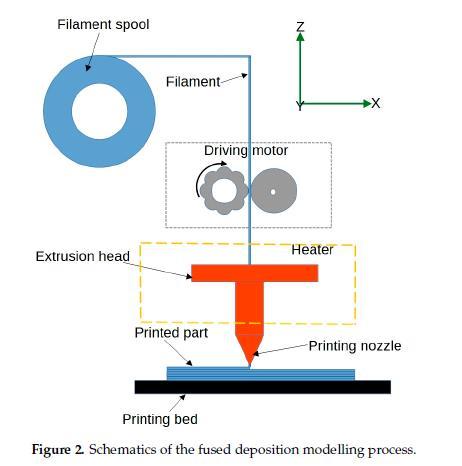
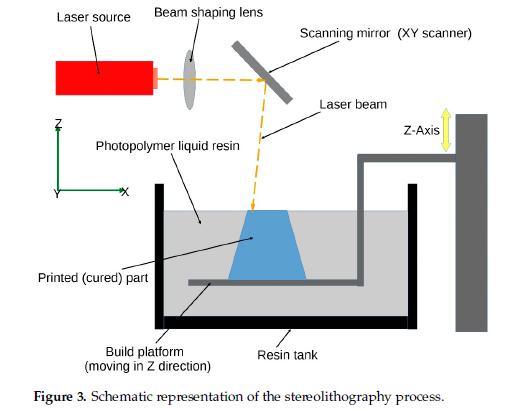
widely used 3D printing technique that involves the extrusion of a thermoplastic filament through a heated nozzle,whichdepositsthemateriallayerbylayertocreate the desired object. Figure 2 shows a schematic representation of the FDM process. In 4D printing for biomedicalengineering,FDMcanbeusedtoprintstructures withshape-memorypolymers,whichcanchangetheirshape uponexposuretospecificstimuli,suchasheat.Forexample, researchers have used FDM to print customisable lattice structures for bone implants. This innovative approach enables the implant to conform to a patient’s unique anatomy, which may enhance osseointegration, improve surgical outcomes, and increase patient comfort. V Stereolithography(SLA)isa3Dprintingtechniquethatuses a light source, usually a laser, to selectively cure a photosensitive resin layer by layer. A sketch of the stereolithography process is depicted in Figure 3. By incorporatingsmartmaterialsintotheresin,researcherscan create4D-printedstructureswithbiomedicalapplications. Forinstance,scientistshaveusedSLAtoprinthydrogelsthat swellorshrinkinresponsetochangesinpH,whichcouldbe usedindrugdeliverysystemsforcontrolledandtargeted releaseofmedications.
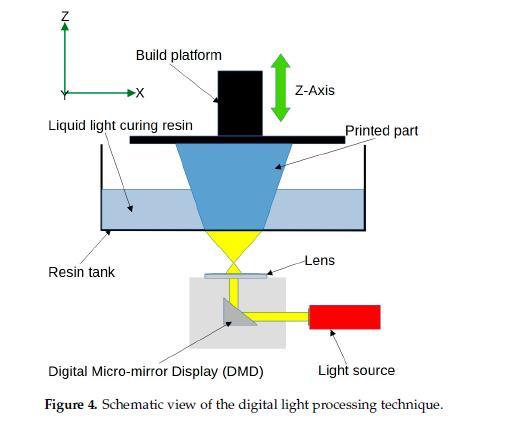
DigitalLightProcessing(DLP)issimilartoSLA,butinstead ofusingalaser,itemploysadigitallightprojectortocurethe resin.Figure4showsaschematicviewoftheDLPprocess. Thistechniquecanachievehigherprintingspeedsandfiner
resolutioncomparedtoSLA,makingitsuitableforprinting intricate4Dstructuresinbiomedicalengineering.
Researchers have used DLP to create 4D-prined bioresorbable devices with near-infrared responsiveness, photothermal properties, and shape-memory functions. These innovative devices have the potential to transform various medical applications, such as drug delivery and minimally invasive surgery, by offering customisable, dynamic,andefficientsolutions
Selective Laser Sintering (SLS) is a powder-based 3D printingtechniquethatusesalasertoselectivelysinteror fuse powdered material layer by layer, as illustrated in Figure5.Byincorporatingshape-memorypolymersorother smartmaterialsinthepowder, itispossible tocreate 4Dprintedstructuresforbiomedicalapplications Forexample, Multi-MaterialJettinginvolvesthesimultaneousdeposition ofmultiplematerialsduringtheprintingprocess,allowing for the creation of 4D-printed structures with varying mechanical properties or responsiveness to stimuli. A schematic presentation of the multi-material jetting technique is shown in Figure 6. Multi-material jetting enablesthefabricationofcomplex,multi-functionalobjects for biomedical applications. Researchers have used this techniquetomanufactureliquid–solidco-printingofmultimaterial 3D fluidic devices with potential biomedical applications such as microfluidic devices or lab-on-a-chip systems.
Direct Ink Writing (DIW) is an extrusion-based printing techniquethatinvolvesthedepositionofaviscousink,often containingparticlesorfibres,tocreatethedesiredstructure. AschematicviewoftheDIWprocessisshowninFigure7.In 4Dprintingforbiomedicalapplications,DIWcanbeusedto print structures using bio-inks containing living cells, enablingthefabricationoffunctionaltissueconstructsfor regenerativemedicineandtissueengineering.Forexample, scientists have used DIW-based 4D printing to fabricate smarthydrogelscaffoldsthatcanundergocontrolledshape transformations in response to specific environmental stimuli. This approach has the potential to enhance the fabrication of patient-specific implants, improving patient outcomes, and advancing the fields of drug delivery and minimallyinvasivesurgery.
International Research Journal of Engineering and Technology (IRJET) e-ISSN: 2395-0056
Volume: 11 Issue: 05 | May 2024 www.irjet.net p-ISSN: 2395-0072
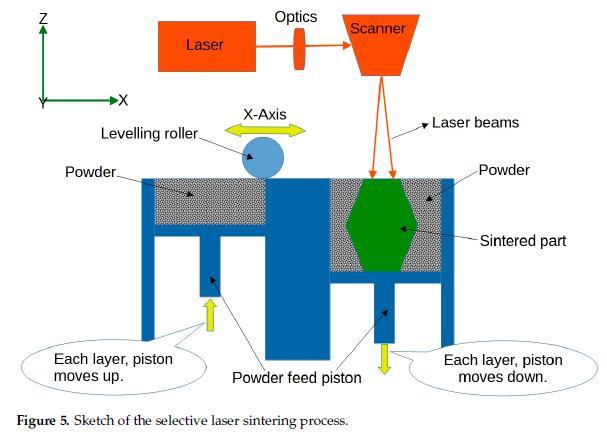
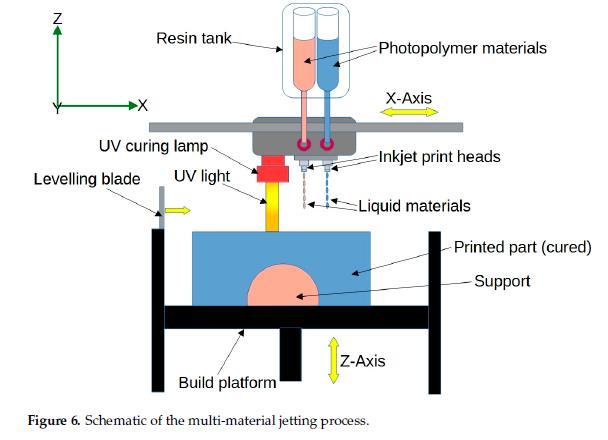
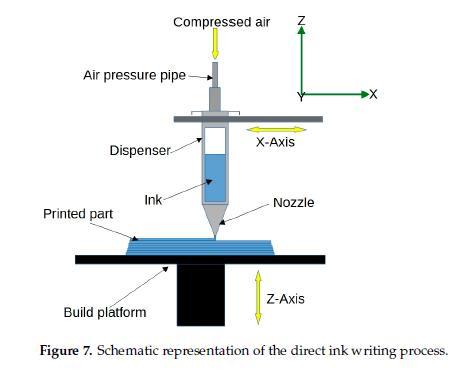
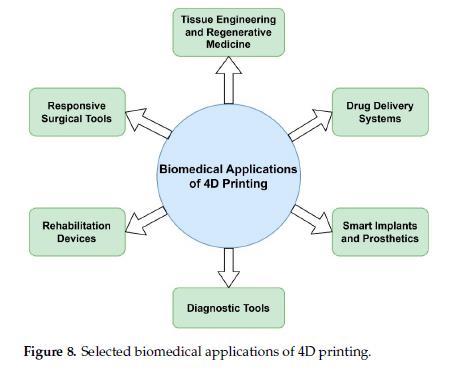
Figure 8 serves as a visual summary of the various biomedicalapplicationsof4Dprintingtechnologythatwill bethoroughlydiscussedinthesubsequentsections,offering a comprehensive overview of the potential impact of this technologyonthefutureofhealthcare
Theemergenceof4Dprintingtechnologyhasbroughtabout remarkableprogressinthecreationofsmartimplantsand prosthetics. By adding the element of time as the fourth dimension,4D-printeddevicescanself-transformoradaptin response to specific stimuli, such as temperature, light, moisture,ormagneticfields.Thisuniqueattributehasledto a significant shift in the field of biomedical engineering, particularly in the design and fabrication of customisable andadaptableimplantsandprosthetics.
4D printing technology has demonstrated remarkable potential in the development of advanced drug delivery systems. These systems offer significant advantages over traditional methods, including controlled release of medication, patient-specific dosing, and targeted delivery, ultimately leading to improved treatment outcomes and patientexperiences.
4Dprintingtechnologyhasshownimmensepromiseinthe fieldsof tissue engineering andregenerative medicine. By incorporating living cells into bio-inks and leveraging the unique capabilities of 4D printing, researchers have been abletocreatestructuresthatcantransformanddevelopinto functionaltissueovertime.Thisground-breakingapproach has the potential to transform organ transplantation and promotefasterhealingfordamagedtissues.
4Dprintingtechnologyhasshownimmensepotentialinthe developmentofresponsivesurgicaltoolsthatcanadaptto changes in their environment, providing surgeons with greaterprecisionandcontrolduringcomplexprocedures.By leveraging the unique properties of 4D-printed materials, theseinnovativetoolscanadjusttheirshapeandstiffnessin response to specific stimuli, leading to improved surgical outcomesandreducedrecoverytimesforpatients
4D printing technology has shown great potential in the development of advanced diagnostic tools that can revolutionisthefieldofmedicaldiagnostics.Byleveraging the unique properties of 4D-printed materials, which can change their shape or properties in response to specific stimuli,researcherscancreatediagnostic devicesthat are more sensitive, accurate, and patient-specific, ultimately leadingtoimprovedpatientcareandoutcomes.
International Research Journal of Engineering and Technology (IRJET) e-ISSN: 2395-0056
Volume: 11 Issue: 05 | May 2024 www.irjet.net p-ISSN: 2395-0072
Theadventof4Dprintingtechnologyhasbroughtabouta paradigm shift in the field of biomedical rehabilitation, introducing a new dimension of possibilities for creating adaptive,responsive,andsmartdevices.Thisnewapproach hasthepotentialtoredefinethedesign,manufacturing,and application of biomedical rehabilitation devices, making them more personalised, efficient, and comfortable for patients.
Despite the significant advancements in 4D printing for biomedical applications, several challenges remain to be addressed before the widespread adoption and implementationofthistechnologyinclinicalsettings.
3.1. Materials Limitations
3.1.1.
The performance of 4D-printed biomedical devices and structuresisheavilydependentonthematerialsused.Smart materials,suchasshape-memorypolymers,hydrogels,and stimuli-responsive materials, need to exhibit the desired behaviour and response to external stimuli to fulfill their intended function. However, finding materials with the appropriatepropertiescanbechallenging.Themechanical properties, such as strength, flexibility, and durability, of thesematerialsmaynotalwaysmeettherequirementsfor specific biomedical applications. Additionally, it is often difficulttocombinemultiplesmartmaterialsinasingle4Dprintedstructure,limitingtherangeoffunctionalitiesthat canbeachieved.Furthermore,the4Dprintingprocesscan alsoimposeconstraintsonthematerialsused.Forinstance, somefabricationtechniquesrequirematerialstowithstand hightemperatures,mechanicalstress,orexposuretolightor chemicals during the printing process. These factors can limit the range of materials available for 4D printing in biomedicalapplications.
Biocompatibility is a critical consideration in biomedical engineering, as the materials used must be non-toxic and non-immunogenic to ensure the safety of patients. This requirementcanfurtherlimitthechoiceofmaterialsfor4D printing.Thedevelopmentofbiocompatiblesmartmaterials isstillanongoingareaofresearch,anditcanbechallenging to find materials that not only exhibit the desired shapechanging behaviour, but also comply with the stringent biocompatibility requirements. Moreover, the processing techniques used in 4D printing can also affect the biocompatibility of the final product. For example, some fabrication methods may leave residual chemicals or
particles that could cause adverse reactions in patients. Ensuringthatthe4Dprintingprocessdoesnotcompromise the biocompatibility of the printed structure is crucial for successfulimplementationinbiomedicalapplications.
Thedegradationrateof4D-printedbiomedicaldevicesisa significantconcern,particularlyinapplicationssuchasdrug delivery systems, tissue engineering, and implantable devices. The materials used in these applications should degrade at an appropriate rate, allowing the device or structuretoperformitsintendedfunctionwithoutcausing harmtothepatient.Forexample,indrugdeliverysystems, the degradation rate should be controlled to ensure the properreleaseofthetherapeuticagentoveraspecificperiod [15]. In tissue engineering, the scaffold material should degradeataratethatmatchesthegrowthanddevelopment ofnewtissue.However,achievingthedesireddegradation rate can be challenging due to the complex interactions between the material, the fabrication process, and the biological environment. Factors such as material composition, structure, and processing conditions can significantlyaffectthedegradationbehaviourof4D-printed devices. Furthermore, the degradation rate may also be influencedbyfactorsspecifictothepatient,suchasthelocal biological environment, immune response, and individual healingrate.Researchersneedtoconsiderthesevariables when designing 4D-printed biomedical devices to ensure optimalperformanceandpatientsafety.
3.2.1.
One of the key advantages of 4D printing is the ability to create structures with varying mechanical properties and responsiveness to stimuli by incorporating different materials into the printed object. This capability is particularly important in biomedical applications, where devicesoftenneedtoexhibitarangeofproperties,suchas flexibility,rigidity,orresponsivenesstospecificstimuli,to functioneffectively.However,integratingmultiplematerials inasingle4D-printedstructurecanbechallengingduetothe limitations of current printing technologies. Achieving precise control over the distribution and interaction of differentmaterialsina4D-printedstructureisessentialto ensurethedesiredperformanceandbehaviourofthefinal product.Thisrequiresadvancedprintingtechniquesthatcan depositmultiplematerialssimultaneouslywhilemaintaining precise control over their placement and interaction Additionally, the materials used must be compatible with one another to prevent potential issues, such as delaminationorpooradhesionbetweenlayers.Addressing these challenges will require the development of new printingtechniques and material formulations specifically designed for multi-material 4D printing in biomedical applications.
International Research Journal of Engineering and Technology (IRJET) e-ISSN: 2395-0056
Volume: 11 Issue: 05 | May 2024 www.irjet.net p-ISSN: 2395-0072
Highresolutionandaccuracyarecrucialin4Dprintingfor biomedicalengineering,astheprintedstructuresoftenneed tohaveintricatefeaturesorprecisedimensionstofunction effectively.Forexample,tissueengineeringscaffoldsrequire a high degree of porosity and precise pore geometry to promotecellattachmentandgrowth[91],whileimplantable devicesmusthaveaccuratedimensionstofitproperlywithin the patient’s body [39]. However, achieving the required resolution and accuracy in 4D printing can be challenging duetothelimitationsofcurrentprintingtechnologies.
Scalabilityisanothersignificantchallengein4Dprintingfor biomedicalengineering,astheprintedstructuresmustoften beproducedinlargequantitiesoratdifferentscalestomeet theneedsofvariouspatients.Moreover,themanufacturing processshouldbecosteffectiveandtime-efficienttoensure thewidespreadadoptionof4D-printedbiomedicaldevices. However, many current 4D printing techniques are timeconsuming and have limited scalability, making them unsuitableforlarge-scaleproduction.
As 4D printing technology continues to mature, there is immensepotentialforfurtheradvancementsinbiomedical engineering.Thissectionhighlightsfuturedirectionsfor4D printing in the field, offering novel solutions to pressing clinicalchallenges.
4Dprintinginvolvesthecreationofsmartmaterialsthatcan changetheirpropertiesor shapeovertimeinresponse to externalstimuli.Asresearchanddevelopmentinthisfield progress,severalemergingtrendsandareasofresearchare expected to shape the future of 4D printing in biomedical engineering.
IntegrationofSensorsandElectronics
BiohybridSystems
Self-HealingMaterials
PersonalisedMedicine
EnvironmentalandBiodegradableMaterials
Multi-StimuliResponsiveMaterials
BiomimeticMaterials
Nanomedicine
Advancements in fabrication techniques are crucial for driving innovation in 4D printing and other emerging technologies.Asthefieldevolves,researcherscontinueto
explorenewmethodsandrefineexistingonestocreatemore sophisticated, efficient, and precise fabrication processes. Some notable advancements in fabrication techniques include
Multi-material and multi-process printing is a pivotal advancementinfabricationtechniques,enablingthecreation of complex, multifunctional structures by combining different materials and processes simultaneously. This innovationisparticularlysignificantfor4Dprinting,where materialswithdiverseresponsivenesstostimuliareoften mergedtoachievedesireddynamicbehaviours.
High-resolution printing has made significant strides in fabrication techniques, allowing for the creation of structures with intricate geometries and features at the micro- or even nano scale. This precision is crucial for applications such as tissue engineering and drug delivery systems, where fine control over structure and material properties is essential. Developments in high-resolution printing techniques, such as two-photon polymerization, haveexpandedthepossibilitiesforfabricatingcomplex3Dand4D-printedconstructs,enablingahigherlevelofdetail and functionality. This has led to the creation of more sophisticated medical devices, biomimetic tissues, and targeteddrugdeliverysystems,amongotherapplications.As researchcontinues,furtheradvancementsinhighresolution printingtechniqueswilldriveinnovationinvariousfields, including biomedical engineering and nanotechnology, enhancing the potential impact and capabilities of 4D printingandotheremergingtechnologies.
Hybrid fabrication techniques, which combine multiple fabricationmethods,haveemergedasakeyadvancementin fabrication technology. These techniques unlock novel structuresandfunctionalitiesbymergingmethodssuchas 3D printing with electro spinning or bioprinting with microfluidics.Thissynergyresultsin4D-printedconstructs with enhanced mechanical, biological, and stimuliresponsiveproperties.Thesehybridtechniquescancreate constructswithdiversecharacteristics,pavingthewayfor new applications in biomedical engineering. For example, combining 3D printing with electrospinning can produce scaffolds with tunable mechanical properties and tailored pore structures, which are ideal for tissue engineering Continuedresearchintohybridfabricationtechniqueswill furtherexpandthecapabilitiesandpotentialapplicationsof 4Dprinting,leadingtonovelinnovationsinvariousfields.
International Research Journal of Engineering and Technology (IRJET) e-ISSN: 2395-0056
Volume: 11 Issue: 05 | May 2024 www.irjet.net p-ISSN: 2395-0072
Self-assembly and self-folding techniques are emerging as promisingfabricationmethodsforcreatingcomplex3Dand 4D structures. By leveraging the inherent properties of materialsandprecisecontrolofenvironmentalconditions, thesetechniquesenabletheformationofdynamicconstructs without the need for external manipulation or assembly. Self-assembly relies on the spontaneous organisation of materials into ordered structures, driven by molecular interactionsandsurfacechemistry.Self-folding,ontheother hand,involvesinducingshapechangesinmaterialsthrough programmedstresspatternsorstimuli-responsiveelements [15,104,105]. Both approaches are vital for 4D printing applications,astheycanproducestructuresthatadaptand respondtoenvironmentalcues.for4Dprintinginbiomedical engineering,contributingtothedevelopmentofinnovative solutionsandtechnologies.
Embeddedsensorsandactuatorsin4D-printedconstructs offerreal-timemonitoringandcontroloftheirbehaviours, enabling the creation of smart structures that respond to variousstimuli.Advancesinfabricationtechniquesallowfor theseamlessintegrationofthesecomponentsintoprinted constructs, enhancing their functionality. For instance, embedded sensors in tissue-engineered constructs can providecontinuousmonitoringofcellularactivities.Further research in embedding sensors and actuators will unlock new possibilities in 4D printing, leading to innovative solutionsacrossvariousdomainsofbiomedicalengineering.
Biofabricationtechniques,suchasbioprintingandcell-laden hydrogelprinting,haveadvancedsignificantly,enablingthe incorporationoflivingcellsandbiomoleculeswithin3D-and 4D-printedconstructs.Thisisessentialforapplicationslike tissue engineering and regenerative medicine, where interactionsbetweenprintedmaterialsandlivingcellsare criticalforsuccess.Advancementsinbiofabricationhaveled to the creation of more biomimetic and functional tissue constructs,improvingtheirintegrationwithinthebodyand promoting healing. As research progresses, biofabrication techniques will continue to evolve, allowing for more sophisticated 4D-printed constructs with enhanced biologicalproperties,ultimatelyrevolutionisinghealthcare andprovidingnewtherapeuticoptions.
Machine learning and AI-driven design have become increasinglyimportantinthedevelopmentandoptimisation of fabrication processes, including 4D printing. These technologies can predict the behaviour of 4D-printed materialsandstructures,guidingtheselectionofmaterials,
geometries,andfabricationparameterstoachievedesired functionalities.IncorporatingAIandmachinelearninginto thedesignprocessallowsfortheexplorationofvastdesign spaces,identificationofoptimalsolutions,andpredictionof material properties and performance. This leads to more efficientand effective fabrication processesand improved 4D-printed constructs. As research in AI and machine learning progresses, their integration into fabrication techniques will enhance the capabilities of 4D printing technology, enabling thecreationof increasinglycomplex, functional,andresponsivematerialsandstructuresacross variousapplicationsandindustries.
Scalabilityandautomationareessentialfortranslating4D printing from research labs to real-world applications. Advancementsinhigh-throughputmanufacturingmethods, automated quality control systems, and standardised processes and protocols will accelerate the large-scale production of 4D-printed constructs. By improving scalability and automation, 4D printing technology can becomemoreaccessibleandcost-effective,pavingtheway for widespread adoption in biomedical engineering. As research continues, further innovations in scalable and automatedfabricationtechniqueswillplayacrucialrolein unlocking the full potential of 4D printing and driving its integrationintovariousapplications.
Thisreviewpaperhasprovidedacomprehensiveoverview oftheadvancements,challenges,andfuturedirectionsfor4D printinginbiomedicalengineering.4Dprintingtechnology has emerged as a promising approach to address various unmetclinicalneedsandrevolutionishealthcarepractices byintegratingtheadvantagesof3Dprintingwiththeadded dimensionoftime-dependentshapetransformations.
Thepaperhasdiscussedthesignificantadvancementsin4D printing for biomedical applications, including the developmentofstimuli-responsivematerials,innovationsin fabrication techniques, and successful implementation in variousfieldssuchastissueengineering,drugdelivery,and medical devices. Moreover, the review has highlighted several exciting future directions for 4D printing in biomedical engineering, such as the development of advancedsmartmaterials,integrationofbioprintingand4D printingtechniques,personalisedmedicine,nanomedicine, andbioelectronicdevices.Addressingthesechallengesand exploring these future directions will be essential for realising the full potential of 4D printing technology in variousbiomedicalapplications.
As4Dprintingtechnologycontinuestoadvance,itispoised tomakesignificantcontributionstobiomedicalengineering, ultimately improving patient outcomes and transforming
International Research Journal of Engineering and Technology (IRJET) e-ISSN: 2395-0056
Volume: 11 Issue: 05 | May 2024 www.irjet.net p-ISSN: 2395-0072
healthcare practices. By fostering interdisciplinary collaboration,promotingpublicengagementandeducation, andencouragingindustrypartnerships,4Dprintinghasthe potentialtotransformthewayweapproachthedesignand developmentofmedicaldevices,treatments,andtherapies. It is clear that 4D printing technology holds immense promise for the future of biomedical engineering, and continuedresearchandinnovationinthisfieldwillpavethe wayforinnovativeadvancementsinhealthcare
[1] Asif,M.;Lee,J.H.;Lin-Yip,M.J.;Chiang,S.;Levaslot, A.; Giffney, T.; Ramezani, M.; Aw, K.C. A new photopolymerextrusion5-axis3Dprinter.Addit. Manuf.2018,23,355–361.[CrossRef]
[2] Domett,P.;Arjmandi,M.;Ramezani,M.Designand manufacturingofkneeimplantsforosteoarthritis patients.SolidStatePhenom.2020,311,1–11.
[3] Saeidi,M.;Gubaua,J.E.;Kelly,P.;Kazemi,M.;Besier, T.; Dicati, G.W.O.; Pereira, J.T.; Neitzert, T.; Ramezani, M. The influence of an extra-articular implant on bone remodelling of the knee joint. Biomech. Model. Mechanobiol. 2020, 19, 37–46. [CrossRef][PubMed]
[4] Marinopoulos, T.; Li, S.; Silberschmidt, V.V. Structural integrity of 3D-printed prosthetic sockets: Experimental study for paediatric applications. J. Mater. Res. Technol. 2023, 24, 2734–2742.[CrossRef]
[5] Yang,J.;Yang,K.;Man,W.;Zheng,J.;Cao,Z.;Yang,C.Y.;Kim,K.;Yang,S.;Hou,Z.;Wang,G.;etal.3Dbioprintedlivingnerve-likefibersrefinetheecological niche for long-distance spinal cord injury regeneration. Bioact. Mater. 2023, 25, 160–175.[CrossRef]
[6] Abdullah, T.; Okay, O. 4D Printing of Body Temperature-Responsive Hydrogels Based on Poly(acrylic acid) with Shape-Memory and SelfHealing Abilities. ACS Appl. Bio Mater. 2023, 6, 703–711.[CrossRef]
[7] Patadiya, J.; Naebe, M.;Wang, X.; Joshi, G.; Kandasubramanian, B. Emerging 4D printing strategiesforon-demandlocalactuationµ printingofsoftmaterials.Eur.Polym.J.2023,184, 111778.
[8] Asif,M.;Ramezani,M.;Khan,K.A.;Khan,M.A.;Aw, K.C.Experimentalandnumericalstudyoftheeffect of silica filler on the tensile strength of a 3Dprinted particulate nanocomposite. Comptes RendusMec.2019,347,615–625.[CrossRef]
[9] Li,M.;Assadian,M.;Ramezani,M.;Aw,K.C.Printed soft angular/torque sensors using carbon blacksiliconecomposite.Sens.Rev.2019,39,598–603. [CrossRef]
[10] Saeidi, M.; Ramezani, M.; Kelly, P.; Neitzert, T.; Kumar,P.Preliminarystudyonanovelminimally invasive extra-articular implant for unicompartmentalkneeosteoarthritis.Med.Eng. Phys.2019,67,96–101.[CrossRef]
[11] Pasang,T.;Ramezani,M.;Prygoski,M.;Wanhill,R.; Byrnes, R.; Kamiya, O.; Tanaka, K. Fatigue of commerciallypuretitaniumdentalimplants.Mater. Phys.Mech.2016,27,79–89.
[12] Arjmandi, M.; Ramezani, M.; Bolle, T.; Köppe, G.; Gries, T.;Neitzert,T. Mechanical andtribological properties of a novel hydrogel composite reinforcedbythree-dimensionalwoventextilesas a functional synthetic cartilage. Compos. Part A Appl.Sci.Manuf.2018,115,123–133.[CrossRef]
[13] Taneja, H.; Salodkar, S.M.; Singh Parmar, A.; Chaudhary,S.Hydrogelbased3Dprinting:Bioink for tissue engineering. J. Mol. Liq. 2022, 367, 120390.[CrossRef]
[14] Muhindo,D.;Elkanayati,R.;Srinivasan,P.;Repka, M.A.; Ashour, E.A. Recent Advances in the Applications of Additive Manufacturing (3D Printing) in Drug Delivery: A Comprehensive Review. AAPS PharmSciTech 2023, 24, 57. [CrossRef][PubMed]
[15] Zhang,Y.;Raza,A.;Xue,Y.-Q.;Yang, G.;Hayat,U.; Yu, J.; Liu, C.; Wang, H.-J.; Wang, J.-Y. Waterresponsive4Dprintingbasedonself-assemblyof hydrophobic protein “Zein” for the control of degradationrateanddrugrelease.Bioact.Mater. 2023,23,343–352.[CrossRef]