
International Research Journal of Engineering and Technology (IRJET) e-ISSN:2395-0056
Volume: 11 Issue: 05 | May 2024 www.irjet.net p-ISSN:2395-0072
International Research Journal of Engineering and Technology (IRJET) e-ISSN:2395-0056
Volume: 11 Issue: 05 | May 2024 www.irjet.net p-ISSN:2395-0072
Pooja
Gupta1, Komal Ahuja2
1M.Tech Student, Computer Science Engineering Department, GRIMT,Radaur(Yamunanagar), Haryana, India
2Assistant Professor, Computer Science Engineering Department, GRIMT,Radaur(Yamunanagar), Haryana, India
Abstract
Software defect along with an intrinsic element of softwareproductisalsoanimportantaspectofsoftware quality. Software defects are an unavoidable co product of the developed software. In addition to this, the guarantee of software quality assurance is not so easy andrequiresalotoftimetoo.Therearedifferentwaysto define defects, such as in terms of quality. The defects may be present in all products whether it is a small program or large-scale software system. A number of defects can be discovered without any complexity. The various steps are applied for the software defect prediction which includes pre-processing, feature extraction and classification. The various techniques whichareproposedintheprevioustimeforthesoftware defect prediction are reviewed and analysed in this paper. The techniques are reviewed in terms of technique description and their findings in terms of variousparameters
Keywords - Software defect, Prediction, Machine learning, Pre-processing, Feature extraction, Classification
1. Introduction
Becauseoftheincreasingcomplexityoftoday’ssoftware and enhance chances of failures, ensuring reliability has become an important concern. Organisations such as Google employ code review and unit testing to identify problems in new code and increases reliability. Meanwhile, testing each code unit is not practical and human code reviews are labour- intensive [1]. With less funding for software projects, it is fruitful to detect potentialissuesimmediately.Asaresult,softwaredefect prediction algorithms are commonly employed to automatically identify possible mistakes, enabling developers to make optimal consumption of their resources. Software defect prediction includes, creating classifiers that analyse data such as change history and complexity of code to identify code segments with potential flaws. This practice ensures code reviewers to allocate their efforts with more strategy and receive warningsaboutpotentiallybuggycoderegionsbasedon the prediction outcomes [2]. These code sections may includealterations,files,orprocesses.Inthetypicalfault prediction process, there are two main stages: feature extraction from source files and the creation of a
classifier using various machine learning techniques. Previous research emphasises on enhancing the precision of predictions has mainly involved manually crafting discriminative features or combining characteristics[3].Halsteadfeaturesbasedonoperators and operands, McCabe features based on dependencies, and CK features for object-oriented programs are some of the examples. However, traditional hand-crafted features often overlook the intricate semantics and clearly-defined syntax concealed in the Abstract Syntax Trees(ASTs)ofprograms.
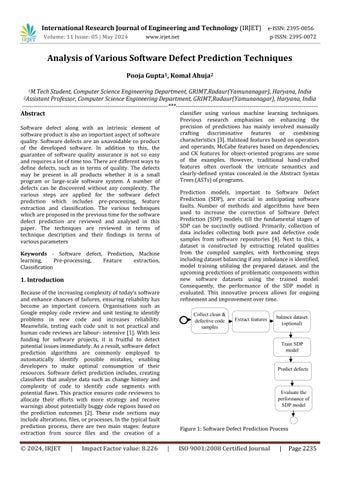
Prediction models, important to Software Defect Prediction (SDP), are crucial in anticipating software faults. Number of methods and algorithms have been used to increase the correction of Software Defect Prediction (SDP) models, till the fundamental stages of SDP can be succinctly outlined. Primarily, collection of data includes collecting both pure and defective code samples from software repositories [4]. Next to this, a dataset is constructed by extracting related qualities from the compiled samples, with forthcoming steps includingdatasetbalancingifanyimbalanceisidentified, model training utilizing the prepared dataset, and the upcomingpredictionsofproblematiccomponentswithin new software datasets using the trained model. Consequently, the performance of the SDP model is evaluated. This innovative process allows for ongoing refinementandimprovementovertime.


Collect clean & defective code samples Extract features


Train SDP model balance dataset (optional)


Evaluate the performance of SDP model Predict defects
Figure1:SoftwareDefectPredictionProcess
International Research Journal of Engineering and Technology (IRJET) e-ISSN:2395-0056
Volume: 11 Issue: 05 | May 2024 www.irjet.net
As described in Figure 1, the first step of the process involvesthecollectionofbothfunctionalandfaultycode examples [5]. Software data, creating source codes, commitmessages,bugreports,andother artifactsexists in different formats and is typically sourced from repositoriesandarchives.Nexttothis,thesecondstepin the Software Defect Prediction (SDP) process is feature extraction. During this phase, various data sources such as commit logs, messages, source codes, and software artifactsarechangedintometricsthatserveasinputfor model training. During feature extraction, it's important to consider the nature of the input data which may encompass McCabe metrics, CK metrics, convert histories, assembly code, and source code, along with representationofdata[6].Alongwithmetric-baseddata, ample of deep learning techniques presently provide automatedfeatureextractioncapabilitiesandcanhandle the data with high-dimension and more complexity. An optional step sometime follows after this. Given that defectdatasetstypicallyconsistofa dramaticallylowest percentage of defective components as compare to fine ones, this stage involves balancing of data. The unbalanced structure of class can cause misleading outcomes for different performance evaluation metrics used in assessing Software Defect Prediction (SDP) [7], therefore badly affect most SDP strategies. Numerous methodslikeoversamplingcanbeemployedtominimize thisconcernandincreasetheperformanceofSDP.
ThefourthphaseoftheSoftwareDefectPrediction(SDP) process involves analysing the problematic areas within the software. At this stage, mainly focus is on selecting optimal Deep Learning (DL) algorithms and techniques, which may encompass various topologies such as Convolutional Neural Networks [8], and machine learning categories like supervised or unsupervised learning. In addition to this, during this step an important consideration is determining the level of granularity at which the sections of problems are to be detected, which could range from module and file levels to class [9], function, or even phrase levels. The upcoming step entails predicting the faulty parts within fresh (test) data by using the model trained in the previous stage. Lastly, the prediction made in this step acts as input for the final phase of the SDP process. The final phase of the Software Defect Prediction (SDP) process including the evaluation of created model. Different alternatives, such as the area under the curve and the F-measure, can be employed to increase the performanceofSDPmodel[10].Thenpredictionmodels are evaluated and compared them with other pertinent studies by using one or more of these measures. In the realm of software defect prediction, Machine learning classifiers have garnered a lot of attention due to their ability to predict the mistakes of software by analysing code and features extraction from raw data sources. Over the past few decades, ample of machine learningbased methods have been developed specifically to
p-ISSN:2395-0072
identify software issues [11]. One prominent machine learning technique for tasks involving reduction of features, detection, regression, and classification is the support vector machine. Locate a hyperplane (or series ofhyperplanesformoreclasses)ismainfocusthatsplits twoclasses.Theplaneisselectedinawaybyincreasing the distance from the two data clusters, that separates the two classes of data points. Because it offers some possibility that future data can be classified more precisely, it is meaningful to increase this kind of distancemetric.Supportvectorsarethedatapointsthat are nearest to the hyperplane [12]. The position of hyperplaneisadjustedinaccordingtothesupportvector positions to preserve the maximum distance between the data points of both classes. A supervised learning method called Random Forest defines the concept of merginglearningmodelstogainasuperiorperformance superior to that of a single model. Specifically, it integratesseveralDecisionTreestoproduceaprediction with more accuracy. In order to construct a lot of decision trees from the dataset and merge them into a final judgment, this approach called randomness [13]. However,thevariableswithmaximumdepthallowsyou to set the tree's depth, and n_estimators enable us to limitthecountofdecisiontreesinthetree.Theabilityto calculate a significance score for every feature which givesussomeinsightintothefeaturesthatareimportant to get an accurate prediction is one benefit of employing random forest. The number of neighbours suchaskistheprimarydeterminingfeatureink-nearest neighbour.Thisclassifierisusedforbothregressionand classification problems [14]. In both circumstances, the output relies on whether k-NN is applied to the regression or classification model, and the k closest training examples are taken into consideration as input [15]. The algorithm work on the presumption that the newandpresentdataissame.Whenanewcaseorsetof data is received, the algorithm places it in the category that shares the lot of similarities with the existing categories[16].
M. Ali, et.al (2024) suggested an intelligent ensemble framework that integrated various classification techniques to forecast software defects [17]. Their approach involved a two-phase procedure designed for detecting defective modules. Initially, the focus was on utilizing four supervised machine learning (SML) methods: Random Forest (RF), Support Vector Machine (SVM), Naïve Bayes (NB), and Artificial Neural Network (ANN). They employed an iterative parameter optimizationtechniquetoenhancetheaccuracyofthese methods. Subsequently, the second phase aimed to amalgamate the accuracy of each method into a voting ensemble to predict defects in software effectively. This framework significantly improved the accuracy and reliability of software defect prediction. The proposed
International Research Journal of Engineering and Technology (IRJET) e-ISSN:2395-0056
Volume: 11 Issue: 05 | May 2024 www.irjet.net
framework was evaluated using seven datasets sourced from the NASA MDP repository. The experimental outcomes demonstrated the superiority of their approach over existing methods in predicting software defects.
R. Haque, et.al (2024) introduced an innovative technique called heterogeneous cross-project defect prediction (HCDP), employing encoder networks and a transfer learning (ENTL) model to anticipate software defects [18]. The encoder networks (ENs) were leveraged to extract significant features from both the source and target datasets. Furthermore, negative transfer in transfer learning (TL) was alleviated by incorporating an augmented dataset containing pseudolabelsandthesourcedataset.Themodelwastrainedon a single dataset and evaluated on sixteen datasets derived from four public projects. A comparative analysis was conducted against traditional methods, employing cost-sensitive learning (CL) to address imbalanced class issues. Experimental results demonstratedtherobustnessoftheproposedmethodin predicting software defects, outperforming traditional methods across metrics such as PD, PF, F1-score, Gmean,andAUC.
Y. Al-Smadi, et.al (2023) introduced an innovative approach for predicting software defects by implementing 11 machine learning (ML) techniques across 12 diverse datasets [19]. They utilized four diverse meta-heuristic algorithms: particle swarm optimization (PSO), genetic algorithm (GA), harmony algorithm (HA), and ant colony optimization (ACO) to select features. Additionally, they applied the synthetic minority oversampling technique (SMOTE) to address imbalanceddataissues.Moreover,theyusedtheShapley additive explanation (SAE) framework to identify decisive features. Experimental results indicated that gradient boosting (GB), stochastic gradient boosting (SGB), decision trees (DTs), and categorical boosting (CB)algorithmsperformed exceptionallywell,achieving anaccuracyandROC-AUCofover90%.Furthermore,the superiority of the categorical boosting (CB) algorithm was demonstrated against other methods for predicting softwaredefects.
A. Wang, et.al (2023) devised a Federal Prototype Learning leveraging Prototype Averaging (FPLPA) method and integrating federated learning (FL) with prototype learning (PL) to forecast heterogeneous defects in software [20]. They employed the one-sided selection (OSS) algorithm to eliminate noise from local trainingdataandutilizedtheChi-SquaresTestalgorithm to select the optimal subset of features. Subsequently, they introduced the Convolution Prototype Network (CPN) model to create local prototypes, which exhibited greater robustness against heterogeneous data compared to convolutional neural networks (CNNs),
p-ISSN:2395-0072
mitigating the impact of class imbalances in software data. The prototype served as the communication subject between clients and the server, with the local prototypedevelopedirreversiblytosafeguardprivacyin the communication process. The final task involved updatingthepresentedmodelusingthelossoflocaland global prototypes as regularization. They evaluated the developed method using the AEEEM, NASA, and Relink datasets, with simulation outcomes demonstrating its superiority over traditional methods for defect prediction.
S. Kwon, et.al (2023) projected a function-level just-intime (JIT) software defect prediction (SDP) technique aimedataddressingthechallengeofpredictingsoftware defects [21]. They prioritized limited testing resources for defect-prone functions. Their approach relied on a pre-trained method, specifically a transformer-based deep learning (TDL) model trained on a large corpus of code snippets to provide defect proneness for altered functions at a commit level. They evaluated the CodeBERT,GraphCodeBERT,andUniXCodermethodson edge-cloud systems, with a primary focus on analyzing their efficacy in this environment. Results indicated that the UniXCoder method outperformed others in the WPDP environment. Furthermore, the projected technique demonstrated stability in predicting software defects.
W. Wen, et.al (2022)introduceda ClassCodeSimilaritybased Cross-Project Software Defect Prediction (CCSCPDP) method for software defect prediction. Initially, thefocus wason converting thecodeset extracted from theAbstractSyntaxTree(AST)intoavectorset[22].To achieve this, they employed a Doc2Bow and TF-IDF (DTI) method. The second step involved computing similarity between the vector sets of target projects and training projects. Finally, they utilized the principle of the majority decision subordinate category in K-Nearest Neighbor(KNN)todeterminethenumberofoccurrences of the same class in the training project. Based on this, the class instance was selected to refine the source project, and predictions were made regarding software defects. The developed method was evaluated against traditional methods, and experimental results indicated its effectiveness, offering higher recall and F1-score in predictingsoftwaredefectscomparedtoothermethods.
S. Kassaymeh, et.al (2022) developed a Salp Swarm Algorithm (SSA) coupled with a backpropagation neural network (BPNN) to predict software faults. Their integrated method, SSA-BPNN, aimed to enhance accuracy in defect prediction by optimizing optimal metrics [23]. They applied various datasets to evaluate the presented method across different parameters including AUC, confusion matrix, sensitivity, specificity, accuracy, and error rate, varying in size and complexity. Simulation results demonstrated that the presented
International Research Journal of Engineering and Technology (IRJET) e-ISSN:2395-0056
Volume: 11 Issue: 05 | May 2024 www.irjet.net p-ISSN:2395-0072
method outperformed conventional methods, achieving higheraccuracyinsoftwaredefectprediction.Moreover, this technique proved to be an effective tool in addressingchallengeswithinsoftwareengineering.
W. Wen, et.al (2022) developed a Cross-Project Defect Prediction (CPDP) model named BSLDP to anticipate software defects. They utilized a Bidirectional Long Short-Term Memory (Bi-LSTM) algorithm combined with a self-attention (SA) method to extract semantic information from source code files [24]. The ALC model wasemployedtoextractsourcecodesemanticsbasedon source code files, and a classifier, termed BSL, was generatedusingthesemantic information fromboththe source and target projects to create a predictive framework. To enhance the model, they adopted an equal meshing method to extract semantic information from small code fragments by splitting the numerical token vector. They evaluated the designed model using the PROMISE dataset and found that it effectively predicted defects, improving the F1 score by up to 14.2%,34.6%,32.2%,and23.6%comparedtofourother techniques,respectively.
C. Yu, et.al (2021) highlighted the use of homomorphic encryption (HE) for defect prediction, introducing a novel technique called HOPE. They presented an algorithm approximation (AA) method to approximate the sigmoid function and selected the Paillier homomorphic encryption (PHE) algorithm to execute
2.1ComparisonTable
Author&Year Techniqueused Dataset
M.Ali,etal. (2024) RandomForest, SupportVector Machine,Naïve Bayes,and ArtificialNeural Network,voting ensemble
R.Haque,etal. (2024) EncoderNetworks andTransfer Learning
Sevendatasets fromdatasets fromtheNASA MDPrepository, namelyCM1,JM1, MC2,MW1,PC1, PC3,andPC4
Sixteendatasets fromAEEM,NASA, PromiseandJIRA.
logisticalregression(LR)[25].Real-timeprojectsserved as experimental subjects for generating the MORPH dataset to evaluate the formulated technique. Subsequently, three control groups were deployed to simulate three different scenarios based on whether the client transmitted encrypted data to the server and whether the formulatedtechniquewas employedonthe server. The results indicated that when the original LR was deployed on the server to generate the technique usingencrypteddata,thetrainedmodelachievedsimilar performance, thus preserving data privacy. Moreover, the formulated technique demonstrated greater efficiencyintermsofminimalcomputingcost.
L. Yang, et.al (2021) conducted a study on a hybrid approach combining particle swarm optimization (PSO) and Salp Swarm Algorithm (SSA), termed SSA-PSO, aimed at improving convergence prior to individual updates in SSA [26]. Additionally, they introduced a novel maximum likelihood estimation (MLE)-based fitnessfunction(FF)ofmetrics,usedtoinitializemetrics. They evaluated this approach using five sets of actual datasets, comparing it against individual techniques Experimental results demonstrated the stability of the SSA-PSO approach over others, showing higher convergencespeedandaccuracy.Moreover,thenovelFF helpedaddressissuesrelatedtoslowconvergencespeed and lower solution accuracy. The investigated approach provedtobemoreeffectiveinestimatingandpredicting software defects.
Findings
Accuracy=87.14, Misclassification
Rate=12.86,False Positive
Ratio=0.003,False NegativeRatio=0.905
PD=0.711,PF=0.0911, F1-score=0.475,Gmean=0.770,AUC=0.663
Y.Al-Smadi,et al.(2023) Machinelearning andmetaheuristic algorithms
Twelvedatasets fromNASA
Accuracy=0.931 ROC-AUC=above90%
Limitations
Thisstudydoesnotexplore sophisticatedmethodsfor selectingfeaturestoboost thereliabilityoftheproposed modelinsoftwaredefect prediction.
Thisevaluatesthepresented modelusing16datasetsfrom fourpubliclyavailable softwaredefectprojects, leavingbenchmarkdatasets likeRelinkandSOFTLABfor futureinvestigation,while consideringmethodslike SMOTEtoaddressclass imbalancemoreaccuratelyin upcomingresearch.
Thisworkdoesnotcompare meta-heuristicalgorithms withfiltermethodsfor
International Research Journal of Engineering and Technology (IRJET) e-ISSN:2395-0056
Volume: 11 Issue: 05 | May 2024 www.irjet.net p-ISSN:2395-0072
A.Wang,etal. (2023) Federated Prototype Learning
S.Kwon,etal. (2023) Function-level justin-time(JIT) SDP)model
AEEEM,NASAand Relink
AUC=0.8098,G-mean= 0.5978
CodeSearch
AUC=0.548,F-measure= 0.667
featureselectionorevaluate theperformanceofSMOTE againstotherresampling techniques.
Numerousmetricvariations significantlyincreasethe complexityofconstructing softwaredefectprediction models.
ThisworkcreatesSDP modelsthroughrefiningpretrainedmodels,withthe exceptionofbatchsizeand maximumsequencelength, adjustedduetomemory constraints.
W.Wen,etal. (2022) CCS-CPDP Promise Recallincreasesby 41.8%andf1-score increasesby15.9%than baselinemodels
S.Kassaymeh, etal.(2022) Salpswarm optimizer(SSA), SSA-BPNN
W.Wen,etal. (2022) DeepLearning WithSelfAttention
Ant-1.7,Ar,CM, Jedit,KC,PC,MC
AUC=0.79,Sensitivity= 0.997,Specificity=0.900, Accuracy=0.9964,
PROMISE Theperformance ofcross-projectdefect predictionintermsofF1 by14.2%,34.6%,32.2% and23.6%,respectively againstfourbaseline (DBN-CP,TCA+,ASTLSTM,DP-CNN)methods.
Theproposedapproach utilizeslimitedprojectsource codedatasetsforevaluation anddoesnotconductdata validationtestsfromvarious aspectstoverifythe performanceoftheproposed method.
Alimitationobservedinthe proposedmethodisits elevatedcomputational expenseacrossmost datasets.
Theproposedmodelsolely extractssemantic informationatthelevelof sourcecodefiles.
C.Yu,etal. (2021) HOPE MORPH Accuracy=79%,AUC=0.5 Duetotheinherent constraintofhomomorphic encryption,onlyintegerscan beencryptedduringthedata encryptionprocess
L.Yang,etal. (2021) Hybrid ParticleSwarm Optimizationand SparrowSearch Algorithm
PROMISE Accuracy=92% Withanincreasingnumberof iterations,theoptimal,worst, andaveragevaluesofy graduallydecrease.
International Research Journal of Engineering and Technology (IRJET) e-ISSN:2395-0056
Volume: 11 Issue: 05 | May 2024 www.irjet.net p-ISSN:2395-0072
Conclusion
Software defect along with an intrinsic element of softwareproduct,isalsoanimportantaspectofsoftware quality. Software defects are an unavoidable co product of the developed software. In addition to this, the guarantee of software quality assurance is not so easy andrequiresalotoftimetoo.Therearedifferentwaysto define defects, such as in terms of quality. However, the defects are generally defined in the form of deviations from specifications or expectations which may be the reasonoffailureinfunctioning.Itisanalyzedthatmajor content is published in the conferences and in the latest trends journals are preferred. In future deep learning approach will be applied for the software defect prediction.
References
[1] R. R. Panda and N. K. Nagwani, ‘‘Classification and intuitionistic fuzzy set-based software bug triaging techniques,’’ J. King Saud Univ., Comput. Inf. Sci., vol. 34, no.8,pp.6303–6323,Sep.2022.
[2]P.Oliveira,R.M.C.Andrade,I.Barreto,T.P.Nogueira, and L. M. Bueno, ‘‘Issue auto-assignment in software projects with machine learning techniques,’’ in Proc. IEEE/ACM8thInt.WorkshopSoftw.Eng.Res.Ind.Pract. (SER IP), Madrid, Spain, Jun. 2021, pp. 65–72, doi: 10.1109/SER-IP52554.2021.00018.
[3]M.PandaandA.T.Azar,‘‘Hybridmulti-objectiveGrey Wolf search optimizer and machine learning approach for software bug prediction,’’ in Handbook of Research on Modeling, Analysis, and Control of Complex Systems. 2020,doi:10.4018/978-1-7998-5788-4
[4]Z.J. Szamosvölgyi,E. T. Váradi,Z.Tóth,J. Jász,and R. Ferenc, ‘‘Assessing ensemble learning techniques in bug prediction,’’ in Computational Science and Its Applications ICCSA 2021 (Lecture Notes in Computer Science),vol.12955.Springer,2021,
[5] S. F. A. Zaidi, H. Woo, and C.-G. Lee, ‘‘A graph convolution networkbased bug triage system to learn heterogeneous graph representation of bug reports,’’ IEEE Access, vol. 10, pp. 20677–20689, 2022, doi: 10.1109/ACCESS.2022.3153075.
[6]A.Goyal andN.Sardana,‘‘An empirical studyofnonreproducible bugs,’’ Int. J. Syst. Assurance Eng. Manage., vol.10,no.5,pp.1186–1220,Oct.2019.
[7] D. Zhan, X. Yu, H. Zhang and L. Ye, "ErrHunter: Detecting Error-Handling Bugs in the Linux Kernel Through Systematic Static Analysis," in IEEE Transactions on Software Engineering, vol.49, no.2, pp. 684-698,1Feb.2023
[8]J.Wang,Y.Huang,S.WangandQ.Wang,"FindBugsin Static Bug Finders," 2022 IEEE/ACM 30th International Conference on Program Comprehension (ICPC), Pittsburgh,PA,USA,2022,pp.516-527
[9]J.Lu,F.Li,C.Liu,L.Li,X.FengandJ.Xue,"CloudRaid: Detecting Distributed Concurrency Bugs via Log Mining and Enhancement," in IEEE Transactions on Software Engineering,vol.48,no.2,pp.662-677,1Feb.2022
[10] K. Foss, I. Couckuyt, A. Baruta and C. Mossoux, "AutomatedSoftwareDefectDetectionandIdentification in Vehicular Embedded Systems," in IEEE Transactions on Intelligent Transportation Systems, vol. 23, no. 7, pp. 6963-6973,July2022
[11] K. Tameswar, G. Suddul and K. Dookhitram, “A hybrid deep learning approach with genetic and coral reefs metaheuristics for enhanced defect detection in software”, International Journal of Information Management Data Insights, vol. 2, no. 2, pp. 12-20, 19 August2022
[12] A. Perera, "Using Defect Prediction to Improve the Bug Detection Capability of Search-Based Software Testing,"202035thIEEE/ACMInternationalConference on Automated Software Engineering (ASE), Melbourne, VIC,Australia,2020,pp.1170-1174
[13] R. Amankwah, J. Chen, A. A. Amponsah, P. K. Kudjo, V.OcranandC. O.Anang,"FastBugDetectionAlgorithm for Identifying Potential Vulnerabilities in Juliet Test Cases,"2020IEEE8thInternationalConferenceonSmart CityandInformatization(iSCI),Guangzhou,China,2020, pp.89-94
[14]D.Zhang,P.QiandY.Zhang,"GoDetector:Detecting Concurrent Bug in Go," in IEEE Access, vol. 9, pp. 136302-136312,2021
[15]Y.Li,"ImprovingBugDetectionandFixingviaCode Representation Learning," 2020 IEEE/ACM 42nd International Conference on Software Engineering: CompanionProceedings(ICSE-Companion),Seoul,Korea (South),2020,pp.137-139
[16]J.Lee,J.Choi,D.RyuandS.Kim,"HolisticParameter Optimization for Software Defect Prediction," in IEEE Access,vol.10,pp.106781-106797,2022
[17] M. Ali et al., "Software Defect Prediction Using an Intelligent Ensemble-Based Model," in IEEE Access, vol. 13, no. 4, pp. 127-134, 2024, doi: 10.1109/ACCESS.2024.3358201.
[18]R.Haque,A.Ali,S.McClean,I.ClelandandJ.Noppen, "Heterogeneous Cross-Project Defect Prediction Using Encoder Networks and Transfer Learning," in IEEE
International Research Journal of Engineering and Technology (IRJET) e-ISSN:2395-0056
Volume: 11 Issue: 05 | May 2024 www.irjet.net p-ISSN:2395-0072
Access, vol. 12, pp. 409-419, 2024, doi: 10.1109/ACCESS.2023.3343329.
[19] Y. Al-Smadi, M. Eshtay and A. A. Abd El-Aziz, “Reliable prediction of software defects using Shapley interpretable machine learning models”, Egyptian Informatics Journal, vol. 24, no. 3, pp. 386-394, 31 July 2023,doi:10.1016/j.eij.2023.05.011.
[20] A. Wang, L. Yang, H. Wu and Y. Iwahori, "Heterogeneous Defect Prediction Based on Federated Prototype Learning," in IEEE Access, vol. 11, pp. 9861898632,2023,doi:10.1109/ACCESS.2023.3313001.
[21] S. Kwon, S. Lee, D. Ryu and J. Baik, "Pre-Trained Model-Based Software Defect Prediction for Edge-Cloud Systems," in Journal of Web Engineering, vol. 22, no. 2, pp. 255-278, March 2023, doi: 10.13052/jwe15409589.2223.
[22] W. Wen et al., "Cross-Project Software Defect Prediction Based on Class Code Similarity," in IEEE Access, vol. 10, pp. 105485-105495, 2022, doi: 10.1109/ACCESS.2022.3211401.
[23] S. Kassaymeh, S. Abdullah and M. Alweshah, “Salp swarm optimizer for modeling the software fault prediction problem”, Journal of King Saud UniversityComputer and Information Sciences, 11 February 2022, vol. 34, no. 6, pp. 3365-3378, June 2022, doi: 10.1016/j.jksuci.2021.01.015.
[24] W. Wen et al., "A Cross-Project Defect Prediction Model Based on Deep Learning with Self-Attention," in IEEE Access, vol. 10, pp. 110385-110401, 2022, doi: 10.1109/ACCESS.2022.3214536.
[25] C. Yu, Z. Ding and X. Chen, "HOPE: Software Defect Prediction Model Construction Method via Homomorphic Encryption," in IEEE Access, vol. 9, pp. 69405-69417, 2021, doi: 10.1109/ACCESS.2021.3078265.
[26] L. Yang, Z. Li, D. Wang, H. Miao and Z. Wang, "Software Defects Prediction Based on Hybrid Particle Swarm Optimization and Sparrow Search Algorithm," in IEEE Access, vol. 9, pp. 60865-60879, 2021, doi: 10.1109/ACCESS.2021.3072993.
© 2024, IRJET | Impact Factor value: 8.226 |