
International Research Journal of Engineering and Technology (IRJET) e-ISSN: 2395-0056
Volume: 11 Issue: 05 | May 2024 www.irjet.net p-ISSN: 2395-0072
International Research Journal of Engineering and Technology (IRJET) e-ISSN: 2395-0056
Volume: 11 Issue: 05 | May 2024 www.irjet.net p-ISSN: 2395-0072
Tejas
Shamkule1 , Abhijit Deshmukh2 , Dr. D. M. Mate3, Keshar Patil4, Aditya Patil5
1,2,4,5Student, Department of Mechanical Engineering, JSPM R Rajarshi Shahu College of Engineering, Pune 3Professor, Department of Mechanical Engineering, JSPM R Rajarshi Shahu College of Engineering, Pune ***
Abstract - Bladeless wind turbines use vortex shedding to harvest wind energy. A bladeless wind turbine converts wind energy into mechanical energy, which is then turned into electrical energy using piezoelectric sensors. In the creation of bladeless wind turbines, we first assessed the necessity to transition to renewable energy sources. This helped us outline the project's goals and objectives. Based on this research, an analysis was undertaken to collect important data, which was then used to create the CAD model. The bladeless wind turbine was then produced and tested, with different design made to boost output and efficiency The output of the bladeless wind turbine increased with increase in quantity and size, increase in the outer diameter of the dome, and change in the material of the circular disc.
Key Words: Renewable energy, Wind energy, Vortex Shedding,Windturbine.
Renewable energy refers to sources of energy that are replenished naturally and can be continuously utilized withoutdepletingfiniteresources.Renewableenergyisalso referred to as clean energy as it doesn't produce harmful pollutantsoremissionsthatareharmfultotheenvironment. Solarenergyisthemostabundantrenewableenergysource, obtainedfromthesun'sradiation,anditcanbeharnessed throughtheuseofphotovoltaicpanels.Anotherrenewable energysourcethatuseswindturbinepoweriswindenergy.
Energyfromwindhasbeenutilisedforthousandsofyears because it is abundant, clean, and dependable. Reducing greenhouse gas emissions, air pollution, and reliance on foreign oil is achieved by the usage of this sustainable substitute for fossil fuels. Recently, as nations all over the worldhavebeentryingtotakethemselvesawayfromfossil fuels and move towards greener energy sources, wind energyhasbecomemorepopular.Indiaiscurrentlyatthe forefront of developing countries in terms of economic growthanddevelopment.Therefore,asIndiacontinuesto grow and develop economically, its energy demand is expectedtoincreasesignificantlyintheupcomingdecades.
However, its relatively low energy concentration per unit area canmakeit expensive toproducecomparedto other energy sources Therefore wind energy is the best choice becauseithasnumerousadvantages,includingitscleanand sustainable nature and its ability to provide a stable and
long-termenergysupply.Itisalsocosteffectiveaswindis freelyavailableinabundantquantities.
Windturbinescomeinavarietyofdesigns,suchasverticalandhorizontal-axismodels.Thesortofturbinesthatrotate alonga horizontal axisarecalledhorizontal-axisturbines, andtheyarethemostoftenused.Incontrast,arotorhaving blades that rotate along a vertical axis is observed in vertical-axisturbines.However,thereareseveraldrawbacks towindenergyaswell,suchastherequirementforsteady windspeedsandthepossibleinfluenceonanimalsandthe naturalenvironment.
Bladelesswindturbinesarearelativelynewtechnologythat aimstoprovideanalternativetotraditionalwindturbines. Astheyhaveconeshapemastinsteadofbladetheydonot have any rotating blades that could harm wildlife and reducednoisepollution.
Bladeless wind turbine is to generate clean and sustainable energy while minimizing the negative impacts on the environment and wildlife. Unlike traditional wind turbines with rotating blades, bladeless wind turbines utilize a different mechanism, such as the vortex shedding effect, to capture wind energy.Thisdesigneliminatesmanyoftheissuesassociatedwith traditionalwindturbines,suchasnoisepollution,birdstrikes,and the need for expensive maintenance.
1. To create unconventional wind turbine that are more efficient, compact and have fewer components.
2. Designingofconventionalwindmilliscomplicated.
3. Thecostofthevariouscomponentofconventional windmillishigh.
4. The production cost and transportation cost of heavypartsofwindmillishigh.
5. Theyemitlowfrequencysoundthatisharmfulfor humanhealth.
International Research Journal of Engineering and Technology (IRJET) e-ISSN: 2395-0056
Volume: 11 Issue: 05 | May 2024 www.irjet.net p-ISSN: 2395-0072
1. Analysed the need for transitioning to renewable energysources.
2. WorkedonadetailedCADmodel.
3. Developedaprototypeofthebladelesswindturbine.
4. Verified that the design is cost-effective, requires lessmaintenance,andiseasytosetup.
5. Promoted the environmental benefits and safety, advantages of bladeless wind turbines over traditionalmodels.
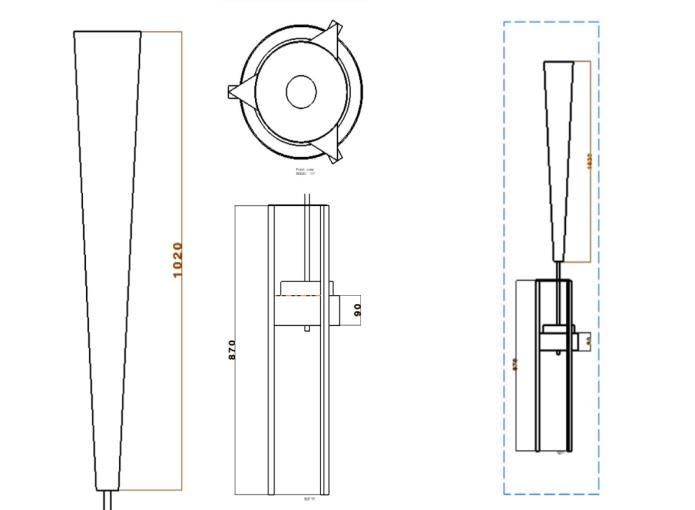
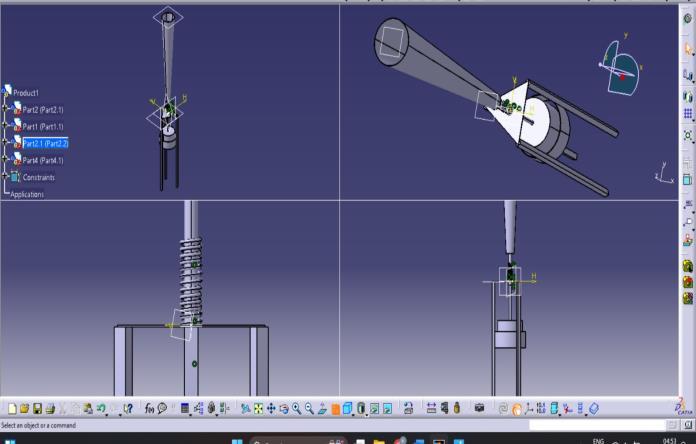
1. Mast /Dome: Mastisaconestructureoftheturbine. Themasthavetomoveandvibratewhenairwith highvelocitystrikestoit. Sothematerial usedfor mast should be light in weight and have higher strengththereforewehaveusedPVCfoamsheetfor mast
2. Piezoelectric sensor: Wehaveusedpiezoelectric sensortoconvertmechanicalenergyintoelectrical energy. We have used 35mm sensors to increase outputofturbine.
3. Connecting rod: Connecting rod works as a connector between mast, stand and circular disc. Also vibrations are transferred through this rod from mast to striker. So it should have higher flexibility and strength, Therefore we have used threadedrodmadeupofmildsteel.
4. Spring: We have used spring to stabilize the structure and promote the vibrations through its elastic properties. This spring will go under high pressures so, we used cast iron spring which can bear high pressure and these springs are easily availableinthemarket
5. Striker (Circular Disc): Strikerisacylindricalpart which actually strikes with sensors. Striker is connectedatthebottomoftheconnectingrodsoit shouldnotheavy.Ifitisheavyinweightitwillresist motionofmastandefficiencyofturbineisreduced. Soweusedlightweighthighdensitypolyethylene whichissolidandlightweightmaterial
6. Stand/tripod: It is a structure on which whole systemisassembled.Itshouldbeheavyandstrong suchthatitcanbearforcesduetohighvelocityair and should not change its position. So to keep it heavy we have used rectangular iron rods for manufacturingofstand
4. WORKING METHODOLOGY
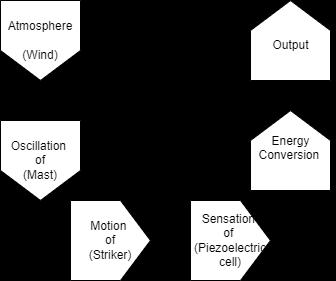
Bladeless wind turbine consists of cone shaped mast that oscillatesduetovortexeffectaroundthemaststructure.As mastisattachedtothestrikerwiththehelpofspringsothat it should oscillate. Due to oscillation the striker exerts pressureonpiezoelectriccellmembrane.Piezoelectriccell convertsmechanicalvibrationintoelectricalpotential.Then theelectricalimpulsesareobservedwiththehelpofDigital multi-meter. The output is measured in terms of voltage deflection.
International Research Journal of Engineering and Technology (IRJET) e-ISSN: 2395-0056
Volume: 11 Issue: 05 | May 2024 www.irjet.net p-ISSN: 2395-0072
-3:WorkingProcess
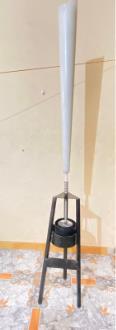
-4:ExperimentalSetup
5. RESULTS
Itwasobservedthatthedome/mastmadeupofPVCsheet connectedwithpiezoelectricsensorsinexperimentalsetup hadconstantcurrentoutput.Butthevoltagewasdependent onthevelocityofair.
Asthewindvelocityincreases,thevortex-inducedvibrations (VIV) also increase. Due to vibrations the frequency and amplitudeofmastarecapturedbypiezoelectricsensors.
WindvelocityandVoltage:
1. Atlowwindvelocity(1-4m/s)theoutputvoltageis minimal.
2. At moderate wind velocity (4-7 m/s) the output voltageisnoticeable.
3. Athighwindvelocity(8m/sandabove)theoutput voltage is significantly optimal for energy conversion.
1. The voltage output of the wind turbine increased when the quantity and size of sensors was increased.
2. The voltage output also increased when polyethylenecirculardiscwasusedinsteadofsteel circulardisc.
3. Withtheincreaseinwindvelocity,thevoltagealso increased.
4. The voltage output increased when the outer diameterofthedomewasincreased.
[1] Sandeep Kumar, Akash Gupta, Upinder Kumar, Himanshu Kumar Yadav , Design and Fabrication of VortexBladelessWindmill,Vol-22-Issue-17-September2019
[2] DavangShubhamS.,ManadeSunilK.,PatilGaneshkumar S., Patil Pavan S., Bladeless Wind Turbine, Volume 5, Issue4,Apr-2018
[3] Dr.Ravindra.M.Moharil1,AnimeshKhairkar2,Ambika Kulkarni2, Niharika Yedekar2 , Shubham Badure2 , ShubhamBawaskar2,BladelessWindTurbine,Vol.4, No.7,2019www.ijies.net
[4] SumitUpadhyaya1,RadhikaAgrawal2,NishantBaish3, AdarshShivhare4,SubashChandPal5,PIEZOELECTRIC BLADELESSWINDTURBINE,Volume:07Issue:05|May 2020
[5] 1Suryaprakash S, 2Mohanraj M, 3Mr.B.Elamvazhudi, WIND ENERGY INTEGRATION BY BLADELESS WINDMILL,JETIRDecember2021,Volume8,Issue12
[6] Mr.SatishRaghuwanshi,AmolSonanis,AyushPandey, AkritiShrivastava,Mayankbanwariya,Chandrashekhar singhMourya,DESIGNANDFABRICATIONOFVORTEX BLADELESSTURBINE,
International Research Journal of Engineering and Technology (IRJET) e-ISSN: 2395-0056
Volume: 11 Issue: 05 | May 2024 www.irjet.net p-ISSN: 2395-0072





Mr.TejasAshokShamkule
Student: B.Tech in Mechanical Engineering,JSPMRajarshiShahu CollegeofEngineering,Pune.
Mr.AbhijitVasantDeshmukh
Student: B.Tech in Mechanical Engineering,JSPMRajarshiShahu CollegeofEngineering,Pune.
Dr.D.M.Mate
Professor: JSPM Rajarshi Shahu CollegeofEngineering,Pune.
Mr KesharSunilPatil
Student: BTech in Mechanical Engineering,JSPMRajarshiShahu CollegeofEngineering,Pune
Mr AdityaBharatPatil
Student: BTech in Mechanical Engineering,JSPMRajarshiShahu CollegeofEngineering,Pune