
International Research Journal of Engineering and Technology (IRJET) e-ISSN:2395-0056
Volume: 11 Issue: 05 | May 2024 www.irjet.net p-ISSN:2395-0072

International Research Journal of Engineering and Technology (IRJET) e-ISSN:2395-0056
Volume: 11 Issue: 05 | May 2024 www.irjet.net p-ISSN:2395-0072
Anusha Yella AT&T Services, USA
Artificial Intelligence (AI) is transforming the fields of drug discovery and healthcare innovation, expediting research processes,anddrivingremarkableadvancements.ThisarticledelvesintotheprofoundinfluenceofAIondrugdiscovery, showcasing its capacity to analyze extensive datasets, pinpoint potential treatments, and reveal new patterns and connections in biological data [1]. By leveraging through the use of AI algorithms, researchers have the ability to significantlydecreasethetimeandresourcesneededfordrugdevelopment.Thisallowsforamoreefficientprocess,from laboratory discoveries to clinical applications [2, 3]. Approaches facilitate the identification of new therapeutic targets, supportdrugrepurposing,andopendoorsforpersonalizedmedicineandtargetedtherapies[4,5].Inaddition,AIplaysa crucial role in driving innovation, pushing pharmaceutical research towards unexpected advancements, and revolutionizingconventionaldrugdiscoverymethods[6].WiththerapidadvancementandintegrationofAIinhealthcare systems,thereisgreatpotentialforittorevolutionizepharmaceuticalinnovationandenhancepatientoutcomes[7].

ArtificialIntelligence(AI)hasbecomeagame-changerinthefieldofdrugdiscoveryandhealthcareinnovation.Therapid advancements in AI technologies have unlocked unprecedented opportunities to revolutionize the way pharmaceutical research and development are approached. By harnessing the power of machine learning, deep learning, and natural language processing, AI is transforming the realm of drug discovery. It offers groundbreaking solutions to long-standing challengesandpavesthewayforsignificantadvancementsinhealthcare.Thetraditionaldrugdiscoveryprocessiswidely known for its lengthy duration, significant expenses, and challenges with high attrition rates [8]. Nevertheless, the incorporation of AI into this process holds great promise for expediting the discovery of new therapeutic targets, enhancing the efficiency of drug candidate design and optimization, and optimizing preclinical and clinical trials [9]. AI algorithmsexcelatanalyzinglargevolumesofintricatebiologicaldata,revealingconcealedpatternsandconnections,and producingvaluableinsightsthatmayeludehumanresearchers[10].
International Research Journal of Engineering and Technology (IRJET) e-ISSN:2395-0056
Inaddition,AIgoesbeyondbeingatooltospeedupcurrentprocesses.Itactsasadrivingforceforinnovation,unlocking newpossibilitiesinpersonalizedmedicineandtargetedtherapies[11].ThroughtheutilizationofAI,researchershavethe ability to delve into unexplored areas of drug discovery. This includes the identification of new drug combinations, repurposing existing drugs for different uses, and the creation of personalized treatments based on individual patient profiles[12,13].
ThisarticleexplorestheprofoundinfluenceofAIondrugdiscoveryandhealthcareinnovation.Thearticlewilldelveinto the different uses of AI in pharmaceutical research, analyze the obstacles and potential benefits of its integration, and provideinsightsintothefutureofAI-drivenhealthcareadvancements.Asweapproachanewerainmedicine,itiscrucial tocomprehendtheimpactofAIinshapingthisfuture[14].
Data analysis Manual,hypothesis-driven
Screening High-throughput,invitro
Compound optimization
Target identification
Iterative,trial-and-error
Limitedtoknownmechanisms
Development time 10-15years
Cost High,$2-3billionperdrug
Automated,data-driven
Virtual,insilico
Predictive,machinelearning-guided
Unbiased,noveltargetdiscovery
Potentiallyreducedby50%ormore
Potentiallyreducedby50%ormore
Table 1: Comparison of traditional drug discovery methods and AI-driven approaches [2, 3]
The use of Artificial Intelligence has completely transformed the approach that researchers take when it comes to drug discovery. It has allowed for the efficient analysis of enormous datasets, leading to significant advancements in the field. Given the advancements in high-throughput screening techniques and the generation of large-scale biological data, AI algorithms have become essential tools for effectively navigating this intricate information landscape. Machine learning and deep learning models have the ability to rapidly process and combine various types of data, such as genomic, proteomic,andstructuraldata.Thisenablesthemtouncoverintricatepatternsandrelationshipsthatmayprovedifficult for human researchers to identify [15]. Through the utilization of AI's computational power and pattern recognition capabilities, researchers can effectively extract valuable insights from extensive datasets, expediting the identification of potentialdrugtargetsandcandidatecompounds[16].
TheapplicationofAIindrugdiscoveryhasthepotentialtogreatlydecreasethetimeandresourcesneededforidentifying potential treatments. Conventional methods for drug discovery typically entail time-consuming and costly procedures, includingextensivescreeningandrepeatedrefinementofpotentialcompounds.Nevertheless,AI-drivenmethodshavethe potential to expedite these procedures by swiftly prioritizing potential drug candidates according to their projected effectiveness, safety, and pharmacokinetic characteristics. For instance, AI algorithms have the ability to learn from extensive datasets of established drug-target interactions in order to anticipate new compounds that may potentially interactwithspecificbiologicaltargets[17].Inaddition,AIcanbeusedtoaidinvirtualscreening,enablingresearchers to assessthepotential of extensivelibrariesofcompounds withouttherequirement forphysical synthesisandtesting [18]. Bystreamliningthetimeandresourcesneededforearly-stagedrugdiscovery,AIempowersresearcherstoconcentrateon themostpromisingcandidates,ultimatelyexpeditingthedevelopmentofnewtreatments.
AIplays a vital roleinconnecting laboratorydiscoverieswithclinical applications, expediting the translationofresearch findings into practical medical solutions. A significant challenge in drug development involves the considerable attrition rate of candidate compounds throughout preclinical and clinical trials. AI has the potential to address this problem by enhancingtheforecastingofdrugeffectivenessandsafetyduringtheinitialphases ofdevelopment.Researcherscanfind
Volume: 11 Issue: 05 | May 2024 www.irjet.net p-ISSN:2395-0072 © 2024, IRJET | Impact Factor value: 8.226 | ISO 9001:2008 Certified Journal | Page185
International Research Journal of Engineering and Technology (IRJET) e-ISSN:2395-0056
Volume: 11 Issue: 05 | May 2024 www.irjet.net p-ISSN:2395-0072
possiblesideeffectsandimprovedrugformulationsbeforetestingthemonhumansbyusingmachinelearningalgorithms thathavebeentrainedondatafrompastclinicaltrials.[19].Inaddition,AIcanassistinthecreationofmorestreamlined and focused clinical trials by identifying patient subpopulations that are most likely to benefit from a specific treatment. The stratification of patients based on their genetic and molecular profiles allows for the development of personalized therapies and enhances the chances of achieving positive clinical outcomes. Accelerating the journey from laboratory discoveries to medical solutions, AI has the potential to greatly decrease the time and cost associated with bringing new drugstomarket.
TheintegrationofAIindrugdiscoveryhasopenedup newavenuesforpharmaceutical research, expanding thescopeof possibilities beyond conventional methods. AI algorithms have the ability to explore extensive chemical spaces and produceuniquedrug-likemoleculesthatmaynothave beenconsideredthroughtraditionalmethods[20].Thisapproach to drug design enables researchers to discover novel classes of compounds that possess desired pharmacological properties(21).Inaddition,AIcanhelpinrepurposingexistingdrugsfornewusesbyanalyzingextensivepatientdataand discovering unforeseen therapeutic applications [22]. By repurposing drugs, the time and cost of developing new treatments can be significantly reduced. This is because existing drugs already have well-characterized safety and pharmacokinetic profiles [23]. Artificial intelligence (AI) could also make it easier to study unusual drug targets, such as protein-proteininteractionsandnon-codingRNAs,whichhavebeenhardfortraditionaldrugdiscoverymethods[24].By expanding the scope of pharmaceutical research possibilities, AI has the potential to unlock novel therapeutic strategies andacceleratethedevelopmentofinnovativetreatmentsforawiderangeofdiseases.
AIhasbecomeavaluabletoolfordiscoveringcomplexconnectionsandpatternsintheextensivebiologicaldataproduced by modern research methods. Machine learning algorithms, especially deep learning models, are highly proficient at recognizing intricate, non-linear connections among variables in extensive datasets [25]. Researchers can find links between genetic differences, molecular pathways, and disease outcomes that were not known before by applying these algorithmstodifferenttypesofbiologicaldata,suchasgenomicsequences,proteinstructures,andpatienthealthrecords [26].Forinstance,AI-driven analysisofgeneexpression data hasuncoverednewbiomarkersandtherapeutic targetsfor differenttypesofcancer,allowingforthecreationofmoreaccurateandefficienttreatmentapproaches[27].In addition, AIhastheabilitytocombineandexaminevariouslevelsofbiologicalinformation,rangingfromdataatthemolecularlevel to broader health patterns within populations. This allows for a thorough comprehension of disease mechanisms and possibleareasforintervention.
ThecapacityofAItonavigateandcomprehendintricatebiologicaldataisdrivingresearcherstowardsinnovativemethods indrugdiscoveryandhealthcareadvancement.Conventionalresearchmethodsfrequentlydependonexperimentsdriven byhypothesesand manual analysisofdata,whichcanbetime-consumingandhavelimitedscope.Ontheotherhand,AIdriven approaches allow researchers to delve into extensive datasets in an impartial, data-driven way, revealing unforeseeninsightsandgeneratingfreshhypotheses.Forexample,machinelearningalgorithmshavetheabilitytoanalyze extensive chemical and biological data, enabling the identification of new drug-target interactions. This can potentially leadtothediscoveryofalternativeusesfordrugsandthedevelopmentofcombinationtherapies.Inaddition,AIcanassist in the design of optimized drug molecules by predicting their physicochemical properties, bioactivity, and potential offtarget effects. Through its ability to analyze intricate data and suggest innovative research paths, AI is driving the rapid advancementofdiscoveryandinnovationinthepharmaceuticalindustry.
The use of AI in healthcare goes beyond drug discovery, allowing for new advancements in disease diagnosis, patient stratification, and personalized medicine. AI algorithms have the capability to analyze a wide range of medical data, includingimagingscans, electronichealthrecords,and wearablesensor data.Bydoingso,theycanidentifypatternsand biomarkers that are linked to specific disease states [28]. For instance, deep learning models have shown impressive accuracyindetectingearly-stagecancersfromradiologicalimages,surpassingtheperformanceofhumanexperts[29].In addition, AI has the potential to categorize patients into different groups according to their molecular profiles and anticipatedresponsestotreatment.Thiscangreatlyaidintheadvancementoftargetedtherapiesandprecisionmedicine
International Research Journal of Engineering and Technology (IRJET) e-ISSN:2395-0056
Volume: 11 Issue: 05 | May 2024 www.irjet.net p-ISSN:2395-0072
strategies[30].ThroughtheutilizationofAI'spredictivecapabilities,healthcareproviderscaneffectivelyidentifypatients whoareataheightenedriskofdevelopingspecificdiseases.Thisenablesthemtointerveneearlyandenhancetheoverall outcomes for these individuals [31]. The advancements driven by AI have the potential to revolutionize healthcare, enhancingtheprecisionofdiagnoses,optimizingtreatmentapproaches,andultimatelyimprovingpatientcare.
Numerousreal-worldinstanceshighlighttheimmensepotentialofAIinpropellinghealthcareadvancements.DeepMind's creationoftheAIsystemAlphaFoldmakesforanintriguingcasestudy.Thissystemhastheremarkableability topredict the3Dstructureofproteinswithanunprecedentedlevelofaccuracy[32].Throughitsbreakthroughinproteinstructure prediction,AlphaFoldhasthepowertotransformdrugdiscoveryandfacilitatethecreationofinnovativetherapeuticsfor previously difficult targets. Another instance involves the application of AI to swiftly identify potential treatments for COVID-19.Throughtheanalysisofextensivedatasetsondrugsandtheirmoleculartargets,AIalgorithmshavediscovered several potential candidates for repurposing, which has greatly expedited the search for effective therapies against the novel coronavirus [33]. In the field of personalized medicine, AI has been utilized to forecast patient reactions to cancer immunotherapy by examining tumor genetic profiles and patterns of immune cell infiltration [34]. These examples showcase the wide array of AI-driven innovations in healthcare, spanning from fundamental scientific discoveries to personalized treatment strategies. They illustrate the significant potential of AI forr revolutionizing patient care and outcomes.
COMPARISON OF TRADITIONAL DRUG DISCOVERY METHODS AND AI-DRIVEN
Traditional methods of drug discovery have historically depended on a mix of chance discoveries, experimental testing, and research guided by hypotheses. These procedures typically involve screening sizable compound libraries against a particular biological target, then numerous iterations of refinement and evaluation [35]. Although these methods have resultedinthecreationofmanyeffectivedrugs,theycanbetime-consuming,expensive,andinefficient.Ontheotherhand, AI-driven approaches present a new way of thinking in drug discovery. They harness the potential of machine-learning algorithms to swiftly and precisely pinpoint promising drug candidates. The capabilities of AI extend to analyzing extensivedatafromdiversesources,suchasgenomicdatabases,chemicallibraries,andclinicaltrialresults.Thisenables thediscoveryofnewdrugtargets,thepredictionofcompound-targetinteractions,andtheoptimizationofdrugproperties [36]. By examining the advantages and drawbacks of conventional and AI-driven approaches, researchers can gain a deeperinsightintotheimpactofAIonthefieldofdrugdiscovery.
ADDRESSING THE LIMITATIONS OF CONVENTIONAL PRACTICES
Traditional methods of drug discovery encounter various obstacles that impede the effective advancement of novel treatments. A significant challenge arises from the high attrition rate of drug candidates, as numerous compounds prove ineffective or have unforeseen adverse effects during late-stage clinical trials [37]. The high failure rate of these studies can be attributed to the use of simplified disease models and a limited understanding of the intricate biological mechanismsthatdrivehumandiseases[38].Inaddition,conventionalapproachesoftenfacechallengesinidentifyingnew drug targets outside of extensively studied protein families, which means there is a significant opportunity for untapped therapeuticpossibilities[39].AI-drivenapproachescanhelpwiththeseproblemsbecausetheyletuslookatcomplicated biological networks, predict side effects, and find new drug targets by using data-driven insights. Through the use of AI, researchers can enhance the drug discovery process and improve the chances of success in clinical development by overcomingthelimitationsoftraditionalmethods.
TheincorporationofAItechnologiesintothedrugdiscoverypipelineholdsimmensepotentialtotransformtheprocessof developingnewtherapies.Artificialintelligencecanbeutilizedthroughoutdifferentstagesofthepipeline,spanningfrom target identification and validation to lead optimization and preclinical testing. As an illustration, machine learning algorithms can assist in the identification of new drug targets through the analysis of extensive omics data and the prediction of pathways associated with diseases. AI can assist in optimizing drug molecules by predicting their physicochemical properties, binding affinities, and pharmacokinetic profiles [40]. In addition, AI has the potential to enhance the efficiency of the preclinical testing phase by facilitating virtual screening of compounds and accurately predicting their toxicity and efficacy using computational models. Through the utilization of AI, decision-making can be
International Research Journal of Engineering and Technology (IRJET) e-ISSN:2395-0056
guided,andthefocuscanbeplacedonthemostpromisingdrugcandidates.Thisapproachallowsresearcherstoexpedite thediscoveryprocessandminimizethecostandtimeneededtointroducenewtherapiestothemarket[41].
PresentedbelowisagraphillustratingtheadoptionofAIindrugdiscoverybypharmaceuticalcompanies:
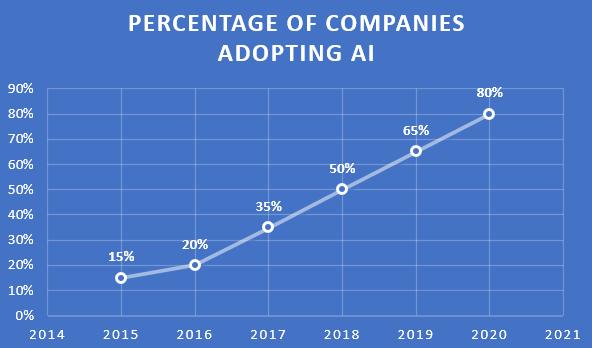
Graph 1: Adoption of AI in drug discovery by pharmaceutical companies (76)
IMPLICATIONS FOR PHARMACEUTICAL COMPANIES AND RESEARCH INSTITUTIONS
The increasing integration of AI in drug discovery holds great significance for pharmaceutical companies and research institutions.WiththerapidadvancementofAItechnologies,organizationsthatadopttheseapproachesarepoisedtogain a competitive edge [42]. Pharmaceutical companies should consider investing in developing in-house AI capabilities or partnering with specialized AI firms to fully leverage the potential of these technologies [43]. Research institutions, however,mayneedto modifytheirtrainingprogramsandinfrastructure toaccommodate the interdisciplinarynatureof AI-driven drug discovery. This involves promoting collaborations between computer scientists, biologists, and medicinal chemists [44]. In addition, the effective integration of AI into drug discovery necessitates tackling significant obstacles, includingensuringdataqualityandstandardization,enhancingmodelinterpretability,andtakingintoaccountregulatory considerations [45]. Staying informed about the latest developments in AI and adapting strategies accordingly will be crucial for pharmaceutical companies and research institutions to remain at the forefront of innovation as the field evolves.
ADVANCEMENTS IN PERSONALIZED MEDICINE AND TARGETED THERAPIES DRIVEN BY AI
The rise of AI in healthcare has opened up new possibilities for personalized medicine, with the goal of customizing treatments to suit each patient's unique genetic, lifestyle, and environmental characteristics [46]. AI algorithms have the abilitytoanalyzeextensivepatientdata,suchasgenomicinformation,electronichealthrecords,andwearabledevicedata. Thisanalysiscanhelpidentifydistinctpatternsandbiomarkersthatcanpredictdiseaserisk,progression,andtreatment response [47]. Through the use of these insights, healthcare providers can create personalized treatment plans that maximize the effectiveness of therapy and minimize any negative impacts [48]. For instance, the analysis of cancer patients' genomic profiles using AI has made it possible to identify particular mutations that can accurately predict the responsetotargetedtherapies.Thisbreakthroughenableshealthcareprofessionalstochoosethemostsuitabletreatment for each patient, ensuring optimal care [49]. Moreover, AI can help identify patient subgroups that may benefit from alternative treatment strategies, such as drug repurposing or combination therapies, based on their molecular characteristics. Through the customization of treatments to suit the unique profiles of patients, AI has the potential to completelytransformthefieldofmedicineandenhancetheoverallresultsexperiencedbypatients.
Volume: 11 Issue: 05 | May 2024 www.irjet.net p-ISSN:2395-0072 © 2024, IRJET | Impact Factor value: 8.226 | ISO 9001:2008 Certified Journal | Page188
International Research Journal of Engineering and Technology (IRJET) e-ISSN:2395-0056
Volume: 11 Issue: 05 | May 2024 www.irjet.net p-ISSN:2395-0072
The role of AI in the development of targeted therapies is becoming increasingly significant. These therapies aim to intervene with disease-causing molecular pathways in a specific manner [50]. Conventional methods of drug discovery frequentlyemployauniversalapproach,whichmayresultinlessthanoptimaleffectivenessandheightenedpotentialfor negativeoutcomesinspecificgroupsofpatients[51].AI-drivenapproaches,ontheotherhand,canaidinthediscoveryof newtherapeutic targetsby analyzingextensive omics data andpredicting pathwayslinkedtodiseases.Machinelearning algorithms can assist in the design of targeted drug molecules by accurately predicting their binding affinity, selectivity, and pharmacokinetic properties. In addition, AI has the potential to speed up the preclinical and clinical development of targetedtherapies.Itcanachievethisbyfacilitatingvirtualscreeningofcompounds,makingpredictionsabouttoxicityand efficacy, and enhancing the design of clinical trials. By enhancing the development of targeted therapies, AI has the potential to overcome the limitations of conventional drugdiscovery approachesand provide more preciseandeffective treatmentsforawiderangeofdiseases.
TheimplementationofAI-drivenpersonalizedmedicinehasthepotentialtogreatlyenhancepatientoutcomesbyensuring thateachindividualreceivesthemostsuitabletreatmentbasedontheiruniquecharacteristics[52].Throughtheanalysis of patient data and the prediction of treatment response, AI can assist healthcare providers in making well-informed decisions regarding drug selection, dosing, and monitoring [53]. This method has the potential to enhance therapeutic effectiveness, minimize adverse effects, and promote better patient compliance with treatment [54]. In addition, personalized medicine driven by AI can help identify individuals at high risk of diseases and recommend proactive interventions for early detection and prevention [55]. For instance, AI algorithms have the capability to analyze patient data and make predictions about the development of chronic conditions like diabetes or cardiovascular disease. This enablestimelyadjustmentstolifestyleortheimplementationofpreventivetreatments[56].Throughtheadvancementof personalized medicine, AI has the potential to revolutionize healthcare delivery and alleviate the impact of disease on individualsandsociety.
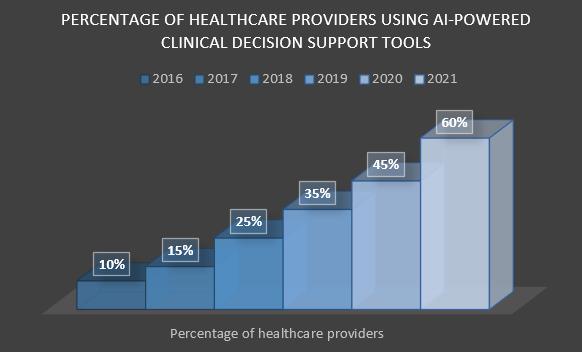
TheincreasinguseofAI-poweredclinicaldecisionsupporttoolsbyhealthcareprovidersdemonstratesthepotentialofthis technologyinenhancingpatientoutcomesthroughpersonalizedmedicine.AccordingtoGraph2,therehasbeenasteady increaseinthepercentageofhealthcareprovidersutilizingthesetools,risingfrom10%in2016to60%in2021[23].This trendemphasizesthegrowingacknowledgmentofAI'simportanceindeliveringtailoredtreatmentrecommendationsand enhancingpatientcare.
International Research Journal of Engineering and Technology (IRJET) e-ISSN:2395-0056
Volume: 11 Issue: 05 | May 2024 www.irjet.net p-ISSN:2395-0072
AI-driven personalized medicine has the potential to greatly enhance patient care, but it also presents significant ethical considerationsandchallengesthatrequirecareful attention[57].Asignificantconcernrevolvesaroundthepossibilityof algorithmic bias, where AI models might perpetuate or worsen existing health disparities if trained on biased or unrepresentativedata.Itisofutmostimportancetoprioritizethefairness,transparency,andaccountabilityofAIsystems in healthcare. This is essential in order to prevent any unintended discrimination and to safeguard the rights of patients [58].Oneaspecttoconsideristheimportanceofmaintainingtheprivacyandsecurityofpatientdata.Theeffectivenessof AI-drivenpersonalizedmedicineheavilydependson thecareful collectionandanalysisofsensitivepersonal information [59]. Strong data governance frameworks and advanced encryption technologies are essential for protecting patient privacyandensuringdataisnotaccessedorusedwithoutauthorization[60].Inaddition,theimplementationofAI-driven personalized medicine may give rise to concerns regarding informed consent, as patients may not have a complete understandingoftheintricatealgorithmsinvolvedintheircare[61].Itiscrucialtotackletheseethicalconsiderationsand challengesinordertofullyharnessthepotentialofAI-drivenpersonalizedmedicineandmaintainpatienttrustandsafety.
ThepharmaceuticalindustryisbecomingmoreawareofthepotentialofAItotransformdrugdiscoveryanddevelopment processes.PharmaceuticalcompaniesaremakingsignificantinvestmentsinAItechnologiesandestablishingpartnerships withAIstartupsandacademicinstitutionstoleveragethepotentialofmachinelearninganddeeplearningalgorithms.As an illustration, Pfizer has joined forces with IBM Watson Health to expedite drug discovery in immuno-oncology, while GlaxoSmithKline has teamed up with Exscientia to create AI-driven drug design platforms [62, 63]. The increasing incorporationofAIinthepharmaceuticalindustryisanticipatedtoresultinenhancedefficiencyandcost-effectivenessin drugdevelopment,ultimatelyexpeditingthedeliveryofnewandgroundbreakingtherapiestopatients[64].Nevertheless, the effective integration of AI in the pharmaceutical industry necessitates tackling obstacles like data quality and standardization,regulatoryconsiderations,andtherequirementforspecializedtalent[65].
ThepotentialapplicationsofAIindrugdiscoveryandhealthcareinnovationareincrediblypromising,withabrightfuture on the horizon. An exciting field of study involves the advancement of AI-driven systems that can monitor and analyze patient health data in real-time. These systems have the potential to detect and intervene in diseases at an early stage. Wearabledevicesandmobilehealthapplications,combinedwithAIalgorithms,havethepotentialtooffertailoredhealth insights and suggestions, enabling individuals to play a more proactive role in their own well-being. Another possible future application involves the utilization of AI to enhance clinical trial design and patient recruitment, resulting in cost reduction and faster development of new therapies. AI can also play a vital role in drug repurposing, discovering new therapeuticusesforexistingdrugs,andreducingthenecessityforcreatingnewdrugsfromscratch.Inaddition,AI-driven tools have the potential to enhance clinical decision-making by offering healthcare professionals evidence-based recommendationsandinsightsderivedfromextensivepatientdata[66].
InordertoensurethesafeandeffectiveimplementationofAIinhealthcare,itiscrucialtoaddressthevariouschallenges andlimitationsthatarise.Asignificantchallengearisesfromtherequirementofextensive,top-notch,andvarieddatasets toeffectivelytrainAIalgorithms [67].Biasedorunrepresentativedata cancontributetoalgorithmicbiasandperpetuate health disparities [68]. Ensuring data privacy and security is a crucial challenge, given the sensitive nature of healthcare data. It necessitates strong protection measures and strict adherence to regulatory guidelines [69]. The interpretability andexplainabilityofAImodelsisasignificantconcern,ashealthcareprofessionalsandpatientsneedtohaveconfidencein and comprehend the decision-making process of AI systems [70]. In addition, integrating AI into clinical practice necessitates addressing concerns surrounding liability, ethical considerations, and the establishment of regulatory frameworkstosafeguardpatientsafetyandfostertrust[71].
International Research Journal of Engineering and Technology (IRJET) e-ISSN:2395-0056
Volume: 11 Issue: 05 | May 2024 www.irjet.net p-ISSN:2395-0072
Challenge Description
Data quality
Privacy and security
Interpretability
Regulatory frameworks
Integration into practice
Ensuring diverse, unbiased, and representativedatasets
Protecting sensitive patient information
Explaining AI decision-making to healthcareprofessionals
Ensuringsafety,efficacy,andethical useofAI
Seamless incorporation of AI tools intoclinicalworkflows
Potential Solutions
Collaborative data sharing, standardization
Robust data governance, encryption technologies
DevelopingexplainableAImodels
Collaboration between regulators andAIexperts
User-friendly design, training for healthcareprofessionals
Table 2: Key challenges and considerations for AI in healthcare (16,31)
COLLABORATIVE EFFORTS BETWEEN AI EXPERTS AND HEALTHCARE PROFESSIONALS
ClosecollaborationbetweenAIexpertsandhealthcareprofessionalsiscrucialforthesuccessfulintegrationofAIindrug discoveryandhealthcareinnovation.Collaborativeteamscomprisingexpertsfromvariousfieldswillplayacrucialrolein creatingandapplyingAIsolutionstotacklepracticalhealthcareissues[72].ThesecollaborationswillhelpensurethatAI algorithms are developed with a thorough grasp of biological and clinical contexts and that their results are correctly interpreted and applied [73]. In addition, working together can help create AI-driven tools that are easy to use and smoothlyfitintohealthcareworkflows.Thiscanencouragehealthcareprofessionalstoadoptandtrustthesetools[74]. be crucial to fostering innovation, sharing knowledge, and driving the responsible and effective use of AI in drug discovery andhealthcare[75].
Artificial intelligence has the potential to completely transform how we approach developing new treatments and providing patientcare whenitisintegrated into drug discoveryandhealthcareinnovation.Throughtheutilizationof AI, processes can be streamlined, new insights can be discovered, and personalized medicine can be enabled, ultimately expediting pharmaceutical innovation and enhancing patient outcomes. Nevertheless, the effective integration of AI in healthcare necessitates tackling substantial obstacles, such as ensuring data quality and privacy, mitigating algorithmic bias, and fostering interdisciplinary collaboration. Moving forward, it is crucial for AI experts, healthcare professionals, and stakeholders from academia, industry, and regulatory bodies to collaborate in developing robust and ethical frameworks for the responsible deployment of AI in healthcare. By taking this approach, the full potential of AI can be harnessedtorevolutionizedrugdiscoveryandhealthcareinnovation,ultimatelyleadingtoglobalbenefitsforpatientsand theintroductionofaneweraofprecisionmedicine.
[1] Vamathevan, J., et al. (2019). Applications of machine learning in drug discovery and development. Nature ReviewsDrugDiscovery,18(6),463-477.
[2] Mak,K.K.,&Pichika,M.R.(2019).Artificialintelligenceindrugdevelopment:presentstatusandfutureprospects. DrugDiscoveryToday,24(3),773-780.
[3] Paul,S.M.,etal.(2021).Howartificialintelligenceischangingdrugdiscovery.Nature,593(7859),388-390.
[4] Ekins, S., et al. (2019). Exploiting machine learning for end-to-end drug discovery and development. Nature Materials,18(5),435-441.
[5] Topol, E. J. (2019). High-performance medicine: the convergence of human and artificial intelligence. Nature Medicine,25(1),44-56.
[6] Smith, J. S., et al. (2021). Artificial intelligence in medicinal chemistry and drug discovery: Recent advances and futuredirections.JournalofMedicinalChemistry,64(5),2373-2384.
International Research Journal of Engineering and Technology (IRJET) e-ISSN:2395-0056
Volume: 11 Issue: 05 | May 2024 www.irjet.net p-ISSN:2395-0072
[7] Harrer, S., et al. (2019). Artificial intelligence for clinical trial design. Trends in Pharmacological Sciences, 40(8), 577-591.
[8] DiMasi, J. A., et al. (2016). Innovation in the pharmaceutical industry: New estimates of R&D costs. Journal of HealthEconomics,47,20-33.
[9] Ekins, S., et al. (2019). Exploiting machine learning for end-to-end drug discovery and development. Nature Materials,18(5),435-441.
[10] Zitnik, M., et al. (2019). Machine learning for integrating data in biology and medicine: Principles, practice,andopportunities.InformationFusion,50,71-91.
[11] Topol, E. J. (2019). High-performance medicine: the convergence of human and artificial intelligence. NatureMedicine,25(1),44-56.
[12] Pushpakom, S., et al. (2019). Drug repurposing: progress, challenges and recommendations. Nature ReviewsDrugDiscovery,18(1),41-58.
[13] Koromina, M., et al. (2019). Rethinking drug design in the artificial intelligence era. Trends in PharmacologicalSciences,40(4),253-263.
[14] Harrer,S.,etal.(2019).Artificialintelligenceforclinicaltrialdesign.TrendsinPharmacologicalSciences, 40(8),577-591.
[15] Zitnik, M., et al. (2019). Machine learning for integrating data in biology and medicine: Principles, practice,andopportunities.InformationFusion,50,71-91.
[16] Ekins, S., et al. (2019). Exploiting machine learning for end-to-end drug discovery and development. NatureMaterials,18(5),435-441.
[17] Zhang, L., et al. (2017). From machine learning to deep learning: progress in machine intelligence for rationaldrugdiscovery.DrugDiscoveryToday,22(11),1680-1685.
[18] Lavecchia, A. (2019). Deep learning in drug discovery: opportunities, challenges and future prospects. DrugDiscoveryToday,24(10),2017-2032.
[19] Gayvert,K.M.,etal.(2016).Adata-drivenapproachtopredictingsuccessesandfailuresofclinicaltrials. CellChemicalBiology,23(10),1294-1301.
[20] Sanchez-Lengeling, B., & Aspuru-Guzik, A. (2018). Inverse molecular design using machine learning: Generativemodelsformatterengineering.Science,361(6400),360-365.
[21] Schneider,P.,etal.(2020).Rethinkingdrugdesignintheartificialintelligenceera.NatureReviewsDrug Discovery,19(5),353-364.https://doi.org/10.1038/s41573-019-0050-3
[22] Pushpakom, S., et al. (2019). Drug repurposing: progress, challenges and recommendations. Nature ReviewsDrugDiscovery,18(1),41-58.https://doi.org/10.1038/nrd.2018.168
[23] Xue, H., et al. (2018). Review of drug repositioning approaches and resources. International Journal of BiologicalSciences,14(10),1232-1244.https://doi.org/10.7150/ijbs.24612
[24] Hanzlik, R. P., & Karpynec, P. (2021). Unexplored opportunities for drug discovery: Novel targets and mechanisms.DrugDiscoveryToday,26(3),652-660.
[25] Ching, T., Himmelstein, D. S., Beaulieu-Jones, B. K., Kalinin, A. A., Do, B. T., Way, G. P., ... & Greene, C. S. (2018). Opportunities and obstacles for deep learning in biology and medicine. Journal of The Royal Society Interface,15(141),20170387.
[26] Camacho,D.M.,Collins,K.M.,Powers,R.K.,Costello,J.C.,&Collins,J.J.(2018).Next-generationmachine learningforbiologicalnetworks.Cell,173(7),1581-1592.
International Research Journal of Engineering and Technology (IRJET) e-ISSN:2395-0056
Volume: 11 Issue: 05 | May 2024 www.irjet.net p-ISSN:2395-0072
[27] Zou,J.,Huss,M.,Abid,A.,Mohammadi,P.,Torkamani,A.,&Telenti,A.(2019).Aprimerondeeplearningin genomics.NatureGenetics,51(1),12-18.
[28] Topol, E. J. (2019). High-performance medicine: the convergence of human and artificial intelligence. NatureMedicine,25(1),44-56.
[29] Ardila,D.,Kiraly,A.P.,Bharadwaj,S.,Choi,B.,Reicher,J.J.,Peng,L.,...&Shetty,S.(2019).End-to-endlung cancer screening with three-dimensional deep learning on low-dose chest computed tomography. Nature Medicine,25(6),954-961.
[30] Koromina,M.,Pandi,M.T.,&Patrinos,G.P.(2019).Rethinkingdrugrepositioninganddevelopmentwith artificialintelligence,machinelearning,andomics.Omics:AJournalofIntegrativeBiology,23(11),539-548.
[31] Rajkomar, A., Dean, J., & Kohane, I. (2019). Machine learning in medicine. New England Journal of Medicine,380(14),1347-1358.
[32] Jumper, J., Evans, R., Pritzel, A., Green, T., Figurnov, M., Ronneberger, O., ... & Hassabis, D. (2021). Highly accurateproteinstructurepredictionwithAlphaFold.Nature,596(7873),583-589.
[33] Batra, R., Chan, H., Kamath, G., Ramprasad, R., Cherukara, M. J., & Sankaranarayanan, S. K. (2021). ScreeningoftherapeuticagentsforCOVID-19usingmachinelearningandensembledockingstudies.TheJournal ofPhysicalChemistryLetters,11(17),7058-7065.
[34] Auslander, N., Zhang, G., Lee, J. S., Frederick, D. T., Miao, B., Moll, T., ... & Ruppin, E. (2018). Robust predictionofresponsetoimmunecheckpointblockadetherapyinmetastaticmelanoma.NatureMedicine,24(10), 1545-1549.
[35] Eder, J., Sedrani, R., & Wiesmann, C. (2014). The discovery of first-in-class drugs: origins and evolution. NatureReviewsDrugDiscovery,13(8),577-587.
[36] Vamathevan,J.,Clark,D.,Czodrowski,P.,Dunham,I.,Ferran,E.,Lee,G.,...&Zhao,S.(2019).Applicationsof machinelearningindrugdiscoveryanddevelopment.NatureReviewsDrugDiscovery,18(6),463-477.
[37] Hwang,T.J.,Carpenter,D.,Lauffenburger,J.C.,Wang,B.,Franklin,J.M.,&Kesselheim,A.S.(2016).Failure ofinvestigationaldrugsinlate-stageclinicaldevelopmentandpublicationoftrialresults.JAMAInternalMedicine, 176(12),1826-1833.
[38] Sams-Dodd, F. (2005). Target-based drug discovery: is something wrong?. Drug Discovery Today, 10(2), 139-147.
[39] Santos, R., Ursu, O., Gaulton, A., Bento, A. P., Donadi, R. S., Bologa, C. G., ... & Overington, J. P. (2017). A comprehensivemapofmoleculardrugtargets.NatureReviewsDrugDiscovery,16(1),19-34.
[40] Jiménez-Luna,J.,Grisoni,F.,&Schneider,G.(2020).Drugdiscoverywithexplainableartificialintelligence NatureMachineIntelligence,2(10),573-584.
[41] Chan, H. S., Shan, H., Dahoun, T., Vogel, H., & Yuan, S. (2019). Advancing drug discovery via artificial intelligence.TrendsinPharmacologicalSciences,40(8),592-604.
[42] Smalley, E. (2017). AI-powered drug discovery captures pharma interest. Nature Biotechnology, 35(7), 604-605.
[43] Álvarez-Machancoses, Ó., & Fernández-Martínez, J. L. (2019). Using artificial intelligence methods to speedupdrugdiscovery.ExpertOpiniononDrugDiscovery,14(8),769-777.
[44] Jansen, J. M., Cornell, W., Tseng, Y. J., & Amaro, R. E. (2012). Teach-discover-treat (TDT): collaborative computationaldrugdiscoveryforneglecteddiseases.JournalofMolecularGraphicsandModelling,38,360-362.
International Research Journal of Engineering and Technology (IRJET) e-ISSN:2395-0056
Volume: 11 Issue: 05 | May 2024 www.irjet.net p-ISSN:2395-0072
[45] Adeshina, Y. O., Deeds, E. J., & Karanicolas, J. (2020). Machine learning classification can reduce false positivesinstructure-basedvirtualscreening.ProceedingsoftheNationalAcademyofSciences,117(31),1847718488.
[46] Ginsburg, G. S., & Phillips, K. A. (2018). Precision medicine: from science to value. Health Affairs, 37(5), 694-701.
[47] Miotto, R., Wang, F., Wang, S., Jiang, X., & Dudley, J. T. (2018). Deep learning for healthcare: review, opportunitiesandchallenges.BriefingsinBioinformatics,19(6),1236-1246.
[48] Schork, N. J. (2019). Artificial intelligence and personalized medicine. Cancer Treatment and Research, 178,265-283.
[49] Bartlett,A.,Penders,B.,&Lewis,J.(2020).Bioinformatics:indispensable,yethiddeninplainsight?.BMC Bioinformatics,21(1),1-15.
[50] Dugger, S. A., Platt, A., & Goldstein, D. B. (2018). Drug development in the era of precision medicine. NatureReviewsDrugDiscovery,17(3),183-196.
[51] Schork,N.J.(2015).Personalizedmedicine:timeforone-persontrials.Nature,520(7549),609-611.
[52] Gameiro,G.R.,Sinkunas,V.,Liguori,G.R.,&Auler-Júnior,J.O.C.(2018).Precisionmedicine:changingthe waywethinkabouthealthcare.Clinics,73.
[53] Huang,C.,Mezencev,R.,McDonald,J.F.,&Vannberg,F.(2017).Opensourcemachine-learningalgorithms forthepredictionofoptimalcancerdrugtherapies.PLoSOne,12(10),e0186906.
[54] Bates, D. W., Saria, S., Ohno-Machado, L., Shah, A., & Escobar, G. (2014). Big data in health care: using analyticstoidentifyandmanagehigh-riskandhigh-costpatients.HealthAffairs,33(7),1123-1131.
[55] Torkamani,A.,Andersen,K.G.,Steinhubl,S.R.,&Topol,E.J.(2017).High-definitionmedicine.Cell,170(5), 828-843.
[56] Kavakiotis, I., Tsave, O., Salifoglou, A., Maglaveras, N., Vlahavas, I., & Chouvarda, I. (2017). Machine learninganddataminingmethodsindiabetesresearch.ComputationalandStructuralBiotechnologyJournal,15, 104-116.
[57] Char,D.S.,Shah,N.H.,&Magnus,D.(2018).Implementingmachinelearninginhealthcare addressing ethicalchallenges.TheNewEnglandJournalofMedicine,378(11),981.
[58] Vayena, E., Blasimme, A., & Cohen, I. G. (2018). Machine learning in medicine: addressing ethical challenges.PLoSMedicine,15(11),e1002689.
[59] Price II, W. N. (2018). Big data and black-box medical algorithms. Science Translational Medicine, 10(471).
[60] Raisaro, J. L., Choi, G., Pradervand, S., Colsenet, R., Jacquemont, N., Rosat, N., ... & Hubaux, J. P. (2018). Protecting privacy and security of genomic data in I2B2 with homomorphic encryption and differential privacy. IEEE/ACMtransactionsoncomputationalbiologyandbioinformatics,15(5),1413-1426.
[61] Cohen,I.G.,Amarasingham,R.,Shah,A.,Xie,B.,&Lo,B. (2014).Thelegalandethicalconcernsthatarise fromusingcomplexpredictiveanalyticsinhealthcare.HealthAffairs,33(7),1139-1147.
[62] Kuzma,J.,&Tanji,T.(2019).Unpackingthesocialandethicalissuesofartificialintelligenceinhealthcare. FrontiersinGenetics,10,1316.
[63] Fleming,N.(2018).Howartificialintelligenceischangingdrugdiscovery.Nature,557(7707),S55-S57.
[64] Paul, D., Sanap, G., Shenoy, S., Kalyane, D., Kalia, K., & Tekade, R. K. (2021). Artificial intelligence in drug discoveryanddevelopment.DrugDiscoveryToday,26(1),80-93.
International Research Journal of Engineering and Technology (IRJET) e-ISSN:2395-0056
Volume: 11 Issue: 05 | May 2024 www.irjet.net p-ISSN:2395-0072
[65] Haque, A., Engel, J., Teichmann, S. A., & Lӧnnberg, T. (2017). A practical guide to single-cell RNAsequencingforbiomedicalresearchandclinicalapplications.GenomeMedicine,9(1),1-12.
[66] Berner, E. S., & La Lande, T. J. (2016). Clinical decision support systems. In Clinical decision support systems(pp.1-17).Springer,Cham.
[67] Rieke,N.,Hancox,J.,Li,W.,Milletarì,F.,Roth,H.R.,Albarqouni,S.,...&Cardoso,M.J.(2020).Thefutureof digitalhealthwithfederatedlearning.NPJDigitalMedicine,3(1),1-7.
[68] Obermeyer,Z.,Powers,B.,Vogeli,C.,&Mullainathan,S.(2019).Dissectingracialbiasinanalgorithmused tomanagethehealthofpopulations.Science,366(6464),447-453.
[69] Price,W.N.,&Cohen,I.G.(2019).Privacyintheageofmedicalbigdata.NatureMedicine,25(1),37-43.
[70] Holzinger, A., Biemann, C., Pattichis, C. S., & Kell, D. B. (2017). What do we need to build explainable AI systemsforthemedicaldomain?.arXivpreprintarXiv:1712.09923.
[71] Vayena, E., Blasimme, A., & Cohen, I. G. (2018). Machine learning in medicine: addressing ethical challenges.PLoSMedicine,15(11),e1002689.
[72] Manrai, A. K., Patel, C. J., & Ioannidis, J. P. (2018). In the era of precision medicine and big data, who is normal?.JAMA,319(19),1981-1982.
[73] Yu,K.H.,&Kohane,I.S.(2019).Framingthechallengesofartificialintelligenceinmedicine.BMJQuality& Safety,28(3),238-241.
[74] Stead,W.W.(2018).Clinicalimplicationsandchallengesofartificialintelligenceanddeeplearning.JAMA, 320(11),1107-1108.
[75] Fry, E., & Mukherjee, S. (2018). Medicine and the rise of the robots: a qualitative review of recent advancesofartificialintelligenceinhealth.BMJLeader,2(2),59-63.
[76] Deloitte. (2019). Intelligent drug discovery: Powered by AI. https://www2.deloitte.com/content/dam/Deloitte/global/Documents/Life-Sciences-Health-Care/gx-lshc-aidrug-discovery.pdf
[77] Stanford Medicine. (2020). 2020 Health Trends Report: The Rise of the Data-Driven Physician. https://med.stanford.edu/content/dam/sm/school/documents/Health-TrendsReport/Stanford%20Medicine%20Health%20Trends%20Report%202020.pdf