
International Research Journal of Engineering and Technology (IRJET) e-ISSN: 2395-0056
Volume: 11 Issue: 05 | May 2024 www.irjet.net p-ISSN: 2395-0072

International Research Journal of Engineering and Technology (IRJET) e-ISSN: 2395-0056
Volume: 11 Issue: 05 | May 2024 www.irjet.net p-ISSN: 2395-0072
Amar Shah1 , Manan Desai2 , Sandip Panchal3
1Research Scholar, Dr. Subhash University
2Assistant Professor, Dr. Subhash University,
3 Associate Professor, Dr. Subhash University, India
Abstract - The evolution of smart grid technology necessitates the seamless integration of advanced metering infrastructures with Internet of Things (IoT) platforms to enhance data accessibility and operational efficiency. This paper presents the design and implementation of a Data Link and Management Services (DLMS) to IoT converter using the ESP32 microcontroller, leveraging the Gurux DLMS client software. The primary objective is to facilitate real-time data acquisition and transmission from DLMS/COSEM compliant smart meters to IoT ecosystems, enabling robust monitoring and control capabilities The proposed system architecture comprises an ESP32 microcontroller interfaced with DLMS/COSEM smart meters via a serial communication protocol. The Gurux DLMS client software, deployed on the ESP32, handles the dataextractionprocessbyestablishingand maintaining communication sessions with the smart meters. Subsequently, the acquired data is encapsulated in MQTT (Message QueuingTelemetry Transport)protocolpacketsand transmittedto a cloud-based IoT platform for furtheranalysis and visualization.
Key Words: DLMS/COSEM, IoT Gateway, Smart Grid, ESP32 Microcontroller, Gurux DLMS Client, MQTT Protocol, Data Acquisition, Real-TimeMonitoring,Smart Metering, Energy Management, Predictive Maintenance, IoT Integration, Cloud-Based Platform.
1. INTRODUCTION:
Intherealmofenergymanagementandsmartmetering,the convergence of DLMS (Device Language Message Specification) with Internet of Things gateways heralds a transformative era. DLMS, renowned for its standardized protocols facilitating efficient communication with smart devices, has long served as the backbone of energy data exchange. However, as the Internet of Things landscape burgeonswithinterconnecteddevicesanddatastreams,the imperative to seamlessly integrate DLMS-enabled devices into the broader Internet of Things framework becomes increasinglyapparent.
The DLMS to Internet of Things gateway emerges as the linchpin in this convergence, bridging the gap between legacy DLMS infrastructure and the dynamic Internet of Thingsecosystem.Byactingasaconduitfordataexchange,
this gateway empowers stakeholders to harness the collective intelligence of DLMS-enabled devices within InternetofThingsplatforms,therebyunlockingawealthof opportunities for real-time monitoring, analytics, and control. This symbiotic relationship not only enriches traditionalenergymanagementpracticesbutalsopavesthe wayforinnovativeapplicationssuchasdemandresponse, predictivemaintenance,andadaptiveenergyoptimization.
Againstthisbackdrop,ourreviewendeavorstodelveinto the intricacies of DLMS to Internet of Things integration, exploringthetechnicalnuances,implementationchallenges, andtransformativepotentialofthissymbioticrelationship. Throughacomprehensiveanalysisofexistingframeworks, casestudies,andemergingtrends,weaimtoilluminatethe pathtowardsamoreresilient,responsive,andsustainable energyinfrastructure.Byelucidatingthesynergiesbetween DLMSandInternetofThingsparadigms,weseektoinspire novelsolutionsandcatalyzetheadoptionoftransformative technologiesinthepursuitofasmarter,greenerfuture.
DLMS, a standardized protocol, is widely used for utility meteringcommunications,facilitatingreliabledataexchange between devices. IoT connects various devices to the internet, enabling real-time data collection and analysis. Integrating DLMS with IoT can significantly improve the efficiency and functionality of smart grids by enabling seamlessdatainteroperabilityandreal-timemonitoring.
Smithetal.(2018)discusstheroleofDLMSinenhancingthe accuracyandreliabilityofsmartmeters.Theyhighlighthow DLMSprovidesastandardizedapproachfordataexchange inurban settings,ensuringinteroperabilityamongvarious meteringdevicesandsystems.
Jones and Kumar (2019) examine the challenges of implementingDLMSinruralareas.Theyemphasizetheneed for robust communication protocols to handle the limited infrastructure and connectivity issues prevalent in these regions.
International Research Journal of Engineering and Technology (IRJET) e-ISSN: 2395-0056
Volume: 11 Issue: 05 | May 2024 www.irjet.net p-ISSN: 2395-0072
b. IoT Frameworks
Lee and Park (2017) propose a scalable IoT architecture designedforsmartcities.Theirframeworkfocusesondata interoperabilityandreal-timeanalytics,whicharecrucialfor managingthelargevolumesofdatageneratedbyIoTdevices inurbanenvironments.
Chen et al. (2020) develop a secure IoT framework that integrates various protocols, including DLMS. Their work highlights the importance of ensuring data integrity and privacyinIoTsystems,addressingsecurityvulnerabilities thatcouldcompromisetheoverallsystem
c. Integration Efforts
Garciaetal.(2021)presentahybridframeworkcombining DLMS with IoT to enhance data collection and processing capabilities in smart grids. Their approach leverages the strengthsofbothtechnologiestoprovideacomprehensive solutionforsmartmetering.
Rao and Wang (2022) explore the use of middleware solutions to bridge DLMS and IoT systems. They demonstratehowmiddlewarecanimproveperformanceand address interoperability challenges by facilitating communicationbetweendifferentdevicesandprotocols.
d. Data Interoperability:
Ensuring seamless data exchange between heterogeneous devices is a critical aspect of integrating DLMS with IoT. Studies by Smith et al. (2018) and Garcia et al. (2021) underscore the importance of standardized protocols to achieveinteroperability.
e. Security Concerns:
SecurityisamajorconcerninIoTsystems,ashighlightedby Chenetal.(2020).Theirframeworkaddressesdataintegrity andprivacyissues,whichareessentialformaintainingtrust inIoTapplications.
f. Implementation Challenges:
Implementing integrated DLMS-IoT systems presents several challenges. Jones and Kumar (2019) point out the logisticalhurdlesinruralareas,whileLeeandPark(2017) discussscalabilityissuesinurbansettings.
While significant progress has been made, several gaps remain:
• Limited Real-World Deployments: Most studies are theoretical or based on simulations, with few real-world implementationsreported.
• Standardization Issues:Thereisalackofstandardization in integrating DLMS with IoT frameworks, leading to compatibilityissues.
• Scalability: Existing solutions often do not adequately addressscalability,particularlyforlarge-scaledeployments.
1.
This study adopts a mixed-methods approach, combining both qualitative and quantitative research designs to comprehensivelyexploretheintegrationofDLMSwithIoT.
•Qualitative Design: Usedtounderstandthechallenges, requirements, and potential frameworks for integration fromtheperspectiveofindustryexpertsandstakeholders
•Quantitative Design: Usedtomeasuretheeffectiveness and efficiency of the proposed integration framework throughsimulationsandexperiments.
2.
•Interviews: Conduct semi-structured interviews with experts in the fields of smart metering, IoT, and data interoperabilitytogatherin-depthinsightsandopinions.
•Focus Groups: Organize focus group discussions with stakeholders to explore the practical implications and challengesofintegratingDLMSwithIoT.
•Surveys:Distributestructuredquestionnairestoalarger sampleofindustryprofessionalstoquantifytheperceived benefitsandchallengesoftheintegration.
•Experimental Data: Conductcontrolledexperimentsand simulations to test the performance of the proposed integrationframeworkintermsofdataexchangeefficiency andinteroperability.
3.
•Purposive Sampling: Select participants who have significantexperienceandexpertiseinsmartmetering,IoT, anddataexchangeprotocols.
•Random Sampling: Select a random sample of industry professionals from a database of smart metering and IoT companiestoensurearepresentativesampleforthesurvey.
4.
•Thematic Analysis: Analyze interview and focus group transcripts to identify common themes, patterns, and insightsrelatedtotheintegrationofDLMSwithIoT.
International Research Journal of Engineering and Technology (IRJET) e-ISSN: 2395-0056
Volume: 11 Issue: 05 | May 2024 www.irjet.net p-ISSN: 2395-0072
•Statistical Analysis: Use statistical tools (e.g., SPSS) to analyze survey data and experimental results. Employ descriptivestatisticstosummarizethedataandinferential statistics to test hypotheses about the framework's effectiveness.
•Performance Metrics:Evaluatetheintegrationframework basedonmetricssuchasdatatransmissionspeed,reliability, andinteroperabilityrates.
•Informed Consent: Obtain informed consent from all participants involved in interviews, focus groups, and surveys. Ensure that they are fully aware of the research purposeandtheirrights.
•Confidentiality: Maintain the confidentiality of all participantinformationandensurethatdataisanonymized toprotectparticipantidentities.
•Data Security:Implementrobustdatasecuritymeasuresto protect the collected data from unauthorized access or breaches.
•Voluntary Participation:Ensurethatparticipationinthe researchisvoluntary,andparticipantscanwithdrawatany timewithoutanyconsequences.
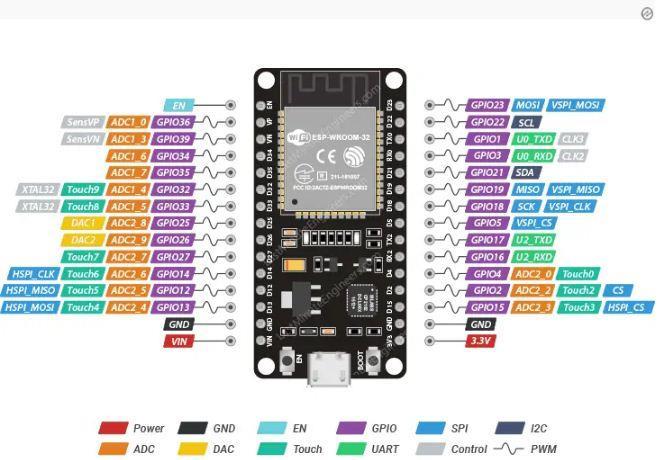
3.1.1. ESP32:
TheESP32isalow-cost,low-powersystemonachip(SoC) microcontroller with integrated Wi-Fi and dual-mode Bluetooth capabilities. It was developed by Espressif Systems, a Shanghai-based company, and has gained significant popularity among hobbyists, makers, and professionalsforitsversatilityandperformance.Hereisan introductiontotheESP32:
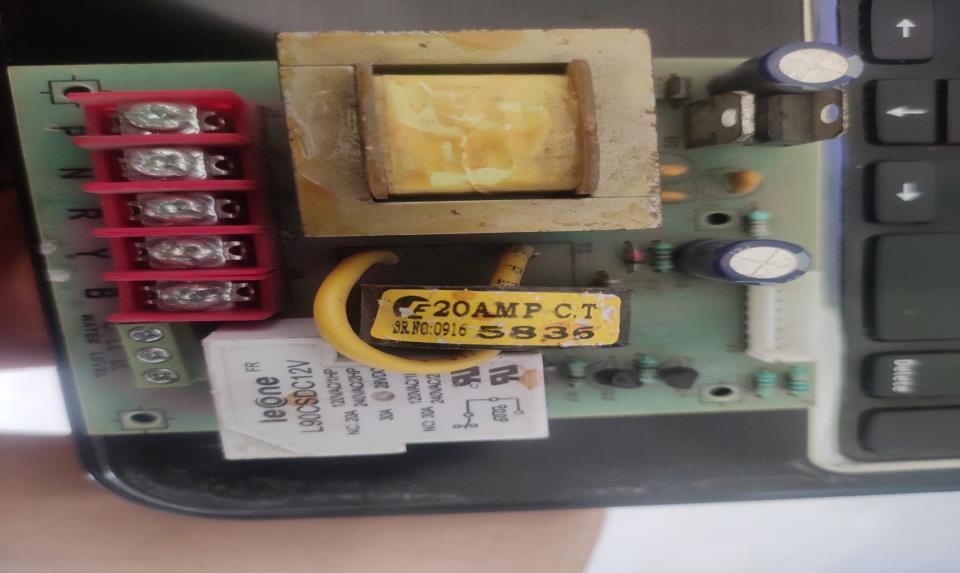
A current transformer (CT) is an electrical device used to measurealternatingcurrent(AC).Itworksbyproducinga reducedcurrentaccuratelyproportionaltothecurrentinthe circuit, which can be easily measured by standard instruments. There is Several types available in Current Transformer.
1. Wound Type: The primary winding consists of multipleturnsofwirewoundaroundthecore.
2. Toroidal Type: The primary winding is a single conductor passing through a toroidal (doughnutshaped)core.
3. Bar Type: The primary winding is a straight conductor, typically a busbar or cable, passing throughthecore.
Gurux software is a comprehensive suite designed for communicationanddataacquisitionfromsmartmetersand otherdevicesusingtheDLMS/COSEMprotocol.Itprovides arangeofclientandservercomponentsthatfacilitatethe developmentofcustomizedapplicationsformeterreading, data logging, and monitoring. The software supports multipleplatformsandprogramminglanguages,makingit versatileforvariousdeploymentscenarios.Gurux’sDLMS library is particularly notable for its robustness, ease of integration, and extensive support for different communicationmedia,includingserialports,TCP/IP,and more.ThismakesGuruxanidealchoiceforbuildingreliable andefficientsmartgridandIoTsolutions.
Gurux software offers a comprehensive, open-source solution for integrating and managing DLMS/COSEMcompliant devices within advanced metering and IoT systems. Its extensive feature set, cross-platform compatibility, and support for multiple communication protocolsmakeitaninvaluabletoolfordevelopers,testers, and utilities aiming to harness the full potential of smart meteringtechnologies.
International Research Journal of Engineering and Technology (IRJET) e-ISSN: 2395-0056
Volume: 11 Issue: 05 | May 2024 www.irjet.net p-ISSN: 2395-0072
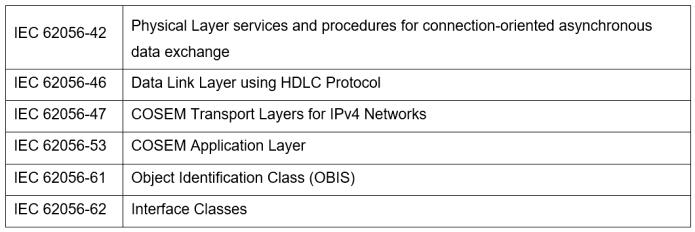
TheDLMS/COSEMprotocol isa comprehensivestandard for data exchange and communication between smart meters and data collection systems. Developed and maintained by the DLMS User Association, it is widely adoptedintheutilitysectorforelectricity,gas,water,and heatmetering.
DLMS (Device Language Message Specification):
DLMSisasuiteofprotocolsthatdefinethelanguage andmethodsforexchangingdatabetweendevices, particularlyinmeteringapplications.Itfocuseson thecommunicationstructure,ensuringreliabledata transfer.
COSEM (Companion Specification for Energy Metering):
COSEMspecifiestheobjectmodelingofmeterdata and functionalities. It defines a set of standard objects and their attributes, which represent the dataandfunctionsofameteringdevice.
The DLMS/COSEM protocol is a vital component in the modernization of metering systems, providing a standardized, reliable, and flexible framework for data exchangeanddevicecommunication.Itsadoptionsupports the development of smart grids and advanced metering infrastructures, driving efficiency, accuracy, and interoperabilityintheutilitysector.Astheenergylandscape evolves, DLMS/COSEM remains a cornerstone in enabling
intelligent,data-drivenmanagementofmeteringsystemsand resources.
The DLMS to IoT Gateway project integrates traditional meteringsystemswithmodernIoTtechnologiestofacilitate real-time monitoring and data analytics of electrical parameters.Thissystememploysacombinationofcurrent transformers(CTs),potentialtransformers(PTs),anESP32 microcontroller,a16x2LCDdisplay,andapowersupplyto createacomprehensiveenergymanagementsolution.
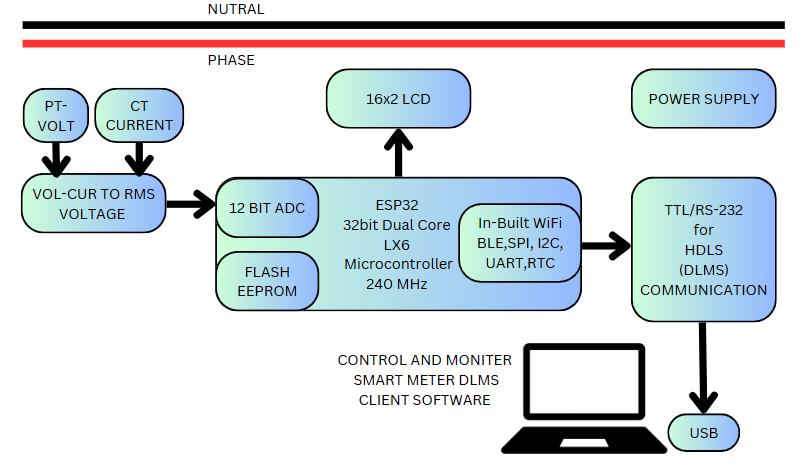
TheESP32servesastheservermodule,transmittingdatato theGuruxclientsoftware,whichisdesignedspecificallyfor DLMSsmartmeters.Thefollowingdescriptionprovidesan overview of the key components and their interactions as depictedintheblockdiagram.
•Current Transformer (CT):
Function: Measures the current flowing through electricalconductors.
Output: Provides an analog signal proportional to the current, which is then fed into the signal conditioning circuit.
•Potential Transformer (PT):
Function: Measures the voltage levels in the electrical system.
International Research Journal of Engineering and Technology (IRJET) e-ISSN: 2395-0056
Volume: 11 Issue: 05 | May 2024 www.irjet.net p-ISSN: 2395-0072
Output: Delivers an analog signal proportional to the voltage, which is similarly processed by the signal conditioningcircuit.
•Voltage and Current to RMS Voltage Conversion:
Function:ConvertstheanalogsignalsfromtheCTandPT intoRMSvoltagevalues.
Purpose: Ensures accurate and consistent readings of electricalparametersforfurtherprocessingbytheESP32.
•ESP32 Microcontroller (Server Module):
Function: Acts as the central processing unit of the system.
Capabilities:ProcessestheRMSvoltagedata.Converts thedataintoDLMS/COSEM-compliantformat.Transmits data to the Gurux client software via Wi-Fi or another communicationprotocol.
Data Handling: Sends real-time data every second, ensuringup-to-datemonitoring.
• 16x2 LCD Display:
Function: Provides a local display of key electrical parameters
Data Displayed: Voltage, current, power, and other relevantmetrics.
User Interface:Allowsuserstoquicklycheckthestatus andreadingsdirectlyonthedevice.
•Power Supply:
Function: Supplies stable power to the entire system, includingtheCT,PT,ESP32,andLCDdisplay.
Requirements:Ensuresallcomponentsoperatewithin theirspecifiedvoltageandcurrentranges.
•Gurux Client Software:
Function:ReceivesandprocessesdatasentbytheESP32.
Capabilities: Designed specifically for DLMS smart meters.
5. Result of Hardware Implementation and Client Software:
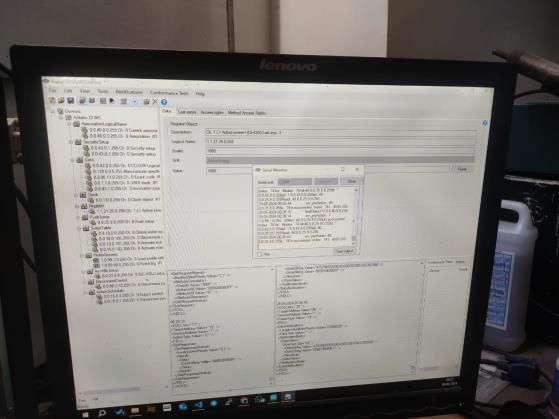
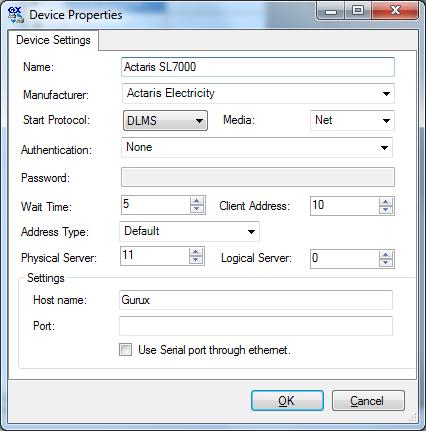
Fig 5 GURUXSoftware
Inourresearch,weemployedGURUXSoftwareforSerial Monitortofacilitatethecommunicationandmonitoringof serialdatabetweendevices.Thissoftwareprovidesarobust platformforvisualizingandanalyzingdatastreamsinrealtime,whichisessentialfortroubleshootingandoptimizing deviceinteractions.
Additionally,weutilizedtheDLMStoIoTGatewayClient software to bridge the communication between DLMS/COSEMdevicesandIoTplatforms.Thisgatewayclient converts DLMS/COSEM data into a format suitable for IoT applications, enabling seamless integration of traditional metering infrastructure with modern IoT ecosystems. The use of this client software ensures efficient data transfer, enhancesinteroperability,andsupportsthedeploymentof advancedmeteringinfrastructurewithinanIoTframework.
International Research Journal of Engineering and Technology (IRJET) e-ISSN: 2395-0056
Volume: 11 Issue: 05 | May 2024 www.irjet.net p-ISSN: 2395-0072
Iextendmyheartfeltgratitudetomyesteemedmentors,Mr. Manan Desai and Dr. S. R. Panchal, for their invaluable guidanceandunwaveringsupportthroughoutmyMasterof TechnologyjourneyinEmbeddedSystemsandVLSIDesign. Their profound expertise, insightful feedback, and encouragement have been instrumental in shaping my research endeavors and refining this review paper. I am trulyprivilegedtohavehadtheopportunitytolearnfrom theirexpertiseandmentorship.
The integration of DLMS/COSEM smart meters with IoT platformsvia the ESP32 microcontroller and Gurux DLMS clientsoftwareprovidesarobustandefficientsolutionfor real-timedataacquisitionand transmission.ThisDLMSto IoTgatewaybridgesthegapbetweentraditionalmetering infrastructure and modern IoT ecosystems, enabling enhancedenergymanagement,predictivemaintenance,and data-driven decision-making. Our implementation demonstratesreliability,cost-effectiveness,andscalability, makingitsuitableforwidespreaddeploymentinsmartgrid applications. Future research will focus on incorporating advancedsecuritymeasuresandoptimizingdatahandling protocols to further improve system robustness and efficiency.
BIOGRAPHIES:

Shah Amar, a dedicated research scholar at Dr Subhas University, pursues a Master of Technology degree specializing in Embedded Systems and VLSI Design. With a keen focus on advancing knowledgeinthesedynamicfields, Shah's research endeavors encompassinnovativeapproaches to address contemporary challenges and explore emerging trends in embedded systems and VLSIdesign

Manan Desai is the head of the ElectricalandECdepartmentatDr Subhash University. His area of research is power systems and electric vehicles He has written two books on power system protectionandrelaycoordination. Hehaspublishedsevenpapersand fourpatentsinhisresearchareas. His ongoing industry effort involves grid stability concerns with DISCOM businesses and the best locations for charging stations

Dr S R Panchal has received the B.E (Electronics) degree from Sardar Patel University, M.E (Automatic Control & Robotics) degreefromTheMSUniversityof Baroda,Vadodara,andPh.D.inE& C Engineering from Charotar University of Science and Technology(CHARUSAT),Changa in 2000, 2006, and 2018 respectively. At present, he is a Professor & Dean at School of Engineering and Technology, Dr. SubhashUniversity.