
International Research Journal of Engineering and Technology (IRJET) e-ISSN: 2395-0056
Volume: 11 Issue: 05 | May 2024 www.irjet.net p-ISSN: 2395-0072
International Research Journal of Engineering and Technology (IRJET) e-ISSN: 2395-0056
Volume: 11 Issue: 05 | May 2024 www.irjet.net p-ISSN: 2395-0072
Saneesh Sabu1, Sreelatha T2
1PG Scholar, Dept. of Civil Engineering, Rajiv Gandhi Institute of Technology Kottayam, Kerala, India
2Associate Professor Dept. of Civil Engineering, Rajiv Gandhi Institute of Technology Kottayam, Kerala, India
Abstract - Bitumen, in its pure form, could not possess all the necessary properties to withstand different climatic conditions and traffic loads. By adding different additives, bitumen may be made more appropriate for usage on road pavements. This study intends to enhance bitumen characteristics and performance by modifying asphalt binder with 6% Crumb rubber and fumed silica at varyingcontents of 0.5%,1%, 1.5%, 2%, and 2.5% by weight of binder. This study investigates the effect of fumed silica and Crumb Rubber on the properties of bituminous binder before and after aging. The physical characteristics of the modified binders have been examined, and test results have been compared with those of the unmodified binder. The binder's characteristics were found to improve with the addition of crumb rubber and fumed silica. The maximum viscosity, softening point, and minimum penetration value are determined for the sample containing 6% crumb rubber and 1.5% fumed silica.
Key Words: Bitumen,Crumbrubber,Fumedsilica,Physical characteristics
Bituminous materials, often known as asphalts, are commonlyutilizedinroadconstructionduetotheirstrong binding and waterproofing capabilities, as well as theirrelativelycheapexpense[8].Variousflawshavebeen identifiedinflexiblepavements,suchascracks,rutting,and potholes [6].Bituminous concrete mixes often deformpermanentlywhensubjectedtorepeatedloadsand hot temperatures. Global research is being conducted to enhancethequalitiesofasphaltconcretebyusingadditives inthe binderor mix preparation [10] Crumb rubber is recycledfromautomobiletyres. Addingcrumbrubbertohot bituminousmixesimprovespavementperformance,protects theenvironment,andleadstofasterandmorecost-effective roadways[12]. Theadditionofcrumbrubbertoahotmix asphalt mixture is regarded as a sustainable construction technique.Theuseofcrumbrubberasaningredientinhotmixasphaltmixturesisregardedasasustainablebuilding strategy. The use of crumb rubber increased both the strengthandthequalityoftheasphaltmix[13].Usingadry procedure to add crumb rubber additives in varying sizes and percentages significantly improved bitumen mix characteristicsandperformance[2]
The use of crumb rubber in bituminousbinders also has adverse effects. Using high percentages of crumb rubber (CR) in asphalt pavement using the dry process can negatively impact adhesion, leading to poor mix performance, fatigue, and rutting, as well as increased susceptibility to moisture damage [3] The settling of the crumb rubber particles in bitumen modified with crumb rubber,however,mayresultinstorageproblems[Ibrahim] Challenges with Crumb rubber-modified asphalt include inadequatestoragestability,elasticity,andhigh-temperature rutting [5]. Crumb rubber is a cross-linked substance that has inadequate compatibility between its particles and bitumen. Two strategies to overcome this issue include nanomaterialsandpretreatedCRparticles[7].Theinclusion of nanomaterials, such as nano-silica, enhances storage stability.Thenano-silicaandcrumbrubber-modifiedasphalt binderisstableandcanbestoredforlongperiodswithout settling.Thispropertymakesitidealforpavingapplications [5]
Fumedsilicaisacost-effective,non-toxicnanomaterialused to modify bitumen. The use of fumed silica nanoparticles may improve bitumen's mechanical and rheological properties,aswellasitsresistancetomoisturedamageand ageing [4]. The inclusion of fumed silica improves asphalt bindercharacteristics,includingpenetrationindex[10].The optimalfumedsilicapercentageis1.5%.Using1.5%fumed silicain 6% CR modification improves softening point, reduces temperature sensitivity, improves rheological characteristics,andimproveslow-temperatureparameters [1]. Modifyingbitumenwithcrumbrubberandfumedsilica istoreducetheenvironmentaldamagecausedbydiscarded automotivetires.Also,themodificationintendstoimprove the properties of the bituminous binder The study compared the physical properties of unmodified and modified bitumen binders, such as viscosity, penetration, softeningpoint,andspecificgravity.
Crumb rubber is tiny pieces of discardedtire shredded fromautomobiles that pose a severe disposal issue [9]. Crumbrubbermodificationincreasesbitumencharacteristics by improving storage and loss modulus, as well as its
International Research Journal of Engineering and Technology (IRJET) e-ISSN: 2395-0056
Volume: 11 Issue: 05 | May 2024 www.irjet.net p-ISSN: 2395-0072
susceptibilitytohighandlowtemperatures.Addingcrumb rubber might be challenging due to the poor rutting performanceofbindersathightemperatures.Crumbrubber (CR), an asphalt modifier, has poor compatibility with bitumenduetoitscross-linkedstructure[7].Crumbrubberis obtainedfromRubbersIndiaPrivateLtd
Fumedsilicaisawhite,fluffypowder.Whenfumedsilica is added, the penetration index of unmodified asphalt increases [10] The modification of bitumen using fumed silicananoparticlesandclaysignificantlydecreasedstiffness and increased resistance to permanentdeformation. The preciseconcentrationofclayandfumedsilicananoparticles greatlyinfluencesthemechanical stabilityofthemodified asphalt [4]. Studies indicate that fumed silica and CR additives make the binder more consistent and reduce its fluidityathightemperatures[1].
Inthisexperimentalstudy,VG30asphaltbinderwasused. Thebitumenismodifiedusing6%crumbrubberand0.5%2.5%offumedsilica Todeterminethecharacteristicsofthe binder,physicalpropertiestestswereconducted.
3.1
The penetration test grades bituminous materials by measuring the depth to which a standard needle can penetrate vertically under specific conditions [9] The reductioninpenetrationvalueindicatesthattheconsistency ofasphaltchangesandgetsharder,therebymakingitbetter [11] In this study penetration values at different percentagesofadditivesaredetermined.
Thesofteningpointisthetemperatureatwhichbitumen reachesaspecificlevelofsofteningunderstandardtesting conditions. This test was performed using a ring and ball apparatus.Bitumendoesnotimmediatelychangefromsolid toliquid,butasthetemperaturerises,itsoftensandflows easily [9]. The susceptibility of bituminous binders to variations in temperature and their resilience to elevated temperatureswereascertainedbytheuseofsofteningpoint testing [1] The softening point test was conducted as per IS:1205-1978
Theviscosityofthemodifiedandunmodifiedbituminous binderwasdeterminedusingaBrookfieldrotationaldial viscometer. A rotating viscometer test was conducted to assess the fluidity of bituminous binders at high
temperatures.Theviscosityresultswereusedtocalculate the mixing and compaction temperatures of modifiedbituminous mixes [1]. Viscosity defines the fluid characteristicsofbituminousmaterialsandinfluencestheir ability to coat particles, which affects the strength of the paving mix [9] The viscosity test is conducted based on ASTMD4402standard
Specificgravityisdefinedasthemassofacertainvolume ofbituminousmaterialdividedbythemassofanequivalent amount of water. The chemical composition of the binder hasanimportantimpactonitsspecificgravity.[9] Thetest isconductedasperIS:1202-1978
TheRollingThin-FilmOven(RTFO)replicatestheshortterm ageing of bituminous binder during production and pavingoperations. Thesamplewasplaced into a separate RTFO bottle, with a mass of 35g. It was then subjected to ageingatatemperatureof163±0.5ºCfor85minutesasper ASTMD2872-19.
4.1 Physical Property of VG30 Bitumen
Physicalpropertytestwasconductedontheneatbinder to evaluate its properties. Table 1 shows the physical characteristics of the neat binder include penetration, ductility, softening point, and rotational viscosity. The penetration value obtained for VG 30 in the physical propertytestis68,whichfallswithintherequiredrangeof 60-70asperIS73:2013forVG30.Thesofteningpointofthe VG30binderis48°C,whichexceedsthespecifiedminimum of 47°C. Viscosity is Brookfield viscometer and value is obtainedas1205cP.
Table -1: PhysicalPropertiesofVG30binder
1. PenetrationValue(dmm)at 25°C,01mm,100g,5s 68 IS:1203- 1978
2. Softeningpoint(°C) 48 IS:1205-1978
3. Specificgravity 097 IS:1202-1978
4. Viscosity(cP)at135°C 1205 ASTMD4402
5. DuctilityValue(cm) 102 IS:1208-1978
Physicalpropertytestconductedonthemodifiedbinder andpropertiesofthemodifiedareprovidedinTable2
International Research Journal of Engineering and Technology (IRJET) e-ISSN: 2395-0056
Volume: 11 Issue: 05 | May 2024 www.irjet.net p-ISSN: 2395-0072
result, it is observed that adding more than 1.5% fumed silicareducesthesofteningpoint.Increasedsofteningpoint indicates increased high-temperature binder properties. Binders with high softening point values tend to be more rigidandhardthanothers.Thisindicatesthatthebinderwill be more immune to rutting and degradation at higher temperatures[1].
Penetration (dmm)at25°C, 0.1mm,100g, 5s
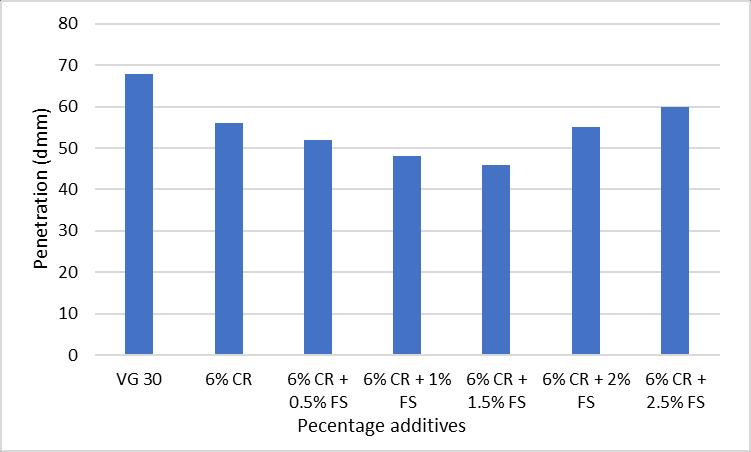
Thepenetrationtestevaluatestheconsistencyofasphalt materialsforgradingpurposes[9].Penetrationtestswere conducted on unmodified and modified samples. The incorporationofcrumbrubberintotheneatbinderlowers penetrationby17.64%whencomparedtotheneatbinder. Addingfumedsilicatocrumbrubber-incorporatedbitumen reducesthepenetrationvalue.Thesamplewith1.5%fumed silica achieves a minimum penetration value of 46 dmm, whichis29.41%lowerthanVG30bitumen. Thedeclinein penetrationvalueindicatesthattheconsistencyofbitumen altersandthebinderbecomeshard[11].Figure1showsthe variationofpenetrationwithpercentageadditives.
Softening point tests were conducted on bitumen to evaluatetheirtemperaturesensitivityandresistancetohigh temperatures[1] Thesofteningpointtestwasconductedon both modified and unmodified binders. The addition of crumbrubberincreasesthesofteningpointby8%.Adding fumedsilicatothecrumbrubbermodifiedsamplefurther increasesthesofteningpoint,andamaximumvalueof58°C isobtainedforthesamplewith1.5%fumedsilica,whichis about20% greaterthanunmodified binder.Fromthetest
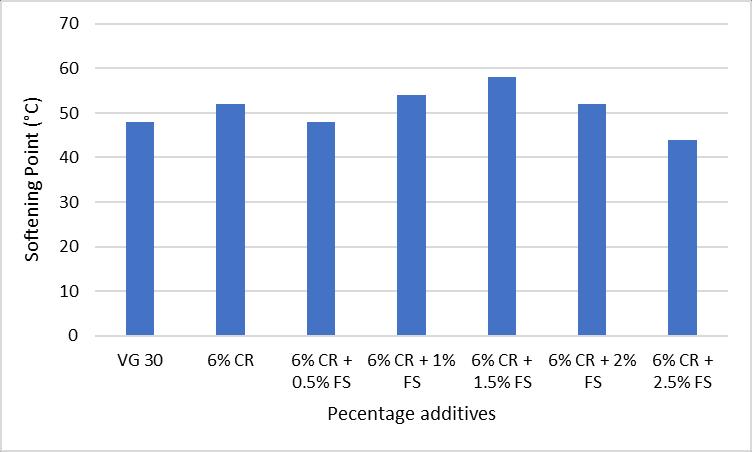
Fig. 2: Variationofsofteningpointwithpercentage additives
4.5 Viscosity
Viscosity describes the fluid properties of bituminous materials. Bituminous material spreads, penetrates voids, and coats aggregates based on its fluidity at a given temperature. The addition of crumb rubber, along with fumedsilica,enhancesviscosity.Themaximumviscosityis obtainedforthesamplewith1.5%FS,whichis56%greater thantheneatbindereventhoughalowpercentageoffumed silica results in lower viscosity. It was found that adding crumb rubber and fumed silica improves the binder's consistency and enhances its durability at high temperatures.
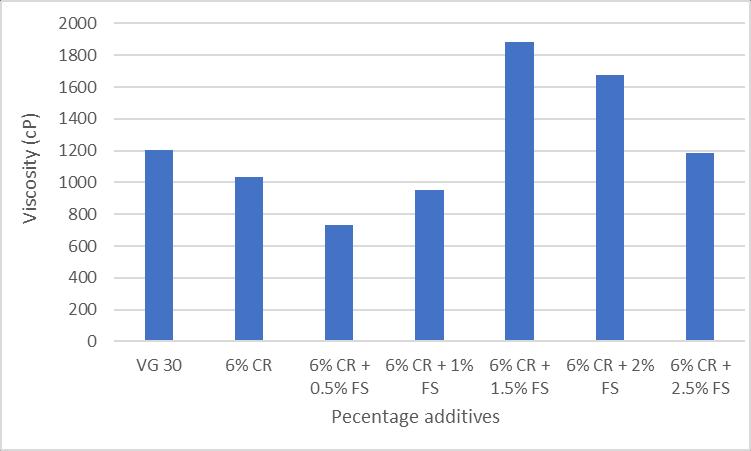
Fig. 3: Variationofviscositywithpercentageadditives
4.6 Rolling Thin-Film Oven Test
Rolling thin film oven tests have been conducted on various binders to assess the impact of ageing on the
International Research Journal of Engineering and Technology (IRJET) e-ISSN: 2395-0056
modifiedbinders.ThephysicaltestconductedontheRTFO residueisshowninTable3
Table. 3 Basicpropertiesofneatandmodifiedbitumen afteraging
Viscosity(cP) at135°C
Penetration (dmm) at 25°C, 0.1mm, 100g,5s 60
Lossinmass,percent
ThetestconductedonRTFOresidueindicatesthatviscosity increasedforboththemodifiedandunmodifiedbinder,after ageingdemonstratingimprovedconsistencyofthebinder. Penetrationtestsconductedontheagedsamplesindicatea reduction in penetration value for all samples, with the lowestvalueobtainedforthesamplecontaining1.5%fumed silica, demonstrating improved binder hardness. The softening point test on aged samples reveals that the softeningpointincreasesforallsamplesafterageing,with themaximumvalueobtainedforthesamplecontaining1.5% fumed silica. The results obtained from loss on heating indicatedthatthemodifiedbindersexhibitedalowervalue oflossinmass,withallsamplesfallingwithintheminimal valueof1%.Theageingpropertiesofvariousbinderstested indicate that modified binders offer better properties compared to unmodified binders. Hence it reveals that modified binders have better performance than neat binders.
Thestudyaimedtoevaluatetheeffectofshort-termaging onthepropertiesofbitumencontainingcrumbrubberand fumedsilica.Varioustestswereconductedonbothagedand unagedsamplestoassesstheiragingcharacteristics,andthe followingresultsweredetermined:
The penetration test was performed for modified and unmodified samples. The addition of 6% crumb rubber reducedthepenetrationvalueby17.64%.Furthermore,the additionoffumedsilicatothesesamplesalsoreducedthe penetration value, with the lowest value obtained for the
sample with 1.5% fumed silica, which showed a 29.41% reduction compared to the neat binder. The results of the softeningpointtestindicatethataddingcrumbrubberand fumed silica improves the softening point of the material. Thehighestsofteningpointvaluewasachievedwhen1.5% fumed silica was added, resulting in a 20% increase comparedtotheunmodifiedbinder.Thissuggeststhatthe modifiedbinderhasincreasedresistancetovarioustypesof temperatureinduceddamages.Theviscosityalsoimproved afteradditionofcrumbrubberandfumedsilicareachedits peakwhen1.5%fumedsilicawasadded,increasingby56% comparedtotheunmodifiedsample.
Therollingthinfilmoventestswereperformedtoevaluate the aging characteristics of the modified binder. The test resultsrevealedthattheviscosityincreasedforallsamples after aging. Additionally, the penetration value decreased afteraging,withtheminimumvalueobtainedforthesample containing1.5%fumedsilica,showinga21.74%reductionin penetration.Thesofteningpointincreasedaftermodifying thebinderwithcrumbrubberandfumedsilica,accordingto IRC SP 53-2010. The percentage increase in the softening pointafteragingshouldbelessthan7°Cforbothunmodified andmodifiedsamplesandthevaluesarewithin7°C.From the study, it is found that adding fumed silica to crumb rubber-modifiedbitumenimprovesitspropertiesbeforeand afteraging.
[1] Akpolat,M.,Kök,B.V.,&Aydoğmuş,E.(2022).“Research on the Rheological Properties of Asphalt Binder ModifiedbyFumeSilicaandCrumbRubberCompound”. Periodica Polytechnica Civil Engineering. https://doi.org/10.3311/PPci.19139
[2] Almusawi, A., Abdulrahman, H. S., Shakhan, M. R., & Doğaroğlu,B.(2020).EffectsofCrumbRubberSizeand Concentration on Marshall Parameters of Rubberized Asphalt Mixture. Pamukkale University Journal of Engineering Sciences, 26(6), 1048–1052. https://doi.org/10.5505/pajes.2020.50318
[3] Arabani, M., Tahami, S. A., & Hamedi, G. H. (2018). Performanceevaluationofdryprocesscrumbrubbermodified asphalt mixtures with nanomaterial. Road Materials and Pavement Design, 19(5), 1241–1258. https://doi.org/10.1080/14680629.2017.1302356
[4] Cheraghian, G., & Wistuba, M. P. (2020). Ultraviolet ageingstudyonbitumenmodifiedbyacompositeofclay andfumedsilicananoparticles.ScientificReports,10(1), 11216.https://doi.org/10.1038/s41598-020-68007-0
[5] Haroon, W., & Ahmad, N. (n.d.). Performance of Nano silicaandCrumbRubberCompositeModifiedBitumen and Asphalt Mixtures. https://ssrn.com/abstract=4525301
Volume: 11 Issue: 05 | May 2024 www.irjet.net p-ISSN: 2395-0072 © 2024, IRJET | Impact Factor value: 8.226 | ISO 9001:2008
International Research Journal of Engineering and Technology (IRJET) e-ISSN: 2395-0056
Volume: 11 Issue: 05 | May 2024 www.irjet.net p-ISSN: 2395-0072
[6] Khanday,R.,Kumar,B.,&Kumar,C.(2021).Macroscopic studyofFailuresinFlexiblePavementandtheirPossible Remedies.www.jetir.org
[7] Lushinga,N.,Dong,Z.,&Cao,L.(2022).‘Evaluatingthe High-TemperaturePropertiesandReactionMechanism of Terminal Blend Rubber/Nano Silica Composite Modified Asphalt Using Activated Rubber”. Nanomaterials, 12(24). https://doi.org/10.3390/nano12244388
[8] PranayKumar,G.,Mahesh,C.,Naresh,D.,&SaiSindhu,K. (2018). “Design of Flexible Pavement”. International Journal of Emerging Technologies in Engineering Research(IJETER),6(9).www.ijeter.everscience.org
[9] Pruthvi, M., Sr, R., Raghavendra S, M., & Maruthi, M. (2019).“PerformancetestsonWasteCrumbrubberand bitumen used in Bitumen mix for the application of flexible pavement”. International Research Journal of EngineeringandTechnology.www.irjet.net
[10] Sarsam, S. I. (2020). “Influence of Binder Type and Additives on Permanent Deformation of Asphalt Concrete”.www.ijdieret.in
[11] Sharma, S., & Goel, A. (2019). “A Study on Fractional Replacement of Bitumen with Crumb Rubber”. International Journal of Civil Engineering and Technology(IJCIET),10(3),1487–1495.
[12] SuganpriyaV,OmprakashS,&Chandralega V.(2016). “Study of Behaviour of Bitumen Modified with Crumb Rubber”.http://www.ijert.org
[13] Wulandari, P. S., & Tjandra, D. (2017). “Use of Crumb Rubber as an Additive in Asphalt Concrete Mixture”. Procedia Engineering, 171, 1384–1389. https://doi.org/10.1016/j.proeng.2017.01.451