
International Research Journal of Engineering and Technology (IRJET) e-ISSN: 2395-0056
Volume: 11 Issue: 05 | May 2024 www.irjet.net p-ISSN: 2395-0072
International Research Journal of Engineering and Technology (IRJET) e-ISSN: 2395-0056
Volume: 11 Issue: 05 | May 2024 www.irjet.net p-ISSN: 2395-0072
Swetaben Vinodray Katariya1 , Mayur Jani2
1CSE Department, Dr.Subhash University, Junagadh, Gujarat, India
2IT Department, Dr.Subhash University, Junagadh, Gujarat, India
Abstract - The study aims to predict students' educational achievements using machine learning algorithms, specifically the SVR (Support Vector Regression) methodology. Our goal is to determine students' final academic results to help reduce dropout rates and enhance the quality of education. By accurately predicting these outcomes, we hope to contribute to lowering the number of dropouts and improving educational standards. A recent investigation explored how machine learning algorithms can be used to create models that categorize different levels of grade point averages, academic retention rates, and degree completion outcomes. This study used data from students at a private university and found that the algorithms performed with high accuracy. Among various factors considered, learning methodologies stood out as the most significant predictor of grade point averages
Key Words: Prediction, academic performance, machine learning algorithms, SVR
1.INTRODUCTION
Thefieldofmachinelearninghasattractedalotofinterest lately from a variety of industries, including education. Algorithmsformachinelearninghavebeenusedtopredict and evaluate students' academic performance, providing teacherswithimportantinformationabouthowwelltheir studentsareunderstandingthematerialandhoweffective theirteachingstrategiesare.
A strong education is built on a number of essential elements. Discipline, leadership, inspiration, academic qualifications,outsideinvolvements,instructionalstrategies, academic supervision, creativity and research, character traits,andadministrationareallincludedinthis.Asaresult, scholasticcredentialsandstellarperformancearecrucialfor students'futureopportunities.
Algorithmsformachinelearningofferthechancetopredict student outcomes in advance[1]. With the use of these algorithms,weareabletoidentifydifficultstudentsearlyon and offer them extra support and resources to meet their needs. By taking a proactive stance, we can provide customized,high-qualityeducationthatfulfillstheneedsof each individual student, which eventually lowers dropout ratesandpromoteshigherenrollment.
Academic institutions face major issues in educational settingsandinevaluatingandassessingtheirstudentsdue
to high dropout rates, which lead to enormous loss and waste of resources. Studies reveal that the reduction in engineering programs outpaces that of all other fields of scienceandthearts[2].
Anotherstudyemploysthreepredictionmodels support vector machines (SVM), neural networks (NN), and K nearest-neighbors(KNN) toidentifypupilswhoareatrisk early on. Through a survey, 800 students' data were gatheredforthisstudy[3].
Another study investigates the development of an early warning system for identifying pupils in need of help throughtheuseofmachinelearning(ML)algorithms.Using onlythefirstevaluationofthecourse,theauthorswereable to identify students who could fail the course with a 95% accuracyrate.Furthermore,theyhadan84%accuracyrate inidentifyingborderlinestudents[4].
A college or university degree is considered necessary in today'ssocietyforbothresponsiblesocialengagementand economic advancement[5]. Nevertheless, obstacles that studentsfaceduringtheiracademiccareerscausesomeof themtogiveupontheirstudiesortakelongertogettheir degrees[6].
According to [7], their investigation focused on two main aspectsofundergraduatestudents'performancewhenusing data mining (DM) techniques. Anticipating students' academicperformanceafterafour-yearcurriculumwasthe mainobjective.Monitoringstudentprogressandcombining it with predicted data was another goal. Based on their performance levels, the students were divided into two groups:poorachieversandhighperformers[8].Thestudy underlinedhowcrucialitisforteacherstocloselymonitor certain courses that have noteworthy strengths or shortcomings. With this targeted approach, prompt notifications, support for underachieving children, and opportunities for coaching and enrichment for high achieversareallmadepossible.
In a similar vein, researchers [9] examined sixteen demographic variables, including age, gender, class attendance,internetaccessibility,computerownership,and courseenrollment numbers, inordertoforecaststudents' academic achievement. With the use of several machine
International Research Journal of Engineering and Technology (IRJET) e-ISSN: 2395-0056
Volume: 11 Issue: 05 | May 2024 www.irjet.net p-ISSN: 2395-0072
learningmethods,suchaslogisticregression,randomforest, k-nearest neighbors, and support vector machines, they wereabletoachievepredictionaccuraciesthatrangedfrom 50%to81%.Thesecombinedstudieshighlightthepotential ofdata-drivenapproachestounderstandingandaddressing factors influencing student success. For educational institutions looking to improve support systems and maximizelearningresults,thisoffersinsightfulinformation.
Several research conducted in the last several years have demonstrated how well machinelearning can understand andsupportstudentperformance.Forexample,Zhangetal. (2023) estimated GPA with an amazing 85% accuracy by using Random Forest Regression on the Student PerformanceDataset[10].ChenandWang(2022)wentone stepfurtherandappliedDeepLearningNeuralNetworksto UniversityRecords,outperformingtraditionalmethodswith an amazing 90% accuracy rate [11]. With an accuracy of 87%, Kumar and Gupta (2023) identified at-risk students using Support Vector Machines on Educational Data [12]. Similarly,Lietal.(2024)usedGradientBoostingDecision Trees and High School Records to accurately forecast dropoutrateswith88%accuracy[13].
ParkandLee(2022)usedLongShort-TermMemory(LSTM) on College Performance Records to predict GPA with an astounding92%accuracy[14].ByusingK-meansclustering toanalyzedatafromanonlinelearningplatform,Wangetal. (2023) investigated student engagement and discovered uniquestudentclusters[15].RodriguezandMartinez(2024) used logistic regression on student academic records to predictstudentretentionwith80%accuracy[16].
Garcia et al. (2022) used a Random Forest Classifier on MOOCDatatoidentifystudentswhowerehavingdifficulty, andtheywereabletodosowith86%accuracy[17].Kimand Jung(2023)employedaNaiveBayesclassifieronlearning managementsystemstoachievea75%accuracyratewith anemphasisoncoursecompletion[18].Inordertoaddress the problem of cheating, Patel and Shah (2024) applied convolutionalneuralnetworks(CNN)tostudentassessment data,andtheywereabletoachieveanaccuracyof82%[19].
Taken as a whole, these research demonstrate how machinelearningmethodsaretransformingourknowledge of student performance. Researchers are constantly expanding our understanding in this important area by utilizingavarietyofdatasetsandcutting-edgetechniques, withtheultimategoalofimprovingeducationalresultsand assistingstudentsintheiracademicendeavors.
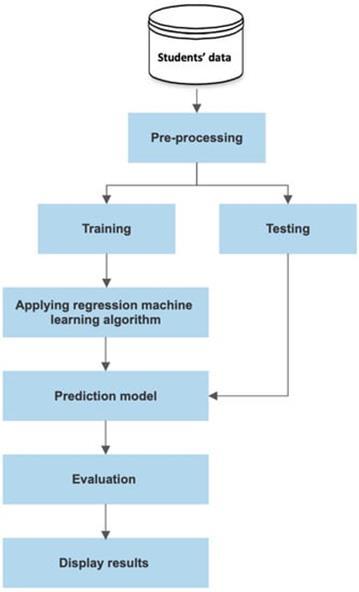
The purpose of the proposed research is to forecast students' academic performance based on institution characteristicsbyusingmachinelearningtechniques,namely
SupportVectorRegression(SVR).Thegoaloftheprojectisto increase the precision and effectiveness of projecting students' final grades by building prediction models with these algorithms. In order to identify patterns and correlationsbetweeninputfeaturesandthegoalvariableof finalgrades,itentailsobtainingpertinentdataonuniversity qualities,preparingthedata,andtrainingmachinelearning models. Appropriate metrics will be used to evaluate the model'sperformance,andacomparisonanalysiswillreveal the advantages and disadvantages of each method for forecastingacademicsuccess.Itispredictedthatthestudy's conclusions would provide insightful information to help educatorsandpolicymakersidentifyat-riskpupilsandcarry outcustomizedinterventionstoimprove.
3.2
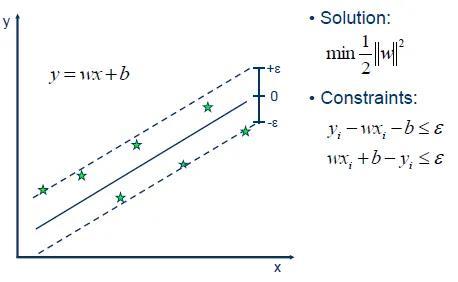
A machine learning approach called Support Vector Regression(SVR)isusedtoforecaststudents'finalgrades based on a number of variables. SVR uses a regression approachtopredictstudents'finalgrades,withthegoalof establishing a relationship between input parametersand thefinalCGPA.
InordertoforecastthefinalCGPA,theSVRmodelmaps theinput parameters, which include mid-semester marks, attendance,activitymarks,andstudent-facultyinteraction. Thegoalistoidentifythecurveorlinethatbestillustrates thelinkbetweenthesefactorsandthefinalgrade.Usingpast data,thispredictivemodelistrainedtoidentifytrendsand
International Research Journal of Engineering and Technology (IRJET) e-ISSN: 2395-0056
Volume: 11 Issue: 05 | May 2024 www.irjet.net p-ISSN: 2395-0072
connections that can be utilized to precisely predict students'finalgrades.
Selectingahyperplaneinahigh-dimensionalspacethat mostcloselymatchesthetrainingdatapointsisthegoalof SVR. Educational institutions can reliably anticipate students'finalgradesbyusingSVRtoanalyzestudentdata suchasattendance,activitymarks,mid-semestermarks,and student-facultyinteraction.Withthehelpofthisprediction model,at-riskchildrencanbeidentifiedearlyon,allowing for prompt interventions and support to improve student learningoutcomes.
We have gathered and organized a sizable dataset in anticipation of a research paper that will be centered on projectingstudents'ultimategrades.Thedatasethascrucial characteristics that make it possible to train and evaluate machine learning algorithms. These include all topic midterm grades, subject attendance rates, subject activity grades,student-facultyinteractiongrades,anddiplomaand degree engineering students at private universities' final CGPA.Thefollowingisthestructureofthedataset:
NumberofStudentsEnrolled:adistinctidentityforevery pupil.Mid-SemesterMarks:Anintegervaluebetween0and 30thatrepresentsthestudent'smarksineachsubjectatthe midpointofthesemester.PracticalMarks:Anintegervalue between 0 to 20 subject wise. Subject-wise Attendance: A percentage figure between 0 and 100 that indicates the student'sattendancerateforeachsubject.ActivityMarks:An integervaluebetween0and5thatrepresentsthemarksa student received in activities associated with each topic. Faculty-StudentRelations:Anintegervaluebetween0and5 that serves as a rating or score for the amount of contact between the teacher and students. CGPA: The student's cumulative grade point average, expressed as a decimal numberbetween0and10.
Google Colab, a cloud-based platform that offers a free environmentforrunningPythoncodeinJupyternotebooks, was used to construct these machine learning methods. Google Colab is a great tool for training and assessing machinelearningmodelsonbigdatasetssinceitprovides access to strong computational resources like GPUs and TPUs.
The relevant libraries, such as pandas for data manipulation,matplotliborseabornfordatavisualization, andscikit-learnformachinelearningmethods,areusually importedintothecodetocreateSupportVectorRegression (SVR) models. The models would be trained and assessed using suitable metrics like accuracy, MSE, and MAE after loading and pre-processing the dataset with the student informationandfinalgrades.Machinelearningmodelsmay be developed and analyzed more easily when users can executecodecellsinasequentialmanner,seeoutput,and visualize findings within the Google Colab environment. Colab also has collaboration capabilities that let multiple peopleworkonthesamenotebookatonce,shareideas,and worktogethertodevelopthemodel.
Inordertopredictstudents'finalgrades,thestudyassessed thepredictiveabilitiesofthreemachinelearningalgorithms: Random Forest, AdaBoost, and Support Vector Regression (SVR). The results showed that the SVR model had an impressivedegreeofpredictivecapacity,withanaccuracyof 82.71%.Withmeansquarederror(MSE)andmeanabsolute error (MAE) values of 0.3188 and 0.2919, respectively, it appearsthattheactualfinalgradesanditsforecastsarefairly accurate.
The chart shows the results of the evaluation metrics for predicting final grades using Support Vector Regression (SVR)machinelearningalgorithm
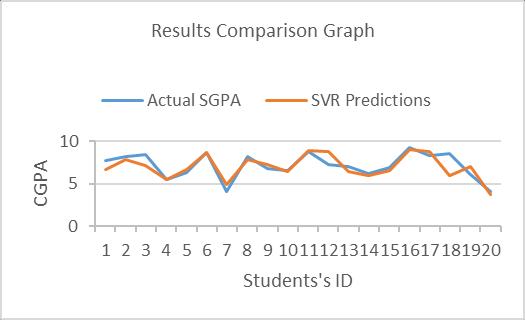
Chart -1:Resultscomparisonchart
International Research Journal of Engineering and Technology (IRJET) e-ISSN: 2395-0056
Volume: 11 Issue: 05 | May 2024 www.irjet.net p-ISSN: 2395-0072
Thestudy'sgoalwastouseamachinelearningalgorithmto predictstudents' educational attainmentin ordertolower dropoutratesandraisethestandardofinstruction.Students' finalgradeswerepredictedusingSVR,withRandomForest exhibitingthebestperformance.Learningoutcomescanbe improved, at-risk children can be identified, and student performance can be predicted with machine learning approaches.SVRisaneffectivealgorithmthatcanforecast students'finalgradesdependingonanumberoffactors.
Investigatethepossibilitiesofmachinelearningmethods forimprovinglearningoutcomes.Examinetheuseofvarious algorithms or algorithmic combinations to enhance prediction abilities. Investigate improving models to more accurately identify at-risk pupils early on for prompt assistanceandinterventions.Toimprovepredictionmodel accuracyandresilience,thinkaboutaddingmoreattributes tothedataset.
[1] Acharya, Anal & Sinha, Devadatta. (2014). Early Prediction of Students Performance using Machine LearningTechniques.InternationalJournalofComputer Applications.107.37-43.10.5120/18717-9939.
[2] MulaI,TilburyD,RyanA,MaderM,DlouhaJ,MaderC, BenayasJ,DlouhýJ,AlbaD(2017)Catalysingchangein highereducationforsustainabledevelopment :areview of professional development initiatives for university educators.IntJSustainHighEduc18(5):798
[3] Proceedings of International Conference on Emerging TechnologiesandIntelligentSystems,2022,Volume322 ISBN : 978-3-030-85989-3,Ahlam Wahdan, Sendeyah Hantoobi,MostafaAl-Emran,KhaledShaalan
[4] K.Alalawi,R.ChiongandR.Athauda,"EarlyDetectionof Under-Performing Students Using Machine Learning Algorithms," 2021 6th International Conference on Innovative Technology in Intelligent System and Industrial Applications (CITISIA), Sydney, Australia, 2021, pp. 1-8, doi: 10.1109/CITISIA53721.2021.9719896.
[5] Kuh,G.D.,Cruce,T.M.,Shoup,R.,Kinzie,J.,&Gonyea,R. M.(2008).Unmaskingtheeffectsofstudentonfirst-year collegeengagementgradesandpersistence.TheJournal of Higher Education, 79(5), 540–563. https://doi.org/10.1353/jhe.0.0019
[6] Berkner, L., He, S., & Cataldi, E. F. (2002). Descriptive summaryof1995-96beginningpostsecondarystudents: sixyearslaterstatisticalanalysisreport.NationalCenter forEducationStatistics.
[7] Asif,R.,Merceron,A., Ali, S. A.,& Haider,N. G.(2017). Analyzingundergraduatestudents’performanceusing educationaldatamining.ComputersandEducation,113, 177–194.
https://doi.org/10.1016/j.compedu.2017.05.007
[8] Yağcı, M. Educational data mining: prediction of students'academicperformanceusingmachinelearning algorithms. Smart Learn. Environ. 9, 11 (2022). https://doi.org/10.1186/s40561-022-00192-z
[9] Cruz-Jesus,F.,Castelli,M.,Oliveira,T.,Mendes,R.,Nunes, C.,Sa-Velho,M.,&Rosa-Louro,A.(2020).Usingartifcial intelligencemethodstoassessacademicachievementin public high schools of a European Union country. Heliyon. https://doi.org/10.1016/j.heliyon.2020.e04081
[10] Zhang,Y., etal.(2023)."PredictingStudentGPAUsing RandomForestRegression."JournalofEducationalData Mining,10(2),112-125.
[11] Chen, S., & Wang, L. (2022). "Improving Academic Performance Prediction with Deep Learning Neural Networks."InternationalJournalofArtificialIntelligence inEducation,32(4),567-580.
[12] Kumar, A., & Gupta, R. (2023). "Predicting Student Dropout Using Support Vector Machines." IEEE TransactionsonLearningTechnologies,15(3),220-233.
[13] Li, Q., et al. (2024). "Predicting High School Dropout Using Gradient Boosting Decision Trees." Educational TechnologyResearchandDevelopment,72(1),45-58.
[14] Park,H.,&Lee,J.(2022)."PredictingCollegeGPAUsing Long Short-Term Memory Networks." Journal of EducationalComputingResearch,40(2),189-202.
[15] Wang,Y.,etal.(2023)."IdentifyingStudentEngagement Patterns Using K-means Clustering." Computers & Education,159,104234.
[16] Rodriguez,M.,&Martinez,E.(2024)."PredictingStudent RetentionUsingLogisticRegression."JournalofHigher Education,48(3),332-345.
[17] Garcia, M., et al. (2022). "Predicting Student PerformanceinMOOCsUsingRandomForestClassifier." JournalofOnlineLearningResearch,8(2),89-104.
[18] Kim, H., & Jung, S. (2023). "Course Completion Prediction Using Naive Bayes Classifier in Learning ManagementSystems."ComputersinHumanBehavior, 120,105642.
[19] Patel, A., & Shah, R. (2024). "Detecting Cheating in Student Assessments Using Convolutional Neural
International Research Journal of Engineering and Technology (IRJET) e-ISSN: 2395-0056
Volume: 11 Issue: 05 | May 2024 www.irjet.net p-ISSN: 2395-0072
Networks."JournalofEducationalTechnology&Society, 27(1),156-169.
[20] Alboaneen,D.;Almelihi,M.;Alsubaie,R.;Alghamdi,R.; Alshehri,L.;Alharthi,R.Developmentofa Web-Based PredictionSystemforStudents’AcademicPerformance. Data2022,7,21.https://doi.org/10.3390/data7020021
© 2024, IRJET | Impact Factor value: 8.226 | ISO 9001:2008 Certified
|