
International Research Journal of Engineering and Technology (IRJET) e-ISSN: 2395-0056
Volume: 11 Issue: 05 | May 2024 www.irjet.net p-ISSN: 2395-0072
International Research Journal of Engineering and Technology (IRJET) e-ISSN: 2395-0056
Volume: 11 Issue: 05 | May 2024 www.irjet.net p-ISSN: 2395-0072
Darshit Jivrajani 1 , Riya Kaku 2 , Sandip Panchal 3
1Research Scholar, Dr. Subhas University
2Assistant Professor, B.H.Gardi College, GTU
3Assistant Professor, Dr. Subhas University, India
Abstract - People in their middle years who work are most commonly suffering from diabetic retinopathy. Due to inadequate resources, diabetic retinopathy can be tough to identify in remote regions. Many scientific and medical techniques are available to For the most part, the disease is examined for and identified by retinal fungal imaging. Here, the goal is to be capable to automatically screen images for retinopathy caused by diabetes. This will be achieved via developing an application for smartphones that makes use of fundus images and a model developed using machinelearning to evaluate an eye image and calculate the patient's level of blindness. This strategy will help shorten the time requiredfor diabetic retinal disease screening.
Key Words: Diabetic retinopathy, Machine learning, Fundus photographs, CNN, Android application.
1. INTRODUCTION
Anexcessivelyelevatedbloodsugarlevelcanleadto diabetes,achronicorgandisease.Individualssuffering from diabetes may get diabetic retinopathy, a major causeofvisionlossresultingfromchronicdamageto the blood vessels in the eyes. It is common to categorize diabetic retinopathy as either nonproliferate or proliferate. Blood vessels start to degenerateandmore fluid enters the eyeduringthe firststageofDR,orNPDR.Inthisphase,therearethree different structures that are visible: hemorrhages (small area of blood streaming into the retina), exudates(dropoffattytissues),andmicroaneurysms (reddot).Proliferatediabeticretinopathyisacondition where there is a reduction in blood flow due to the constrictionofbloodvesselsintheretina.PDRreduces eyesightinboththecenterandperiphery.
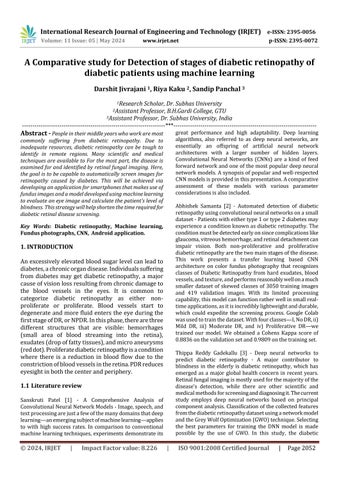
Sanskruti Patel [1] - A Comprehensive Analysis of ConvolutionalNeuralNetworkModels-Image,speech,and textprocessingarejustafewofthemanydomainsthatdeep learning anemergingsubjectofmachinelearning applies to with high success rates. In comparison to conventional machinelearningtechniques,experimentsdemonstrateits
great performance and high adaptability. Deep learning algorithms, also referred to as deep neural networks, are essentially an offspring of artificial neural network architectures with a larger number of hidden layers. Convolutional Neural Networks (CNNs) are a kind of feed forwardnetworkandoneofthemostpopulardeepneural networkmodels.Asynopsisofpopularandwell-respected CNNmodelsisprovidedinthispresentation.Acomparative assessment of these models with various parameter considerationsisalsoincluded.
Abhishek Samanta [2] - Automated detection of diabetic retinopathyusingconvolutionalneuralnetworksonasmall dataset-Patientswitheithertype1ortype2diabetesmay experienceaconditionknownasdiabeticretinopathy.The conditionmustbedetectedearlyonsincecomplicationslike glaucoma,vitreoushemorrhage,andretinaldetachmentcan impair vision. Both non-proliferative and proliferative diabeticretinopathyarethetwomainstagesofthedisease. This work presents a transfer learning based CNN architecture on color fundus photography that recognizes classes of Diabetic Retinopathy from hard exudates, blood vessels,andtexture,andperformsreasonablywellonamuch smaller dataset of skewed classes of 3050 training images and 419 validation images. With its limited processing capability,thismodelcanfunctionratherwellinsmallrealtimeapplications,asitisincrediblylightweightanddurable, which could expedite the screening process. Google Colab wasusedtotrainthedataset.Withfourclasses I,NoDR,ii) Mild DR, iii) Moderate DR, and iv) Proliferative DR we trained our model. We obtained a Cohens Kappa score of 0.8836onthevalidationsetand0.9809onthetrainingset.
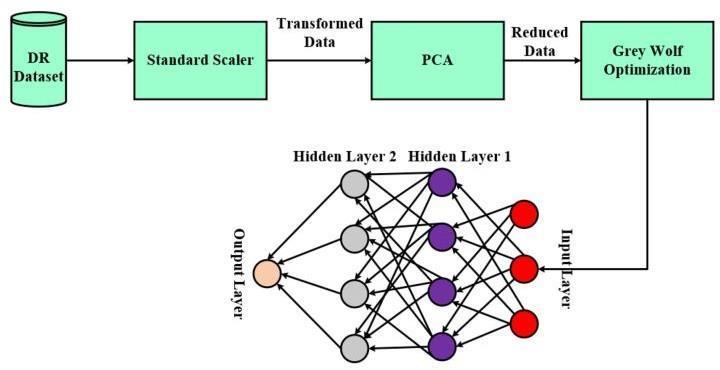
Thippa Reddy Gadekallu [3] - Deep neural networks to predict diabetic retinopathy - A major contributor to blindness in the elderly is diabetic retinopathy, which has emerged as a major global health concern in recent years. Retinalfungalimagingismostlyusedforthemajorityofthe disease's detection, while there are other scientific and medicalmethodsforscreeninganddiagnosingit.Thecurrent study employs deep neural networks based on principal componentanalysis.Classificationofthecollectedfeatures fromthediabeticretinopathydatasetusinganetworkmodel andtheGreyWolfOptimization(GWO)technique.Selecting the best parameters for training the DNN model is made possible by the use of GWO. In this study, the diabetic
International Research Journal of Engineering and Technology (IRJET) e-ISSN: 2395-0056
Volume: 11 Issue: 05 | May 2024 www.irjet.net p-ISSN: 2395-0072
retinopathydatasetisfirstnormalizedusingastandardscaler normalizationmethod.Next,dimensionalityisreducedusing PCA,optimalhyperparameterselectionisdonebyGWO,and thedatasetistrainedutilizingADNN model.Basedonthe performance metrics of accuracy, recall, sensitivity, and specificity,thesuggestedmodelisassessed.Themodelisalso contrasted with the support vector machine (SVM), naive bayesclassifier,decisiontree,andxGBoostclassicalmachine learning algorithms. The findings demonstrate that, in comparison to the previously described algorithms, the suggestedmodelperformsbetter.
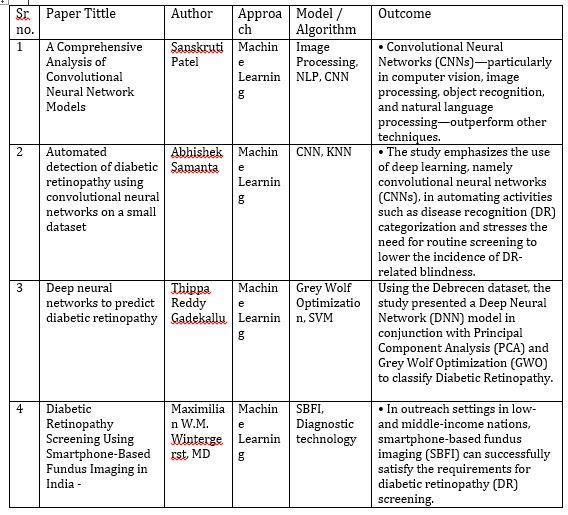
MaximilianW.M.Wintergerst,MD[4]-DiabeticRetinopathy Screening Using Smartphone-Based Fundus Imaging in India - Indirect ophthalmoscopy-based SBFI, which uses a smartphonetoobtainfundusimages,hasbeenfoundtohave thegreatestpicturequalityanddiagnosticaccuracyamong theseveralSBFImethodsevaluatedinthisstudyfordiabetic retinopathy (DR) screening in India.The burden of DR screening in low- and middle-income countries may be lessenedwiththeuseofsmartphone-basedfundusimagingin low-resourcesettings
Nikita Kashyap [5] - Mobile Phone Based Diabetic Retinopathy Detection System Using ANN-DWT - Fluid passagefrombloodvesselstotheretinacancausediabetic retinopathy (DR), a common retinal condition.The best treatmentforDRisearlydetectionandeyeexams.awayto slowthespreadofthisillness.Withtheuseofartificialneural network (ANN) algorithms, we describe in this research a low-cost,portablemobilephone-basedresultfindingmethod fortheearlyidentificationofdiabeticretinopathy.Inorderto makeadecision,themobiledevicewilluseacondensinglens to capture retinal images and then an ANN detection algorithm.ThefirstscreeningforDR.Anexistingdatabaseof retinasisexaminedtogaugetheamountofworkcompleted. Ourgoalistodesignanaffordable,efficienttestingmethod thatcanbeusedbyeveryone,eveninlessdevelopedareas.
Bhavana Sosale [6] - Simple, Mobile-based Artificial Intelligence Algorithm in the detection of Diabetic Retinopathy(SMART)study-Highsensitivityforreferable andsight-threateningdiabeticretinopathyisdemonstrated by the study's unique AI system, Medios AI, which detects diabetic retinopathy using a smartphone fundus camera whenusedoffline WiththeRemidioNMfundus-on-phone camera and Medios AI, diabetic retinopathy screening is made accessible and scalable in situations with limited resources
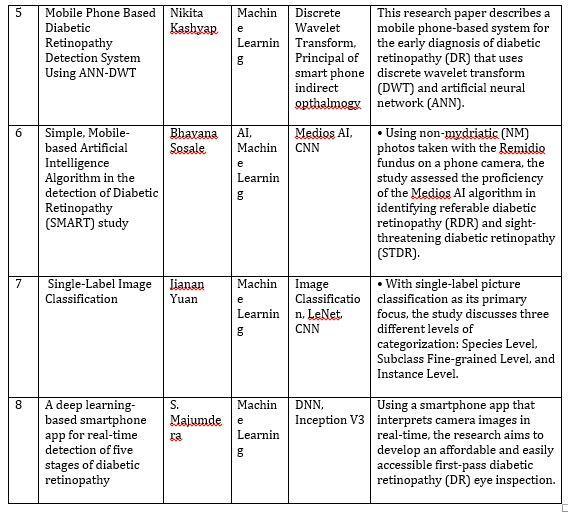
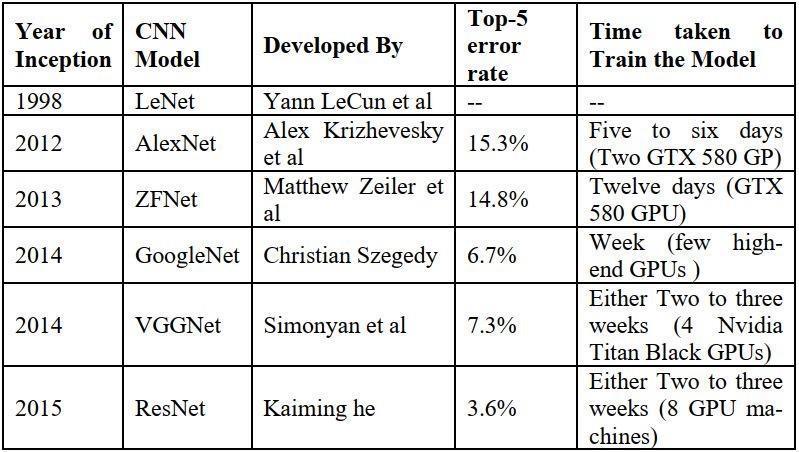
JiananYuan[7]-Single-LabelImageClassification-Inrecent decades,imagecategorizationhasbecomeaprominenttopic forstudy.Itdrawsalotofpeopletoconductstudybecauseit is so potent in the majority of fields. Single-label image classification is the simplest basic method of picture classification.Therearethreedistincttierstoit.Everylevel hasadifferentlevelofdifficulty.NeuralNetworks(NN)are
amongthemosteffectivetechnologiesforclassifyingphotos. Inadditiontointroducingafewrelevant,well-knownpicture databases, the main focus of this paper will be on convolutionalneuralnetworks,orCNNs.Thisarticleincludes illustrations of several indicators, such as the Top-5 and ConfusionMatrix,toassessthemodel.
S.Majumdera[8]-Adeeplearning-basedsmartphoneappfor real-timedetectionoffivestagesofdiabeticretinopathy-The use of deep neural networks in real-time on smartphone platforms to identify and categorize diabetic retinopathy from eye fundus images is shown in this research. This versiontakesintoaccounteachofthefivestagesofdiabetic retinopathy,expandinguponapreviouslypublishedversion. Thefirsttwodeepneuralnetworkstrainedareoneutilizing transferlearningandfundusimagesfromtheEyePACSand APTOS datasets for the purpose of identifying four phases andanadditionaltwoforfurtherclassifyingthefinalstage. Next, a demonstration of how these trained networks are incorporated into an Android and iOS smartphone app is provided, which enables real-time image processing from smartphonecameras.Smartphonescannowtakeandprocess fundus photos in real time thanks to the app's design accompaniedbycommerciallyaccessiblelensattachments. For first-pass diabetic retinopathy eye exams in outlying clinicsorplaceswithrestrictedaccesstofunduscamerasand ophthalmologists,areal-timesmartphonesoftwarehasbeen developedthatisbothaffordableandeasilyused.
International Research Journal of Engineering and Technology (IRJET) e-ISSN: 2395-0056
Volume: 11 Issue: 05 | May 2024 www.irjet.net p-ISSN: 2395-0072
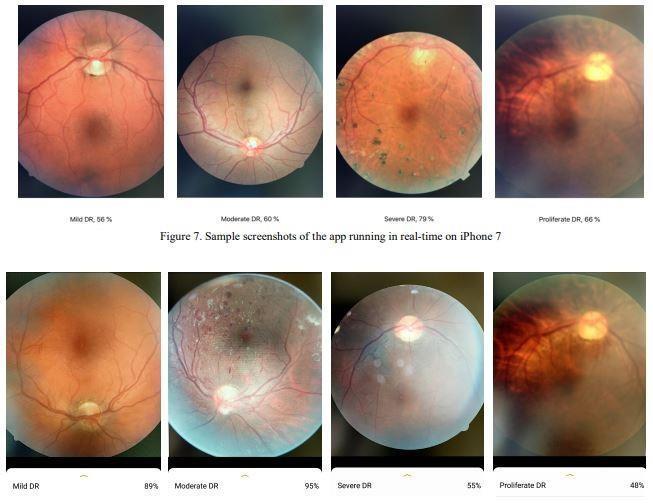
Sample screenshots of the app running in real-time on GooglePixel2.
A mobile gadget was used to detect DR. A convolutional neuralnetworkcalledResNet50isusedtoclassifydiabetic retinopathy into five phases. This model uses about 3500 images for training, validation, and testing. This model is thenusedtocreateaFluttermobileapplicationthatrunson Android.A98.8%accuracyrateisobtainedfromthisresult.
1 Sanskruti Patel, “A Comprehensive Analysis of Convolutional Neural Network Models”, International JournalofAdvancedScienceandTechnology•January 2020
2 Abhishek Samantaa, Aheli Sahaa, Suresh Chandra Satapathya,,Steven Lawrence Fernandes b, Yo-Dong Zhangc, “Automated detection of diabetic retinopathy usingconvolutionalneuralnetworksonasmalldataset”, 0167-8655/©2020ElsevierB.V.Allrightsreserved.
3 Thippa Reddy Gadekallu1 • Neelu Khare1 • Sweta Bhattacharya1•SaurabhSingh2•PraveenKumarReddy Maddikunta1 • Gautam Srivastava3,4,5, “Deep neural networkstopredictdiabeticretinopathy”,Received:18 January 2020 / Accepted: 6 April 2020© SpringerVerlagGmbHGermany,partofSpringerNature2020.
4 Maximilian W.M. Wintergerst,1 Divyansh K. Mishra, 2 Laura Hartmann,1 Payal Shah, 2Vinaya K. Konana,2 Pradeep Sagar, 2 Moritz Berger, 3 Kaushik Murali, 2Frank G. Holz, 1 Mahesh P. Shanmugam, FRCSEd,2,* RobertP.Finger,“DiabeticRetinopathyScreeningUsing
International Research Journal of Engineering and Technology (IRJET) e-ISSN: 2395-0056
Volume: 11 Issue: 05 | May 2024 www.irjet.net p-ISSN: 2395-0072
Smartphone-Based Fundus Imaging in India”, ISSN 0161-6420/20, 2020 American Academy of Ophthalmology,PublishedbyElsevierInc.
5 NikitaKashyapDr.DharmendraKumarSinghDr.Girish kumarsingh,“MobilePhoneBasedDiabeticRetinopathy Detection System Using ANN-DWT”, 4th IEEE Uttar PradeshSectionInternationalConferenceonElectrical, Computer and Electronics (UPCON)GLA University, Mathura,Oct26-28,2017.
6 Bhavana Sosale , Sosale Ramachandra Aravind, Hemanth Murthy, Srikanth Narayana, Usha Sharma, Sahana G V Gowda, Muralidhar Naveenam, “Simple, Mobile-based Artificial Intelligence Algorithm in the detectionofDiabeticRetinopathy(SMART)study”,BMJ Open Diab Res Care 2020;8:e000892. doi:10.1136/bmjdrc-2019-000892.
7 Jianan Yuan , College of Computer Science Software EngineeringShenzhen University, Shenzhen, China, Email: yuanjiajiaqq@outlook.com, “Single-Label Image Classification”,ReviewPaper.SanskrutiPatel,Charotar University of Science and Technology, “A Comprehensive Analysis of Convo lutional Neural NetworkModels”,January2020,InternationalJournalof AdvancedScienceandTechnology,29(4):771-777.
8 Sharmin Majumder, Yaroub Elloumi, Mohamed Akil, Rostom Kachouri, Nasser Kehtarnavaz, “A deep learning-basedsmartphoneappforreal-timedetection of five stages of diabetic retinopathy”, HAL Id: hal02556991,April2020.
2024, IRJET | Impact Factor value: 8.226 |