
International Research Journal of Engineering and Technology (IRJET) e-ISSN: 2395-0056
Volume: 11 Issue: 05 | May 2024 www.irjet.net p-ISSN: 2395-0072
International Research Journal of Engineering and Technology (IRJET) e-ISSN: 2395-0056
Volume: 11 Issue: 05 | May 2024 www.irjet.net p-ISSN: 2395-0072
Padmavati K1 , Amruth Kumar D K2 , Ganavi S M3, Keerthi K C4 , Sourabha Y N5 ,
1Assistant Professor, Dept. of Computer Science & Engineering, Mandya, Karnataka, India
2,3,4,5Student, Dept. of Computer Science & Engineering, GMIT, Mandya, Karnataka, India
Abstract - Musicaltherapyisatypeoftreatmentthatuses music to help people improve their physical, emotional, cognitive, and social functioning. It is a non-invasive treatmentthathasbeenshowntohavebeneficialeffectson mental health.Facial recognitiontechnologyhasgrown in prominence as a tool for analyzing human emotions and behavior’s in recent years. We are investigating the possibility of facial recognition technology in musical therapy. In this project, we propose approach to musical therapy that uses facial recognition technology to create personalized playlists for individuals based on their emotionalstate.Weuseaconvolutionneuralnetwork(CNN) toanalyzefacialexpressionsandclassifythemintodifferent emotionalstates,suchashappiness,sadness,oranger.Based ontheemotionalstatedetected,werecommendmusicthat is likely to have a positive effect on the individual's emotionalwell-being.Avoiceassistantisalsointegratedinto thesystemtoprovideadditionalsupportandguidancetothe users.Thesystemisdesignedtobeaccessibletopeopleofall ages and abilities, including those with disabilities. Our approachhasthepotentialtoimprovetheeffectivenessof musical therapy by providing personalized recommendationsbasedontheindividual'semotionalstate. Moreover,ourprojectprovidesaconvenientandaccessible platformforindividualstoreceivemusicaltherapywithout theneedforin-personvisitstoatherapist.
Key Words: Musical Therapy using Facial expression, Emotion Based Music Detection, Terapeutic Music Intervention, Music Driven Facial Analysis, Mood Enhancement.
The humans being has natural intelligences to watch a face and guess their emotional state. This intelligences, if copied by an electronic computer - desktop, robotic automaton or a movable machinery - will have useful applications in the real world. Music is seen as a good mediumofemotionalcommunique.Emotionalexpressionis seen as an important treatment idea. In every form and technical literature, it is linked to mental welfare when inhibition of feelings seems to have a role in different diseases,alongwithphysicalsicknesses.
Using traditional music therapies, where the therapist previously neededto manuallyanalyze thepatient’s mood
***
usingvariousobservingtechniquesthatdidn'tinvolveany computer machinery or specific intelligent systems. After determining the patient's mood, the therapist picks songs thatcouldcalmtheirmoodandemotionalstate.Thisprocess waslaborious,moretimeconsuming,andanindividualoften encounteredtheproblemofarrivingatasuitablesonglist. Eveniftheyidentifytheuser'smood,theirchoiceofsongsfor creatingaplaylistsimplyselectssongsthatreflecttheuser's currentfeelingsanddoesnottrytoimprovetheirmoodin anyway.
Therefore,iftheuserissad,theyarepresentedwithalist ofsongswithsademotionsthatcouldworsentheirmoodand potentiallyleadtosadness.So,thesystemproposedinthis paper can identify the user's emotions from their facial expressions. It will then offer the user a playlist of songs, ensuring that the user may feel better.
1.”Smart Music Player Integrating Facial Emotion Recognition and Music Mood Recommendation”
Authors: Shlok Gilda, Husain Zafar, Chintan Soni, KshitijaWaghurdekar.
Methodology: Themethodologyencompassestheutilization ofdeeplearningalgorithmsforfacial emotion recognition and the extraction of acoustic features for music classification. These processes are integrated to map the user's mood to recommended songs, enhancing the personalizedmusiclisteningexperience.Thestudyleverages datasetscomprisingfacialexpressionsandlabeledsongsto train artificial neural networks for accurate emotion identificationandmusicmoodclassification.Theevaluation ofthesystem'sperformanceinvolvestestingonasubstantial datasetofimagesandsongstoachievehighaccuracylevels. Future enhancements include exploring the system's performance with all seven basic emotions, incorporating songsfromdiverselanguagesandregions,andintegrating userpreferencesthroughcollaborativefilteringforfurther refinementoftherecommendationsystem.
2.”Smart Space with Music Selection Feature Based on Face and Speech Emotion and Expression Recognition”
Authors: Jose Martin Z. Maningo, Argel A. Bandala, Ryan RhayP.Vicerra,ElmerP.Dadios,KarlaAndreaL.Bedoya.
International Research Journal of Engineering and Technology (IRJET) e-ISSN: 2395-0056
Volume: 11 Issue: 05 | May 2024 www.irjet.net p-ISSN: 2395-0072
Methodology: The methodology of the research paper involvesdevelopinganembeddedsystemusingaRaspberry Pi3,camera,microphone,andspeakerstoselectappropriate musicbasedonuseremotion.Thesystemcomprisesthree main features: Face Recognition for emotion detection, SpeechRecognitionforextractingspeechcomponents,and Emotion Classification for identifying displayed emotions. TheFacialExpressionDatabaseusedistheExtendedCohnKanadeDataset,whiletheSpeechEmotionDatabaseisthe RAVDESSdatabase.FaceEmotionRecognitioninvolvesimage processing, feature extraction, and training the algorithm usingadatasetsplitintotrainingandtestsets.Thesystem captures user images and processes them for emotion recognition. Speech input is recorded and classified using SVMalgorithms.ThesystemrunsinacontrolledSmartSpace environmentwithsufficientlightingandminimalnoise.The studyrecommendsgatheringmoredatasamplesfortraining, improving system efficiency, integrating additional modalities for emotion recognition, and using better componentsforenhancedaccuracy
3.”Musical Therapy using Facial Expressions”
Authors: Pranjul Agrahari,AyushSinghTanwar,BijuDas, Prof.PankajKunekar.
Methodology: The methodology of the study "Musical Therapy using Facial Expressions" involves a multi-step approachtoimplementtheproposedfacialexpression-based music therapy system. Firstly, facial expressions are extracted from images using image processing techniques and machine learning algorithms. Multiple images are captured from a webcam to predict emotions accurately, with blurred images being averaged to reduce errors. Histogramequalizationisappliedtoenhanceimagecontrast, followed by cropping and conversion to grayscale for foregroundisolation.Formusicemotionrecognition,amusic datasetisobtainedandfeatureextractionisperformedusing MIR packages like LibROSA and PyAudio Analysis. These packagesanalyzemusicalfeaturessuchastempo,rhythm, and timbre, along with lyrics, for clustering using unsupervised learning with the k-means algorithm. Centroidsaremanuallysetforefficientexecution,andsongs are labeled with descriptors for search optimization postfacialemotionrecognition.Machinelearningalgorithmsare utilizedforemotionclassification,withthedevelopmentof anemotionAPItoprovideoutputbasedontheinputtothe system.
Authors: Shruti Aswal, Sruthilaya Jyothidas, S Shankarakrishnan.
Methodology: Themethodologyofthestudyinvolvedthe development and implementation of a novel approach to musical therapy through the integration of convolutional
neural networks (CNNs) and facial emotion recognition technology. Real-time video data capturing facial expressionswasanalyzedusingCNNstoclassifyemotional statessuchashappiness,sadness,oranger.Thisemotional state classification was then used in conjunction with a musicrecommendationalgorithmtoprovidepersonalized playlists tailored to the individual's mood, enhancing the therapeutic experience. Furthermore, a voice assistant component was integrated into the system to offer additional support and guidance, ensuring inclusivity for users of varying ages and abilities. By leveraging machine learning techniques, the study aimed to create a personalized and immersive musical therapy experience, withtheultimategoalofimprovingmentalhealthandwellbeingthroughinnovativeandeffectivetherapysessions.
The goal is, like, creating this system thing that can, like, detectandclassifydifferentfacialexpressionssuchashappy, sad, mad, scared, chill, surprised, and grossed out in, like, real-time.Byusing,like,imagestuffandsmartalgorithms,the goalistoautomatethewholeemotionthing,youknow,sowe canplaythetunesforwhoeverbasedonhowthey'refeeling. And,like,wealsowannafigureoutwhatkindoftunesfolks likebasedontheirfaces,sowecanmakethemplayliststhat matchtheirvibes.So,withthesesmartalgorithms,man,the plan is for the system to keep learning and get better at readingemotions,whichwillmakemusictherapyevenmore awesome. Plus, we wanna make it easier for therapists by pickingtunesbasedonexpressions,sotheydon'tgottawork sohard,youknow?Thisstudyalsowantstomaketherapya betterexperiencebymakingtheinterfacecoolandrelaxing, sopeopleareintoit.Attheendoftheday,whatwe'rereally aimingforistoshowthatusingfacialexpressionsformusic therapyistotallydoableandactuallyworks.It'sawholenew way of helping folks with their mental health, bringing togethertechandtherapyinaradway.
The problem statement was addressed in the study on "Musical TherapyusingFacial Expressions" isa need fora more precise and customized approach to music therapy withinmentalhealthtreatment.Traditionalmethodsofmusic therapy often involve therapists manually analyzing a patient'smoodandselectingappropriatesongs,whichcanbe time-consuming and may not always lead to the most effective therapy outcomes. This manual process lacks automation and personalization, leading to challenges in providing tailored music therapy that aligns with the patient'semotionalstate.Moreover,thetraditionalapproach maynotalwaysconsiderthenuancesofindividualemotions or provide a comprehensive understanding of the mental well-beingofthepatient.Amoreadaptiveandpersonalized therapysolutionisneededthatcandynamicallyrespondto the patient's emotional cues in real-time, enhancing the
International Research Journal of Engineering and Technology (IRJET) e-ISSN: 2395-0056
Volume: 11 Issue: 05 | May 2024 www.irjet.net p-ISSN: 2395-0072
effectiveness of music therapy sessions. The studyaimsto addressthesechallengesbydevelopinganintelligentsystem thatintegratesfacialexpressionrecognitiontechnologywith music therapy. By automating the process of emotion detectionandmusicselectionbasedonfacialexpressions,the systemseekstoprovideamoreefficient,personalized,and engaging music therapy experience for patients. This innovative approach aims to overcome the limitations of traditionalmusictherapymethodsandimprovetheoverall qualityofmentalhealthtreatmentthroughtechnologyand therapeuticinterventions.
Theintendedsystemcanidentifythefacialstatementofthe userandsupportedonhis/herfacialtoneextractthefacial milestones, which would then be classified to acquire a unique emotion of the user. When the feeling has been classified the tunes corresponding the user's emotions would be shown to the user. In this intended system, we constructamodelinsuggestionofforcefulmusicsuggestion system depending on human feelings. Depending on each human listening outline, the tunes for each emotions are skilled. Composition of feature extraction and machine education methods, from the actual face the feeling are identified and once the feeling is produced from the contribution display, respective tunes for the exact spirit would be played to contain the users. In this advance, the request gets associated with human beliefs thus deliver a particularstroketotheusers.Consequentlyourconsidered system intensify on recognizing the human feelings for developing feeling based musical player using computer senseandmachinelearningmethods.Forempiricaleffects, we practice openCV for feeling identification and musical endorsement.
6. Methodology
In the propose algorithm, face images and facial landmark detections are performing first for recognition of stress. A ConvolutionalNeuralNets(CNN)algorithmwasusedinthe propose network, face images and expressions detected earlierareinputinordertooutputstressrecognitionresults.
The results of face recognition are consisted of students presentintheclass.
Step1:Convolution
Aconvolutionisaconnectedintegrationoftwomethods thatshowsyouhowonemethodtransformstheother.
Step2:ImplementtheRLU(RevisedLinearityUnit)
In this step, the correctional function is used to increase nonlinearityonCNN.Thedatasetconsistsofdifferentobjects whichare notlineartoeachother.Underthisfunction,the groupingofinformationcanbeseenasalinearproblem,even thoughitisanon-linearproblem.
Spatial invariance isa termthat does not affectthe neural network's ability to detect its particular features when discoveringaniteminthedatacollection.PoolinghelpsCNN todetectswimmingpools,suchasmaxandminimumpools, forexample.
Basing on the weather forecast, detect the faces and student'sattendancewillbetaken.
7. MODULE DESCRIPTION:
Data Collection Module
Asurveyisbeingcollectedfromusersbasedon3parameter whichare,1.Whattypeofsongwouldtheywantstolistento when they was happy? 2. What kind of song would they wants to listen to when they is sad? 3. What type of song wouldtheyliketolistentoiftheyareangry?.
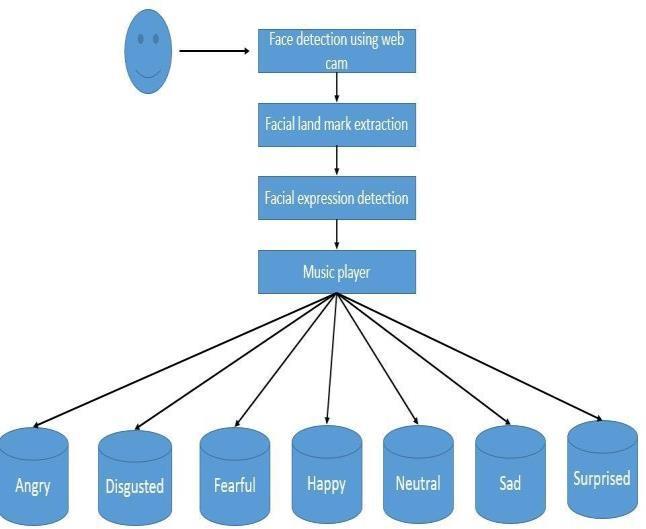
The picture of the user is captured with the help of a camera/webcam.Whenthephotoistaken,theframeofthe picture captured from webcam feed is converted to a grayscale image to better the completion of the classifier, whichisusedtoidentifythefaceexistinginthepicture.When the conversion is done, the picture is sent to the classifier algorithmwhich,usingthefeatureextractionmethods,can extractthefacefromtheframeofthewebcamfeed.Fromthe face extracted, individual features is got and sent to the trainednetworktodetecttheemotionexpressedbytheuser. Thesepictureswillbeusedtoeducatetheclassifiersothat when an absolutely new and strange set of pictures are shown to the classifier, it is able to extract the position of faciallandmarksfromthosepicturesbasedontheknowledge thatitalreadyhadacquiredfromthetrainingsetandreturn thecoordinatesofthenewfaciallandmarksthatitdetected. Thenetworkiseducatedusingextensivedataset.Thisisused torealizetheemotionbeingexpoundedbytheuser.
Aftertheemotionoftheuserisextractedthemusic/audio basedontheemotionexpoundedbytheuserisshowntothe user,alistofsongsbasedontheemotionisshown,andthe usercanenjoyanysonghe/shelikes.Basedontheregularity that the user would listen to the songs are shown in that order.
Theemotionsthatareextractedforthesongsarestored,and thesongsbasedontheemotionsareshownonthewebpage. Forexample,iftheemotionorthefacialfeatureisclassified underthewordhappy,thensongsfromthehappydatabase areshowntotheuser.
International Research Journal of Engineering and Technology (IRJET) e-ISSN: 2395-0056
Volume: 11 Issue: 05 | May 2024 www.irjet.net p-ISSN: 2395-0072
The overall software features concern with define requirements and establish the high level of system. In architecturaldesign,variouswebpagesandtheirconnections are identified and are designing. The major software componentsidentifyanddecomposeintoprocessingmodules andconceptualdatastructuresandinterconnectionsamongst modules are identified. Following modules identify in proposedsystem!
ReduceAnxiety
ReduceDepression
ReduceStress
ImproveEmotionalRegulation&Processing
PromoteFeelingsofSafety&Security
ImproveSelf-Esteem&SenseofIdentity
Real-TimeFeedback
EnhancedEngagement
AccessibleMentalHealthSupport
In this project, we have discussed that how our proposed systemrecommendmusicbasedonfacialexpressionusing machinelearning algorithms. The proposed system is also scalableforrecommendingmusicbasedonfacialexpressions byusingtechniquesaftercollectingdata.Thesystemisnot havingcomplexprocesstorecommendmusicthatthedata liketheexistingsystem.Proposedsystemgivesgenuineand fastresultthanexistingsystem.Hereinthissystemweuse machinelearningalgorithmstorecommendmusicbasedon realtimefacialexpression.
Personalization:Implementafeaturethatallowsusersto create personalized playlists based on their specific emotionalneedsandpreferences.
9. Application
Online Mental Health Platforms
Mood Tracking and Self-Care
Support for Special Needs Individuals
Clinical Therapy Settings
Stress Management Programs
Special Education and Developmental Disorders
Rehabilitation Programs
Senior Care and Dementia Management
Pain Management
Rehabilitation and Recovery
Stress Reduction in Workplaces
Real-timeFeedback:Incorporateafeedbackmechanism foruserstoratetheeffectivenessoftherecommended musicinimprovingtheirmood.
ExpandedMusicDatabase:Enhancethemusicdatabase byincludingawiderrangeofgenresandsongstocaterto diverseemotionalstatesandpreferences.
Machine Learning Algorithms: Explore advanced machinelearningalgorithmsformorepreciseemotion detection and music recommendation, such as deep learningmodelsorensemblemethods.
[1] Shlok Gilda, Husain Zafar, Chintan Soni, Kshitija Waghurdekar,"Smart music player integrating facial emotionrecognitionandmusicmoodrecommendation", DateofConference:22-24March2017,India.
[2] A. Fathallah, L. Abdi, and A. Douik, “Facial Expression RecognitionviaDeepLearning,”in2017IEEE/ACS14th International Conference on Computer Systems and
International Research Journal of Engineering and Technology (IRJET) e-ISSN: 2395-0056
Volume: 11 Issue: 05 | May 2024 www.irjet.net p-ISSN: 2395-0072
Applications(AICCSA),Hammamet,2017,pp.745–750, doi:10.1109/AICCSA.2017.124
[3]H.Bahuleyan,“MusicGenreClassificationusingMachine LearningTechniques,”arXiv:1804.01149[cs,eess],Apr. 2018.
[4]A.Elbir,H.BilalÇam,M.EmreIyican,B.Öztürk,andN. Aydin,“MusicGenreClassificationandRecommendation by Using Machine Learning Techniques,” in 2018 Innovations in Intelligent Systems and Applications Conference (ASYU), Oct. 2018, pp. 1–5, doi: 10.1109/ASYU.2018.8554016.
[5]S.L.HappyandA.Routray,"Automaticfacialexpression recognition using features of salient facial patches," in IEEETransactionsonAffectiveComputing, vol.6,no.1, pp.1-12,1Jan.-March2015.
[6]Rahulravi,S.VYadhukrishna,Rajalakshmi,Prithviraj,"A Face Expression Recognition Using CNN & LBP",2020 IEEE.
[7] Anuja Arora, Aastha Kaul, Vatsala Mittal,”Mood based musicplayer”,Dateofconference:2019,India
[8]S.Deebika,K.A.Indira,Jesline,"AMachineLearningBased MusicPlayerbyDetectingEmotions",2019IEEE
[9] Karthik Subramanian Nathan, manasi arun, Megala S kannan,"EMOSIC Anemotion-basedmusicplayerfor Android,2017IEEE
[10]H.I.James,J.J.A.Arnold,J.M.M.Ruban,M.Tamilarasan, AndR.Saranya,“EmotionBasedMusicRecommendation System,”Vol.06,No.03,P.6,2019.
2024, IRJET | Impact Factor value: 8.226 |