
International Research Journal of Engineering and Technology (IRJET) e-ISSN: 2395-0056
Volume: 11 Issue: 05 | May 2024 www.irjet.net p-ISSN: 2395-0072
International Research Journal of Engineering and Technology (IRJET) e-ISSN: 2395-0056
Volume: 11 Issue: 05 | May 2024 www.irjet.net p-ISSN: 2395-0072
Mr.Krishna
Swaroop C D1 , Dr. Kishor Kumar S2
1Assistant Professor, Dept. Of Civil Engineering, Malnad College of Engineeering, Hassan, Karnataka, India
2Assistant Professor, Dept. Of Civil Engineering, Malnad College of Engineeering, Hassan, Karnataka, India ***
Abstract - As we know that, surface water and ground water are polluted because of anthropogenic activity. Adequate Supplyoffresh and cleandrinkingwater isessential for all human beings on the earth, yet it has been observed that millions ofpeople worldwide are stilldrinkingwaterthat is contaminated by bacteria, toxic chemicals and other pollutants. This work investigates the feasibility of replacing reverse osmosis (RO) with low-cost adsorbent through physico-chemical characteristics. This work suggests that adsorbent filtration offers a cost-effective alternative with comparable contaminant removal efficiency, providing valuable insights for sustainable water treatment solutions. We are usingadsorbentsi.e,Sugarcanebagasse,Walnutshells, Ricehusk, Orangepeel, Neem saw dust and investigating it’s effectiveness and contaminant removal capacity. We have tested the basic parameters like PH test, Alkalinity test, Chloride test, TDS test, Turbidity& Hardness test. Activated sugar cane bagasse and activated walnut shells have given better results.Sugarcanebagassereducedhardnessby23.33% andTDS by32%, where as Walnut shells reducedhardnessby 16.67%. But both failed in chloride test as it is increased by 31.66% for Sugarcane bagasse and 25% for walnut shells. Neem saw dust gives poor results compared to all adsorbents
Key Words: TDS: Total dissolved solids, RO: Reverse osmosis
Access to clean and safe drinking water remains a critical global challenge, particularly in regions with limited resourcesandinfrastructure.Conventionalwatertreatment methods,suchasreverseosmosis(RO),whileeffective,often present barriers to widespread adoption due to their high costs and energy-intensive nature. In response to these challenges,thereisgrowinginterestinexploringalternative andsustainablewaterpurificationtechnologiesthatareboth cost-effectiveandenvironmentallyfriendly.
Onepromisingavenueforaddressingthesechallengesliesin theutilizationoflow-costadsorbentsderivedfromnaturalor waste materials. Materials such as walnut shell, rice husk, sugarcane bagasse, orange peel, and neem wood possess inherent adsorptive properties that can effectively remove contaminants from water through physical or chemical interactions.Thesematerials,oftenconsideredasagricultural or industrial byproducts, offer a renewable and readily available source of adsorbents that can be harnessed for watertreatmentapplications.
Thisstudyaimstoinvestigatethepotentialofutilizingwalnut shell,ricehusk,sugarcane bagasse,orangepeel,and neem woodaslow-costadsorbentsforwaterpurification.Through a combination of laboratory experiments and economic assessments, we seek to evaluate the effectiveness, affordability, and scalability of these adsorbents in comparisontotraditionalwatertreatmentmethodssuchas reverse osmosis. By harnessing the natural adsorptive capabilitiesof these materials,we aim tocontribute tothe development of sustainable and accessible solutions for providingcleandrinkingwatertocommunitiesworldwide.
Preparationof0.1Mzincschloridesolution:
Takeproperlyweighed13.63gmofzincchlorideanddissolve inaminimumvolumeof2MHCl,add500mlofdistilledwater and allow cooling and dissolving. Once it has completely dissolved,makeupthevolumeto1000mlwithwater.
Preparationof2MHCl:
Take07.30gmofconcentratedhydrochloricacidin1000ml ofdistilledwater.
ThismembraneconsistsofPVCpipe,wiremesh,one inletandoneoutlet.
Thediameterofwiremeshis3.75cmanddiameterof PVCpipeis7.5cmandthelengthofthepipeis65cm.
Theadsorbentsof5cmeachareplacedlayerbylayerin thewiremeshfrombottomandeachlayerisdividedby a3cmlayerofcotton.
• Through the comprehensive evaluation of water qualityparametersforNeemSawWood,Sugarcane Bagasse, Rice Husk, Orange Peeland Walnut, our study has yielded valuable insights into their potentialasadsorbentsforwatertreatment.
• Across the board, these natural materials have demonstrated effectiveness in reducing key contaminantssuchasChloride,Hardness,Alkalinity and Total Dissolved Solids (TDS) to levels within acceptable ranges, as defined by established standards. Their performance underscores the
International Research Journal of Engineering and Technology (IRJET) e-ISSN: 2395-0056
Volume: 11 Issue: 05 | May 2024 www.irjet.net p-ISSN: 2395-0072
viabilityofemployinglow-costadsorbentsinwater treatmentprocesses,aligningwiththeprinciplesof sustainabilityandenvironmentalstewardship.
• However,certainconsiderationshaveemergedfrom our analysis. Neem Saw Wood exhibits efficacy in contaminantremovalbutfallsshortinmaintaining an acceptable pH level, indicating a need for optimization in its application. Conversely, SugarcaneBagassestandsoutforitscomprehensive performance,includingsatisfactorypHlevels,positioningitas a promising candidate for immediate implementation in watertreatmentstrategies.
Table -1: Column Study for the Treatment of Raw Water using Integrated Adsorbents
WallNut+RiceHusk +NeemSawDust+OrangePeel+ Sugarcanebagasse
Parameters
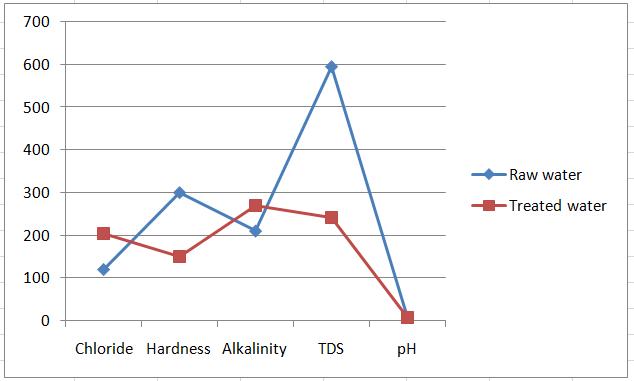
From these results we can understand that the Chloride efficiency is 70%, Hardness efficiency is 50%, Alkalinity efficiencyis28.57%,TDSefficiencyis57.81%,pHefficiencyis 2.27%.Chloride, Hardness,Alkalinityand pHareall in the acceptable limit as per IS Standards. But TDS not in the acceptablelimit.
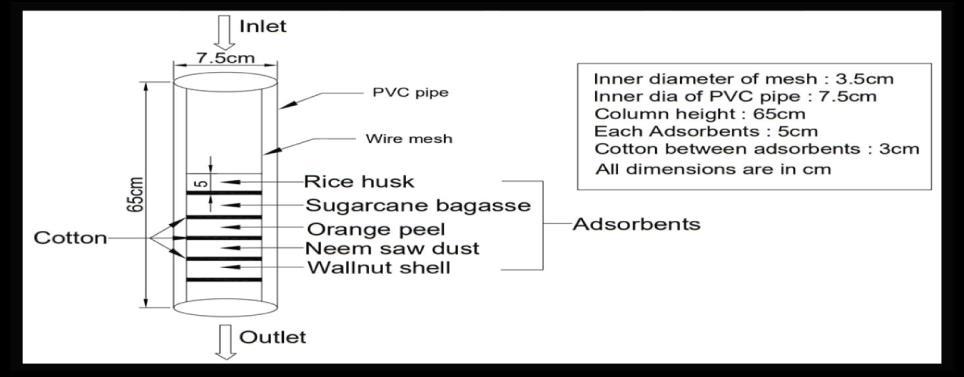
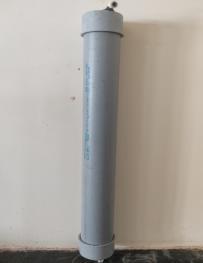
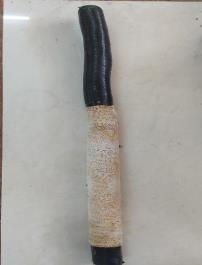
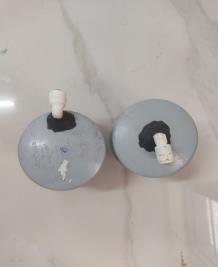
This membrane consists of PVC pipe, wire mesh, one inlet and one outlet. The diameter of wire mesh is 3.75cm and diameterofPVCpipeis7.5cmandthelengthofthepipeis 65cm.Theadsorbentsof5cmeachareplacedlayerbylayerin the wire mesh from bottom and each layer is divided by a 3cmlayerofcotton.
• Thephysico-chemicalparametersanalysedshowed that the amount of chloride, alkalinity, and pH satisfiedasperISSTD10500-2012.
• Through the comprehensive evaluation of water qualityparametersforNeemSawWood,Sugarcane Bagasse, Rice Husk, Orange Peeland Walnut, our study has yielded valuable insights into their potentialasadsorbentsforwatertreatment.
• Across the board, these natural materials have demonstrated effectiveness in reducing key contaminants such as Chloride, Hardness, AlkalinityandTotalDissolvedSolids(TDS)tolevels withinacceptableranges,asdefinedbyestablished standards. Their performance underscores the viabilityofemployinglow-costadsorbentsinwater treatmentprocesses,aligningwiththeprinciplesof sustainabilityandenvironmentalstewardship.
• However,certainconsiderationshaveemergedfrom our analysis. Neem Saw Wood exhibits efficacy in contaminantremovalbutfallsshortinmaintaining an acceptable pH level, indicating a need for optimization in its application. Conversely,
International Research Journal of Engineering and Technology (IRJET) e-ISSN: 2395-0056
Volume: 11 Issue: 05 | May 2024 www.irjet.net p-ISSN: 2395-0072
SugarcaneBagassestandsoutforitscomprehensive performance, including satisfactory pH levels, positioning it as a promising candidate for immediate implementation in water treatment strategies.
• Moreover, Rice Husk, Orange Peeland Walnut demonstrate varying degrees of effectiveness in contaminant reduction, with each material presentinguniqueadvantagesandchallenges.While Rice Husk and Walnut show notable efficiency in certainparameters,suchasChlorideandHardness, OrangePeelexcelsinAlkalinityreduction.However, all three materialsrequire further optimization to addressspecificshortcomings,suchasinconsistent pHlevelsandlimitedremovalefficiency.
• Movingforward,ourprojectwillfocusonrefining the application methodologies of these low-cost adsorbents to maximize their efficiency across all parameters. By leveraging the strengths of each materialandaddressingtheirrespectivelimitations, we aim to develop tailored solutions that offer sustainable, cost-effective alternatives for water treatmentapplications.
• IS STD 10500-2012, Indian Standard code for drinkingwater.
• Abejon,A.Garea,A.Irabien,2015,Arsenicremoval from drinking water by reverse osmosis: Minimizationofcostsandenergyconsumption.
• Bagastyo, A.Y, Keller, J, Poussade, Y, Batstone, D.J, 2011,Characterizationandremovalofrecalcitrants in reverse osmosis concentrates from water reclamationplants.WaterRes.45,2415e2427.
• JavadZolgharnein1Ali,Shahmoradi1Jahanbakhsh Ghasemi, 2011, Pesticides Removal Using ConventionalandLow-CostAdsorbents:AReview.
• Krishna Swaroop C D, Shiva Kumar B P, Kishore Kumar S, 10 Oct 2022, Study on Removal of Hardness from Groundwater using Low-Cost Adsorbent.
• Lu Lin Xuesong Xu, Charalambos Papelis, Tzahi Y. Cath, Pei Xua, 2014, Sorption of metals and metalloids from reverse osmosis concentrate on drinkingwatertreatmentsolids.
• MAhmaruzzaman,VinodK.Gupta,2011,RiceHusk andItsAshasLow-CostAdsorbentsinWater.
• ParipurnandaLoganathana, Saravanamuthu Vigneswarana, Jaya Kandasamya, Ravi Naidub, 2015,Defluoridation of drinking water using adsorptionprocesses.
• RupaChakraborty,AnupamaAsthana,AjayaKumar Singh,BhawanaJain&AbuBinHasanSusan,2015., Adsorption of heavy metal ions by various lowcostadsorbents:Areview.
• Shirra Gur-Reznik, Ilan Katz, Carlos G. Dosoretz, 2008,Removal of dissolved organic matter by granular-activated carbon adsorption as a pretreatment to reverse osmosis of membrane bioreactoreffluents.
• S.M.Kakom1,N.M.Abdelmonem1, I.M.Ismail1, A.Refaat,2022, Activated Carbon fromSugarcane BagassePyrolysisforHeavyMetalsAdsorption.
• SnehaDeshmukh,NirajS.Topare,SunitaRaut-Jadhav, Prashant V. Thorat, Shantini A. Bokil and Anish Khan,2017,Orangepeelactivatedcarbonproduced from waste orange peels for adsorption of methyl red.
• Sanghratna S. Waghmare1,Tanvir Arfin, 2013, FluorideRemovalfromWaterbyvarioustechniques: Review
• Sung Hee Joo, Berrin Tansel, 2007, Novel technologies for reverse osmosis concentrate treatment:A review.
• W.Bouguerraa,A.Mnif,B.Hamrounia,M.Dhahbib, 2008,Boronremovalbyadsorptionontoactivated aluminabyreverseosmosis.
• YilinJianga,2020,Preparationofactivatedcarbon from walnut shell and itsapplication in industrial wastewater.