
International Research Journal of Engineering and Technology (IRJET) e-ISSN: 2395-0056
Volume: 11 Issue: 05 | May 2024 www.irjet.net p-ISSN: 2395-0072
ASSESSING THE PERFORMANCE OF CONCRETE FILLED STEEL TUBE
COLUMN( CFST) AND PROFILED STEEL DECK SLAB ALONG WITH NANOTECH MATERIAL(GO) IN TERMS OF COST , TIME & SPACE
Ar.Harini selvakumar1 , Ar.Indrapriya2 , Ar.Fathima taskeen3
1Post Graduate student , Faculty of architecture, Dr. MGR University, Tamil nadu, India
2Deputy HOD, Faculty of Architecture, Dr. MGR University, Tamil nadu, India
3Additional HOD, Faculty of Architecture, Dr. MGR University, Tamil nadu, India
Abstract - This paper delves into the benefits of CFST (Concrete Filled Steel Tube) columns and profiled steel deck composite roofs, enhanced with graphene oxide nanotechnology, with a focus on space, cost, and time efficiencies.ItconductsacomparativeanalysisofCFSTcolumn performance with graphene oxide against RCC (Reinforced Concrete Cement) columns and compares profiled steel deck slabswithRCCslabs.Throughmulti-casestudiesandempirical investigation, the study emphasizes the advantages of composite construction in terms of speed, performance, and value. Cost estimates derived from supplier interviews and real-time market values are analyzedalongside conventional RCC structures using Spreadsheet for cost comparison and ETAB for performance analysis, while Primavera software is used for time analysis. The findings reveal significant reductions in construction timelines and costs attributed to decreasedweightandeliminationoffalseworks.Specifically,a G+17commercialbuildingprojectdemonstratesa30.4%cost reduction and a 19.4% time efficiency improvement with compositeconstructionovertraditionalRCC.Thereplacement of RCC columns with CFST columns results in the elimination of three columns, maintaining balanced shear stress and bending moments and leading to a 76% reduction in column area, thus achievingsignificant spatial savings. Furthermore, the incorporation of graphene oxide into concrete enhances strength, reduces permeability, increases resistance to corrosion and cracking, and accelerates curing. This amalgamationofcostefficiency,improvedconstructionspeed, and optimized structural performance underscores the advantagesofcompositeconstructionforcommercialbuilding projects.
Key Words: CFST column, profiled steel deck slab, graphene oxide(GO), nanotech material, cost, time, space
1.INTRODUCTION
Structural engineering practices in India have historically favored masonry construction, but modern trends lean towards R.C.C or Steel framed structures for multi-story buildings. The recent surge in interest towards composite structures,spurredbypastbuildingfailuresduringseismic events, underscores the industry's quest for safer
alternatives.Compositeorhybridmaterialshaveemergedas promisingsolutions,offeringenhancedperformancewithout significant changes to manufacturing or construction methods.
Despitetheirclearbenefits,theadoptionofsteel-concretecompositestructuresamongIndianconsultingengineershas beencautiousduetoperceivedcomplexitiesinanalysisand design. However, existing literature suggests that welldesignedcompositesystemscandelivercost-effective,timeefficient, and space-efficient structural solutions, boasting rapiderection,durability,andsuperiorseismicperformance.
Given the evolving landscape and the absence of updated designcodes,there'sapressingneedtoexplorecomposite analysisanddesignformulti-storybuildings,particularlyin the Indian context. Our study focuses on interpreting the advantages of replacing traditional R.C.C structures with ConcreteFilledSteelTube(CFST)columns,steelbeams,and profiledsteeldeckslabsinaG+17Storeybuilding.Weassess structuralstability,cost,space,andtimeefficiencywhilealso exploring the benefits of incorporating Graphene oxide, a nanotechmaterial.Throughthisresearch,weaimtoprovide valuable insights into the advantages of composite construction, particularly CFST columns and profiled steel deck slabs, augmented with graphene oxide, within the Indianconstructionindustry.
2. OBJECTIVE
Theprimaryobjectivesofthisresearchstudyare:
AnalysisofCFSTColumn:Examinethecost,space,andtime factors associated with Concrete-Filled Steel Tube (CFST) columns to assess their economic feasibility, spatial efficiency,andconstructionspeed.
Spatial Comparison with RCC Column: Conduct a spatial comparisonbetweenRCCandCFSTcolumnsto determine theirrelativephysicaldimensionsandspatialefficiency.
StudyofNanotechMaterialsforCFSTColumn:Investigate variousnanotechnologymaterialstoidentifythemostcosteffective and time-efficient option for enhancing CFST columnperformance.
International Research Journal of Engineering and Technology (IRJET) e-ISSN: 2395-0056
Volume: 11 Issue: 05 | May 2024 www.irjet.net p-ISSN: 2395-0072
AnalysisofProfiledSteelDeckCompositeRoof:Evaluatethe cost and time implications of using Profiled Steel Deck Compositeroofsinconstructionprojects.
PerformanceAnalysisofCFSTColumnandCompositeRoof: Analyze the overall performance of CFST columns and composite roofs, focusing on cost, time efficiency, and the impact of graphene oxide as a nanotech material on their performanceinreal-worldapplications.
3. METHODOLOGY
This study entails a two-fold approach. Firstly, a comprehensive literature review will be conducted to explorecompositecolumnandroofsystemsandnanotech material study emphasizing their benefits in construction projects. Following this, an empirical investigation employing a multi-case study approach will analyze the study objectives .Cost estimates derived from supplier interviews will be utilized, and the additional costs of composite column and roof systems will be compared to conventional RCC elements using E-tab, Spreadsheet and Primaverasoftware.
5. LITERATURE REVIEW
The Steel option outperforms R.C.C, but for high-rise buildings, the Composite option is best. It reduces dead weight by 30-32%, with significant reductions in steel membersizes. ( D. R. Panchal and P. M. Marathe,2011). Including0.04%grapheneoxide(GO)inthecementpaste improvedcompressivestrengthbyupto15.1%comparedto plaincementpaste.Additionally,incorporating0.03%GOby weightofcement(bwoc)inordinaryPortlandcement(OPC) paste increased both compressive and tensile strength by over40%after28daysofcuring.GOfunctionsasacatalyst, accelerating cement hydration without altering the oxygenatedfunctionalgroups. (S.C. Devi,2020)
6. CASE STUDY
6.1. CFST COLUMN

4. SCOPE AND LIMITATION
This studydelveinto a comprehensiveanalysisofvarious factorsincludingmaterialcosts,laborexpenses,andthetime required for construction. Specifically, we compare these aspects between two construction methods: conventional construction,whichreliesonReinforcedConcreteCement (RCC)forstructuralpurposes,andcompositeconstruction, which integrates concrete with ,steel. Our focus narrows down to the incorporation of graphene oxide within compositestructures.Byscrutinizingtheseelements,weaim toshedlightonthecomparativeadvantagesandpotential efficiencies offered by composite construction methods, particularlythoseutilizinggrapheneoxide.
InaconstructionprojectintegratingCFST(ConcreteFilled SteelTube)technologyacross14acres,boastingabuilt-up area of 5.6 lakh sq.ft, the endeavor spanned 7 years and incurredatotalcostof₹450Cr.(450Crores).Thisstructure, encompassing 5 floors and 3 basements, strategically employedCFSTcolumnsintheaisleareaonapartialbasis. These CFST columns, towering approximately 80ft height, presentadistinctcontrasttoRCCcolumns,measuring0.8m x0.8m(0.64sq.m)for64ftbeforeshrinkingto0.5mx0.5m (0.36sq.m)atthetop16ftheight.Thisreductionincolumn sizewithCFSTresultsinanotable43.75%savinginspatial area.Additionally,a meticulous material quantityanalysis conducted with the assistance of RCC structural and steel consultants revealed significant cost disparities between RCCandCFST.Thesedifferencesincludea52.2%lowercost forcementbags,a52.4%decreaseinfineaggregatecost,and a52.5%reductionincoarseaggregatecost.However,CFST columnsrequire38.3%moresteelthanRCCcounterparts, yet the return on value of steel is higher in CFST construction.
6.2.PROFILED STEEL DECK
AcommercialcomplexprojectinMadurai,featuringaG+1 structure,spansasiteareaof2480sq.ftwithabuilt-uparea of2290sq.ft,designedforcommercialusageovertwofloors of 1100 sq.ft each. The construction involves 20 I-section column girders measuring 800mm x 400mm, which are erectedinjust2daysusingasinglecrane.Thefoundation comprises pile foundations reaching a depth of 9 feet, utilizinga16mmmainrodand8-inchcircularstirrupgap, withafoundationradiusof1foot6inches.Siteclearanceis expected to take 1 day, and foundation work up to plinth levelisscheduledfor2.5weeks.Fortheprofiledsteeldeck slabconstruction,39JSWsheetsareused,withacontracted work cost of Rs. 1500 per sq.ft. The construction employs 10mmsteelrods,with3daysdedicatedtotukkinsheetand reinforcementwork,followedby1dayforconcreting.The totalcost,includingformworkat1.5%,isRs.2,76,660.786.
International Research Journal of Engineering and Technology (IRJET) e-ISSN: 2395-0056
Volume: 11 Issue: 05 | May 2024 www.irjet.net p-ISSN: 2395-0072
AnanalysiscomparingthismethodtoconventionalRCCslab construction reveals significant cost savings and time efficiency. The use of Renocon blocks further reduces material quantity by 30-40%, showcasing a 24.75% cost differenceinfavorofthesteeldeckslabanda32%reduction inconstructiontimecomparedtoRCCslabs.
Table-1:ProfileddeckslabandRCCslabmaterialquantity comparison Material
Formwork 1.5% 3%
Cement 79bags 119bags
Steel 685kg 980kg
Fineaggregate
Courseaggregate
Steeldecksheet 39no.s
InaG+5structuredcommercialproject,approximately 400 sheets of JSW brand steel are utilized, with a work contract priced at Rs. 1450 per sq.ft. Construction incorporates 12mm and 16mm steel rods. The pile foundation, reaching depths of 25 feet due to soil sedimentations, faced delays due to financial settlement issues,extendingthefoundationworkdurationto2months. Thebuildupareaspans15,028sq.ft,featuringacommercial typology across ground plus three floors. The steel roof designaimsforslimgirdersspanningover30ft,achieved through a diagonal grid connection. Façade columns measure 800mm x 600mm, composed of welded steel plates,withbeamsprefabricatedorconstructedon-sitein twopieces.Interlockingblocksexpediteconstructionand reduce mortar costs. Column erection, facilitated by two equipment, takes around 20 days. During roof tukking, approximately 12 laborers are involved, taking 11 days, whilereinforcementandconcretingrequire12daysand1 day,respectively.Eachfloor'sroofworkiscompletedin25 days. For the profiled steel deck slab, the total cost, including1.5%formwork,amountstoRs.5,87,470.83,while conventional RCCslab replacement costs Rs.9,06,821.27, including 3% formwork. Material quantity savings of 3040% areachieved, witha notable 35.21% cost difference favoring the steel deck slab, which also saves 37.5% of constructiontimecomparedtoconventionalmethods.
Table- 2:MaterialquantitycomparisonG+5storeybuilding
Fineaggregate 644cu.ft 966cu.ft
Courseaggregate 966cu.ft
Steeldecksheet 400no.s
Based on the case study analysis and data collection duringcasestudyanddiscussionwiththefieldexpertisethe drawbacksofprofiledsteeldeckslabsarenotable.Without proper painting, there's a risk of corrosion over time, especially if the paint quality is poor. Moreover, if water sealingisn'tdoneadequately,itcanleadtoleakageproblems, compromisingtheintegrityofthemetalsheets.Installingtile flooring can also pose issues with vibrations, prompting a preferenceforconcretepolishinginstead.Fortunately,these challengescanbeaddressedwithgrapheneoxide,offeringa solution to counter the disadvantages associated with profiledsteeldeckslabs.Despitetheseconcerns,it'sworth noting that profiled steel deck slabs exhibit exceptional durabilityandresilience,capableofresistingrustfor60to75 yearswhenmaintainedproperly.
6.3. GRAPHENE OXIDE
In the case study of a residential building located in Chitlapakam, Chennai, comprising a stilt plus three floors structure,withasiteareaof2762sq.ftandabuild-upareaof 7300sq.ft,innovativeuseofgrapheneoxide(GO)inconcrete hasbeenemployed.Concreteelements,utilizingM25grade concrete,havebeenenhancedbyadding0.01mgto0.06mg ofGOperbagofcement,resultinginstrongercompressive strengthandreducedcuringperiods.Thisadditionhasledto a reduction in material quantity requirements and accelerated concrete setting by 50%, thereby saving constructiontimeon-site.Specifically,inthestiltplusthree project,thereductionincuringperiodsandtheintroduction ofparallelactivitieshavecollectivelysaved37daysfromthe total construction period of 309 days. Although initial estimations suggested a potential 40% cost reduction, a realisticassessmentindicatesamoremodestyetsignificant 9-12%reduction,equivalenttoapproximatelyRs.12-16lakh costsavinginthisproject.Eachbagofcementintheconcrete mixtureissupplementedwith0.04mgofGO,while0.01mgis usedforplasteringwalls.ThiscasestudyunderscoresGO's potential to deliver substantial cost savings, with the percentage increasing with the number of storeys in a building,reachingupto40%incertainscenarios.
7. ANALYSIS
7.1.SPATIAL ANALYSIS
The analysis focuses on a commercial office building (G+17) situated on a 10-acre plot of land, boasting a total built-upareaof2.4millionsquarefeet.Specifically,TowerA andTowerB,comprisingacombinedareaof82,500square feet(32,500sq.ftforTowerAand50,000sq.ftforTowerB), areselectedforspatialanalysisusingE-TABsoftware,cost
International Research Journal of Engineering and Technology (IRJET) e-ISSN: 2395-0056
Volume: 11 Issue: 05 | May 2024 www.irjet.net p-ISSN: 2395-0072
analysis utilizing spreadsheet, and time analysis through Primavera. The building's construction primarily utilizes ReinforcedConcrete(RCC)structuralelements,withaglass facade. Proposed modifications include replacing RCC columnswithConcrete-FilledSteelTube(CFST)columnsand RCCslabswithprofiledsteeldeckslabs,aimedatenhancing effectiveness. Additionally, the analysis explores the introduction of graphene oxide into the structure. The existingbuildingfeaturestwotypesofRCCcolumns:square columnsmeasuring1.5metersby1.5metersandelliptical columnswitharadiusof0.3meters,totaling53columns.
ModelinfoforRCCcolumnandRCCslab:
Consideredaccordingtoequilateralmethod
3-Dmodelisbeingpreparedfortheframestaticanalysis ofthebuildinginETABS
Thebasicparametersconsideredforthedesign
Slabdepth:300mmthick


(ExistingplanandETABgeneratedRCCcolumn andslabplan)
Liveloadinofficearea:5.0kN/sqm
Liveloadinpassagearea:5.0kN/sqm
Liveloadinurinals:2kN/sqm
Floorfinishload:1.5kN/sqm
Seisemicload-2.5KN/sqm
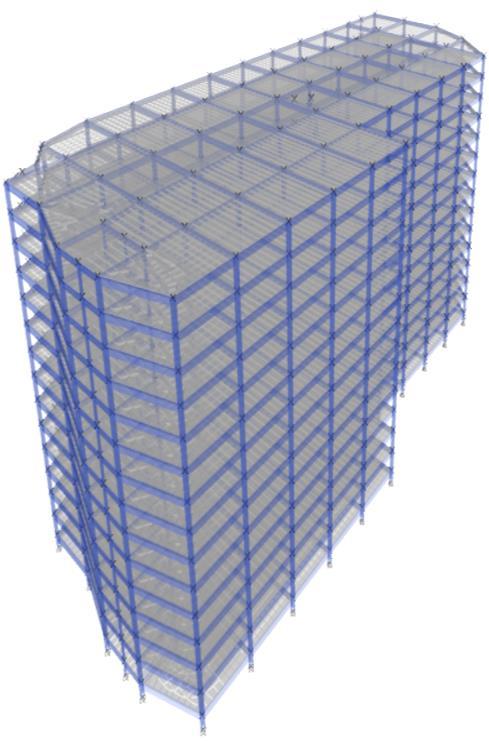
Figure-3:(ETABgeneratedmodel)
Modelhaspassedthestructuralrequirementwiththe
Columnsize-1.5mx1.5m
Beamsize-0.3mx0.6m
Slabthickness–300mm
Model info for CFST column and Profiled steel deck slab:
Consideredaccordingtoequilateralmethod
3-Dmodelisbeingpreparedfortheframestaticanalysisof thebuildinginETABS
Thebasicparametersconsideredforthedesign
Slabdepth:150mmthick
Liveloadinofficearea:4.0kN/sqm
Liveloadinpassagearea:4.0kN/sqm
Liveloadinurinals:1.75kN/sqm
Floorfinishload:1.0kN/sqm
International Research Journal of Engineering and Technology (IRJET) e-ISSN: 2395-0056
Volume: 11 Issue: 05 | May 2024 www.irjet.net p-ISSN: 2395-0072

Modelhaspassedthestructuralrequirementwiththe columnsize-0.75mx0.75m
Beamsize-0.3mx0.14m
Slabthickness–150mm
The Spatial comparison between the RCC (Reinforced Concrete)columnandtheCFST(Concrete-FilledSteelTube) columnrevealssignificantdifferencesintheircharacteristics andefficiency.FortheRCCcolumn,consideringatotalfloor areaof6670.46squaremetersandacolumnareaof130.5 squaremeters,withasizeof1.5metersby1.5meters,the clearfloorareaiscalculatedas6540squaremeters.Onthe otherhand,theCFSTcolumn,withthesametotalfloorarea, has a smaller column area of 32.625 square meters, corresponding to a column size of 0.75 meters by 0.75 meters. Consequently, the clear floor area increases to 6637.3 square meters. The comparison indicates that the replacementofcompositewithRCCcolumnsresultsinthe reduction of three columns, achieving a balance in shear stressandbendingmoment.Additionally,thecolumnarea saved amounts to 76%, indicating a substantial improvementinstructuralefficiencyandmaterialutilization.
7.2.COST ANALYSIS
7.2.1.COLUMN
A comparative analysis between traditional Reinforced Concrete (RCC) columns and Concrete-Filled Steel Tube (CFST) columns reveals significant differences in cost efficiencyandstructuralcapabilities.Theconstructioncost for RCC columns totals Rs. 52,94,74,657.2. This includes usingsquarecolumnsof1.5mx1.5mandellipticalcolumns with a 0.3m radius, made with M40 grade concrete for structuralstability.Incontrast,CFSTcolumnshaveamuch lower construction cost of Rs. 28,50,09,298.72. This reduction is due to more efficient column sizes: 0.75m x 0.75m for square columns and elliptical columns with a 0.15m radius. The CFST columns use M30 grade concrete enhanced withgraphene oxide(GO),improvingstructural performance.
7.2.2.BEAM
Comparing traditional Reinforced Concrete (RCC) beams with Composite Steel beams shows notable differences in cost and structural efficiency. RCC beams cost Rs. 17,65,76,083.8intotal.Thesebeamsare0.3mx0.6minsize and use M40 grade concrete to ensure stability, following industry standards. On the other hand, Composite Steel beams costless,at Rs.14,60,86,292.9. This costreduction comesfromusingmoreefficientsteelbeamsizesof0.35mx 0.14m.Thesebeamsadheretostrictstandards,including for designingcompositebeamsandslabsandCompositeSteel andConcreteStructures
7.2.3.ROOF
Comparing conventional Reinforced Concrete (RCC) slabs withProfiledSteelDeckslabsrevealssignificantdifferences inbothcostandstructuralefficiency.ThetotalcostforRCC slabsamountstoRs.85,65,26,079,whileProfiledSteelDeck slabs are significantly more economical, costing Rs. 55,10,42,643.1. Structurally, RCC slabs have a substantial thicknessof300mm,utilizingM40gradeconcretetomeet industrystandardsforstabilityandload-bearingcapacity.In contrast,ProfiledSteelDeckslabsareconsiderablythinner at 150mm. Despite using M30 grade concrete, which is generally of lower strength compared to M40, the incorporation of graphene oxide (GO) enhances the structuralintegrityoftheseslabs.Grapheneoxideimproves theconcrete'sstrength,reducespermeability,andincreases resistance to cracking and corrosion. This enhancement allows Profiled Steel Deck slabs to achieve superior performance with a reduced thickness, leading to better materialefficiencyandcost-effectiveness.Thiscomparison highlightsthefinancialadvantagesandimprovedstructural efficiency of Profiled Steel Deck slabs, making them a favorable alternative for modern construction projects aimingforoptimalperformanceandeconomy.
International Research Journal of Engineering and Technology (IRJET) e-ISSN: 2395-0056
Volume: 11 Issue: 05 | May 2024 www.irjet.net p-ISSN: 2395-0072
Table-3: Materialcostandquantitycomparison
7.3.TIME ANALYSIS
Interpretingtheprojectforanalysis, projectoperatesona schedule of 6 working days per week, with Sundays designated as holidays. Each working day is presumed to consistof8hoursoflabor. The efficiencyoflabor work is calculatedbasedonestablishedstandardsandincorporated intothisanalysis.Sinceitisalargescaleprojectinorderto speed up the construction time ,activities were parallelly assigned
Table-4:RCCcolumnandslabtimelineschedule

Eachfloorisconstructedataconsistentpace,requiring67 daystocomplete.Witha totalof17floors,thecumulative timeforconstruction iscalculatedas17 multiplied by 67, resultingin1139days.Additionally,theconstructionofthe foundation to the third basement level takes 193 days. Hence, the total number of construction days for the RCC structure amounts to 1132 days, equivalent to approximately3.1years.
Table-5: CFSTcolumnandProfileddeckslabconstruction timelineschedule
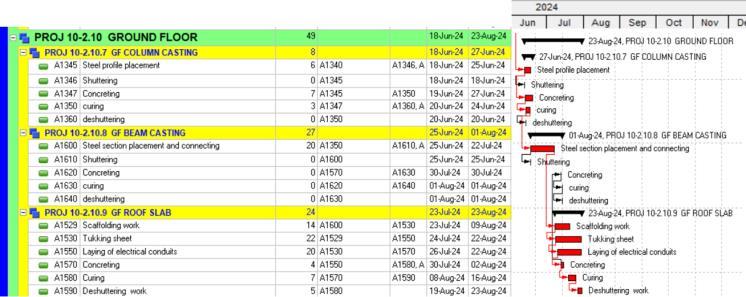
Forcompositestructure-eachfloorisconstructedwithina timeframe of 47 days. With a total of 17 floors, the cumulativetimerequiredforconstructionisdeterminedby multiplying17by47,resultingin799days.Additionally,the constructionofthefoundationuptothethirdbasementlevel entailsaperiodof175days.Therefore,thetotalnumberof constructiondaysfortheRCCstructureiscalculatedas799 daysforfloorconstructionplus175daysforfoundationto basement3construction,yieldingatotalof974days.This timeframe equates to approximately 2.5 years for the completionoftheRCCstructure.
8.0.RESULT
Table- 6: RCCConstructionandCFSTcolumn&profiled steeldeckslab(compositeconstruction)comparison
International Research Journal of Engineering and Technology (IRJET) e-ISSN: 2395-0056
Volume: 11 Issue: 05 | May 2024 www.irjet.net p-ISSN: 2395-0072
of construction 168cr 117cr Time of construction 3.1yr 2.5yr
After conducting a comprehensive analysis encompassing spatial, cost, and time considerations for the Commercial building project, it has been revealed that there is a significant cost difference of 30.4% between traditional ReinforcedConcrete(RCC)constructionandtheproposed composite construction replacement in G+17 building Additionally,atimedifferenceof19.4%hasbeenidentified, indicatinganotableimprovementinconstructionefficiency withthecompositeconstructionapproachwiththeaddition ofgrapheneoxideinclusion AdditionallyreplacingtheRCC columnswithCFSTcolumnsresultedintheeliminationof threecolumnswhilemaintainingbalancedshearstressand bending moments. This replacement also led to a 76% reduction in column area in G+17 commercial building whichhelpsinspatialareasaving.
9.0.CONCLUSIONS
The comprehensive analysis of the commercial building project highlights the substantial benefits of adopting compositeconstructionovertraditionalReinforcedConcrete (RCC)construction.Theproposedcompositemethodoffers notablecostsavingsandenhancesconstructionefficiency, allowing for quicker project completion. Replacing RCC columns with Concrete-Filled Steel Tube (CFST) columns optimizes the building's structural performance, ensuring balanced shear stress and bending moments, and significantly reducing the column area. This reduction resultsinmoreusablefloorspacewithinthebuilding.Using profiledsteeldeckslabsprovidesrapidinstallationdueto their lightweight and prefabricated nature, reducing constructiontimeandlabourcosts.Theyactaspermanent formwork,eliminatetheneedfortemporarysupports,and enhance load-bearing capacity, allowing for longer spans withfewercolumns.Thisleadstocostsavingsonmaterials and increased design flexibility. Additionally, they are durable, often coated with corrosion-resistant graphene oxidepaint,andcontributetosustainablebuildingpractices throughrecyclablematerials.Incorporatinggrapheneoxide intoconcretemixturesenhancesmechanicalanddurability characteristics.Itimprovesstrength,reducespermeability, and increases resistance to corrosion and cracking. Graphene oxide can also accelerate the curing process, offeringtimeandenergysavings. Thecombinationofcost efficiency, improved construction speed, and optimized structural performance underscores the advantages of composite construction for commercial building projects. Thismethodfacilitatesbetterresourceutilizationandoffers enhanced design flexibility, making it a highly beneficial alternativeformodernconstructionneeds.
ACKNOWLEDGEMENT
We gratefully acknowledge the support provided by Er. Paneerselvam and Vivek (steel consultant) for his valuable suggestions, which significantly enhanced the qualityofthisresearch.
REFERENCES
[1] D. R. Panchal and P. M. Marathe ,INSTITUTE OF TECHNOLOGY,NIRMAUNIVERSITY,AHMEDABAD–382481,08-10DECEMBER,2011
[2] https://doi.org/10.1016/j.jobe.2019.101007