
International Research Journal of Engineering and Technology (IRJET) e-ISSN:2395-0056
Volume: 11 Issue: 05 | May 2024 www.irjet.net p-ISSN:2395-0072
International Research Journal of Engineering and Technology (IRJET) e-ISSN:2395-0056
Volume: 11 Issue: 05 | May 2024 www.irjet.net p-ISSN:2395-0072
Rahul Singh1, Mr. Avinash Pandey2
1Master of Technology, Mechanical Engineering, SITM, Barabanki, Uttar Pradesh, India
2Assistant Professor, Department of Mechanical Engineering, SITM, Barabanki, Uttar Pradesh, India
Abstract - The widespread adoption of fuel cell electric vehicles (FCEVs) has prompted intensive research into efficient methods for measuring hydrogen consumption within these vehicles. Among these methods, flowmeterbased measurement systems have emerged as a promising avenue due to their accuracy, reliability, and compatibility with onboard vehicle systems. This review paper provides a comprehensive overview of flowmeter-based measurement techniques employed in the quantification of hydrogen consumption in FCEVs. It explores various types of flowmeter technologies, including thermal, ultrasonic, and mass flow sensors, highlighting their principles of operation and performance characteristics. Furthermore, the paper discusses key considerations in the design and implementation of flowmeter-based measurement systems, such as calibration procedures, sensor placement, and data processing techniques. Additionally, it examines the challenges and limitations associated with flowmeter-based measurements, such as sensitivity to operating conditions, accuracyunder dynamic flowregimes,andpotentialsources of error. Through a critical analysis of existing literature and case studies, this review aims to provide insights into the state-of-the-art methodologies and emerging trends in flowmeter-based hydrogen consumption measurement in FCEVs, offering valuable guidance for future research and developmenteffortsinthisburgeoningfield.
Key Words: fuel cell electric vehicles, hydrogen consumption measurement, flowmeter, thermal flow sensor, onboard vehicle systems, emergingtrends.
Fuel cell technology has a rich history spanning over two centuries. Its roots can be traced back to the groundbreaking work of Sir William Grove in 1839 when hefirstdemonstratedtheprincipleofconvertingchemical energy into electricity through hydrogen and oxygen. Throughout the 20th century, fuel cell research progressed steadily, buoyed by interest from both scientificandindustrialcommunities.NASA'sinvolvement in the 1960s propelled fuel cells into the spotlight, especially with the development of the Proton Exchange Membrane (PEM) fuel cell for space missions. Despite early successes, commercialization faced hurdles due to highcostsandtechnicalchallenges.However,thelate20th century saw significant strides in cost reduction and
performance improvement, leading to niche applications such as backup power and forklifts. With ongoing advancements in efficiency, hydrogen infrastructure development, and integration with renewables, fuel cell technology is poised to play a vital role in a sustainable energy future, particularly in transportation and stationarypowergeneration.
Thetransitiontosustainabletransportationhasfueledthe development and adoption of fuel cell electric vehicles (FCEVs) powered by hydrogen. These vehicles offer zeroemission operation and the potential to significantly reduce greenhouse gas emissions compared to conventional internal combustion engine vehicles. Central to the efficient utilization of hydrogen in FCEVs is the accurate measurement of hydrogen consumption. Among various methods employed for measuring hydrogen consumption in FCEVs, flowmeter-based techniques have emerged as a promising solution. Flowmeters provide direct and real-time measurements of hydrogen flow rates, offering advantages such as high accuracy, rapid responsetimes,andcompatibilitywithdynamicoperating conditions.
This review paper aims to provide a comprehensive overviewofflowmeter-basedmeasurementtechniquesfor hydrogen consumption in FCEVs. It will delve into the principles underlying flowmeter operation, highlighting the different types of flowmeters utilized in FCEV applications, including thermal mass flowmeters, Coriolis flowmeters, and volumetric flowmeters. Furthermore, the paper will explore the calibration procedures and accuracy considerations essential for ensuring precise measurement of hydrogen flow rates. In addition to technical aspects, this review will also address the practical challenges and limitations associated with flowmeter-based measurement systems in FCEVs, such as sensitivity to temperature and pressure variations, maintenance requirements, and cost considerations. Moreover, the integration of flowmeter-based measurementsystemsintoonboardhydrogenstorageand dispensing infrastructure will be discussed, emphasizing their role in enabling efficient refueling operations and extending the driving range of FCEVs. The review will highlight recent advancements and emerging trends in
International Research Journal of Engineering and Technology (IRJET) e-ISSN:2395-0056
Volume: 11 Issue: 05 | May 2024 www.irjet.net p-ISSN:2395-0072
flowmeter technology, including the development of miniaturized and cost-effective flow sensors suitable for mass-market adoption of FCEVs. Additionally, the integration of flowmeter data with onboard vehicle systems and telematics for real-time monitoring and optimization of hydrogen consumption will be explored. By synthesizing the current state-of-the-art and identifying areas for future research and development, this review aims to provide valuable insights for researchers, engineers, and policymakers working towardsadvancingtheadoptionofFCEVsasasustainable transportationsolution.
Hydrogen fuel cell technology presents an innovative approach to powering electric vehicles (EVs), operating through an electrochemical reaction between hydrogen andoxygen.Thisreactiongenerateselectricitytodrivethe vehicle,emittingonlywatervaporasabyproduct.Notably, hydrogen fuel cell EVsoffer distinctadvantages,including rapid refueling times, extended driving ranges, and potentially lighter vehicle weights without bulky battery packs. However, significant challenges remain, foremost among them being the sparseinfrastructure for hydrogen refueling stations. Moreover, the current high costs associated with hydrogen production, storage, and distribution pose obstacles to widespread adoption. Efficiency concerns also linger, as hydrogen fuel cell technologycontinuestoimprovebutstillfallsshortofthe energy efficiency achieved by battery electric vehicles. Despite these challenges, hydrogen fuel cell EVs find promising applications in heavy-duty transportation sectorslikebusesandtrucks,wherelongrangesandquick refueling are crucial. Furthermore, ongoing research and development efforts aim to enhance the technology's efficiency,lowercosts,andincreasescalability,potentially paving the way for a more sustainable future in transportation.
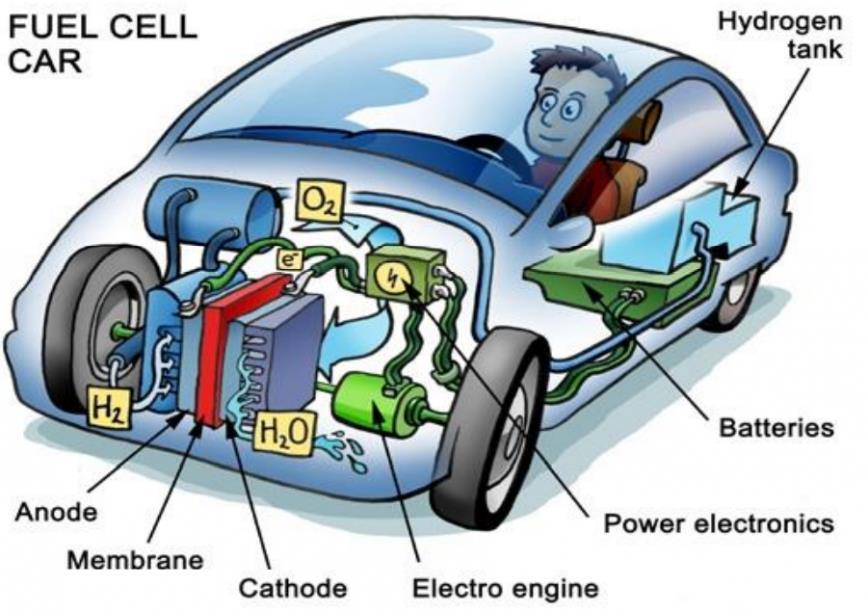
3.1.MECHANISM OF HYDROGEN FUEL ELECTRIC VEHICLE
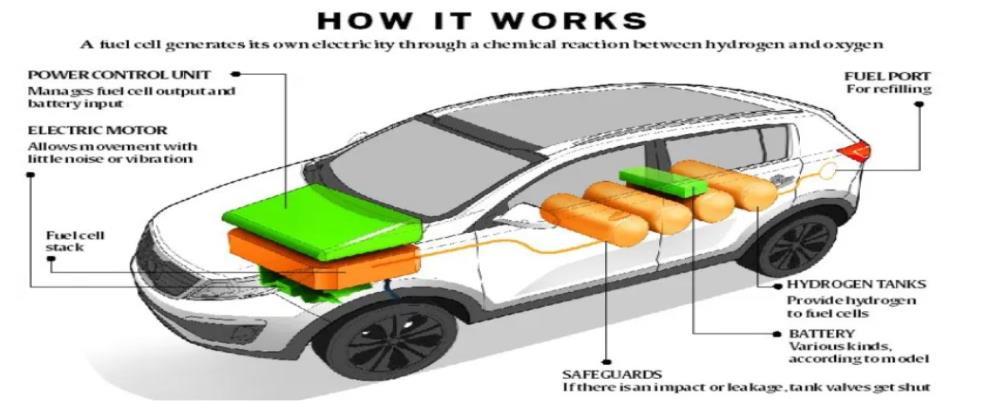
A hydrogen fuel cell electric vehicle (FCEV) operates through a sophisticated mechanism that harnesses the energy potential of hydrogen gas. Stored in high-pressure tanks onboard the vehicle, hydrogen is drawn into a fuel cell stack alongside oxygen from the surrounding air. Within this stack, numerous individual fuel cells, each containing an anode, a cathode, and an electrolyte membrane, facilitate an electrochemical reaction. At the anode, hydrogen molecules split into protons and electrons, with the latter flowing through an external circuit, generating an electric current that powers the vehicle's electric motor. Meanwhile, protons migrate through the electrolyte membrane to the cathode, where they combine with oxygen and electrons, forming water vapor as the only byproduct. This seamless process produces electricity for propulsion, with the vehicle emitting only water vapor, making FCEVs an appealing option for clean and sustainable transportation. Despite these advantages, challenges persist, including the need for infrastructure development and cost reduction to realizetheirfullpotentialintheautomotivemarket.
3.2.IMPROVEMENT OF HYDROGEN
Improving hydrogen fuel electric vehicles (HFEVs) involvesadvancementsinseveralkeyareastomakethem more efficient, practical, and widespread. Here are some potentialareasforimprovement:
HydrogenProduction: TheprimarychallengewithHFEVs istheproductionofhydrogen.Currently,mosthydrogenis producedthroughsteammethanereforming(SMR),which generates greenhouse gases. Advancements in renewable energy-powered electrolysis, such as solar or wind, could make hydrogen production more sustainable and environmentallyfriendly.
International Research Journal of Engineering and Technology (IRJET) e-ISSN:2395-0056
Volume: 11 Issue: 05 | May 2024 www.irjet.net p-ISSN:2395-0072
Storage and Distribution: Developing more efficient and lightweight hydrogen storage solutions is crucial. Research into advanced materials like carbon nanotubes or metal-organic frameworks (MOFs) could enhance hydrogen storage capacity and safety. Improving distribution infrastructure, including pipelines and refueling stations, is also necessary for widespread adoption.
Fuel Cell Technology: Enhancements in fuel cell technology can improve efficiency, durability, and costeffectiveness. Research efforts should focus on increasing power density, reducing platinum catalyst usage, and improvingheatandwatermanagementwithinthefuelcell stack.
Cost Reduction: Cost is a significant barrier to the widespread adoption of HFEVs. Continued research and development to reduce the cost of hydrogen production, storage,andfuelcellcomponentsareessential.Economies ofscaleinmanufacturingcanalsohelpdrivedowncosts.
Performance and Range: Increasing the driving range of HFEVs and enhancing their performance are crucial for consumer acceptance. This involves improving fuel cell efficiency, optimizing vehicle aerodynamics, and reducing weightthroughadvancedmaterialsanddesign.
Safety: Addressing safety concerns associated with hydrogen,suchasitsflammabilityandpotentialleakage,is vital. Developing robust safety protocols, implementing effective leak detection systems, and improving crashworthinessofhydrogentanksareessentialsteps.
Regulatory Support and Infrastructure Development: Governments play a critical role in supporting HFEV technology through incentives, subsidies, and regulations. Policies that encourage investment in hydrogen infrastructure and research and development can accelerateprogressinthisfield.
Public Awareness and Acceptance: Increasing public awareness and acceptance of HFEVs is essential for market growth. Education campaigns highlighting the benefits of hydrogen as a clean energy carrier and addressing misconceptions about safety and practicality canhelpdriveconsumerinterest.
Integration with Renewable Energy: Leveraging surplus renewable energy to produce hydrogen through electrolysis can help address intermittency issues and facilitate the transition to a low-carbon energy system. Integrating HFEVs with renewable energy sources can enhancesustainabilityandreducerelianceonfossilfuels.
Hydrogen fuel cell electric vehicles (FCEVs) offer several advantages over traditional gasoline or even battery electricvehicles(BEVs).Herearesomekeyadvantages:
Zero Emissions: FCEVs produce zero tailpipe emissions, only emitting water vapor and heat as byproducts. This makesthemenvironmentallyfriendlyandhelpsreduceair pollution,particularlyinurbanareaswhereairqualityisa concern.
Longer Range: Hydrogen fuel cells typically offer longer driving ranges compared to battery electric vehicles. FCEVs can refuel much faster than charging a battery, allowing for longer journeys without extended downtime forrecharging.
Fast Refueling: Refueling a hydrogen fuel cell vehicle is comparable in time to refueling a gasoline vehicle, taking just a few minutes. This is much faster than charging a batteryelectricvehicle,whichcantakesignificantlylonger dependingonthecharginginfrastructureandthebattery's capacity.
Energy Density: Hydrogen has a higher energy density compared to batteries, meaning more energy can be storedinagivenvolumeorweight.Thiscontributestothe longerrangecapabilitiesofFCEVs.
Versatility: Hydrogenfuelcanbeproducedfromavariety of sources, including natural gas, biomass, and renewable energysourceslikewindandsolar.Thisversatilitymeans thatFCEVscanbepoweredbydomesticallyproducedand renewable sources of energy, potentially reducing dependenceonimportedfossilfuels.
Reduced Dependence on Rare Earth Metals: While battery electric vehicles require significant amounts of rare earth metals for their batteries, hydrogen fuel cells use more common materials like platinum and carbon. This can reduce concerns about the scarcity of rare earth metalsandtheirenvironmentalimpact.
Potential for Energy Storage: Hydrogen can serve as a meansofstoringexcessrenewableenergygeneratedfrom sources like wind and solar power. This stored hydrogen canthen be used to generate electricity in fuel cellswhen needed,helpingtobalancetheintermittencyofrenewable energysourcesandsupportgridstability.
Inthesectionoftheliteraturereview,wehavestudeidthe previousresearchworkonthehygroenfuelintheelectric vehicle, and technique used in those research paper, the summaryofthepreviousresearchgivenbelow:
International Research Journal of Engineering and Technology (IRJET) e-ISSN:2395-0056
Volume: 11 Issue: 05 | May 2024 www.irjet.net p-ISSN:2395-0072
Tao Ma (2024): In this paper , a Q-learning-based algorithm was used to reduce the variation of the SOC battery by about 0.7 per unit, while a Deep Deterministic PolicyGradient(DDPG)basedenergymanagementsystem (EMS)started operatingthe fuel cell ata higherefficiency rate comparatively while using the battery. Q-learningbased algorithm reduced SOCbattery variation by 0.7 per unit. DDPG-based EMS operated fuel cell at higher efficiency.
Jinchao (2023): In this article , the development of hydrogenfuelcellvehiclesiscomprehensivelyintroduced, and the related characteristics of hydrogen energy, hydrogen fuel cells work are discussed, while the use of thehydrogenfuelcarandchallenges,analysisofthecases of several existing hydrogen fuel-cell cars and hydrogen fuelcell vehicles in China in the future are given in this paper. The development and characteristics of hydrogen fuel cell vehicles are discussed. The future of hydrogen fuelelectricvehiclesispresented.
Guangjin et.al (2023): Inthisarticle,theauthorsprovide reference and guidance for the future development of renewablehydrogenenergyandhydrogenfuelcellhybrid electricvehicles,andsummarizetheexistinghybridpower circuit topology, categorizes the existing technical solutions, and finally looks forward to the future for different scenarios of hydrogen fuelcell hybrid power systems. Summarizes existing hybrid power circuit topology for hydrogen fuel cells. Provides guidance for futuredevelopmentofhydrogenfuelcellvehicles.
Dinda et.al (2023): The research paper presents a systemusingNode-REDsoftwareandRS232flowmeterto monitor hydrogen output in Fuel Cell Electric Vehicles, achieving 1.38 with 1.46 l/min speed. In this article , a serial flowmeter monitoring system for hydrogen output inFCEVsusingNode-REDsoftwareapplicationandRS232 output was presented. But the authors did not provide new knowledge regarding the monitoring system. Design of a monitoring system for hydrogen output in FCEVs using Node-RED software and RS 232 flowmeters. Flowmeter testing experiment obtained hydrogen output data.
Tiande et.al (2023): The automotive industry is undergoingaprofoundtransformationdrivenbytheneed for sustainable and environmentally friendly transportationsolutionsasdiscussedbytheauthors,and the automotive industry needs to be transformed to meet the needs of the future. Fuel cell vehicles have lower energy consumption costs and total cost of ownership comparedtotraditionalandelectricvehicles.Thematurity offuelcellsystemtechnologydeterminesthedevelopment prospectsoffuelcellvehicles.
Aiman et.al (2023): In this paper , the authors investigated whether hydrogen vehicles will replace
electric vehicles in the future, and they concluded that hydrogen vehicles are unlikely to compete with electric cars, at least before 2050. Fuel-cell electric vehicles (FCEVs) are unlikely to compete with electric vehicles (EVs)duetoadvancementsinEVtechnologyandcharging infrastructure. Hydrogen vehicles may be beneficial for heavy transport in remote areas, but niche markets may not be large enough to support fuel-cell electric truck commercialization.
Yang et.al (2022): In this article , a power-source sizing model based on the Pontryagin's Minimum Principle (PMP)wasdevelopedtominimizethefuelconsumptionof FCHVs, considering different driving cycles (i.e., FTP-72 and US06) and battery state of charge (SOC) ranges. Fuel consumption is significantly affected by different SOC ranges and driving cycles. Power-source size is positively correlated with fuel consumption, with fuel cell size havingagreaterimpactthanbatterysize.
Murphy (2022): In this article , an approach combining traditional multiphysics analyses, design of experiments, andmachinelearning isan effective blendforaccelerated data supply and analysis that accurately predicts the fuel consumption peaks in fuel cell electric vehicles. AI-based machine learning is effective for fuel cell electric vehicle assessment and optimization.The combination of traditionalmultiphysicssimulation,designofexperiments, and machine learning accurately predicts fuel consumptionpeakswithlessthan1%error.
Kang et.al (2022): Flowmeter calibration methods for hydrogen refueling stations are developed, ensuring accuratemeasurementofhydrogenflowratesforfuelcell electric vehicles, aiding in precise consumption monitoring. In this paper , a flow measurement characteristic test of the hydrogen mass flowmeter under identical density conditions of the refueled hydrogen was conducted using the high-pressure gas flow standard system of the Korea Research Institute of Standards and Science to assess the effects on the medium and pressure of the mass flow meter in a density-matching approach. Developedcalibration methodsforhydrogenflow meters. Establishedastandardtoverifymeasurementaccuracyin Korea.
David (2022): A comprehensive overview of real and currentapplicationsispresentedinthisarticleconcerning existing prototypes and commercially available vehicles, withafocusonthemainkeyperformanceindicators,such asefficiency,mileage,andenergyconsumption.Thepaper provides a comprehensive analysis of hydrogen-fuel cell hybrid powertrains. It presents different layouts, operating solutions, and energy performance of fuel cell applicationsintheroadsector.
Igor & Andrii (2022): Inthisarticle,the influenceof the radialandaxialheatfluxofthethermalflowmetertubeon
International Research Journal of Engineering and Technology (IRJET) e-ISSN:2395-0056
Volume: 11 Issue: 05 | May 2024 www.irjet.net p-ISSN:2395-0072
theaccuracyoffuelflowmeasurementisinvestigated.And the authors make recommendations on the choice of designparameters of a thermal flowmeter atthestage of its design, development or use under the condition of reducingtheinfluenceontheradialheatflowontheaxial one,whichwillreducethetotalerrorinthemeasurement of the fuel flow rate. nfluence of design parameters on thermal flowmeter's accuracy analyzed. Recommendationsforreducingtotalerrorinfuelflowrate measurement.
Lan et.al (2022): In this paper , the authors provide a comprehensive overview of fuel cell electric vehicles' hydrogen dispersion and the burning behavior and introduce the relevant work of international standardization and global technical regulations. Hydrogen safety is both a technical and psychological problem. Fuel cell electric vehicles have a high level of safety.
Tarek et.al (2022): AreviewofEVsfocusingonhydrogen FCEVswiththeabovemattersinmindispresentedinthis paper,whereanexaminationoftheFCEVtechnologyand their prospective worldwide is investigated in this work. FCEVs have minor issues but promising solutions have been proposed. Countries are setting deadlines for fossil fuel-basedcars,leadingtoashifttowardselectricvehicles.
Thomas et.al (2022): In this paper , the authors presented the first FCEV sampling system and its comparisonwiththehydrogenfuelsamplingfromtheHRS nozzle (as requested by international standard ISO 14687). The prototype FCEV sampling system provides representative samples. The system can be an alternative todeterminehydrogenfuelquality.
Kyoungho & Hesham (2022): In this article , a simple hydrogen fuel cell vehicle (HFCV) energy consumption model was proposed to evaluate the energy consumption effects of transportation projects and connected and automated vehicle (CAV) transportation applications within microscopic traffic simulation models. Proposed model accurately estimates HFCV energy consumption. Model can be used in transportation projects and CAV applications.
Dong et.al (2020): In this article, a new test method for the hydrogen consumption, electric energy consumption, and range of FCVs is proposed without the use of additionalhydrogensupply,measurementinstruments,or energy consumption correction, which can improve the operability of the test and avoid the conversion between electricenergyandhydrogen. Newtestmethodmeetsfuel economy requirements for FCVs. Operability improved without additional instruments or energy consumption correction.
Stephen et.al (2020): Inthispaper,theauthorsevaluated the possibility of replacing the IC engine in the existing hybrid vehicles with the Hydrogen fuel cell system and validated the fuel economy performance of the vehicle usingexperimentaldata.PossibilityofreplacingIC engine with hydrogen fuel cell system. Reduction in CO2 and pollutantsbyreplacingICengineswithhydrogenfuelcell.
Hoon et.al (2011): The indirect hydrogen recirculation flow rate measurement method for fuel cell vehicle is presentedandthetotalflowratewascalculatedbymeans of the mass balance and heat balance at Anode In/Outlet. Indirect hydrogen recirculation flow rate measurement method presented. Hydrogen recirculation flow rate calculatedusingmassandheatbalance.
Nicalo et.al (2011): Inthisarticle,differentlow-polluting vehicles and fuels have been proposed to improve environmental situation, which include advanced internal combustion engine (ICE), spark-ignition (SI) or compressionignition(CI)engines,hybridelectricvehicles (ICE/HEVs),batterypoweredelectricvehiclesandfuelcell vehicles (FCVs). SOFC systems suitable for small and hybrid vehicles. Emphasized theoretical basis and design guidelinesforelectricvehicles.
In conclusion, the utilization of flowmeter-based measurement systems presents a promising avenue for accurately quantifying hydrogen consumption in fuel cell electric cars. Through a comprehensive review of the literature,wehavehighlightedthevariousmethodologies, advancements, and challenges associated with this approach. Flowmeter-based systems offer advantages such as high accuracy, real-time monitoring capabilities, and compatibility with different fuel cell architectures. However, challenges such as calibration accuracy, temperature sensitivity, and cost remain areas for improvement. Future research efforts should focus on addressing these challenges to further enhance the reliability and applicability of flowmeter-based measurement systems in advancing the efficiency and performance of fuel cell electric vehicles. Overall, the insights gathered from this review underscore the importance of continued innovation and collaboration withinthescientificcommunitytopropelthedevelopment andwidespreadadoptionofhydrogenfuelcelltechnology inthetransportationsector.
1. Desain sistem monitoring flowmeter komunikasi rs 232 menggunakan software node-red pada fuel cell electric vehicle. (n.d.). Desain sistem monitoring flowmeterkomunikasirs232menggunakansoftware node-red pada fuel cell electric vehicle. https://doi.org/10.21009/jkem.8.2.5
International Research Journal of Engineering and Technology (IRJET) e-ISSN:2395-0056
Volume: 11 Issue: 05 | May 2024 www.irjet.net p-ISSN:2395-0072
2. InvestigationofaCalibrationMethodofCoriolisMass Flowmeters by Density- and Pressure-Matching Approaches for Hydrogen Refueling Stations. (n.d.). InvestigationofaCalibrationMethodofCoriolisMass Flowmeters by Density- and Pressure-Matching Approaches for Hydrogen Refueling Stations. 12(24), 12609–12609.
https://doi.org/10.3390/app122412609
3. Optimal Design Parameters of Thermal Flowmeter for Fuel Flow Measurement. (n.d.). Optimal Design Parameters of Thermal Flowmeter for Fuel Flow Measurement. 22, 8882–8882. https://doi.org/10.3390/s22228882
4. Reviewonthe HydrogenDispersionandtheBurning Behavior of Fuel Cell Electric Vehicles. (n.d.). Review on the Hydrogen Dispersion and the Burning BehaviorofFuelCellElectricVehicles.15(19),7295–7295.https://doi.org/10.3390/en15197295
5. Fuel cell–based electric vehicles technologies and challenges. (2022). Fuel cell–based electric vehicles technologies and challenges. 29(52), 78121–78131. https://doi.org/10.1007/s11356-022-23171-w
6. First Hydrogen Fuel Sampling from a Fuel Cell Hydrogen Electrical Vehicle–Validation of Hydrogen Fuel Sampling System to Investigate FCEV Performance. (n.d.). First Hydrogen Fuel Sampling from a Fuel Cell Hydrogen Electrical Vehicle–Validation of Hydrogen Fuel Sampling System to Investigate FCEV Performance. 10(9), 1709–1709. https://doi.org/10.3390/pr10091709
7. Developing a Hydrogen Fuel Cell Vehicle (HFCV) Energy Consumption Model for Transportation Applications. (n.d.). Developing a Hydrogen Fuel Cell Vehicle (HFCV) Energy Consumption Model for Transportation Applications. 15(2), 529–529. https://doi.org/10.3390/en15020529
8. An Improved Test Method for Energy Consumption andRangeofFuelCellVehicles.(2020).AnImproved Test Method for Energy Consumption and Range of Fuel Cell Vehicles. 2020, 1–9. https://doi.org/10.1155/2020/5704180
9. Hydrogen Fuel Cell Vehicles; Current Status and Future Prospect. (n.d.). Hydrogen Fuel Cell Vehicles; Current Status and Future Prospect. 9(11), 2296. https://doi.org/10.3390/APP9112296
10. Modeling of Hydrogen Recirculation System for Fuel Cell Vehicle. (2011). Modeling of Hydrogen Recirculation System for Fuel Cell Vehicle. 22(4), 481–487. https://doi.org/10.7316/KHNES.2011.22.4.481
11. Advantages and Technological Progress of Hydrogen Fuel Cell Vehicles. (n.d.). Advantages and Technological Progress of Hydrogen Fuel Cell Vehicles. 14(6), 162–162. https://doi.org/10.3390/wevj14060162
12. FutureofElectricandHydrogenCarsandTrucks:An Overview. (n.d.). Future of Electric and Hydrogen Cars and Trucks: An Overview. 16(7), 3230–3230. https://doi.org/10.3390/en16073230
13. Minimizing Energy Consumption and Powertrain Cost of Fuel Cell Hybrid Vehicles with Consideration of Different Driving Cycles and SOC Ranges. (n.d.). Minimizing Energy Consumption and Powertrain Cost of Fuel Cell Hybrid Vehicles with Consideration of Different Driving Cycles and SOC Ranges. 15(17), 6167–6167.https://doi.org/10.3390/en15176167
14. Artificial Intelligence-Based Machine Learning toward the Solution of Climate-Friendly Hydrogen Fuel Cell Electric Vehicles. (n.d.). Artificial Intelligence-Based Machine Learning toward the Solution of Climate-Friendly Hydrogen Fuel Cell Electric Vehicles. 4(3), 663–680. https://doi.org/10.3390/vehicles4030038
15. Hydrogen Fuel Cell Implementation for the Transportation Sector. (n.d.). Hydrogen Fuel Cell Implementation for the Transportation Sector. https://doi.org/10.5772/INTECHOPEN.95291
16. Hydrogen Fuel Cell Vehicle for Mexico City. (2020). Hydrogen Fuel Cell Vehicle for Mexico City. https://doi.org/10.4271/2020-01-1169
17. Fuel Cell Hybrid Electric Vehicles. (n.d.). Fuel Cell Hybrid Electric Vehicles. https://doi.org/10.5772/18634
18. Microflow-generator for fuel-cell methanol hydrogen microreactor.(n.d.).Microflow-generatorforfuel-cell methanol hydrogen microreactor. 110–115. https://typeset.io/papers/microflow-generator-forfuel-cell-methanol-hydrogen-2wwt59ka70
19. AnIntegratedAssessmentoftheImpactsofHydrogen Economy on Transportation, Energy Use, and Air Emissions. (2006). An Integrated Assessment of the Impacts of Hydrogen Economy on Transportation, Energy Use, and Air Emissions. 94(10), 1838–1851. https://doi.org/10.1109/JPROC.2006.883719
20. A comparative study of the machine learning-based energy management system for hydrogen fuel cell electric vehicles. (n.d.). A comparative study of the machine learning-based energy management system for hydrogen fuel cell electric vehicles. 3(1), 13–24. https://doi.org/10.55670/fpll.futech.3.1.2