
International Research Journal of Engineering and Technology (IRJET) e-ISSN:2395-0056
Volume: 11 Issue: 05 | May 2024 www.irjet.net p-ISSN:2395-0072
International Research Journal of Engineering and Technology (IRJET) e-ISSN:2395-0056
Volume: 11 Issue: 05 | May 2024 www.irjet.net p-ISSN:2395-0072
Narayanan S1, Sivaganesh A2, Vignesh V3, Gokulakumar K4, Syed Alam M5, Prithish Kanna S6
1Head of the Department, Department of Mechanical Engineering, Rajiv Gandhi College of Engineering & Technology, Puducherry, India
2,3,4,5,6Student, Department of Mechanical Engineering, Rajiv Gandhi College of Engineering & Technology, Puducherry, India ***
Abstract - This paper describes the comparative study of pistons made of three different materials by using Finite Element Method (FEM) and attempts to increase the properties of piston used in Supercars. The parameters used for the analysis are pressure, temperature and many other material properties of piston. The specifications used for the study of these pistons belong to four stroke six cylinder engine of Toyota GR Supra 2998cc. This project represents the procedure for analytical design of Al2618, Al4032 and Ti-3Al-8V-6Cr-4Mo-4Zr alloy piston. The dimensions are obtained and a 3-D CAD model on Solid Works (2022) is prepared. Static structural and thermal stress analyses are performed by using ANSYS 2023R1. The results predict the maximum stress, strain, total deformation and heat flux on the pistons using FEA. The best material is then selected on basis of these results and a comparison is made with the titanium alloy to find out whether the titanium alloy is better than aluminium alloy.
Key Words: Alloys, Pistons, Al2618, Al4032, Ti-3Al-8V6Cr-4Mo-4Zr,Stress,Deformation,Analysis
1. INTRODUCTION
Engine pistons are the most complex and important partofanengine.Thefunctionofthepistonismakingthe crankshaft rotation by using pressure generated in combustionchamber.Pistonworksinhighertemperature, higher pressure, more speed and less lubrication conditions. Piston works with cyclic gas pressure and the inertial forces and this condition may cause the fatigue damageofpistonsuchassidewear,headcracksetc
Piston in an IC engine must had the following characteristics:
Strengthtoresistinggaspressure
Musthaveminimumweight
Mustbeabletoreciprocatewithlessnoise
Musthaverequiredbearingareatopreventwear
Mustdispersetheheatgeneratedduringcombustion
Musthavegoodresistancetodistortionunderheavy forcesandhightemperature.
The main objective of piston design is to predict the pressure and temperature distribution on the body of piston. Most of the car pistons are made up of aluminium alloywhichhasbetterthermalexpansioncoefficient.Also, to improve mechanical efficiency and reduce inertia force inhigh-speedmachines,theweightofthepistonalsoplays amajorrole.
Finiteelementanalysisisacomputerizedmethodfor predicting how a piston reacts to real-world forces, vibration and heat. It is used to reduce the number of physical prototypes, experiments and optimize componentsintheirdesigntodevelopbetterproducts
Finiteelementanalysisshowswhetheraproductwill break,wearoutorworkasitwasdesigned.FEAworksby breaking down a real object into a large number of finite elements (Meshing) FEA helps predict the behaviour of products affected by many physical effects including stress,strain,deformation,temperature,heattransferetc.
There are lots of research works proposing for engine pistons, new geometries, materials and this evolution has undergone with a continuous improvement over the years and required thorough examination of the smallestdetails.
Aluminiumalloysareusedinthepistonsofsupercars. Theoperatingpressureandtemperaturesareveryhighin such cars and this material struggles to sustain and work in such conditions. That so we introducing titanium alloy piston. The objective of the present work is to design and analysepistonmadeofAl2618,Al4032andTi-3Al-8V-6Cr4Mo-4Zralloys,comparetheanalysisresults,findthebest material amongst them and choosing that the titanium alloyisasuitableoption.
International Research Journal of Engineering and Technology (IRJET) e-ISSN:2395-0056
Volume: 11 Issue: 05 | May 2024 www.irjet.net p-ISSN:2395-0072
Analyticaldesignofpistonsbasedonstandarddesign
3-DpistonmodelsarecreatedinSolidWorks.
Meshing and analysis of piston is done in ANSYS Workbench2023R1.
Various stresses are determined by performing structuralanalysisandthermalanalysis.
Various regions where chances of damage in piston arepossibleareanalyzed.
Comparison is made between the three materials in termsofstresses,strain,deformationandheatflux.
3.1 Design of Piston
Engine:BMWB58petrolengine.
Table-1: EngineSpecifications
PARAMETERS VALUES
Enginetype Fourstroke,petrolengine
Induction Watercooledtype
No.ofcylinders Sixcylinder
Bore(D) 82mm
Stroke(L) 94.6mm
Displacementvolume 500cm3
Compressionratio 11:1
Maximumpower 285kW
Maximumtorque(T) 500N-mat7000rpm(N)
No.ofrev/cycle 2
3.2 Analysis of Piston
3.2.1 Material Assignment
Foranalysisofpiston,the3-DCADmodelpreparedin SolidWorksisconvertedintoIGESformatsothatitcanbe importedin ANSYS 2023R1. After importing the model in ANSYS, material properties are assigned in engineering data.
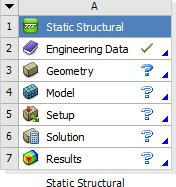
Fig-1: StaticStructuralStandalone System
Material properties of the three materials are mentionedinthetablebelow:
Table-2: MaterialProperties
Elasticmodulus(GPa) 75 80 96
Ultimate tensile strength(MPa)
3.2.2
After imported material properties, model is opened in mechanical. The whole body of the piston model is selected and meshing is performed. Tetrahedral elements typeisusedandthemeshingelementsizeis2mm.
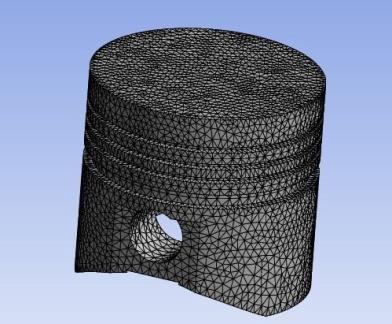
Fig-2: MeshingofPiston3-DModel
3.2.3 Static Structural Analysis
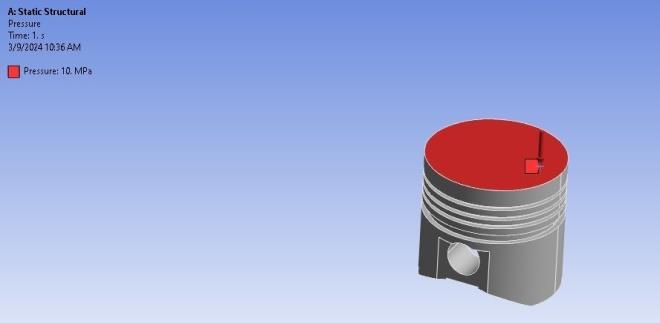
In static structural analysis, boundary conditions areapplied.
Pressureattheheadofpiston:13.65MPa
Fixedsupportsareappliedatedgesofgudgeonpin hole.
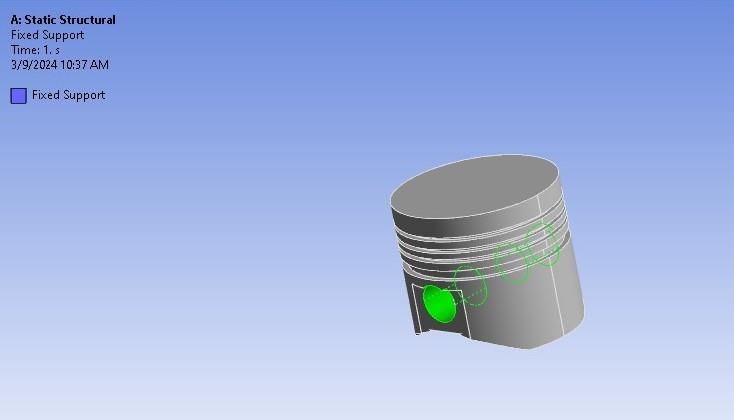
Fig-3: Fixedsupport
International Research Journal of Engineering and Technology (IRJET) e-ISSN:2395-0056
Volume: 11 Issue: 05 | May 2024 www.irjet.net p-ISSN:2395-0072 © 2024, IRJET | Impact Factor value: 8.226 | ISO 9001:2008 Certified Journal | Page1966
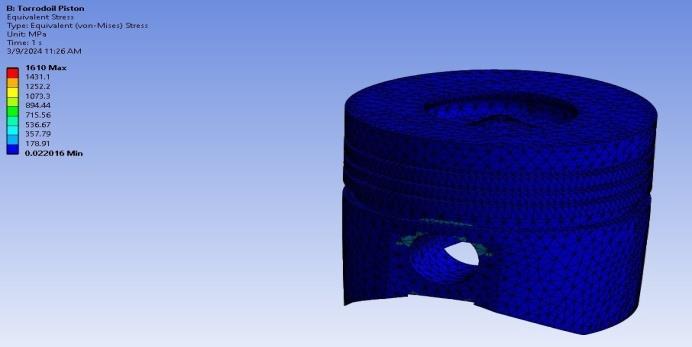
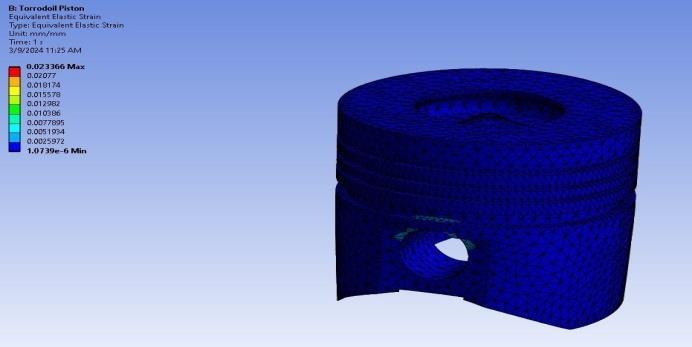
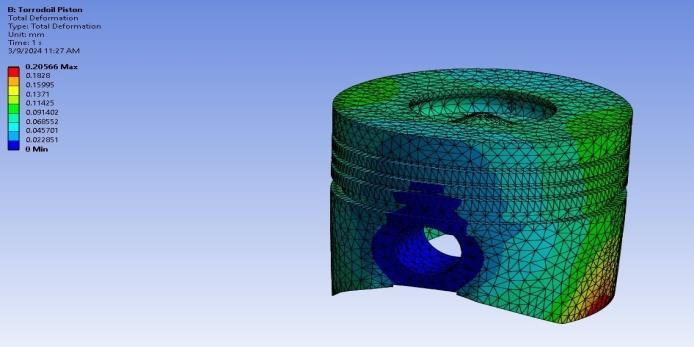
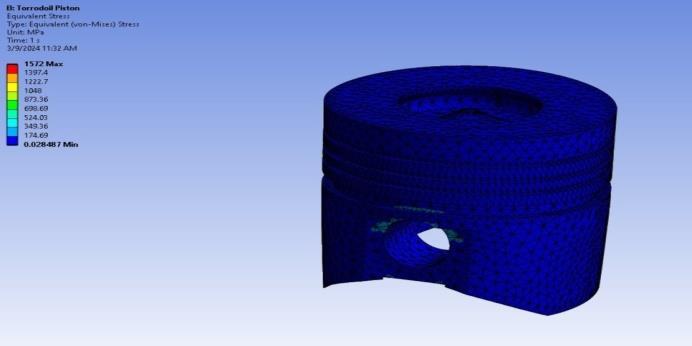
International Research Journal of Engineering and Technology (IRJET) e-ISSN:2395-0056
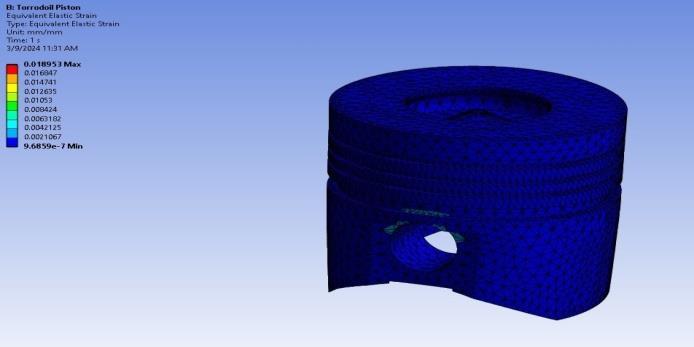
Strain
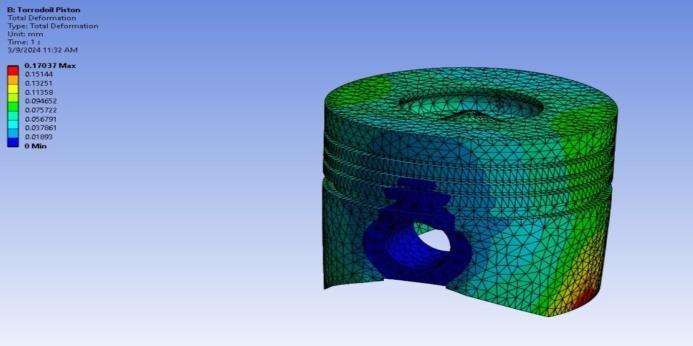
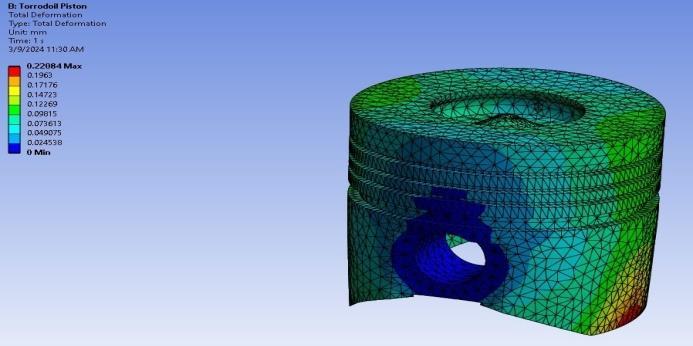
Fig-13: TotalDeformation
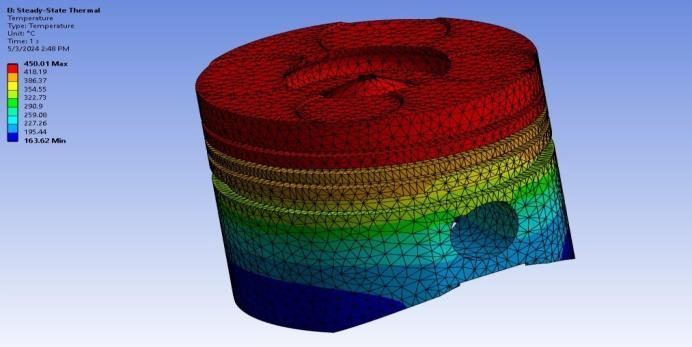
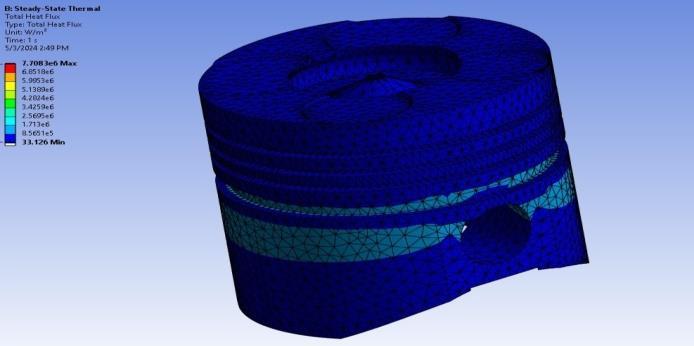
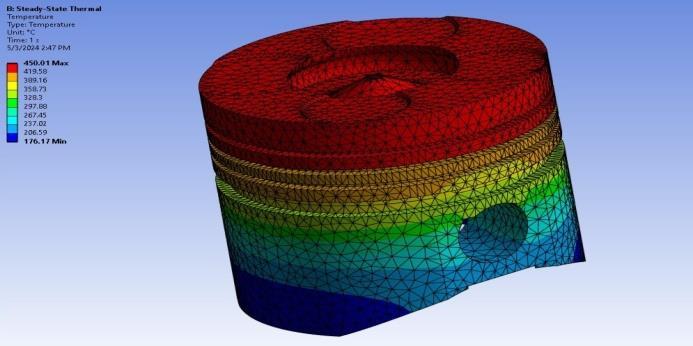
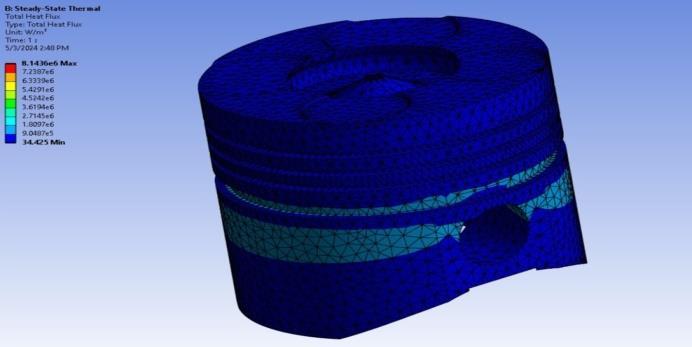
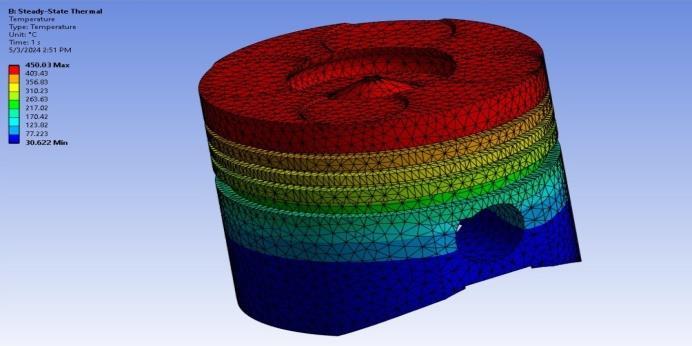
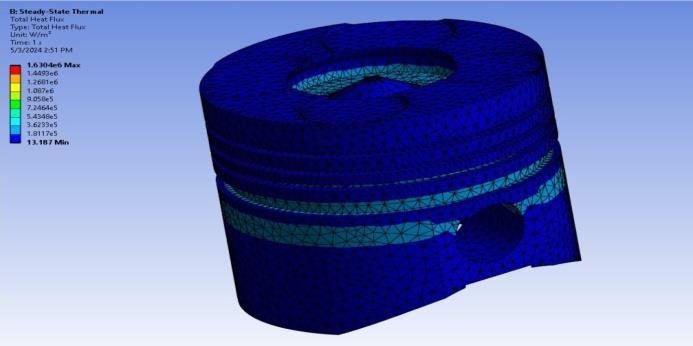
3.2.4 Steady State Thermal Analysis
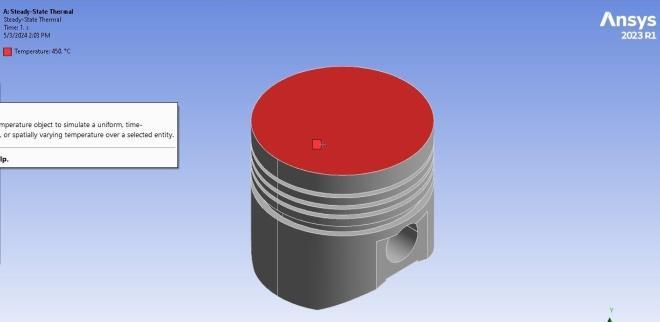
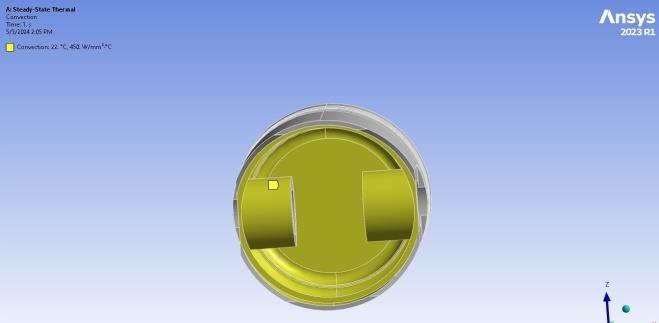
Insteadystatethermalanalysis,boundaryconditions areapplied.
Temperatureatheadofpiston:450°C
Filmcoefficientsofthepistonarefoundbearound 450W/mm2Cfromsimilarpapercarriedoutin researchpaper.
Volume: 11 Issue: 05 | May 2024 www.irjet.net p-ISSN:2395-0072 © 2024, IRJET | Impact Factor value: 8.226 | ISO 9001:2008
International Research Journal of Engineering and Technology (IRJET) e-ISSN:2395-0056
Volume: 11 Issue: 05 | May 2024 www.irjet.net p-ISSN:2395-0072
4. RESULTS
4.1 Static Structural Analysis
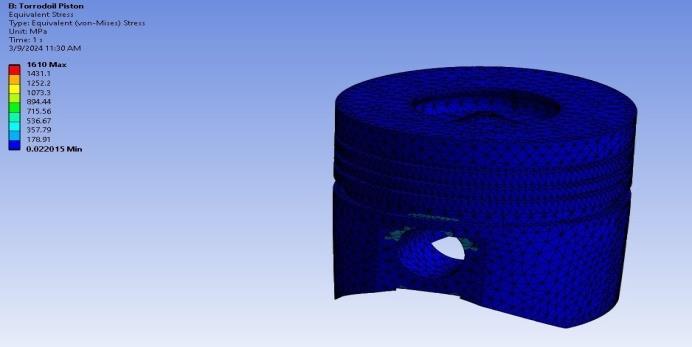
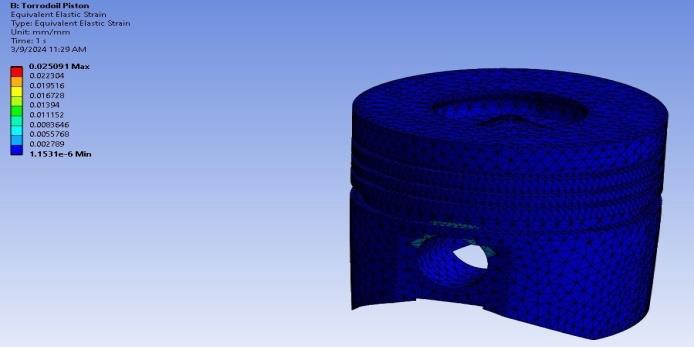
Table-3: StaticStructuralAnalysisResults
4.2 Steady State Thermal Analysis
Table-4: SteadyStateThermalAnalysisResults
5. CONCLUSIONS
In conclusion, the research into the possibility of enhancing car pistons has been an important thing. After much research, it was clear that the typical use of aluminium alloys in supercars had limitations in terms of lifetime, strength, and thermal stability. To overcome these problems, switching to titanium alloy is the most suitableoption.
Titanium alloy have good strength, durability, wear resistance and thermal resistance than aluminium alloys.Itisslightlyhigherweightbutotherpropertieslike ductility, hardness and thermal stability make it to overcomelikethatdrawbacks.
We got the results in terms of stress, strain, deformation and heat flux is favorable to titanium alloy. So, we conclude titanium is the best option for piston makingtosupercars.
[1] Ghosh, Amit, and Asim Tewari. Advanced Thermodynamics Engineering. CRC Press, 2013. [Textbook]
[2] Davis, Joseph R., et al. "Materials selection guidelines for low thermal expansion optical, structural and thermal management applications" Materials & Design(2011).[JournalArticle]
[3] Bhadeshia, H. K. D. H., and T. Sourmail. "Bainite in steels." International Materials Reviews 56.3 (2011). [JournalArticle]
[4] Leyens,Christoph,andManfredPeters. “Titaniumand Titanium Alloys: Fundamentals and Applications.” JohnWiley&Sons,2003.[Book]
[5] Lütjering, Gerd. "Influence of processing on microstructureand mechanicalpropertiesof titanium alloys." Materials Science and Engineering, (1998) [JournalArticle]
International Research Journal of Engineering and Technology (IRJET) e-ISSN:2395-0056
[6] Zhang, Xudong, et al. "Microstructure and mechanical propertiesoftitaniumalloyswithdifferentalpha/beta phase ratios." Materials Science and Engineering, (2013).[JournalArticle]
[7] Chandrasekar,S.,andM.N.Satish."Reviewoneffectof piston bowl geometry on performance and emission characteristics of DI diesel engine." International Journal of Engineering and Innovative Technology, (2013).[JournalArticle]
Volume: 11 Issue: 05 | May 2024 www.irjet.net p-ISSN:2395-0072 © 2024, IRJET | Impact Factor value: 8.226 | ISO 9001:2008 Certified Journal | Page1969