
International Research Journal of Engineering and Technology (IRJET) e-ISSN: 2395-0056
Volume: 11 Issue: 05 | May 2024 www.irjet.net p-ISSN: 2395-0072
International Research Journal of Engineering and Technology (IRJET) e-ISSN: 2395-0056
Volume: 11 Issue: 05 | May 2024 www.irjet.net p-ISSN: 2395-0072
Poojitha K1, A Maheswari2 ,
1 M.Arch Student, Faculty of Architecture, Dr. M.G.R Educational and Research Institute, Chennai, Tamil Nadu, India.
2 Asst. Professor, Faculty of Architecture, Dr. M.G.R Educational and Research Institute, Chennai, Tamil Nadu, India
Abstract - The study evaluates theintegrationofhorizontal light transmitting systems in high-rise, glazed office buildings to enhance energy efficiencyand daylight utilization. It focuses on regions without overcast skies and minimum day illuminance. Methodology includes literature review, case studies, and comparativeanalysis betweentraditionallighting systems and horizontal light pipes. The study finds that horizontal light transmitting systems can save up to 38% of lighting energy and 24% of overall energy consumption in office buildings. The proposed model indicates a payback period of 3 years, making the investment economically viable. Limitations includeapplicabilitytoonlyhigh-rise, glazedoffice buildings and potential variations in effectiveness based on different climates and daylight hours. Long-termperformance and future lighting advancements are not fully addressed in the study.
Key Words: Daylighting, Energy Efficiency, Horizontal light pipes, Office Building
Assessinginnovativedaylightingsolutionsinworkspacesis vital for enhancing natural lighting utilization and cutting downonelectricityconsumption.Thisevaluationfocuseson their impact on reducing energy usage and advancing sustainablearchitecture.
The aim of the study is to assess and demonstrate the effectiveness of integrating horizontal light transmitting system as a daylighting solution in office buildings to enhanceenergyefficiency.Theobjectivesofthestudyare; Identify - To evaluate the current energy consumption patternsintypicalofficebuildings,identifyingareaswhere lightingsystemsplayasignificantrole
Analyse - To analyse the design principles and technical specifications of horizontal light transmitting system to understandtheirpotentialforharnessingnaturallightand enhancingdaylightutilization
Evaluate - Tostudythefinancialfeasibilityandassessthe return on investment for the implementation of these horizontallighttransmittingsystem
Thestudyfocusesonhigh-rise,glazedofficebuildingsprone to issues like glare and thermal comfort. It considers new construction in regions with minimal overcast skies and adequate daylight. A speculative model is created using simulationtooptimizeenergyefficiencyandtocalculatethe implementationcosts,energysavings,andpaybackperiod.
Limitationsincludethestudy'sapplicabilityonlytohigh-rise, glazed office buildings and its variability in effectiveness depending on regional climate conditions and daylight hours.Itdoesnotconsiderlong-termperformanceorfuture advancementsinlightingtechnology.
The methodology followed for the study was, firstly, a literature study was done to understand the need for daylighting,energyefficiency,theoreticalaspects,typesand the components of these horizontal light transmitting system.Next,acomparativestudywasconductedbetween traditional lighting systems and horizontal light pipes in termsofenergyefficiency,lightingdistribution,electricity consumption.Thisisdonethroughanexperimentwherea simulationmodelissetupforahypotheticallysaidsituation. Theabstractcostingwasbedonetolearnthecostingaspect oftheproposedmodel.Lastly,costofimplementationand payback analysis was done to understand the potential returnoninvestment.
Among the electrical energy consuming services lighting energy contributes to almost 30%.[1] In a glazed building conditionstheareanexttotheglazinggetsmaximumamount ofnaturallightcomparedtotheotherdeeperregion.Butthe amount of glare provided by this glazing system is causing visual discomfort.[2] Hence by introducing innovative daylightingtechnologyalongwithcontrolswecangetdaylight into deeper office spaces and also reduce electrical energy consumption.[3]
Therearetwotypesofprovidingdaylighting:Steppedand Diming. Stepped gives more energy efficiency but when
International Research Journal of Engineering and Technology (IRJET) e-ISSN: 2395-0056
Volume: 11 Issue: 05 | May 2024 www.irjet.net p-ISSN: 2395-0072
analysedw.r.tvariousclimaticaspects dimming isa more effective system.[4] By introducing these daylighting strategies along with artificial light it increase the energy performance of that building. Also the thermal load of the buildingisdecreasedinturnreducingtheHVACloadingand thetotalenergyconsumption.[5]
Theapplicationoftubulardaylightingdevicesprovidesthe meansofintroducingdaylightintopoorlylitenvironments, which has a huge potential for electric energy saving.[6] Light pipes will possess high quality when the bends are designedbyathoroughanalysis.Alsotheinnermaterialsfor the light transmitting pipe should have very high reflectance.[7] An experiment done shows that light pipe technologycanbeadoptedtoutilizethenaturallightinginto deeper areas of the building and it also helps in energy savings.[8]
Various experiments done on these horizontal light transmittingsystems.Anexperimentinanopenofficeplan says that by orienting the collector towards south we can achievemoredistributionoflightingintodeeperofficespace and for longer time of the day.[9] Another study on educational building shows that the system of daylighting andthereflectanceofthefilmusedplacesaveryimportant role.[10]
The implementation of daylighting require a substantially greater capital investment than normal electrical lighting system.Butthesetubulardaylightingsystemshaveshownto beeconomicoverthelongterm.[11]Byintegrating daylight systems one can reduce this electric energy consumption and also the return on investment is acceptable.[12] The horizontallightpipesystemnotonlygetinmoreluxlevelsin office space but also provide uniform lighting almost throughouttheyear.[13]Thedesignofdaylightingrequiresa throughmacroandmicrolevelanalysis.Understandingthese variablescanbeakeytosuccessfuldaylightingsystem.[14] Formoreefficiencyaluminiumfoilisthebestmaterialthat can be used to increase the overall transmission of daylightingintoinnerspaces.[15]
4.1
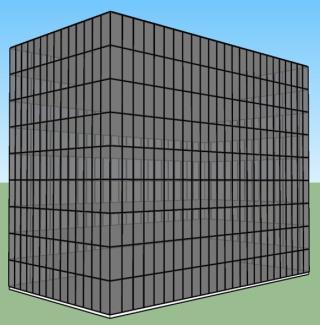
Fortheproposedprototypesimulationthelocationischosen to be Chennai. The building orientation is North-South, whereasthedaylightingissouthfacing.Numberoffloorsis ground+8floorandfloortofloorheighttakenis3.6m.The averagefloorareatakenis980Sqmandtotalfloorareais 11,150 Sqm for the envelope glazing type chosen is Aluminum frame with 6mm reflected glass structural glazing.
Workinghourswastakenfrom9amto6pmand6daysper week.TheHVACsystemtypeisvariablerefrigerantvolume
(VRV)system.ThelightingtypeisLEDlightswith10hper dayoflightingload.
Locatedontherooforfaçadelevel,thiscomponentcollects sunlight from the outside. It is usually a transparent or translucentdome-shapedstructuremadeofpolycarbonate, acrylic or glass designed to capture sunlight from various angles.
Light Pipe or Tube
This is a highly reflective tube that extends from the collectordowntotheinteriorofthebuilding.Itisdesigned totransportanddistributesunlightwithoutsignificantloss of intensity. Light pipes are typically made of highly reflective materials such as polished aluminum or silvercoatedsurfacestomaximizelighttransmission.
Diffuser or Fixture
The light pipe terminates in a diffuser or fixture located within the interior space of the building. This component disperses the natural light into the room, providing even illumination. The diffuser is made of either acrylic polycarbonate prismatic or textured glass and may be a simple opening or a more complex fixture designed to spreadthelightinaspecificpattern.
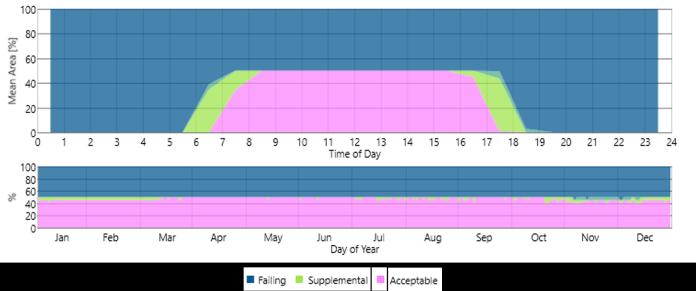
ALightingSimulationwasconductedinRhino-Climatestudio andfollowingresultswereobtained Fromtheabovefigures itisseenthatonly50%oftheofficefloorareaisreceiving daylight without the use of proposed daylighting system (figure-2).Whereasintheproposedhorizontal lightpipes systemofdaylightingthereisalmost100%distributionof daylightthroughoutthedaytime(figure-3)
Volume: 11 Issue: 05 | May 2024 www.irjet.net
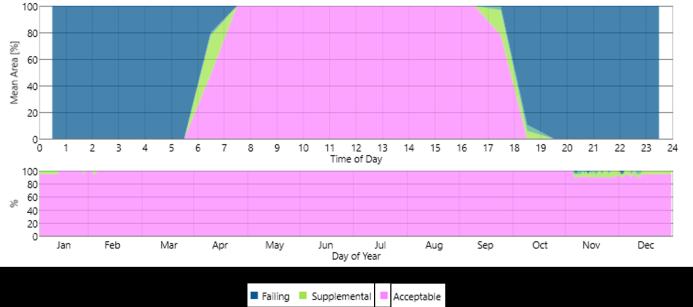
-3:DaylightDistributionwithDaylightingSystem
An energy simulation was conducted in EnergyPlusOpenstudio In without daylight system scenario the total energy consumption was seen to be 10,92,960 kWh and lighting energyconsumptionwas1,19,454kWh. When the daylighting system was implemented the total energy consumption was seen to be 8,28,355 kWh and lighting energyconsumptionwas75,450kWh.
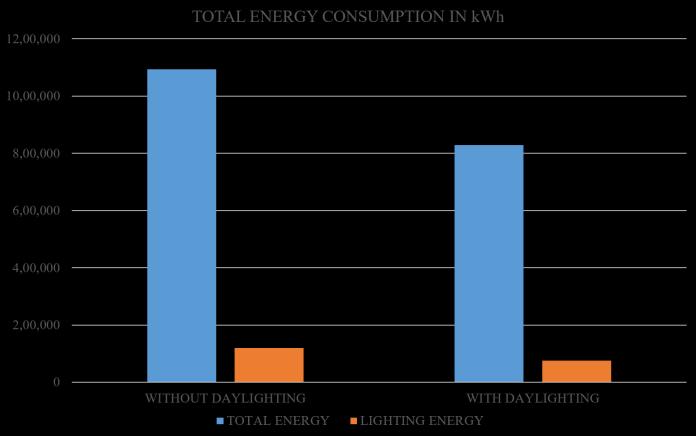
Chart -1:EnergyConsumptionwithoutandwith DaylightingSystem
The total energy savings was 2,64,561 kWh and lighting energysavingwas45,004kWh,whichis24%and38%of savingsrespectively.
Totalcostofinstallationof120HLP(20ineachfloorinto6 upper floor) is rupees 67,57,440 and the details is mentionedinthetablebelow.
Table -1: CostofInstallation
Totalcostofinstallationof120HLP (20ineachfloorinto6upperfloor)
Forthepaybackcalculationfollowingdataisfollowed, Energysavingsdone:2,64,561kwh Costofelectricity:8.70rs/kwh
TotalCostsavingsperyear: Rs. 23,01,680
TotalInvestmentCost: Rs. 67,57,440
Hencepaybackisgivenby, Payback = Initial Investment Annual inflows Payback = 67,57,440 23,01,680 = 3 years
The payback for the investment done can be withdrawn within 3 years
Fromtheaboveresultswecanseethatthehorizontallight transmittingsystemplacedinanofficebuildingcansaveup to 38% of lighting energy and 24% of overall energy consumption.Thisshowsthatthereissignificantreduction inenergyconsumptionpatternsintheofficebuilding.
Eventhoughthecostofinstallationiscomparativelyhighwe can see that in the proposed model for office building the
International Research Journal of Engineering and Technology (IRJET) e-ISSN: 2395-0056
Volume: 11 Issue: 05 | May 2024 www.irjet.net p-ISSN: 2395-0072
payback period is derived as 3 years indicating that the investmentisviable.
Utilizing daylight through horizontal light transmitting systems improves thermal and visual comfort in office environments. This approach greatly reduces reliance on artificial lighting, leading to significant electricity cost savings. Additionally, by lessening the need for artificial lighting, these systems also decrease HVAC expenses, enhancingoverallenergyefficiency.Incorporatinghorizontal light transmitting systems into building designs promotes sustainablearchitectureandenvironmentalresponsibility.
Researchindicatesthatimplementingthesesystemsinoffice buildingscansaveupto38%oflightingenergy.Moreover, thesesystemscanreduceoverallenergyconsumptionbyup to 24%, demonstrating their effectiveness and potential impact.Theproposedmodelshowsapaybackperiodofjust 3 years, making the investment in horizontal light transmitting systems both viable and economically advantageous
[1] Joseph,C.,Lam.,Danny,H.W.,Li.,Sai,On,Cheung.(2003). Ananalysisofelectricityend-useinair-conditionedoffice buildingsinHongKong.BuildingandEnvironment, doi: 10.1016/S0360-1323(02)00132-4
[2] Badeche, Mounira,and Yasmina Bouchahm. AStudy of Indoor Environment of Large Glazed Office Building in Semi Arid Climate.Journal of Sustainable Architecture andCivilEngineering29.2(2021):175-188.
[3] Danny,H.W.,Li.,Ernest,K.W.,Tsang.(2008).Ananalysis ofdaylightingperformanceforofficebuildingsinHong Kong. Building and Environment, doi: 10.1016/J.BUILDENV.2007.07.002
[4] Nastaran, Shishegar., Mohamed, Boubekri. (2017). Quantifyingelectricalenergysavingsinofficesthrough installing daylight responsive control systems in hot climates.EnergyandBuildings,153:87-98
[5] AfrozMostofa,S.(2015).SmartLightPipeStrategiesin DeepPlanOfficeBuildinginDhaka,Bangladesh.Nakhara :JournalofEnvironmentalDesignandPlanning,11,125–136. Retrieved from https://ph01.tcithaijo.org/index.php/nakhara/article/view/104856
[6] Shuxiao,Wang&Jianping,Zhao&Lixiong,Wang.(2015). ResearchonEnergySavingAnalysisofTubularDaylight Devices. Energy Procedia. 78. 1781-1786. 10.1016/j.egypro.2015.11.305
[7] Taengchum, Thanyalak & Chirarattananon, Surapong. (2015).RayTracingMethodofLightthroughRectangular Light Pipe with Bends. Energy Procedia. 79. 791-798. 10.1016/j.egypro.2015.11.568.
[8] R.,Canziani.,Fabio,Peron.,G.,Rossi.(2004).Daylightand energyperformancesofanewtypeoflightpipe.Energy andBuildings, doi:10.1016/J.ENBUILD.2004.05.001
[9] Mohsen Roshan and Aliyu Salisu Barau, Assessing Anidolic Daylighting System for Efficient Daylight in Open Plan Office in the Tropics, Journal of Building Engineering,
[10] GarciaChavez,JoseRoberto&RUIZ,Karen&Scartezzini, Jean-Louis.(2015).ApplicationofanAnidolicSystemto ImproveDaylightinginEducationalBuildings.
[11] Mayhoub, M. S., & Carter, D. J. (2011).The costs and benefits of using daylight guidance to light office buildings. Building and Environment, 46(3), 698–710.doi:10.1016/j.buildenv.2010.09.014
[12] Srisamranrungruang, Thanyalak & Hiyama, Kyosuke. (2019).Possibilitiesofusinglightpipestobuildings.IOP Conference Series: Earth and Environmental Science. 294.012064.10.1088/1755-1315/294/1/012064
[13] Elsiana,Feny&Ekasiwi,SriNastiti&Antaryama,Ngurah. (2021).IntegrationofHorizontalLightPipeandShading Systems in Office Building in the Tropics. Journal of Applied Science and Engineering. 25. 10.6180/jase.202202_25(1).0024.
[14] Ukpong, Edidiong. (2017). Understanding The Design VariablesThatAffectDaylightHarvestingInBuildings
[15] Thongtha, A.; Laphom, P.; Mahawan, J. Investigation of theEfficacyofHorizontalHollowLightTubesforEnergy ConservationinIlluminating Buildings.Energies2023, 16,7545.https://doi.org/10.3390/en16227545