
International Research Journal of Engineering and Technology (IRJET) e-ISSN: 2395-0056
Volume: 11 Issue: 05 | May 2024 www.irjet.net p-ISSN: 2395-0072
International Research Journal of Engineering and Technology (IRJET) e-ISSN: 2395-0056
Volume: 11 Issue: 05 | May 2024 www.irjet.net p-ISSN: 2395-0072
Ashutosh Kumar Jaiswal1 , Ashish Banjare2 , Abhishek Yadav3 , Vikram Singh 4 , Ashim Mukharjee5
1 Asst. Professor, LCIT Group of Institutions, Bilaspur;
2 UG Scholor, , LCIT Group of Institutions, Bilaspur;
3 UG Scholor, LCIT Group of Institutions, Bilaspur;
4 UG Scholor, , LCIT Group of Institutions, Bilaspur;
5 Asst.Professor, LCIT Group of Institutions, Bilaspur
Abstract
In simpler terms, a smart street light is a type of street light that automatically adjusts its brightness based on the presence of vehicles on the road. The idea behind it is to save energy by reducing brightness when there's no need for full illumination. So, when there are no vehicles detected, the lights stay dim. But when a vehicle approaches, infrared sensors detect it and trigger the lights to brighten up, illuminating the area ahead of the vehicle. This helps in conserving energy while still ensuring safety and visibility on the road. As the vehicle passes by, the trailing lights turn dim automatically. Thus, we save a lot of energy When there's no vehicle activity on the highway, the smart street lights will stay dim, conserving energy by not using unnecessary brightness.
Keywords: Automation, smart light, power consumption, energy saving.
Introduction
Traditional street lighting systems have been a cornerstoneofurbaninfrastructurefordecades,providing illumination to roads, sidewalks, and public spaces during nighttime hours. These systems typically consist of highpressuresodium(HPS)ormetalhalidelamps mountedon polesatregularintervalsalongstreetsandhighways.HPS lamps emit a warm, amber-colored light and have been widely used in street lighting due to their relatively low costandlonglifespan.Metalhalidelampsproduceawhite lightsimilartonaturaldaylightandareoftenusedinareas wherecolorrenderingisimportant,suchasincommercial districtsorsportsfacilities.
Inrecenttimes,therehasbeennotableinterestin smart street lighting systems owing to their capacity to boost energy efficiency, lower expenses, and enhance publicsafety.Numerousresearchendeavorshaveexplored diverse methodologies for implementing smart street
lightingsystems,leveragingadvancedtechnologieslikethe Internet of Things (IoT), artificial intelligence (AI), and sensornetworks.
Advancements in Internet of Things (IoT) technology allowed smart street lights to communicate witheachotherandwithcentralcontrolsystems.Wireless connectivity, such as Wi-Fi, Zigbee, or cellular networks, enables remote monitoring, management, and optimizationofstreetlightingnetworks
Proposed Methodology
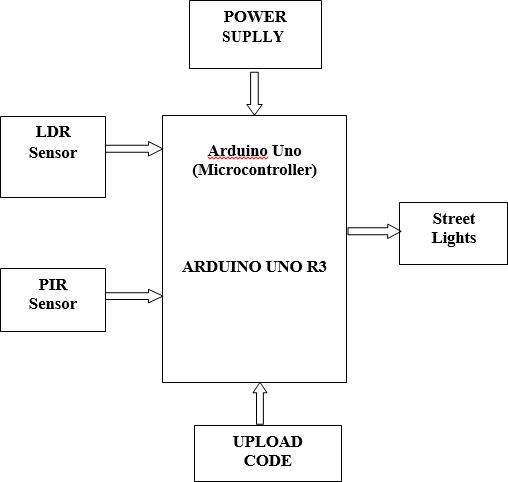
Theblockdiagramoutlineshowthe"SmartStreet Light System with IoT" Arduino Nano and Node MCU WiFi module to the internet with the code specified in the code and the corresponding AT commands. The LDR sensor sences the power of light and transfers value to Arduino which collects and stores data. The IR sensor detects movement or the presence of objects on the road andsendsthisdatatotheArduino.Whenlightintensityis lowtheArduinohastosendasignaltotherelaytoturnon the Smart Street light. If the IR sensors sense any movement, then the Arduino has to send a signal to the relaytotheSmartStreetlight.
International Research Journal of Engineering and Technology (IRJET) e-ISSN: 2395-0056
Volume: 11 Issue: 05 | May 2024 www.irjet.net
The Arduino Uno R3 is a microcontroller board that serves as the core of many electronic projects. It's built around the ATmega328 microcontroller and is popular due to its simplicity and versatility, suitable for both beginners and professionals. Here'sabreakdownofitskeyfeatures.
Microcontroller:Based on theATmega328,capable ofrunningat16MHz.
Digital I/O Pins: 4 pins that can be used as either inputs or outputs. Six of these pins can generate PWM signals for controlling analog devices like motorsorLEDs.
Analog Inputs: ix analog input pins for reading analogsensorsorotheranalogsignals.
Crystal Oscillator: A 16 MHz crystal oscillator providesthetimingforthemicrocontroller.
USB Connection: AllowstheArduinoUnotoconnect toacomputerforprogrammingandcommunication.
Power Option: CanbepoweredviaUSBconnection, AC-to-DCadapter,orbattery.
ICSP Header: Allows for programming the microcontrollerusinganin-circuitprogrammer.
Reset Button: Pressing the reset button on the Arduino Uno R3 will restart the microcontroller, resetting it to its initial state and restarting any programrunningonit.
ATmega 16U2 Microcontroller: Used for USB communication, providing faster transfer rates and morememorycomparedtopreviousversions.
Additional Pins: SDA and SCL pins for I2C communication, and two new pins (IOREF and reservedpin)forfutureexpansion.
Compatibility: Works with existing Arduino shields and can adapt to new shields that utilize the additionalpins.
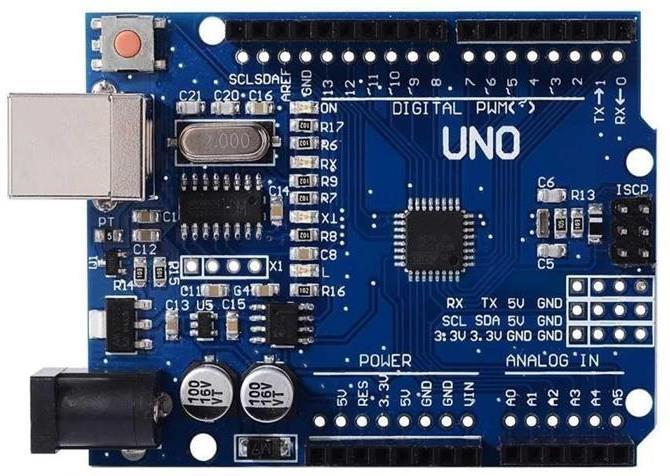
Features of theArduino UNO:
Microcontroller:ATmega328
OperatingVoltage:5V
InputVoltage(recommended):7-12V
InputVoltage(limits):6-18V
DigitalI/OPins:14(ofwhich6providePWMoutput)
AnalogInputPins:6
DCCurrentperI/OPin:40mA
DCCurrentfor3.3VPin:50mA
Flash Memory: 32 KB of which 0.5 KB used by bootloader
SRAM:2KB(ATmega328)
EEPROM:1KB(ATmega328)
ClockSpeed:16MHz
Smart street lights leverage a variety of technologies to enhance their functionality and efficiency. Here are some key technologies commonly used in smart streetlightingsystems:
LED Lighting: Light Emitting Diode (LED) technology is the foundation of smart street lights. LEDs offer high energy efficiency, long lifespan, and controllability, makingthemidealforsmartapplications.
Sensors: Motion Sensors: Detect movement and can trigger the adjustment of lighting levels to conserve energy when no activity is detected. Ambient Light Sensors: Measure natural light levels to adjust the
International Research Journal of Engineering and Technology (IRJET) e-ISSN: 2395-0056
Volume: 11 Issue: 05 | May 2024 www.irjet.net p-ISSN: 2395-0072
brightness of the street lights accordingly, ensuring optimal illumination while minimizing energy usage. OccupancySensors:Determine thepresence of people or vehicles in the vicinity and adjust lighting levels accordingly
Wireless Connectivity: Wi-Fi: Enables communication between individual street lights and a central control system, allowing for remote monitoring and management. Zigbee: A low-power wireless communication protocol commonly used in IoT applications, enabling communication between street lights and other smart devices. Cellular Networks: ProvideconnectivityforstreetlightsinareaswithoutWiFiinfrastructure,enablingremotecontrolandmonitoring viacellulardatanetworks.
Central Control Systems: Centralizedsoftwareplatforms or control hubs manage and coordinate the operation of smartstreetlights.Thesesystemsallowadministratorsto monitor lighting performance, adjust brightness levels, schedulemaintenance,andgatherdataforanalysis.
Data Analytics: Advanced analytics algorithms process datacollectedfromsensorstooptimizelightingschedules and intensity levels. Machine learning algorithms can predicttrafficpatterns,detectanomalies,anddynamically adjustlightingsettings tomaximize energysavings while maintainingsafetyandvisibility.
Energy Management Systems: Energy management software monitors and controls the energy consumption of smart streetlights, optimizing operation to minimize costs and reduce environmental impact. These systems may incorporate features such as dimming schedules, power-saving modes, and demand-response capabilities tomanageenergyusageefficiently.
Integration with IoT Platforms: Smart street lights can integrate with broader IoT platforms to enable interoperability with other urban infrastructure systems, such as transportation, public safety, and environmental monitoring. Integration with IoT platforms allows for holisticurbanmanagement andplanning,leveragingdata from multiple sources to optimize city operations and services .By leveraging these technologies, smart street lighting systems can achieve significant energy savings, reducemaintenancecosts,improvesafety,andcontribute tothecreationofsmarter,moresustainablecities.
In the context of smart street lights, several theoretical models and frameworks can provide a
conceptual basis for understanding their design, implementation, and impact. Here are some theoretical frameworksrelevanttosmartstreetlights:
Internet of Things (IoT): TheIoTframework focuseson connecting physical devices and objects to the internet, enabling them to collect and exchange data. Smart street lightscanbeviewedasIoTdevicesequippedwithsensors and communication capabilities, contributing to a networkedurbanenvironment.
Sustainable Urban Development: "Sustainable Urban Development" ensures that cities are built to meet present needs without sacrificing the ability of future generationstomeettheirs Smartstreetlightsplayarole in sustainable urban development by reducing energy consumption, minimizing light pollution, and enhancing safetyandefficiencyinurbanareas.
Smart Cities: The smart cities framework envisions urbanenvironmentsthatleveragetechnologyanddatato improvequalityoflife,sustainability,andefficiency.Smart streetlightsareakeycomponentofsmartcity initiatives, contributing to enhanced urban infrastructure, energy management,andpublicservices.
Human-Centered Design: The human-centered design frameworkprioritizestheneedsandexperiencesofusers inthedesignandimplementationoftechnologysolutions. Smartstreetlightsshouldbedesignedwithconsideration for factors such as user safety, comfort, and accessibility toensuretheyeffectivelymeettheneedsofresidentsand visitors.
Energy Efficiency and Conservation: The energy efficiencyframeworkfocusesonoptimizing energyusage and reducing waste to achieve environmental and economic benefits. Smart street lights contribute to energy efficiency by dynamicallyadjusting lighting levels based on real-time conditions, thereby reducing unnecessaryenergyconsumption.
Data-Driven Decision Making: The data-driven decision-making framework emphasizes using data analytics and insights to inform decision-making processes. Smart street lights generate valuable data on traffic patterns, lighting conditions, and energy usage, which can be analyzed to optimize lighting schedules, improveurbanplanning,andenhancepublicsafety.
Energy Efficiency: One of the primary benefits of smart street lights is their ability to optimize energy usage. By
International Research Journal of Engineering and Technology (IRJET) e-ISSN: 2395-0056
Volume: 11 Issue: 05 | May 2024 www.irjet.net p-ISSN: 2395-0072
dimming or brightening in response to real-time conditions,suchasthepresenceofpedestriansorvehicles, smart street lights can significantly reduce energy consumption compared to traditional systems, leading to costsavingsandenvironmentalbenefits.
Sustainability: Smart street lights contribute to sustainability efforts by minimizing light pollution and carbonemissions.Byonlyilluminatingareaswhenneeded and adjusting brightness levels accordingly, they help conserve energy and reduce the overall environmental impact of street lighting on ecosystems and natural habitats.
Improved Safety: Another key advantage of smart street lights is their potential to enhance safety in urban environments. By providing more consistent and uniform illumination, smartstreet lights can improve visibility for pedestrians, cyclists, and drivers, reducing the risk of accidentsandenhancingoverallpublicsafety,especially in locationswherethereisasignificantamountoftrafficflow orfrequentpedestrianmovement.
Enhanced Flexibility and Control: Smart street lights offergreaterflexibilityandcontrolcomparedtotraditional systems. With built-in sensors and communication capabilities,theycanberemotelymonitoredandmanaged, allowing for proactive maintenance, automatic fault detection, and real-time adjustments to lighting levels basedonchangingconditionsoruserpreferences.
Data CollectionandAnalytics:Smartstreetlightsserveas valuablesourcesofdata forurbanplanners, policymakers, and researchers. By collecting information on traffic flow, environmental conditions, and other relevant parameters, theyenabledata-drivendecision-makingandfacilitatethe development of smarter, more efficient urban infrastructureandtransportationsystems.
Overall, smart street lights represent a transformative innovation with the potential to revolutionize urban lighting, enhance sustainability, improve safety, and pave the way for smarter, more livablecitiesinthe21stcentury.Ascitiesaroundtheworld continue to grapple with the challenges of rapid urbanization, climate change, and resource scarcity, the adoptionof smart street lights offers a promising solution toaddress these pressing issuesand create more resilient and sustainable urban environments for future generations
Initial Cost: The upfront cost of deploying smart street lights, including sensors, communication infrastructure, and centralized management systems, can be higher than traditional lighting systems, posing a barrier to adoption forsomemunicipalities.
Technological Complexity: Smart street light systems require integration of various technologies, including sensors, wireless communication protocols, and data analyticsplatforms,whichmayposechallengesintermsof compatibility,interoperability,andsystemcomplexity.
Maintenance Requirements: While smart street lights offer potential savings in maintenance costs over the long term,theymayrequirespecializedskillsandresourcesfor ongoing monitoring, troubleshooting, and software updates,particularlyinremoteorunderservedareas.
Data Privacy and Security Concerns: The collection of data by smart street lights raises privacy and security concernsregardingtheprotectionofpersonalinformation, surveillance risks, and potential misuse of data, requiring robustprivacypoliciesandsecuritymeasures.
Reliability and Resilience: Dependence on technology and connectivity exposes smart street light systems to risks such as equipment failures, cyber attacks, and network outages, necessitating redundancy measures and resiliencestrategiestoensureuninterruptedoperation.
Power Supply Dependency: Smart street lights still rely on consistent power sources, which can be challenging in remote or underdeveloped regions with unreliable electricity grids or limited access to renewable energy sources.
In the context of smart street lights, "Results & Discussion" typically refers to the analysis and interpretation of data collected from the implementation of smart street light systems. Here's how it might be approached:
Operational Performance*: Data on the operational performance of smart street lights, such as uptime, reliability, and maintenance requirements, would be analyzed. Any improvements or challenges observed compared to traditional systems would be discussed, alongwithpotentialstrategiesforoptimization.
International Research Journal of Engineering and Technology (IRJET) e-ISSN: 2395-0056
Impact on Safety and Security*: If relevant data is available, the impact of smart street lights on safety and security in the community could be assessed. This might include crime statistics, accident rates, or resident feedbackregardingperceivedsafetyimprovements.
Environmental Impact*: Discussion would cover the environmental impact of smart street lights, including reductions in light pollution and habitat disruption, as well as any unintended consequences observed during implementation.
Community Feedback and Engagement*:Resultswould include feedback from residents, businesses, and other stakeholdersregardingtheirexperiencewithsmartstreet lights. This would be discussed in terms of satisfaction levels, concerns raised, and opportunities for further engagement.
Cost-Benefit Analysis*: A cost-benefit analysis would be conducted to evaluate the overall economic impact of implementing smart street lights. This would involve comparing upfront costs, ongoing operational expenses, andthetangibleandintangiblebenefits derivedfromthe system.
Future Considerations and Recommendations*: The discussionwouldconcludewithconsiderationsforfuture deployments of smart street lights, including potential areasforimprovement,emergingtechnologiestoexplore, andstrategiesformaximizingthebenefitsofthesesystems forthecommunity.
Integration with Smart City Initiatives*: Discuss how smart street lights fit into broader smart city initiatives and their potential synergies with other smart infrastructure, such as transportation systems, waste management,andpublicservices.
Energy-Efficient Lighting: Smart street lights use LED technologyandsensorstoadjustlightinglevelsbasedon real-time conditions, maximizing energy efficiency and reducingelectricityconsumption.
Traffic Management: Smart street lights can be equipped with sensors to monitor traffic flow and congestion, providingdatainsightsforoptimizingtraffic signaltimingandroadnetworkmanagement.
Environmental Monitoring: Smart street lights can incorporate sensors for monitoring environmental parameters such as air quality, temperature, and
Volume: 11 Issue: 05 | May 2024 www.irjet.net p-ISSN: 2395-0072 © 2024, IRJET | Impact Factor value: 8.226 | ISO 9001:2008 Certified Journal | Page1850
humidity, providing valuable data for environmental monitoringandmanagement.
Urban Planning and Management: Data generated by smart street lights, such as traffic patterns, pedestrian activity, and lighting usage, can be analyzed to inform urban planning decisions, optimize infrastructure investment,andimproveresourceallocation.
Public Services Integration: Smart street lights can be integratedwithotherurbaninfrastructuresystems,such astransportation,publictransit,wastemanagement,and emergency services,to improve overall service delivery andurbanmanagement.
Smart City Initiatives: Smart street lights are an integral component of broader smart city initiatives aimed at leveraging technology and data to improve quality of life, sustainability, and efficiency in urban environments.
Community Engagement: Smart street lights can serve as platforms for citizen engagement and interaction, providing opportunities for feedback, participation, and collaboration in urban planning and governance processes.
Tourism and Events Management: Smart street lights canbeprogrammedtocreate
dynamiclightingeffectsandambianceforspecialevents, festivals, and tourist attractions, enhancing the visitor experienceandpromotinglocaltourism.
Cost-Effectiveness Studies: Conductingcomprehensive cost-benefitanalysesandlifecycleassessmentstoquantify theeconomic,environmental,andsocialbenefitsofsmart street lightsand identify strategies for maximizing costeffectivenessandreturnoninvestment.
*Standardization and Interoperability: Developing industry standards and protocols for smart street light systems to promote interoperability, compatibility, and scalability across different vendors, technologies, and geographicalregions.
Advanced Sensor Integration: Exploring advanced sensor technologies,suchasLiDAR, thermalimaging,and air quality sensors, for enhanced data collection capabilitiesandbroaderapplicationsbeyondlighting,such as traffic management, environmental monitoring, and disasterresponse.
International Research Journal of Engineering and Technology (IRJET) e-ISSN: 2395-0056
Volume: 11 Issue: 05 | May 2024 www.irjet.net p-ISSN: 2395-0072
Edge Computing and AI Integration: Leveraging edge computing and artificial intelligence techniques to process data locally within smart street lights or at the network edge, enabling real-time analytics, predictive maintenance, and autonomous decision-making without relyingsolelyoncentralizedservers.
Sustainability and Resilience Planning: Integrating smart street lights into broader sustainability and resilience planning efforts, including climate adaptation strategies, disaster preparedness, and green infrastructure initiatives to enhance community resilienceandenvironmentalsustainability.
User-Centric Design and Accessibility: Prioritizing user-centric design principles and accessibility considerations in the development of smart street light systems to ensure inclusivity, usability, and equitable access for all members of the community, including personswithdisabilitiesandmarginalizedgroups.
Autonomous Operation and Self-Healing Networks: Developing autonomous operation and self-healing capabilities within smart street light networks to enable self-configuring, self- optimizing, and self-repairing systems that can adapt to changing conditions and mitigatedisruptions.
Community Co-Creation and Innovation: Engaging communities in co-creation processes, living labs, and open innovation platforms to encourage grassroots experimentation, creativity, and innovation in designing, deploying, and managing smart street light solutions tailoredtolocalneedsandcontexts.
Cross-Sector Collaboration and Ecosystem Integration: Facilitating cross-sector collaboration and ecosystem integration among government agencies, private sector companies, research institutions, and community organizations to leverage synergies, share resources, and co-create holistic solutions that address interconnectedurbanchallengesbeyondlighting.
Conclusion
In conclusion, smart street lights represent a transformative approach to urban lighting withsignificant potential benefits and opportunities for improvement. Whiletheyofferadvantagessuchasenergy efficiency, cost savings, and enhanced safety, several limitations and challengesmustbeaddressedtorealizetheirfullpotential. The deployment of smart street lights requires careful consideration of factors such as initial costs, technological complexity, and regulatory compliance. Additionally,
ensuring privacy, security, and public acceptance are essential for successful implementation and widespread adoption.
Looking ahead, future work in the field of smart street lights should focus on addressing theselimitations through advancements in technology, policy, and community engagement. This includes research into energy harvesting technologies, autonomous operation, and human- centric design, as well as fostering crosssectorcollaborationandlong-termimpactassessment.
By overcoming these challenges and leveraging opportunities for innovation and collaboration, smart street lights have the potential to play a pivotal role in creating more sustainable, resilient, and livable cities for futuregenerations.
1. Al-Sultan, S., & Al-Dala'ien, A. (2019). Smart street lighting system: design and implementation. Journal of Advanced Transportation, 2019,6852949. doi:10.1155 /2019/6852949
2. Arulmozhiyal, R., & George, S. M. (2019). Smart street lighting system for energy optimization and reduction of light pollution. International Journal of Engineering and AdvancedTechnology(IJEAT),8(1),3011-3017.
3. Cheng, M., & Huang, Y. (2020). Smart Street lighting system based on Internet of Things technology. In Proceedingsofthe20202ndInternational Conferenceon Frontiers of Sensors Technologies (pp. 13-17). doi:10.1145/3425454.3425464
4. Ghobadpour, A., & Balas, V. E. (2018). Intelligent street lighting control system. In Proceedings of the 2018 International Conference on Computing, Networking and Communications (ICNC) (pp. 430-435). doi:10.1109/ ICCNC.2018.8390350
5. Gupta, A., & Arun, N. (2019). Smart street light with automatic brightness adjustment and monitoring system using IoT. In 2019 4th International Conference on Computing,Communication,andAutomation(ICCCA)(pp. 1-5).doi:10.1109/CCAA45533.2019.8994731
6. Hafeez, M. A., & Chowdhury, M. Z. (2019). Smart street lighting control system based on IoT and artificial intelligence. In 2019 IEEE 8th Global Conference on Consumer Electronics (GCCE) (pp. 62-65). doi:10.1109/ GCCE46687.2019.9016426
© 2024, IRJET | Impact Factor value: 8.226 | ISO 9001:2008 Certified Journal | Page1851
International Research Journal of Engineering and Technology (IRJET) e-ISSN: 2395-0056
Volume: 11 Issue: 05 | May 2024 www.irjet.net p-ISSN: 2395-0072
7. Javed, M. A., & Ahmed, S. (2018). IoT based smart street light management system. In 2018 International Conference on Computing, Mathematics and Engineering Technologies (iCoMET) (pp. 1-6). doi:10.1109/ iCoMET. 2018.8469715
8. Kaur,M.,&Singh,M.(2019).Smartstreetlightingsystem using IoT. In 2019 3rd International conference on Electronics, Communication and Aerospace Technology (ICECA) (pp. 1134-1137). doi:10.1109/ ICECA.2019.8822175
9. Mardhani, F., & Akbarzadeh-T, M. R. (2019). Smart street lightmanagementsystembasedonIoTandLoRaWAN.In 2019 2nd International Conference on Computer and Drone Applications (IConDA) (pp. 191-194). doi:10.1109/ICCDA47830.2019.9030813
10.Mohapatra, D., & Jena, S. K. (2018). Smart street light automation and monitoring system using IoT. In 2018 International Conference on Inventive Research in Computing Applications (ICIRCA) (pp. 283-287). doi:10.1109/ICIRCA.2018.8597469
11.Rani,A.,&Mohan,G.S.(2020).Smartstreetlightingsystem using IoT. In 2020 InternationalConference on Electronics and Sustainable Communication Systems (ICESC) (pp. 439444).doi:10.1109/ICESC48985.2020.9164244
12.Rastogi, S., & Reddy, D. K. (2019). Implementation of smart street light system using IoT. In 2019 International Conference on Communication and Signal Processing (ICCSP) (pp. 0223- 0227). doi:10.1109/ ICCSP. 2019.8698033
13.Siddique, M. A., & Aftab, S. (2018). Smart street light control system based on IoT. In 2018 IEEE 20th International Conference on High Performance Computing and Communications; IEEE 16th International Conference on Smart City; IEEE 4th International Conference on Data Science and Systems (pp. 1098-1103). doi:10.1109/ HPCC/ SmartCity/DSS.2018.00192
14.Singh, G., & Sinha, R. (2018). Smart street light management system using IoT. In 2018 3rd International ConferenceforConvergenceinTechnology(I2CT)(pp.1-4). doi:10.1109/I2CT43850.2018.8761222
15.Vijayalakshmi, M., & Nalini, P. (2020). Smart street lighting system using IoT. In 2020 6th International Conference on Advanced Computing and Communication Systems (ICACCS) (pp. 740-743). doi:10.1109/ ICACCS50848.2020.907
2024, IRJET | Impact Factor value: 8.226 |