
International Research Journal of Engineering and Technology (IRJET) e-ISSN: 2395-0056
Volume: 11 Issue: 05 | May 2024 www.irjet.net p-ISSN: 2395-0072
International Research Journal of Engineering and Technology (IRJET) e-ISSN: 2395-0056
Volume: 11 Issue: 05 | May 2024 www.irjet.net p-ISSN: 2395-0072
B. Sudheer Reddy 1, N. Nandini2, K. Madhu Sudhan3, A. Arun Reddy4, M. Sudharshan5, K. Vamsi Krishna6
1 Assistant Professor, Department of Mechanical Engineering, Annamacharya Institute of Technology & Sciences (Autonomous), Tirupati, A.P., India 2-6
B.Tech Student, Department of Mechanical Engineering, Annamacharya Institute of Technology & Sciences (Autonomous), Tirupati, A.P., India ***
Abstract - Polymersmatrixcompositesarecommonlyused ina varietyofapplications,includingaerospace,automotive, marine, and household, due to their design flexibility, lightweight,highmodulus,easeofmanufacturingtomeetspecific requirements, when compared to traditional metals composites. However, they possess poor mechanical, tribological and physical properties. In order to improve the aforementioned properties researchers introduced different fibers,flaks,andfillersintopolymers. Thisarticlepresentsthe recent development of the polymer matrix composites reinforced co-related with the mechanical characteristics (flexural strength, tensile strength, and hardness), Morphological characters (scanning electron microscopic (SEM), X-ray diffraction analysis (crystallinity), and FTIR (chemicalcompound)) analysis.
Key Words: Natural Fiber, Polymer Matrix Composites (PMCs), Epoxy, Flexural Strength, Tensile Strength, and Hardness,
Polymersarefrequently usingina varietyofapplications, includingaerospace,automotive,marine,andhousehold,due totheireaseofmanufacturingvariedformstomeetspecific requirements, when compared to traditional metals and composites[1-2].Polymershavepossessedgoodmodulusof elasticity,strength-to-weightratio,corrosionresistance,less water absorption, electrical conductivity and many more features.Overall,thepropertiesofpolymers makethem a popular choice for a wide range of applications across differentindustries.Theirabilitytomaintainstrengthand durability in challenging environments, along with their cost-effectiveness and versatility, make them a valuable material for various products. As technology continues to advance,theuseofpolymersislikelytoexpandevenfurther, offeringinnovativesolutionsforavarietyofneeds[3-4]
One of the key advantages of polymers is their flexibility in design and production. With the ability to be molded into virtually any shape or size, polymers can be customizedtomeetspecificrequirementsandapplications [5-6].Thisversatilityallowsforthecreationofcomplexand intricate designs that may not be possible with other materials.Thepolymersareclassifiedintothermoplastics, thermosets,andelastomers.
Whatever the polymer type, it can be easily combinedwithothermaterialstoenhancetheirproperties andperformance,furtherexpandingtheirpotentialusesin various industries. The combination of matrix and reinforcement phases is merely known as a composite material, where the polymer will be matrix/base material thenitisreferredaspolymercomposites [8-9].PMCs, are classified as either particle, fiber, or flakes reinforced depending onthekind of reinforcementthat isintegrated intothepolymers.ParticlereinforcedPMCstypicallyinvolve theadditionofsmallparticles,suchasceramicsormetals,to thepolymermatrixtoimprovestrengthandstiffness.Fiber reinforcedPMCs,ontheotherhand,uselongerfibers,such ascarbonorglass,toenhancethemechanicalpropertiesof the polymer [10-12]. Lastly, flake reinforced PMCs incorporate flat flakes, like mica or graphite, to provide thermalandelectricalconductivitytothepolymer.Overall, the flexibility and versatility of polymer composites make them a valuable material for a wide range of applications acrossindustries.Nevertheless,thetypeoffiberisalsovery importantinenhancingPMCqualities.
The fibers are majorly classified into two categories as syntheticandnaturalfibersasshowninFig.1.Normally,the man-made(synthetic)fibersderivedfromsyntheticmaterials enhance the load-carrying capacity and mechanical properties ofPMCs, butthey have poor energy dissipation capabilitiesandarenotenvironmentallyfriendly.Duetothis, MotherEarthisfacingseveralissues. Theunsustainableuse ofsyntheticfibersinPMCshasledtoincreasedpollutionand wastethatisharmingtheenvironment.Asaresult,thereisa growingneedformoresustainablealternativesthatcanstill provide the necessary strength and durability without causing further damage [8, 13]. Researchers are now exploringnaturalfibersandbio-basedmaterialsaspotential solutionstoreducethenegativeimpactontheplanetwhile still meeting the performance requirements of PMCs. By makingthesechanges,wecanhelpprotectMotherEarthand createamoresustainablefutureforgenerationstocome.Asa resultofpolymers'inabilitytodegrade,thestudyshiftstothe developmentofgreenproducts(bio-degradableproducts)as well as the reduction of natural fibers' (NFs) carbon footprints[14-15].
International Research Journal of Engineering and Technology (IRJET) e-ISSN: 2395-0056
Volume: 11 Issue: 05 | May 2024 www.irjet.net p-ISSN: 2395-0072
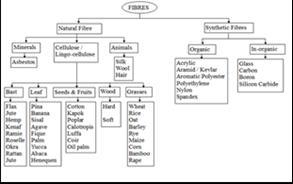
Natural fiber reinforced polymer matrix composites (NFRPMC) came into existence because the NFs are biodegradableinnatureandpossessgoodenergydissipating features. Such NFs are directly harvested from the living organism,whichconsistsofignocellulose.NFRPMCareaimed todevelopforintermediateandlow-slungloadapplications. There are different kinds of NFs are available (Ref. Fig. 1) [14]. The cellulous/lingo-cellulous are classified as Plant fibres (jute, talipot, hemp, coir, sisal, palmyra, pineapple, banana, etc); Stem or Bast fibres (banana, baggase, jute, mesta,etc.);Fruitfibres(coir,oilpalm,cottonetc.);andLeaf fibres (pineapple, sisal, screw pine etc.) are wide range of explorationasfibersutilizedinproductionofNFRPMCsto improve the environmental sustainability for industrial materials,[15].Thesenaturalfibersarenotonlyrenewable and biodegradable but also possess good mechanical properties,makingthemsuitableforavarietyofapplications. Byutilizingtheseplant-basedfibersinNFRPMCs,industries canreducetheirrelianceonnon-renewableresourcesand decrease their environmental footprint. In addition, these fibers can also help in enhancing the performance and durabilityofthecompositematerials,makingthemaviable alternative to traditional synthetic fibers. Overall, the utilization of natural fibers in NFRPMCs is a step towards creating more sustainable and eco-friendly industrial materials.
TheseNFsareavailableindissimilararrangementssuch as short, randomly oriented, and continuous forms. Incorporation of short and randomly oriented NFs in polymersfounddifficultyinobtaininguniformdistributionof fiberstherebynon-uniformstressdistributionwilloccurdue tofiberdiscontinuityandpronetoearlyfailureofthePMCs. In addition, agglomeration of fibers with high-density polymersgeneratespoorstresstransfersbetweenthefibermatrixandpronetoaffectsthestiffnessofthecompositesas well as diminishes the mechanical properties [16]. Also, increaseinfibercontentandloadingoffibersdecreasesthe stiffness of the PMCs, whereas increase in length of NFs enhances the properties. Therefore, many researchers concluded that fiber orientation, loading, and length plays crucial role in obtaining exceptional properties of the composites[17].TheNFsareweavingindiversepatternslike
plain,twill,baskets,braided,stain,knitted,andotherpatters [16, 18]. Among them, the woven fabrics (WFs) are in forefrontinenhancingthemodulusofNFPMCsforvarietyof structural applications. Also, woven fabrics reinforced NFRPMCs improves the natural frequency owing to free vibrationcharacteristicsandorientationofthefiberswithin theyarn.
Chkala et al. (2024), investigated the effect of incorporatingdifferentamountsofdatepalmfiber(DPF)on the mechanical, physical, and structural properties of geopolymercomposites.Thesecompositeswereformulated by utilizing mining residue as the geopolymer matrix and DPFasareinforcingagent.Thesynthesisprocedureinvolved activating the mining residue with a highly concentrated NaOHsolutiontoformthegeopolymermatrix.Subsequently, theresultingmatrixwasblendedwithdifferentproportions ofDPF,rangingfrom1%to20%(wt/wt),andunderwenta 28-daycuringperiodunderambientconditions.Mechanical properties were assessed through compression (CS) and flexural (FS, FM) tests, while water absorption (WA) and thicknessswelling(TS)wereemployedtoevaluatephysical properties[1]
Ekpechi et al. (2023), developed novel composite materials using coconut shell fiber municipal solid waste (MSW),siliconcarbide(SiC),aluminumoxide (Al2O3), and epoxy,using hand-layup andcompression moldingprocess. The developed specimens were subjected to mechanical, thermal, and water absorption tests using suitable apparatus. From the result obtained, specimen S1 which polymermaterial(epoxy)wasreinforcedwithcoconutshell fiber, displayed the impact of natural waste fiber on improvingthepolymermaterial’sthermalandmechanical strength.50.45MPa,32.33,and0.25W/mKvaluesoftensile, hardness, and thermal conductivity strength respectively, wereobservedontheresultingtestonsampleS1,whichis satisfactory compared to the value results from sample E, havingonlypolymermaterial.AlthoughsampleEpossesses the highest impact strength (15.2 J/m2) and water absorptionvalues,duetotheabsencereinforcefiber.Natural syntheticfibersincorporationinthespecimenshadahuge impact on thermal and mechanical strength, such as seen from specimen S2 - S4 having a thermal conductivity of 0.45W/mKandhardnessvalueof44.52[25].
Rana et al. (2023) investigate the bio-composites withreinforcednaturalsisal(Agavesisalana)fibresbyhand lay-up method. Sisal fibre loading was kept constant (30 wt%) with varying fibre lengths (5, 10, 15 and 20 mm) incorporatedinepoxycompositestostudytheireffectson mechanical properties & Thermal stability. Mechanical testing(Tensile,FlexuralandImpact)andwereperformedto identifymechanicalproperties.Aremarkableimprovement in tensile, flexural and impact strength were noticed in composites incorporated with sisal fibers of 15 mm. The
International Research Journal of Engineering and Technology (IRJET) e-ISSN: 2395-0056
Volume: 11 Issue: 05 | May 2024 www.irjet.net p-ISSN: 2395-0072
significant enhancement in tensile, flexural and impact strength was evaluated by 20.15%, 39.95% and 47.27% respectivelyascomparedtoneatepoxycomposite[5].
Deeban et al. (2023), utilized plant leaf fibers as reinforcements in thermo-plastic resins to produce affordable and light-weight composites. Although, these fibers have several advantages over synthetic fibers, mechanicalcharacteristicsofcompositessuchasmoisture absorption, poor wettability, and insufficient adhesion between the matrix and the fiber cause disadvantages. To overcometheseissues,inthisexperimentalstudy,twoleafbasedplantfibersarehybridizedandthecompositeshave been fabricated by hand lay-up process. The composites weresubjectedtoseveraltests.Theresultsshowedthatthe hybridization of sisal and pineapple leaf fiber (PALF) increases the mechanical strength of the composite by a maximumtensilestrengthof3.59kN,alittlelowerflexural strengththantheindividual fiber,anda noticeablyhigher compressivestrength.Theresultsfurthershowedthatthe decreased affinities for moisture content and the aged compositesseemtobepronetobehydrophilic.Findingsof the experiments reveal that the hybridization of sisal and PALF has a significant influence on the properties of the composites.Thescanningelectronmicroscopymicrographs offracturedsurfaceshavebeenexamined,andthefindings haveeffectivelybeeninvestigated[3].
Sankarlal and Balaji (2022), demonstrated that comprises fabrication of Sisal Fibre Reinforced composite material in six different compositions and analyzing their mechanicalpropertiesfordeterminingeffectivecomposition ofcompositematerials.Theoptimalcombinedmaterialcan be replaced with materials for conventional wheel rim, bumper,anddoorpanelsinautomobiles[4].
Sinitsky et al. (2022), investigated the effective elastic properties and strength of materials composed of unidirectional sisal fibers withina thermosetting polymer matrix,containing20%,40%and60%fiber-volumefraction. Experimentswithaxialandoff-axisloadsinconjunctionwith finite-element modeling were utilized to determine the effectivemechanicalresponseofthecomposites.Analytical and numerical models were considered, using both isotropic-andanisotropic-fiberapproaches.Itisshownthat only by considering the sisal-fiber anisotropy can the experimental results of the off-axis experiments be reproduced. A total of 15 tensile tests were performed on different sisal-fiber bundles: five for each bundle group, whichcontaineddifferentquantitativecontentofthefibers. During theloading,atfirstthefiberswerestretched,then someofthefibersbeganto breakbeforetheloadreached themaximummeasuredvalue;thebulkofthefibersbroke afterthisinthestrainrangeof1.5–2%,andonlysomeofthe fibersreachedastrainof2.5%.Thecriticalvalueoftheload increasedwithanincreaseinthenumberoffibers:the44, 88and132gspecimenbundles,onaverage,withstood419, 807and1197N,respectively.Thus,withanincreaseinthe
numberoffibers,theload-bearingcapacityalsogrewclose toalinearrelationship[27].
Gobikannan et al. (2021), studied on mechanical properties of composite board made from waste paper, wooddust,andsisalfiberswithvariousweightproportions. The obtained result is compared with those of the conventional ceiling board results and it is observed that thesecompositematerialscanbeusedforinternallow-cost construction work for separation, and acoustic & thermal insulationpurposes[18]
Ayyappaetal.(2021),studiedoncaryota,sisalfiberbased epoxy resin hybrid composites were developed by using the hand layup technique, and the mechanical properties were investigated. Experimental results stated thathybridcompositesshowedsuperiorproperties.From thetensiletest,itwasfoundthat15C/25Shybridcomposites have shown 38 MPa whereas single fiber composites (0C/40S,40C/0S)showed25and22MParespectively.From flexuralproperties,itwasfoundthatthehybridcomposites showed improved flexural properties than single fiber composites. The 15C/25S hybrid composites showed flexural strength and flexural modulus as 89.16 MPa and 3.40GPa.SingleCaryotafibercompositesshowedtheleast strengthandmodulusas64.09MPaand2.14GPa.Comingto the impact strength 15C/25S composites showed as 97 joulesandinsinglesisalfibercomposites,itwasobserved that 83.5 joules. in all the tests hybridization effect was observedclearlyexceptthehardnesstest.Inthehardness test,singlefibercompositesshowedsuperiorpropertiesto hybridcomposites.Thereasoncouldbefabricationerrorsor poor bonding between matrix and reinforcement material[24]
Nagamadhuetal.(2019)studiedthatinfluenceon dynamicmechanicalandwaterabsorptionbehaviorofepoxy composites with three different woven fabric sisal fiber naturalfiber.Inthatstudyresultsshowedthatdecreasing theyarndiameter,thestorageandlossmodulusincreased. Waterabsorptionislessinplaintypeoffabriccomparedto othertypeoftextilefabricweavingpattern[10].
Khalid et al. (2021), researched lowering the harmfuleffectsofadvancedmaterialsontheenvironment thecompletedegradationofthematerialsforthispurpose, researchersshouldconsistentlysearchforthosematerials which are completely combustible or biodegradable. It is concludedthattheseNFRPCsaresuperiortothesynthetic fiberreinforcedcompositesduetothefollowingattributes. TheseNFsarepresentabundantlyin nature,whichmakes themcheapandsustainable materials.Therearedifferent techniques like chemical treatments, coating of different materials on NFs and hybridization technique, which enhancethemechanicalandphysicalpropertiesofNFRPCs. NFRPCs,arebestsuitedtoballisticsapplicationsduetotheir high-impactproperties[30]
International Research Journal of Engineering and Technology (IRJET) e-ISSN: 2395-0056
Volume: 11 Issue: 05 | May 2024 www.irjet.net p-ISSN: 2395-0072
Arputhabalan et al. (2020), developed sandwich panelwithdissimilarnaturalfiberlikealoevera,sisal,kenaf, jute,flaxasreinforcementsandepoxyLY556andGY250as matrix.AA6061facingsheetsisplacedbetweenthenatural fiber and compared. The epoxy GY250 and LY556 based epoxycomposites[25]
Gupta, M. K., & Deep, V. (2019). Effect of water absorption and stacking sequences on the properties of hybrid SF/glass fibre reinforced polyester composite. ProceedingsoftheInstitutionofMechanicalEngineers,Part L: Journal of Materials: Design and Applications, 233(10), 2045-2056.
Betelie et al. (2019), investigated mechanical properties of sisal fiber reinforced epoxy composites are developedusinghandlayupprocesswith15,25,30,35,and 40 wt% sisal fiber to epoxy ratio. Tests for the properties indicated were made using the Instron material testing system.Testresultsdemonstrated,amongthesamples,that 30 wt% of sisal fiber-reinforced composites have the maximum tensile and flexural strength of 85.5 MPa and 85.79MParespectively.Theimpactstrengthhasbeenfound tobemaximumfor40wt%sisalfiberwhichis24.5kJ/m2. As the result show, and compared with other researcher findings, the mechanical properties are acceptable as substitutesforapplicationsdemandinglow-costengineering applications such as automotive internal parts including interiordoorpanel,backseat,andbodypanels[11].
Rajan et al. (2019), studied processing and characterizationofsisalfiberreinforcedepoxycomposites. Based on the experimental results, it is observed the increaseinvolumefractionoffiberincompositestendsto increasethetensilestrength,flexuralstrength,andimpact strength. Tensile strength, flexural strength, and impact strength of 30% volume fraction is higher than 10% and 20%[12]
Ravi Teja et al. (2019), explored the mechanical properties of hybrid composite materials reinforced with jute and sisal fibers. Mechanical testing, including tensile, flexural, and impact tests, revealed promising results in termsofstrength,stiffness,andtoughness.Thehybridization exhibited synergistic effects, demonstrating improved mechanicalpropertiescomparedtosingle-fibercomposites. These findings suggest that jute and sisal fiber-reinforced hybrid composites have great potential for various engineeringapplications,offeringasustainablealternative to synthetic fiber composites with comparable or even superiormechanicalperformance[26]
Krishnasamy and Thiagamani et al. (2019), investigatedthemechanical,waterabsorptionandthermal behaviorofhemp,sisalfibreswerefabricatedbyhandlayuptechnique,followedbyhotpresswithdifferentstacking sequences. The experimental results indicate that hybrid compositeswithsisalfiberastopandbottomlayerexhibited
optimizedmechanicalproperties.Majorvariationintensile strength,whenthestackingsequencewasaltered[9].
Niranjan et al. (2019), conducted a comparative analysis and optimization of footrests by replacing aluminium with composite sisal fiber. Mechanical tests, including tensile and flexural evaluations, highlighted the potential of sisal fiber composites to meet the required strength criteria while significantly reducing weight. Furthermore, finite element analysis and design optimizationmethodswereemployedtorefinethefootrest's geometry and material distribution. The findings suggest that sisal fiber-reinforced composites offer a viable alternative to aluminium, achieving weight reduction without compromising functional performance in footrest applications[28].
SenthilKumaretal.(2016)preparedtwodifferent fibersshortbanana(B)andnaturallywovencoconutsheath (C)washybridizedinpolyestermatrixcompositesusing compression molding. Static mechanical and dynamic characteristicswerestudied.Theresultsrevealedthatthe maximummechanicalpropertiesareobtainedatthehighest relativeamountofbananafiberinthecomposite.There is also vary in the mechanical properties with a change in a layering pattern. The CBC layering pattern showed the greatest damping, indicating better energy absorption capability[19]
Kamaraj,etal.(2018),studiedtheepoxycomposites reinforced with SiC particle and sisal fiber by using hand layupprocess.Themechanicalperformanceoftheproduced composites was investigated and the results shows that addition of SiC particles into sisal fiber/epoxy composite reduced the ultimate tensile strength and percent elongation.Whenthewt.%ofSiCwasincreasedupto10%, the ultimate tensile strength and elongation was reduced from 18 MPa and 1.192 % to 10.94 MPa and 0.729 % respectively[13]
Munde and ingle et al. (2018) studied experimentallyinvestigatetheeffectoffibreweightfraction (0–30 %) on vibrational damping and acoustic characteristics. Polypropylene composites are fabricated usingextrusion–injectionmouldingtechnique.Inthatwork modalanalysisshowsthatincorporationofsisalfibresby30 wt.% to polypropylenes made the natural frequency superiorwhencomparedwithothercompositions[6].
Kumar et al.(2017), studiedthe effectofchemical treatmentonthetensilepropertiesofsisalfiberreinforced epoxy composites It is clearly observed that the alkali (NaOH)treatmentimprovesthetensileproperties.The3% NaOH treated sisal fiber composite has optimum tensile strength[8]
International Research Journal of Engineering and Technology (IRJET) e-ISSN: 2395-0056
Volume: 11 Issue: 05 | May 2024 www.irjet.net p-ISSN: 2395-0072
Vieira et al. (2017), investigated and comparing various the mechanical properties between sisal fiber compositesandsisalfiberreinforcedaluminumlaminates. Theresultsinthatstudyshowedthathugeimprovementin specific tensile strength, specific flexural strength and modulus.delaminationwasobservedduringbending[14]
Ayyappaetal.(2021),StudiedonCaryotaandsisal fiber-basedepoxyresinhybridcompositesweredeveloped by using the hand layup technique and the mechanical properties were investigated. Experimental results stated thathybridcompositesshowedsuperiorproperties.From thetensiletest,itwasfoundthat15C/25Shybridcomposites have shown 38 MPa whereas single fiber composites (0C/40S,40C/0S)showed25and22MParespectively.From flexuralproperties,itwasfoundthatthehybridcomposites showed improved flexural properties than single fiber composites. The 15C/25S hybrid composites showed flexural strength and flexural modulus as 89.16 MPa and 3.40GPa.SingleCaryotafibercompositesshowedtheleast strengthandmodulusas64.09MPaand2.14GPa.Whereas the impact strength of 15C/25S composites showed as97 joules and in single layer sisal fiber composites, it was observedthat83.5joules.Inthehardnesstest,singlefiber composites showed superior properties to hybrid composites.Thereasoncouldbefabricationerrorsorpoor bondingbetweenmatrixandreinforcementmaterial[7].
Sivakandhanetal.(2019)studiedthemechanical properties of the hybrid composites of sisal and jute fiber combination.Theresultssuggestthattheimpactproperties ofsisalfiber/epoxycompositearebetterthanthejutefiber epoxycompositesandalsoadditionofsisalfiberdecreases thetensile,flexural,compressionpropertiesbutincreasesits impactproperties[16]
ParandamanandJayaraman(2016)studiedthat the mechanical properties of jute/sisal fiber/glass and jute/banana/glasshybridcompositematerials.Theresults showsthatthehighstrengthhybridcompositemadeofjutebanana-glass (JBG) provides better mechanical properties and it could be used for a wide range of applications like structural,aerospaceandautomobileindustries[15]
James et al. (2019) concluded the influence of mechanical behavior on different stacking sequence of bagasse and sisal fiber hybrid epoxy composites. In that study composites were prepared with four different proportions and tested the mechanical and morphology behavior of composites. Results showed that stacking sequence with s-s-s (three SF) is having good properties comparedtotheotherstackingsequences[20].
Rajesh Krishna and Chandramohan (2019), studiedthatthesurfacetreatment andstackingsequenceon mechanicalpropertiesofbasalt/glassepoxycomposites.In the present work, sandwich hybrid composites have been fabricated using hand layup technique followed by
compressionmouldingprocess.Thisfabricwasusedinboth untreated and treated conditions using hydrochloric acid and sodium hydroxide solutions. The results show that hybridization and surface treatment improve tensile strengthandhardnessinallthecomposites[2].
SoundharandKandasamy(2019)demonstrated themechanical,morphologyandchemicalpropertiesofsisal natural fibers and epoxy blended with different weight percentageofcrabshell.Theexperimentalresultsshowed thatonincreasingcrabshellweightpercentageuptofourin sisal fibers there is considerable increase in tensile and flexuralproperties[17].
Girisha et al. (2012), Studied the mechanical propertiesofchemicallytreatedhuskofarecanutfruitand tamarindfruitfibersreinforcedwithepoxycompositesthe novel composites are developed by manual hand layup techniquetheresultsfoundthattreatedfibershowsbetter results than the untreated fiber composites. Further, it is noticed that the strength of hybrid composites increases withincreaseinvolumefractionoffiber[22]
In conclusion, Natural fiber composites represent a promising material solution that combines sustainability, mechanical performance, and economic viability. As the demand for eco-friendly and cost-effective materials continuestogrow,sisalfibercompositesarepoisedtoplay anincreasinglyvitalroleinvariousindustries,contributing to a more sustainable future while meeting the everevolvingmaterialrequirementsofmodernapplications.
TheauthorscanacknowledgemanagementofAITS-TPTfor supportingthroughoutthisresearchwork
[1]. Hassan Chkala, Ilham Kirm, Said Ighir, Atmane Ourmiche, Mohammed Chigr, 2024, Preparation and characterization of eco-friendly composite based on geopolymer and reinforced with date palm fiber, ArabianJournalofChemistry,vol.17,pp1-15.
[2]. RajeshKrishna,C.R.,Chandramohan,P.,&Saravanan, D. (2019). Effect of surface treatment and stacking sequence on mechanical properties of basalt/glass epoxycomposites.PolymersandPolymerComposites, 27(4),201-214.
[3]. Booramurthy Deeban, Jaganathan Maniraj and ManickamRamesh,2023,‘Experimentalinvestigation ofpropertiesandagingbehaviorofpineappleandsisal leaf hybrid fiber-reinforced polymer composites’, epolymers,vol.10,pp1515-1524.
International Research Journal of Engineering and Technology (IRJET) e-ISSN: 2395-0056
Volume: 11 Issue: 05 | May 2024 www.irjet.net p-ISSN: 2395-0072
[4]. SankarlalRL,BalajiSM,PrashanthMD,Senthilnathan N,2023,‘fabricationandtestingofsisalfiberreinforced compositematerial’,pensee,vol.51,pp658-663.
[5]. S.S.RanaR.KumarM.K.Gupta,2023,‘Investigationof mechanical and thermal behavior of sisal fibre reinforcedpolymerbio-composites’,MaterialsToday, vol.10,pp1016-1024.
[6]. Munde, Y. S., Ingle, R. B., & Siva, I. (2019). Vibration damping and acoustic characteristics of SF fibre–reinforcedpolypropylene composite. Noise&Vibration Worldwide, 50(1),13-21.
[7]. Ayyappa Atmakuri, Arvydas Palevicius, Lalitnarayan Kolli,AndriusVilkauskasandGiedrius Janusas,2021, ‘DevelopmentandAnalysisofMechanicalPropertiesof Caryota and Sisal Natural Fibers Reinforced Epoxy HybridComposites’,polymersvol.13,pp864-883.
[8]. Kumar, P.S.S., & Allamraju, K. V. (2019). A Review Of Natural Fiber Composites [Jute, SF, Kenaf]. Materials Today:Proceedings,18,2556-2562
[9]. Krishnasamy,S.,Thiagamani,S.M.K.,Muthukumar,C., Tengsuthiwat,J.,Nagarajan,R.,Siengchin,S..&Brintha, N. C. (2019). Effects of stacking sequences on static, dynamic mechanical and thermal properties of completely biodegradable green epoxy hybrid composites. Materials Research Express, 6(10), 105351.
[10].Nagamadhu, M., Jeyaraj, P., & Kumar, G. M. (2020). Influenceoftextilepropertiesondynamicmechanical behaviorofepoxycompositereinforcedwithwovenSF fabrics.Sādhanā,45(1),1-10..
[11].Araya Abera Betelie,AnthonyNicholasSinclair,Mark Kortschot, Yanxi Li and Daniel Tilahun Redda, 2019, ‘Mechanical properties of sisal-epoxy composites as functions of fiber-to-epoxy ratio’, AIMS Material Science,Vol.6,pp.985–996.
[12].B. Muthu Chozha Rajan, T.R.Sarathkumar, A.Rajeshkumar, K.M.Saravana kumar, (2019), “Processing And Characterization Of Sisal Fiber ReinforcedEpoxyComposites”, InternationalResearch Journal in Global Engineering and Sciences. (IRJGES), Volume03,Pages99-106.
[13].M Kamaraj, R Santhanakrishnan, E Muthu, 2018, ‘An experimentalinvestigationonmechanicalpropertiesof SiC particle and sisal fibre reinforced epoxy matrix composites’,ICAME,vol.10,pp1-9.
[14].Vieira,L.M.G.,dosSantos,J.C.,Panzera,T.H.,Rubio,J. C. C., & Scarpa, F. (2017). Novel fibre metal laminate sandwich composite structure with SF woven core. IndustrialCropsandProducts,99,189-195
[15].Parandaman,P.,&Jayaraman,M.(2015).Experimental investigation on the mechanical properties of jute/SF/glassandjute/banana/glasshybridcomposite materials.EuropeanJournalofAppliedSciences,7(3), 138-144
[16].Sivakandhan,C.,Murali,G.,Tamiloli,N.,&Ravikumar,L. (2019).StudiesonmechanicalpropertiesofSFandjute fiber hybrid sandwich composite. Materials Today: Proceedings.
[17].Soundhar, A., & Kandasamy, J. (2019). Mechanical, ChemicalandMorphologicalAnalysisofCrabshell/SF Natural Fiber Hybrid Composites. Journal of Natural Fibers,1-15.
[18].Priya, M., Venkatesan, R., Deepa, S., Sana, S.S., Arumugam,S.,Karami,A.M.,Vetcher,A.A.andKim,S.C., 2023.Greensynthesis,characterization,antibacterial, and antifungal activity of copper oxide nanoparticles derivedfromMorinda citrifolia leafextract.Scientific Reports,13(1),p.18838.
[19].P. Senthil kumar, S. Prakash, J. Prakash, (2018), “The EffectofChemicalTreatmentonTheTensileProperties of Sisal Fiber Reinforced Epoxy Composite”, International Research Journal of Engineering and Technology(IRJET),Volume5,pp1431-1435.
[20].JamesD,J.D.,Manoharan,S.,Saikrishnan,G.,&Arjun,S. (2019).Influenceofbagasse/SFfibrestackingsequence on the mechanical characteristics of hybridepoxy composites.JournalofNaturalFibers,1
[21].GuptaMK,SrivastavaRK,(2016),“Propertiesofsisal fibre reinforced epoxy composite” Indian Journal of Fibre&TextileResearch(IJFTR),Volume41,pp36-44.
[22].Girisha.C,SanjeevMurthy,GuntiRangaSrinivas,Manu. S, 2012, “Mechanical Performance of Natural FiberReinforced Epoxy Hybrid Composite”, International Journal of Engineering Research and Applications (IJERA),Vol.2,pp.615-619.
[23].Jeswin Arputhabalan, L Karunamoorthy, K Palanikumar,2020,‘Experimentalinvestigationonthe mechanical properties of aluminium sandwiched sisal/kenaf/aloevera/jute/flaxnaturalfiber-reinforced epoxy LY556/GY250 composites’, Polymers and polymercomposites,vol.29,pp1495-1504.
[24].Ayyappa Atmakuri, Arvydas Palevicius, Lalitnarayan Kolli,AndriusVilkauskasandGiedrius Janusas,2021, ‘DevelopmentandAnalysisofMechanicalPropertiesof Caryota and Sisal Natural Fibers Reinforced Epoxy HybridComposites’,Polymers,vol.13,pp1-19.
[25].D. A. Ekpechi, O. O. Obiukwu, E. I. Nwankwo, V. C. Okpalaku-Nath, 2023, ‘Experimental Study of the
International Research Journal of Engineering and Technology (IRJET) e-ISSN: 2395-0056
Volume: 11 Issue: 05 | May 2024 www.irjet.net p-ISSN: 2395-0072
Thermal and Mechanical Properties of EpoxyReinforcedComposites’,IJAPS(Internationaljournalof AppliedPhysicalScience,vol.15,pp6-16.
[26].P.RaviTeja,MPrasadRao,2019,‘StudytheMechanical Properties of Jute and Sisal fiber reinforced Hybrid CompositeMaterials’,InternationalResearchJournalof EngineeringandTechnology(IRJET),vol.6,pp741-749.
[27].Olga Sinitsky, Nir Trabelsi and Elad Priel, 2022, ‘The Mechanical Response of Epoxy–Sisal Composites Considering Fiber Anisotropy: A Computational and ExperimentalStudy’,Fibers,vol.10,pp1-17.
[28].Niranjan Kandhare, Prof. V. M. Bansode, Prof. S. M. Jadhav,2019,‘TheComparativeStudyandOptimization of Foot Rest by using Composite Sisal Fibre as Replacement for Aluminium, along with Weight and Strength Optimization’, International Journal for ResearchinAppliedScience&EngineeringTechnology (IJRASET),vol.7,pp160-169.
[29].MuhammadYasirKhalid,AnsAlRashid,ZiaUllahArif, Waqas Ahmed, Hassan Arshad Asad Ali Zaidi, 2021, ‘Natural fiber reinforced composites: Sustainable materials for emerging applications’, Results in Engineering,vol.11,pp1-12.
© 2024, IRJET | Impact Factor value: 8.226 |
|