
International Research Journal of Engineering and Technology (IRJET) e-ISSN: 2395-0056
Volume: 11 Issue: 05 | May 2024 www.irjet.net p-ISSN: 2395-0072
International Research Journal of Engineering and Technology (IRJET) e-ISSN: 2395-0056
Volume: 11 Issue: 05 | May 2024 www.irjet.net p-ISSN: 2395-0072
Anup Murumkar1 , Danish Shaikh2 , Sanskriti Sharma3 , Dhiraj Khivasara4
1,2,3,4 Student, Department of Electronics and Telecommunications Engineering, Vishwakarma Institute of Information Technology, Pune, Maharashtra, India
Abstract - The increase in urban population and vehicle numbers has resulted in a critical issue: traffic congestion. This issue not only frustrates and delays drivers, but also contributes to higher fuel use and air pollution. While pollution impacts many locations, megacities face the brunt of the consequences. To properly manage this ever-increasing difficulty, realtime road traffic density must be monitored to ensure efficient signal control and traffic management. The effectiveness of traffic control has a substantial impact on traffic flow, necessitating optimization to meet increasing demand. Our suggested approach uses live video feeds from traffic junctions to calculate traffic densityusingimageprocessingandartificialintelligence (AI).Furthermore,oursystemincludesanalgorithmthat adjusts traffic lights based on vehicle density, to reduce congestion and improve transit times, and reducing pollution.
Keywords: Traffic control, Traffic light system, Traffic management, Intelligent transport systems, Smart surveillance, Computer Vision, Machine Learning, Object detection, YOLO.
Urban regions are dealing with an increase in vehicle traffic, resultingincapacity restrictionsonroad networks and a lower level of service. One important contributing issueistheuseoffixedsignaltimersatcrossings,whichdo not adjust to changing traffic circumstances. This rigidity causesseveral traffic-relatedconcerns.Asthedemand for road capacity increases, there is an urgent need for innovativetrafficcontroltechnologies,notablyinthefieldof IntelligentTransportSystems(ITS).
MumbaiandBangaloreareprimeexamplesofhowsevere trafficcongestioncanbe.Bangalorehastheterribletitleof having the world's worst traffic flow, closely followed by Mumbaiinfourthplace,asperacomprehensivereporton traffic conditions across numerous cities and countries. Duringrushhours,journeysinBangaloretake71%longer, whileinMumbai,theincreaseis65%[9].
Currently,threemainmethodsareusedfortrafficcontrol:
1) Manual Control: This system requires human intervention,usuallyfromtrafficpolicestationedinspecified regions.Theyusesignboards,signallights,andwhistlesto controltrafficflow.
2) Traditional Traffic Lights with Fixed Timers: These trafficlightsusepredeterminedtimers,withfixednumerical valuesdefiningthedurationofredandgreensignals.These timedsettingscausethelightstogoonandoffautomatically.
3) Electronic Sensors:Amoreadvancedsolutioninvolves installingloopdetectorsorproximitysensorsonhighways. Thesesensorscollectreal-timetrafficdata,whichisutilized tochangetrafficsignaltimingsaccordingly.
Theseconventionalapproacheshaveseverallimitations.The manualcontrollingsystemdemandsasignificantamountof labor.Duetolimitedtrafficpoliceresources,humantraffic managementisnotfeasibleinallregionsofacityortown. Thus, a more effective traffic control system is required. Static traffic control involves a fixed traffic signal with a timerforeachphase,whichdoesnotrespondtoreal-time traffic on the road. Using electronic sensors, such as proximitysensorsorloopdetectors,canleadtoconflicting accuracyandcoverageduetotheexpenseofcollectinghighqualityinformation.Limitedbudgetsmaylimitthenumber of facilities available. Furthermore, due to the limited effectiveness range of motion, the total coverage on a networkoffacilitiesrequiresalotofsensors.
Dynamic traffic management control systems have been promptedbytheadventofnewtechnology,especiallyinthe fields of computer vision and artificial intelligence (AI). Thesesystemsoptimizetrafficflow,reducecongestion,and improve overall road network efficiency by utilizing the capability of real-time data collecting and analysis. Thisstudyexaminesthetheoryandpracticeofa dynamic traffic management control system, which aims to upend establishedtrafficcontrolmodels.Thissystemattemptsto dynamicallymodifytrafficsignaltimingsbasedonreal-time traffic density and vehicle categorization data by utilizing computervisiontechniquesandcleveralgorithms.Byusing cutting-edgetechnologylikeYOLO(YouOnlyLookOnce),the suggestedsystemisexpectedtoyieldnotableenhancements in traffic control effectiveness, resulting in decreased fuel consumptionandenvironmentalimpact.
International Research Journal of Engineering and Technology (IRJET) e-ISSN: 2395-0056
Volume: 11 Issue: 05 | May 2024 www.irjet.net p-ISSN: 2395-0072
Reference [1] ThispaperpresentsadeepQ-learning-based reinforcement learning (RL) strategy to adaptive traffic signal regulationatjunctions.Tooptimizetrafficflow,the modelusesreal-timetrafficdata(queuelengthsandwaiting times) and adjusts traffic signal phases accordingly. Simulation findings illustrate the potential for decreased congestionandgreaterefficiencywhencomparedtotypical fixed-timecontrols.
Reference [2] Thisresearchpresentsanintelligenttraffic signal managementsystem basedonreal-timetrafficflow and ultrasonic sensors. The technology monitors vehicle presence in each lane and modifies the green light length appropriately, favoring lanes with the highest traffic flow. The authors note possible benefits such as reduced congestion and increased traffic flow efficiency. However, drawbacksincludeafailuretoaccountforelementssuchas pedestriantrafficandthepossibilityoffailingsensors.
Reference [3] This paper presents a unique Multi-Agent Reinforcement Learning (MARL) technique for Adaptive TrafficSignalControl(ATSC)inanInternetofThings(IoT) context.Thesystemreliesonreal-timetrafficdataacquired by IoT sensors (surveillance cameras) at crossings. Theimportantfeaturesare: 1) Distributed MARL using an Advantage Actor-Critic (A2C)approachthatemploysDeepNeuralNetworks(DNNs) for policy learning at each intersection. 2) Information transmission between nearby junctions improvescoordinationandaccountsforlargertrafficflow impacts.
The technique is tested on a real-world traffic network in Shiraz,Iran,whichsimulatessixlinkedcrossings.Theresults indicatethattrafficflowmightbeenhancedwhencompared tothecurrentfixed-timecontrolscheme
Reference [4] Traffic signal timing is critical for efficient traffic movement. Here are two major approaches:
1)TrafficEngineering:Developstimingplansforsingleor connected crossings utilizing techniques such as Webster (minimizes travel time) and GreenWave (creates progression bands). Sensors can also be employed to implement adaptive control.
2) Machine Learning: A modern solution that uses algorithms to alter timing based on real-time traffic data (perhapsbeyondloopsensors).Thisprovidesflexibilityand data-drivencontrol.
Reference [5] This research presents a system that uses wirelesssensornetworkstodynamicallyaltertrafficsignal green times at an isolated intersection. The purpose is to prevent red-light running (RLR), which is caused by extended wait periods. Here's a summary of the main points. Problem: Traditional fixed-cycle traffic signals, as well as
thosewithhumancontrol,cancauseexcessivewaitperiods, resulting in irritation and increased RLR infractions. Solution: A network of wireless sensors measures traffic flowandtransmitsinformationtoacentralunit.Thisdevice dynamicallymodifiesgreentimestofavortheroutewiththe longest line, reducing wait times and discouraging RLR. BenefitsincludelessRLR accidents, improvedtrafficflow, andperhapsdecreasedfueluse.
Reference [6] suggestsanArduino-UNO-basedsolutionto alleviatetrafficcongestionandwaittime.Thesystemusesa camera to capture photos, which are then processed in MATLAB to create a threshold image with reduced saturationandcolors.Trafficdensityisalsocomputed. To link Arduino and MATLAB, use preconfigured simulation packagesoverUSB.TheArduinoadjuststhegreenlighttime foreachlanebasedontrafficquantityanddensity.However, this approach has significant limitations. The number of automobilesontheroadmightbedifficulttodeterminedue tofrequentoverlap.
Reference [7] suggests the usage of an adjustable light timer. Control via image processing algorithms and traffic density.Thissystemcomprisesmicrocontroller-controlled trafficlights.Timer,high-resolutionimagesensors,MATLAB, andUART-basedcommunication.Thetechnologydoesnot prioritize authorized emergency vehicles or identify accidentsatintersections.
Reference [8] This research looks at the use of Deep Reinforcement Learning (DRL) to optimize traffic signal timing at junctions. Here's a summary of the main points. Problem: Traditional traffic signal controllers, which have set cycles or need human modifications, can result in excessive wait times and increased red-light running. Solution:DRLprovidesaviableapproachtothisproblem.A DRLagentmaycontinuallychangegreenlightperiodsbased on real-time traffic data, prioritizing lanes with larger lineups and attempting to minimize wait times while discouragingRLRbreaches.
Advantages: Potential advantages include fewer RLR incidents, better traffic flow, and maybe lower fuel usage. The review further emphasizes the benefits of DRL over standardapproaches:
1)Adaptability:DRLagentscanrespondtoreal-timetraffic circumstances, even if they are unpredictable owing to variables such as inclement weather or accidents.
2)Model-freelearningallowsDRLagentstolearnonthefly withoutpriorknowledgeofthetrafficnetwork,decreasing complexity.
3)Multi-factorrewardfunctions:DRLmaymakejudgments basedonvariousparametersimpactingtrafficflow,suchas average wait time, queue length, and throughput.
International Research Journal of Engineering and Technology (IRJET) e-ISSN: 2395-0056
Volume: 11 Issue: 05 | May 2024 www.irjet.net p-ISSN: 2395-0072
Addressing the curse of dimensionality: DRL successfully manages the numerous factors involved in traffic management.
Convolutional Neural Networks (CNNs) represent a transformative leap in the realm of artificial intelligence, particularlyinthedomainofcomputervision.Attheheartof CNN architecture lies a sophisticated arrangement of interconnectedlayersmeticulouslyengineeredtointerpret and process visual data with unparalleled accuracy and efficiency.The cornerstone of CNNs is the convolutional layer, where convolutional filters, also known as kernels, systematicallytraversetheinputimage,extractinglocalized featuressuchasedges,textures,andpatterns.Thesefilters, through the process of convolution, capture hierarchical representationsoftheinputdata,enablingthenetwork to discernincreasinglycomplexfeaturesasinformationflows throughsuccessivelayers.
Accompanyingtheconvolutionallayersarepoolinglayers, whichservetodownsamplethefeaturemapsgeneratedby the convolutional operations. Pooling operations, such as max pooling, aggregate information within local regions, preserving essential features while reducing the spatial dimensions of the data. This downsampling not only mitigates computational burden but also enhances the network'srobustnesstospatialtranslationsanddistortions intheinput.
Interspersedbetweentheconvolutionalandpoolinglayers are activation functions, most commonly Rectified Linear Units (ReLU), which introduce non-linearity into the network.Thisnon-linearityallowsCNNstomodelcomplex relationships within the data, facilitating the extraction of intricatepatternsandrepresentationscrucialforaccurate classificationandrecognitiontasks.
Moreover,CNNsleveragetheprincipleofparametersharing, whereinthesamesetofweightsissharedacrossdifferent spatial locations of the input. This sharing of parameters vastly reduces the number of trainable parameters in the network, promoting parameter efficiency and enhancing generalizationtounseendata.
Beyondtheconvolutionalandpoolinglayers,CNNstypically incorporate fully connected layers towards the end of the networkarchitecture.Theselayersaggregatethehigh-level featuresextractedfromearlierlayersandmapthemtothe desired output classes through a series of learned transformations. Finally, the output layer, often equipped withactivationfunctionslikesoftmax,yieldsthenetwork's predictions or classifications based on the learned representations.
TheversatilityandefficacyofCNNshavepropelledtheminto various applications across diverse domains. From image classificationandobjectdetectiontosemanticsegmentation and medical image analysis, CNNs have demonstrated unparalleled prowess in interpreting and understanding visual data. Their automatic feature learning capabilities, coupled with scalability to high-resolution images, have revolutionizedfieldsrangingfromautonomousdrivingand roboticstohealthcareandsecurity.
In essence, Convolutional Neural Networks epitomize the fusion of cutting-edge research in machine learning and computervision,empoweringmachineswiththeabilityto perceive,interpret,andinteractwiththevisualworldwith unprecedentedprecisionandinsight.
OpenCV,shortforOpenSourceComputerVisionLibrary, stands as a cornerstone in the realm of computer vision, offering a rich array of tools and algorithms meticulously crafted to empower developers and researchers in unraveling the complexities of visual data. Originally incubatedbyIntelin1999andsubsequentlynurturedbya collaborativeglobalcommunity,OpenCVhasflourishedinto a versatile, open-source framework accessible across multiple platforms and programming languages. Its extensive repertoire encompasses a myriad of functionalities, from fundamental image processing operationslikefilteringandtransformationtosophisticated tasks such as object detection, recognition, and 3D reconstruction. Leveraging its robust machine learning integration, OpenCV facilitates the creation of custom classifiers, regression models, and deep learning architectures,enablingthedevelopmentofstate-of-the-art vision-basedapplications.Withitsoptimizedperformance, comprehensive documentation, and vibrant ecosystem of users and contributors, OpenCV finds application across diverse domains including autonomous systems, surveillance, healthcare, augmented reality, and beyond, serving as an indispensable catalyst for innovation and discovery in the dynamic landscape of computer vision.
YouOnlyLookOnce(YOLO)representsaparadigmshift in object detection within the realm of deep learning, offeringagroundbreakingapproachtoreal-timedetection andlocalizationofobjectsinimagesandvideos.Introduced byJosephRedmonetal.in2016,YOLOrevolutionizedobject detection by framing it as a single regression problem, bypassingtheneedforcomplexregionproposalnetworksor multiplestagesofprocessing.Atitscore,YOLOdividesthe input image into a grid and predicts bounding boxes and class probabilities directly from this grid. This holistic approach enables YOLO to achieve impressive speed and accuracy,capableofprocessingimagesinreal-timewithout
International Research Journal of Engineering and Technology (IRJET) e-ISSN: 2395-0056
Volume: 11 Issue: 05 | May 2024 www.irjet.net p-ISSN: 2395-0072
sacrificing detection quality. YOLO's architecture typically consists of a convolutional neural network backbone followed by detection layers responsible for predicting boundingboxesandassociatedclassprobabilities.Moreover, YOLO is highly versatile, offering variants tailored for different trade-offs between speed and accuracy, such as YOLOv2,YOLOv3,andYOLOv4.Itsreal-timecapabilitiesand robust performance have made YOLO a cornerstone in various applications, including autonomous driving, surveillance,augmentedreality,androbotics,propellingthe field of object detection forward and inspiring further advancements in deep learning-based vision systems.
Pygameemergesasacornerstoneintherealmofgame development,offeringa versatileandintuitiveframework for creating immersive 2D games and multimedia applications using the Python programming language. Establishedin2000byPeteShinnersandfurtherdeveloped byavibrantcommunityofenthusiasts,Pygameprovidesa comprehensive set of modules and functions tailored to handletaskssuchasgraphicsrendering,userinputhandling, audioplayback,andeventmanagement.Atitscore,Pygame leverages the Simple DirectMedia Layer (SDL) library, providing developers with direct access to graphics hardwareaccelerationandmultimediafunctionalitiesacross different platforms. Its straightforward API and Pythonic syntax make it accessible to both novice and experienced developers,empoweringthemtobringtheircreativevisions tolifewithease.Pygame'sextensibilityfurtherenhancesits appeal,withaplethoraofthird-partylibrariesandresources available to augment its capabilities and streamline developmentworkflows.Whethercraftingretro-stylearcade games,educationalsimulations,orinteractivevisualizations, Pygame serves as a versatile toolkit, fostering experimentation, creativity, and innovation within the Pythoncommunityandbeyond.
OurproposedsystemutilizesimagescapturedbyCCTV cameras at traffic junctions as input for real-time traffic densitycomputationthroughimageprocessingandobject detection techniques. The captured image undergoes processing by a vehicle detection algorithm, employing YOLO,toidentifyandcountvehiclesofvariousclassessuch ascars,bikes,buses,andtrucks,therebyestimatingtraffic density. Subsequently, the signal switching algorithm incorporatesthisdensity,alongsideotherrelevantfactors,to dynamicallyadjustthegreensignaltimerdurationforeach lane,therebyupdatingthecorrespondingredsignaltimings.
To prevent lane starvation, the green signal duration is constrained within predefined maximum and minimum thresholds. Additionally, a simulation is developed to
showcasethesystem'sefficacyandconductacomparative analysis against the static traffic management system currentlyinuse.
The proposed system employs YOLO (You Only Look Once)forvehicledetection,ensuringthedesiredaccuracy and processing efficiency. A tailored YOLO model was trained specifically for vehicle detection, capable of identifying vehicles across various classes such as cars, bikes, heavy vehicles (including buses and trucks), and rickshaws.
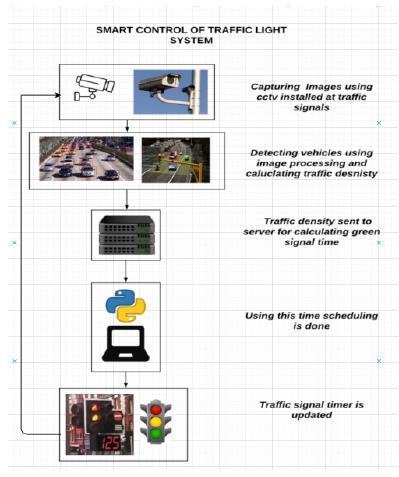
YOLO stands as a sophisticated convolutional neural network(CNN)designedforreal-timeobjectdetection.The algorithmoperatesbyapplyingasingleneuralnetworkto the entire image, segmenting it into regions, and then predictingboundingboxesandprobabilitiesforeachregion. These bounding boxes are weighted by the predicted probabilities. YOLO's popularity stems from its ability to achieve high accuracy while maintaining real-time performance.It"onlylooksonce"attheimage,requiringjust oneforwardpropagationpassthroughtheneuralnetworkto generate predictions. Following non-max suppression to ensure each object is detected only once, YOLO outputs recognizedobjectsalongwiththeircorrespondingbounding boxes. With YOLO, a single CNN simultaneously predicts multipleboundingboxesandclassprobabilities.
International Research Journal of Engineering and Technology (IRJET) e-ISSN: 2395-0056
Volume: 11 Issue: 05 | May 2024 www.irjet.net p-ISSN: 2395-0072
The backbone CNN utilized in YOLO can be further streamlinedtoenhanceprocessingspeed.Darknet,anopensource neural network framework implemented in C and CUDA, serves this purpose. Darknet boasts speed, ease of installation, and compatibility with both CPU and GPU computation. Leveraging Darknet, YOLO achieves an accuracy of 72.9% and a top-5 accuracy of 91.2% on ImageNet.Darknetprimarilyemploys3×3filtersforfeature extraction and 1 × 1 filters for reducing output channels. Additionally, it utilizes global average pooling for predictions.
Topreparethetrainingdataset,imagesweresourcedfrom Google and manually labeled using LabelIMG, a graphical imageannotationtool.Subsequently,themodelunderwent trainingusingpre-trainedweightsobtainedfromtheYOLO website. The configuration of the .cfg file was adjusted to align with our model specifications, including setting the number of output neurons in the last layer equal to the numberoftargetclasses(4inourcase:Car,Bike,Bus/Truck, and Rickshaw) and adjusting the number of filters accordingly.Trainingcontinueduntil thelosssignificantly diminished, signifying completion. The updated weights were then imported into the code and utilized for vehicle detectionwiththeaidoftheOpenCVlibrary.Athresholdwas set to ensure a minimum confidence level for successful detection.Uponloadingthemodelandinputtinganimage, results were generated in JSON format, consisting of keyvalue pairs where labels served as keys and their correspondingconfidencelevelsandcoordinatesasvalues. Once again, OpenCV facilitated the drawing of bounding boxes on the images based on the received labels and coordinates.
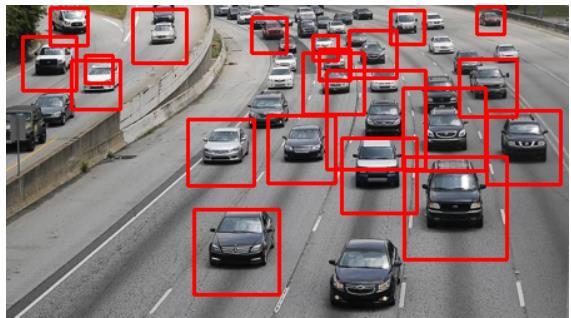
The Traffic Signal Switching Algorithm dynamically adjusts green signal timers based on traffic density data provided bythevehicledetection module,whichcaptures vehicleinformationinJSONformat,includingobjectlabels, confidencelevels,andcoordinates.Thisinputisparsed to calculatethetotalcountofvehiclesforeachclass.
Factorsconsideredduringalgorithmdevelopmentinclude:
1.ProcessingTime:Thisdetermineswhentheimageneeds to be acquired to calculate traffic density and green light duration.
2.LaneCount:Thenumberoflanesattheintersectionaffects trafficflowandsignaltimingadjustments.
3.VehicleClassCount:Totalcountofvehiclesofeachclass, suchascars,trucks,motorcycles,etc.
4. Traffic Density: Calculated based on the above factors, influencinggreensignaltime.
5.LagTime:Timeaddedduetolagexperiencedbyvehicles duringstartupandnon-linearincreaseinlagforvehiclesat theback.
6. Average Vehicle Speed: Speed at which each class of vehiclecrossestheintersectionwhenthegreenlightstarts.
7.GreenLightDurationLimits:Minimumandmaximumtime limitstopreventtrafficstarvation.
Thealgorithmoperatescyclically,initializingsignaltimings forthefirstcycleandsubsequentlyadjustingtimingsbased on real-time data. A separate thread manages vehicle detectionforeachdirection,whilethemainthreadhandles signaltiming.
At 5 seconds remaining on the green light timer, the next directionsnapshotistaken,processed,andthenextgreen signaltimerissetseamlessly.Thesystemcapturesanimage whenthenextgreensignalis5secondsaway,allowing10 secondsforimageprocessing,greensignaltimecalculation, andadjustmentofsignaltimings.
Thegreensignaltimeisdeterminedusingtheformula:
GST= ∑(NoOfVehiclesvehicleClass *AverageTimevehicleClass) (NoOfLanes+1)
where:
- GSTisgreensignaltime,
- noOfVehiclesOfClass: is the number of vehicles of each classdetectedbythevehicledetectionmodule,
- averageTimeOfClass: is the average time each class of vehicletakestocrossanintersection,and
- noOfLanes: isthenumberoflanesattheintersection.
TheorderofsignalswitchingfollowsafixedpatternofRed → Green → Red, ensuring consistency with existing traffic management systems and minimizing confusion for motorists
International Research Journal of Engineering and Technology (IRJET) e-ISSN: 2395-0056
Volume: 11 Issue: 05 | May 2024 www.irjet.net p-ISSN: 2395-0072
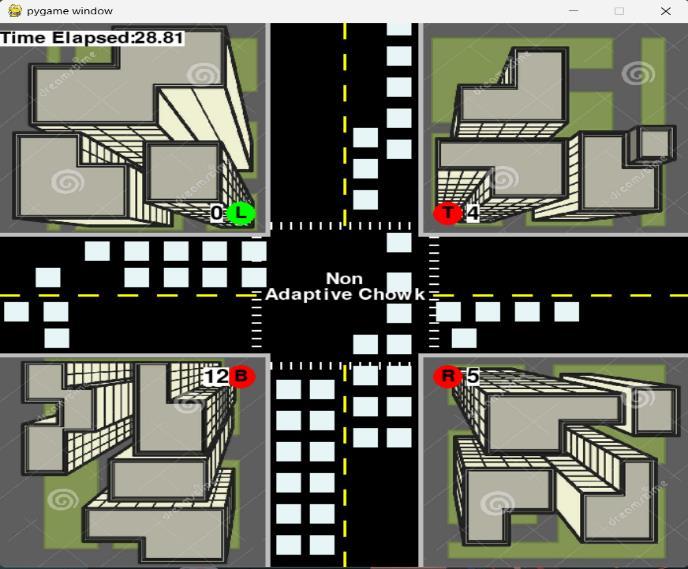
AcustomsimulationwascraftedusingPygametoreplicate real-world traffic scenarios, aiding in visualizing and comparingdynamictrafficsystemsagainststaticones.The simulationfeaturesa4-wayintersectionequippedwithfour trafficsignals,eachdisplayingacountdowntimerindicating the transition between green, yellow, and red phases. Additionally, the number of vehicles traversing the intersection is displayed alongside each signal. Various vehicle types, including cars, bikes, buses, trucks, and rickshaws,navigatefromalldirections.Toenhancerealism, vehiclesintherightmostlanehavethepossibilityofturning at the intersection, determined by random number generation during vehicle generation. Moreover, a timer trackstheelapsedtimesincethesimulation'sinitiation.Fig. 3 showcases a snapshot of the simulation's final output. Pygame, a cross-platform Python module suite primarily designedforgamedevelopment,providesthebackbonefor this simulation. Leveraging computer graphics and sound libraries integrated with the Python language, Pygame extends the capabilities of the SDL library, empowering users to create immersive games and multimedia applications.
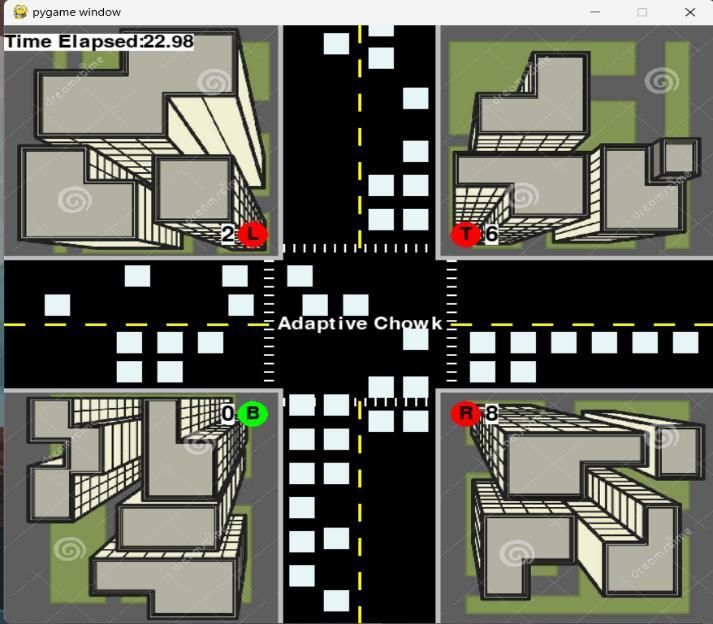
Oursuggesteddynamictrafficmanagementcontrolsystem, which uses real-time traffic density calculation and intelligent signal switching, shows promising results in terms of increasing traffic flow efficiency and lowering congestion. We show persuasive evidence of the system's success in tackling urban traffic congestion concerns by conductingafullexaminationofitsperformance,including vehiclerecognitionaccuracy,signalswitchingeffectiveness, andsimulationoutcomes.
1) Vehicle Identification Accuracy: By utilizing the YOLO (YouOnlyLookOnce)algorithmforvehicleidentification, our system identifies and classifies cars at traffic intersections with high accuracy. The specialized YOLO model,trainedexclusivelyforvehiclerecognition,accurately recognizes a wide range of vehicle types, including automobiles, bikes, buses, trucks, and rickshaws. Using convolutional neural networks (CNNs) and the Darknet framework,oursystemachievesrobustperformanceinrealtime object detection, laying the foundation for accurate trafficdensityestimation.
2)SignalSwitchingEfficiency:TheTrafficSignalSwitching Algorithm, which is built into our system, dynamically modifies signal timings based on real-time traffic density data from the vehicle recognition module. The system successfully accommodates variable traffic loads by optimizing green signal durations based on lane count, vehicle class count, traffic density, and average vehicle speed.Oursolution enables smoothsignal transitionsand minimizesdelaysandcongestionbyseamlesslyintegrating withtheexistingtrafficmanagementinfrastructure.
3)SimulationAnalysis:Acustomsimulationcreatedusing Pygame depicts our dynamic traffic control system in operation.Thesimulation,whichreplicatesreal-worldtraffic circumstances at a four-way junction, demonstrates the system's capacity to efficiently control traffic flow. By dynamicallyalteringsignaltimingsbasedontrafficdensity, thetechnologysuccessfullyminimizescongestionanddriver wait times. Furthermore, the simulation shows how our technologyaffectsdifferenttypesofvehicles,demonstrating itsversatilityandadaptabilityinavarietyofmetropolitan settings.
4) Comparison with Non-Adaptive Systems: Our adaptive traffic management system outperforms classic nonadaptivesystemsintermsoftimeefficiency.Thesimulation results show that the adaptive system completes the simulatedtrafficsituationin1.74minutes,whereasthenonadaptivesystemtakes2.34minutestoreachthesameresult. Thisreductionintraversaltimedemonstratestheexcellent performanceofourdynamictrafficmanagementtechnology, underliningitscapacitytospeeduptrafficflowandimprove overalltransportationefficiency.
International Research Journal of Engineering and Technology (IRJET) e-ISSN: 2395-0056
Volume: 11 Issue: 05 | May 2024 www.irjet.net p-ISSN: 2395-0072
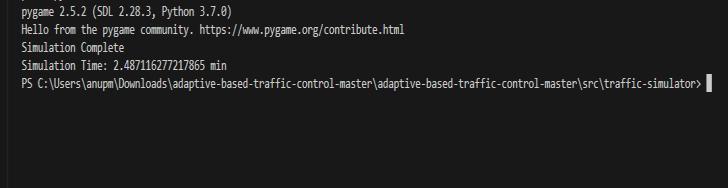
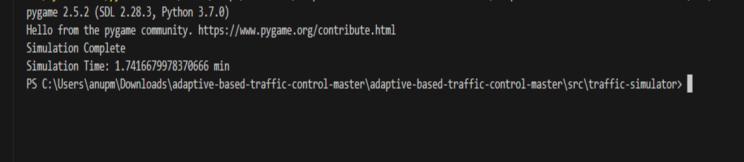
In conclusion, the proposed system aims to dynamically adjustthegreensignaldurationbasedonthetrafficdensity at the signal. This adaptive approach ensures that the directionwithhighertrafficvolumereceivesalongergreen signaldurationcomparedtothedirectionwithlowertraffic volume,therebyminimizingdelaysandreducingcongestion and waiting times. Consequently, this efficient traffic managementstrategyleadstodecreasedfuelconsumption andpollution.
Accordingtosimulationresults,thesystemdemonstratesa noteworthy23%enhancementoverthecurrentsystemin terms of the number of vehicles passing through the intersection. This improvement signifies the system's efficacy.Furtherrefinementthroughtheutilizationofreallife CCTV data for model training holds promise for even greaterperformanceenhancements.
Furthermore,theproposedsystemoffersseveraladvantages overexistingintelligenttrafficcontrolsystemslikePressure MatsandInfraredSensors.Itsdeploymentcostisminimalas it leverages existing CCTV camera infrastructure at traffic signals, requiring no additional hardware in most cases. Maintenance costs are also reduced compared to other systems like pressure mats, which are prone to wear and tear. Thus, integrating this system with CCTV cameras in majorcitiescouldvastlyimprovetrafficmanagement.
Expandingtheproject'sfunctionalitiescouldfurtherenhance traffic management and alleviate congestion. Firstly, the system could be equipped to identify vehicles violating traffic rules, such as running red lights or illegal lane changes, using image processing techniques. Additionally, prompt detection of accidents or breakdowns at intersectionscouldbefacilitatedtominimizecongestionand ensurepublicsafety.Synchronizationoftrafficsignalsacross multipleintersectionsalongastreetwouldoptimizetraffic flow,whileadaptingsignaltimingstoprioritizeemergency vehicles would ensure efficient passage through intersections.
Insummary,theproposedsystemnotonlyoffersaneffective solution for traffic management but also presents opportunities for expansion and refinement to address variouschallengesassociatedwithurbantrafficcontrol.
[1] Pan, T. (2024, February 26). Traffic light control with reinforcement learning. Applied and Computational Engineering, 43(1), 26–43. https://doi.org/10.54254/2755-2721/43/20230804
[2] Li, Z., Li, C., Zhang, Y., & Hu, X. (2017, January). Intelligenttrafficlightcontrolsystembasedonrealtime traffic flows. 2017 14th IEEE Annual Consumer Communications & Networking Conference (CCNC). https://doi.org/10.1109/ccnc.2017.7983196
[3] Damadam,S.,Zourbakhsh,M.,Javidan,R.,&Faroughi,A. (2022,September27).AnIntelligentIoTBasedTraffic Light Management System: Deep Reinforcement Learning. Smart Cities. https://doi.org/10.3390/smartcities5040066.
[4] Ye,B.L.,Wu,W.,Ruan,K.,Li,L.,Chen,T.,Gao,H.,&Chen, Y. (2019, May). A survey of model predictive control methodsfortrafficsignalcontrol.IEEE/CAAJournalof Automatica Sinica, 6(3), 623–640. https://doi.org/10.1109/jas.2019.1911471
[5] Collotta,M.,Pau,G.,Scatà,G.,&Campisi,T.(2014,March 1).Adynamictrafficlightmanagementsystembasedon wirelesssensornetworksforthereductionoftheredlight running phenomenon. Transport and Telecommunication Journal, 15(1), 1–11. https://doi.org/10.2478/ttj-2014-0001
[6] Vogel, A., Oremovic, I., Simic, R., & Ivanjko, E. (2018, September).ImprovingTrafficLightControlbyMeansof Fuzzy Logic. 2018 International Symposium ELMAR. https://doi.org/10.23919/elmar.2018.8534692
[7] Siddharth Srivastava, Subhadeep Chakraborty, Raj Kamal, Rahil, Minocha, “Adaptive traffic light timer controller”,IITKANPUR,NERDMAGAZINE
[8] Rasheed,F.,Yau,K.L.A.,Noor,R.M.,Wu,C.,&Low,Y.C. (2020).DeepReinforcementLearningforTrafficSignal Control: A Review. IEEE Access, 8, 208016–208044. https://doi.org/10.1109/access.2020.3034141
[9] TomTom.com, 'Tom Tom World Traffic Index', 2019. [Online].Available:https://www.tomtom.com/en_gb/tra ffic-index/ranking/