
International Research Journal of Engineering and Technology (IRJET) e-ISSN: 2395-0056
Volume: 11 Issue: 05 | May 2024 www.irjet.net p-ISSN: 2395-0072
International Research Journal of Engineering and Technology (IRJET) e-ISSN: 2395-0056
Volume: 11 Issue: 05 | May 2024 www.irjet.net p-ISSN: 2395-0072
Ar. Priyadharshini Mohan1 , Ar. Fathima Taskeen2 , Ar. Indrapriya3
1Post Graduate student , Faculty of architecture, Dr. MGR University, Tamil Nadu, India, 2 Additional HOD, Faculty of Architecture, Dr. MGR University, Tamil Nadu, India, 3 Deputy HOD, Faculty of Architecture, Dr. MGR University, Tamil Nadu, India ***
Abstract - Urban areas face rising floods and water scarcity,worsenedbyclimatechange, urbanization,andpoor watermanagement.ThisstudyexaminesGreenInfrastructure Systems (GIS) and Real-Time Control (RTC) systems to enhance storm water management in cities, focusing on reducing surface runoff and improving rainwater harvesting in Chennai, India. The research evaluates the effectiveness of RTC technology and green infrastructure techniques, both individually and combined, under various rainfall conditions. By studying the Perumbakkam urban catchment in Chennai, the feasibility and performance of these strategies will be assessed.Theaimistoprovideinsightsforurbanplanningand policy, promoting resilient and sustainable water management infrastructure. The studyinvolves siteselection, and simulations using SWMM software to develop practical recommendations for integrating effective storm water management into urban development plans, aiming to mitigate flooding and address water scarcity.
Key Words: Urban areas, Floods, Water scarcity, Climate change, Green Infrastructure Systems (GIS), Real-Time Control (RTC), Storm water management, Surface runoff, Rainwater harvesting.
Urbanenvironmentsareincreasinglythreatenedbythedual challenges of rising floods and water scarcity, driven by climate change, urbanization, and inadequate water management. This paradoxical situation highlights the complex interplay of these factors. Cities are witnessing morefrequentandintensefloods,damaginginfrastructure andeconomieswhileendangeringlives.Concurrently,many regionsfacewaterscarcity,complicatingeffortstomaintain sustainablewatersupplies.
Floodinginurbanareasisprimarilyduetochangingclimate patternsandincreasedrainfallintensity.Urbanization,with its expansion of impermeable surfaces and changes to naturaldrainage,exacerbatescities'floodvulnerabilities.As aresult,urbanplannersandpolicymakersmustimplement resilientinfrastructureandsustainableland-usepracticesto mitigatefloodimpactsandprotectresidents.
Water scarcity, another facet of the global water crisis, is caused by over-extraction from aquifers, pollution,
populationgrowth,andinefficientwatermanagement.This scarcity threatens community needs, industrial activities, and agriculture. With climate change disrupting precipitationpatternsandworseningdroughts,addressing waterscarcitybecomesincreasinglycritical.
Totackletheseinterconnectedissues,holisticandintegrated water management approaches are essential. Sustainable urbanplanning,investmentinresilientinfrastructure,and water conservation measures form the core of a comprehensivestrategy.
This research aims to implement Green Infrastructure Systems (GIS) and Real-Time Control (RTC) systems in building campuses to improve storm water management, reducesurfacerunoff,andenhancerainwaterharvesting.
ThisstudyexaminesReal-TimeControl(RTC)stormwater technologyandgreenstormwaterinfrastructuretechniques, focusingontheflood-pronePerumbakkamareainChennai. It assesses RTC and Green Infrastructure Systems (GIS) performanceundervariousrainfallscenariosandanalyzes their effectiveness in flood mitigation. The study aims to provide valuable insights for urban planning, civil engineering,environmentalscience,andpublicpolicy.Italso seekstoenhancestormwatermanagementsystemefficiency andofferpracticalrecommendationsforintegratingeffective stormwaterstrategiesintofutureurbandevelopmentplans.
Themethodologyinvolvesseveralsteps:aliteraturestudyto understandthecurrentissuesinChennaiandintroduceRealTimeControl(RTC)andGreenInfrastructureSystems(GIS); ajournalstudytoexplorestrategiesforintegratingRTCand different types of GIS; a case study to review projects that have implemented these technologies and their impact on floodcontrolandstormwaterreuse;alivestudyselectinga flood-affectedandwater-scarcesiteinChennaitoanalyzethe feasibilityofRTCandGISstrategies;andasimulationusing SWMMsoftwaretoevaluatetheeffectivenessoftheproposed technologiesinreducingsurfacerunoffandenhancingwater storage.
International Research Journal of Engineering and Technology (IRJET) e-ISSN: 2395-0056
Volume: 11 Issue: 05 | May 2024 www.irjet.net p-ISSN: 2395-0072
Tamil Nadu, a state in southern India, endures significant seasonal fluctuations in water availability. It experiences periodsofbothexcessiverainfallandseveredrought.
Location
Chennai, India IndiaEastCoast December
Chennai, India IndiaEastCoast November
Chennai, India IndiaEastCoast October
Chennai, India IndiaEastCoast September
Chennai, India IndiaEastCoast August
Chennai, India IndiaEastCoast July
Chennai, India IndiaEastCoast June
Chennai, India IndiaEastCoast May
Chennai, India IndiaEastCoast April
Chennai, India IndiaEastCoast March
Chennai, India IndiaEastCoast February
Chennai, India IndiaEastCoast January
Low - Medium (10-20%)
Low - Medium (10-20%)
Low - Medium (10-20%)
Low - Medium (10-20%)
Low - Medium (10-20%)
Low - Medium (10-20%)
Low - Medium (10-20%)
Low-Medium (10-20%)
Low - Medium (10-20%)
Low - Medium (10-20%)
Low - Medium (10-20%)
Low - Medium (10-20%)
Table -1: Waterstresslevelthroughouttheyear
Chennai,thecoastalcapitalwithapopulationof10million, faceda"DayZero"crisisinthesummerof2019whenitsfour mainreservoirscompletelydriedup.Conversely,thecityalso suffersfromfrequentandsevereflooding,suchastherecordbreakingrainsin2015thatresultedinhundredsofdeaths.
Chennai,themostdenselypopulateddistrictinTamilNadu, despite being the smallest in area, encompasses much of Greater Chennai, previously divided among Tiruvallur, Kanchipuram, and Chengalpattu districts. The city experiences a typical oppressive tropical climate with temperaturesrangingfrom26to35°Candanaverageannual rainfall of 1400 mm. The majority of rainfall occurs from September to December, brought by northeast monsoon windsandoftentriggeredbycyclonesintheBayofBengal. Thus,Chennaiendurestheparadoxofseverefloodingduring the monsoon season and acute water shortages in the summermonths.
Therapidpaceofurbanizationisaprimarycauseofflooding, asexpandingurbanareasreducegreenspacesandincrease concrete surfaces, overwhelming drainage systems. Encroachment on lakes, wetlands, and natural drainage channelsforconstructiondisruptswaterflow,whileoutdated and poorly maintained drainage infrastructure, initially designed for smaller populations, cannot handle the increased runoff. Climate change intensifies heavy rainfall events, further straining these systems. Water scarcity in Chennaiarisesfromthecity'sinabilitytocaptureandstore concentrated monsoon rainfall, overexploitation of groundwater,andsignificantlossesfromleakydistribution networks and inefficient agricultural practices. Pollution exacerbates the problem, making many water bodies unusable. In response, the Chennai Metropolitan Water Supply and Sewerage Board has initiated measures like desalination, sewage treatment reuse, and rainwater harvesting.Thecityaimsfora75%wastewaterreuserate and is reallocating industrial freshwater to domestic use, whilepilotingindirectpotablereuseplantstoenhancewater securityandresilience.
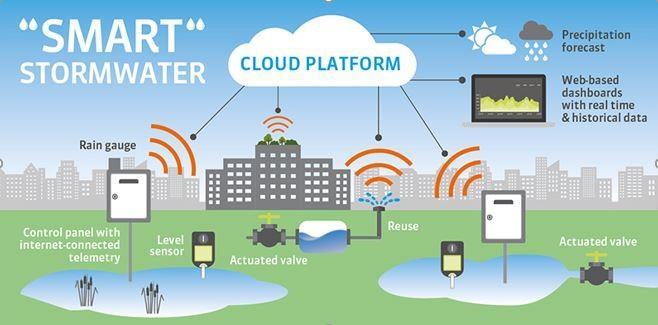
Real-timecontrol(RTC)enhancesstormwatermanagement by using sensors and automated systems to optimize infrastructure,reducefloodrisk,improvewaterquality,and adapttochangingconditions.Itmaximizesexistingresources cost-effectively,offeringaproactiveandefficientsolutionto urbanizationandclimatechangechallenges.
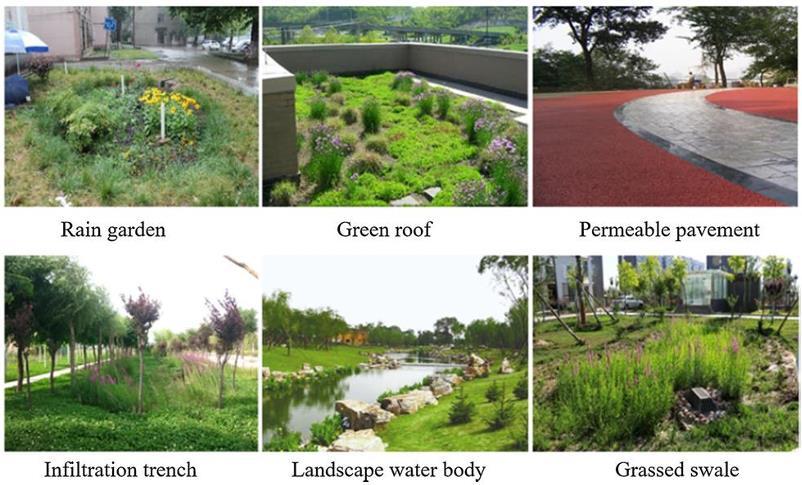
Green infrastructure for storm water management uses natural systems to manage runoff in urban areas. Key methods include green roofs, which absorb rainwater and reduce heat; permeable pavements that allow water infiltration,reducingrunoffandpollution;raingardensthat filterwaterandenhancebiodiversity;bioretentionswales that filter and infiltrate water, reducing floods; detention tanks that manage runoff flow; and rainwater harvesting tanksthatstorerainwaterforvarioususes.
International Research Journal of Engineering and Technology (IRJET) e-ISSN: 2395-0056
Volume: 11 Issue: 05 | May 2024 www.irjet.net p-ISSN: 2395-0072
Urbanfloodingposesagrowingthreatduetoclimatechange and rapid urbanization. This journal article collection explores two promising solutions: real-time control (RTC) systemsandgreeninfrastructure(GI).RTCsystemsutilize rainfall forecasts to optimize rainwater harvesting and detentionbasins,improvingwatersupply,floodcontrol,and pollutantremoval(e.g.,[3,4,5]).StudieslikeAltobellietal. (2023) demonstrate significant efficiency gains in nonpotable water savings (32-90%) and discharge volume reduction(11-31%)usingRTC[3].However,challengessuch ascost,maintenance,andregulatoryhurdlesrequirefurther investigation(e.g.,[5]).
Green infrastructure, on the other hand, leverages natural elementslikeraingardensandbioswalestomanagestorm waterrunoffandmitigatefloodrisk.Casestudiesacrossthe globe showcase the effectiveness of GI in reducing flood events and improving water quality (e.g., [6, 8, 9]). The research by Webber et al. (2023) highlights the value of catchment-scaleGIimplementation,wheremultiplesmaller interventions collectively deliver significant flood managementbenefits[9].
Integrating RTC with Nature-Based Solutions (NBS) like green roofs, bio retention, and detention basins provides significantbenefitsforurbanwatermanagement(Articles10, 12). RTC improves water quality in bio retention systems, enhances storage capacity in green roofs, and optimizes waterquantityandqualitymanagementindetentionbasins (Article 10). However, major challenges arise during the planning stage, including decisions about centralized vs. decentralized systems, modelling, forecasting, and monitoringcosts(Article10).
Greenroofswithstoragelayersreducerunoffandincrease evapotranspiration more effectively than conventional designs (Articles 11, 12). Optimal storage layer depth, vegetationtype,substratedepth,andweatherconditionsare criticalfactorsinfluencingtheirperformance(Articles11,12, 13).Additionally,greenroofssignificantlymitigatefloodsby reducingsurfacerunoffandpeakflowrates(Articles12,13).
Permeablepavements,aformofLowImpactDevelopment (LID),substantiallydecreasesurfacerunoffandpeakflood flow(Articles14,15,16).Permeableroadsoutperformother pavements in reducing runoff coefficient and peak flow (Article 14). Pavement thickness, void ratio, and surface materialareinfluential,withthickergravellayersenhancing runoffdelayandretention(Article15).
RaingardensareeffectiveGItoolsformanagingstormwater pollution, reducing runoff volume and flow, removing pollutants,andpromotinggroundwaterrecharge(Article17). Theirsaturatedhydraulicconductivityimprovesovertime, enhancinglong-termdrainagecapacity(Article18).
Bio retention systems have traditionally focused on hydrologic control, with limited research on contaminant removal (Article 18). Assessing water balance provides insights into bio retention system dynamics (Article 18). Analysing historical rainfall data and simulating future scenarios can predict climate change impacts on these systems(Article19).
WhilebothRTCandGIofferindependentsolutions,themost effective approach may lie in their combined application. Integrating real-time control with green infrastructure createsamoreholisticstrategyforurbanfloodmanagement.
Overall,combiningGIandRTCofferssignificantadvantages forurbanwatermanagement,thoughchallengesinplanning andimplementationrequirecarefuladdress.Theinference fromthesefindingssuggeststhatwhileGIandRTCpresenta promising path for sustainable urban drainage, a strategic approachintheinitialplanninganddesignphasesisessential forrealizingtheirfullpotential.
Ascitiesexpandrapidly,existingstormwatermanagement systemsstruggletohandletheincreasedrunoff,leadingto floodingandwaterqualityproblems.Fortunately,innovative solutions exist. Combining green infrastructure (GI) with real-timecontrol(RTC)systemsoffersapromisingapproach, as evidenced by successful case studies around the world. Thisintegrationcaneffectivelyaddressthechallengesposed by urban storm water and create more sustainable managementpractices.Thesecasestudieshighlightasuiteof GItechnologieseffectivelyemployedtomanagestormwater runoff. Green roofs, exemplified by one of the case study, captureandfilterrainwater,reducingpeakrunoffbyupto 40% while offering insulation benefits. Rain gardens, strategicallyplacedlikethoseattheUniversitiesinCalifornia, utilize native plants and engineered soils to filter and infiltratestormwater,preventingpollutantsfromentering waterways. Permeable pavements, implemented at all the studiedcasestudiesallowrainwatertosoakintotheground, replenishing groundwater reserves and reducing surface
International Research Journal of Engineering and Technology (IRJET) e-ISSN: 2395-0056
Volume: 11 Issue: 05 | May 2024 www.irjet.net p-ISSN: 2395-0072
runoff.Detentiontanks,employedinthecases,storeexcess stormwaterduringheavyrainevents,mitigatingfloodrisks.
Beyond capturing and storing storm water, RTC systems optimize the performance of these GI elements. These intelligent control systems, at the studied projects, continuously monitor rainfall, water levels, and other parametersthroughoutthestormwatermanagementsystem. Utilizingthisdata,theycanmakereal-timeadjustmentsto optimize the system's performance and ensure efficient water use. One of the case study at city level, further demonstratesthepowerofalayeredRTCsystem,employing local, global, and global predictive control strategies to preventfloodingacrosstheentirecity.
ThebenefitsofthesecombinedGIandRTCapproachesare evident across the presented case studies. Rainwater harvestingsystems,provideasustainablewatersourcefor irrigationandothernon-potableuses,reducingrelianceon municipal supplies by up to 40%. The natural filtration capabilities of GI significantly improve water quality, as observed in all the university case studies. Permeable pavements and infiltration practices, employed in all the universitycasestudies,contributetogroundwaterrecharge.
Inconclusion,theprojectsstudied offercompellingevidence for the effectiveness of green infrastructure and real-time control systems in sustainable storm water management. Thesestrategiescansignificantlyreducemunicipalwateruse, improve water quality, mitigate flood risks, and replenish groundwater reserves. By embracing these advancements, cities can create more resilient and water-secure urban environments.
Perumbakkam, a Chennai suburb located along the IT corridor,presentsastarkcontrastbetweenitsecologicalpast andurbanpresent.Hometoinstitutions,high-endresidences, slums, agricultural land, and remnants of a floodplain, the area boasts a unique character of carrying water. The Arsankhazhani Lake sits within its boundaries, flanked by hills and tanks. Neighbouring forests further enhance its ecologicalsignificance.
However,Perumbakkam'spopulationof28,130,residingona mere5.88squarekilometres,paintsapictureofhighdensity. Thisrapidurbanizationhascomeatacost.Acomparisonof oldandnewmapsrevealsadramatictransformationofthe landscape.
The 1954 map showcases a vast green expanse, the Perumbakkam marshland, dotted with water bodiesanda network of natural drains. This intricate system facilitated the flow of water from the Pallikarnai marsh to the Buckingham Canal and ultimately, the sea. Unfortunately, developmenthasdisruptedthisdelicatebalance.
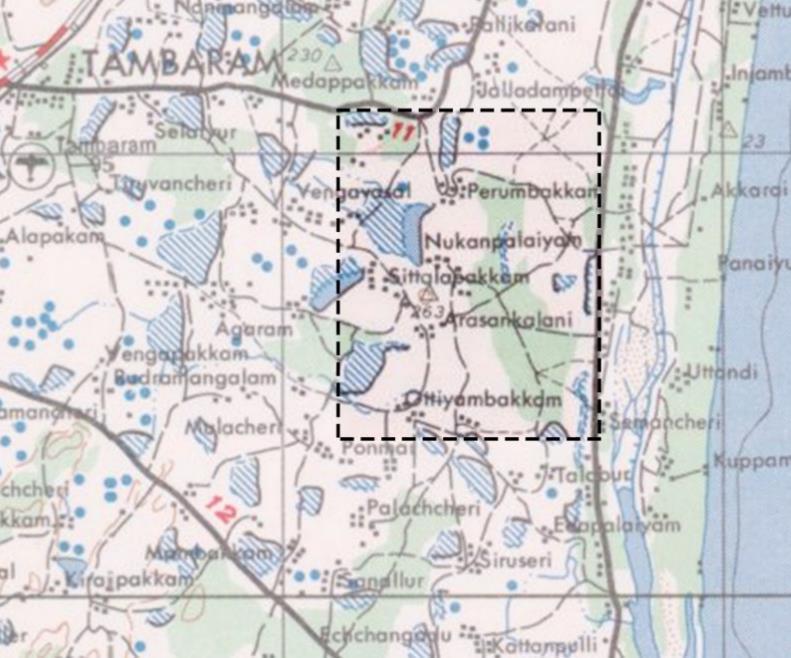
Fig -2:Perumbakkam’smapin1954almostcoveredwith greenpatch
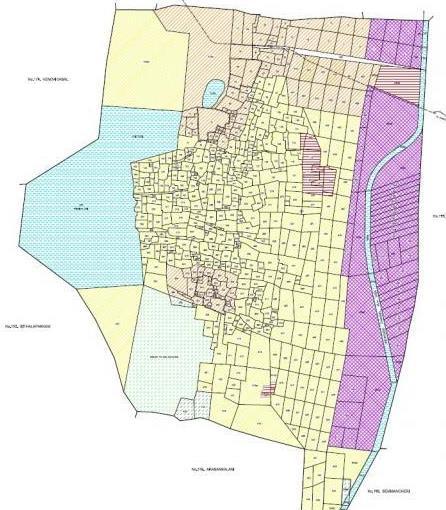
Fig -3:LanduseofPerumbakkamin2016masterplanby CMDA
The construction of major apartment complexes, starting around 2008, coincided with increased water stagnation events.Blockagesinnaturaldrains,somedatingbacktothe establishmentofSatyabhamaUniversityinthe1990s,only exacerbatedtheissue.Thisvulnerabilitybecametragically evidentduringthe2015Chennaifloods.
International Research Journal of Engineering and Technology (IRJET) e-ISSN: 2395-0056
Volume: 11 Issue: 05 | May 2024 www.irjet.net p-ISSN: 2395-0072
Thearea'snaturaltendencytocollectwater,coupledwiththe destruction of marshland and blocked drains, led to substantialflooding.Theinadequatestormwaterdrainage networkandflawedbuildingdesignfurthercompoundedthe damage.Shockingly,immediateattentionseemedtobypass theslumtenements,leavingtheminaprecariousposition.
areas(fig5.).Aproposedcanalprojecttoexpandtheexisting drain aims to address this,but concerns about inadequate capacitycalculationsremain.
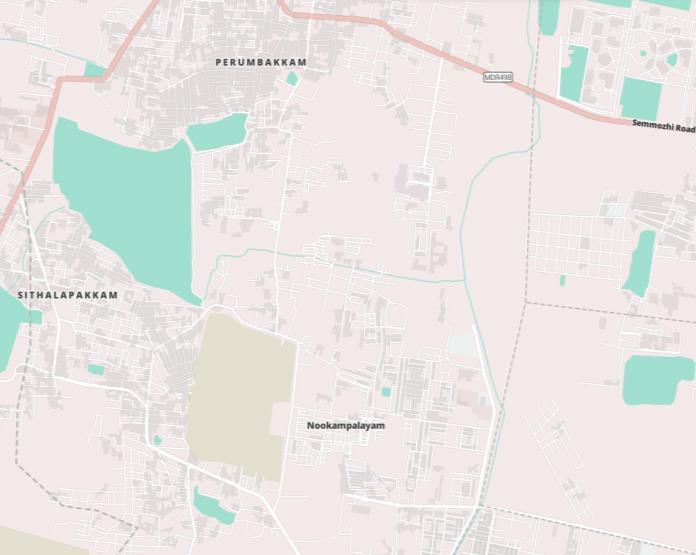
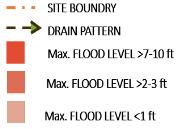
Fig -4:Mapshowingthe“S”shapewaterdrainalongwith areawithhightolowfloodingarea
The natural water flow pattern, resembling an "S" shape, channelled water from the Perumbakkam Eri towards the slumtenements.TheconvergencepointnearthePSBBSchool intensifiedtheflow,inundatingthesesettlements.Theselfsustainingstormwaterdrainnetworkprovedinsufficientto handletheburden.
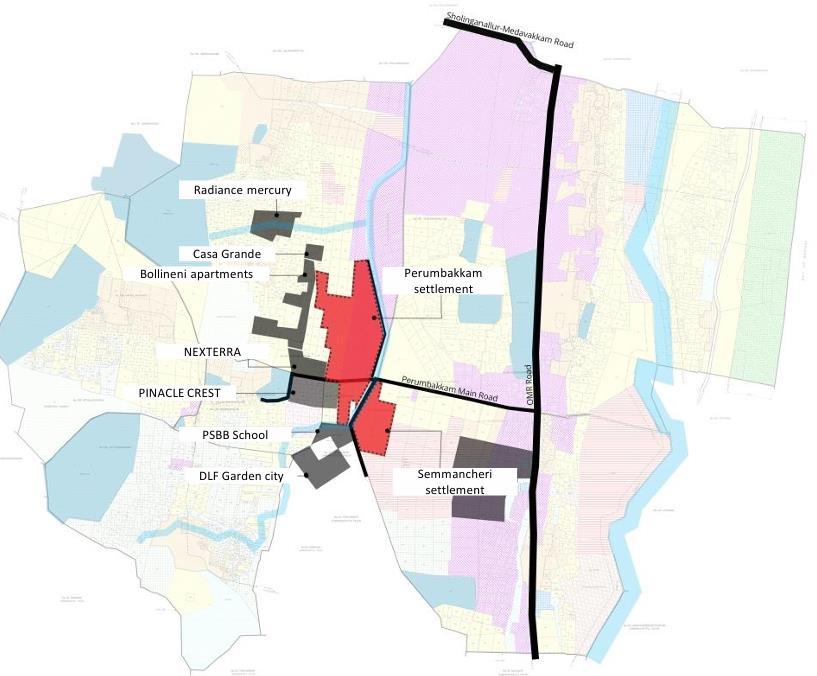
Fig -5:Mapshowingtheneighbouringbuildings
Encroachment on crucial drainage areas has resulted in water stagnation near Global Hospitals and neighbouring
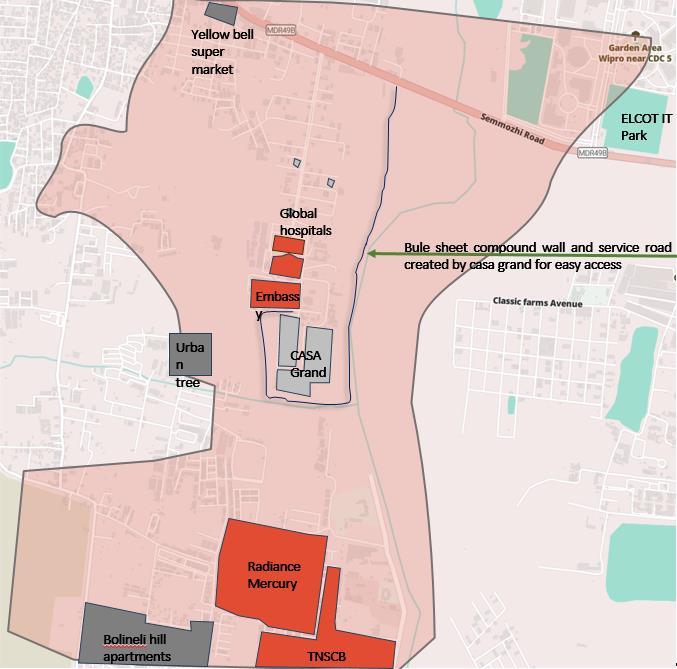
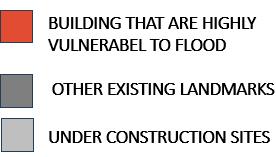
Fig -6:Mapshowingtheimportantlandmarksandtheir vulnerabilitytoflood.
Ironically, this water-rich area faces severe water scarcity duringsummers.Residentsrelyonexpensivetruckedwater for bothdrinkinganddailyneeds. Even the relatively new apartmentbuildingsstrugglewithlimitedwatersupply.The current infrastructure simply cannot meet the growing demand.
Perumbakkam's story highlights the consequences of uncontrolleddevelopmentonnaturalecosystems.Theurgent needforsustainablewatermanagementandinfrastructure developmentthatprioritizesthewell-beingofallresidents cannotbeignored.
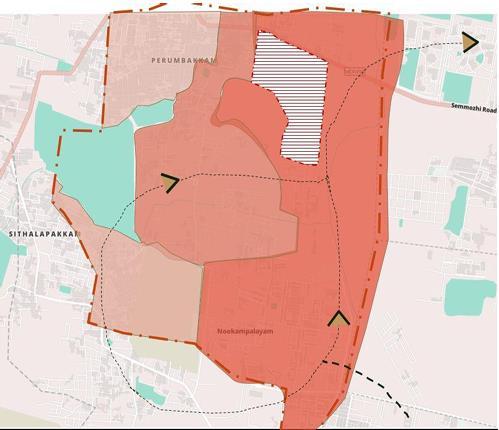
Fig -7:Maphighlightingtheareaselectedforthestudy
International Research Journal of Engineering and Technology (IRJET) e-ISSN: 2395-0056
Volume: 11 Issue: 05 | May 2024 www.irjet.net p-ISSN: 2395-0072
This study investigates the application of a storm water simulation model in Perumbakkam, India, focusing on a historicallyflood-proneareaneartheGlobalHospital.The 175-acresiteencompassesamixofresidential,commercial, andinstitutionallanduses,dividedintofivesub-catchments for analysis. The model incorporates a detailed drainage networkdesignbasedonsitecontoursandculminatingin dischargetotheOkkiyamMadavuchannelandBuckingham Canal. Manning's formula was employed to determine the optimaldrainsizeconsideringpeakrunoff,imperviousness, and channel characteristics. Hourly rainfall data from December 2023 serves as the model's time series input. Additionally,thestudyexplorestheimplementationofGreen Infrastructure (GI) and Real-Time Control (RTC) technologies within each sub-catchment. These strategies includedetentiontankswithRTCpumps,greenroofswithor without storage, permeable pavements, and bios wales. Detention tank sizing and pump control rules for the RTC system will be determined based on separate calculations and referenced journals, respectively. This research contributes to the exploration of sustainable storm water drainagesolutionsinrapidlyurbanizingareasbyevaluating the effectiveness of combined GI and RTC approaches throughsimulationmodeling.
4.2
Theanalyzedsystemstoresapproximately11,61800liters ofwater,whichcanfulfillroughly14.34%ofthedailynonpotable water needs of a 27,000 person population. The studydemonstratesthatRTCandGIcansignificantlyreduce surface runoff while saving water. Integrating RTC with otherGItechnologiesofferspromisingavenuesforfurther reduction in runoff and increased water savings in urban areas.Additionally,exploringRTCintegrationwithotherGI systemscanpotentiallyminimizewaterloss duringheavy floods.
This study investigated smart drainage (RTC) and green spaces (GI) for managing city rainwater. Both showed promise. Upgrading existing systems with RTC improved efficiency, while combining it with rainwater harvesting could potentially reuse 90% of storm water and reduce dischargeby31%.
Greensolutionslikegreenroofs,specialpavements,andrain gardenswereidentifiedassustainableoptions.Choosingthe bestmethoddependsonthelocationandpollutants.Green roofs with storage significantly reduced runoff, while pavements minimized its depth and rain gardens filtered pollutants.
Thestudystressedtheimportanceofmaintainingthesystem and collaboration between designers and operators. Realtimedataandsimulationswerecrucialforoptimization.The analysedsystemusingstormwatermanagementmodelling
softwarecouldsave14%ofacommunity'sdailynon-potable waterneeds.
Overall, smart drainage and green spaces offer significant potential for sustainable urban water management. Addressingchallengeslikecostandmaintenancewillmake thesesolutionsevenmoreeffective.
Various green solutions like rooftop gardens, special pavements, and rain gardens proved effective for storm watermanagement,withthebestchoicedependingonthe environment and pollutants. Green roofs with storage significantly reduced runoff volume, while pavements minimizeditsdepthandraingardensfilteredimpurities.
The study stressed the importance of maintaining these systemsandcollaborationbetweendesignersandoperators. Real-timedata andsimulationswere essential foroptimal performance.Theanalysedsystem'swatersavingspotential highlightsthevalueofbothsmartdrainage(RTC)andgreen infrastructure(GI).
Future research should focus on integrating these approaches, like combining RTC with various green solutions. Developing advanced forecasting models and exploringcost-effectiveimplementationstrategiesarealso crucial.Additionally,researchonhybriddesignsforgreen infrastructure, user-friendly design tools, and long-term performancemonitoringwouldbebeneficial.Socialaspects, lifecycleassessments,andpolicyframeworksalsowarrant investigation.Byfocusingontheseareas,wecancreatemore well-roundedandsustainablesolutionsformanagingurban stormwater.
[1] MargheritaAltobelli,MargheritaEvangelistiandMarco Maglionico “Multi objective performance of detection basins” Year : 2024 Source: https://doi.org/10.3390/w16010071
[2] MaleselaMichaelMogano1andJohnOkedi “Accessing thebenefitsofRTCtoenhancerainwaterharvestingat building in Cape town” Year : 2023 Source: https://doi.org/10.17159/wsa/2023.v49.i3.3907
[3] E.Gaborit,D.Muschalla,B.Vallet,P.A.Vanrolleghem&F. Anctil “Improving the performance of storm water detention basin byRTCusingrainfall forecast” Year : 2019 Source: https://doi.org/10.1080/1573062X.2012.726229
[4] WeiD.Xu, MatthewJ.Burns, FrédéricCherqui, SophieDuchesne,GenevièvePelletie, TimD.Fletcher “Real-Time Control of Rainwater Harvesting Systems: The Benefits of Increasing Rainfall Forecast Window”
International Research Journal of Engineering and Technology (IRJET) e-ISSN: 2395-0056
Volume: 11 Issue: 05 | May 2024 www.irjet.net p-ISSN: 2395-0072
Year:2022
Source: https://doi.org/10.1016/j.jhydrol.2022.128503
[5] JoeNaughton,SazzadSharior,AnthonyParolari,David Striflingand WalterMcDonald, A.M.ASCE “Barriers to Real-Time Control of Stormwater Systems’ Year:2021
Source: https://ascelibrary.org/doi/10.1061/JSWBAY.0000961
[6] SalmanAneesSoz,JolantaKryspin-Watson,andZuzana Stanton-Geddes “The Role of Green Infrastructure SolutionsinUrbanFloodRiskManagement”year:2016
Source: https://www.gfdrr.org/sites/default/files/publication/ role-of-flood-risk-management.pdf
[7] Mina Khodadad, Ismael Aguilar-Barajas and AhmedZ.Khan “Green Infrastructure for Urban Flood Resilience: A Review of Recent Literature on Bibliometrics, Methodologies, and Typologies” Year : 2022Source:https://doi.org/10.3390/w15030523
[8] Andrea R. McFarland,Larissa Larsen, Year : 2019 Kumelachew Yeshitela, Agizew Nigussie Engidad and NancyG.Love“Guideforusinggreeninfrastructurein urban environments for stormwater management”
Source:https://doi.org/10.1039/C8EW00498F
[9] J.L.Webber, T.D.Fletcher,L.Cunningham, G.Fu,D.Butler&M.J.Burns“Isgreeninfrastructureaviable strategy for managing urban surface water flooding?” Year:2019 Source: https://doi.org/10.1080/1573062X.2019.1700286
[10] José Brasil 1, Marina Macedo, César Lago, Thalita Oliveira, Marcus Júnior, Tassiana Oliveira Eduardo Mendiondo “Nature-Based Solutions and Real-Time Control: Challenges and Opportunities “ Year : 2021 Source:https://doi.org/10.3390/w13050651
[11] Shu-xiao Lia, Hua-peng Qina,⁎, Yue-nuan Pengb, Soon ThiamKhuc“Modellingthecombinedeffectsofrunoff reductionandincreaseinevapotranspirationforgreen roofs with a storage layer” Year : 2018 Source: https://doi.org/10.1016/j.ecoleng.2018.12.003
[12] LiLiu,LiweiSun,JieNiu,andWilliamJ.Riley“Modeling Green Roof Potential to Mitigate Urban Flooding in a Chinese City” Year : 2020 Source: https://www.mdpi.com/2073-4441/12/8/2082
[13] MallorySquier-Babcock,andCliI.Davidson“Hydrologic Performance of an Extensive Green Roof in Syracuse, NY” Year:2020 Source: https://doi.org/10.3390/w12061535
[15] Wen Liu,QiFeng, Weiping Chen & Ravinesh C. Deo, “Stormwater runoff and pollution retention performancesofpermeablepavementsandtheeffectsof structural factors” Year : 2020 Source: https://doi.org/10.1007/s11356-020-09220-2
[16] R.AndrewTirpak, RyanJ.WinstonMelissa Feliciano,JayD.Dorsey,ThomasH.Epps “Impacts of permeableinterlockingconcretepavementontherunoff hydrograph: Volume reduction, peak flow mitigation, and extension of lag times” Year:2021 Source: https://doi.org/10.1002/hyp.14167
[17] Rozi Sharma | PiyushMalaviya “Management of stormwater pollution using green infrastructure: The role of rain gardens” Year : 2020 Source: https://doi.org/10.1002/wat2.1507
[18] SylvieSpraakman“BioretentionSystemsforStormwater Management: Assessment, Performance and Changes Over Time” Year : 2021 Source: DOI:10.1002/wat2.1507
[19] LaurenM.Cook,JeanneM.VanBriesen& ConstantineSamaras “Using rainfall measures to evaluatehydrologicperformanceofgreeninfrastructure systems under climate change “ Year:2019 Source: https://doi.org/10.1080/23789689.2019.1681819
[14] WangChen,MulianZheng,QianGao,ChaoxianDeng,Yue MaandGuoqiangJi“Simulationofsurfacerunoffcontrol effect by permeable pavement” Year : 2021 Source: Simulationofsurfacerunoffcontroleffectbypermeable pavement-PubMed(nih.gov)