
International Research Journal of Engineering and Technology (IRJET) e-ISSN:2395-0056
Volume: 11 Issue: 05 | May 2024 www.irjet.net p-ISSN:2395-0072
International Research Journal of Engineering and Technology (IRJET) e-ISSN:2395-0056
Volume: 11 Issue: 05 | May 2024 www.irjet.net p-ISSN:2395-0072
1
Neha Koli
, Bhargavi Dongale
2 ,
Pravin Gosavi
3
1U.G. Student, Department of Mechanical Engineering, at Kolhapur Institute of Technology’s College ofEngineering (Autonomous), Kolhapur.
2U.G. Student, Department of Mechanical Engineering, at Kolhapur Institute of Technology’s College ofEngineering (Autonomous), Kolhapur.
3Assistant Professor at Kolhapur Institute of Technology’s College of Engineering (Autonomous), Kolhapur.
Abstract - The design of airbag systems in vehicles incorporates adaptive conditions to ensure optimal deployment and enhance occupant safety during crashes. Theseconditionsaremeticulously calibrated torespondto diverse factors, reflecting advancements in sensor technology and a commitment to strict safety standards. Crash severity is a primary determinant, with sensors gauging impact intensity. Airbags are programmed to deploy during moderate to severe collisions, surpassing predefined impact thresholds. Additionally, sensors discern the impact direction, allowing selective deploymentbased on whetherthe collision is frontal,side, or rear. Occupant safety is further addressed by considering position and weight. Advanced systems adjust deployment force based on occupant attributes, ensuring optimized protection. Seatbelt usage is also factored in, influencing deployment force depending on whether seatbelts are engaged. In scenarios involving multiple collisions, the system adapts by deciding not to deploy airbags in secondary impacts if already deployed in the initial collision. Vehicle speed at the time of impact is crucial, influencing airbag deployment for enhanced protection during high-speed collisions. Roll-over sensors add an extra layer of safety, detecting potential roll-over situationsandtriggeringsidecurtainairbags.Furthermore, braking and acceleration patterns just before a collision are considered to fine-tune the airbag deployment strategy. This adaptive approach to airbag deployment variesbetweenvehiclemakesandmodels,highlightingthe continuous evolution of safety measures. Rigorous testing and adherence to safety standards by manufacturers underscore the commitment to ensuring airbags deploy appropriatelyindiverseandchallengingscenarios.
Key Words: Adaptive condition, Sensor technology, Crash severity,OccupantAttributes, Multiple collisions, Roll-over Sensors
Airbag systems in vehicles are designed to deploy under specific conditions to maximize safety for occupants. These conditions are typically adaptive and take into account various factors toensure theairbags deploy when needed. Here are some common adaptive conditions for airbagdeployment:
Airbags are designed to deploy during moderate to severe crashes.Thesystemusessensorstomeasuretheintensityof the impact, and if it exceeds a predefined threshold, the airbagsaredeployed.
Sensorsinthevehiclecandeterminethedirectionofimpact. Airbags may deploy selectively based on whether the collision is frontal, side, or rear, deploying only those airbagsthataremostrelevanttotheimpact.
Advancedsystemstakeintoaccounttheweightand position of the occupants. They may adjust the deployment force or decide not to deploy certain airbags if the sensors detect thattheseatisunoccupiedorachildisintheseat.
Some airbag systems consider whether occupants are wearing seatbelts. In certain situations, the deployment force may be adjusted based on whether the seatbelt is beingusedtooptimizeprotection.
If a vehicle is involved in multiple collisions, the airbag system may adaptits response. It may choose notto deploy the airbags in a secondary collision if they have already deployedintheinitialimpact.
The speed of the vehicle at the time of impact is considered. Higher speeds may trigger airbag deployment to provide additionalprotectionduringmoreseverecollisions.
Some vehicles are equipped with sensors that candetect a potentialroll-over.Insuchcases,sidecurtainairbagsmaybe deployedtoprotectoccupantsintheeventofaroll-over.
Some systems take into account information about the braking and acceleration patterns just before a collision to determine the appropriate airbag deploymentstrategy.
It's important to note that the specific adaptive conditions for airbag deployment can vary between different vehicle makes and models, and advancements in sensor technology continue to enhance the precision of airbag deployment systems for increased safety. Manufacturers follow strict safety standards and conduct extensive testing to ensure that airbags deployappropriately in various scenarios.
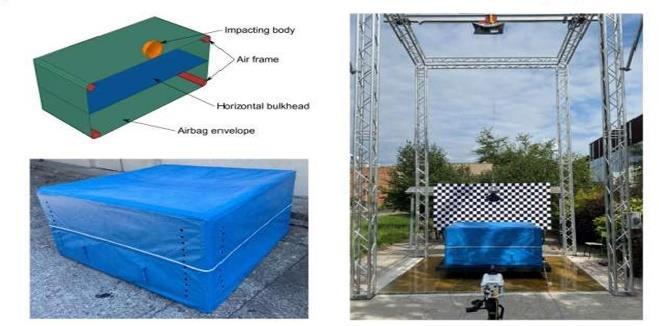
The primary goal of a rescue air cushion is to minimize the negative effects of the impact resulting from an evacuated person landing on it. A number of quality indices is used in the automotive industry, including the classical head injury criterion (HIC). Similarly, the German norm DIN-14151 which is devoted particularly to rescue cushions specifies the maximum acceptable values of accelerations acting onhead, chest and pelvis during the impact. These valuescannot be exceeded for longer than Δt = 3ms. Within this study we consider one quality index for which thetotal force F, acting on the amortized object, is taken into account. Due to mechanical properties of the impacting objectutilized in the experimental study, theminimization of total force may be considered as an equivalent to minimization of decelerations.Theaimof
theoptimizationprocedureisto find the venting area Av which will ensure that the highest level of the total force F, exceeded for no longer thanatimeperiodΔt,is minimal.
It's important to note that the specific adaptive conditions for airbag deployment can vary between different vehiclemakes and models, andadvancementsin sensor technology continue to enhance the precisionof
airbag deployment systems for increased safety. Manufacturers follow strict safety standards and conduct extensive testing to ensurethatairbagsdeployappropriatelyinvariousscenarios.The primary thing of a deliverance air bumper is to minimize the negativegoods of the impact performing from an vacated person wharf on it. A number of quality indicators is used in the automotiveassiduity,including theclassicalheadinjurycriterion (HIC). Also, the German norm noise- 14151 which is devoted particularly to deliver cocoons specifies the maximum respectable values of accelerations acting on head, casket and pelvis during the impact. These values cannot be exceeded for longer than Δt = 3ms. Within this study we consider one quality indicator for which the total force F, acting on the amortized object, is taken into account. Due to mechanical parcels of the impacting object employed in the experimental study, the minimization of total force may be considered as an original to minimization of retardations. The end of the optimization procedureistofindtheventingareaAvwhichwillinsurethatthe loftiestpositionofthetotalforceF,exceededfornolongerthana time period Δt, is minimum Comparison of numerical and experimentalresultsintwonamedcases:-
Case(a)m=5.7kg,v0=2.53m/s(h=0.33m)
Case( b) m = 10.7 kg, v0 = 6.96 m/ s( h = 2.47 m)The study indicates a significant problem, which is veritably important from the practical point of view and should be addressed by the experimenters working in the field of engineering structures, in particular adaptiveimpact immersion. The donation consists of formulating a new problem and presenting a general frame, which is applied by the authors to break the problem and make evacuation operations safer. Numerical models of the airbag system, which haven't been published by any experimenters to date, were developed by the authors and outlined at the morning of the composition. Novelty of the presented exploration can be set up also in the proposed adaption system, which includes consideration ofthedelicacyoftheimpactparameters’estimation.
Since its invention in the early 1990s, the side curtain airbags have become an important part of vehicle restraint systems and they are widely used to prevent serious injuries by increasing head protection for both front and rear seatoccupants.FortheUSmarket,onemeasurementis the safety criteria that include measuring the amountthat a human head can go out of the widows (in millimeters) and is called, Ejection Mitigation. One of the principal requirements for inflatablecurtains is to shield the occupants from intruding objects. The design process for curtain airbags in automobiles is a complex and iterative one, involving communication between car manufacturers (OEMs)and airbag suppliers. The coverage area, which includes considerations for various occupants and the positioning of car pillars, roof rails, door glass,seats,
International Research Journal of Engineering and Technology (IRJET) e-ISSN:2395-0056
Volume: 11 Issue: 05 | May 2024 www.irjet.net p-ISSN:2395-0072
dashboard, and steering wheel, is a critical factor communicated to airbag manufacturers as a requirement. The design of the curtain airbag involves front-loading simulations from early conceptual phasesto meet specificrequirements suchas volume and Energy-to-Mass ratio (EjM). The design process is simulation-drivenand iterative, wherefinite element simulations are employed withseparate models for each requirement. Thecoverage requirement is addressed first in a Computer-Aided Design (CAD) environment, and then volume and EjM are calculated using finite element simulation models. The number of islands and the size of chambers in the airbag design depend on the size of the designed bag, which, inturn, is influenced by the size of the vehicle. For larger vehicles like SUVs, additional chambers may be added, requiring a higher capacity of inflators. The iterative nature of the design process involves adjusting the design parameters, such as the number of chambers and inflatorcapacity,untilallsafetyand designrequirements are met The design process involves multiple loops between coverage, volume, and EjM requirements, with engineers goingthrough as many as 50–60 iterations. This iterative looping continues until all three requirements are satisfied. The process is time-consuming, involving pre- processing, processing, and post-processing steps. The importance of an automatedprediction model in the early phases of the design process isemphasized to streamline andexpedite the overall process.
This investigates the impact of design parameters on airbag volume, focusing on a generic prototype inspired by the front chamber of an actual curtain airbag. The prototype incorporates essential features for comprehensive analysis. 14 carefully selected parametersarestudied,guidedbydesign
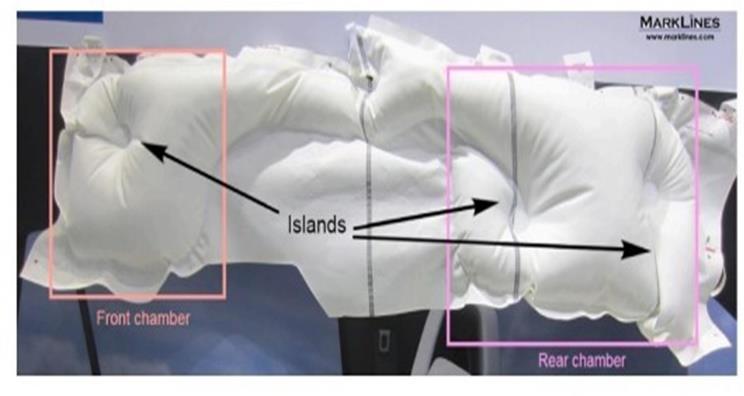
Figure.3:- CurtainAirbagsDesign
parameterization principles, including the Independence and Information axioms. The Independence axiom ensures the autonomyofdesignintent,withparameters confinedtointervals allowing for variation. The Information axiom minimizes the information content by selecting parameters to cover diverse design cases with a minimal set. The study aims to identify the most influential parameters affecting airbag volume, with Table presenting parameter names and associatedbounds.
| Parameter Name | Min (mm) Max (mm)
|Offset1 |50 |100
|Offset2 |50 |100
|Radius1 |40 |135 |Offset12 |40 |135
|Radius2 |40 |60 |Offset22 |35 |70
|Radius3 |40 |100
|Radius4 |60 |100
|IslandOffset |100 |250
|IslandR1 |10 |50
|IslandR2 |10 |50
|IslandAngle |40° |130°
|IslandLength |150 |220
|IslandBottom |40 |180
This study investigates theimpact of 14geometry parameters on airbag volume using a One Factor at a Time approach, altering each parameterin fivesteps. Theresults, presentedin, reveal the sensitivity of volume to parameter changes, with length-like parameters showing linearcorrelation andradiuslike parameters exhibiting quadratic correlation. Parameters'IslandOffset' and 'IslandAngle' demonstrate a uniquebehavior, initially decreasing and then increasing thevolume. The Pearson coefficient (R²) is employed to evaluate correlations, indicating the linear relationship between parameters and volume. The study highlights theimportance of considering parameter effects on volumechange and the implications for machine learningprecision.Inasecond studyusingaLatinHypercube,100design samples are generated, illustrates the limited correlation (low R² values) between three parameters and volume. The lack of correlation among all CAD parametersand simulation output is attributed to varying impacts of parameters on volume change, affecting the accuracy of machine learning regression models. The study emphasizes the challenges of meaningful relation discovery in machine learning algorithmswhenusinglow-correlatedfeatures.
International Research Journal of Engineering and Technology (IRJET) e-ISSN:2395-0056
Volume: 11 Issue: 05 | May 2024 www.irjet.net p-ISSN:2395-0072
Airbag in care safety devices that deploy in the event of collision to protect occupants. They do not operate on a frequency range like electronic signals or waves. Airbags in cars are designed to deploy in the event of a significant impact, such as a collision. The deployment of airbags is triggered by sensors within the vehicle thatdetect rapid deceleration or a collision. When these sensors detect a forcethat exceeds a predetermined threshold, theysenda signal to the airbag control module. The airbag control module then activates an igniter or inflator within the airbag system. This igniter rapidlyproduces agas, usually nitrogen or argon, whichinflates the airbag. The inflated airbag acts as a cushion to help protect occupants from strikinghardsurfacesinsidethevehicleduringacrash.It's important to note that not all collisions will result in airbag deployment, as the sensors are programmed to consider variousfactorssuchastheseverityanddirection of theimpact. Airbags are designed to deployin moderate to severe frontal collisions, but not necessarily in lowspeed impacts, side collisions, or rear-end collisions. After the airbags deploy, they generally deflate rapidly to allow the occupants to exit the vehicle safely. It's crucial for individuals involved in a crash to follow proper safety procedures, such as wearing seat belts, and to seek medical attention as needed. Additionally, once airbags deploy, they typically need to be replaced, and the vehicle's airbag system should be inspected by aqualified technician to ensure it functions properly for future use. Airbags deployin response to significant
impacts detected by sensors in the vehicle. The deployment process involves the activation of an igniter or inflator, rapidly producing gas to inflate the airbag. Not all collisions trigger airbag deployment, as various factors such as impact severity and direction are considered. After deployment, airbags deflate rapidly to allow occupants to exitsafely.
The time it takes for airbags to deploy in a car varies, but it typically happens very quickly. In most cases, it takes just milliseconds (thousandths of a second) for the airbags to deploy once the sensors detect a collision or rapid deceleration that surpasses the predetermined threshold. The speed ofdeployment is crucial in ensuring that the airbags are fully inflated and able to provide protection to occupants before they come into contact with hardsurfaceswithinthevehicle.Modernairbag systems are designed to react almost instantly to theforces associated with a collision. It's important to note that the exact deployment time may vary based on the make and model of the vehicle, as well as the specific design of the airbag system. Manufacturers conduct extensive testing to determine the optimal deployment time for their airbag systems to maximizesafetyinvariouscrashscenarios.
The pressure developed in airbags during deployment can vary, but it is typically within the range of 2,000 to 3,000 pounds per square inch (psi) or approximately138 to 207 bar. The highpressure gas generated by the inflator rapidly fills the airbag, causing it to inflate within milliseconds to provide acushioning effectduringa collision It's worth noting that the pressure in the airbag decreases quickly after deployment as the gasvents from theairbag.Theprimarypurposeofthehighpressureistoensure rapid and effective inflation to provide protection to the vehicle occupants. The specific pressure levels can vary based on the design and specifications of the airbag system used by different vehicle manufacturers. These systems are carefullyengineered and tested to meet safety standards and provide effective protectioninvariouscrashscenarios.
CASE 1-
A 29- time-old manly subdued motorist of a 13- time-old compact hydrofoil was injured in a head- on collision. Paramedics set up him lying prone outside his auto, the airbag was noted to have stationed. He'd a Glasgow coma scale (GCS) of 15 and was noted to have a large rent on the rightjaw.Insanitariumhewasconsciousandalertbutdueto the threat of a compromised airway, he was intubated alternatively. He'd no other egregious injuries. His head motorized topographic (CT) check-up flicks showed an oppressively milled fracture involving the right hemi- beak withdisturbanceoftherighttemporalandfibular joint.A2.2 ×2.1 ×2.1 cm hyper dense foreign body (FB) was seen in the vicinity of the fracture scrap at the position of the right ramus.Multiplefracturesoftheanteriorandsidewallsofthe rightzygoma.
|Patient|Age/Sex|CrashDetails|VehicleAge (YearofManufacture)|AirbagInjuries|OtherInjuries |Outcome|Seatbelt|ForeignBodyDimensions|
| 1 | 29/M | Head-on collision, driver | 2008 | Right mandibular fracture | None | Alive, discharged on 14th post-injuryday|Yes|22x21x21mm| |2 |43/M |Singlevehiclefrontalcollision, driver, entrapped, extricated by EMS | 2009 | None | Expiredon128thpost-injuryday|Yes| 25x25mm(MeasuredonCTImages)|
| 3 | 24/M | Head-on collision, driver, single vehicle collision | 2011 | None | Fracture of Cl vertebrae, basioccipital,etc.|Alive,dischargedon8thpost-injuryday | Yes | 20 x 15 mm maxillary sinus reaching the bottom of the right route were also noted. The case wastaken to the operating room (OR) and passed disquisition with reclamation of a round metallic FBand open reduction andinternalobsession(ORIF)ofthebeak.
International Research Journal of Engineering and Technology (IRJET) e-ISSN:2395-0056
Volume: 11 Issue: 05 | May 2024 www.irjet.net p-ISSN:2395-0072
| 4 | 37/F | T-bone or side impact on driver's side, driver, entrappedinvehicle,foundincardiacarrest|2013|Right suckingchestwound,lunglaceration,etc.|Diffusecerebral edema, Grade 2 spleen and liverinjuries, etc. | Expired on 6thpost-injuryday|No|Notavailable|
| 5 | 28/M | Mechanic working on airbag, no damagetovehicle,Sedanvs.truckdriver|2009|None
|Rightmandiblefracture,penetratinginjuryto rightneck, etc. | Alive, discharged on 7th post-injury day |Yes | 25x25x2.1cm|
|6 |21/M |Foreignbodydimensions|2008|None | The patient underwent ORIF right mandible | Alive, dischargedon4thpost-injuryday|Yes|None|
CASE 2-
A 43- time-old manly intoxicated subdued motorist of a3timeoldhydrofoil wasinjuredin ananterior collisionwith afixed object. There was significant damagetothevehicle and the case was entangled. When theparamedics arrived he'd a GCS of 12, was tachycardia with a systolic blood pressure (SBP) of 90 and an oxygenachromatic below 80. Hewasalsonotedtohaveastinkingcrackintheleftupper casketwithactivebleeding.
The case was intubated at the scene, and a 3- sided dressing was applied to the crack, and aneedle relaxation was performed. In the trauma bay, a left sidedcasket tube was fitted still his achromatic didn't significantly ameliorate. A casket x-ray (CXR) showed significant lung bruises with a rounded metallic FB noticed in his upper casket and verbose subcutaneous emphysema with mild pneumothorax was noted. Casket CT check-up showed a metallic FB lying between the leftscapula and the skin. There was an substantiation of pre Being cystic bronchiectasis in both lung fields. Expansive surgical emphysema was also noted on the left side of the casket extending to the neck and abdominal wall with bilateral pneumothorax and multiple shattered caricatures on the leftsideandmanubriumsternum.
Thecasepassedaleftthoracotomy.Hewassetuptohavea rentintheapexoftheleftlungwitharoundedmetallicFB, bone,andcartilage fractions within the lung.Hemostasis was performedand the case was put on extracorporeal membrane oxygenation (ECMO) due to severe respiratory failure. He expired after 4 months in the sanitarium while still on extracorporeal membrane oxygenation (ECMO). This case series would help the trauma healthcare providers to more understand airbagrelated injuries which could impact the operation of road business injury casethathasanassociatedpiercing trauma.
Also, it would bring attention to injury forestallment brigades as well as the state and artificial authorities to revaluate safety norms in vehicles. participating this information with original authorities who govern product safety norms and recalls is essential to insure that further conduct are taken to ameliorate thepublicsafetyinthisregard.
Nowadaytheimpactofthisisreducesbecausethesodiumazied NaN3isconvertedinNitrogenthat’shelp toreducetheimpactof thesecases.
Real-life cases illustrate the impact of airbag deployment on individualsinvolvedinaccidents.Thecaseshighlightinjuriesand the role of airbags in providing protection. The importance of proper medical attention, adherence to safety procedures, and the need for airbag systeminspection and replacement after deployment areemphasized.Inconclusion,thereportprovidesa comprehensive overview of various aspects related to airbag systems, from design considerations to real-life impacts. It underscores the importance of continuous research, safety standards, and collaboration between automotive and safety authorities to enhance the effectiveness of airbag systems and reduceinjuriesinvehicularaccidents.
[1] Shivapirakasam S Pa, Balasubramanaian K Ra and Surianarayanan Mb,Thermo-kinetic studies on azodicarbonamide/potassiumperiodateairbaggasgenerants (2020),aIndustrial Safety lab, National Institute of Technology, Tiruchirappalli, Tamil Nadu, India, bCell For IndustrialSafetyandRiskAnalysis,CentralLeatherResearch Institute,Chennai,TamilNadu,India.
[2] FarajR,PoplawskiB,GabryelD,KowalskiTandHincK, Adaptive airbag system for increased evacuation safety (2022), Institute of Fundamental Technological Research PolishAcademyofSciences,Warsaw,Poland.
[3] Ahmad Z, The unassuming danger of carairbags: Injuries secondary to airbag deployment (2011), Department of Plastic Surgery and Burns, Salisbury District Hospital, Salisbury, Wiltshire SP28BJ,UK.
[4] Rada M A , Salomonssonb K , Cenanovica M ,Balaguec H, Raudbergeta D and Stolta R, Correlation- based feature extraction fromcomputer-aided design,case study on curtain airbags design (2022),Department of Product Development, School of Engineering, Jönköping University, Jönköping, Sweden.
[5] KhoschnauS, Ramzee A,El-MenyarA,PeraltaR,Consunji R, Kloub A, Ajaj A, Abdelrahman H and Al- Thani H, Airbag-related penetrating injuries: Acaseseries from a level 1 trauma center (2023), Department of Surgery, Trauma Surgery, HamadMedicalCorporation,Doha,Qatar.
International Research Journal of Engineering and Technology (IRJET) e-ISSN:2395-0056
Volume: 11 Issue: 05 | May 2024 www.irjet.net p-ISSN:2395-0072



Miss.NehaRupendraKoli.
U.G. Student, Department of Mechanical Engineering, Kolhapur Institute of Technology’s College of Engineering (Autonomous),Kolhapur.
Miss.BhargaviBhimraoDongale
U.G. Student, Department of Mechanical Engineering, Kolhapur Institute of Technology’s College of Engineering(Autonomous),Kolhapur
Mr.PravinGosavi.
Assistant Professor, Kolhapur Institute of Technology’s College of Engineering(Autonomous),Kolhapur.