
Volume: 11 Issue: 05 | May 2024 www.irjet.net p-ISSN: 2395-0072
Volume: 11 Issue: 05 | May 2024 www.irjet.net p-ISSN: 2395-0072
Neha Tyagi1 , Vijay Maheshwari2
1M.tech [Department of Computer Science &Engineering] Shobhit University, Meerut .Uttar Pradesh.
2Associate Professor [Department of Computer Science &Engineering] Shobhit University, Meerut .Uttar Pradesh
Abstract - Personalized meal planning systems are important in addressing individual nutritional needs, health concerns,anddietarychoices.However, challengesexistwhen effectively accommodating diverse user requirements, resulting in low user preference adherence and satisfaction. This research suggests a novel approach that combines the power of collaborative filtering (CF) and deep reinforcement learning (DRL) by applying the Deep Deterministic Policy Gradient (DDPG) algorithm to effectively handle these obstacles completely. Nutrition, health, preferences, culture, flavor, choices, and dietary restrictions factors like these usually influence eating habits. Traditional systems find difficulties in matching meal suggestions with the user's lifestyle, preferences, and individual dietary requirements or restrictions, owning to less-than-ideal user interactions. Our framework leverages CF insights into user preferences, and dietaryrestrictions,andthen appliesDRL'sadaptivedecisionmaking based on users' interactions as feedback. Using the DDPG algorithm to integrate CF with DRL, our approach effectively caters to most of the user requirements and preferences. DRL principles like Markov decision processes (MDPs)areessentialforinteractivemealrecommendations.A reward-shaping feature is included offering multi-criteria decision-makinginproducing personalized mealplansforthe user. Through this research study, we've compared the effectivenessofourproposedintegrated methodologyagainst conventional methods.Thisstudyshedslightonthepossibility of CF-DRL integration in providing individualized meal ideas, promisingtoimproveuserexperiencesandhealthgoalsinthe best possible way.
Key Words: personalized meal planning, collaborative filtering,deepreinforcementlearning,DDPGalgorithm,user preferences, dietary choices, nutritional needs, health considerations.
Inthepresentdigitalworld,wearelivingin,theintermixing ofculinaryexplorationandtechnologicaladvancementshas resulted in numerous food recipe platforms, therefore peopleengagewiththemdifferently.Centraltothisculinary evolutionisthecreationandutilizationofintegratedfood recommendationsystems,seamlesslymixingthedomainsof flavorandhealthtoprovidecustomizedculinaryjourneys thatcatertopersonaltastesanddietaryrequirements.The analysis of all these interrelated elements shows that
creating the most effective customized meal plans is importantaswellaschallenging.Despitetheiremphasison meeting nutritional and health needs, traditional meal planning systems have never been able to accommodate people'sdiversetastes,lifestyles,orcoverteatingpatterns [1][2][3]. As there is a disconnect in between what we expectandwhatthesystemperformsoftenresultsinpartial or no user requirements adherence, thereby affecting the efficacy of the solutions systems are producing [1][4]. Therefore, personalized meal planning systems are undergoingevolutiontobetteraccommodatethesediverse needsdayandnight.Theobjectiveforourresearchprojectis provided by this introduction, which tells how we can predict the interdependent variables between user satisfaction, following suggested meal plans, and the incorporationofuserpreferencesandnutritionaldatainto these creative systems. This study reveals the details of customized food recommendations and the resulting benefits for encouraging healthier eating habits and improvinggeneralwell-beingbydivingintothecomplicated phenomenaofnutritionalvalueandtaste.
Customizednutritionthatconsidersanindividual'sneeds, interests, and health circumstances is what personalized mealplanningisallabout it'snotsimplyacuisinecraze. Still,thereareobstaclestoovercometoachievethisdegree of customization. When it comes to delivering consumers with recommendations that are too generic or generic, traditionalmeal-planningsystemsfrequentlyfallshort.The resultisthatitisdifficultforconsumerstoadheretothese customized strategies, which lowers engagement rates. Thoughcustomizednutritionmakesalotofpromises,itis frequentlydifficulttogettheintendedresults.
To address these obstacles, this research presents an innovativesolutionthatcombinescollaborativefiltering(CF) with deep reinforcement learning (DRL) through the utilizationoftheDeepDeterministicPolicyGradient(DDPG) algorithm. The combination results in a significant advancementinpersonalizedmealpreparation,providinga comprehensive structure that seamlessly integrates datadrivenanalysiswithflexibledecision-makingprocesses.
Ourproposedmethodologygainsusefulinsightsintousers' culturalpractices,preferences,anddietaryrestrictionsusing the basic approach which is collaborative Filtering. These insights serve as the foundation upon which our Deep International Research Journal of Engineering and Technology (IRJET) e-ISSN: 2395-0056
International Research Journal of Engineering and Technology (IRJET) e-ISSN: 2395-0056
Volume: 11 Issue: 05 | May 2024 www.irjet.net p-ISSN: 2395-0072
Learning Filtering model functions, thereby dynamically adjustingmealsuggestionsbasedonuserfeedbackandrealtime interactions likes, dislikes, ratings, etc. Through the complementarystrengthsofCFandDRL,weaimtobridge the gap between generic meal plansand truly customized nutritionsolutions.
In the following sections of the study, we will give a literaturereviewofallfoodrecommendationsystemsthat have been researched so far, after that will explain the intricaciesofourintegratedCF-DRLapproach,includingits key components, methodologies, and its impact on customized meal planning. By performing practical assessmentandcomparativeresearch,wetrytoshowcase the effectiveness of our proposed algorithm in enhancing usersatisfaction,andadherencelevels,andmeetinggeneral healthandwellnessgoals.
Recommender systems serve a vital role in delivering customizedrecommendationsacrossdiversefieldstotackle the challenge of information overload. These systems are specificallycraftedtooffertailoredsuggestionsalignedwith individual user preferences, thereby enriching user experienceandfacilitatingdecision-makingprocesses.The rise of customized meal planning platforms has garnered considerableinterestfromavarietyofdisciplines,suchas nutritionscience,computerscience,andhuman-computer interaction[1,5,6].Weexplorearangeofmethodsemployed inthe questfor effective meal-planningsolutions, ranging fromrule-basedsystemstoadvancedmachinelearning(ML) approaches.
While prior studies have predominantly concentrated on creating computational instruments for dietary guidance, alsotheyhavenotfullyincorporateduserpreferencesand nutritional data [5]. Raciel Yera Toledo et.al proposed framework aims to address the research gap by simultaneouslyconsideringuserpreferencesandnutritional information in daily meal plan recommendations. The researchendeavorstoaddressthisgapcomprehensivelyby proposing a framework that generates personalized daily meal plans accommodating both user preferences and nutritionalrequirements.
Rule-basedsystemsemploypredefinedrulesandconstraints based on nutritional guidelines to produce meal plans, lacking flexibility for individual preferences or lifestyle changes[12,13]
Expert systems utilize nutritionist expertise to create personalizedmealplansbutrequirefrequentupdatestostay currentwithnutritionalresearchandguidelines.[12,13]
Traditionally,foodrecommendationsystemshavefocused on providing personalized food or recipe suggestions to individual users, often overlooking groupinteractions [6]. These systems cannot frequently offer recommendations tailoredforgroupactivitiessuchasdiningout,neglectingan important aspect of user preferences. To address this gap researchers like Mehrdad Rostami et.al have explored community detection techniques to identify user groups with similar tastes, enhancing recommendation accuracy. Time-awarealgorithmsareessential,takingintoaccountthe temporal dimension of user engagements to maintain the relevance of recommendations. Group recommendation systems are more complex than individual ones, as they must cater to the preferences of multiple users within a group.Theproposedmodelinthisstudyintegratesmetrics for group satisfaction, contributing to an improved recommendation process. Their study presents an innovativegroupfoodrecommendationsystemthatutilizes deepsocialcommunitydetectionanduserpopularity,aiming to overcome limitations identified in current models. By incorporatingfeaturesfromfoodrecommenders,community detection,time-awarealgorithms,andgrouprecommenders, theirproposedsystemdemonstratessuperiorperformance comparedtoexistingliterature.
Manyresearchinitiativeshavedelvedintothedevelopment of prediction models for type-2 diabetes harnessing the power of artificial intelligence(AI),machinelearning, and deep learning methodologies. The primary objective has been to bolster early detection capabilities and provide tailored health recommendations for individuals. [6] It creativelyemploysauser-cloudenvironmentforreal-time applications, demonstrating the DP-UCE framework's ensembleofmachinelearningmodelsandcloud-baseduser applicationsfortype-2diabetespredictionandsuggesting diet plans. Moreover, recent research has explored innovativemethodologiessuchashybridstackedensemble merginggeneticalgorithms,healthcaremonitoringsystems reliantonconvolutionalneuralnetworks(CNNs),andfused machinelearningmodels.Theseeffortsaregearedtowards enhancing predictive accuracy and enabling real-time monitoringinthemanagementofdiabetes.Theintegration of Internet of Things (IoT) technology, deep learning algorithms,andensembletechniquessignalsanotableshift towardsmorecomprehensiveandefficaciousstrategiesfor diabetes prediction and management evident in contemporaryliterature.
Machine learning is rapidly becoming one of the most dynamic technologies applied in healthcare. A range of machine learning techniques is being combined to create personalized recommendation models, utilizing data from restaurants and the Indonesian food composition list [8]. The system takes into consideration individual variability such as age, sex, physical activity, and medical history to furnishtailoredfoodrecommendations,particularlycatering to consumers with conditions like diabetes, hypertension,
Volume: 11 Issue: 05 | May 2024 www.irjet.net p-ISSN: 2395-0072
and cardiovascular disease. Through the utilization of a geneticalgorithm,thestudyaimstostrikeabalancebetween nutritional adequacy and individual preferences in food selection.
Collaborativefilteringsuggestsmealsbasedonsimilaruser preferencesbutfacesthecold-startproblemwithnewusers oritemslackingdata.
Content-basedfilteringrecommendsmealssimilartothose likedinthepastbutmaylimitvariety.
Hybrid systems merge collaborative and content-based filteringformorediverseandaccuraterecommendations.
Within the realm of food recommendation, meal recommendationhasemergedasafocalpoint,concentrating onpresentingcoursesfromspecificcategoriesforusersto enjoy as a complete meal. Previous research efforts have recognized the importance of integrating health and nutritionconsiderationsintomealrecommendationsystems to encourage healthier eating habits [9]. To address this, researchershavedevelopedvariousmodelssuchasDIETOS, multi-objective optimization technology,and evolutionary approaches, aiming to provide personalized and healthconsciousdietaryrecommendations.Theevolutionofmeal recommendation research has increasingly emphasized health-oriented recommendations, underscoring the necessity of incorporating healthiness criteria into food suggestions.
Existingculinaryappscannotidentifyaccuratelyavailable ingredients,leadingtoingredientsubstitutionsormissing items in recipes. Food ingredient recognition is achieved throughaconvolutionalneuralnetworkmodel(CNNModel), specifically ResNet-50, trained on a dataset containing 36 classes of vegetables and fruits [10]. Recipe recommendations are made based on the recognized ingredient labels, utilizing the Edamam API to search for suitablerecipes.
Clustering algorithms help in organizing and categorizing foods based on their nutritional content, enabling the recommendationsystemtosuggestfoodoptionsthatalign with the user's dietary requirements and preferences effectively.
Thesestudieshighlightthesignificanceofpersonalizedfood recommendations aligned with user preferences and nutritionalrequirements,employingclusteringtechniques anddataminingapproaches.[12]
Lately,therehasbeenasurgeininterestindeeplearning, primarilybecauseofitscapacitytoadjusttochangingdata dynamics and its remarkable versatility in identifying
complexpatternsandconnectionsinuser-iteminteractions and content data [14,15]. This method satisfactorily addresses the needs of contemporary recommendation algorithmsintheeraoflarge-scaledata.
Deeplearningautomatesfeatureextractionbyusingneural networks to identify and extract relevant patterns from inputdatawithoutmanualintervention.Throughmultiple layers, each processing data to find increasingly complex features, deep learning models discover intricate patterns and relationships. This capability allows them to handle high-dimensionaldataeffectively,improvingperformancein taskslikerecommendationsystems.
Deep learning addresses challenges like the cold-start problem, where new users or objects lack interaction history. By generalizing from existing data, it aids in recommendationswheretraditionalmethodsstruggle.This makes deep learning crucial in recommendation systems, leading to more precise, flexible, and data-driven suggestions.Itsabilitytonavigatecomplexdatalandscapes enhances user engagement and experiences. Moreover, it enables the exploration of advanced concepts like reinforcement-learning-basedrecommendationsystems.
Deep learning has established itself as a potent tool for unraveling insights from intricate datasets. However, the pursuitofinnovationinrecommendationsystemsextends beyond conventional methods, delving into the realm of reinforcement learning. This method introduces a distinct frameworkcomprisingstates,actions,environments,agents, and rewards, giving a fresh perspective on optimizing recommendations. Within reinforcement-learning-based recommendation systems, user interactions with the recommendationplatformareconceptualizedassequential decision-makingprocesses.Here,the"state"representsthe user's prevailing context, "actions" denote the recommendationsmadetotheuser,andthe"environment" encompassestherecommendationsystemitself.An"agent" isresponsibleforgeneratingrecommendationsbasedonthe user'sstateandpastinteractions,while"rewards"serveas feedback on the quality and relevance of these recommendations.Thisapproachenablesrecommendation systemstoevolve,leveraginguserfeedbackandinteractions to continually enhance the pertinence and engagement of suggestedcontent.
Therefore, the studies so far highlight the importance of integratinguserpreferencesandnutritionalinformationinto foodrecommendationsystemstoenhanceusersatisfaction and promote adherence to healthier dietary habits. By synthesizing insights from diverse research works, this thesis aims to contribute to our understanding of user satisfaction and adherence within the context of these International Research Journal of
Volume: 11 Issue: 05 | May 2024 www.irjet.net p-ISSN: 2395-0072
innovativesystems,pavingthewayfor enhancedculinary experiencesandimprovedhealthoutcomes.
Thissectionexplainsthedifferentaspectsofcomprehensive recommendation systems, including the problem context, architecturaldesign,andalgorithmicframework.Byutilizing advanced techniques like the actor-critic methodology in deepreinforcementlearning,weimplementtheDDPGmodel toimprovehowthesystemachievesrewardsandshapesits policies.Ourmaingoalistocatertoactivelyengageduser demographicsmoreeffectively
3.1.
Intheworldoffoodrecommendationsystems,conventional models often find it challenging to keep up with users' changingtastesanddietarypreferences.Weaimtocreatea recommendationsystemthatgoesbeyondjustlookingata user's past interactions with food. Instead, we want it to continuouslylearnandimproveitssuggestionsbasedonthe user's evolving dietary preferences and health objectives. Thismeansthatfooditemssimilartoauser'sfavoritesare recommended, taking into account their latest culinary preferences, nutritional requirements, and any dietary restrictionstheymayhave.
Weplantoutilizedeepreinforcementlearning,particularly theDeepDeterministic PolicyGradient(DDPG)method, to createadynamicsystem.Thissystemwillcontinuouslylearn fromuserinteractions,improverecommendationsbasedon real-timefeedback,andadjusttochanginguserpreferences. By representing recommendations as a Markov Decision Process,ourgoalistoprovidepersonalizedandadaptable food suggestions that optimize user satisfaction and align withtheirdietaryobjectivesandhealthgoals.
3.2 System Framework
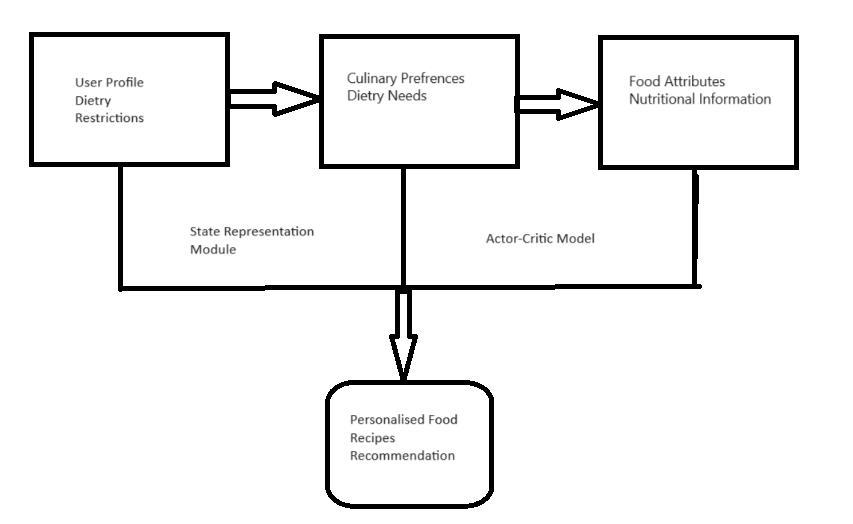
WedelineatethesystemframeworkinFigure1,illustrating thecombinationofpoliciesandvaluesintrinsictotheActorCritic Model, tailored for the domain of food recommendation. Within this framework, the recommendationsystemfunctionsbasedontheActor-Critic model,whereintheactormakesthepolicydecisionsandthe criticevaluateshowwelltheywork.
At the heart of this model lies the state representation module, which captures various aspects of the user's culinary preferences and dietary needs. This module includespastinteractions,userprofiles,contextualcues,and food attributes. Using this comprehensive representation, the actor network creates personalized food recommendationsfortheuserinquestion.Meanwhile,the Criticnetworkevaluatestheactor'sdecisionsbyestimating theexpectedrewardorvaluelinkedtotheaction,takinginto accounttheuser'scurrentsituation.
Moreover, the system integrates user feedback such as recipe ratings, ingredient selections, and dietary restrictions as a reward signal, enabling continuous updatestoboththeactorandthecritic.Thisfeedbackloop facilitates adaptive learning from user interactions, improving the system's ability to offer tailored food recommendations over time. In food recommendation systems,policylearning(actor)directlylinksstateactions, efficientlymakingrecommendationswithinextensiveaction spaces.Valueestimation(critic)minimizesupdatevariance, expediting learning and ensuring system stability. ActorcriticmethodslikeDDPGexcelincontinuousactionspaces, balancing exploration-exploitation trade-offs for tailored suggestions.DDPG'ssampleefficiencyandversatilityallow effectivelearningfromlimiteddata,makingitwell-suitedfor dynamicfoodrecommendationenvironments.
Policylearning(actor)involvesdirectlyacquiringa policy that maps state actions, proving advantageous in systems with large and complex action spaces, such as recommending food items. This method proves more efficientthanvalue-basedapproaches,allowingtheactorto makerecommendationsaccordingtouserpreferencesand dietaryrequirements.
Value estimation (critic) plays a crucial role in policy by reducing update variance, making learning faster, and ensuring consistent training. In food recommendation systems, where offering personalized meal suggestions is key, combining actor and critic components enhances the system'sabilitytoadjusttouserpreferencesovertime.
Volume: 11 Issue: 05 | May 2024 www.irjet.net p-ISSN: 2395-0072
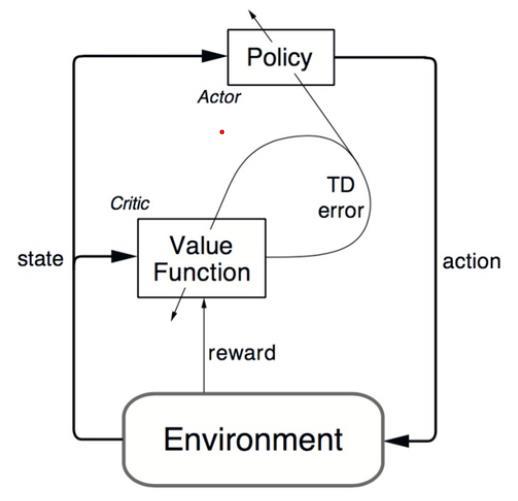
Fig2Actor-criticModel,source:[18]
Actor-criticmethodslikeDDPGareparticularlysuitablefor foodrecommendationsystems,handlingcontinuousaction spacesandbalancingtheexploration-exploitationtrade-off effectively. DDPG's efficiency in utilizing past experiences allowsforlearningfromlimiteddata,makingitperfectfor craftingpersonalizedrecommendations.
Furthermore, DDPG's versatility adapts to various operational scenarios in food recommendation, allowing training in both real-time user interactions and batchprocessing setups. The integration of DDPG into the food recommendation system will be further detailed during implementation, showcasing its effectiveness in handling dynamic environments and providing personalized recommendations.FurtherdetailsonDDPGintegration[18] and its benefits will be elaborated in the implementation phase.
Step 1
DataPreparation
TheFood.comdatasetissourcedtocommencethe analysis.Thisdatasetcomprisesavastcollectionof recipes, user reviews, and recipe metadata. This initial phase involves preprocessing the dataset, including tasks such as cleaning, organizing, and structuring the data to facilitate subsequent analysisandmodeling.
EmbeddingsGeneration
Thedatasetispartitionedintotrainingandtesting sets to evaluate the performance of the recommendationmodel.Thedatasetisstructured toincludeessentialinformationsuchasrecipeIDs, userIDs,ratings,andotherrelevantattributes.
State Representation- In food recommendation systems,accuratelycapturingthepresentcontextis vitalforguidingboththeActorandCriticnetworks. Thisinvolvesblendinguniqueusertraitswiththeir past interactions with food recipes. The state representation module combines user characteristics with recipe attributes, adjusting theirdimensionsusinganAdaptivePoolingblock. The"concatandflatten"processmergesdatafrom various sources into a unified vector [18]. This unified state then serves to create and assess actions, emphasizing the importance of the state representation process in providing personalized reciperecommendationsbasedonuserpreferences andrecipecharacteristics.
Thisstagefocusesongeneratingembeddings,which capture latent features of recipes and users in a compact space, enhancing recommendation efficiency.Techniquessuchasmatrixfactorization may be employed to derive recipe and user embeddings from the recipe-user interaction matrix. These embeddings are then stored for efficient retrieval during the recommendation process.
ActorandCriticInitializationOurproposedsystem of food recommendation system, we initialize an ActorandCriticarchitectureusingDDPG.Theactor network begins by defining the neural network architecture, which takes the state (including the user's profile, food items, and historical interactions)asinput.Toensurediversity,network weights are initialized with small random values, often employing Xavier initialization to maintain reasonablebounds.BothActorandCriticnetworks utilizefullyconnected(dense)layers,thestandard for processing high-dimensional input data. The Actor network comprises three linear layers (linear1, linear2, linear3), responsible for processing the state input and outputting the recommendedaction.Similarly,theCriticnetwork also utilizes three linear layers (linear1, linear2, linear3),butitprocessesboththestateandaction together,outputtingasinglevalueestimatingtheQvalueofthestate–actionpair.Inbothnetworks,the input layer receives either thestate (intheactornetwork) or the state–action pair (in the Critic network), initiating the feature transformation process. Subsequent layers, often referred to as hidden layers, further process these inputs, facilitating the creation of more intricate representations and interactions among features. Thesehiddenlayersareessentialforcapturingthe non-linearrelationshipspresentinthedata. Intheactornetwork,thefinallayergeneratesthe recommendedaction,whileintheCriticnetwork,it producestheestimatedQ-value.Theseoutputsplay crucial roles in decision-making (Actor) and International Research Journal of Engineering and Technology (IRJET) e-ISSN: 2395-0056
International Research Journal of Engineering and Technology (IRJET) e-ISSN: 2395-0056
Volume: 11 Issue: 05 | May 2024 www.irjet.net p-ISSN: 2395-0072
evaluation (Critic). The Actor network generates food recommendations, while the Critic network assessesthequalityoftheserecommendations[18].
Algo 1 Actor-critic algorithm Initialisation
The Actor-critic algorithm [16] for a food recommendation system:
1. Define Actor Network-
- Create a neural network architecture for generatingfoodrecommendations.
- Include three linear layers followed by LeakyReLUactivationanddropoutlayersfor regularization.
- Definetheforwardmethodtoprocessinput state information and produce food recommendations.
2. Define Critic Network-
- Develop a neural network architecture for evaluating the quality of food recommendations.
- Consists of three linear layers with LeakyReLU activation and dropout layers, concatenating the state and action before processing.
- Implementtheforwardmethodtoestimate thevalueofthestate-actionpair.
3. Model Initialization-
- Set dimensions based on the food recommendationdatasetcharacteristics.
- InitializeActorandCriticnetworkinstances with specified dimensions and dropout probability.
- Set up target networks for stability during training.
4. Optimizer Definition
- ConfigureoptimizersforupdatingActorand Critic network parameters during training, usingadefinedlearningrate.
This algorithm outlines the steps to establish and initialize neural networks for generating and evaluating food recommendations within a reinforcement learning-based food recommendationsystem.
Employing DDPG for Training
TheDeepDeterministicPolicyGradient(DDPG)isa model-free algorithm that combines actor-critic strategies to address challenges in continuous action spaces, making it apt for reinforcement learning scenarios [18]. Derived from Deep Q learning, it effectively handles continuous action spaces by incorporating key components. The
trainingprocessforDDPG,outlinedinAlgorithm2, involves several steps aimed at optimizing the modelandenhancingitseffectiveness.
Algorithm 2: DDPG Training
1. Networks and Parameters Initialization-
- Begin by initializing the actor_model with input dimension, hidden dimension, and outputdimension.
- Next initialize the critic_model with input dimension, output dimension, and hidden dimension.
- Assign actor_model to actor_target and critic_modeltocritic_target.
- Createareplaybuffertostoreexperiences.
2. Setting Exploration Noise, Discount Factor, Tau (Soft Update Parameter)-
- Specifyparameterssuchasexplorationnoise, discountfactor,andtauforsoftupdates.
3. Training Loop-
- Iterate through episodes from 1 to max_episodes:
- Initializeexplorationnoise.
- Observetheinitialstate.
- Iterate through timesteps from 1 to max_timesteps:
- Generate action using the actornetwork with added exploration noise.
- Execute action and observe the next state, reward, and terminationsignal.
- Store experience in the replay buffer.
- Sample a batch from the replay buffer.
- ComputetargetQ-valuesusingthe critic_targetnetwork.
- Update the critic network using the sampled batch and target Qvalues.
- Update the actor-network using the sampled batch and critic_model.
- Soft update the target networks usingthetauparameter.
- Updateexplorationnoise.
- If the episode is done, break the loop.
- Endepisodeloop.
International Research Journal of Engineering and Technology (IRJET) e-ISSN: 2395-0056
Volume: 11 Issue: 05 | May 2024 www.irjet.net p-ISSN: 2395-0072
This algorithm outlines the training process for the Deep DeterministicPolicyGradient(DDPG)algorithm,itinvolves iterativelyupdatingtheactorandcriticnetworksbasedon experiences stored in a replay buffer to optimize the networks for improved performance in continuous action spaces.
Step Three
This section presents the algorithm of the proposed approach to develop and assess a food recommendation systemusingdeepreinforcementlearningtechniques.
Input:recipes_data,user_preferences
Output:evaluation_criteria,tailored_recommendations, Best-N_recommendations
Procedure:
1: Data loading and preprocessing:
-Loadthedataset,recipedata,anduserpreferences.
-Preparerecipe-userinteractionmatrix.
2: Partition data into training and testing sets:
- divide users into training and testing groups based on theirrecipeinteractions.
3: Data preparation for deep reinforcement learning:
-Createdataloadersfortrainingandtestingsets.
4: Reinforcement learning models Initialization:
- Initialize actor and critic models for making and evaluatingrecommendations.
-Setuptargetnetworksforstability.
-Initializereplaybuffertostoreexperiences.
5: State representation Definition:
- Define functions to represent the state, including user preferencesandrecipefeatures.
6: Model Training:
-Foreachtrainingepisode:
-Foreachbatchofdata:
-Computethestaterepresentation.
-Usetheactormodeltosuggestrecipes.
- Calculate rewards based on user interactions with recommendedrecipes.
-Updatethereplaybufferwithexperiences.
-Ifthereplaybufferissufficientlyfilled,updatetheactor andcriticmodels.
7: Model Testing:
-Foreachbatchoftestdata:
-Computethestaterepresentation.
- Generate recommendations using the trained actor model.
-Evaluatetherecommendationsagainsttheactualuser interactions.
8: Compute evaluation metrics:
-Calculatemetricssuchasaccuracy,precision,andrecallto assesstheperformanceofthemodels.
9: User-specific recommendations generation:
-Selectaspecificuserfromthetestset.
-Generatepersonalizedrecommendationsforthechosen user.
10: Recommendation Analysis using cosine similarity:
- Compute cosine similarity between user-specific recommendations.
11: Output Return:
- Provide evaluation criteria, tailored recommendations fortheselecteduser,andtop-Nbestrecommendationsfor generalusers.
4. Results
PerformanceMeasuresIn recommendation systems, the evaluation and optimizationofperformancetypicallyrelyonthree keymetrics:Precision,Recall,andtheF1Score[18]. These metrics ensure that the systems deliver relevantandcomprehensiveresultstousers.
1. Precision@k measures the accuracy of recommendationsbydeterminingtheproportionof relevantitemsamongthetop-krecommendations provided by the system. It gauges how well the recommendationsalignwiththeuser'spreferences.
2. Recall@kassessesthesystem'sabilitytocaptureall relevant items within the recommended list by calculating the percentage of relevant items includedinthetop-krecommendations.
International Research Journal of Engineering and Technology (IRJET) e-ISSN: 2395-0056
Volume: 11 Issue: 05 | May 2024 www.irjet.net p-ISSN: 2395-0072
3. TheF1Scoreservesasabalancedmeasureofmodel accuracy, combining Precision and Recall into a singlemetric.Itisparticularlyusefulwhenstriking abalancebetweenPrecisionandRecalliscrucial.
Theformulasforthesemetricsareasfollows:
- Precision@k = Number of relevant items amongthetop-krecommendations/Number ofrecommendeditems@k
- Recall@k=Numberofrelevantitemsamong thetop-krecommendations/Totalnumber ofrelevantitems
- F1Score=2*Precision*Recall/(Precision +Recall)
These metrics are pivotal in evaluating recommendationsystems,allowingresearchersand developers to fine-tune algorithms for more accurateandpersonalizedrecommendations.
Weprimarilyassessedouralgorithm'sperformance using the acceptance score, reflecting user satisfaction with the generated food recipes [17]. This score, rated on a scale of 1 to 5, with 1 indicating dissatisfaction and 5 indicating satisfaction,averagedat4.Significantlyhigherthan alternative methods, this result underscores the highsatisfactionlevelsouralgorithmachieved
Weemployedapreferencescoretogaugehowwell our algorithm's meal plans matched users' preferences. This score, calculated as the average TOPSIS score ranging from 0 (no similarity) to 1 (perfectsimilarity),reflectsthedegreeofalignment betweenthemealplansanduserpreferences.
In our upcoming research, there are opportunitiestoenhancetheeffectivenessandflexibility of our algorithm by exploring additional factors and addressing biases and limitations. Here are some avenuesforfutureexploration:
Developing a user interface to simplify user interaction and feedback is important. The algorithm can benefit immensely from an intuitiveanduser-friendlyinterfacethatmakes itsimpleforuserstochoose,rate,andmodify theirmealplans[17].Foreverymealselection, it should provide nutritional statistics, user ratings, and other pertinent information in addition to offering comments and feedback. Monitoringthealgorithm'soveralldevelopment andperformancewouldalsobehelpful.
Another topic worth investigating is the integration of data from social media and the
Internet of Things (IoT) for contextual suggestions. These platforms may collect and combine data from several sources, including social media interactions, Internet of Things devices,andlocation-basedservices,toprovide a more comprehensive knowledge of user context. Recommender systems can make recommendations that reflect users' true preferences thanks to this contextual information.
Thedigitalworldtodayisevolvingeachsecond towards more multimodal content, including text,images,andvideos.Thisevolutionthereby forces recommender systems to expand their capabilities beyond text-only interactions. By looking at visual content, these systems must gaininsightsintousers'preferences.
With the integration of GPT-based chatbots combining natural language processing (NLP) with recommendation technology, fundamentally changing the way recommendations are presented. By engaging users in natural conversations, these chatbots improve interaction and personalization, enhancingtheoveralluserexperience.
In this paper, we conclude by suggesting how we can overcome the limitations of traditional food recommendationsystemsbyusingadynamicand customizedrecommendationframeworkusingdeep reinforcement learning, particularly the Deep DeterministicPolicyGradient(DDPG)method[18].
Thecruxofthewholediscussioninvolveshowthe utilization of advanced reinforcement learning in recommendation systems. By applying the Actorcriticmodelfordeeplearningthensupportedbythe DDPGalgorithmmayexcelinhandlingcontinuously changing user preferences action spaces and balancing exploration-exploitation trade-offs effectively, making them well-suited for dynamic foodrecommendationenvironments.Thepowerof DDPGliesinefficientlearningwherelimiteddataor no data is available, making customized recommendationsforusers.
Inourresearchmethodology,weproposetheusage of the actor-critic technique within the Deep Reinforcement Learning (DRL) algorithm [18] which plays a very crucial role. This approach combines both policy-based and value-based strategies,whichhasthepotentialtoimprovethe wholerecommendationprocesssubstantially.The beauty lies here in the incorporation of the Deep Deterministic Policy Gradient (DDPG) method supports ongoing and constantly changing interactionsbetweenusersandfoodrecipes.This
International Research Journal of Engineering and Technology (IRJET) e-ISSN: 2395-0056
Volume: 11 Issue: 05 | May 2024 www.irjet.net p-ISSN: 2395-0072
resultsinsuchadynamicsystemthatcancaterto individualuserpreferenceseffectively.Additionally, by using Singular Value Decomposition (SVD) for matrixfactorizationinCollaborativeFiltering(CF), we have achieved further advancements in innovation.Byextractingpreciseembeddingsthat capture important user and food features, our methodimprovesrecommendationoutcomesand customizationaccuracysignificantly. AnadaptivestaterepresentationobtainedbySVDis alsoincludedaspartofourtechnique.Byadapting to user choices, this dynamic method makes it possibletogivesuggestionsthatarenotonlymore accurate but also customized to the tastes and concernsofindividualusers.
References
1.Ducrot,P.;Méjean,C.;Aroumougame,V.;Ibanez,G.;Allès, B.;Kesse-Guyot,E.;Péneau,S.MealPlanningIsAssociated withFoodVariety,DietQualityandBodyWeightStatusina LargeSampleofFrenchAdults.Int.J.Behav.Nutr.Phys.Act. 2017,14,12.[CrossRef][PubMed]
2. Stefanidis, K.; Tsatsou, D.; Konstantinidis, D.; Gymnopoulos,L.;Daras,P.;Wilson-Barnes,S.;Dimitropoulos, K. PROTEIN AI Advisor: A Knowledge-Based RecommendationFrameworkUsingExpert-ValidatedMeals for Healthy Diets. Nutrients 2022, 14,4435. [CrossRef] [PubMed]
3. Curll, M.; DiNardo, M.; Noschese, M.; Korytkowski, M.T. Menu Selection, Glycaemic Control and Satisfaction with Standard and Patient-Controlled Consistent Carbohydrate MealPlansinHospitalisedPatientswithDiabetes.BMJQual. Saf.2010,19,355.[CrossRef][PubMed]
4. Lokuge, C.; Ganegoda, G.U. Implementation of a personalizedandhealthymealrecommendersysteminaid to achieve user fitness goals. In Proceedings of the 2021 InternationalResearchConferenceonSmartComputingand Systems Engineering(SCSE), Colombo, Sri Lanka, 16 September2021;Volume4,pp.84–93.[CrossRef]
5.Racielyeratoledo,ahmada.Alzahrani,andluismartinez, (Member,IEEE)-AFoodRecommenderSystemConsidering NutritionalInformationandUserPreferences.
6. Mehrdad Rostami, Kamal Berahmand, Saman Forouzandeh, Sajad Ahmadian, Vahid Farrahi, Mourad Oussalah - A novel healthy food recommendation to user groups based on a deep social community detection approach.
7.GPrabhakar,VaishnaviReddyChintala,TrishalaReddy,T Ruchitha-User-cloud-basedensembleframeworkfortype-2 diabetespredictionwithDietplansuggestion.
8. Kudang Boro, Evy Damayanthi, Nugraha Edhi Suyatma, KarlisaPriandana,HarryImantho,BonangWaspadadiLigar, AnnisaUtami-AnIntelligentFoodRecommendationSystem for Dine-in Customers with Non-Communicable Diseases History.
9.AgapitoG.,CalabreseB.,GuzziP.H.,CannataroM.,Simeoni M.,CareI.,LamprinoudiT.,FuianoG.,PujiaA. -DIETOS:a recommender system for adaptive diet monitoring and personalizedfood.
10. Miguel Simões Rodrigues, Filipe Fidalgo and Ângela Oliveira-RecipeISRecipeRecommendationSystemBased onRecognitionofFoodIngredients.
11. Mahdi Nsaif Jasim, Ahmed Bahaddin Hamid -Food recommendation system based on nutritional needs of humanbeingsanduserpreferences
12. M. Phanich, P. Pholkul, and S. Phimoltares, ‘Food recommendation system using clustering analysis for diabeticpatients,’inProc.Int.Conf.Inf.Sci.Appl.(ICISA),Apr. 2010,pp.1–8.
13.N.Suksom,M.Buranarach,Y.M.Thein,T.Supnithi,andP. Netisopakul, ‘A knowledge-based framework for the developmentofpersonalizedfoodrecommendersystem,’in Proc.5thInt.Conf.Knowl.,Inf.CreativitySupportSyst.,2010, pp.1–4.
14. Zhang, S.; Yao, L.; Sun, A.; Tay, Y. Deep learning based recommendersystem:Asurveyandnewperspectives.ACM Comput.Surv.(CSUR)2019,52,1–38.[CrossRef]
15.Cheng,H.T.;Koc,L.;Harmsen,J.;Shaked,T.;Chandra,T.; Aradhye,H.;Anderson,G.;Corrado,G.;Chai,W.;Ispir,M.;et al.- Wide & deep learning for recommender systems. In Proceedings of the 1st Workshop on Deep Learning for Recommender Systems, Boston, MA, USA, 15 September 2016;pp.7–10.
16.LIShuang,YANYanghui,RENJu,ZHOUYuezhi,ZHANG Yaoxue. A Sample-Efficient Actor-Critic Algorithm for Recommendation Diversification[J]. Chinese Journal of Electronics, 2020, 29(1): 89-96. doi: 10.1049/cje.2019.10.004
17. Maryam Amiri, Fatemeh Sarani Rad and Juan LiDelighting Palates with AI: Reinforcement Learning’s TriumphinCraftingPersonalizedMealPlanswithHighUser Acceptance
18. Sony Peng 1, Sophort Siet 1, Sadriddinov Ilkhomjon 1, Dae-YoungKim2,*andDoo-SoonPark2,*-CombiningDeep Reinforcement Learning with Collaborative Filtering for MovieRecommendations