
International Research Journal of Engineering and Technology (IRJET) e-ISSN: 2395-0056
Volume: 11 Issue: 05 | May 2024 www.irjet.net p-ISSN: 2395-0072

International Research Journal of Engineering and Technology (IRJET) e-ISSN: 2395-0056
Volume: 11 Issue: 05 | May 2024 www.irjet.net p-ISSN: 2395-0072
Trishir Patel1 , Milli Shakhla2
1M. Tech Student, L.J. University Ahmedabad
2Millie Shakhla, Assistance Professor, Civil Engineering Department, L.J. University, Ahmedabad, India
Abstract - Soft floors or open floors are a common feature in modern high-rise buildings inurbanIndia.Suchfeatures are not very attractive in buildings built in seismically active areas; It has been confirmed in many strong shaking experiences in past earthquakes. Although open (soft) firstfloor high-rise buildings are at risk of collapse due to earthquakes, their construction is still common in developing countries such as India. A soft floor may be aesthetically or commercially desirable, which means there are fewer opportunities to install an earthquake resistance system. For the current study, the symmetrical flexible story structure in the plan was modeled and analyzed using Etabs software. Static and dynamic analysis methods are adopted to analyze the structure. Thestructureisprovidedwithattacheddampers to control the seismic impact and increase the strength of the structure. The composite damper structure was modeled and analyzed with the same parameters using Etabssoftware.The results obtained in displacement, story drift and main shear are compared.
Key Words: Structures, Analysis, Seismic Response, Earthquake, Viscous Damper, Wind Analysis, Etabs, Staad Pro
1.INTRODUCTION
Parkinghasbecomeanunavoidablefeatureofmosthigh-rise buildingsinthecity.Thefirstfloorofthebuildingisusually openwithoutwallstofacilitateparking.Soft-risebuildings are high-rise buildings with wide openings, open to commercialspacesorparking,meaningthatthe first-floor columnsdonothavepartitionwalls(constructionorRC)in between.AsoftfloorasperIS-1893:2016(PartI)isasoft floorhavinglessthan70% oftheupperlayerorlessthan 80%oftheaveragelateralstrengthofthethreeupperlayers. Inaverysoftlayer,thelateralstiffnessislessthan60%of theupperlayerorlessthan70%oftheaveragestiffnessof the three layers above. The main loads that affect tall buildingsaregravity(dead andliveloads),dynamicloads (earthquakes,wind,explosions,collisions,etc.),snowloads. Amongthesedeadloads,earthquakeandwindloadsarethe most important loads that govern building design. Wind loads can be divided into static and dynamic loads depending on time. Earthquake motion causes horizontal and vertical seismic loads on structures. These horizontal forces create axial forces, bending moments, torsional moments and shear forces in structural members. The
purposeofseismicanalysisistoensurethatthestructure behaves satisfactorily under earthquake loads. A seismic damper is a mechanical device that dissipates the kinetic energy of seismic waves traveling through a building or other structure. Seismic dampers reduce vibrations in structures during earthquakes. Damper reduces the deformationofthestructureandincreasesthestrengthof the structure. Seismic dampers used in tall buildings are adhesivedampers,viscoelasticdampers,frictiondampers, vibration dampers, tuned mass dampers, performance dampers,andmagneticdampers.
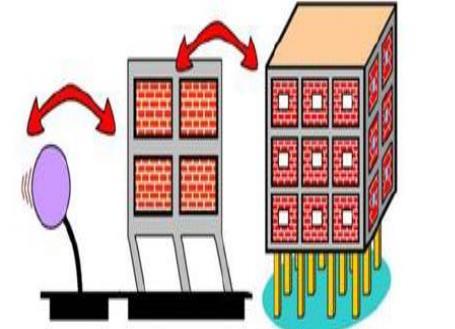
Among different structural systems, dampers are the most effective for designing buildings, so the purpose of this project is to study the seismic response of buildings with dampers installed at differentlevelsofsoftlayers.
Investigate the effect of dampers to improve the seismicperformanceofsoft-storybuildings.
Comparative study of various seismic parameters suchasbaseshearforsolidlayershear,layershear, undampedanddamper.
International Research Journal of Engineering and Technology (IRJET) e-ISSN: 2395-0056
Volume: 11 Issue: 05 | May 2024 www.irjet.net p-ISSN: 2395-0072
• Technologicalsuperiority
• Innovationininfrastructure
• Duetorapidpopulationgrowth
• Increasingdemandforhousingandparking
• Economicdevelopment
• Desireforaestheticsinurbanareas
2. Literature Review
[1] Akshay Shaji , Amrutha Binu, Dibi Divakaran, Swaraj V, “Seismic Analysis of Soft Storey Buildings”, International Journal of Scientific & Engineering Research
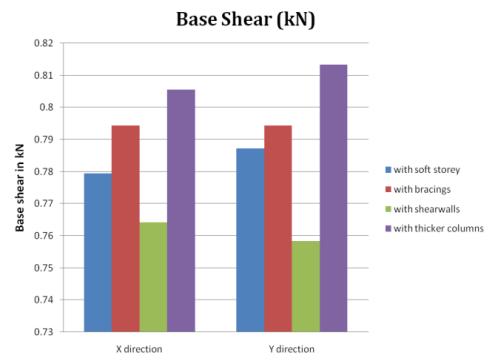
Inthisstudy, theseismic behaviour of differentmodels of soft-storied frame buildings reinforced with shear walls, bracingandrigidcolumnsiscomparedwiththesoft-storied framemodel.ETABSisusedtoperformresponsespectrum analysis, and parameters such as main shear, stiffness, interaxialdrift,andlayerdriftareinvestigated.
Whenitisbuiltwithshearedwalls,comparedtoreinforced concretestructures,itsstrengthisincreasedandthereisa reductionindisplacementanddisplacement.Themainshear oftheshearwallmodelwasfoundtobetheleastcompared toothermodels.
[2] Uma Devi R, Kavitha S, Sahana S Sastry, “Seismic Performance of A RC Frame with Soft Storey Criteria”, International Journal of Research in Engineering & Technology
Inthepresentstudy,anattemptwasmadetoinvestigatethe seismic behaviour of multi-story buildings with soft soil
floors.Whenexposedtoseismicloads,soft-plyframeswere observedtobelessresistantthaninfillframes.
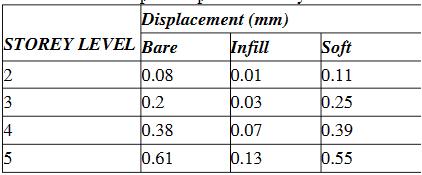
Figure3:ResponseSpectrumAnalysisResult
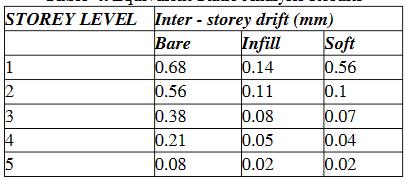
Figure4:EquivalentStaticAnalysisResult
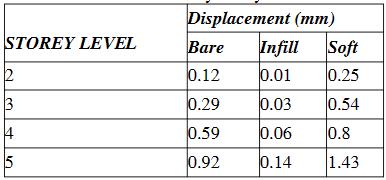
Figure5:TimeHistoryAnalysis
Filled frames should be preferred over open first floor frames in seismic areas because the first floor of an open firstfloorframeislargerthanthetopfloor,whichmaycause thestructuretocollapse.
[3] S. uttamraj, K. Mythili, “Analysis of Soft Storey for Multi Storied Building in Zone-4”, International Journal of Research and Innovation (IJRI)
Inthisthesisanalysisofsoftfloorforhigh-risebuildingsin zone4,thefiniteelementapproachisusedto analyseand studythebehaviourofsoftfloorbuildingsatdifferentfloor levelsundertheactionofseismicloadandtheactionofwind load.AllanalyseswereperformedwithEtabssoftware.base shear, layer displacement, layer drift are calculated and comparedforallmodels.
Theresultsofthisstudyshowthatthesoftfloorwillhavea very decisive effect on the structural behaviour of the buildingandthestructuralcapacityunderthelateralload. Changesandrelativestorydriftsareinfluencedbystructural irregularities.
International Research Journal of Engineering and Technology (IRJET) e-ISSN: 2395-0056
Volume: 11 Issue: 05 | May 2024 www.irjet.net p-ISSN: 2395-0072
[4] Eben C. Thomas, “Seismic Response of Soft Storey Buildings with Viscoelastic Dampers”, International Journal of Engineering Research & Technology
Inthecurrentstudy,theseismicperformanceofsoft-story buildings equipped with VED was investigated. Dynamic analysis is performed using ETABS software, considering different time history analyses. The results obtained from the software for models with and without dampers were analyzed in terms of upper story displacement, interstory drift,androofacceleration.
Viscoelasticdamperoffersasignificantseismicreductionof thebuilding.VEDsaremaintenancefreeandeasytoinstall comparedtootherdampers.ThemainadvantageofVEDsis that they absorb even small vibrations, while friction dampers, producing dampers, absorb seismic energy only afteracertainthreshold.
[5] S. Zubair Ahmed,K.V.Ramana,RamancharlaPradeep Kumar, “SEISMIC RESPONSE OF RC FRAME STRUCTURE WITH SOFT STOREY”, International Journal of Research in Engineering and Technology
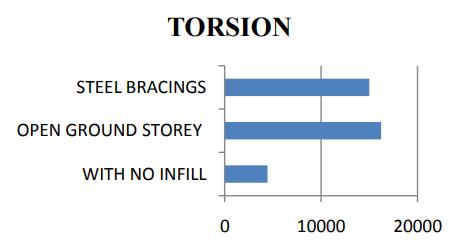
InthiscaseR.C.C.Thisbuildingwasmodelledandanalysed inthreecases.I)Modelwithoutwalls(baremodel).II)open modelwithbottomlayer.III)Structuralsteelmodelonthe groundfloor.Dynamicanalysisofthebuildingmodelisdone in ETABS. Building performance is evaluated in terms of store drifts, lateral displacements, lateral force, layer stiffness,baseshear,timeperiod,torque.
It was found that the steel bracing system in the exposed sub-floorsignificantlycontributestothestructuralstrength andreducesthedisplacementofthemaximumstoryspanof the R.C.C building. It was found that the X-type torsional effectofthesub-floorsteelframeislow.
[6] Pravesh Gairola, Mrs. Sangeeta Dhyani, “Seismic Analysis of Open Soft Storey Building for Different Models”,International Journal of EngineeringResearch & Technology
In this paper, a study was conducted to investigate the seismic behaviour of soft floor buildings with different
models (bare frame, infill frame, span frame, shear wall frame)underearthquakeloads.Ifprovidedwithadifferent model,itincreasesthedurablemovementofthestructure comparedtothesoftlayerprovided.
Thesingle-layershearstrengthwasthehighestforthefirst layer and decreased to a minimum in the top layer in all cases.Itisobservedthatthesoliddriftishigherinthebare framemodel.Asaresultofthecomparison,thestiffnessis thehighestfortheshearwallmodel.Theseresultsshowthat the shear wall system provides stronger retention and performanceagainstseismic changesandisa goodmodel amongall.
Theeffectsofthemodelarecomparedinaseriesofresults, comparingvariousparameterssuchasdisplacements,layer drifts and basic shear. From the obtained results, the followingconclusionsaredrawn,
1) Hard floor and floor displacement of soft-story buildingsincreaserespectivelyby7.8%and10.3% comparedtoconventionalbuildings.
2) It is observed that the drift is higher in the bare framemodel.
3) The drift floor for all stories is within the limits allowedbythecode.
4) Withtheuseofdampersattachedtothestructure, thesoftlayerstorydriftandlayerdriftarereduced by 53.7% and 47.89%, respectively, without the dampermodel.
5) RC frame buildings with an open lower floor are knownmalfunctioninastrongearthquake.That'sit is clear that such buildings will show poor performanceduringastrongshock.
6) The average displacement value in the soft layer withthesmallestdampermodel(47.53%).
7) Thedriftlayerincreasesslightlyinthesecondlayer becausethereisaneffectofalesssmoothlayerin theupperlayer.
8) From the comparative study, construction with angledamperhasbetterperformancewhenseismic forceisconsidered.
[1] Abhishek Kumar Maurya, V.K. Singh “Analysis of Building Using Viscous Dampers in Seismic”, InternationalJournalofAdvancesinMechanicaland CivilEngineering,Volume-5,Issue-3,Jun.-2018
International Research Journal of Engineering and Technology (IRJET) e-ISSN: 2395-0056
Volume: 11 Issue: 05 | May 2024 www.irjet.net p-ISSN: 2395-0072
[2] AkshayShaji,AmruthaBinu,DibiDivakaran,Swaraj V “SEISMIC ANALYSIS OF SOFT STOREY BUILDINGS”, International Journal of Scientific & Engineering Research Volume 10, Issue 5, May2019
[3] Eben.C. Thomas “SEISMIC RESPONSE OF SOFT STOREY BUILDINGS WITH VISCOELASTIC DAMPERS”, International Journal of Engineering Research&Technology,SpecialIssue2015
[4] IS 1893 (Part 1):2002, “Criteria for earthquake resistant design of structures”, Bureau of Indian standards,NewDelhi,2002
[5] IS 875 (Part 1):1987, “Code of practice for design loads (other than earthquake) for buildings and structures”, Part 1, Dead loads, Bureau of Indian standards,NewDelhi,1989
[6] IS 875 (Part 2):1987, “Code of practice for design loads (other than earthquake) for buildings and structures”, Part 2 Live loads, Bureau of Indian standards,NewDelhi,1989
[7] IS 875 (Part 3):1987, “Code of practice for design loads (other than earthquake) for buildings and structures”, Bureau of Indian standards, New Delhi,1989
[8] S.uttamraj,K.Mythili“ANALYSISOFSOFTSTOREY FOR MULTI STORYED BUILDING IN ZONE-4”, International Journal of Research and Innovation (IJRI),Volume1Issue1,September2014
[9] Uma Devi R, Kavitha S, Sahana S Sastry “SEISMIC PERFORMANCE OF A RC FRAME WITH SOFT STOREY CRITERIA”, International Journal of Research in Engineering & Technology Volume 4 Issue3,March2015