
International Research Journal of Engineering and Technology (IRJET) e-ISSN: 2395-0056
Volume: 11 Issue: 05 | May 2024 www.irjet.net p-ISSN: 2395-0072
International Research Journal of Engineering and Technology (IRJET) e-ISSN: 2395-0056
Volume: 11 Issue: 05 | May 2024 www.irjet.net p-ISSN: 2395-0072
P.NiranjanReddy Professor Computer Science and Engineering.
Kakatiya Institute of Technology and Science.
Warangal, India
Anvitha Kandi Computer Science and Engineering.
Kakatiya Institute of Technology and Science.
Warangal, India
Sai KumarReddyRikkala
Computer Science and Engineering
Kakatiya Institute of Technology and Science.
Warangal, India
Abstract This large-scale effort aims to improve images by using reinforcement learning approachesto overcome the difficulties related to underwater imagery. Due to the special challenges presented by underwater environments such as low contrast, color distortion, and limited visibility traditional image processing techniques struggle to produce acceptable results. This work suggests a novel method for adaptively improving underwater photos that makes use of reinforcement learning algorithms. The study starts with a thorough examination of the components that contribute to underwater image deterioration and an investigation of current improvement techniques. Deep neural networks are then used in a reinforcement learning framework to determine the best improvement policies. Through training on a wide range of underwater photo datasets, the model learns to automatically modify contrast, brightness, and color correction settings. The performance of the suggested model is evaluated using a range of metrics, such as visual comparisons with the state-of-the-art improvement strategies and an evaluation of image quality. The outcomes show how well the reinforcement learning strategy works to dramatically increase underwater image visibility and quality. Experiments carried out in various settings and with diverse illumination conditions are also used to evaluate how well the model adapts to various underwater situations. This study introduces a data-driven, learning-based method to improve image quality, which advances the field of underwater imaging. The model can adapt to a variety of underwater conditions thanks to the application of reinforcement learning, which also automates the enhancement process. The results of this work may find use in marine biological studies, environmental monitoring, and underwater surveillance, where high-quality photography is needed
Keywords Double Deep Q network, Markov decision process (MDP), reinforcement learning, underwater image enhancement.
Underwater environments present unique challenges for imaging systems, characterized by poor visibility, light attenuation,andcolourdistortioncaused byscatteringand
Mohammed AbdulSameer Computer Science and Engineering
Kakatiya Institute of Technology and Science.
Warangal, India
Soniya Chalamalla
Computer Science and Engineering
Kakatiya Institute of Technology and Science.
Warangal, India
absorption phenomena. Capturing high-quality images in such conditions is crucial for various applications, including marine biology [3], oceanography, underwater archaeology[2], and surveillance. According to research literature, humans experience between 70% and 80% of their environment through visual information [1]. Traditional image enhancement techniques often struggle toaddressthecomplexanddynamicnatureofunderwater scenes, prompting the exploration of novel approaches such as reinforcement learning (RL). Reinforcement learning, a branch of machine learning, has garnered significant attention in recent years for its ability to learn optimal decision-making policies through interaction with an environment. In the context of underwater image enhancement, RL offers a promising framework for automatically improving image quality by learning to adaptively adjust parameters or operations based on feedback from the environment or human experts. This research paper aims to explore the application of reinforcement learning techniques to the task of underwater image enhancement. By formulating the enhancement process as a sequential decision-making problem, RL algorithms can learn to make intelligent adjustments to image parameters such as contrast, brightness, and colour balance to maximize visual quality and clarity. Moreover, RL-based approaches have the potential to adapt to varying underwater conditions, such as changes in water turbidity, illumination, and scene complexity, making them robust and versatile for realworld deployment. By leveraging the power of reinforcement learning, we aim to advance the state-ofthe-artinunderwaterimageenhancement.
Many obstacles arise from underwater imaging, making it more difficult to collect and process visual data in aquatic settings. One of the main challenges is light attenuation, which causes less contrast and visibility in underwater photos as light is absorbed and scattered as it passes through water. Water stains and suspended particles can
International Research Journal of Engineering and Technology (IRJET) e-ISSN: 2395-0056
Volume: 11 Issue: 05 | May 2024 www.irjet.net
cause scattering, which worsens the quality of the image. Anothermajorissueiscolordistortion,whichiscausedby water functioning as a selective filter that changes and absorbs colors differently depending on depth, losing contrast and color integrity in the process. Moreover, backscatter, which is the result of light bouncing off of suspended particles or underwater life, adds extra noise and haziness to photos. Addressing these challenges requires innovative approaches in image processing, computer vision, and machine learning to develop robust techniques for enhancing underwater images and extractingmeaningfulinformationfromthem.
B. Objectives
• To elevate underwater image quality by fine-tuning parameterssuchascontrast,brightness,colorbalance,and sharpness.
• To adapt its enhancement process by learning to choose appropriateactionsbasedonthespecificcharacteristicsof eachimage.
• To rectify color casts, ensuring images exhibit more naturalandaccuratecolors.
• To learn an optimal sequence of actions to achieve the best possible enhancement while taking into account the specificcharacteristicsofeachimage.
• Togeneralizeitsenhancementstrategiestonew,unseen images, even if they were captured under different conditions
A. Existing System
Many approaches in underwater image enhancement draw inspirationfrom imagedehazing techniques used in computer vision. The goal of these techniques is to eliminate the deteriorating effects of light absorption and scattering in water, which affect underwater photos. Underwater picture improvement has led to the adaptation and extension of techniques including dark channel prior, atmospheric light estimate, and transmission map estimation. Histogram equalization[4] and contrast enhancement techniques[5] are commonly employed to stretch the dynamic range of underwater images, making them visually more appealing and informative. Convolutional neural networks (CNNs) have been used to enhance underwater images thanks to currentdevelopmentsindeeplearning.Theseapproaches often involve training CNNs on large datasets of paired underwater and reference images to learn complex mappings between degraded and enhanced image domains.
B. Drawbacks of Existing System
Conventionally, underwater picture enhancement methods based on image processing techniques are very explicable
p-ISSN: 2395-0072
because they often rely on simplified underwater optical features. Nonetheless, the image processing technique typically uses an invariant parameter setup and does not discernbetweenvarioussceneries(e.g.,turbidity,light,and filmingangles).Inthiscase,a singletechnique is unableto adjust to different underwater scenarios. The intricacy of the underwater environment might lead to inconsistent method performance, causing inaccurate or even wrong enhancementoutcomes.Anend-to-endnetworkistypically usedtostructuredeeplearningtechniques.Theend-to-end structure's nonlinear compositions can be approximated universally. but do not inherently represent the fundamental idea or workings of underwater image processing. As a result, the deep learning method's black box processing strategy neither permits it to use explainable models based on image processing nor offers any guiding principles for enhancingthemodels.Adeepmodelneedsalotoftraining data pairs to be trained, and each pair consists of an underwaterimageandareferenceimagethatservesasthe underwater image. Nevertheless, obtaining clear, ground-truth underwater photographsisnotachievable.Asaresult,referenceimages in current methods are typically synthesized images that have been chosen by volunteers. The reference images' image quality serves as the upper bound for end-to-end network training, despite the fact that they are not the actual ground truth. The problem in this situation is still howtoproduceenhancedphotosthatareofhigherquality thanthereferencephotographs.
Duetolowvisibility,colordistortion,andlightattenuation, underwater imaging faces many difficulties. In this paper, weofferanovelreinforcementlearning(RL)frameworkto improve the quality of underwater images. The four main partsoftheframeworkareanactionselection modulethat usesanε-greedypolicy,adeepQnetwork(DQN)foraction estimation, a feature extraction module that extracts color and perception features from underwater images, and a reward calculation mechanism that prioritizes improving image quality. Our method uses reinforcement learning (RL) to dynamically modify enhancement parameters in order to maximize image quality under different underwater situations. Comparison with traditional enhancementmethods,experimentalresultsshowthatour suggested framework is effective in greatly increasing underwaterimagequality.
• Begin by selecting a single underwater image as inputtoenhanceitfromrawunderwaterdataset.
• Taketheperceptionandcolourfeaturesoutofthe input image. It shows the condition of the environment.
International Research Journal of Engineering and Technology (IRJET) e-ISSN: 2395-0056
Volume: 11 Issue: 05 | May 2024 www.irjet.net
• The agent, a deep Q network, interprets the state andcalculatesthevalueofQ(s,a)foreveryaction a.
• Choose a course of action governed by the εgreedyprinciple.
• The calculation of rewards for improving image quality,whichonlytakesplaceduringthetraining phaseandnotduringtheinferencephase.
• Design a User Interface Design using flask Django wheretheusercanselectanyrandomunderwater imageandgettheenhancedimageasoutput.
Feature Extraction: We employ the characteristics of the imagesasstates.Inparticular,weuseaperceptualfeature (Fp) and a global color feature (Fc). We use a color histogram from CIE Lab[6]. In our approach, we employ a method to quantify each axis of the CIE Lab color space into 20intervals. Specifically, we divide the three axes of theCIE Labspace L (lightness),a (green-redaxis),andb (blue-yellow axis) into 20 equal intervals each. We proceed to calculate the number of pixels falling within each interval. By aggregating this information, we construct a three-dimensional histogram spanning a (20×20×20) dimensional space. The perceptual information of the image is embedded in the VGG-19 model's intermediate activation. This 4096-dimensional activationvectorservesasourperceptionfeature,denoted asFp.Eachelementofthevector encapsulatesthemodel's learned representation of different aspects of the input image, ranging from basic visual elements to complex patternsandstructures.
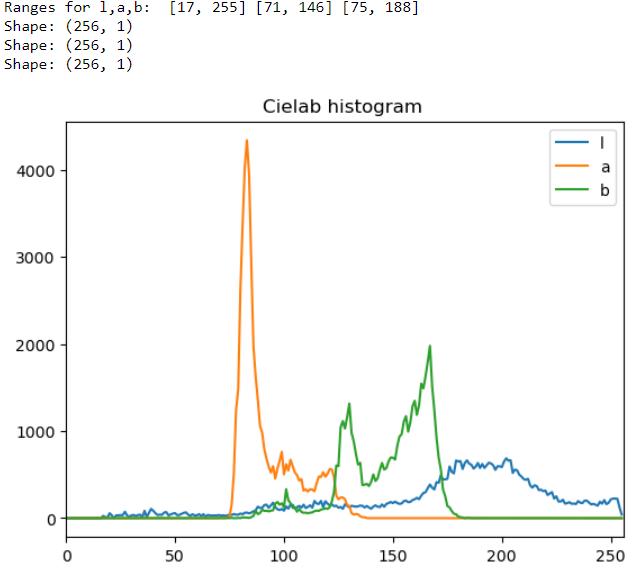
Fig4.1.CIELabcolorfeatures
p-ISSN: 2395-0072
Deep Q Network: Fourfullyconnectedlayersmakeupthe DQNinmostcases.Thecurrentstaterepresentationisfed into the network. This could be a feature vector in some applications that represents the state, or it could be an image's properties in computer vision tasks. The output layer consists of nodes corresponding to each possible action in the environment, with each node outputting the estimatedQ-valueforthataction.
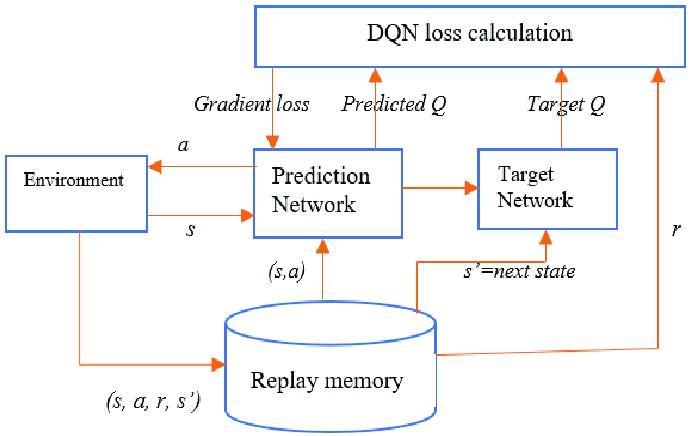
fig4.2 DeepQnetworkarchitecture
Double Deep Q Network: TherearetwodeepQ-networks that make up the DDQN: the assessment deep Q-network and the target deep Q-network. They are both identical. Generally speaking, both networks have the same fully connected layer architecture. Given the current state, the actionsto be taken are chosen by the evaluation network, and their estimated value is determined by the target network.
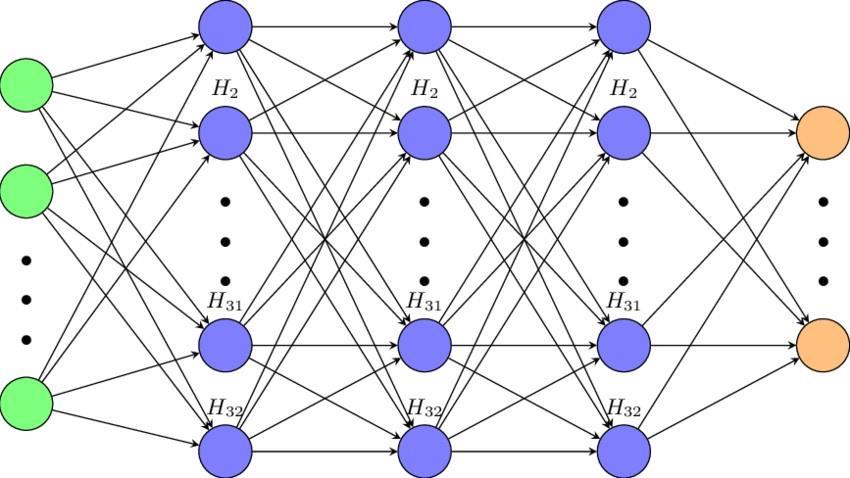
Fig4.3.VisualizationofDDQNstructure
Action Selection:Inourapproach,weemployanε-greedy policy for action selection, a widely used strategy in reinforcement learning that balances exploration and exploitation. This policy allows the agent to explore new actionswithaprobabilityofεandexploitthecurrentbest actionwithaprobabilityof(1-ε).
The agent selects actions from a predefined set, including brightness adjustment, contrast enhancement, color
International Research Journal of Engineering and Technology (IRJET) e-ISSN: 2395-0056
Volume: 11 Issue: 05 | May 2024 www.irjet.net
saturationadjustment,and noisereduction,amongothers. These actions are designed to address common issues encountered in underwater imaging, such as poor illumination, low contrast, and high levels of noise. Additionally,weintroducenewactionstailoredspecifically for underwater image enhancement, such as dark channel prior (DCP) dehazing and color temperature adjustment. Through extensive experimentation and evaluation, we demonstrate the effectiveness of our approach in significantly improving the quality of underwater images, Actionsperformedarelistedtable4.1.Ourresultsindicate that the RL-based image enhancement method outperforms traditional enhancement techniques and achieves state-of-the-art performance in underwater imagequalityenhancement.
Reward Calculation: Todefinetheimagequality,weusea reward calculation mechanism in our approach that combines perceptual loss and pixelwise loss. This hybrid approach leverages both low-level pixelwise differences and high-level perceptual features to provide a comprehensive assessment of image fidelity and perceptualsimilarity.
The pixelwise reward is defined as the change of the negativepixelwiselossandisgivenasfollows:
Rc(t)=−[Lc(t)–Lc (t−1)]
WhereLc(t)ispixelwiseloss.
The perception reward is defined as the change of perceptionlossandisgivenasfollows:
Rp(t)=−[Lp(t)–Lp(t−1)].
WhereLp(t)isperceptualloss.
Finally,therewardisgivenasfollows:
R=αRc +βR
Whereαandβarebalancecoefficients
B. Reinforcement learning
Withthegoalofmaximizingcumulativerewards,anagent canlearntomakesuccessivedecisionsbyinteractingwith its environment. This challenge is addressed by the powerful machine learning paradigm known as reinforcementlearning(RL).Reinforcementlearning(RL) is the process by which an agent discovers the best strategy by making mistakes and using input from its surroundings. The agent gains the ability to assess the
p-ISSN: 2395-0072
meritsofvariousstatesandactionswiththeassistance of this feedback, which usually takes the shape of rewards. Thisallowstheagenttodevelopefficientdecision-making procedures. Natural language processing, robots, gaming, finance, healthcare, and other fields where complicated decision-makingproblemscallforintelligentandadaptive behaviour are among the many fields in which reinforcement learning finds use. Even though reinforcement learning (RL) has substantial theoretical and computational obstacles, such as managing sparse incentives, maintaining convergence in learning algorithms, and striking a balance between exploration and exploitation, it also offers potential solutions to difficult issues. To overcome these obstacles and improve the capabilities of reinforcement learning systems, new algorithms, theoretical understandings, and useful techniques must be developed. Our goal in this research article is to shed light on the theoretical foundations and practicalconsequencesofreinforcementlearningforrealworld problem solving by delving into its core ideas, algorithms,andapplications.
Markov Decision Process (MDP) is a mathematical framework designed to simulate decision-making in scenarios where decisions have partially controlled and partially unpredictable results. It's stochastic in discrete time. Rewards, transition probabilities, states, and actions definethecharacteristicsofacontrolprocess.
WithinanMDP:
1. States (S): These represent the different situationsorconfigurations ofthe environmentin whichthedecision-makerfindsitself.Ateachtime step,thesystemisinoneofafinitesetofstates.
2. Actions (A):Thesearethechoicesavailabletothe decision-maker in each state. The decision-maker selectsanactionbasedonitscurrentstate.
3. Transition Probabilities (P): For each stateactionpair,thereisaprobabilitydistributionover next states. It captures the likelihood of transitioning from one state to another after takingaspecificaction.
4. Rewards (R): After each action, the decisionmaker receives a numerical reward signal that indicates the immediate desirability of the stateaction pair. The goal of the decision-maker is to maximize the cumulative sum of rewards over time.
5. Policy (π): This is the strategy or rule that the decision-makerusestoselectactionsineachstate.
© 2024, IRJET | Impact Factor value: 8.226 | ISO 9001:2008
International Research Journal of Engineering and Technology (IRJET) e-ISSN: 2395-0056
Volume: 11 Issue: 05 | May 2024 www.irjet.net
It maps states to actions, defining the decisionmakingbehaviouroftheagent.
The central tenet of a Markov Decision Process (MDP) is the Markov property, according to which the future depends only on the action and state at hand, not on the history of past actions and situations. This characteristic makes decision-making process modelling and analysis easier, allowing effective algorithms to be used to identify thebestpolicies.policies.
A. Framework
There are four main components to the framework. A feature extraction module in the first section takes an underwater image and extracts its color and perceptual features.Itshowshowtheenvironmentisinthatsituation. The deep Q network, which makes up the second section, processesthestateandcalculatesanapproximatevalueof Q(s, a) for every action a. The action selection module, located in the third section, chooses an action that compileswiththeε-greedypolicy.Rewardcomputationfor improving image quality, which only functions during the training phase and not during the inference phase, is the lastsection.
B. OBJECTIVE:
The objective of applying reinforcement learning to the MDP problem is to find the best (exploitation) that is subjecttothehighestaccumulatedreward.Thecumulative reward at step t is represented by the value Q(st, at). A recursive process can be used to increase the cumulative rewardas:
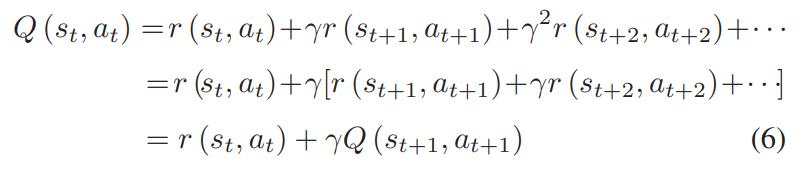
The Markovian property of the MDP means that, independent of the states at earlier stages, the action at step t is only decided based on the state st at step t. By maximizingtheaccumulatedrewardQ(st,at)atstept:
We can choose the best course of action at that point. Thegoalofreinforcementlearningisthattheagentlearns the best course of action in long-term progressive interactionswiththeenvironmentinaccordancewith(7).
p-ISSN: 2395-0072
Step 1 - Choose Dataset: Begin by selecting a single underwater image as input to enhance it from raw underwaterdataset.
Step 2 - Feature Extraction: It takes an inputimage and extractsitsperceptionandcolorfeatures.Itshowshowthe stateoftheenvironment.
Step3-AgentNetwork:TheagentisadeepQnetworkthat receives input fromthestateandcalculatesthe valueof Q (s,a)foreveryactiona.
Step 4-Action Selection: chooses an action that complies withtheε-greedypolicy.
Step 5: Reward Calculation: This step calculates rewards basedona improvementin imagequalitythatonlyoccurs during the training phase and not during the inference phase.
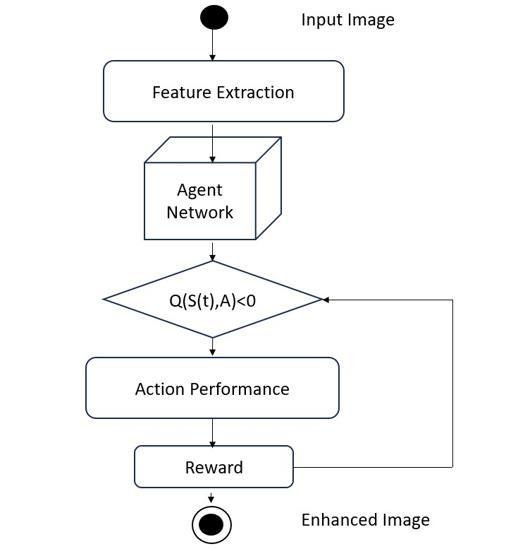
Fig5.1Framework
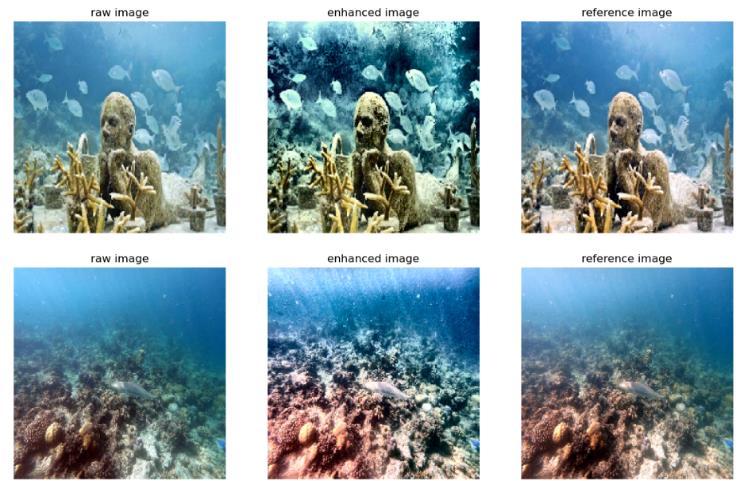
Fig5.2.Raw,ReferenceandEnhancedimages
International Research Journal of Engineering and Technology (IRJET) e-ISSN: 2395-0056
Volume: 11 Issue: 05 | May 2024 www.irjet.net
Graphical User Interface (GUI): The reinforcement learning (RL) algorithm is integrated into a web applicationframework combining Flask andDjango. Flask andDjangoarebothwebframeworksforPython,butthey serve different purposes and have different approaches. Flask is a micro web framework, while Django is a fullfledged web framework with many built-in features. The webapplicationfacilitatesuserinteraction,allowingusers to upload underwater images and receive enhanced versionsinreal-time.
1.2DataPreprocessing
Table4.1ActionsPerformed
Experimental assessments of our work in this field are presented.Weprovidetheexperimentsetupsanduseboth qualitative and quantitative evaluations to confirm the effectivenessofourmethodology
A. Setup Details
1.Introduction
1.1ExperimentalData
The research is grounded in the UIEB (Underwater Image Enhancement Benchmark) dataset, a carefully curated collection of underwater images capturing diverse environmental conditions. This dataset is instrumental in training and evaluating our proposed reinforcement learning-basedmodel.TherichnessandvariabilityofUIEB contribute to the robustness and generalization capability ofourmodelacrossdifferentunderwaterscenarios.
p-ISSN: 2395-0072
To ensure the integrity of the experimental data, a meticulous preprocessing stage was employed. This included color correction to address underwater color distortions, artifact removal to eliminate anomalies, and resizing images to a standardized resolution. By maintaining a consistent and high-quality dataset, biases were minimized, and the model's performance was optimizedforreal-worldapplications.
2.TrainingDetails
2.1ModelArchitecture
Our model architecture integrates a convolutional neural network (CNN) as the underlying image processing backbone.Thereinforcementlearningcomponentsaddan adaptive layer to the model, enabling it to learn and enhance features specific to underwater images. This architecture is designed to capture the complexities of underwater scenes and provide a flexible framework for improvement.
2.2ReinforcementLearningSetup
StateRepresentation:Rawunderwaterimagesserveasthe input, allowing the model to learn and extract relevant features.
Action Space: Adaptive transformations applied to pixel values,addressingcolorbalance,contrast,andvisibility. Reward Mechanism: The reward mechanism is carefully designed to guide the learning process, emphasizing improvements in perceptual quality, color accuracy, and visibility.
2.3TrainingData
Training Dataset: A subset of the UIEB dataset, annotated with corresponding ground truth images, forms the training data. This ensures the model learns from diverse underwaterscenarios.
Data Augmentation: Experimental assessments of our work in this field are presented. We provide the experiment setups and use both qualitative and quantitativeevaluationstoconfirmtheeffectivenessofour methodology2.4TrainingProcedure
The training process involves iterative optimization of model parameters, using an appropriate optimization algorithm, such as Adam. Convergence criteria were established, and early stopping mechanisms were implemented to prevent overfitting. This careful training procedure ensures the model's adaptability and effectivenessinenhancingunderwaterimages.
3.ComparisonMethods
3.1BaselineMethods
Baseline 1: Traditional image processing techniques, including histogram equalization, color correction, and contraststretching.
Baseline 2: A CNN-based approach without reinforcement learningcomponents.
International Research Journal of Engineering and Technology (IRJET) e-ISSN: 2395-0056
Volume: 11 Issue: 05 | May 2024 www.irjet.net p-ISSN: 2395-0072
3.2EvaluationMetrics
Quantitative assessments leveraged standard image quality metrics, including Peak Signal-to-Noise Ratio (PSNR)andStructuralSimilarityIndex(SSI).Thesemetrics provideobjectivemeasurestocomparetheperformanceof ourmodelagainstbaselinemethods.
B. Qualitative Evaluations
Within the intricate fabric of our research, qualitative evaluations unfold as a profound exploration, immersing us in a detailed and meticulous journey through the enhanced underwater images. This immersive analysis extends its reach to encompass a diverse panorama of methodologies, casting a comprehensive spotlight on the distinctive capabilities inherent in Raw, FUnIE-GAN [7], UWCNN[8],Water-Net[9],DeepSESR[10],Reference,and the groundbreaking Reinforcement Learning-based approach.
1.VisualResults
Navigating the intricate details embedded within Figure, weembark ona panoramic odyssey,a visual tapestrythat intricately weaves together Raw, FUnIE-GAN, UWCNN, Water-Net, Deep SESR, Reference, and the Reinforcement Learning-based method. This visual symposium transcends mere observation, delving into the subtleties with a discerning eye. The interplay of color fidelity, the finesse in contrast enhancement, and the overarching orchestrationofscenevisibilityunfoldinavisualnarrative thatseeksnotonlytoshowcasebuttodecodethenuanced contributions each method brings to the enhancement of underwater imagery. This rich and multifaceted explorationisanimmersivediveintothevisualintricacies, allowing for a profound understanding of the distinct attributes that define each method's impact on the underwatervisuallandscape.
Color Fidelity: The Reinforcement Learning-based method demonstrates superior color correction, mitigating typical underwater color distortions. Enhanced images exhibit natural and accurate color representations essential for applicationslikemarinebiologyresearch.
Contrast Enhancement: The adaptive learning mechanism excels in enhancing contrast, revealing finer details in underwater scenes. This is particularly evident in challenging conditions where traditional methods may struggletomaintainvisibility.
Scene Visibility: Overall improvement in scene visibility is apparent. The Reinforcement Learning-based method effectively addresses challenges such as low visibility and hazeinunderwaterenvironments,resultinginclearerand moreinformativeimages.
2024, IRJET | Impact Factor value: 8.226 |
1.1ComparisonwithOtherMethods
RawImages:Rawunderwaterimagesserveasthebaseline for comparison. The Reinforcement Learning-based method outperforms raw images, showcasing substantial improvementsincolorrepresentationandscenevisibility.
FUnIE-GAN, UWCNN, Water-Net, Deep SESR: Comparative analysis against existing methods reveals the strengths of the Reinforcement Learning-based method. It demonstrates adaptability and enhanced performance acrossdiverseunderwaterconditions.
Reference Images: Reference images serve as the ground truth for evaluation. The Reinforcement Learning-based method strives to approach the visual quality of reference images, indicating promising results in underwater image enhancement.
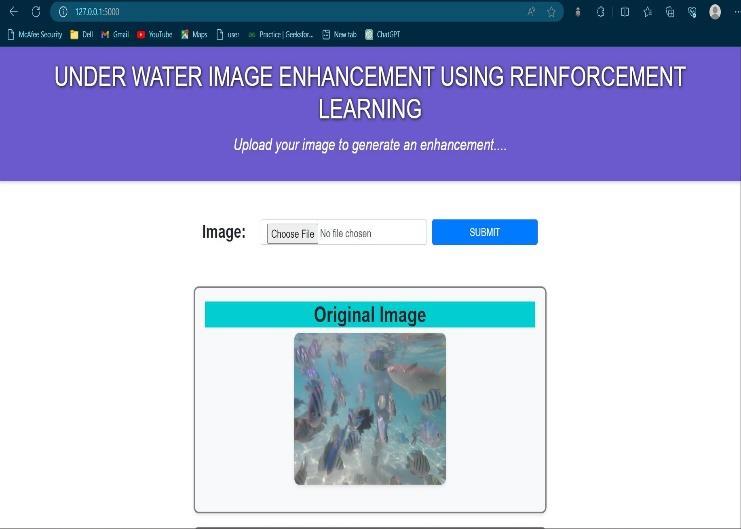
Fig6.1GUIApplicationforUnderWaterImage Enhancement
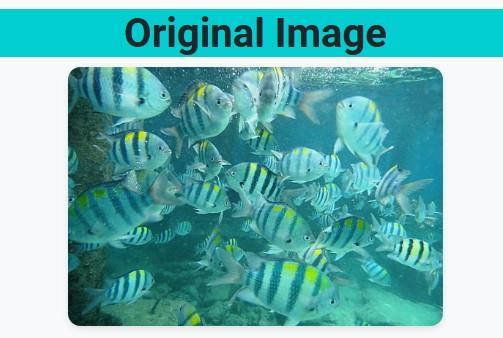
Fig6.2InputRawImage
International Research Journal of Engineering and Technology (IRJET) e-ISSN: 2395-0056
Volume: 11 Issue: 05 | May 2024 www.irjet.net
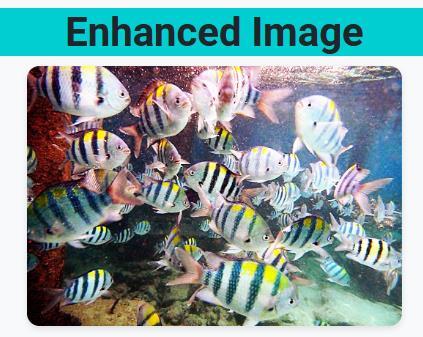
Fig6.3EnhancedImageForgivenInputimage
C. Quantitative Evaluations
Quantitative evaluations provide numerical insights into the performance of various methods, including Raw, FUnIE-GAN, UWCNN, Water-Net, Deep SESR, Reference, and the proposed Reinforcement Learning-based method. This section includes PSNR and SSIM values for a comprehensiveassessment.
1.MetricsandValues
Table presents the quantitative metrics for Raw, FUnIEGAN, UWCNN, Water-Net, Deep SESR, Reference, and the ReinforcementLearning-basedmethodontheUIEBtesting set.
Table6.1Metricsandvalues
The agent may learn to improve the photographs by executingactionsutilisingfactorslikebrightness,contrast, and colour balance through the use of reinforcement learning.Theagentadjusts thesesettingsandisrewarded orpunishedaccordingtohowcloselytheimprovedphotos meet the target quality. Over time, the agent learns to make better adjustments, resulting in improved
p-ISSN: 2395-0072
underwaterimagequality.Thisapproachhasthepotential to greatly enhance underwater images, making them clearer, sharper, and more vibrant. It can be particularly useful for different types of applications like underwater photography, marine research, and underwater exploration.
Furthermore, applications of this technology can extend beyond just image enhancement. It can be utilized in underwater robotics, underwater surveillance systems, and even in virtual reality experiences. We can improve marine research, conservation, and underwater exploration by improving the quality of random underwaterphotos.
We have improved underwater photos in this project by using a novel reinforcement learning technique. A collectionofimageenhancementactionscanbechosenby the reinforcement learning framework, and it can then arrange them in the best possible order to convert the initial raw underwater image progressively into highqualityunderwaterphotographs.Throughbothqualitative analyses and quantitative analyses, it's confirmed that the paradigm for reinforcement learning works well for improving undersea pictures There are many advantages toourframework.
Initially, It has the ability to arrange a series of simple image improvement methods, each of which has a finite amount of power if used separately, to create a comprehensive one. Secondly, it provides significant insights into the underlying mechanism of picture improvement and is more evident than deep learning techniquesappliedend-to-end.Thirdly,itmakesupforthe generalization capacity shortfall caused by deep learningbased underwater picture improvement. Our technology canproduceanimprovedimagethatismoreinaccordance with human visual perception than the reference image quality limit. Finally, our framework is easily able to integrate additional image improvement methods to increasetheframework'soverallcomprehensiveness.This gives our system a great deal of flexibility so that it can support picture enhancing techniques that are more successful.
[1] B. K. Gunturk and X. Li,Image Restoration: Fundamentals and Advances. Boca Raton, FL, USA: CRC,2012.
[2] G. N. Bailey and N. C. Flemming, “Archaeology of the continental shelf: Marine resources, submerged landscapes and underwater archaeology,” Quaternary Sci.Rev.,vol.27,nos.23/24,pp.2153–2165,2008.
International Research Journal of Engineering and Technology (IRJET) e-ISSN: 2395-0056
Volume: 11 Issue: 05 | May 2024 www.irjet.net p-ISSN: 2395-0072
[3] M. Ludvigsen, B. Sortland, G. Johnsen, and H. Singh, “Applications of geo-referenced underwater photo mosaics in marine biology and archaeology,” Oceanography,vol.20,no.4,pp.140–149,2007.
[4] L. Wedding et al., “Managing mining of the deep seabed,” Science, vol. 349, no. 6244, pp. 144–145, 2015.
[5] ] J. S. Jaffe, “Underwater optical imaging: The past, the present,andtheprospects,”IEEEJ.Ocean.Eng.,vol.40, no.3,pp.683–700,Jul.2015.
[6] K. Simonyan and A. Zisserman, “Very deep convolutional networks for large-scale image recognition,”2014,arXiv:1409.1556.
[7] M.J.Islam,Y.Xia,andJ.Sattar,“Fastunderwaterimage enhancement for improved visual perception,” IEEE Robot. Autom. Lett., vol. 5, no. 2, pp. 3227–3234, Apr. 2020.
[8] C.Li,S.Anwar,andF.Porikli,“Underwatersceneprior inspired deep underwater image and video enhancement,”PatternRecognit.,vol.98,2020,Art.no. 107038.
[9] C. Li et al., “An underwater image enhancement benchmark dataset and beyond,” IEEE Trans. Image Process.,vol.29,pp.4376–4389,2020.
[10] M. J. Islam, P. Luo, and J. Sattar, “Simultaneous enhancement and superresolution of underwater imagery for improved visual perception,” 2020, arXiv:2002.01155.