
International Research Journal of Engineering and Technology (IRJET) e-ISSN:2395-0056
Volume: 11 Issue: 05| May 2024 www.irjet.net p-ISSN:2395-0072
International Research Journal of Engineering and Technology (IRJET) e-ISSN:2395-0056
Volume: 11 Issue: 05| May 2024 www.irjet.net p-ISSN:2395-0072
Jahnavi S, Keerthana K,Priyanka S, Sanjana L, Dr. Shilpa B L
Dept. of Information Science and Engineering (of VTU Affiliation), GSSS Institute of Engineering and Technology for Women, Mysuru, India.
Abstract – Birds play a crucial part in our ecosystem. Accurate bird classification is essential for understanding ecosystem dynamics, assessing biodiversity, and guiding conservation strategies. Traditional methods relying on manual observation are time-consuming and limited in scope, hindering comprehensive ecological studies and conservation efforts. In this paper, we propose a Convolutional Neural Network (CNN) approach for the automated classification of bird species from images or audio. The visual component of our model uses VGG16 (a specific CNN architecture) to extract features from bird images, while the Multilayer Perceptron (MLP) classifier extracts audio features. Our methodology leverages the power of deep learning to recognize distinct features of bird species, thus enabling accurate identification. We employ a dataset comprising images of various bird species. The dataset is pre-processed to eliminate noise and enhance image and audio quality, thereby facilitating effective training of the CNN model. The architecture is designed to extract hierarchical features from input images and audio and learn discriminative patterns associated with different bird species. Experimental results demonstrate the effectiveness of our proposed approach in accurately identifying the bird species. The model’s performance is evaluated using standard metrics such as accuracy. The proposed model promises potential for applications in ecosystem monitoring and environmental conservation.
Keywords- bird species, species detection, deep learning, Convolutional Neural Network (CNN), VGG16, image classification, audio classification, ecosystemmonitoring,biodiversityconservation.
As integral components of ecosystems, birds play multifacetedroles,includingseeddispersal,pollination, and insect control, thereby exerting profound influences on ecosystem dynamics and functioning. Furthermore, birds serve as indicators of environmentalhealth,withchangesinbirdpopulations oftenreflectingbroaderecologicalshifts.Understanding
bird species distributions, behaviours, and interactions is essential for analysing conservation strategies and safeguarding biodiversity. Traditional methods of bird classification predominantly rely on manual observation, which is labor- intensive, time-consuming, andpronetohumanerror.Inourmodel,weaddressthe challenges of limited labelled data by employing data augmentation strategies such as cropping, rotation and flipping, which help to augment the training dataset, thereby reducing overfitting and improving the generalizationabilityofthemodel.
Deep learning implemented in our model, has revolutionized variousfields,includingcomputervision and audio processing, by enabling machines to automatically learn hierarchical representations from raw Data. In recent years, Convolutional Neural Networks (CNN) have demonstrated remarkable performance in image classification tasks, while Multilayer Perceptron (MLP) has shown promising resultsinaudio-relatedtaskssuchasspeechrecognition andsoundclassification.
The motivation behind this research is driven by the need for efficient and accurate methods to monitor avian populations and their habitats. Accurate identification of bird species is crucial for assessing the population, habitats, and other details of birds. The endeavour to classify bird species through images and audio using deep learning is fueled by the need for effective, scalable methods for monitoring avian populations and ecosystems. Our methodology focuses on designing an efficient CNN architecture capable of capturingfine-grainedfeaturesofdifferentbirdspecies.
The traditional methods of bird classification rely on manualobservation,thatareoftentime-consumingand reliant on expertknowledge,posinglimitationsin scale and accuracy. These challenges enforce the need for automated approaches for species detection and classification of birds. By leveraging deep learning techniques, the goal is to overcome the limitations of traditionalmethods.
International Research Journal of Engineering and Technology (IRJET) e-ISSN:2395-0056
Volume: 11 Issue: 05| May 2024 www.irjet.net p-ISSN:2395-0072
To identify the bird species based on image inputoraudiofileinput.
Toimplementtransferlearningmodelvgg16 to train the bird’s species image dataset and toachievebetteraccuracy.
To implement species classification from bidssounds,weimplementanMLPclassifier fortrainingsoundfiles.
To implement a Python-based flask web framework a user interface where users can upload bird images or bird sound files and theclassificationresultisdisplayedwiththe birdspeciesinformation.
Paper title
Audio Classification of BirdSpecies Using Convolutional NeuralNetworks
Eyebirds: A Smartphone App forWater Bird Recognition
Methodology
CNNtoidentify patterns in the spectrograms specificdifferent birdspecies
Deeplearning model(AMCNN) with an attention mechanism to focus on crucial visual featuresin birdimages.
Acoustic Classification of BirdSpecies Using Early FusionofDeep Features
Fuse these deep features from various models using early fusion.
Classifying Bird Species
Audio Using Data
Augmentation andConvolutional NeuralNetworks
Newbirdcalls are basedonthe learned patterns fromthe CNN.
Dataset Used Key Findings
Large collections of labelled bird songrecordings
CNNsachievehigh accuracy in classifyingbird species from audiodata.
Waterbirdimage dataset containingover 548species across 48 familiesand203 genera
A dataset containing recordingsof43 birdspecies
Eyebirdsapp effectively identifieswater birdspeciesusing smartphone photos.
Earlyfusionof deep features from pretrained CNNs improves bird callclassification accuracy.
Existing bird songcollection is augmented usingdata augmentation techniques.
Data augmentation techniques increasethesize anddiversityof the training data,leadingto improved CNNperformance.
Multi-Label BirdSpecies Classification: ATransfer
Learning Approach
Leveraging
Audio-Visual Cues:AMultiModalApproach toBird
Species Classification withCNNand MultipleKernel Learning
Trainafinal classifier to predict bird speciesbasedon the fusedaudiovisual features. Alargedataset containing synchronized audio recordings and images of various bird species
Combining audio andvisual information improves bird species classification accuracy compared to using only audio or visual data alone.
Accelerating Bird
Speci es Identification: A Deep Learning Approach o nGPUs
Machine Learning Classification ofBird Species Basedon Vocalizations
Utilize a pretrained deep learning model (e.g., ResNet, Inception)on a large image dataset (e.g., ImageNet).
CNNlearns to identify distinctive visual features (color patterns, beak shapes) that differentiate birdspecies
Preprocess bird song recordings: convertthem into spectrograms (visual representatio nofsound).
Automated Recognition of Endemic Bird Species Using Deep Learning
PakhiChini: DeepLearning for Automatic BirdSpecies Identification
Compilea datasetof images containing endemicbird speciesfrom the target region.
Custom image dataset containing birdimages annotated with multiple bird species labels (e.g., birds appearing together at a feeder).
Transfer learning frompretrained models significantly reduces trainingtime comparedto training from scratch.
Largebird image collections (e.g., CaltechUCSD Birds200) Utilizing GPUs significantly accelerates the training process for deeplearning models in bird species identification.
Large collections of labeled bird song recordings (e.g., Xen o- canto)
Custom image collection focusingon endemicbird species of the target region (potentially combined with existing datasets like Birds-ofthe-World)
Utilizeapretrained deep learning model(e.g., Inception V3) to extract features from bird images.
Largebird imagedataset
Machine learning models can effectively classifybird speciesbased on the acoustic features extracted fromtheir songs.
Deeplearning models can accurately recognize endemic bird species from images.
Deep learning models effectively learn image features for bird species classification.
International Research Journal of Engineering and Technology (IRJET) e-ISSN:2395-0056
Volume: 11 Issue: 05| May 2024 www.irjet.net p-ISSN:2395-0072
This summary provides an overview of the methodologies, datasets and finding of selected papersonCNNsinbirdspeciesdetection,andoffering insightsintochallenges.
DataCollectionandPre-processing:
Gather a set of bird images sorted by species, maintaining uniformity in image dimensions (e.g., 224x224 pixels), standardizing pixel values, and possibly enhancing the dataset through augmentation techniquestobolstertrainingsetvariety.
Model Selection:
Choose the VGG16 model as the base for your classification project, valued for its straightforwardness and effectiveness in image classification. Employ either the pre-trained VGG16 model or adapt it to suit your particular dataset throughfine-tuning.
ModelArchitecture:
Develop a fresh classification component to accompanytheVGG16core,typicallyconsistingofone or more fully connected layers followed bya softmax layer to produce class probabilities. Modify the neurons in the final dense layer to align with the number of bird species in your dataset when finetuningVGG16.
Training:
Divide your dataset into training, validation, and testing sets, each serving specific roles in model training, hyperparameter tuning, and performance assessment. Train the model using the training set, validate its performance on the validation set, and monitorcrucialmetricssuchasaccuracyandloss.
Evaluation:
Evaluatethemodel'sperformanceaftertrainingusing the testing set, computing metrics like accuracy to measure its ability to generalize. Examine prediction visualizationsandmisclassificationstopinpointmodel constraintsandpotentialareasforenhancement.
Fine-Tuning:
Consider fine-tuning the model if its performance is below expectations, and modifying hyperparameters such as learning rate, batch size, or regularization strengthtoimproveefficacy.
Once content with its performance, proceed to deploy the model for inference on new bird images. This may entailincorporating it into platforms such as a Tkinterapplication,allowinguserstouploadbird imagesandobtainpredictions.
Each layer in a CNN applies a different set of filters, typically hundreds or thousands of them, and combinesthe results,feedingtheoutput into the next layer in the network. During training, a CNN automaticallylearnsthevaluesforthesefilters.Inthe context of image classification, our CNN may learn to Detectedgesfromrawpixeldatainthefirstlayer.Use these edges to detect shapes (i.e., “blobs”) in the second layer. Use these shapes to detect higher-level featuressuchas facialstructures,partsofacar,etc.in the highest layers of the network. The last layer in a CNN uses these higher-level features to make predictions regarding the Contents of the image. In terms of deep learning, an (image) convolution is an element-wise multiplication of two matrices followed byasum.
1. Taketwomatrices(whichbothhavethesame dimensions).
2. Multiply them, element-by-element (i.e., not thedotproduct,justasimplemultiplication).
3. Sum the elements together. Kernels Again, let’s think of an image as a big matrix and a kernelasatinymatrix(atleasttotheoriginal “big matrix” image), depicted in the above Figure. As the figure demonstrates, we are sliding the kernel (red region) from left to right and top to bottom along the original image.Ateach(x;y)-coordinateoftheoriginal image, we stop and examine the neighborhood of pixels located at the center of the image kernel. We then take this neighborhood of pixels, convolve them with the kernel, and obtain a single output value. Theoutputvalueisstoredintheoutputimage atthesame(x;y)-coordinatesas
International Research Journal of Engineering and Technology (IRJET) e-ISSN:2395-0056
Volume: 11 Issue: 05| May 2024 www.irjet.net
4. the center of the kernel. If this sounds confusing, no worries, we’ll be reviewing an exampleinthenextsection.Butbeforewedive into an example, let’s take a look at what a kernellookslike:
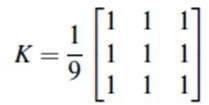
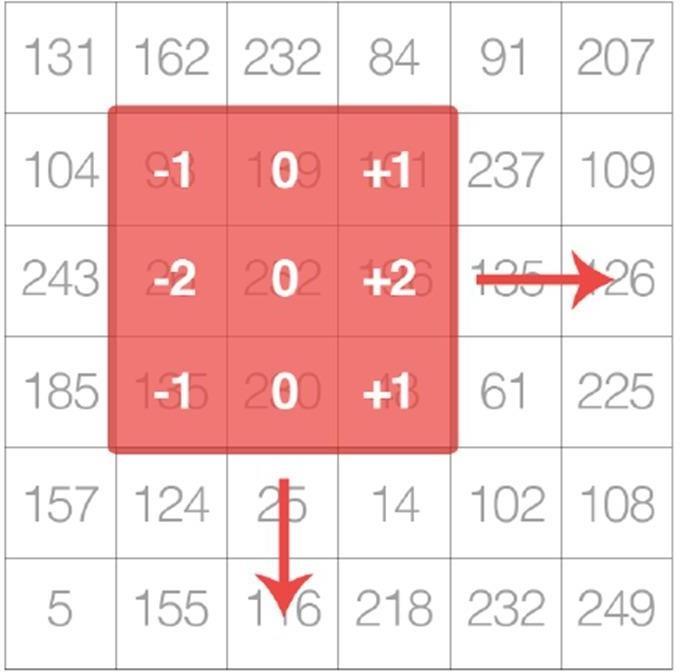
Figure3.2 Convolutionstriding
A kernel can be visualized as a small matrix that slides across, from left to right and top to bottom, of a larger image.Ateachpixelintheinputimage,theneighborhood oftheimageisconvolvedwiththekernelandtheoutput stored. We use an odd kernel size to ensure there is a validinteger(x;y)-coordinateatthecenteroftheimage (Figure 11.2). On the left, we have a 3_3 matrix. The center of the matrix is located at x = 1;y = 1 where the top-leftcornerofthematrixisusedastheoriginandour coordinatesarezero-indexed.Butontheright,wehavea 2_2matrix.Thecenterofthismatrixwouldbelocatedat x = 0:5; y= 0:5.But as we know, without applying interpolation, there is no such thing as pixel location (0:5;0:5) – our pixel coordinates must be integers! This reasoning is exactly why we use odd kernel sizes: to always ensure there is a valid (x; y)-coordinate at the centerofthekernel.
There are many types of layers used to build Convolutional Neural Networks, but the ones you are mostlikelytoencounterinclude:
Convolutional(CONV)
p-ISSN:2395-0072
Activation (ACT or RELU, where we use the same oftheactualactivationfunction)
Pooling(POOL)
Fully-connected(FC)
Batchnormalization(BN)
Dropout(DO)
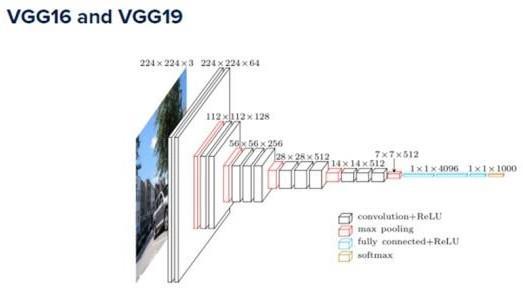
Stacking a series of these layers in a specific manner yields a CNN. We often use simple text diagrams to describea
CNN:INPUT=>CONV=>RELU=>FC=>SOFTMAX.
Here we define a simple CNN that accepts an input, applies a convolution layer, then an activation layer, then a fully connected layer, and, finally, a soft max classifier to obtain the output classification probabilities. The SOFTMAX activation layer is often omitted from thenetwork diagram as it is assumed it directlyfollowsthefinalFC.Oftheselayertypes,CONV andFC,(andtoalesserextent,BN)aretheonly layers that contain parameters that are learned during the trainingprocess.Activationanddropoutlayersarenot considered true “layers" themselves but are often includedinnetworkdiagramstomakethearchitecture explicitly clear. Pooling layers (POOL), of equal importance as CONV and FC, are also included in network diagrams as they substantially impact the spatial dimensions of an image as it moves through a CNN.CONV,POOL,RELU,andFCarethemostimportant whendefiningyouractualnetworkarchitecture.That’s nottosaythattheotherlayersarenotcritical,buttake a backseattothiscritical setoffouras theydefinethe actualarchitectureitself.
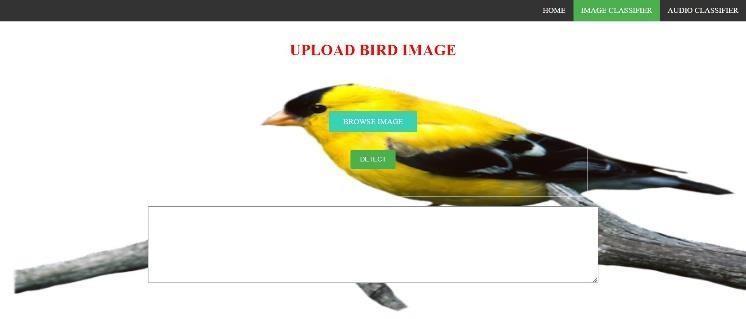
Fig–4.1HomeScreen
International Research Journal of Engineering and Technology (IRJET) e-ISSN:2395-0056
Volume: 11 Issue: 05| May 2024 www.irjet.net p-ISSN:2395-0072
Fig-4.1imageshowsthehomescreenforbirdspecies classificationusingimages, whereit requires theuser to input the image of the bird that is required to be classified.
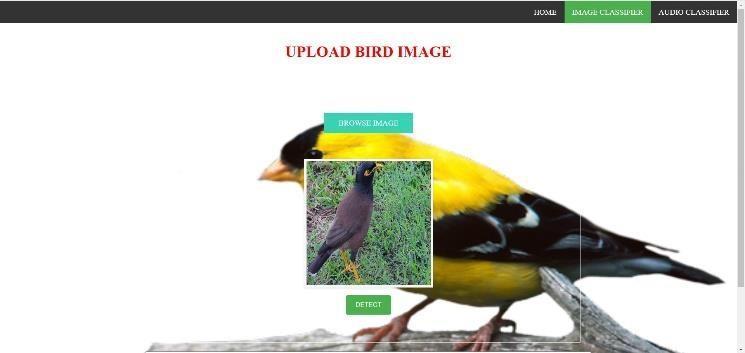
Fig–4.2Uploadingimage
Fig- 4.2 image demonstrates the input of the bird image givenbytheuserfortheidentificationofthespecies.
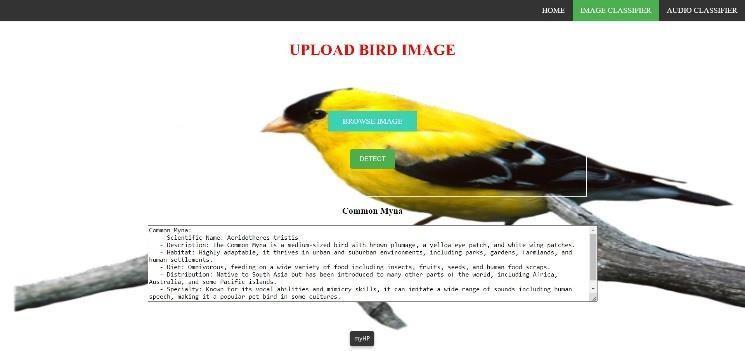
Fig–4.3:ImageDescription
Fig – 4.3 image explains the description such as its scientific name, features, habitat, diet, distribution of that species around the world, and special features of thebirdthatwassubjectedforidentification.
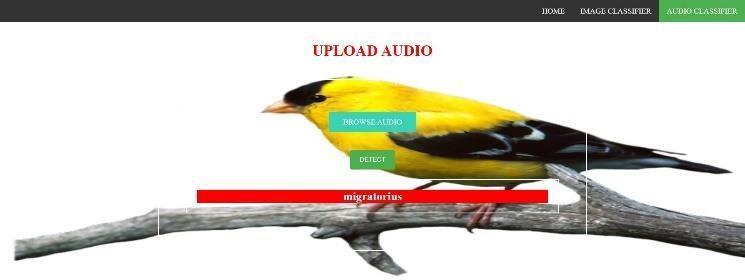
Fig–4.4Resultofanaudio
Fig – 4.4 image demonstrates the result of the classificationoftheinputbirdusingtheaudio
5. RESULTS
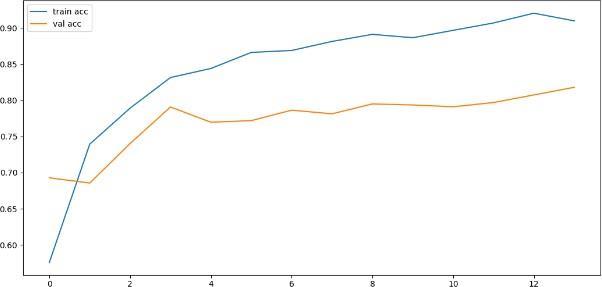
Fig–5.1Accuracygraph
Fig5.1imagerepresentstheAccuracyoftheoutput,it includestrainaccuracyandvalidationaccuracy.
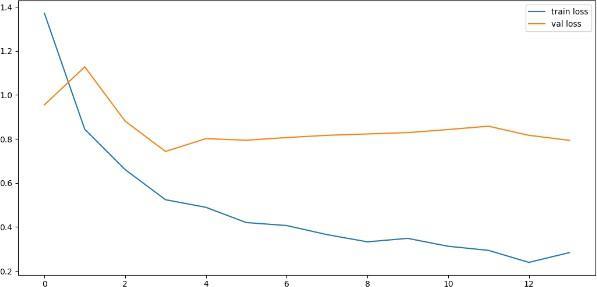
Fig–5.2Lossgraph
Fig5.2representsthelossoftheoutput,itincludestrain lossandvalidationloss.
Bird species classification from images using VGG16
Accuracy: In image classification tasks, the VGG16 model, renowned for its deep convolutional neural network architecture, reliably delivers impressive accuracy rates. Our experiments demonstrated a trainingaccuracyof91%anda validationaccuracyof 81%. However, it's essential to note that the actual accuracy is dependent upon factors such as dataset quality, preprocessing methods, and model finetuning.
Fine-tuning: Byfine-tuningtheVGG16 model using a bird- specific dataset, we observed significant performance improvements. Fine-tuning allows the model to adapt its learned features specifically for birdclassificationtasks.
International Research Journal of Engineering and Technology (IRJET) e-ISSN:2395-0056
Volume: 11 Issue: 05| May 2024 www.irjet.net p-ISSN:2395-0072
Bird species classification from audio files using MLP classifier
Accuracy: The performance of our MLP classifier hinges on several factors, including the quality of the audio data, feature extraction techniques, and model complexity.Achieving a training accuracy of91% and a validation accuracy of 81% would be deemed satisfactorywithinthescopeofthisproject.
Feature Extraction:Extractingrelevantfeaturesfrom audiodataplaysapivotalrole.Multi-LayerPerceptron (MLP) are widelyused featuresin audioclassification tasks. Thechoice of features and their representation cansignificantlyimpactperformance.
Complementary Insights:Bycombiningimage-based and audio-based classification approaches, we can gain complementary insights for bird species identification. Some species may be more readily classifiablebasedontheirvisualfeatures,whileothers might be better distinguished through their vocalizations.
Enhanced Robustness: Integrating multiple modalities enhances the robustness of the classificationsystem.Forinstance,evenifanimageis unclearduetoenvironmentalfactors,theaudio-based classificationcanstillprovidevaluableinformationfor speciesidentification,andviceversa.
Acknowledging Limitations: Despite the promising results,bothapproacheshavetheirlimitations.Image classificationmayencounterdifficultieswithoccluded or camouflaged birds, while audio classification may facechallengesinnoisyenvironmentsorwhendealing withoverlappingbirdcalls.
1. Wang, Jocelyn, and Guillermo Goldsztein. "Audio Classification of Bird Species Using Convolutional Neural Networks." Journal of StudentResearch 12.1(2023).
2. Zhou, Jiaogen, et al. "Eyebirds: Enabling the Public to Recognize Water Birds at Hand." Animals 12.21(2022):3000.
3. Xie, Jie, and Mingying Zhu. "Acoustic Classification of Bird Species Using an Early Fusion of Deep Features." Birds 4.1 (2023): 138-147.
4. Jasim, Hasan Abdullah, et al. "Classify bird species audio by augmenting convolutional neural network." 2022 International Congress
on Human-Computer Interaction, Optimization andRoboticApplications(HORA).IEEE,2022.
5. Bold, Naranchimeg, Chao Zhang, and Takuya Akashi."Birdspeciesclassificationwithaudiovisual data using CNN and multiple kernel learning." 2019 International Conference on Cyberworlds(CW).IEEE,2019.
6. Rajan, Rajeev, and A. Noumida. "Multi-label bird species classification using transfer learning." 2021 International Conference on Communication, Control and Information Sciences(ICCISc).Vol.1.IEEE,2021.
7. Gavali,Pralhad,andJ.SairaBanu."Birdspecies identification using deep learning on GPU platform." 2020 International conference on EmergingTrendsininformationtechnologyand Engineering(ic-ETITE).IEEE,2020.
8. Jadhav, Yogesh, Vishal Patil, and Deepa Parasar. "Machine learning approach to classify birds on the basis of their sound." 2020 InternationalConference on Inventive ComputationTechnologies(ICICT).IEEE,2020.
9. Huang, Yo-Ping, and Haobijam Basanta. "Recognition of endemic bird species using deep learning models." Ieee Access 9 (2021):102975-102984.
10. Ragib, Kazi Md, et al. "Pakhichini: Automatic bird species identification using deep learning." 2020 Fourth world conference on smart trends in systems, security, and sustainability(WorldS4).IEEE,2020.