
International Research Journal of Engineering and Technology (IRJET) e-ISSN:2395-0056
Volume: 11 Issue: 05 | May 2024 www.irjet.net p-ISSN:2395-0072
International Research Journal of Engineering and Technology (IRJET) e-ISSN:2395-0056
Volume: 11 Issue: 05 | May 2024 www.irjet.net p-ISSN:2395-0072
Amit Kumar1, Tripti Gangwar2 , Jayant Kumar3 , Akshay Anand4
1 Research Scholar, Patliputra University,Patna,India
2 Professor, Department of Chemistry & Head Department of Env.Sc.,A.N. College, Patna
3 Project Associate, Centre for Fluorosis Research, A.N. College, Patna
4Department of Environmental Sciences, A.N. College, Patna
Abstract- Monitoring of drinking water quality is an important component of water management, while data analysis is necessary for the identification and characterization of water quality problems. Assessment is the process by which water quality data is transformed into information. Monitoring can also verify water pollution following corrective action. It is therefore vital to regularly monitor the quality of groundwater. Drinking water contamination with different chemicals and heavy metals, released from different anthropogenic sources has become a global concern.The city of Patna is a large city and the capital of Bihar, which is located in the northeastern part of India. It is a historic city built on the southern banks of the Ganges River, lies on 25.5941° N latitude, 85.1376°E at an altitude of 53 m (174 ft) above mean sea level. The city is spread over an area of about 3,202 square km. According to census 2011 population of Patna is 1,684,222 million and the current estimated population of Patna city in 2024 is 2,633,000. This paper presents a study on drinking water quality of samples collected from ten different Government Hospitals situated in Patna town and analyzed from August 2023 to October 2023. Physico-chemical studies such as temperature, pH, total dissolved solids, electrical conductivity, chlorides, alkalinity, total hardness, ionic concentration: calcium, magnesium, sodium, potassium, iron, arsenic, fluoride, sulphate and nitrate of drinking water were carried out and compared with the standard values prescribed by WHO and BIS standards. Correlation matrix was prepared to find out the relation between differe nt parameters.
Keywords: Drinkingwaterquality,physico-chemicalanalysis,governmenthospitals,waterpollution
1.
Clean drinking water is one of the United Nations Sustainable Development Goals. Despite significant progress in the water purificationtechnology,manyregionsstilllackaccesstocleanwater.Waterqualityhasbeenlinkedtohealthoutcomesacross theworld.Availabilityandeasyaccesstosafeandqualitywaterisafundamentalhumanright (1)
Inaddition,the watersupplysectoris facing enormous challengesdue toclimate change,global warmingandurbanization. Insufficient quantity and poor quality of water have serious impact on sustainable development, especially in developing countries (2).AccordingtoWorldHealthOrganizationsafewatershouldalsonotcontributetoanysensitivitythatmayoccur during different stages of life (3). Drinking water is considered safe if its physical, chemical and biological characteristics meetWHOguidelinesoranyothernationalstandards.
Effortstounderstandtheimplicationsforhealth,particularlyoutcomeswithlonglatencyorcritical exposurewindows,have been hampered by lack of historical exposure data for unregulated pollutants. Adequate characterization of water quality heterogeneity within water supplies is an important component of exposure assessment methodologies in health studies investigatingimpacteddrinkingwater (4)
Tapwatersuppliesareconsideredtobeamongthesafestintheworld,watercontaminationcanstilloccur.Therearemany possible sources of contamination. In addition, drinking water, that is not properly treated or that travels through an improperly maintained distribution system (pipes) may also create conditions that increase risk of contamination. The presence of certain contaminants in our water can lead to health issues, including gastrointestinal illness, reproductive problems, and neurological disorders. Infants, young children, pregnant women, the elderly, and the people with weakened immunesystemsmaybeespeciallyatrisksofillness.
International Research Journal of Engineering and Technology (IRJET) e-ISSN:2395-0056
Volume: 11 Issue: 05 | May 2024 www.irjet.net p-ISSN:2395-0072
The area for the present investigation was selected in Patna town. The city of Patna is a large city and the capital of Bihar, whichislocatedinthenortheasternpartofIndia.ItisahistoriccitybuiltonthesouthernbanksoftheGangesRiver,lieson 25.5941°Nlatitude,85.1376°Eatanaltitudeof53m(174ft)abovemeansealevel.Thecityisspreadoveranareaofabout 3,202Squarekm.Accordingtocensus 2011populationofPatnais1,684,222millionandthecurrentestimate populationof Patnacityin2024is2,633,000 (5).
Itisthereforevital to regularlymonitorthe qualityof groundwater. Human HealthRisk Assessment due toHeavyMetalsin GroundandSurfaceWaterandAssociationofdiseaseswithdrinkingwatersourceswerereported byseveralworkers (6, 7).QualityassessmentofdrinkingwaterofdifferentGovernmentHospitalswascarriedoutandreported (8-10).Thispaper presents a study on drinking water quality of samples collected from ten different Government Hospitals (marked in GIS map)situatedinPatna townandanalyzedfromAugust2023toOctober2023.Seventeenphysicochemicalparameterswere analyzedandtheresultswerecomparedwithwaterqualitystandardsprescribedbyWorldHealthOrganization(2) andBIS: IS10500:2012 (11).
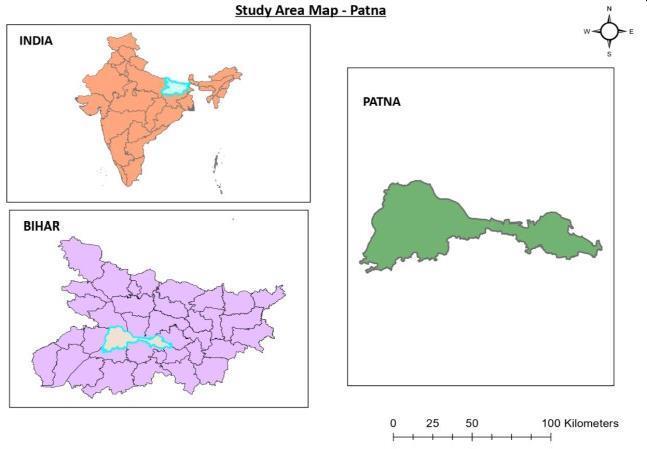
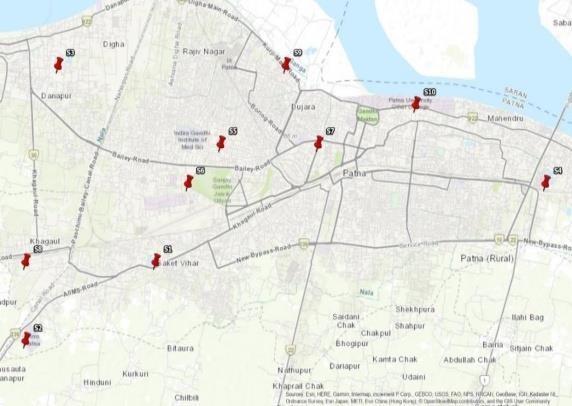
This paper presents a study on drinking water quality of samples collected from ten different Government Hospitals (markedinGISmap)situatedinPatnatownandanalyzedfromAugust2023to October2023.Seventeenphysicochemical parameters were analyzed and the results were compared with water quality standards prescribed by World Health Organization (2) andBIS:IS10500:2012 (11).
The physico–chemical properties electrical conductivity, pH and temperature of water were measured in the field using portablemetersatthetimeofsampling.Theinstrumentswerecalibratedinaccordancewiththemanufacturer’sguideline beforetakingthemeasurements.Thevalueofeachsamplewastakenaftersubmergingtheprobeinthewaterandheldfor acoupleofminutestoachieveareliablereading.Aftermeasurementofeachsample,theprobewasrinsedwithde-ionized watertoavoidcrosscontaminationamong differentsamples.Watersampleswereplacedincleancontainersprovidedby
International Research Journal of Engineering and Technology (IRJET) e-ISSN:2395-0056
Volume: 11 Issue: 05 | May 2024 www.irjet.net p-ISSN:2395-0072
theanalyticallaboratory(glassandacid-washedpolyethyleneforheavymetals).Nitricacidwasusedtopreservesamples for metal analysis. All physicochemical parameters were analyzed as per the standard method prescribed by American PublicHealthAssociation(APHA) (12, 13).
2.1. Analysis of Physical Parameters:
2.1.1. pH:
AcalibratedpHmeter(EcoTesterpH1)wasusedforon-sitemeasurementsfollowedbytestinginthelaboratorybyusing Systronics,pHSystem361andtheaverageofthetworeadingswasrecorded.Itwasstandardizedwithabuffersolutionof pHrangebetween4and9.
2.1.2.Temperature:
Thiswascarriedoutatthesiteofsamplecollectionusinga mobilethermometer. Thiswas doneby dippingthe thermometerintothesampleandrecordingthestablereading.
2.1.3.Turbidity:
TurbiditywasdeterminedbyusingSystronicsDigitalNephlo-TurbidityMeter132.
2.1.4.Conductivity and TDS:
SystronicsConductivity-TDSmeter307wasusedtodetermineconductivity.Theprobewasdippedintothecontainer of thesamplesuntilastablereadingwasobtainedandrecorded.
2.2.
2.2.1.Total Hardness:Totalhardnessinwatersampleswasdonebytitratingsampleswithstandardsolutionofethylene diaminetetraaceticacid(EDTA),achelatingagentbyusingcomplexometrictitration.
2.2.2.Alkalinity:
The alkalinity of water was determined by titrating the water samples with standard acid solution of known pH and Stoichiometryofthereactionandnumberofmolesofacidneededtoreachtheendpoint,theconcentrationofalkalinityin waterwascalculated byvolumetricmethods.Alkalinityof waterisattributedtothepresenceof OH-,HCO3 –andCO32-ions (12).
2.2.3.Mineral Concentration:
The chloride content was determined by argentometric method. The samples were titrated with standard silver nitrate usingpotassiumchromateindicator.CalciumandMagnesiumionsconcentrations(hardness)weredeterminedusingEDTA titrimetricmethod.Sulphateionsconcentrationwasdeterminedusingcolorimetricmethod. Mineralconcentrations,includingcalcium,magnesium,sodium,andpotassiumwereanalyzedbyFlamePhotometer128of Systronics.
ConcentrationofnitrateswasanalyzedbyAPHA23rd Edition–NO3-MethodDbyUVscreeningmethod (13). SulphateionsconcentrationwasdeterminedbyAPHA23rdEdition4500-SO4MethodbyusingUVscreeningmethod (14). IronconcentrationinwatersampleswasanalyzedbyAPHA23rdEdition3500-FeMethodBusingPhenanthrolineMethod. ArsenicconcentrationwasdeterminedbyIS3025(PART37)1987 (14);silverdiethyldithiocarbamatemethod(AAS) Ionselectiveelectrodewasusedtomeasurefluorideconcentrationsinwatersamples.
3.RESULTS AND DISCUSSION:
WaterqualityparameterswereanalyzedandincorporatedinTable-1.Graphicalrepresentationofalltheparameterstested forallsamplingsitesandtheircorrelationsareshowninGraphs–1to9.
3.1. TDS: According to the WHO, the acceptable TDS range for drinking water is less than 600 ppm. TDS in the present studywasobservedintherangeof229to641mg/L.HighvaluesofTDSingroundwaterisgenerallynotharmfultohuman beings (15), but high concentration of these (S-3 & S-4) may affect persons who are suffering from kidney and heart diseases and may be objectionable to consumers owing to the resulting taste and to excessive scaling in water pipes, heaters,boilers,andhouseholdappliances.Watercontaininghighsolidmaycauselaxativeorconstipationeffects.
3.2. EC: Pure water is not a good conductor of electric current rather is a good insulator. Increase in ions concentration enhancestheelectricalconductivityofwater.Generally,theamount ofdissolvedsolidsinwaterdeterminestheelectrical
International Research Journal of Engineering and Technology (IRJET) e-ISSN:2395-0056
Volume: 11 Issue: 05 | May 2024 www.irjet.net p-ISSN:2395-0072
conductivity. Electrical conductivity (EC) actually measures the ionic process of a solution that enables it to transmit current.AccordingtoWHOstandards,ECvalueshouldnotexceeded400μS/cmandthecurrentinvestigationsshowedthat ECvaluewas361–1069μS/cm.Theseresultsclearlyindicatethatwaterinthestudyareaisconsiderablyionizedandhas highthelevelofionicconcentrationactivityduetodissolvesolids. HighestECwasobservedinwatersamplesS-3andS-4. ECandTDSarewaterqualityparameterswhichindicatelevelofsalinity (16).
3.3. Total Hardness: Total hardness is one of the most important properties of drinking water. It is a measure of the quantityofdivalentions(saltswithtwopositivecharges)suchascalcium(Ca),magnesium(Mg)and/oriron(Fe)inwater. Calciumcontributesto the hardnessof water withinthe bicarbonate(HCO3 -)formingtemporal carbonatehardness while sulphate (SO42-), chloride (Cl-) and nitrate (NO3 -) forming permanent or non carbonate hardness. According to BIS acceptablelimitoftotalhardnessi.e.200mg/Landpermissiblelimitintheabsenceofalternatesourceis600mg/L.
3.4. Magnesium Ion Concentration: Mgisthe8thmostabundantelementonearthcrustandnaturalconstituentofwater. It is essential for proper functioning of living organisms and found in minerals like dolomite, magnetite etc. Human body contains about 25g of Magnesium (60% in bones and 40% in muscles and tissues). According to WHO standards, the permissiblerangeofmagnesiumions(Mg2+)inwatershouldbe50mg/L.Magnesiumionconcentrationinthestudyareas rangefrom5.9to34.5mg/L,whichiswithinpermissiblelimit.
3.5. Calcium Ion Concentration: Caisthe5thmostabundantelementonearthcrustandisveryimportantforhumancell physiologyandbones.About95%ofcalciuminhumanbodyisstoredinbonesandteeth.Thehighdeficiencyofcalciumin humans may cause rickets, poor blood clotting, bones fracture etc., and the exceeding limit of calcium produced cardiovascular diseases. According to WHO (2011) standards, the permissible range of calcium ions (Ca2+) in drinking wateris75mg/L.Inthestudyareas,resultsshowthattheconcentrationofcalciumrangesfrom 23.6to56.2mg/Lwhich waslowerthanthestandardlimit.
3.6. Mg to Ca Ratio: The ratio of calcium and magnesium in water is also a crucial factor to cause several hard water relatedhealthproblems(17). ItwasrecommendedthattheMgtoCatotalintakeratioshouldbe1to2asrequiredforthe bestMgabsorption(18).Magnesiumandcalciumratiowascalculatedandfromthefinding(Table-1),itisevidentthatin thesamplesS-3,S-5,S-6,S-7&S-8,thisratioiswithinthelimitasperrequirements.However,inthesamplesS-1,S-2and S-4,theratioismuchhigheri.e.1:6,1:5and1:4,respectively.ThereductioninMgtoCaratioisassociatedwithincreasing risk for mortality from ischemic heart disease and acute myocardial infarction (19), while the increase in Mg: Ca ratio is associatedwithincreasingriskforgastriccancer.
The acceptable limit of alkalinity is 200mg/l and in the absence of alternate water source, alkalinity up to 600 mg/l is acceptable for drinking. Total alkalinityof analyzed water samplesvariedfrom 108 to 428 mg/l asgiven in Table1. Total alkalinityofallsampleswasbelowthepermissiblelimit.Waterqualitywithrespecttohardnessandalkalinityisimportant fortheassessment(20).
3.7. Chloride Ion Concentration: Chloride(Cl-)ismainlyobtainedfromthedissolutionofsaltsofhydrochloricacidas table salt (NaCl), and added through industrial waste, sewage, sea water etc. Surface water bodies often have low concentrationofchloridesascomparedtogroundwater.Ithaskeyimportanceformetabolismactivityinhumanbodyand other main physiological processes. High chloride concentration damages metallic pipes and structure, as well as harms growingplants.AccordingtoWHOstandards,concentrationofchlorideshouldnotexceed250mg/l.Inthestudyareas,the chloridevaluerangesfrom20-114.2mg/linstudyareas.
3.8. Sulphur Concentration: Sulphur in groundwater is normally present in sulphate form. Sulphate may enter into groundwaterthroughweatheringofsulphidebearingdeposits.Thehighestdesirablelimitofsulfateindrinkingwateras establishedbyWHO,is200mg/l.Sulphateions(SO42-)contentinanalyzedwatersamplesvariedfrom10.14to88.04mg/l as shown in Table1. All the samples found to be well within permissible limit. The results exhibit that concentration of sulfatearefoundtobelowerthanthestandardlimitanditmaynotbeharmfulforhumanhealth.
3.9. Sodium Ion Concentration: Sodium (Na) is a silvery white metallic element and found in less quantity in water. Properquantityofsodiuminhumanbodypreventsmanyfataldiseaseslikekidney damages,hypertension,headacheetc.
International Research Journal of Engineering and Technology (IRJET) e-ISSN:2395-0056
Volume: 11 Issue: 05 | May 2024 www.irjet.net p-ISSN:2395-0072
No health base guideline values have been derived (WHO, 2006). On comparison with BIS standards, sodium ion (Na+) concentration of all samples was found to be within the permissible limit. In the study areas, the finding shows that sodiumconcentrationrangesfrom13.8to72.1mg/1.
3.10. Potassium Ion Concentration: Potassium (K) is silver white alkali which is highly reactive with water. Potassiumisnecessaryforlivingorganismfunctioning hencefoundinall humanandanimal tissuesparticularlyinplants cells.Thetotalpotassiumamountinhumanbodyliesbetween110and140g.Itisvitalforhumanbodyfunctionslikeheart protection,regulationofbloodpressure,proteindissolution,musclecontraction,nervestimulusetc.Potassiumisdeficient in rare but may led to depression, muscle weakness, heart rhythm disorder etc. According to WHO standards the permissiblelimitofpotassiumis12mg/1.K+concentrationofanalyzedwatersamplesvariedfrom0.3to0.8mg/l.
3.11. Nitrate Ion Concentration: Nitrate (NO3 -) is one of the most important diseases causing parameters of water qualityparticularlyb3luebabysyndromeininfants.Thesourcesofnitratearenitrogencycle,industrialwaste,nitrogenous fertilizers etc. WHO allows maximum permissible limit of nitrate 50mg/l in drinking water. In study areas, results more clearthattheconcentrationofnitraterangesfrom43.8 to0.42mg/l.Theseresultsindicatethatthequantityof nitratein thestudysitesisacceptable.
3.12. Iron Ion Concentration: Ironishigher(Graph-9)thanthepermissiblelimitinthreewatersamples(S-2,S-4&S8).Itisresponsibleforthebadtasteassociatedwiththewater.Highconcentrationofironinwaterstainslaundry,sanitary ware, gives an undesirable taste and develops turbidity as well. Iron also promotes the growth of “iron bacteria” which derives their energy from the oxidation of ferrous iron to ferric iron and in the process deposits a slimy coating on the piping.
Samples
International Research Journal of Engineering and Technology (IRJET) e-ISSN:2395-0056
Volume: 11 Issue: 05 | May 2024 www.irjet.net
2395-0072
International Research Journal of Engineering and Technology (IRJET) e-ISSN:2395-0056
Volume: 11 Issue: 05 | May 2024 www.irjet.net p-ISSN:2395-0072
International Research Journal of Engineering and Technology (IRJET) e-ISSN:2395-0056
Volume: 11 Issue: 05 | May 2024 www.irjet.net p-ISSN:2395-0072
S1S2S3S4S5S6S7S8S9S10
S1S2S3S4S5S6S7S8S9S10 Nitrate Sulphate
3.13. Arsenic Concentration: Arsenic may be introduced into drinking water via natural sources primarily by dissolution of naturally occurring minerals, ores, and industrial effluents. Study on ground water contamination and associated diseases in Bihar were reported earlier (21). The present study revealed that the value of Arsenic in water sampleslieswithinWHOandBISguidelines.
3.14. Fluoride Concentration: Fluoride is found in trace amounts in water, plants, soil, and animals in the natural environment. Fluoride concentration in drinking water must be controlled to avoid skeletal, non-skeletal and dental fluorosis.ThePublicHealthEngineeringDepartment,Biharfoundthatthegroundwaterin4,157habitatsof98blocksof11 districtsof Biharhavedangerouslyhigh level offluoride. Eversince the work underfluorosis mitigation programme (22, 23), focusing on consumption of fluoride safe potable water together with Moringa leaf powder on fluorosis patients of somehabitationofRajauliblock,Nawada,Bihar,reportedpositiveimpactstofluorosispatients.
However,fluoridecontentinallsamplesinpresentstudyhasbeenfoundtobewithinthepermissiblelimitprescribedby WorldHealthOrganization.
International Research Journal of Engineering and Technology (IRJET) e-ISSN:2395-0056
Volume: 11 Issue: 05 | May 2024 www.irjet.net p-ISSN:2395-0072
Maximumcorrelationhasbeenobservedbetweentotaldissolvedsolidsandelectricalconductivity. (Graph-4).Amongallthe watersamplesanalyzed,lowestvaluesoftemperatureandturbiditybuthighestvaluesofsulphateandalkalinityarerecordedin sampleS4howevervaluesofTDSandECarelowerthanS-3.SampleS-2showslowestvalueoftotalhardness,alkalinity,TDS,EC andhighest value of iron. Iron ishigher than the permissible limit in three water samples(S2, S4 & S8).All the observed parametersinthesamplesS-2andS-10showmaximumcorrelationamongeachother.
Onthebasisoffindings,itwasconcludedthatallPhysico-chemicalparametersofdrinkingwaterintheGovernmentHospitals locatedinPatnawereconsistentwithWHOandBISstandardfordrinkingwater.Thesampleswereanalyzedforintendedwater qualityparametersfollowinginternationallyrecognizedandwell-establishedanalyticaltechniques.Itisevidentthatphysicochemicalparameters,temperature,pH,totaldissolvedsolids,electricalconductivity,chlorides,alkalinity,totalhardness,calcium, magnesium,sodium,potassium,arsenic,fluoride,sulphateandnitratefallunderthepermissiblelimitandtherewasnotoxicity problem. It was recommended that the Mg to Ca total intake ratio should be 1 to 2 as required for the best magnesium absorption.InthesamplesS-3,S-5,S-6,S-7&S-8,thisratioiswithinthelimitasperrequirements.However,inthesamples S-1, S-2 and S-4, the ratio is much higher i.e. 1:6, 1:5 and 1:4, respectively. Correlation matrix was prepared, maximum correlationhasbeenobservedbetweentotaldissolvedsolidsandelectricalconductivity.Ironishigherthanthepermissiblelimit inthreewatersamples(S2,S4&S8).Itisresponsibleforthebadtasteassociatedwithwater.Strategieslikeprotectionofnatural sources,treatmentanddistributionmanagementshouldbeappliedinordertomaintainandimprovedrinkingwatersupply system.Amongallthesamplesofdrinkingwater,theobservedparametersofS2andS10showmaximumcorrelationamong eachother.
Author’s Acknowledgement: The authors are thankful to Centre for Fluorosis Research (CFR) Laboratory, A.N. College, Patna,Indiaforprovidingfacilities foranalysis.
Author’s Contribution: A.Kumar(FirstAuthor):On-sitemonitoring,laboratoryanalysisofwatersamplesandmanuscript preparation.J.Kumar:executionofworkon-siteandlaboratoryanalysis.A.Anand:acquisitionofdata,analysisandreviewing thearticle,T.Gangwar(correspondingAuthor):conceptionofwork,studydesign,interpretationofdataandframeworkofthe manuscript.
1. Sick Water: The Central Role of Wastewater Management in Sustainable Development - A Rapid Response Assessment,https://wedocs.unep.org/20.500.11822/9156
2. WHOGuidelinesforDrinkingWaterQuality4th Edition www.who.int/publications/i/item/9789241549950.
3. Safely Managed Drinking Water: Thematic Report on Drinking Water, 2017, WHO,https://iris.who.int/handle/10665/325897
4. H. C. Swartz, A. Ruthann, J. R. K. Rudel, and G. B. Julia Historical reconstruction of wastewater and land use impacts to groundwater used for public drinking water: Exposure assessment using chemical data and GIS, J. Expo Anal Environ Epidemiol,Sep;13(5):403-16,2003.https://doi.org/10.1038/sj.jea.7500291
5. Patnadistrictpopulationcensus,2011,https://www.census2011.co.in/census/district/82-patna.html.
6. G.Mawari N.Kumar, S.Sarkar., A.L.Frank., M.K.Daga M.M ., Singh., T.K.Joshi., and I.Singh Human health risk assessment duetoheavymetalsingroundandsurfacewaterandassociationofdiseaseswithdrinkingwatersources:Astudyfrom Maharashtra,India.EnvironmentalHealthInsights,16,1-11,2022,https://doi.org/10.1177/11786302221146020
International Research Journal of Engineering and Technology (IRJET) e-ISSN:2395-0056 Volume: 11 Issue: 05 | May 2024 www.irjet.net p-ISSN:2395-0072
7. D.Shukla, H.B. Paliwal and A. James., Assessment of Drinking Water Quality of Different Hospitals at Allahabad, India, International Journal of Environment, Ecology, Family and Urban Studies (IJEEFUS)ISSN(P) 2250-0065, ISSN(E), 23210109,5(6),15-20,2015,https://dx.doi.org/10.13140/RG.2.1.4457.3842
8. N.D.Bharadwaj.,D.K.Uchharia,R.Jain,Physical-ChemicalAnalysisofDrinkingWaterofGovernmentHospitalsofGwalior City,InternationalResearchJournalofEngineeringandTechnology(IRJET)e-ISSN:2395-0056,ISO9001:2008,Volume: 03(03),2016.
9. Y.K.Faleh.A.I.Fatlawy.,F.Kadhim.,B.A.Mahdii.,AStudyofDrinkingWaterPropertiesinSomeHospitalsinBaghdadCity, IraqiJournalofScience,Vol.65,No.1,43-542024,https://doi.org/10.24996/ijs.2024.65.1.5
10. H.Rehman.,N.A.KhanH.HiraandA.Bibi,AnalysisofPhysiochemicalParametersofHospitalWastewater:ACaseStudy inFaisalabad,Pakistan,PureAppl.Biol.Vol.9,Issue1,p1191-1198,2020.
11. BIS(1991)Drinkingwaterspecifications,BureauofIndianStandards,IS:10500
12. APHA, Standard Methods for the Examination of Water and Wastewater, Method 2320, (18th ed.). Washington DC: AmericanPublicHealthAssociation,1982.
13. APHA, Standard Methods for the Examination of Water and Wastewater (23rd ed.). Washington DC: American Public HealthAssociation,2017.
14. Methodforsamplingandtestingphysicalandchemicalforwaterandwastewater:Arsenic,IS3025,Part37(BIS),1988.
15. S. Sasikaran., K. Srithara., S. Balakumar, V. Arasaratnam Physical, Chemical and Microbial analysis of bottled drinking water.JCeylonMedical,57(3),111–116,2012.https://dx.doi.org/10.4038/cmj.v57i3.4149
16. A.F. Rusydi, Correlation Between Conductivity and Total Dissolved Solids in Various Types of Water: A Review, IPO ConferenceSeries,EarthandEnvironmentalScience,(01),118,2018, https://dx.doi:.1088/1755-1315/118/1/012019
17. Kamlesh and M.K. Kidwai., Review on Chemical and Biological Aspects of Hardness in Water, Indian Journal of EnvironmentalSciences,ISSN0971-8958,22(1)pp.1-15,2018.
18. Chun-Yuh Yang P, Calcium and Magnesium in Drinking Water and Risk of Death from Cerebrovascular Disease, NIH, Stroke,29(2),411-414,1998,https://doi.org/10.1161/01.str.29.2.411
19. JDurlach,RecommendedDietaryAmountsofMagnesium:MgRDA.MagnesiumResearch,NIH, PMID:2701269,2(3)195203,1989.
20. Md. S. Islam. & S.M.M.H. Majumder, Alkalinity and Hardness of Natural Waters in Chittagong City of Bangladesh, International Journal of Science and Business, Volume:4, Issue:1, Page:137-150, 2020,https://dx.doi.org/10.5281/zenodo.3606945
21. S.KSingh.,A.K.Ghosh,A.Kumar.,K.Kislay,C.Kumar,R.R.Tiwari,R.ParvezN Kumar.,Md.Imam.,GroundwaterArsenic ContaminationandAssociatedHealthRisksinBihar,India,InternationalJournalofEnvironmentalResearch,Vol.8,4960,2014.
© 2024, IRJET | Impact Factor value: 8.226 | ISO 9001:2008 Certified Journal | Page1673
International Research Journal of Engineering and Technology (IRJET) e-ISSN:2395-0056 Volume: 11 Issue: 05 | May 2024 www.irjet.net p-ISSN:2395-0072
22. B. Singh, R. Kumar, T. Gangwar, A.K. Singh., P. Chandra, V. Patel., and Kumar J., Kyryological Study of an Endemic Anti FluorosisPlantSpeciesofRajauliBlockofNawadaDistrictofBihar,J.Chemtracks,24(1&2),177-180,2022.
23. B.Singh,R.Kumar,T.Gangwar,A.K.Singh,P.Chandra,V.PatelandJ.Kumar,PositiveImpactofConsumptionofFluoride Safe Potable Water Together with Moringa Leaf Powder on Fluorosis Patients of Some Habitation of Rajauli Block of NawadaDistrictofBihar,J.Chemtracks,25(1&2),161-178,2023.