
International Research Journal of Engineering and Technology (IRJET) e-ISSN: 2395-0056
Volume: 11 Issue: 05 | May 2024 www.irjet.net p-ISSN: 2395-0072
International Research Journal of Engineering and Technology (IRJET) e-ISSN: 2395-0056
Volume: 11 Issue: 05 | May 2024 www.irjet.net p-ISSN: 2395-0072
EKECHUKWU, DARLINGTON EZE
Department of Renewable Energy and Sustainable Technology, University of South Wales, United Kingdom
Abstract - ThisstudyexaminesproblemswithNigeria'sgrid network and suggests a long-term fix: using smart grid technologies to increase the proportion of renewable energy sources. It seeks to improve commercial opportunities in the power industry, decrease greenhouse gas emissions, increase access to electricity, and integrate more renewable energy sources. The study makes use of the PRISMA paradigm in conjunctionwithasystematicliteraturereviewto guarantee data quality. It addresses issues including transmission networks, power limitations, Nigeria's existing electricity status, renewable energy integration, smart grid adoption, and state of play. The results advocate for enhanced forecasting,demandresponseinitiatives,energystorage,and other long-term solutions through the integration of renewable energy sources. The paper suggests legislative actions to encourage the use of smart grid technologies in order to improve the electricity industry, create jobs, and maintain environmental sustainability. It provides a comprehensiveexaminationofthelimitationsoftheelectrical system and suggests workable fixes. For efficient and sustainable energy generation, this research emphasises the significance of supporting smart grid technologies and environmentally friendly legislation. It is beneficial to academics, industry practitioners, policymakers, and the discourse surrounding renewable energy and sustainable development inNigeria.
Key Words: Smart grid technology, Renewable energy, Grid network, Sustainable energy, Non-renewable energy
ThereareanumberofproblemswithNigeria'spowergrid systemthatimpactthecountry'stransmission,distribution, and supply of electricity. Among these problems are inadequateinfrastructure,insufficienttechnicalandfinancial losses,andrestrictedaccesstoelectricityinisolatedplaces (Emeasoba,2018).Duetotheseissues,Nigeria'seconomy and society have been significantly impacted by an inconsistentelectricitysupply.Nigeria'sexcessivereliance onnon-renewableenergysourceshashadanegativeimpact on both the environment and the health of its citizens. Nigeria has substantial untapped renewable energy resources that might be used to diversify the country's energysourcesandreduceitsrelianceonfossilfuels,suchas hydroelectricity,wind,andsolarenergy(Emeasoba,2018).
However, the country's energy mix is dominated by nonrenewableenergysourceslikeoilandgas.Asaresult,both Nigeria'snaturalresourcesandcitizens'healthhavesuffered duetoenvironmentaldegradation.Fossilfuelsaccountfor themajorityofNigeria'senergyproduction,whichincreases carbon emissions and the country's reliance on imported fuel.Theintegrationofrenewableenergysourcesintothe Nigerian electrical system is beset by significant technologicalandeconomicalchallenges.Forexample,the gridsystemneedstobeflexiblebecauserenewableenergy sourcesaresporadic.Themassiveinfrastructureinvestment requiredtoincorporaterenewableenergysourcesintothe grid system might be beyond the nation's means. Implementingsmartgridtechnologiesmaybeexpensiveand requireshiringofspecialistswiththenecessaryskills,which maynotexistinthenation(NwosuandIwu-James,2019). Asthecountry'spopulationgrows,morepowerisneeded, thegridhasalsobeenseverelyplaguedbysystemfailureand frequent interruptions, necessitating interventions from foreigngovernmentsandtechnicalpartnersovertheyears. As a result, the government has put forth a plan (vision 30:30:30) to increase generation capacity and expand the grid in order to accommodate and deliver dependable power. By 2030, the Nigerian government's 30:30:30 strategiesaretogenerate30GWofelectricity,with30%of that energy coming from renewable sources (Kabeyi and Olanrewaju,2022).Withtheaidofsmartgridtechnologies,it isessentialtomovetowardsamoresustainableenergymix by integrating renewable energy sources into the grid system. Solar, wind, and hydropower are examples of renewableenergysourcesthatareclean,plentiful,andhave thepotentialtolessenNigeria'sdependencyonfossilfuels. Nigeria may reduce its carbon footprint and improve the stability and dependability of its electricity supply by incorporatingthesesourcesintothecurrentinfrastructure (Adeniyi, et al., 2019).
In order to boost automation and enable real-time monitoring, smart grid technology entails integrating cutting-edgedigitalcommunicationandcontroltechnologies intotheconventionalelectricalgrid.Thistechnologymakes it possible to integrate renewable energy sources and optimizeenergyuse,whichimprovesenergyreliabilityand efficiency(Nwanji, et al., 2020).
ThesubstantialdifficultiestheNigeria’spowergridsystem faces and the possible advantages of switching to a
International Research Journal of Engineering and Technology (IRJET) e-ISSN: 2395-0056
Volume: 11 Issue: 05 | May 2024 www.irjet.net p-ISSN: 2395-0072
sustainable energy mix serve as the justification for this study’s reasoning. These challenges include poor infrastructure for power production, distribution, and transmission,substantialtechnicalandeconomiclosses,as well as environmental degradation (Ministry of Power, 2019).Hence,theuseofsmartgridtechnology,integrating renewable energy sources into the grid system has the ability to solve these problems and advance sustainable development.Therefore,thispaperwillprovideinsighton theenvironmental,economic,andtechnologicalaspectsof Nigeria'stransition toa mix of renewable energysources, whichcanhelpstakeholdersandpolicymakersdecideonthe bestcourseofaction.
1.1 The aim of the study
Thisresearchaimstorecommendasustainablesolutionthat willusherinefficientstabilityinNigeria’sgridnetworkwith more renewable energy mix, while also addressing other technical challenges faced by the Nigerian electricity grid system.
1.2Objectivesofthestudywereto:
i. To identify the technological difficulties the Nigerianelectricitygridsystemhasthatpreventthe gridnetworkfromincorporatingrenewableenergy sources
ii. To assess the Nigerian grid system's current capacity and calculate the additional renewable energy capacity needed to achieve effective stability.
iii. To suggest a framework for public policy that promotesinvestmentininfrastructureofenergies that are renewable and foster the expansion of regional businesses and generates employment possibilities.
iv. To make recommendations on how to minimize greenhouse emissions, by expanding the share of renewableenergyinNigeria'sgridnetwork,inline withinternationalinitiativestoslowdownclimate change
v. To make recommendations for the best practices andmethodstousewhenrunningagridinorderto reduce or completely avoid system collapse, increasegridreliability,boostenergyefficiency,and integratesmartgridsolutions,withatimetablefor implementationwithinthenextfiveyears.
2. Review of related literature
Dubbed"thegiantofAfrica," Nigeria struggleswith50.9% energyaccess,whichimpedeseconomicdevelopment.The country'srelianceonafossilfuel-powered,centralisedgridis besetby several problems suchasdeteriorating electricity generation and distribution infrastructure as well as increasing demand. Education, healthcare, and agriculture wereamongthethemajorindustriesthatsuffer.Integration ofrenewableenergysourcesandsmartgridtechnologiesare
being used as solutions to this problem. (Pudjianto et al., 2018;WorldBank,2022).
2.1 Overview of Nigeria’s power grids
TheNationalElectricPowerAuthority(NEPA),whichwas foundedin1972andsubsequentlyrenamedPowerHolding CompanyofNigeria(PHCN),wasoneofthemajorchangesto the 1898-old Nigerian electric grid. In order to address capacityandefficiencydifficulties,PHCNwasdividedinto18 firms by the Power Reform Act by 2005, with the goal of privatisationwhereindependentPowerPlantsplayedakey roleinthischange.Evenwithasophisticatednetworkmade upofgenerating,transmission,anddistributioncomponents, problemsstillexistbecauseoflowinvestment,inadequate upkeep, and vandalism of infrastructure, which results in frequentoutagesandlimitedaccesstoenergy(Nwakaliand Iwuoha,2020).Theintegrationofrenewableenergysources, industry privatisation, and anti-vandalism laws are the solutions.Theprimarysourceofenergyishydroelectricity, howeverthermalplantsalsocontribute.Low-voltagelines helpwithdistribution,whilehigh-voltagelinesmanagefinal delivery(NwakaliandIwuoha,2020).
2.2 Renewable energy integration
Several studies point out obstacles to Nigeria's grid's integration of renewable energy, these obstacles include inadequatefunding,inadequateinfrastructure,andlaxlaws (Adeniyi et al., 2019). Notwithstanding obstacles, there is acknowledgement of significant advantages such as improved energy security, decreased emissions, and economic expansion (Adebayo et al., 2018). Encouraging regulatoryenvironments,infrastructureexpenditures,and strong government support are essential for successful integrationofrenewableenergyintotheNigeriansenergy mix
2.3 Smart grid technology
Implementing smart grid technology is crucial for strengthening Nigeria's power grid resilience. Previous attempts have been hindered by issues like insufficient investment, poor infrastructure, and a lack of awareness aboutthebenefitsofsmartgrids.However,studiessuggest significantadvantages,includingenhancedenergystability, efficiency,andbetterintegrationofrenewablesources.The NigerianVision30:30:30,anationaldevelopmentstrategy, aimstoincreaseelectricityproductionto30,000megawatts and provide access to at least 80% of the population by 2030,underscoringtheimportanceofsmartgridinvestment andpolicysupport.
2.4 The current electricity situation in Nigeria
Nigeria's electrical supply condition is characterized by a lackofsupply,alackofinfrastructureandexcessivepricing (Okenyi, 2021). This condition is examined one after another.
International Research Journal of Engineering and Technology (IRJET) e-ISSN: 2395-0056
Volume: 11 Issue: 05 | May 2024 www.irjet.net p-ISSN: 2395-0072
The Nigerian Electricity Regulatory Commission (NERC) reportedthatasofDecember2020,thenation'selectricity generationcapacitywas12,522MW,whileactualgeneration averaged 4,175 MW, resulting in a large supply deficit (NERC,2021).Sevenofthetwenty-threegenerationstations aremorethantwentyyearsold,andtheaveragedailypower generationislessthanthepeakanticipatedforthecurrent infrastructure.Despite the planned capacityprojects for a betterfuture,Nigeria'spowergenerationsituationcurrently presents challenges. These include a lack of available generation,delayedfacilitymaintenance,inadequatefunding for power plants, outdated tools, safety facilities, and operationalvehicles,outdatedcommunicationequipment,a lack of exploration to tap all sources of energy from the available resources, and low staff morale (Emodi, et al., 2014).
Nigeria'stransmissionnetworkconsistsof32330/132kV substationsandlongtransmissionlinesmeasuring6801.49 kmfor132kVand5523.8kmfor330kV,withacombined capacityof7688MVA.Inaddition,thereare105substations with a 9130 MVA capacity operating at 132/33/11 kV. Nevertheless,thegridhassignificantpoweroutagesbecause ofthelengthytransmissionlines,especiallyonrouteslike Benin-Ikeja West, Oshogbo-Benin, Jebba-Shiroro, Birnin Kebbi-Kainji, Jos-Gombe, and Kaduna-Kano (Emodi, et al., 2014) Nigeria's economy has been hindered by a lack of energy, which has increased manufacturing costs and interfered with business operations. Growing energy use putsstressonthetransmissionanddistributionnetworks, which can result in systemic breakdowns and unstable powersupplies.Asaresult,peopleandcompaniesturnto pricey substitutes like solar PV systems and diesel generators. In many states, access is limited due to the transmissiongrid'svulnerabilitytodisruptions.Significant obstacles encompass insufficient federal funding, poor electrical capacity, antiquated grid segments devoid of redundancies, recurrent acts of vandalism, overloading transformers, insufficient spare parts, and inadequate securityandsurveillance(Emodi,etal.,2014)
Despite having an installed power generation capacity of 10,390MW,Nigeriasuffersfromasubstantialpowerdeficit. Thenationshouldideallyproduceabout174,508MWtosuit its demands, but actual generation is still less than 6,506 MW,despitehavingapopulationofover174million(Emodi, etal.,2014) DespiteNigeria'sremarkable6%to8%growth rate, this deficit has an influence on economic growth. In contrast, South Africa generates more than 45,000 MW of powerwhilehavingapopulationthatislessthanone-third thatofNigeria(Emodi,etal.,2014).Privatisation,reforms, andrenewable energyinitiativesareamongthemeasures takento improveNigeria'selectrical condition;yet,issues includinglowsupply,shoddyinfrastructure,andexorbitant
pricesstillexist.TheOshogboNationalGrid,whichwasput intoservicein1983,isessentialfortransferringelectricity fromsouthwesternpowerplants.Ontheotherhand,ithas problems with deteriorating infrastructure, malfunctions, vandalism, and sabotage (Ogbonna, et al., 2020). The Nigeriangovernmenthastakenanumberofstepstosolve these problems, including as establishing power purchase agreementswithprivatecompaniestoconstructnewpower plantsandupgradeinfrastructure.Moreover,initiativeslike theNationalEnergyEfficiencyActionPlanseektolowerthe demand for electricity while increasing energy efficiency (Ezennia,2018).
2.5 The current state of the Nigerian energy grid system in terms of renewable energy integration and smart grid technology
Nigeria produces most of its electricity from fossil fuels, mostly natural gas, with very little help from renewable sources.Just0.1%ofelectricityisproducedbyrenewable energysourceslikesolarandwind,despitetheirenormous potential (NERC, 2021). The objective of 30% renewable energyby2030andprogrammesliketheRenewableEnergy Feed-in Tariff (REFiT) programme attempt to incorporate renewableenergysourcesintothegrid,asfossilfuelsnow account for 85% of electricity output (IRENA, 2019). Althoughthenation'ssmartgridinfrastructureisstillinits infancy,programmessuchastheNEPseektoadvancerural electrification through the use of smart mini-grid technologies(NERC,2021).Allthingsconsidered,movingto a system powered by renewable energy necessitates significant financial outlay, cooperation from all parties involved,andthoroughenvironmentalevaluations(World Bank,2021).
2.6 Renewable energy status
Theuseof renewableenergysources,suchassolar,wind, and hydro power, can help to reduce the dependence on fossilfuelsandmitigatethenegativeimpactsoftraditional powergenerationontheenvironment(KammenandPeters, 2010).Thefollowingarerenewableenergysourcesandtheir benefits, similarly the influence of the introduction of the smartgridtechnologyintotheNigerianenergygridsystem.
Nigeriamightbenefitgreatlyfromwindenergybyproducing affordable, sustainable electricity, especially in the north where wind speeds can reach nine metres per second (Ibrahim, et al., 2020). However, obstacles such a lack of fundingsources,policybacking,andinfrastructurepreventit from being used (Ogwueleka and Nnabuchi, 2020). The governmentmustpasslawsthatencouragewindenergyuse, provideincentivesliketaxcutsandfeed-intariffs,andmake investmentsinvitalinfrastructureliketransmissionlinesif itistorealisethefullpotentialofwindenergy.Inorderto improve the efficiency and dependability of wind energy technologies through partnerships with domestic and internationalpartners,researchanddevelopmenteffortsare
International Research Journal of Engineering and Technology (IRJET) e-ISSN: 2395-0056
Volume: 11 Issue: 05 | May 2024 www.irjet.net p-ISSN: 2395-0072
also essential (Adeoye, et al., 2019). According to the National Renewable Energy and Energy Efficiency Policy, wind energy has a potential capacity of over 10,000 MW. This means that wind energy might play a major role in helping Nigeria meet its target of producing 30% of its electricityfromrenewablesourcesby2030(Ibrahim,etal., 2020)
2.6.2
With an average daily solar radiation of 5.5 kWh /m2/, Nigeria hasanabundanceof solarresources.Solarenergy has the potential to supply evenly distributed, reasonably priced,andsustainableelectricitynationwide(Oyedepo, et al., 2020).Itsuseishamperedbyhighinitialexpenditures, inadequate infrastructure, and weak policy backing. The governmentshouldprovidetaxbreaks,feed-intariffs,and infrastructural fundingtoincreasetheuseofsolarenergy (Fagbenle, et al., 2020). In line with Nigeria's Vision 30:30.30, solar energy can lower emissions and improve energysecurity.Thedevelopmentofsolarenergyisbeing fuelled by government initiatives, private sector involvement, and international backing, despite obstacles including low investment and lax regulatory frameworks (Adebayo, et al., 2018). Nigeria needs to invest in infrastructure, adopt laws that support it, and encourage research and development of solar technology if it is to realiseitsfullpotential(Adeniyi, et al., (2019)
2.6.3
Nigeria has a lot of potential for hydroelectric power, especially considering how many big rivers it possesses, suchtheNigerandBenue(generation(Adelabu, etal., 2020) However, due to issues including insufficient finance, infrastructure, and policy support, it is still underutilized (Olawale, et al., 2020). The government should provide favourable policy conditions and incentives to draw in investmentsfromtheprivatesectorinordertorealisethis potential(Adelabuetal.,2020).Thiscouldinvolvefeed-in tariffs, tax breaks, and other forms of financial assistance. Moreover, integrating hydroelectric electricity into the nationalgridrequiresspendingonvitalinfrastructure,such astransmissionlinesanddams(Olawale, et al., 2020).The prospectivecontributionsofhydropowerfromafewstates inNigeriaisshowninTable1.
Table 1: Smallhydropowerpotentialsacrosssome selectedstates
By2030,theNigerianVision30:30:30seekstoimprovethe nation's energy sector by producing 30,000 megawatts of powerandprovidingaccesstoatleast80%ofthepopulation (OduwoleandIpinmoroti,(2018).Hydroelectricrenewable energycangreatlyaidinachievingthisobjective.Because hydroelectricpowerisclean,sustainable,anddependable,it has a lot of promise to stabilise Nigeria's energy system (Olowo, et al., 2020). According to Aremu and Adekoya (2019),Nigeriamightproducemorethan20,000megawatts ofhydroelectricpower.Butobstacleslikelowfunding,poor infrastructure, and a lack of investment prevent it from developing. Concerns are also raised by social and environmentaleffects,suchastheuprootingofcommunities andthedevastationofecosystems.Governmentinitiatives, such as tax breaks and subsidies, work in tandem with foreign aid and private sector capital to promote the development of renewable energy (IEA, 2020). Nigeria requires infrastructural investments, hydroelectric technology R&D, and a supporting policy environment in ordertofullyrealisethepotentialofhydroelectricelectricity (WorldBank,2020).
Additionalrenewableenergysourcesthatcanbeutilizedto helpNigeria'sgovernmentachieveitsgoalsinclude:Energy fromorganicmatter,suchaswood,plants,andgarbage,is convertedintoelectricitytocreatebiomassenergy.TheIEA estimatesthatin2019,theusageofbiomassforbothpower andheatingincreasedby1%(IEA,2020).Theheatfromthe Earth is converted into electricity to provide geothermal energy.TheIEAreportsthattheinstalledgeothermalenergy capacity worldwide has increased by just 1% this year, remainingcomparativelysteady(IEA,2020).Theamountof energy that can be produced from biomass materials is displayedintheTable2.
International Research Journal of Engineering and Technology (IRJET) e-ISSN: 2395-0056
Volume: 11 Issue: 05 | May 2024 www.irjet.net p-ISSN: 2395-0072
Table 1: TheAmountofEnergythatcanbeGenerated fromBiomassSubstances
2.7 Benefits of integrating renewable energy and smart grid technology intothe Nigeria’s energy grid system.
The benefit of integrating renewable energy sources and implementationofsmartgridtechnologyincludes:
i. Reduced greenhouse gas emissions: Renewable energysourcessuchassolar,wind,andhydropower generate electricity without emitting greenhouse gases, which can help to mitigate climate change (IRENA,2019).
ii. Improvedenergysecurity:Diversifyingtheenergy mixbyintegratingmorerenewableenergysources can reduce Nigeria's dependence on fossil fuels, which are subject to price volatility and supply disruptions.Thiscanimproveenergysecurityand reduce the country's exposure to energy price shocks(IRENA,2019).
iii. Cost savings: Renewable energy sources such as solar and wind are becoming increasingly costcompetitivewithfossilfuels,andintegratingmore renewableenergyintothegridcanhelptoreduce electricitygenerationcosts(IRENA,2019).
iv. Increased access to electricity: According to the InternationalEnergyAgency(IEA),around50%of thepopulationinNigerialackaccesstoelectricity. Integrating more renewable energy sources, particularly in rural areas, can help to increase access to electricity and improve the standard of living(IEA,2021).
v. Improved grid stabilityand reliability: Smartgrid technologycanimprovethestabilityandreliability of the grid by enabling real-time monitoring and control ofthesystem.Thiscanhelptoreduce the frequency and duration of power outages (World Bank,2021).
Smart grid technology is a digital technology used to improvetheefficiency,reliability,andsustainabilityofthe electricity grid. This technology integrates advanced technologies, such as sensors, communication networks, control systems, and data analytics, to enable real-time monitoring,control,andoptimizationoftheelectricitygrid. AccordingtoFaruqui, etal., (2010),smartgridtechnologyis
characterized by "two-way communication and control between the utility and its customers, automation of distribution and substation operations, and advanced meteringanddataanalytics."Thisinformationtechnology smartsystemtransformstheelectricalgridintoanenhanced energy solution that offers real-time information on electricity demand, production, and consumption. This makesthenetworkmoredependableandbetterabletobe sustained by a variety of renewable energy sources by predictingnetworkcharacteristicslikelossesandadjusting forsuchvariableswhileeffectivelyintegratingsmall-scale energy sources into the network. It is crucial to create a smartgridsystemthatisprimarilypoweredbyrenewable energysourceswhichusedigitaltechnologytoimprovethe efficiency,reliability,andsustainabilityofthepowersystem. Although this has the significant drawback of being intermittent, the development of IT and digitally smart deviceshavebeenmadetoeffectivelymitigatetheproblems with the traditional grid. Smart grids allow for the integration of renewable energy sources, distributed generation, and energy storage, which can reduce dependenceonfossilfuelsandimprovetheoverallefficiency ofthepowersystem(Pudjianto, et al., 2018).
2.9 Features of the smart grid technology
Oneofthekeyfeaturesofsmartgridtechnologyisadvanced metering infrastructure (AMI), which involves the installationofsmartmetersthatcanmeasureandtransmit dataonenergyconsumptioninreal-time.AccordingtoHo, et al., (2016), AMI enables utilities to collect data on energy consumption and usage patterns, which can be used to optimize the grid and improve energy efficiency. Another featureofsmartgridtechnologyisdistributionautomation (DA), which involves the use of sensors and automation systemstomonitorandcontrolthedistributionofelectricity across the grid. According to Wang, et al., (2018), DA can improvethereliabilityandresilienceofthegridbydetecting andisolatingfaultsmorequickly.
2.10 General smart grid features
Thefollowingcharacteristicsofasmartgrid
Interactingwithmarketsandcustomers
Scalableandflexiblefordifferentsituations
Designed to use resources and equipment as efficientlyaspossible
To avoid emergencies, be proactive rather than reactive.
Gridsthatcanself-healusingmodernautomation
Integrated,combiningmaintenance,EMS,DMS,AMI, andotherservices.
Havingplug-and-playcapabilitiesforICTsystems andnetworkhardware
SafeandtrustworthyCost-effective
Providesmonitoringandreal-timedata
Theintegrationofsmartgridtechnologyintotheelectrical grid enables real-time monitoring and control of the grid,
International Research Journal of Engineering and Technology (IRJET) e-ISSN: 2395-0056
Volume: 11 Issue: 05 | May 2024 www.irjet.net p-ISSN: 2395-0072
allowing for the efficient integration of renewable energy sources, improved grid reliability and security, and increased integration of distributed energy resources (GriffinandNewman,2010).
Smartgridtechnologyalsoincludesenergystoragesystems, which involve the use of battery storage systems to store excessenergygeneratedbyrenewableenergysourcesand releaseitwhenneeded.AccordingtoLi, etal., (2020),energy storagesystemscanhelptobalancesupplyanddemandon thegridandenablegreaterintegrationofrenewableenergy sources.Demandresponse(DR)isanotherfeatureofsmart grid technology, which enables customers to adjust their energy consumption patterns in response to changes in electricitypricesorgridconditions.AccordingtoPudjianto, et al., (2013), DR can help to reduce peak demand and improve the efficiency of the grid. Finally, smart grid technologyincludesmicrogrids,whicharesmall-scale,selfcontainedelectricitysystemsthatcanoperateindependently orinparallelwiththemaingrid.Accordingto(Bahramirad, et al., 2014), micro grids can improve the resilience and reliabilityofthegridbyprovidingbackuppowerintheevent ofagridoutage.Inconclusion,smartgridtechnologyoffers numerous benefits, including reduced energy costs, improved reliability and resilience, increased renewable energy integration, and reduced carbon emissions. While there are challenges and barriers to implementation, the potentialbenefitsaresubstantialandcouldhavesignificant implications for the future of the energy sector. Table 3 showsthedisparitybetweensmartgridandthetraditional powergrid.
2.11 Integrating the smart grid technology and renewable energy into the Nigerian grid system
Developingamoresustainableandeffectiveenergysystem requiresintegratingsmartgridtechnologywithrenewable energysources(Liu,2016).Renewableenergysourcescan beintegratedthankstosmartgridtechnology,whichoffers real-time monitoring and control of energy production, distribution, and consumption (Liu, 2016). Due to the fluctuating and intermittent nature of renewable energy sourceslikesolarandwind,gridoperatorsmayencounter difficultiesbalancingsupplyanddemand(Liu,2016).But,by giving real-time data on energy production and consumption,smartgridtechnologycanassistaddressthese issues. This will enable better energy flow prediction and control(Deng,etal.,2018).
Using energy storage devices is a crucial part of incorporatingrenewableenergyintothesmartgridsystem. Byholdingexcessenergywhenitisavailableandreleasingit whenitisneeded,energystoragesystemslikebatteriescan assist reduce the unpredictability of renewable energy sources(Deng,etal.,2018).Thiscouldlessenthedemandfor peaked plants that burn fossil fuels and increase grid reliability (Liu, 2016). Ultimately, the move to a more sustainable and effective energy system depends on the
combinationofsmartgridtechnologyandrenewableenergy sources(Deng,etal.,2018).Smartgridtechnologyenables in-the-moment monitoring and management of energy production, distribution, and consumption, which can maximizetheuseofrenewableenergysourcesandlessen dependencyonfossilfuels(Liu,2016).Nigeria'sgridsystem maybeimprovedintermsofenergyaccess,dependability, andgreenhousegasemissionsbyincorporatingsmartgrid technologyandrenewableenergysources(Onohaebi,2018). Nigeria'svastrenewableenergyresources,suchasitssolar, wind, hydro, and biomass plants, might be used to help satisfy the nation's rising energy needs (Onohaebi, 2018). Renewable energy sources can be successfully integrated into Nigeria's grid system with the use of smart grid technologies.Smartgridtechnologycanassistbalancethe fluctuation of renewable energy sources and provide a steadyanddependablepowersupplybyofferingreal-time monitoringandcontrolofenergygeneration,distribution, andconsumption(Akorede,etal.,2013)
The absence of energy storage facilities is a significant obstacletointegratingrenewableenergyintoNigeria'sgrid system(Onohaebi,2018).Byholdingexcessenergywhenit isavailableandreleasingitwhenitisneeded,energystorage systemslikebatteriescanassistreducetheunpredictability of renewable energy sources (Deng et al., 2018). To maximize the usage of renewable energy in Nigeria's grid system, it is essential to invest in energy storage infrastructure. The requirement for advanced metering infrastructure (AMI), which enables two-way communication between the utility and customers, is a crucial component in integrating renewable energy into Nigeria'sgridsystem(Akorede,etal.,2013).Customerscan useAMItotracktheirenergyconsumptioninreal-timeand modify their use based on the availability of renewable energy.
Nigeriacanbenefitfromsmartgridtechnologiesinanumber of ways: Firstly, it can increase the electrical grid's dependabilityandefficiency,whichisessentialforfostering economic development (Aboyade, et al., 2019). The smart grid makes it possible to monitor and manage the energy network in real-time, which can help to decrease power outagesanddowntime(Oyedepo,2015).
Secondly, the benefit of smart grid technology is that it makes it easier to incorporate renewable energy sources intothegrid.Thesmartgridcanbeextremelyimportantin allowingthisshiftasNigeriatriestoboosttheproportionof renewable energy in its energy mix (Oyedepo, 2015). A consistentanddependablepowersupplycanbeachievedby utilizing the smart grid to control the fluctuation of renewable energy sources (Oyedepo, 2015). Lastly, the smartgridcanalsomakeitpossibletoimplementdemand responseprograms,whichcanhelptolowerpeakdemand andenhancethegridsystem'soverallefficiency(Oyedepo, 2015).
International Research Journal of Engineering and Technology (IRJET) e-ISSN: 2395-0056
Volume: 11 Issue: 05 | May 2024 www.irjet.net p-ISSN: 2395-0072
The integration of more renewable energy into Nigeria's electricalgridsystemfacesanumberofobstaclesdespitethe country's potential for renewable energy sources. The followingaresomeofthechallenges:
i. Insufficient grid infrastructure: Nigeria's current grid infrastructure was not built to support extensiverenewableenergyproduction.Since the grid is frequently unstable and prone to outages, integrating intermittent renewable energy sources like solar and wind can be challenging(Olawale,etal.,2020).
ii. Restricted financial access: The construction of renewable energy projects in Nigeria needs a considerable investment, and project developers may find it difficult to secure financialsupport.Itcanbechallengingtoentice privatesectorinvestmentinrenewableenergy projectsduetothehighcostofcapitalandthe absenceofgovernmentpoliciesthatfavorsuch investments(IRENA,2019).
iii. Lack of policy support: Despite the Nigerian government'simplementationofprogramslike theREFITprogram,additionalpolicysupportis still required to promote the development of renewable energy projects. To minimize the costofrenewableenergyprojects,forinstance, laws that offer tax incentives, subsidies, and other financial support mechanisms are required(Olawale,etal.,2020).
iv. Inadequatetechnicalcapacity:Nigeria'srenewable energyindustrylackstechnicalknow-howand qualified people. This can make designing, building, and maintaining renewable energy projectschallenging(IRENA,2019).
v. Social and environmental issues: Local people occasionally oppose the establishment of renewable energy projects due to worries about land use, environmental effects, and social upheaval. The growth of renewable energyprojectsmaybesloweddownoreven stopped by these worries (Olawale, et al., 2020).
2.13 Challenges facing the smart grid technology
Owing to the system's incorporation of renewable energy sourceslikewindandsolarpower,thesmartgridtechnology is distinguished by its intermittent nature (Huang, et al., 2020).Thesesources'productionmightvarydramatically and unexpectedly because they are weather-dependent, which causes changes in the electrical supply. Due to the needforcutting-edgetechnologiesandtacticstomanagethe variabilityofrenewableenergysources,thisintermittency mightprovidedifficultiesforthestabilityanddependability ofthegrid(Huang,etal.,2020).Thesetechnologies,which
allow grid operators to predict and react to changes in energysupplyanddemand,includeenergystoragedevices, demandresponseprograms,andsophisticatedforecasting tools.
Overall, the smart grid technology's intermittent nature emphasizes the necessity for continual innovation and investmentinthecreationoffreshapproachestodealwith thedifficultiesofintegratingrenewableenergysourcesinto thegrid.
2.14 Policies to be implemented that promote integration of renewable energy sources and smart grid technology in Nigeria
In Nigeria, there are various policies and regulations that encourage the use of more smart grid technologies and renewableenergysources,andtherearealsopotentialsfor newlawsandregulationstobeadopted.Thesearesomeof the policies of the Nigerian Electricity Regulatory Commission(NERC).
i. TheFeed-inTariff(FiT)policy:Thisoffersincentive forrenewableenergyprojectdevelopersandisone ofthepoliciesthattheNERChasenactedtoassist theintegrationof renewableenergyinto thegrid. Also,theNERChascreatedrulesforgridconnection and net metering, allowing small-scale renewable energysystemstobeconnectedtothegrid(IRENA, 2019).
ii. The Nigerian government's National Renewable Energy and Energy Efficiency Policy (NREEEP), whichwasintroducedin2015,offersaframework for the growth of renewable energy and energy efficiencyinNigeria.Thepolicyidentifiesstrategies for meeting the renewable energy generation targets that are specified (IRENA, 2019). Rules established by the Rural Electrification Agency (REA):TheREAhasestablishedregulationsforthe development of projects using off-grid renewable energy in rural regions. These regulations offer project creators help, including funding and technicalsupport(IRENA,2019).
iii. Tax incentives: To promote the development of renewable energy projects, the Nigerian governmentmayoffertaxadvantages.Investorscan receive tax incentives for renewable energy projects, for instance, in the form of accelerated depreciation or investment tax credits (ITCs) (IRENA,2019).
iv. Regulationssupportingthedevelopmentanduseof smart technologies can be implemented by the Nigerian government. These rules may include connectivity standards, data privacy and cyber security restrictions, and standards for communicationprotocols(WorldBank,2021).The implementation of this regulation is essential for expansion.
International Research Journal of Engineering and Technology (IRJET) e-ISSN: 2395-0056
Volume: 11 Issue: 05 | May 2024 www.irjet.net p-ISSN: 2395-0072
TheNigerianElectricityRegulatoryCommission(NERC)has created regulations for smart metering, grid codes, and renewable energy integration (NERC, 2021). Yet, it is important to examine how these restrictions may affect Nigeria's infrastructure expansion and adoption of smart grid technologies. Regulations for data privacy, cybersecurity, and communication protocols are also essential for ensuring the safety and dependability of the smart grid infrastructure. To make sure that they do not prevent the implementation of smart grid technologies, these restrictions must alsobe examined. Hence,lawsare required to direct the implementation of smart grid technologies in Nigeria, but in order to ensure their successfulimplementation,theireffectsonthegrowthofthe gridandtheacceptanceofsmartgridtechnologiesmaybe carefullyconsidered.
2.15 Stakeholders collaboration in ensuring successful integration of renewable energy sources and smart grid technology in Nigeria
The public policy frameworks mentioned above, such as Feed-in Tariffs, Renewable Portfolio Standards, Net Metering, Tax Incentives, and Green Bonds, can be implemented in Nigeria to promote investments in renewableenergyinfrastructure,supportlocalbusinesses, andgenerateemploymentopportunities.Nigeria'selectricity gridsystemfacesvarioustechnicalchallenges,includinglack of infrastructure, high transmission losses, and limited access to electricity in some areas. By adopting these policies,Nigeriacanaddressthesechallengesandtransition towardsamoresustainableandstablegridnetworkwitha higher renewable energy mix. Additionally, policies like these can attract private sector investment, improve the quality of life for communities with limited access to electricity, and promote economic growth. The Nigerian governmentcanworkcloselywithprivatesectorinvestors, energy providers, and other stakeholders to implement these policies effectively and create a more sustainable energyfutureforthecountry.
Nigeria has already put in place a number of laws and policiestoencouragetheuseofsmartgridtechnologyand morerenewableenergysources.However,morelawsand rulesneedtobeputinplace,notablythosethatofferbetter financial incentives for renewable energy initiatives, encouragetheadvancementofsmartgridtechnologies,and lowerentrybarriersforprojectdevelopers.Thegovernment, utilities, regulators, investors, and consumers must work together for the integration of more renewable energy sources and smart grid technology in Nigeria. Every stakeholder has a crucial part to play in making sure that programs for smart grids and renewable energy are implemented successfully. Secondly, the government can support legislative initiatives and regulatory frameworks that encourage the adoption of smart grid and renewable energy technologies. For instance, to stimulate private investment in renewable energy projects, the Nigerian governmentmayprovidetaxincentives,feed-intariffs,and
otherfinancialincentives.Thegovernmentcanalsocreate rules that guarantee fair and equal access to the grid for producers of renewable energy and facilitate the implementationofsmartgridtechnology.Inordertoassure the grid integration of renewable energy sources, utilities mightworkwithproducersofrenewableenergy.According to Qu, et al. (2020), utilities can invest in smart grid technologytofacilitatetheintegrationofrenewableenergy sources and boost grid efficiency. Examples of these technologies include enhanced metering infrastructure, distribution automation, and energy storage systems. Thirdly regulators can oversee compliance with laws that supportthefusionofsmartgridtechnologywithrenewable energysources.Regulatorscanalsosetrequirementsforthe production, transmission, and distribution of renewable energyandmakesurethatallpartiesinvolvedfollowthose requirements.Fourthly,moneyforsmartgridinitiativesand renewableenergyprojectscancomefrominvestors.Inorder tofosterinnovationandbringdownprices,investorsmight alsoassistresearchanddevelopmentinthefieldsofsmart gridtechnologiesandrenewableenergy.
Finally,bybeinginformedandeducatedontheadvantages of these technologies, consumers may encourage the deploymentofrenewableenergyandsmartgridtechnology. The successful integration of more renewable energy sourcesandsmartgridtechnologyinNigeria requiresthe cooperationofnumerousstakeholders.Consumerscanalso take part in demand response programs and modify their energyconsumptionpatternstosupporttheintegrationof renewable energy sources into the grid. Stakeholders can buildasustainableenergyfutureforNigeriathatbenefitsthe nation'seconomy,ecology,andsocietybycooperating.
Thesystematicreviewapproachwasutilizedforthisstudy, tosynthesizeallavailabledatatransparentlyandrepeatedly on the research question. It is a thorough and organized method of reviewing the literature that include finding, analyzing, and synthesizing pertinent papers in order to providearesponsetoaparticularresearchtopic.Toprovide a thorough and objective overview of the evidence that is currentlyavailableonthistopic,thesystematicreviewwas adopted in conducting the research with the intention of assistinginpolicyandpracticedecision-making.Systematic reviews were also used because it can also point out knowledgegapsandsuggestareasforfurtherstudy.
Base on the aim and objective the following research will guidethereview:
1. Whattechnologyobstaclespreventtheinclusionof renewableenergysourcesintotheNigerianpower gridsystem?
2. How large a renewable energy capacity must be addedtotheNigeriangridsysteminordertoattain effectivestability?
International Research Journal of Engineering and Technology (IRJET) e-ISSN: 2395-0056
Volume: 11 Issue: 05 | May 2024 www.irjet.net p-ISSN: 2395-0072
3. What kind of public policy framework can encourage investments in renewable energy infrastructure, support the growth of local companies,andprovidejobopportunities?
4. How can Nigeria's grid network employ more renewableenergytocutgreenhousegasemissions in accordance with global efforts to slow down climatechange?
5. What are the best practices and procedures for managing a grid to lessen or prevent system collapse, improve grid dependability, increase energy efficiency, and incorporate smart grid solutions, and what is the timeframe for putting theseproceduresintoactionoverthecourseofthe nextfiveyears?
3.2 Research strategy
The following databases were utilized for this systematic reviewwhichincludeWebofScience,Scopus,ScienceDirect, IEEEXplore,ProQuest.Theterminologiesutilized SearchWordsandKeywords:Thefollowingwereamongthe search terms and keywords used in the search: Nigeria, renewable energy, Grid system, smart grid, emissions of greenhouse gases emission, system collapse, Energy efficiency,publicpolicy,technologydifficulties.Searchas
1. "Nigeria"AND"electricitygrid"
2. "renewableenergy"AND"Nigeria"
3. "smartgrid"AND"Nigeria"
4. "gridstability"AND"Nigeria"
5. "greenhousegasemissions"AND"Nigeria"
The study selection process for this research will be conductedsystematicallyfollowingthePreferredReporting ItemsforSystematicReviewsandMeta-Analyses(PRISMA) guidelines
3.3 Inclusion and Exclusion Criteria:
To focus the search results, the following inclusion and exclusioncriteriawereapplied: InclusionStandards:
Studies done in Nigeria or pertaining to the country'selectricitygridsystem
Studiesonenergyefficiency,smartgrid,renewable energy,andpublicpolicy
Researchdonebetween2010and2023
StudiesthatwerewrittenandpublishedinEnglish
ExclusionStandards:
Papersthatareunrelatedto thereview's goalsor researchquestions
research conducted prior to 2010 research conductedinalanguageotherthanEnglish
researchdoneoutsideofNigeria
studies not focused on renewable energy, smart gridsolutionsandNigeriaelectricitygridsystem
Thefollowingprocedureswastakenaspartofthescreening procedure to assess whether studies were eligible to be includedinthereview.
Titlesandabstractsarescreenedtofindstudiesthat mayberelevantusingtheinclusionandexclusion criteria.
Full-text screening of the studies that may be pertinenttoevaluatewhethertheyqualifyforthe reviewbasedonthestudy'sgoalsandquestions.
Evaluationoftheeligiblestudies'qualityusingthe CochraneRiskofBiastooltoassessthereliability andvalidityoftheresults.
Data gatheringandcompilationfromtherelevant researchthatqualifyforthereview
Data extraction comprises the discovery, selection, and analysisofpertinentinformationfrompublishedliterature, report,andotherpertinentsourcesbecausesecondarydata was employed in this study. The data synthesis process involvedtheextractionand analysisofrelevantdata from theselectedarticles.Thishelpstoensurethatthefindings aremeaningfulandinformative.AccordingtoPopay, et al., (2006), the data synthesis process should be transparent andsystematic.Thearticleswerecategorizedbasedontheir relevance to the study objectives. Data from each article were extracted and summarized according to the study objectives.Readingthrougheachofthechosenpublications and determining the most important conclusions, suggestions,andfindingsinrelationtothestudy'sgoalswas dataextraction.
Thethematicapproach,whichinvolvescategorizingthedata inaccordancewithtopicsorcategoriesrelatedtothestudy objectives,wasusedtoorganizeandanalyzethecollected dataaspartofthedatasynthesisprocedure.Withtheuseof thistechnique,patternsandtrendsinthedatawerefound, and a thorough understanding of the integration of renewableenergyintotheNigeriangridmaybedeveloped.
Secondarydatawasmainlyusedinthisinvestigation.Asa result, the authenticity and dependability of the sources employed will be the main emphasis of the quality assessment, according to McLeod and Wright, (2021). A thoroughsearchofreputableacademicdatabaseslikeWeb ofScience,Scopus,andGoogleScholarwillbeusedtofind peer-reviewedarticles,books,reports,andotherpertinent sources related to the goals of the study as part of the processusedtoevaluatethequalityofthestudiesthatwere included.
The relevance of the study to the research question, the caliber and rigor of the research methods employed, the validity and reliability of the data, the accuracy and credibilityofthefindings,andthestandingandreputationof
International Research Journal of Engineering and Technology (IRJET) e-ISSN: 2395-0056
Volume: 11 Issue: 05 | May 2024 www.irjet.net p-ISSN: 2395-0072
the authors and publishers was considered when determiningthelevelofevidenceforeachstudy.
The search strategy was created to incorporate a varied range of sources from different geographical regions and viewstoreducethedangerofbias.Onlysourcesthathave been rigorously peer-reviewed or that were released by recognizedacademicpublishers,governmentalsourcesand independentreportwillalsobeincluded.Thefindingsofthe systematic literature review were reported in a clear and transparent manner, following established reporting guidelinessuchasPRISMA(PreferredReportingItemsfor Systematic Reviews and Meta-Analyses). This helps to ensurethatthereviewistransparentandreproducible,this studyalsoidentifiesanddisclosesanypotentialconflictsof interest.
4.0 Presentation of findings, interpretation and discussions.
Thepresentationandinterpretationofdataacquiredfrom secondary sources including books, journals and internet publicationsarepresentedinthischapterandthedatawill beanalyzedusinggraphs,frequencytablesandtext.Thegoal istofindanswerstotheresearchquestionsandrealizethe study'sobjectives.Thefindingsandtheirramificationsare alsodiscussedinthischapter
4.2 Data Analysis
Research question 1: Whattechnologyobstaclesprevent theinclusionofrenewableenergysourcesintotheNigerian powergridsystem?
AccordingtoastudybytheNigerianEnergyProgram(NESP) andtheUnitedNationsDevelopmentProgram(UNDP),the lackofgridinfrastructureisthemostsignificanttechnology obstaclewith53%ofsurveyrespondentsidentifyingitasa challenge(NESPandUNDP,2017).Limitedstoragecapacity rankedsecondwith24%ofrespondentsidentifyingitasan obstacle,whileoutdatedgridtechnologyrankedthirdwith 16% of respondents (NESP and UNDP, 2017). The inadequatemeteringandbillingsystemrankedfourthwith 5%ofrespondentsandlimitedhumancapacityrankedlast, withonly2%ofrespondents(NESPandUNDP,2017). This rankingisshowninFigure1.
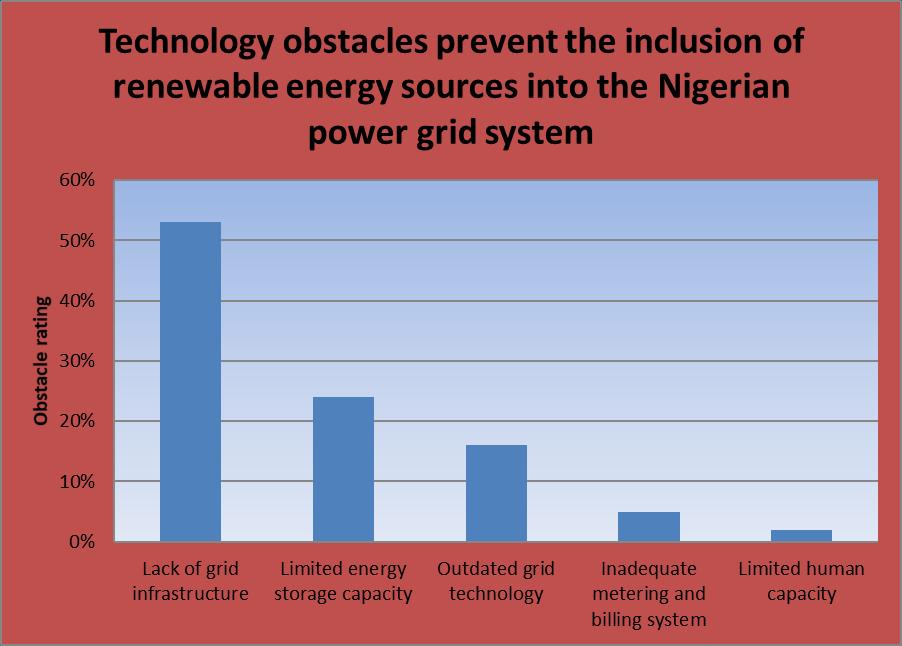
Figure 1: Chart showing ratings of technological obstacles preventing the inclusion of renewable energy sources into the Nigerian power grid system.
ThestudyconductedbyNESPandUNDPshedslightonthe technological challenges that Nigeria's power grid system facesinintegratingrenewableenergysources.Thebiggest issueisalackofgridinfrastructure,whichcanbesolvedby investing money on substations and transmission lines to assist renewable energy sources (NESP and UNDP, 2017). Anotherchallengethatcanbeovercomeisalackofenergy storage capacity, which can be overcome by developing energy storage technologies such batteries and pumped hydrostorage(NESPandUNDP,2017).Theelectricitygrid systemcanbeupdatedwithcontemporarytechnology,such as smart grid technologies, to address out-of-date grid technology(NESPandUNDP,2017).
Additionally,adependablemeteringandbillingsystemcan be implemented to address the insufficient system, which canboostearningsandstimulateinvestmentinrenewable energy(NESPandUNDP,2017).Lastly,theNigerianpower sectormayaddressitslimitedhumancapacitybyinvesting intheeducationandtrainingofqualifiedworkers.
Overall, the study's aim of recommending a sustainable solutionthatwillbringaboutefficientstabilityinNigeria's grid network with a greater mix of renewable energy sources while also addressing other technical challenges facedbytheNigerianelectricitygridsystemcanbeachieved withthehelpoftherecommendationsbasedonthefindings oftheNESPandUNDPstudy.
Research question 2: How large a renewable energy capacity must be added to the Nigerian grid system in order to attain effective stability?
Presentation of data
International
Volume: 11 Issue: 05 | May 2024 www.irjet.net
Table 3: Power Generation Sources in Nigeria
Power
Note: "Other sources" include sources such as coal and diesel.Source:NigerianElectricityRegulatoryCommission (NERC), 2021. The Nigerian Electricity Regulatory Commission (NERC) estimates that as of 2021, Nigeria's installed capacity for power generation is roughly 13,427 megawatts(MW),withabout1,447MWcomingfromgridconnected renewable energy (NERC, 2021). This includes contributions from renewable energy sources including solar,biomass,andhydropower.However,gas-firedpower plantsstillmakeuparound86%ofallinstalledcapacityin Nigeria,wherethemajorityofthecountry'selectricityisstill producedusingfossilfuels(NERC,2021).
Table 4: RenewableEnergyCapacitytargetsinNigeria
According to the Federal Ministry of Power, Works, and Housing(2018),grid-connectedrenewableenergyaccounts for13.8GWor45%oftotalgenerationand9.1GWor30% whenmediumandlargehydropowersisexcluded.
Itwillbenecessarytoconcentrateonboostingthecapacity of grid-connected renewable energy sources through the development of policies and incentives to encourage investmentinthesectorinordertoaccomplishthisresearch aimofrecommendingasustainablesolutionthatwillusher in efficient stabilityinNigeria'sgridnetwork with a more renewable energy mix, while addressing other technical challenges.Someofthesepoliciesarediscussedinresearch questionthreebelow.Itmayalsobenecessarytoaddress technicalchallengessuchasthelackofgridinfrastructure, limited energy storage capacity, and outdated grid technology,whichwereidentifiedaskeyobstaclesinastudy by the Nigerian Energy Support Program and the United NationsDevelopmentProgram(NESPandUNDP,2017).
Research question: What kind of public policies can encourage investments in renewable energy infrastructure, support the growth of local companies, and provide job opportunities?
Research Findings
Source: Federal Ministry of Power, Works and Housing (2018);NERC(2021).
AccordingtotheNigeriangovernment’scapacityexpansion target. A total of 13.8 GW of grid-connected renewable energy capacity needs to be added to the Nigerian grid systeminordertoattaineffectivestabilityby2030(Federal Ministry of Power, Works and Housing, 2018). This represents 45% of the total installed capacity target of 30GW. However, this figure includes medium and large hydropowerandwhenexcludingthem,thegrid-connected renewable energycapacitytargetis9.1GWor30%ofthe total installed capacity target (Federal Ministry of Power, WorksandHousing,2018).Thisisshowninthefrequency tablebelow.
Inaccordancewiththedata,Nigeria'sinstalledcapacityfor grid-connected renewable energy is currently quite low, makinguponlyaround10.8%ofallinstalledcapacityasof 2021(NERC,2021).Inordertoreachthegovernment'sgoal of30GWinstalledon-gridcapacityby2030,itisclearthat renewableenergycapacitymustbesignificantlyincreased.
Publicpolicyframeworksthatcanpromoteinvestmentsin infrastructureforrenewableenergy,aidsmallenterprisesin thearea,andgenerateemploymentprospectsinclude: Feed-intariffs(FITs)isapublicpolicyframeworkthatcan promote investments in renewable energy infrastructure, fostertheexpansionofregionalbusinesses,andprovidejob opportunities.FITsareregulationsthatpromisesetpricesto producersofrenewableenergyfortheelectricitytheycreate and feed into the grid. This gives producers of renewable energy a steady source of income and encourages investmentinrenewableenergyinfrastructure.Additionally, FITsmaystipulatethataspecificproportionofrenewable energy must be produced domestically, fostering the expansion of regional businesses, and generating employmentpossibilities(Aznar, et al., 2017).
Renewable Portfolio Standards (RPS): RPS is a regulatory framework requiring utilities to produce a certain percentage of their electricity from renewable energy sources. RPS can encourage the development of the renewableenergyindustry,advancetechnology,andopen upjobopportunities(Wiser&Barbose,2008).
Netmetering:Netmeteringisalegalframeworkthatenables users to resell any extra electricity they produce from renewable sources to the grid. Customers will have a financial incentive to invest in renewable energy infrastructure, which will help local businesses thrive (Alderfer, et al., 2017).
Tax Incentives: Tax benefits like Production Tax Credits (PTCs)andInvestmentTaxCredits(ITCs)canlowerthecost ofrenewableenergyprojectsandpromoteinvestmentinthe sector.Incentiveslikethesecanhelplocalfirmsexpandand provideemployment(Friedman,2016).
International Research Journal of Engineering and Technology (IRJET) e-ISSN: 2395-0056
Volume: 11 Issue: 05 | May 2024 www.irjet.net p-ISSN: 2395-0072
Green Bonds: Issued as fixed-income securities to finance ecologicallybeneficialinitiatives,greenbondsareanother option.Thismightpromoteinvestmentininfrastructurefor renewableenergysources,assistneighbourhoodbusinesses, andcreatejobpossibilities(Brinkman&Simonsen,2018).
Interpretation of Findings
By promoting investment in renewable energy infrastructure, assisting local businesses, and generating employmentopportunities,theintroductionoffeed-intariffs (FITs)andotherpoliciescanbeaviablesolutiontoNigeria's gridnetworkproblems.AccordingtotheFederalMinistryof Power, Works, and Housing, (2018), Nigeria may use this regulatoryframeworktomeetitscapacityexpansiongoalof 30 GW of installed on-grid capacity by 2030, with gridconnectedrenewableenergyaccountingfor13.8GW(45% ofgeneration).
Feed-in Tariffs, Renewable Portfolio Standards, Net Metering, Tax Incentives, and Green Bonds are a few examples of public policy frameworks that can be implemented in Nigeria to encourage investments in renewableenergyinfrastructure,supportlocalbusinesses, and create job opportunities. Numerous technical issues, suchasalackofinfrastructure,hightransmissionlosses,and restrictedaccesstoelectricityinsomeareas,faceNigeria's electricitygridsystem.Nigeriamayaddresstheseissuesand movetowardsamoresustainableandreliablegridnetwork with a higher proportion of renewable energy by implementingthesepolicies.Thesekindsofregulationscan alsoencourageprivateinvestment,enhancethestandardof living in areas with poor access to energy, and advance economicdevelopment.
To effectively implement these policies and build a more sustainable energy future for the nation, the Nigerian government can collaborate closely with private sector investors,energysuppliers,andotherstakeholders.
Research question 4
How can Nigeria's grid network employ more renewable energy to cut greenhouse gas emissions in accordance with global efforts to slow down climate change?
Research Findings
According to a report by the International Energy Agency (IEA),Nigeria'senergydemandisexpectedtotripleby2040 (IEA,2019).Thisincreaseindemandmakesitessentialfor Nigeria to focus on renewable energy sources to meet its energyneedswhilereducinggreenhousegasemissions.To achieve this goal, the government has introduced policies andincentivestoencouragethedevelopmentofrenewable energy, including the Nigerian Electricity Regulatory Commission'sfeed-intariffsystemandtheestablishmentof theNigerianBulkElectricityTradingCompanytopurchase electricity from renewable energy producers (Federal MinistryofPower,2015),netmetering,andtaxincentives, whichgiverenewableenergyproducersasteadysourceof
income and support the financial viability of renewable energyprojects(IRENA,2020).
Byestablishingpublic-privatepartnershipsandgivinglocal businesses the chance to take part in renewable energy projects, another option is to encourage private sector investment in renewable energy (IRENA, 2020). Private sectorinvestmentisalsocrucialforthegrowthofrenewable energyinNigeria.AccordingtoareportbytheWorldBank, Nigeria'sprivatesectorinvestmentinrenewableenergyhas been increasing, with investments totaling over $2 billion between 2010 and 2017 (World Bank, 2019). To further encourage private sector investment, the Nigerian governmenthasestablishedtheNigerianRenewableEnergy andEnergyEfficiencyFundtoprovidefinancialsupportto renewable energy projects (Federal Ministry of Power, 2015).
Nigeria can also look into ways to use more renewable energy in industries that contribute significantly to greenhouse gas emissions, such transportation and agriculture. In order to reduce emissions and increase demand for renewable energy, for instance, sustainable farmingmethodsandthemarketingofelectricvehiclescan bothbeimplemented(IRENA,2020).
InordertopromotetheuseofrenewableenergyinNigeria's grid network and lower greenhouse gas emissions in line with international efforts to combat climate change, a multifacetedstrategyisrequired.
Theimplementationofamultifacetedstrategythatpromotes the use of renewable energy and lowers greenhouse gas emissions in Nigeria's grid network can help achieve the research goal of recommending a sustainable solution to achieve efficient stability in Nigeria's grid network with a more renewable energy mix while addressing technical challenges. This can be accomplished, in accordance with IRENA, (2020), by creating a supportive regulatory environment, implementing policies that support the developmentofrenewableenergy,suchasfeed-intariffs,net metering, and tax incentives, encouraging private sector investment in renewable energy, and looking into opportunities to increase the use of renewable energy in sectors that significantly contribute to greenhouse gas emissions. Nigeria's grid network can provide effective stability, lower greenhouse gas emissions, and promote sustainabledevelopmentbyimplementingthesemeasures. Research question 5: What are the best practices and procedures for managing a grid to lessen or prevent system collapse, improve grid dependability, increase energy efficiency, and incorporate smart grid solutions, and what is the timeframe for putting these procedures intoaction over the course of the next five years?
Thefollowingareinstancesofbestpracticesandprocesses for managing a grid to avoid system failure, increase
International Research Journal of Engineering and Technology (IRJET) e-ISSN: 2395-0056
Volume: 11 Issue: 05 | May 2024 www.irjet.net p-ISSN: 2395-0072
dependability,boostenergyefficiency,andimplementsmart gridsolutions:
1. Ensuringthegridinfrastructure'sdependabilityand safety by performing routine maintenance and improvements(Xueetal.,2020):Makingensuring that the grid infrastructure is continuously maintainedandenhancedisoneofthemainwaysto avoidsystemcollapseandboostgriddependability. This calls for a variety of actions, such as system updates, equipment replacements, and standard maintenance jobs like vegetation control and system testing. Operators can find and address problems before they become serious ones by engaginginsuchoperations.Forinstance,according toXueetal.(2020),routineequipmentinspections andmaintenancecanassistidentifyproblemslike worn-out or broken components that could eventuallyleadtosystemfailures
2. Demand response programs are being used to balance electricitysupplyanddemand to prevent gridoverload(Khan, et al., 2018):Programmesfor demand response (DR) have become an essential toolforgridmanagement,especiallyduringtimesof high demand. When power demand is high, these programmes encourage users to use less of it, balancingsupplyanddemandandpreventinggrid overload. Khan, et al., (2018) claim that DR programmescanlowerpeakdemandbyupto20%, reducingthechanceofasystemicfailure.However, in order for DR programs to be successful, they must be well-thought-out, well-funded, and supported by smart grid technologies that enable real-timepowerflowmonitoringandcontrol.
3. To enhance grid monitoring, control, and management, advanced metering infrastructure (AMI)andothersmartgridtechnologiesarebeing installed(Xueetal.,2020):Inordertoimprovegrid monitoring, control, and management, smart grid technologieslikeadvancedmeteringinfrastructure (AMI)andsupervisorycontrolanddataacquisition (SCADA) systems are essential. Real-time monitoring of energy use at the customer level is made possible with AMI, enabling precise load balancing and demand forecasting. While this is going on, SCADA systems provide remote monitoringandcontrolofgridcomponents,giving operator’s access into the health of the grid and allowing them to react swiftly to system outages. AccordingtoXue, etal., (2020),theimplementation of such smart grid technology is essential for the stabilityanddependabilityofthegrid.
4. Improvinggridefficiencyandreducingrelianceon fossil fuels by increasing the usage of renewable energysourcesandenergystoragedevices(Khan, et al., 2018): Moving towards renewable energy
sourceslikesolarandwindpowerisonestrategyto promote grid sustainability and efficiency. These sources are a desirable substitute for fossil fuels sincetheyareaffordable,plentiful,andgenerateno greenhouse gases. Batteries and other energy storage technologies can also lessen the intermittentcharacterofrenewableenergysources andprovidegridoperatorsmorecontroloverhow power flows. However, large infrastructure and policy support investments are necessary for the deployment of renewable energy sources and energystoragetechnologies.Thecostofrenewable energy technologies has significantly decreased recently, making them more competitive with conventional sources, claim Khan et al. (2018). Therefore, there is a chance for policymakers to encourage their adoption through encouraging regulationsandpolicies
5. Creatingresponsestrategiesandcontingencyplans to deal with unforeseen situations, including equipmentfailure,cyberattacks,andharshweather (Xue, et al., 2020): Despite taking precautions to avoidsystemfailure,unforeseencircumstancescan stillhappenandinterferewithgridoperations.To lessen the effects of the disruption in such situations,itisessentialtohavereactiontacticsand contingencyplansinplace.Suchpreparationscan entail restoring electricity as soon as possible, putting backup power systems in place, and interacting with clients and stakeholders to give updates and direction. Response methods and emergency plans are essential for improving grid resilienceandloweringtheriskofsystemcollapse during unforeseen events claim by Xue, et al., (2020).
This information gives important insights into how to manage a grid in the best possible ways to avoid system failure, improve dependability, increase energy efficiency, andimplementsmartgridtechnologies.Theseprocessescan be used to improve the stability and sustainability of the Nigerianpowergridsystem,aswellastoaddresstechnical issuesandusemorerenewableenergysources.
Accordingtothereport,regularmaintenanceandupgrades to the grid infrastructure should be made to guarantee dependability and safety. To further enhance grid monitoring,control,andmanagement,advancedmetering infrastructure(AMI),demandresponseprograms,andother smart grid technologies can be deployed. In addition, expanding the use of energy storage technologies and renewable energy sources can enhance grid performance andlessentherelianceonfossilfuels.
These suggestions can be used as a springboard for the creation of a long-term fix to increase the proportion of renewable energy sources in Nigeria's grid network and increasegridstability. The rightscheduleforcarryingout
International Research Journal of Engineering and Technology (IRJET) e-ISSN: 2395-0056
Volume: 11 Issue: 05 | May 2024 www.irjet.net p-ISSN: 2395-0072
these operations can be created by looking at the grid's currentstate,theresourcesathand,andthegoalsofthegrid operator.
This research sought to identify long-term strategies that wouldsupporteffectivestabilityinNigeria'sgridnetwork, combiningagreaterproportionofrenewableenergysources andsolvingothertechnicalissuesthecountry'spowergrid system was currently confronting. The results show that Nigeria's electricity sector is dealing with serious issues, such as a dependency on fossil fuels, frequent power outages, inadequate energy production and distribution facilities,andexcessiveenergycosts.Inordertoensurethe nation's energy security and sustainable development, urgentactionmustbetaken.
According to this study, Nigeria possesses a wealth of renewableenergyresources,suchassolar,wind,hydro,and biomass, which might be used to diversify the nation's energy supply. Additionally, Nigeria needs to establish favourableregulatoryframeworksthatwouldencouragethe development of renewable energy. This might be done by implementingpolicieslikefeed-intariffs,netmetering,and taxincentives.Anothersuccessfultacticcouldbetoprovide local businesses the possibility to engage in renewable energyprojectsandtopromoteprivatesectorinvestmentin renewableenergythroughpublic-privatepartnerships. Several best practices and processes, such as routine maintenance and enhancements, demand response programs, advanced metering infrastructure (AMI), renewable energy sources, and energy storage devices shouldbeimplementedinordertoguaranteegridstability and increase energy efficiency. Nigeria must also have response plans and backup procedures to handle unanticipatedcircumstanceslikeequipmentfailure,cyberattacks,andbadweather.
In order to achieve energy security, sustainable development, and climate change mitigation, the Nigerian government must priorities the promotion of renewable energy sources and the adoption of best practices and guidelines. These solutions will need a lot of money and politicalwilltobeputintoplace,butovertimetheywillhave ahugepositiveimpactontheeconomyandtheenvironment. Overall,thesuggestionsmadeinthisstudyareessentialfor Nigeria to construct a strong and sustainable energy infrastructure that can offer its inhabitants dependable, inexpensive and sustainable energy while fostering economic growth and reducing climate change. Policymakers, grid operators, investors, and other stakeholders are urged to priorities implementing these solutionsinordertoaidNigeria'stransitiontoasustainable energyfuturebyreadingthisresearch.
Based on the study's findings, the following recommendationsaremade:
i. The study discovered that Nigeria's reliance on fossilfuelsforelectricitygenerationisasubstantial contributortogreenhousegasemissionsandother environmental issues. It therefore recommends increasingtheusageofrenewableenergysources. Therefore, in order to lower the nation's carbon footprint and improve the sustainability of its energysystem,thereisaneedtoincreasetheusage ofrenewable energysourceslikesolar,wind,and hydropower.
ii. The study showed that one of the main issues Nigeria'senergysystemisfacingisalackofsuitable gridinfrastructure.Inorder toincreasethegrid's dependability and efficiency, it is necessary to engageinmodernizationandexpansionprojects.
iii. Implement smart grid technologies: According to the study, demand response Programmes and advanced metering infrastructure (AMI) can considerablyenhancegridmanagementandlower the likelihood of system failure. Therefore, it is necessary to integrate these technologies into Nigeria'selectricalinfrastructure.
iv. Promote private sector investment: The study discoveredthatprivatesectorinvestmentmayplay acriticalroleinfosteringthegrowthofrenewable energy projects and enhancing the grid infrastructure. Therefore, it is necessary to enact policies like feed-in tariffs, tax incentives, and public-private partnerships in order to foster a climate that is favorable for private sector investment.
v. Improvecooperationandcoordination:Thestudy revealed that cooperation and coordination between electrical sector players are essential to thedevelopmentofasustainableenergysystem.In order to improve collaboration and coordination among stakeholders, including governmental organizations, grid operators, producers of renewableenergy,andconsumers,itisnecessary.
vi. Boosting public participation and knowledge was found to be crucial for encouraging the use of renewable energy sources and boosting the sustainabilityofthepowersystem.Asaresult,there is a need to raise public awareness through educationalandoutreachinitiativesandtopromote publicparticipationthroughlawslikenetmetering andinitiativesforlocallysourcedrenewableenergy.
vii. Byputtingthesesuggestionsintopractice,Nigeria maycreateanelectricitysystemthatisdependable and sustainable, supports economic growth, and addresses environmental issues. Also, more research should be carried out in the area
International Research Journal of Engineering and Technology (IRJET) e-ISSN: 2395-0056
Volume: 11 Issue: 05 | May 2024 www.irjet.net p-ISSN: 2395-0072
sustaining applying these technology and renewableenergyinsmallerunitstopowerhomes.
[1] Aboyade, A. O., Aina, O. B., and Onabajo, O. S. “Smart Grids: An overview of enabling technologies and potentialsforNigeria”Heliyon,5(12),2019,pp.e03020.
[2] Adaramola, M. S., Oyewola, O. M., and Paul, S. S. “An overview of renewable energy potential in Nigeria”. RenewableandSustainableEnergyReviews,103,2019, pp.59-67.
[3] Adebayo, O. A., Adebisi, B., and Adebayo, O. “The integration of renewable energy into Nigeria's grid: A review of the potential benefits and challenges” RenewableEnergy,121,2018,pp.753-760.
[4] Adelabu, N. A., Adeyemi, A. O., and Ibitoye, S. A. “Hydroelectric power in Nigeria: Challenges and prospects” Journal of Energy and Natural Resources Management,3(1),2020,pp.1-11.
[5] Adeleke,S.A.,Adebisi,B.,andAdebayo,O.“Thepotential benefits and challenges of smart grid technology in Nigeria”A review.RenewableandSustainableEnergy Reviews,99,2019,pp.381-390.
[6] Adeniyi,A.,Idris,A.,Dikko,A.,andOluwafemi,O.“The integrationofrenewableenergyintoNigeria'snational grid: A review” Renewable and Sustainable Energy Reviews,101,2019,pp.476-487.
[7] Adeniyi,O.A.,Oyedepo,S.O.,andAkinola,S.O.“Areview ofrenewableenergysources,sustainabilityissuesand climate change mitigation in Nigeria”. International Journal of Energy and Environmental Engineering, 10(2), 2019, pp.183-198. doi: 10.1007/s40095-0190293-9.
[8] Adeoye,P.O.,Agbetuyi,A.F.,Oduyemi,O.O.,Oyewola,O. M., and Jatto, S. “Renewable energy development in Nigeria: Challenges and prospects” Journal of Energy andNaturalResourcesManagement,4(1),2019,pp.115.
[9] Adewale, B. A., and Olusegun, S. S. “Environmental ImpactsofBuildingConstructioninNigeria:AReview”. Environmental Scienceand PollutionResearch,27(9), 2020,pp.8938-8954.
[10] Ajanaku, K. O., and Okeniyi, J. O. “Renewable energy potentials in Nigeria: Meeting rural energy needs”. RenewableandSustainableEnergyReviews,43,2015, pp.1073-1086.
[11] Akinbami, F. K., Awosope, C. O. A., Adewale, A. K., and Olabode,O.A.“AnalysisoftheNigerianpowersystem: Challengesandopportunities”.EnergyReports,7,2021, pp.2193-2203
[12] Akinjare, O. A., Alagbe, O. A., and Tunji-Olayeni, P. F. “TowardsSustainableConstructionIndustryinNigeria: Opportunities and Challenges for Bamboo-Based
Construction”.SustainableCitiesandSociety,38,2018, pp.583-590.
[13] Akorede,M.F.,Hizam,H.,andAb-Kadir,M.Z.A.“Smart gridtechnology:Potentials,challengesandprospectsin developing countries”. Renewable and Sustainable Energy Reviews, 20, 2013, pp.386-400. doi: 10.1016/j.rser.2012.11.056
[14] Akorede, M. F., Hizam, H., and Ab-Kadir, M. Z. A. “Technical aspects of grid integration of renewable energysources:Areview”.RenewableandSustainable EnergyReviews,22,2013,pp.391-413.
[15] Akpan,E.O.,andEwoh,S.O.Smartgridandrenewable energy in Nigeria: prospects and challenges. Energy Sources, Part A:” Recovery, Utilization, and EnvironmentalEffects,42(1),2020,pp.70-82.
[16] Alderfer,J.,Feldman,D.,andMargolis,R.“TheImpactof NetMeteringontheAvailabilityandCostofDistributed Solar”.NationalRenewableEnergyLaboratory.2017.
[17] Aremu,A.O.,andAdekoya,A.F.“Policiesforrenewable energyinNigeria:Areview”.JournalofEnergyResearch andReviews,2(1),2019,pp.1-11.
[18] Aznar, A., and Zambrano-Barragán, P. “Promoting renewable energy sources through feed-in-tariffs:” A theoretical framework. Renewable and Sustainable EnergyReviews,67,2017,pp.1145-1154.
[19] Bahramirad,S.,Ghandhari,M.,andWang,J.“Microgrids: Energy management by strategic selection of DG sources, storage and dispatchable loads”. IEEE Power andEnergyMagazine,12(1),2014,pp.66-74.
[20] Bazeley,P.“Mixedmethodsdataanalysis:Opportunities and challenges”. In N. K. Denzin & Y. S. Lincoln (Eds.), TheSAGEhandbookof qualitativeresearch.2018,pp. 643-655.
[21] Booth, A., Sutton, A., and Papaioannou, D. “Systematic approachestoasuccessfulliteraturereview”2016.
[22] Brinkman, G. L., and Simonsen, J. “Green Bonds: FinancingtheFutureofEnergy”.TheElectricityJournal, 31(9),2018,pp.66-71.
[23] CASP. “Critical Appraisal Skills Programme (CASP) Checklist” (2018). Retrieved from https://caspuk.net/wp-content/uploads/2018/01/CASPSystematic-Review-Checklist_2018.pdf.
[24] Creswell,J.W.“Aconciseintroductiontomixedmethods research”.SagePublications.2014.
[25] Creswell, J. W., and Plano-Clark, V. L. “Designing and conductingmixedmethodsresearch”.SagePublications, 2018.
[26] Delgado, J. A. “Smart grid: fundamentals and technologiesinelectricalengineering.Springer”2015.
[27] Deng, Y., Wang, Y., Wang, J., Zhang, X., and Liu, J. “Integrationofrenewableenergyintothesmartgrid”: Recent developments and challenges. Renewable and
International Research Journal of Engineering and Technology (IRJET) e-ISSN: 2395-0056
Volume: 11 Issue: 05 | May 2024 www.irjet.net p-ISSN: 2395-0072
SustainableEnergyReviews,90,2018,pp.226-237.doi: 10.1016/j.rser.2018.03.091
[28] Department of Energy (DOE). “Quadrennial Energy Review: Chapter 2 Electricity Transmission, Distribution, and Storage Infrastructure, 2014. Retrieved from https://www.energy.gov/sites/prod/files/2014/07/f18 /QER%20Chapter%202%20%20Electricity%20Transmission%2C%20Distribution %2C%20and%20Storage%20Infrastructure%20%20FINAL.pdf
[29] Emeasoba, C. “An overview of the Nigerian power sector”.RenewableandSustainableEnergyReviews,82, 2018,pp.2971-2985.
[30] Emejuru,A.A.,Okeniyi,J.O.,Ogunjuyigbe, A.S.O.,and Oyewola,O.M.“Areviewofsmartgridtechnologyand its applications to the Nigerian power sector”. RenewableandSustainableEnergyReviews,113,2019, pp.109271.
[31] EnergyInformationAdministration.“Nigeria-Analysis. 2021. Retrieved 3 March 2023, from https://www.eia.gov/international/analysis/country/N GA
[32] EPA “Greenhouse Gas Reporting Program (GHGRP)FacilityLevelInformation.2019.
[33] Ewona,I.O.,andEyo,E.O.“Renewableenergypoliciesin Nigeria: A review of achievements, challenges and prospects.Heliyon,6(7),2020,e04349.
[34] Ezeilo,C.N.,Nwosu,O.P.,andEzeilo,A.N.“Areviewof renewable energy sources and their potential in mitigating greenhouse gas emissions in Nigeria”. EnvironmentalScienceandPollutionResearch,27(27), 2020,pp.34168-34184.
[35] Ezennia, C. “Nigeria's power sector reforms: An overview of recent developments and future plans”. OxfordInstituteforEnergyStudies.2018.
[36] Fagbenle,R.O.,Adegun,A.S.,Katende,J.,andBolaji,B.O. “SolarenergydevelopmentinNigeria:Challengesand prospects”.RenewableandSustainableEnergyReviews, 119,2020,pp.109565.
[37] Fagbenle,R.O.,Katende,J.,andAjayi,O.O.“Renewable energy potentials, policies and challenges in Nigeria”. EnergyPolicy,129,2019,pp.1129-1137.
[38] Faruqui, A., Harris, D., and Hledik, R. “The power of dynamicpricing”.TheElectricityJournal,23(5),2010, pp.27-39.
[39] FederalMinistryofPower,WorksandHousing.“Power Sector Recovery Programme: 2017-2020”. 2018. Retrieved from http://www.psrp.gov.ng/documents/PSRP%20Docume nt%20(080717)%20web.pdf
[40] FederalMinistryofPower,WorksandHousing.“Power Sector Report 2018” 2018. Retrieved from
https://www.fmwh.gov.ng/doc/PowerSectorReport201 8.pdf
[41] FederalMinistryofPower,WorksandHousing.“Power Sector Roadmap” 2016. Retrieved from https://www.fmpwh.gov.ng/assets/attachments/POWE R%20SECTOR%20ROADMAP%202016%20PDF.pdf
[42] FederalMinistryofPower.(2015).NationalRenewable Energy Action Plan (NREAP). Retrieved from https://www.power.gov.ng/national-renewableenergy-action-plan-nreap/
[43] Federal Ministry of Power. “Nigerian Electricity Grid Code”. 2015. Retrieved from https://www.nigerianelectricityregulatorycommission.o rg/documents/gridcode/13.html
[44] Feng,J.,Wang,Z.,Chen,L.,andZhang,W.“Applicationof distributionautomationsysteminsmartgrid.In2015 IEEE Advanced Information Management, Communicates, Electronic and Automation Control Conference”. 2015, pp.915-919). IEEE. doi: 10.1109/IMCEC.2015.246.
[45] Feng, S., Wu, Y., Wang, C., He, X., and Zhao, X. “Distribution automation system with smart grid communicationtechnology”.ElectricPowerAutomation Equipment,35(1),2015,pp.6-11.
[46] Friedman,B.,Ho,J.,andMatisoff,D.C.“Taxincentives andinvestmentinrenewableenergy:ThecaseoftheUS windproductiontaxcredit”.AppliedEconomics,48(24), 2016,pp.2253-2266.
[47] Gleick, P. H. “The world's water: 2008-2009”. Island Press.2008.
[48] Gomez. D., and Miret-Artes, J. “Smart Grids for the integrationofrenewableenergy”,theJournalofCleaner Production,2019.
[49] Gough,D.,Oliver,S.,andThomas,J.“AnIntroductionto SystematicReviews”.Sage,2012.
[50] Griffin,S.M.,andNewman,J.D.“Smartgridintegration ofrenewableenergyresources”.IEEEPowerandEnergy Magazine,8,2010,pp.18-28.
[51] Higgins,J.P.T.,andGreen,S.“CochraneHandbookfor SystematicReviewsofInterventions”.Wiley-Blackwell, 2011.
[52] Higgins,J.P.T.,Thomas,J.,Chandler,J.,Cumpston,M.,Li, T.,Page,M.J.,andWelch,V.A.“CochraneHandbookfor Systematic Reviews of Interventions”. John Wiley & Sons.2019.
[53] Ho,K.W.,Chau,K.T.,Chan,K.W.,andLu,L.“Demand response in smart grid: An overview and customer feedback”.RenewableandSustainableEnergyReviews, 62,2016,pp.1209-1226.
[54] Huang, X., Zhang, J., and Fang, H. “Challenges and solutionsfor integrating renewableenergyintosmart gridsystems”.EnergyReports,6,2020,pp.1745-1754. doi:10.1016/j.egyr.2020.08.004
© 2024, IRJET | Impact Factor value: 8.226 | ISO 9001:2008
International Research Journal of Engineering and Technology (IRJET) e-ISSN: 2395-0056
Volume: 11 Issue: 05 | May 2024 www.irjet.net p-ISSN: 2395-0072
[55] Huang, X., Zhang, L., and Fang, X. “Intermittency managementofrenewableenergyinsmartgrid”.Journal of Renewable and Sustainable Energy Reviews, 133, 2020,pp.110232.doi:10.1016/j.rser.2020.110232
[56] Ibrahim, A., Ibrahim, A. M., Aliyu, A., and Mshelia, H. “Assessment of wind energy potential in Nigeria”. InternationalJournalofEnergyEconomicsandPolicy, 10(6),2021,pp.524-529.
[57] IEA.“Renewables2020:Analysisandforecastto2025. InternationalEnergyAgency”2020.
[58] InternationalEnergyAgency(IEA),“Renewableenergy forelectricitygeneration.InternationalEnergyAgency”. 2016.
[59] International Energy Agency (IEA). “Electricity Information 2021”. 2021. Retrieved from https://www.iea.org/reports/electricity-informationoverview-2021
[60] International Energy Agency (IEA). “Nigeria”. 2021. Retrievedfromhttps://www.iea.org/countries/nigeria
[61] International Energy Agency. “Africa Energy Outlook 2019”. 2019. Retrieved from https://www.iea.org/reports/africa-energy-outlook2019
[62] InternationalEnergyAgency.”AfricanEnergyOutlook 2019. 2019, Retrieved from https://www.iea.org/reports/africa-energy-outlook2019
[63] International Renewable Energy Agency. “Renewable Energy Policies in a Time of Transition: Lessons from Country Experiences”. 2018. Retrieved from https://www.irena.org/publications/2018/Sep/Renew able-energy-policies-in-a-time-of-transition
[64] International Renewable Energy Agency. “Renewable Energy Policies in a Time of Transition: Heating and Cooling”. 2020. Retrieved from https://www.irena.org/publications/2020/Oct/Renewa ble-Energy-Policies-in-a-Time-of-Transition-Heatingand-Cooling
[65] International Renewable Energy Agency. “Renewable Energy Policies in a Time of Transition: Lessons from Country Experiences”. 2019. Retrieved from https://www.irena.org/publications/2018/Sep/Renew able-energy-policies-in-a-time-of-transition
[66] IRENA. “Renewable Energy Policies in a Time of Transition: Heating and Cooling Edition – 2020 International Renewable Energy Agency” 2020. https://www.irena.org/publications/2020/Jun/Renewa ble-energy-policies-in-a-time-of-transition-Heating-andcooling-edition-2020
[67] IRENA. “Renewable Energy Prospects: Nigeria”. 2019. Retrieved from https://www.irena.org/publications/2019/Aug/Renew able-energy-prospects-Nigeria
[68] Kabeyi, M.J.B. and Olanrewaju, O.A. “Smart grid technologiesandapplicationinthesustainableenergy transition: a review”. International Journal of SustainableEnergy,42(1),2022,pp.685–758.
[69] Kammen, D. M., and Peters, M. A. “The path to a lowcarboneconomy”.Nature,468(7321),2010,pp.290-292.
[70] Kempton, W., and Tomic, J. “Integrating Variable Renewable Energy in Electric Power Markets: Best Practices from International Experience”. National Renewable Energy Laboratory, 2005. Retrieved from https://www.nrel.gov/docs/fy05osti/37654.pdf
[71] Khan, U. M., Abbasi, A. Z., Anjum, M. A., and Khalid, S. “Demandresponseinsmartgrid:Areview”.Renewable and Sustainable Energy Reviews, 81, 2018, pp.31293148.
[72] Kitchenham,B.“Proceduresforperformingsystematic reviews. Keele, UK, Keele University, 33(2004), 2004, pp.1-26
[73] Kong, L., Chen, J., and Chen, M. “A review of energy storage technologies for renewable energy power systems”.RenewableandSustainableEnergyReviews, 81, 2018, pp.3182-3192. doi: 10.1016/j.rser.2017.06.073
[74] Kumar,R.“Researchmethodology:Astep-by-stepguide forbeginners.SagePublications.2019.
[75] Li,H.,Xu,Z.,andZhang,X.“Optimaloperationofenergy storage system in smart grid based on fuzzy logic control”.JournalofRenewableandSustainableEnergy, 12(4),2020,pp.043703.
[76] Liberati, et al., “The PRISMA Statement for Reporting SystematicReviewsandMeta-AnalysesofStudiesThat Evaluate Health Care Interventions: Explanation and Elaboration.PLoSMedicine,6(7),2009.
[77] Liu,H.“Smartgridandrenewableenergyintegration:A critical review”. Renewable and Sustainable Energy Reviews, 60, 2016, pp. 1123-1133. doi: 10.1016/j.rser.2016.02.004
[78] Lopez, R., Elizondo, M., and Vazquez, S. “Renewable energyintegration:Challengesandsolutions.Renewable andSustainableEnergyReviews,29,2014,pp.877-891. doi:10.1016/j.rser.2013.08.105.
[79] Luchies, J. M., Shaltout, R. M., and Zhang, X. “Flywheel energy storage technology: A review. Applied Energy, 2019,pp.233-234.doi:10.1016/j.apenergy.2018.10.006
[80] McLeod,S.A.,andWright,J. “Evaluatingthequalityof researchsources.SimplyPsychology”.2021.Retrieved from https://www.simplypsychology.org/researchsources.html
[81] MinistryofPower.“PowerSectorRecoveryProgramme (PSRP)”. 2019. Retrieved from https://www.nigeriaelectricityhub.com/wpcontent/uploads/2019/01/Power-Sector-RecoveryProgramme-PSRP-Final.pdf
International Research Journal of Engineering and Technology (IRJET) e-ISSN: 2395-0056
Volume: 11 Issue: 05 | May 2024 www.irjet.net p-ISSN: 2395-0072
[82] Moher,etal.,“PreferredReportingItemsforSystematic Reviews and Meta-Analyses: The PRISMA Statement”. PLoSMedicine,6(7).2009.
[83] NationalRenewableEnergyandEnergyEfficiencyPolicy (NREEEP)(2013).FederalRepublicofNigeria:Ministry ofPower.2013.
[84] NERC. “Nigerian Electricity Supply IndustryGeneration.NigerianElectricityRegulatoryCommission. 2021. Retrieved from http://www.nerc.gov.ng/index.php/library/documents /nesi-generation
[85] NERC. “Nigerian Electricity Supply Industry (NESI) Power Sector Report: Q4 2020”. 2021. https://www.nerc.gov.ng/index.php/library/category/ 6-nigerian-electricity-supply-industry-nesi-powersector-reports
[86] NESPandUNDP“NigerianEnergySupportProgramme: Technical Assistance Report: Assessing Off-Grid Electrification Options in Nigeria. 2017. Available at: https://nigeriasupport.org.ng/wpcontent/uploads/2018/02/UNDP_NESP_Assessing-OffGrid-Electrification-Options-in-Nigeria.pdf[Accessed26 Apr.2023].
[87] Nigerian Electricity Regulatory Commission (NERC). “NigerianElectricitySupplyandInstallationStandards:” 2021. Revised Edition. Retrieved from https://www.nercng.org/index.php/library/documents /regulations/nesis-revised-edition/file.
[88] Nigerian Electricity Regulatory Commission. “Regulations”. 2021. Retrieved from https://nerc.gov.ng/regulations/.
[89] Nwakali, O., and Iwuoha, E. Power generation, transmission and distribution in Nigeria: a review. Journal of Energy, Environmental & Chemical Engineering, 3(1), 2020, pp. 63-70. doi: 10.11648/j.jeece.20200301.15.
[90] Nwanji, T. I., Adebisi, B., and Shittu, M. O. “Renewable energy integration and smart grid technology: A review”. Renewable and Sustainable Energy Reviews, 137,2020,pp.110305.
[91] Nwanji, T. I., Adewumi, A. O., and Daramola, M. O. “A review of smart grid technologies for efficient renewable energy integration and management in Nigeria”. International Journal of Energy and Environmental Engineering, 11(3), 2020, pp.267-288. doi:10.1007/s40095-020-00360-w
[92] Nwosu, O. C., and Iwu-James, J. “The challenges and prospects of smart grid technology in Nigeria's electricitysector”.EnergyPolicy,127,2019,pp.431-437.
[93] Oduwole, O., and Ipinmoroti, K. O. “The potential of hydroelectric power in Nigeria: An overview”. Energy Reports,4,2018,pp.113-119.
[94] Ogbonna, A. C., Urama, N. A., and Onyejiuwa, C. C. “Assessment of renewable energy development in
Nigeria: achievements, challenges, and prospects”. JournalofRenewableEnergy,2020,2020,pp.1-14.doi: 10.1155/2020/8369197.
[95] Ogbonna,C.,Atubi,A.O.,andUzuegbu,C.P. “Nigeria's electricitycrisis:Causes,consequences,andsustainable solutions”. Heliyon, 6(6), 2020, pp. e04202. https://doi.org/10.1016/j.heliyon.2020.e04202
[96] Ogunjuyigbe, A. S., Okeniyi, J. O., and Ogunsina, B. S. “Renewableenergypolicies,initiatives,andchallenges inNigeria.RenewableandSustainableEnergyReviews, 113,2019,pp.109282.
[97] Ogwueleka, F. N., and Nnabuchi, M. N. “Renewable energydevelopmentinNigeria:Policyframeworkand incentives for wind energy”. Energy Reports, 6, 2020, pp.1176-1183.
[98] Ojolo,S.J.,Ogundana,O.M.,Ijomah,W.L.,Ojolo,S.J.,and Anyaogu,A.C.“Implementationofsmartgridtechnology forefficientenergymanagementinNigeria”.Journalof CleanerProduction,256,2020,pp.120548.
[99] Okenyi,N.“Nigeria:TheElectricitySituation.AllAfrica” 2021.
https://allafrica.com/stories/202102120476.html
[100]Okenyi, V. C. “Analysis of energy crisis in Nigeria”. JournalofEnergyStorageandConversion,2(1),2021, pp.16-19.doi:10.11648/j.jesc.20210201.13
[101]Oladeji, A. O., Ohunakin, O. S., and Akinola, A. O. “A reviewofsmartgridtechnologiesandtheirapplication for demand response in Nigeria”. Journal of Energy Storage,30,2020,pp.101436.
[102]Olawale, O. O., Taiwo, O. J., and Odetunmibi, O. A. “HydroelectricpowergenerationinNigeria:Challenges andthewayforward”.JournalofEnergyTechnologies andPolicy,10(1),2020,pp.1-9.
[103]Olawale, Y. A., and Sun, M. “Overview of Sustainable ConstructionPoliciesandPracticesinNigeria”.Journal ofCleanerProduction,176,2020,pp.638-649.
[104]Olowo, O. A., Adebisi, B., Adebayo, O. A., and Dikko, A. “TheintegrationofhydroelectricenergyintoNigeria's national grid: A review of the potential benefits and challenges”. Renewable and Sustainable Energy Reviews,132,2020,pp.e110119.
[105]Onohaebi,O.“Reviewofrenewableenergydevelopment in Nigeria: potentials, prospects, and challenges”. RenewableandSustainableEnergyReviews,94,2-18, pp.754-774.
[106]Onohaebi, O. F. “Renewable energy integration into smart grid in Nigeria”. Renewable Energy, 121, 2018, pp.743-752.doi:10.1016/j.renene.2018.01.063
[107]Onuoha,M.D.,andObi,C.O.“Integrationofrenewable energy sources into the Nigerian electricity grid: A review of progress, challenges, and way forward”. JournalofEnergyStorage,32,2020,pp.101778.
International Research Journal of Engineering and Technology (IRJET) e-ISSN: 2395-0056
Volume: 11 Issue: 05 | May 2024 www.irjet.net p-ISSN: 2395-0072
[108]Oyedepo, S. O. “Smart grid development in Nigeria: prospectsandchallenges”.JournalofEnergyinSouthern Africa,26(4),2015,pp.43-52.
[109]Oyedepo,S.O.,andFagbenle,R.O.“Reviewofrenewable energypotentialinNigeria”.RenewableandSustainable EnergyReviews,90,2018,pp.226-238.
[110]Oyedepo, S. O., Ohunakin, O. S., and Adaramola, M. S. “Solar energy development in Nigeria: Progress, challenges and prospects. Energy Sources, Part A:” Recovery, Utilization, and Environmental Effects, 42(7),2020,pp.877-891.
[111]Panteli,M.,andMancarella,P.“Reviewoftheapplication of risk assessment methodologies for critical infrastructure protection”. Electric Power Systems Research, 121, 2015, pp.89-97. doi: 10.1016/j.epsr.2014.11.002.
[112]Petticrew,M.,andRoberts,H.“Systematicreviewsinthe social sciences: A practical guide”. Wiley-Blackwell. 2008.
[113]Popay, et al. “Guidance on the Conduct of Narrative Synthesis in Systematic Reviews. A Product from the ESRCMethodsProgramme.Version1.2006.
[114]Pudjianto, D., Bak-Jensen, B., and Sørensen, P. “Smart gridsystemsandtechnologies:”fundamentals,design, andimplementation.JohnWiley&Sons.2018.
[115]Pudjianto,D.,Ramsay,C.,andStrbac,G.“Demand-side management: Benefits and challenges. Proceedings of theIEEE,101(6),2013,pp.1498-1517.
[116]Qu, S., Lei, X., Zhang, S., and Li, Y. “Smart grid technologies for integration of renewable energy resources: A review”. Renewable and Sustainable EnergyReviews,124,2020,pp.e109797.
[117]Simms, R., and Wood, L. “How to do a systematic literature review in nursing: a step-by-step guide”. McGraw-HillEducation(UK),2019.
[118]Sustainable Energy for All. “Renewable Energy in Nigeria. 2019. Retrieved from https://www.seforall.org/sites/default/files/201911/Nigeria%20Country%20Profile.pdf
[119]Thomas, J., Harden, A., and Newman, M. “Synthesis: combiningresultssystematicallyandappropriately”.In Methods for the thematic synthesis of qualitative researchinsystematicreviews,2019,pp.179-202.SAGE Publications.
[120]UNDP. “Nigeria’s Integrated National Energy Policy: EnergyforAll,SustainableDevelopmentforAll”.2019. Retrieved from https://www.ng.undp.org/content/nigeria/en/home/li brary/energy/nigeria-s-integrated-national-energypolicy.html
[121]UnitedNationsDevelopmentProgramme.“Sustainable Development Goals Report” 2017. available at https://www.undp.org/content/dam/undp/library/SD
Gs/English/Sustainable-Development-Goals-Report2017.pdf
[122]Uzochukwu,G.A.,Nwosu,P.N.,andAjaero,C.K.“Smart gridsysteminNigeria:Areviewoftheenablingpolicies, technologies, and associated challenges”. Energy Technology,7(5),2019,pp.e1800928.
[123]Wang, Z., Lian, J., Fang, J., and Xu, Z. “A distribution automation system for distribution networks with distributed generators”. Electric Power Systems Research, 157, 2018, pp.91-101. doi: 10.1016/j.epsr.2017.11.007.
[124]Wiser, R., and Barbose, G. Renewables Portfolio StandardsintheUnitedStates:AStatusUpdate.2008. LawrenceBerkeleyNationalLaboratory.
[125]World Bank. (2022). Access to electricity (% of population). Retrieved from https://data.worldbank.org/indicator/EG.ELC.ACCS.ZS?l ocations=NG
[126]World Bank. (2021). Nigeria Electrification Project. Retrieved from https://www.worldbank.org/en/projectsoperations/project-detail/P167805
[127]World Bank. “Nigeria – Energy”. 2018. Retrieved 3 March 2023, from https://www.worldbank.org/en/country/nigeria/brief/ nigeria-energy
[128]World Bank. “Nigeria: Unlocking the potential of its renewable energy resources”. 2020. Retrieved from https://www.worldbank.org/en/news/feature/2020/1 2/10/nigeria-unlocking-the-potential-of-its-renewableenergy-resources.
[129]World Bank. Nigeria - Investment Brief: Renewable Energy. 2019.Retrieved from https://documents.worldbank.org/en/publication/docu mentsreports/documentdetail/472801571889027238/nigeri a-investment-brief-renewable-energy
[130]Xue, M., Li, F., Chen, Z., and Li, J. Research on grid operationandmanagementintheeraofsmartgrid.IOP Conference Series: Earth and Environmental Science, 495(4),2020,pp.e042056.
[131]Zhang,P.,Li,W.,andYang,H.“Energystoragesystem: The backbone of the future grid”. Renewable and SustainableEnergyReviews,2018.
[132]Zheng, X., Yang, B., Zhang, Y., Chen, C., and Fang, X. Overview of demand response in smart grid. IET Generation,Transmission&Distribution,11(10),2017, pp.2447-2456. doi: 10.1049/iet-gtd.2016.1428.D. Kornack and P. Rakic, “Cell Proliferation without NeurogenesisinAdultPrimateNeocortex,”Science,vol. 294, Dec. 2001, pp. 2127-2130, doi:10.1126/science.1065467.
[133]M.Young,TheTechnicalWriter’sHandbook.MillValley, CA:UniversityScience,1989.
International Research Journal of Engineering and Technology (IRJET) e-ISSN: 2395-0056
[134]R. Nicole, “Title of paper with only first word capitalized,”J.NameStand.Abbrev.,inpress.
[135]K.Elissa,“Titleofpaperifknown,”unpublished.
Volume: 11 Issue: 05 | May 2024 www.irjet.net p-ISSN: 2395-0072 © 2024, IRJET | Impact Factor value: 8.226 | ISO 9001:2008 Certified Journal |