
International Research Journal of Engineering and Technology (IRJET) e-ISSN: 2395-0056
Volume: 11 Issue: 05 | May 2024 www.irjet.net p-ISSN: 2395-0072
International Research Journal of Engineering and Technology (IRJET) e-ISSN: 2395-0056
Volume: 11 Issue: 05 | May 2024 www.irjet.net p-ISSN: 2395-0072
Md. Shahadat Hossan Sayem1 , Md. Mainuddin Sagar2, Md. Rezwan Alam3, Dr. Abdullah AlFaruk4,
1,3Research Scholar, Department of Mechanical Engineering, Khulna University of Engineering & Technology, Khulna, Bangladesh
2Research Scholar, Department of Mechanical Engineering, Chittagong University of Engineering & Technology, Chittagong, Bangladesh
4Professor, Department of Mechanical Engineering, Khulna University of Engineering & Technology, Khulna, Bangladesh ***
Abstract - This effort examined the potential of winglets on wings in aircraft for the reduction of induced drag coefficient and the increase of lift coefficient without increasing the span of the wings. In this study, the aerodynamic characteristics of an airfoil wing having winglets have been studied with the help of simulation software ANSYS Fluent. Here, the drag co-efficient and lift coefficient have been studied for different cant angles of winglets on aircraft wing. For the effort, subsonic flow of air will be considered over the wing. NACA 0012 symmetric airfoil is considered for the study. In this report, the preeffort for numerical analysis of the using and performance of winglets have been observed and also, the shape of the wing and winglets. From the study, it is observedthat the lift to drag coefficient ratio exhibits maximum values for wing with 90° winglet. The values of CL/CD shows lowest values for normal wing. In the case of wing with 30° and 45° winglet, the values or curves seem similar with each other. Blended winglet will increase lift coefficient about approximately 42% to 49% and reduce drag coefficients. These winglet designs are capable of reducing the induced drag and converting wing tip vortices to increase thrust, saving costs by reducing fuel consumption, reducing noise levels and enhancingaircraft engine performance.
Key Words: NACA, Aerofoil, Winglets, Lift Coefficient, Subsonic Flow, Reynolds Number, Chord Length
1.INTRODUCTION
Wings are the most important and vital part of an aeroplanewhichkeepstheaircraftfloatedandsteadyand also helps it to move through a direction into the air streamofsurroundings.Morethan100yearsago,aircraft designers sought to improve the existing methodologies for aircraft control.. An airfoil-shaped body, called ‘Wing’ which moves through a fluid produces an aerodynamic strength. The part of this force is called raise which is perpendicular to the direction of motion. The parallel aspecttothedirectionoffreestreammotioniscalleddrag. Subsonicflightairfoilshaveatypicalformwitharounded
leading edge, accompanied by a straight trailing edge, oftenwithupperandlowersurfacecurvaturesymmetrical. Foils constructed with water with similar function as the operatingfluidarecalledhydrofoils.Awingletisanalmost vertical extension to the tips of the wing. The winglet’s upward angle (or Cant), its inward angle (or toe), as well as its size and shape are critical for proper performance, anduniqueineveryapplication.
Winglets help mitigate the effects of "induced drag." Most airplanes are designed so that the outer tips of the wing are higher than where the wings are attached to the fuselage. This upward angle is called the dihedral and helps to keep the airplane from rolling unexpectedly duringflight.Whenanaircraftisinflight,theairpressure ontopofthewingislowerthantheairpressureunderthe wing. That’s why there would be a pressure difference between the upper surface of the wing and the lower surface of the wing causing a pressure gradient region. That would result in the desired lift which would help an aircraft to float in the air considering the required consequences. A winglet is a vertical or inclined attachment of the wing tips. Winglets make it easier for the wings to generate lift, which ensures the planes need fewer input from the engines. Winglets has been used extensively as they offer better fuel efficiency for the aircraft.
Thewinglettransformssomeoftheotherwisewastedene rgyintoanapparentthrustinthewingtipvortex. This small contribution can be worthwhile, provided the benefit offsets the cost of installing and maintaining the winglets during aircraft's lifetime. The vortex that rotates around from Mow the wing impacts the winglet's cambered surface, creating certain angles with a push. Also they can perform to reduce the strength of the wing tip vortex, which trails downstream of the plane. It is a highriskforanaircrafttopassthroughthesevortices,the turbulent air can push the aircraft into an accident by causinglossofcontrol.
International Research Journal of Engineering and Technology (IRJET) e-ISSN: 2395-0056
Volume: 11 Issue: 05 | May 2024 www.irjet.net p-ISSN: 2395-0072
In the 1970s, biologists began to explore the flying characteristics of soaring birds, such as eagles, hawks, condors, vultures and ospreys. Each of these birds has high lift wings at the ends that produce slotted wingtips with feathers called "pin." Biologists find that the pin feathers function in the same manner as aircraft ailerons inreducingdragwhileglidingaswellasinrollcontrol.As for the California Condor, these multi-winglets are quite often long and prominent. . He used small, nearly vertical fins installed on a KC-135A and flight tested1-2 in 1979 and 1980. The winglet concept actually dates back to patent in 1897, but not until Whitcomb investigated winglet aerodynamics did the concept mature. Whitcomb found that at cruising speeds, winglets could increase the rangeofanaircraftbyasmuchassevenpercent.ANASA contract3 in the 1980s assessed winglets and other drag reduction devices, and they found that wingtip devices (winglets,feathers,sails,etc.)canimprovedrag-due-to-lift efficiencyby10to15%iftheyaredesignedasanintegral part of the wing. Several types of improvements to the wingtip have been patented in recent years. The tip6 "spiroid" wing creates a decrease in the induced drag, comparable to that of a winglet. Although the wing tips maybeeliminatedbyaclosedliftingsystem,thisdoesnot eliminate the trailing vortex wake. By eliminating the discontinuity between the wing tip and the winglet, the blended winglet10 reduces drag. A smoothed version is being used on the Boeing 737-400's gently upswept winglet. Boeing Business Jets and Aviation Partners, Inc. have embarked on a cooperative program to market the Boeing 7xx series of jetliners with conventional winglets forretrofit.
In those early years, structural compliance techniques were actively incorporated into aircraft structures as a means of controlling aircraft with the most notable technique being the ingenious "wing warping" used for roll control by the Wright brothers Error! Reference source not found. The last 25 years have spanned modern interest in winglets. NASA Langley Research Center'sRichard Whitcomb Error! Reference source not found. first looked at modern winglet applications for aircraft transport in the 1970's. Bourdin et al.Error! Reference source not found., investigated a novel method for the control of “Morphing” aircraft. At that concept, a pair of winglets are consisted with adjustable cant angle, attached at the tips of a baseline flying wing and actuated independently. A vortex lattice model is computed and subsequent wind tunnel tests are demonstrated the viability of the concept. Comparisons are made to good agreement between the experimental and numerical findings, with the main differences assumedtobeattributedtoaeroelasticeffectsofthewind tunnelmodel.
Houghton Error! Reference source not found. observed that if a winglet is attached to a wing then it would substantially reduce the flutter speed of the wing in transonicMachnumber.Therefore,theresultofslideslips on winglets is to produce increased loads similar to wing loads due to angle of attack. Satran demonstrated the static and dynamic stability and control and free-flight behaviorofa0.36scalemodelofacanardgeneral-aviation airplanewithasinglepusherpropellerandwingletsinthe Langley30by60feetwindtunnel.Heconsiderthemodel showing very strong dihedral impact but poor steering stability. Analysis and design of wings and wing/winglet Combinations at low speeds is done by Chattot Error! Reference source not found. who considered numerical treatment in Prandtl lifting –line theory of the nonlinearity associated with a 2-D lift curve, when the local incidenceisgreaterthantheincidenceofmaximumlift.An artificial viscosity term has been acquainted to the governing equation that allows the iterative method to converge to the correct solution. The effect of yaw has been determined and the optimal wing/winglet combinations have been found to have weathercock stability.
Gall et al. Error! Reference source not found. examined both theoretically and experimentally, the most likely improving the aerodynamic characteristics of a biplane configuration by adding winglets. A good agreement with experiment in predicting inviscid drag due to lift is exhibited by theoretical calculations. The ideal efficiency factorisincreasedupto13%aswellasincreasingthe lift curve slope and maximum lift coefficient. Astatisticalstudycomparedthebiplane withanimprove dwinglettoamonoplanereveals thebiplanehasthepote ntialtoincreaseL/Dmaxby6.4percentand13percent increase in CL 3/2 / CD , the classical endurance parameter. Research by evolutionary biologists at the Technical University of Berlin has also shown the effectiveness of several slotted wings and shown how these traits could have evolved naturally in birds by gradually increasing wing performance. Their evolutionary theory has been emulated in an aircraft optimization algorithm developed by Kroo et al. Error! Reference source not found.,whichhasdiscovereda‘C’wing configuration with a winglet and a horizontal extensionthatshowsreduceddragforfixedlift,span,and height.
Kroo et al. Error! Reference source not found. dealt with the broad concept of non-planar wings, which includes winglets. They examined a variety of aircraft types, including winglets, nag wings, box wings and the exploitation of non-planar wakes in general. Such designs are of interest because of their potential for lower vortex drag without increased span, a key constraint for many aircraft. The Wright brothers exploited the structural advantages of biplanes. At very low Reynolds number,
International Research Journal of Engineering and Technology (IRJET) e-ISSN: 2395-0056
Volume: 11 Issue: 05 | May 2024 www.irjet.net p-ISSN: 2395-0072
highly cambered, thin sections, making the cable braced Wright biplane concepts especially attractive. However, Smith et al.Error! Reference source not found. figured out that the adjustments of single winglets onto the biplanesimproves13%inendurance,aswellasincreasing thelift-curveslopeandthemaximumliftcoefficientofthe vehicle. Jonathan Santos anticipated the innovation in the current proposal in his patent on wingtip airfoils. Santos realized that a sequence of winglets at the wingtips could takeadvantageofthespiraldesignofthewingtipvortices to increase a single winglet's efficiency. At the Cranfield Institute of Technology in England, Spillman et al.Error! Reference source not found. carried out a series of programs to investigate devices akin to the wing tip airfoils, which he called “wing tip sails”. He explored the useof one to four sailson a ParisMS760 Trainer aircraft wingtip fuel tank. Flight test experiments confirmed the wind tunnel tests, and demonstrated shorter takeoff rolls and reduced fuel consumption. Spillman later determined wingtip vortex reduction due to wing tip sails, and found lower vortex energy 400-700 m behind the aircraft, although the rate of decay beyond that was somewhat lower.
Hossain et al.Error! Reference source not found. investigated about the aerodynamic characteristics for aircraft wing model with and without bird feather like winglet. NACA 653-218 airfoil is used in this regard. The experimental analysis shows that a decrease of 25-30 percent in the drag coefficient and a 10-20 percent increase in the lift coefficient by using bird feather like wingletforangleofattack8degrees.Beechooketal. Error! Reference source not found. found that the efficiency of an aircraft is greatly affected by induced drag generated bywingtipvortices.Wingletsataircraftwingtips,referred toasvertical orangled extensions,areusedto reduce the creationofvorticestoincreasethefuelefficiency.
The objectives of the study were to analyze the aerodynamic characteristics and to examine winglet efficiencyatcantangles0°,30°,45°,and60°atdifferent angles of attack (AOA). The experimental work was carried out under conditions at sea level and free-stream velocity of 35 m / s in a closed-loop wind tunnel. Using Finite Volume Process, the CFD simulations were performedatlowsubsonicflowrateinANSYSCFXsolver. Cosin et al.Error! Reference source not found. developed a multi-winglet study as a method for minimizing induced drag in low-speed aircraft, based on experimental observations of the Re= 4x10⁵ wing-body semi-model. A baseline and six other configurations of different multi winglets were tested. The system resulted inagainof32percentintheOswaldperformancemetric, reflectinga7percentincreaseintheoverallaerodynamic efficiency. Improvements were also made in the overall climbaverageof12percentandinthemaximumrangeof 7 per cent. The pressure distribution was tested to
validate multi-winglet global and local impacts, showing only a small impact of the unit on the wing filling. Also conductedwerestructuralinvestigationsaswellaswakeupsurveys using a seven-holePitotprobe which revealed significantchangesintheflowfieldnearthewingtip.
Mattos et al.Error! Reference source not found. discussed some of the experience acquired in modeling wingletsforseveralaircrafttypes,varyingfromabusiness jet and a 70-passenger twinjet airliner to an AEW&C military aircraft. Embraer's experience and the widespread use of winglets in new aircraft designs allow ustoconcludethattheoldquestionaboutthefeasibilityof designers adopting winglets is no longer valid. Instead a newissueiscurrentlyinplaceabouttheoptionofthebest configuration of the wingtip unit. Pfeiffer et al. Error! Reference source not found. introduceda procedure for maximizingawinglet'sorientationonawingandincluded the results of profile drag as well as the caused drag. The methodmakesuseoftheperformancefromfourpotentialflow solutions well behind the lifting surfaces in the Trefftz plane. The four alternatives are a reference, an improvement in angle of attack, an increase in the winglet's root incidence, and an increase in the winglet's tip incidence. Results for the case studied show small differences in the incidences of root and tip between an induced-drag-onlysolutionandonewhichincludesprofile drag. Himisch Error! Reference source not found. investigated to demonstrate a tool for estimating the aerodynamic effect of a design shift in a local wall. A winglet was created for a specific configuration in the illustration described. To choose the most promising design, a lifting line approach was used to reduce the amount of computation time taking into account the specified structural boundary conditions. Since lifting line methods are only capable of predicting the induced drag effect, initial numerical simulations of the base reference geometrywereusedtounderstandsomeoftheadditional effects, such as that of increasing the wetted surface area by contrasting those numerical findings with the establishedequationsofaquadraticpolardrag.
Myilsamyetal.Error! Reference source not found. found thatwingletwinggenerateshigherperformanceintheCl/ Cd ratio than standard wingletless aircraft. His performancehasbeendiminisheduptoacertaindegreeof angleofattackandbyincreasingfurthertoahigherangle of attack. The concept of variable angle winglets under investigation appears to be a promising alternative for improvinganaircraft'saerodynamicefficiency.
3.1 Theoretical Description:
Aerodynamics is an applied science which deals with the movement of air or something that moves in the air. It is generally used for problem arising from flight and other
International Research Journal of Engineering and Technology (IRJET) e-ISSN: 2395-0056
Volume: 11 Issue: 05 | May 2024 www.irjet.net p-ISSN: 2395-0072
topics involving with the flow of air. Aerodynamic forces andmomentsonthebodytakesplaceduetotworeasons–1.Pressuredistributionoverthebodysurfaceand2.Shear stress distribution over the body surface. Pressure acts normaltothesurfaceandshearactstangentialtothebody surface.Shearstressdueto“tuggingaction”onthesurface, which is caused by the friction between body and the air. The net effect of the pressure distributions and the shear stress distribution integrated over the complete body surfaceisaresultantforceandmomentactingonthebody. Liftanddragarethetwocomponentsofthisresultantforce.
If the flight speed is small compared with the speed of sound,thechangesinpressurewhicharegeneratedbythe vehicle motion are small relative to the free-stream static pressure, and the influence of compressibility can be neglected. Hence, the flow can be assumed as incompressible. Streamlines converge as the incompressible flow accelerates past the midsection of an airfoil.Thewideningofthestreamtubesnearthenoseand the contraction of the stream tubes in the regions of increased velocity lead to a progressive reduction in the curvature of the streamlines. As a consequence, the flow distortion is easilyattenuated by distance from the airfoil. In this study, the flow is considered as an incompressible wherethedensityofflowdoesnotvarywithtimeinaflow field.
The varieties of air flowing over the body surface can be classified into several types such as 1. Subsonic flow 2. Supersonic flow 3. Transonic flow 4. Hyper-sonic flow. In this study, subsonic flow over the wing surface is considered for low flight speeds where the Mach number (theratiooffreestreamvelocitytostandardairvelocity)is lessthanunity.Subsonicflowarecharacterizedbysmooth streamlines(nodiscontinuityinslope).
Mach number less than 1 does not guarantee a totally subsonic flow over the body. In expanding over an aerodynamic shape, the flow velocity increases above the free-stream value (V∞) and if M∞ is close enough to 1, then the local Mach number may become supersonic in certainregionsoftheflow.Itgivesrisetoathumblawthat forsubsonicflowoverslenderlimbs,Mdenotes<0.8.
Lift is mainly due to the imbalance of pressure distributions between the upper body surface and lower body surface of the aerodynamic shape. Specially, the pressure of aerodynamic shape is lower on top surface than lower surface which results in lifting of the object. Aerodynamic flow over the airfoil or wing follows the law ofnature-continuityequationandmomentumequationor Newton’sSecondlaw.BecauseoftheBernoulli’seffect,the flow velocity over the aerodynamic shape increases when the static pressure decreases on the top body surface. On the contrary, the flow velocity decreases on the bottom bodysurfaceasthestaticpressureincreasessatisfyingthe Bernoulli’stheorem Error! Reference source not found..
Thelift coefficient(CL) is adimensionlesscoefficientthat relates theliftgenerated by alifting bodyto thefluid
densityaround the body, thefluid velocityand an associatedreference area. A lifting body is afoilor a complete foil-bearing body such as afixed-wing aircraft.CLisafunctionoftheangleofthebodytotheflow, itsReynolds numberand its’Mach number. The lift coefficientclrefers to the dynamic lift characteristics of atwo-dimensionalfoil section, with the reference area replacedbythefoilchord.
Drag coefficient (CD) is adimensionless quantitythat is used to quantify thedragor resistance of an object in a fluid environment, such as air or water. It is used in thedrag equationin which a lower drag coefficient indicates the object will have lessaerodynamicorhydrodynamicdrag.
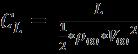
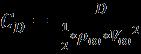
LiftCoefficientanddragcoefficientaredefinedas,
Where,
…….(3.1)
…….(3.2)

L is the lift force in N, and D is the drag force in N, is the density of air in kg/m3, is the free stream velocity ofairinm/s,cisthechordlengthinm,Sisreferencearea in m2. Using equations of state for perfect gas the air density, kg/m3isdefinedas,


…..……..(3.3)
Where, P is the absolute pressure in N/m2, T is the temperature in K and R is the gas constant of air in Nm/(kg) (K). Reynolds number is used to indicate whether a fluid flowing around or through a body is laminar or turbulent. It is the ratio of the inertia force to theviscousforceofafluidflowingaroundsomeboundary. Based on the chord length of an airfoil, Reynolds number isdefinedas,
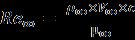
…………(3.4)

Where, is the free stream velocity in m/s; is the dynamicviscosityinkg/(m)(s)andcisthechordlengthin m. The air viscosity is determined using the Sutherland’sequationdescribedbelow, ………..(3.5)


International Research Journal of Engineering and Technology (IRJET) e-ISSN: 2395-0056
Volume: 11 Issue: 05 | May 2024 www.irjet.net p-ISSN: 2395-0072
Where,TisthetemperatureinK.
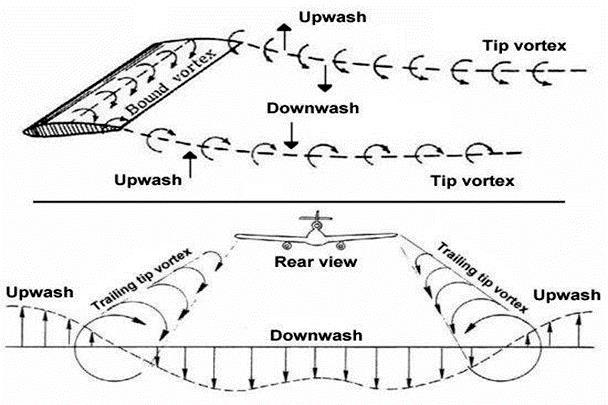
However, in all real aeroplane wings, the flow over the wing is 3 dimensional flow having a component a span wise direction. Sinceincompressible flow passespressure informationinalldirectionequally,pressurevariationcan besensedbetweentheuppersurfaceandlowersurfaceof thewing.Duetothepressureimbalancearoundthewing, theflowatthewingtiptendstocurlaroundthetip(leakor spill out around the wingtip) from the high pressure region just underneath of the wing to the low pressure regionontop.
Asaconsequenceofspilloutofflowtendencyaroundthe wingtip equalizes the pressure between the bottom and topsurfaceofthewing.Thiscausesliftforceperunitspan decreasestowardsthewingtip.Asaresultofthespanwise pressure variation, the air on the upper surface flows inboards toward the root. Similarly, on the lower surface, air will tend to flow outward toward the tips. The resultant flow around the wing is 3 dimensional having bothchordwiseandspanwisevelocitycomponents.
Whentheflowsfromtheuppersurfaceandlowersurface join at the trailing edge, the difference in span wise velocity components causes the air to roll up into a number of cortices at the wingtips. These small vortices rollupintotwolargevorticesjustinboardofthewingtips calledthetipvortex.Sincetheliftforceactingonthewing section at a given span wise location is related to the strength of circulation, such that the circulation around thewingtipiszero.
An airfoil is the cross sectional shape of a wing or wing turbine blade or a sail used in propeller, motor blade etc. The NACA airfoil sections considered herein are obtained bycombiningathicknessdistributionandameanline.An airfoilisobtainedfromaperpendicularplanewithrespect to the corresponding wing considered as a cross section shape.
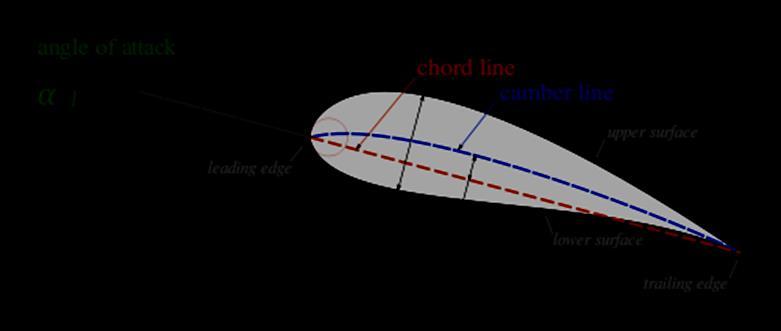
Some terms are related to the description of the airfoil. The major design feature of an airfoil is the mean line, which is the locus of points halfway between the upper and lower surfaces as measured perpendicular to the mean line itself. The most forward point of a mean line is knownastheleadingedgeandthemostrearwardpointof themeanlineisknownasthetrailingedge.Astraightline which connects between the leading edge and trailing edgeisknownaschordlineoftheairfoilandthedistance measured simply between the leading edge and trailing edge is known as chord of the airfoil, which is designated by‘c’.TheCamberisconsideredasthemaximumdistance between the mean camber line and the chord line, measuredperpendiculartothechordline.Twobasictypes of airfoil can be demonstrated or used extensively which are, symmetrical airfoil and non-symmetrical airfoils. Symmetricalairfoilsusedtohavenocamberinitselfasthe mean camber line and the chord line is same in this case. On the contrary, non-symmetrical airfoils are also known as cambered airfoils. Cambered airfoils shows lifting characteristics even at 0 degree angle of attack (angle betweenthefree-streamvelocityandthechordlineofthe airfoil) due to its cambered type shape. But in the case of symmetricalofnon-camberedairfoil,therewouldnoliftat 0 degree angle of attack due to symmetrical shape of the airfoil.Thecamber,theshapeofthemeancamberlineand to a lesser extent, the thickness distribution of the airfoil essentiallycontrolstheliftandmomentcharacteristics.
There are several types of NACA airfoils families used as crosssectionshapeinconstructionofwingofairplane.For example, NACA 4 digit series, NACA 5 digit series and NACA 6 digit series. In this study, NACA 4 digit series is considered. The first digit of the designated number indicatesthelocusofthemaximumpositionalpointofthe corresponding airfoil in number of hundreds of the chord of the airfoil. The second digit indicates the horizontal distanceofthemaximumcamberfromtheleadingedgeof the airfoil in number of tenths of the chord of the airfoil. Andthelasttwodigitsindicatesthemaximumthicknessof theairfoilinhundredsofthechordoftheairfoil.
If Xu and Yu represent respectively the abscissa and ordinate of a typical point of the upper surface of the airfoil and yt is the ordinate of the symmetrical thickness
International Research Journal of Engineering and Technology (IRJET) e-ISSN: 2395-0056
Volume: 11 Issue: 05 | May 2024 www.irjet.net p-ISSN: 2395-0072
distribution at chord wise position Xi, the upper surface coordinatesaregivenbythefollowingrelations:
Yu=yt
The corresponding expressions for the lower surface coordinatesare: Xt=x
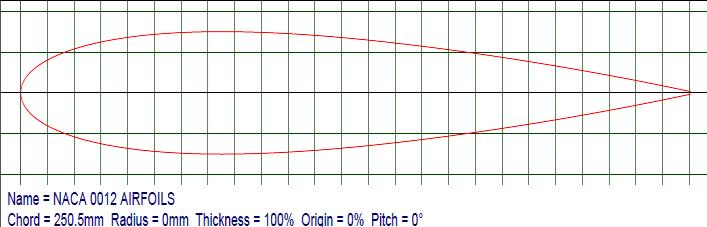
Fig. 3: DesignedNACA0012airfoil[14]
3.3 Description of NACA 0012 Airfoil:
NACA 0012 is a symmetrical airfoil meaning that it has zero camber in its symmetrical shape. The 2 digits ‘00’ indicatesthatitisasymmetricalairfoilandthelast2digit ‘12’ indicates that the maximum thickness of the airfoil is 12%ofthechordlengthoftheairfoil.
Table 1 :Airfoilspecificationsatdifferentsectionsfor geometrydesigning
Continuity equation, Navier Stokes or Momentum equation and Energy equation are the key governing equationofthefluiddynamicswhicharealsoinstrumental for Computational Fluid Dynamics (CFD). From simple creeping flow, and Couette flow, to the state-of-the-art turbulence modelling, moving boundaries simulation, nanofluids motion, multiphase flow, complex geometry aerodynamic design wave modelling and oceanic engineering, all these engineering researches fall under the purview of these governing equation. The governing equations stem from the fundamental principles of Newton’s Laws and Reynold’s transport theorem, which can be expressed in a general form of integral equations. In this aerodynamic study, energy equation is not consideredforbasicpurpose.
3.4.1

Theequationforasymmetrical4-digitseriesNACAairfoil is .…….(3.6)
Where, xisthepositionalongthechordfrom0toc t is the maximum thickness as a fraction of the chord cisthechordlength
The leading edge is constructed as a part of cylindrical shapewitharadiusof r=1.1019t2
Now the coordinates (Xu, Yu) of the upper airfoil surface, and(Xu,Yl)ofthelowerairfoilsurfaceare:
Xu=Xl=x
Yu=+y and Yl=-yt
The fundamental physics of Continuity Equations is the principle of conservation of mass, proposed by Lavoisier in 1985. Conservation of mass can be defined as: the conservation law that the rate of change of mass within a control volume (CV) is equivalent to the net rate of mass flowingintotheCV.Considertheintegralformofthemass conservationequation:

……..(3.7)
This equation can be transformed into differential form usingGaussDivergencetheoremtoform
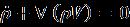
……….(3.8)
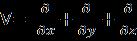
In Cartesian co-ordinate, considering the length of fluid element infinitesimal in x, y and z direction, can be assignedasδx,δyandδz.Taking,V=[ux uy uz ]inan incompressible flow, the continuity equation will be reducedto where

International Research Journal of Engineering and Technology (IRJET) e-ISSN: 2395-0056
Volume: 11 Issue: 05 | May 2024 www.irjet.net p-ISSN: 2395-0072
3.4.2 Navier Stokes Equation or Momentum Equation:
Momentum equations are originated from Newton’s second law which states that force of a moving object is equivalenttoitsrateofchangeofmomentum.



3.5 Wing Model Designing:
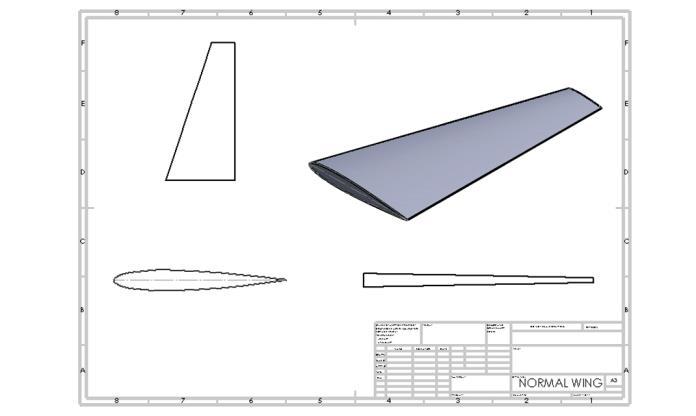
TheCADmodelofnormalwingandwingwithwingletare designed by using Solid Works 2016 software. The airfoil data for NACA 0012 [15] is imported to the Solid Works software and the sketch for the airfoil is generated for wing root and also for wingtip. The span length of the wingsisconsidered500mm.Themaximumandminimum chord lengths for the wing are 250.50 mm and 85.81 mm respectively. Thus the chord length based Reynolds number relevant at low flight speed or subsonic speeds. The chord length of the model was determined to have Reynolds number of the same order. The span length of the model, relative to the chord length is one of the importantdesignparameters.
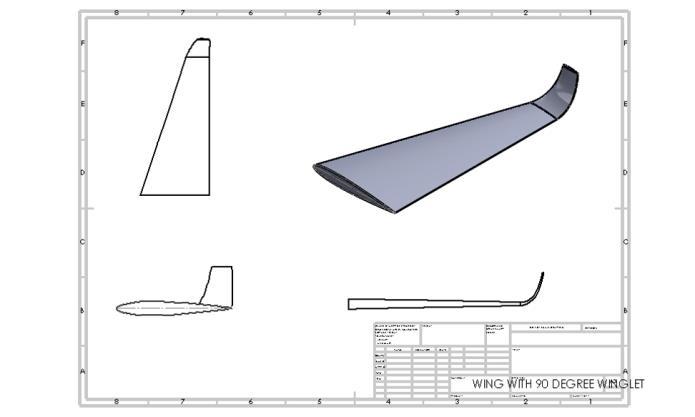
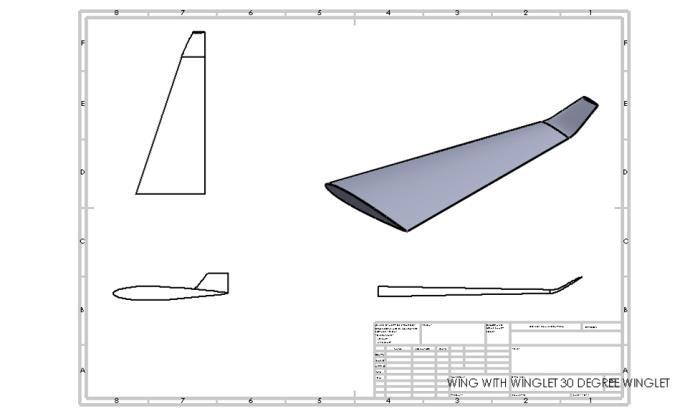
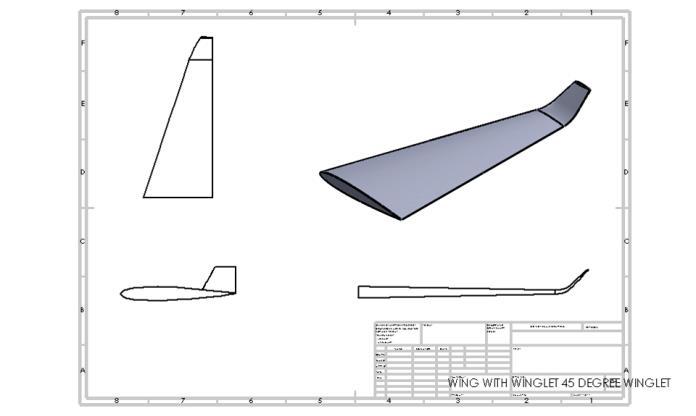
Table 2: Specifications of Aircraft Wing
4.1 Proposed Methodology:
Computational Fluid Dynamics (CFD) process is used for assisting the numerical analysis of this study. The numerical analysis usually consists of 3 stages: preprocessing, computation and post-processing. The preprocessing stage involves with the geometry generation andsetupand grid(mesh) generation. Thecomputational domain (C-domain) is constructed as fluid properties aroundthe3-Dgeometryfollowedbythemeshgeneration using ANSYS Workbench R19.2 software. The mesh element size is smaller close to the wing and winglet geometry and gradually increases towards the domain boundary walls. 3-D unstructured tetrahedral mesh with inflation layers was generated around the geometry. This wascarriedoutinordertoselectanappropriaterangefor the number of elements in the mesh. Mesh dependency is carriedouttoensuretheindependencyofresultsfromthe number of elements for the numerical analysis of both normal wing and wing with winglets. In this particular case,thenumberofmeshelementsisconsideredabout4.2 to 4.9 million numbers of mesh elements for better accuracyofresults.
Table 3: Specifications of Winglets
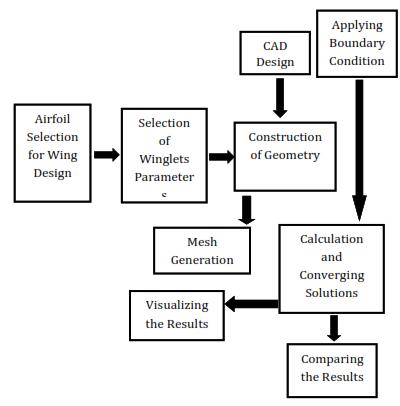
Fig. 8: FlowchartofProposedMethodologyofthestudy
4.1.1 Geometry Setup:
The designed wing geometry and wing with winglet geometry constructed in Solid works software are exported to the workspace of Design Modeler of Ansys Workbenchfor further pre-processing works.AC-domain
International Research Journal of Engineering and Technology (IRJET) e-ISSN: 2395-0056
Volume: 11 Issue: 05 | May 2024 www.irjet.net p-ISSN: 2395-0072
is constructed for both types of geometry which is assigned as fluid and the previously designed geometries are assigned as solid object. The total volume of the domain around the normal wing geometry is measured about4.5226m3andforthewingwithwingletgeometry, itismeasuredabout17.401m3
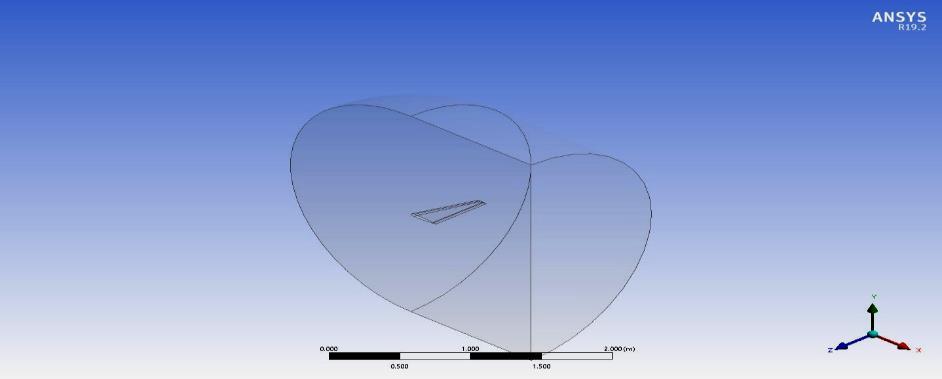
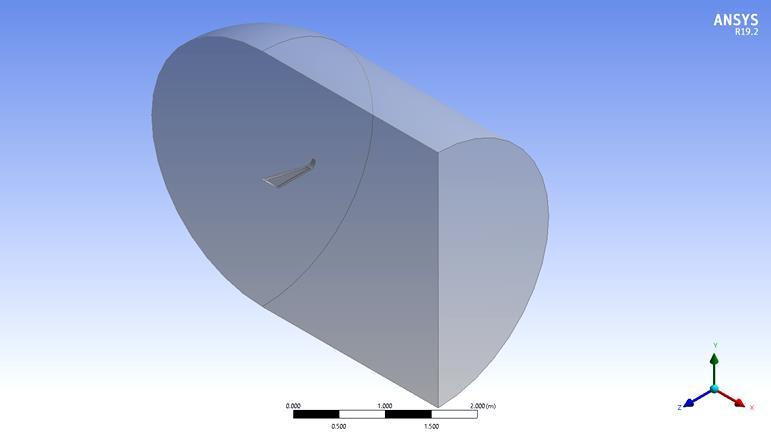
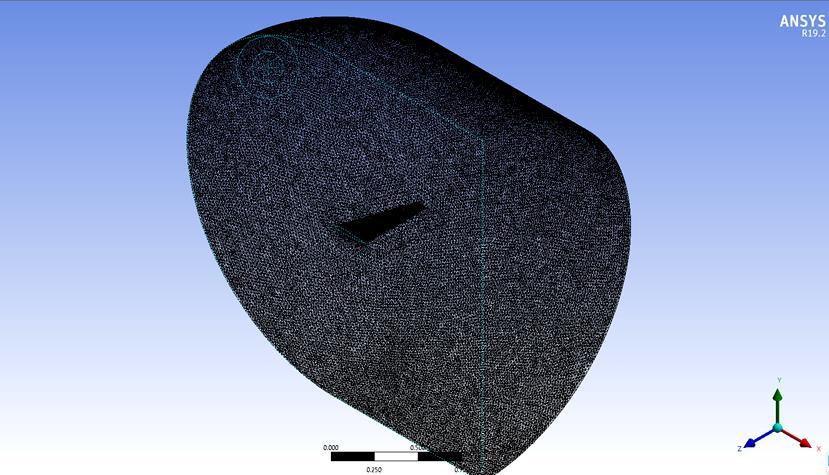
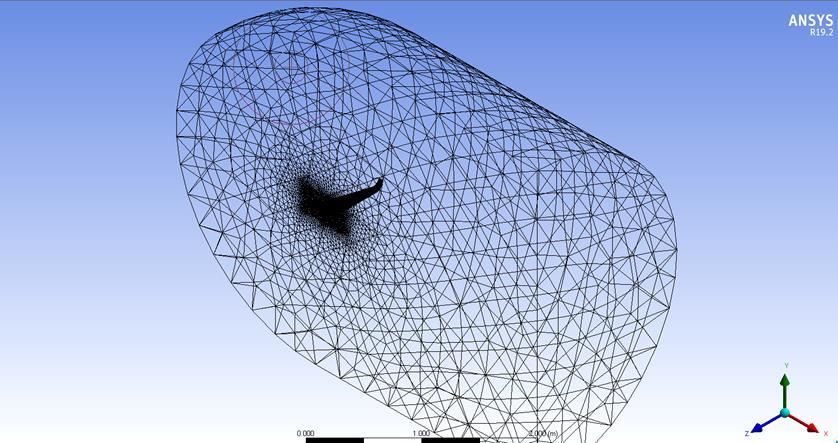
Inmeshsetup,unstructuredtetrahedralmeshelements is assigned for the mesh generation. Body sizing mesh controlisdoneforfluiddomaingeometrywherethe solid wing surface is considered as the body of influence. Differentmeshelementsizeisdoneforensuringthemesh independencyonresults.Facesizingmeshcontrolisdone for meshing the forward and rearward face of the wing surfaceandalsotheinwardtopandbottomofthesurface. Highqualitysmoothingisconsideredformeshgeneration. Usually the element size will increase gradually moving forwardtothefluiddomainandthemeshelementswillbe smaller so much than the body geometry mesh elements Inflation is done about considering 5 layers with 0.008 m total thickness. In this case, post inflation algorithm is used. Then, the necessary surfaces are named due to assign the boundary conditions to the fluid domain and wing geometry. In this, inlet, outlet, symmetry, wing surface and wingtip (for normal wing) and wing surface with winglet (for winglets) are named to observe the propertiesinfurtherpost-processing.
4.1.3
In the “SETUP” portion of the analysis, the double precision option is checked before starting the configurationoftherequiredsetup.Inthegeneralsettings of the analysis, the solver type is set to pressure based system and the flow type is considered as steady flow. In themodelssegment,the“multi-phase”optionisturnedoff astheincompressibleflow surroundingtheairplane wing is being considered. As the study is to found the aerodynamics characteristics of the airplane wing only according to the relative flow properties of air surroundingthewingandwinglets,sotheenergyoptionis unchecked which is related to the calculation of energy equations. At the viscous model segment, the “k-epsilon” modelwithstandardtypeisbeingconsideredandat“Near Wall Treatment”, Standard wall functions are considered as this combination has produced the desired results relatedtotheanalysispurposes.Thefluidisconsideredas air and the solid part is considered as aluminum with standardproperties.Atthe boundaryconditionssegment, thevaluesofflowvelocityareinsertedfordifferentvalues ofangleofattackat“Inlet”surfaceasitwasdefinedasthe entranceoffreestreamflowtowardsthewinggeometryat
Volume: 11 Issue: 05 | May 2024 www.irjet.net
the +X direction at mesh segment. In this case, at the “Velocity Specification Method” option, the “Magnitude and Direction” option is selected which enable us to specify the X,Y components of the flow direction individually which actually would results in drag forces andliftforcesvaluesacting onthewingsaftercompleting the numerical calculation. These values has been changed withrespecttothechangeinthevaluesofangleofattack. That is why, a “Parameter” setup is introduced for changing the values of X and Y components of the free streamvelocitywhilechangingthecorrespondingvalueof angle of attack for a specific wing geometry. This process is repeated for the normal wing geometry, wing with 90º winglet, 45º winglet and 30º winglet geometry respectively.Andtheoutletisdefinedas“PressureOutlet” while setting the back flow turbulent intensity to 5% and thebackflowturbulentviscosityratioto10.Thereference values are computed from the inlet. In monitors segment, two different individual new monitors are created manually to observe the change of values for lift coefficientanddragco-efficientwithrespecttotheiteration number while doing the numerical calculation. In “Solution Initialization” part, “Standard Initialization” is selectedaswewouldliketosolvethecalculationfromthe correspondinginletvalueswhicharedefinedasboundary conditionsatinlet.Inthe end,thenumberofiterationare set from 100 up to 10000 for calculation in several different cases. The results are extracted each time after theprocessedsolutionisbeingconverged.
In this study, the outward flow simulation over 3 dimensional wing will be analyzed. As the free stream air will strike the wing at a specified angle of attack, it is desired to generate lift and drag forces on the surfaces of thewing.Thepressuredifferencesbetweentheupperand lower surfaces of the wing will be observed and it would be discussed whether the properties and the regarding acting forces changes with changing flow direction with same type of flow and at a same Reynolds number. After that, the pressure coefficient curves along with the positional line as well as the chord line will be studied whetherhowdifferencesitwouldexhibitatdifferentflow directions.DuetoconsideringlowMachnumber,theflow willbeattachedatmostofthecasesoftheflowdirections. After the stall of airfoils takes place where the maximum liftcoefficientisfound,theflowseparationoftheflowmay occur.
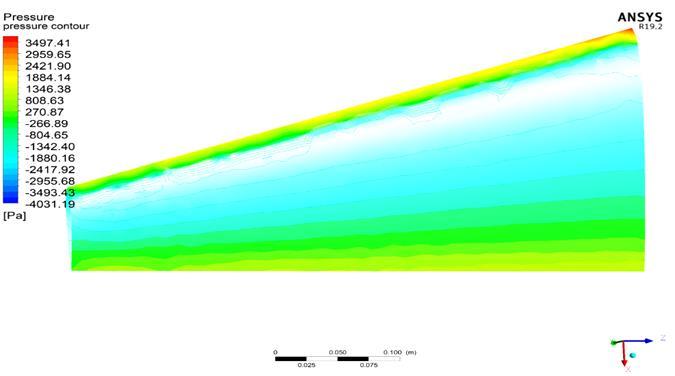
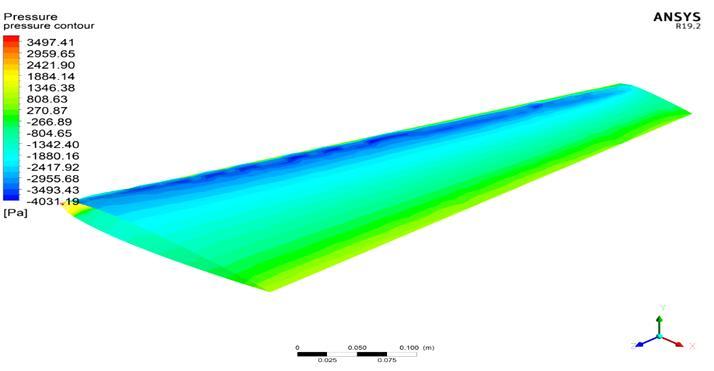
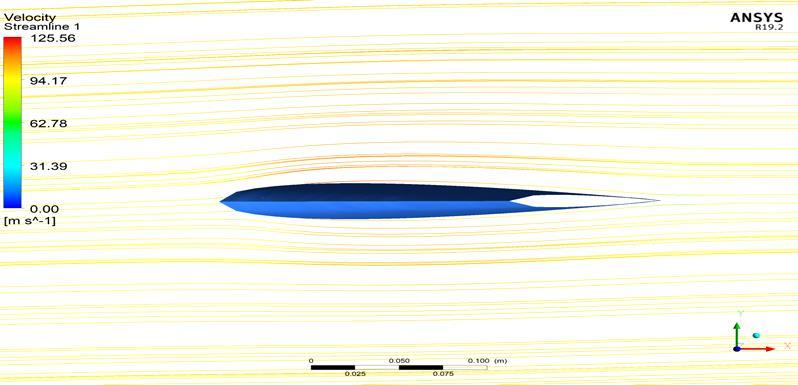
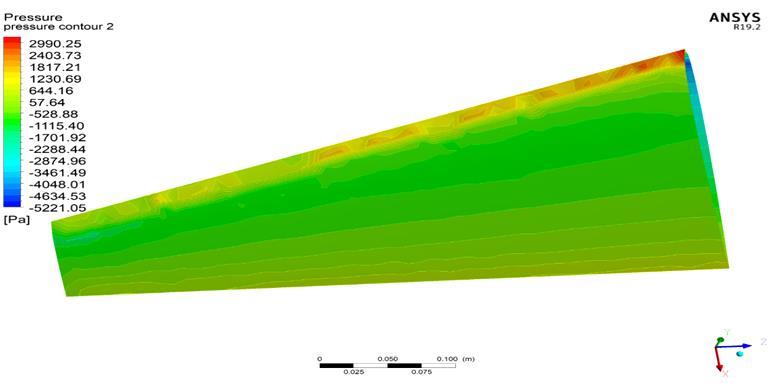
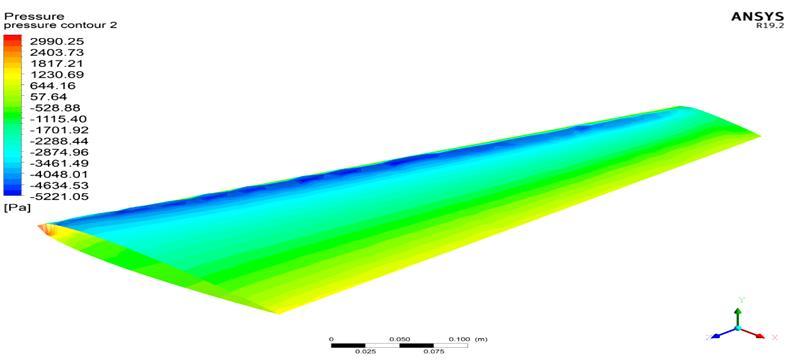
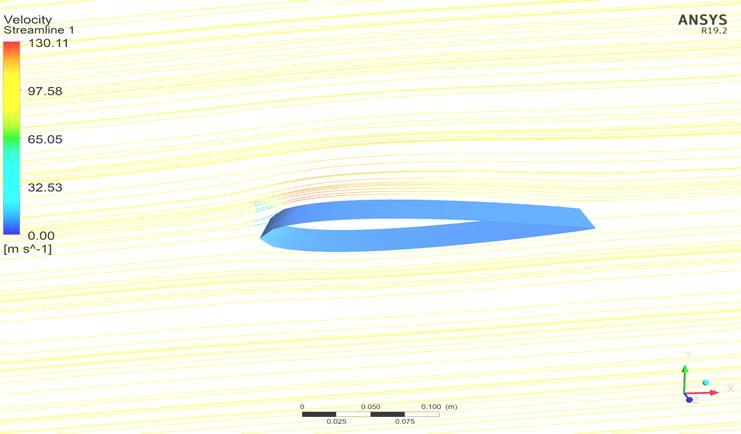
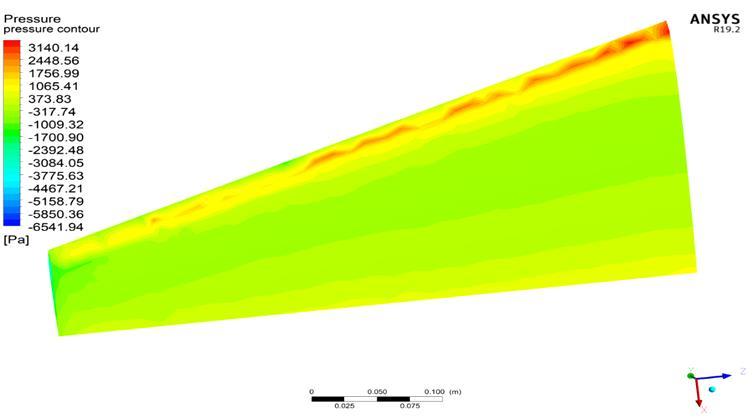
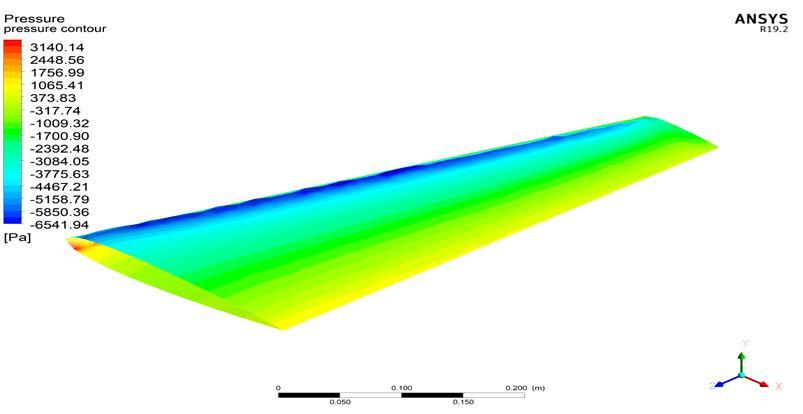
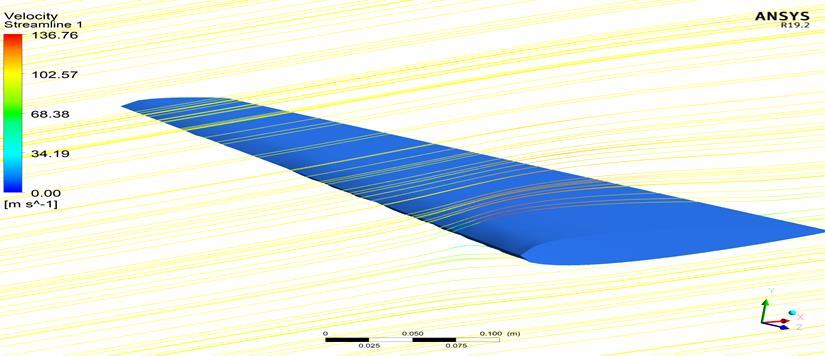
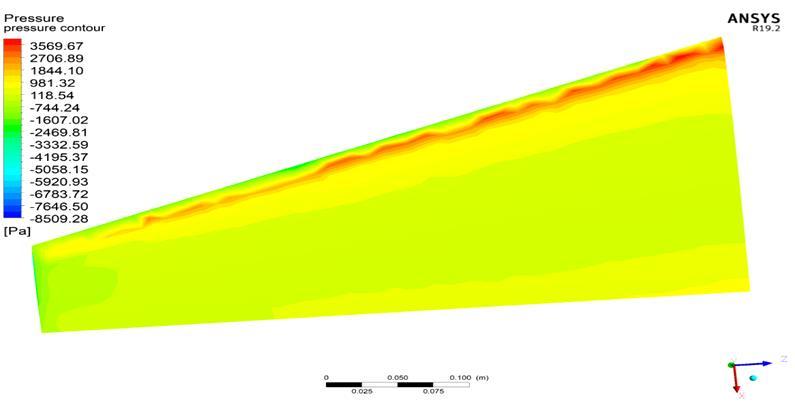
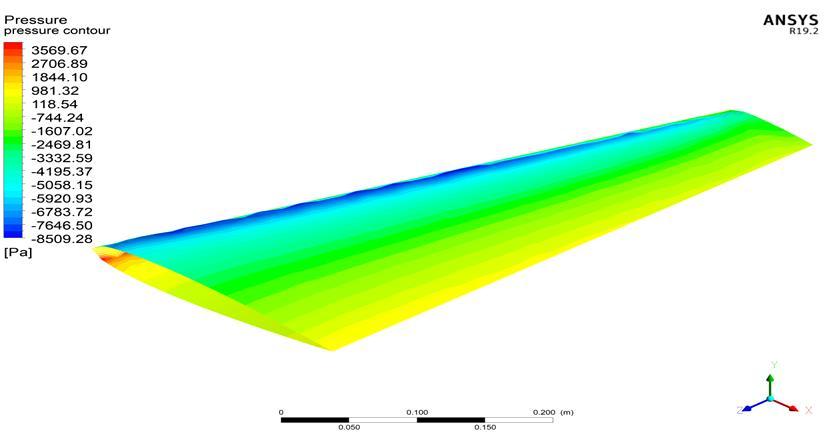
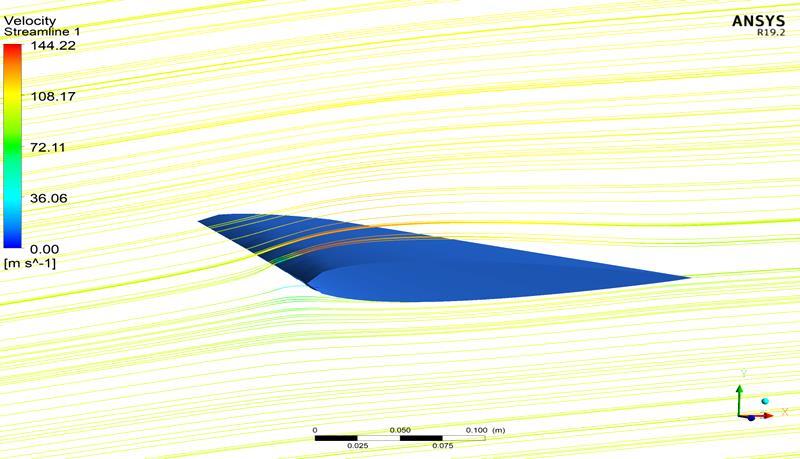
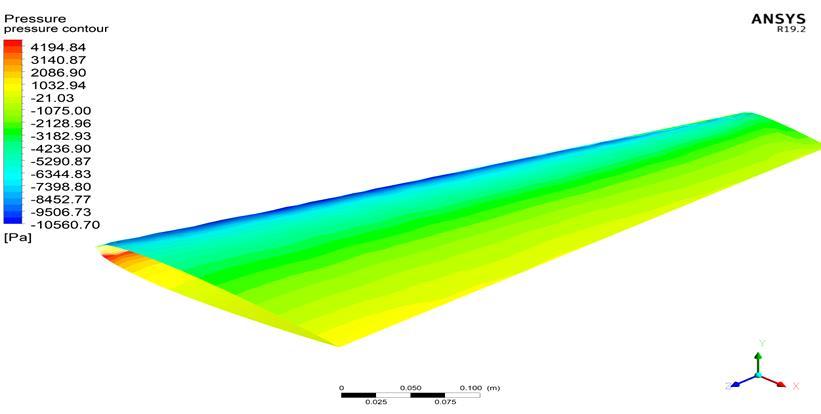
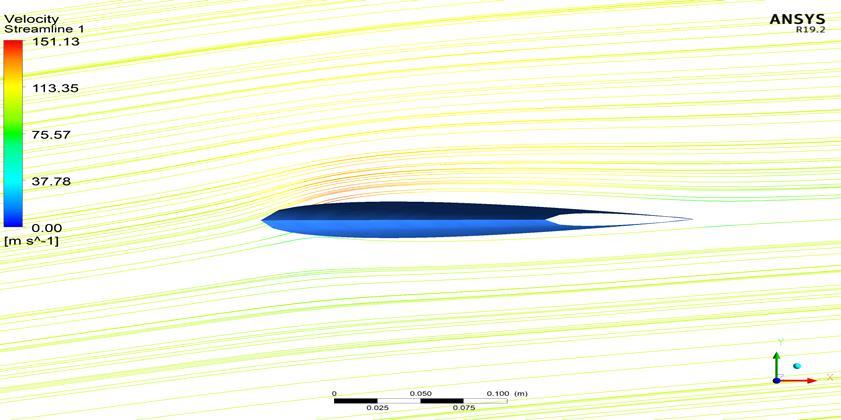
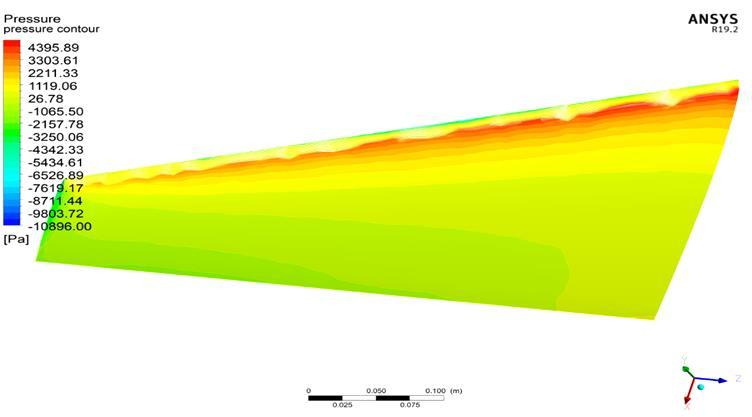
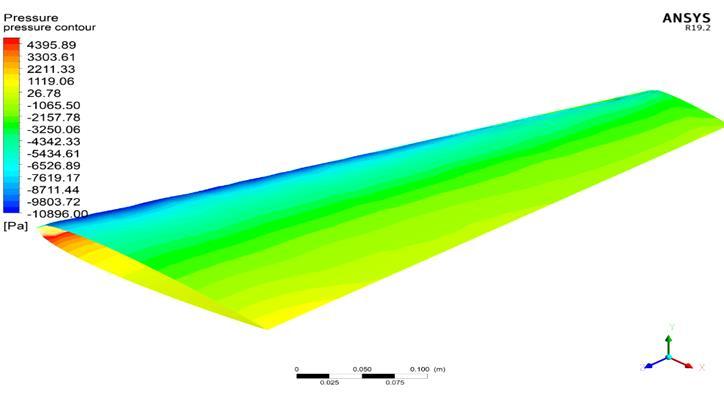
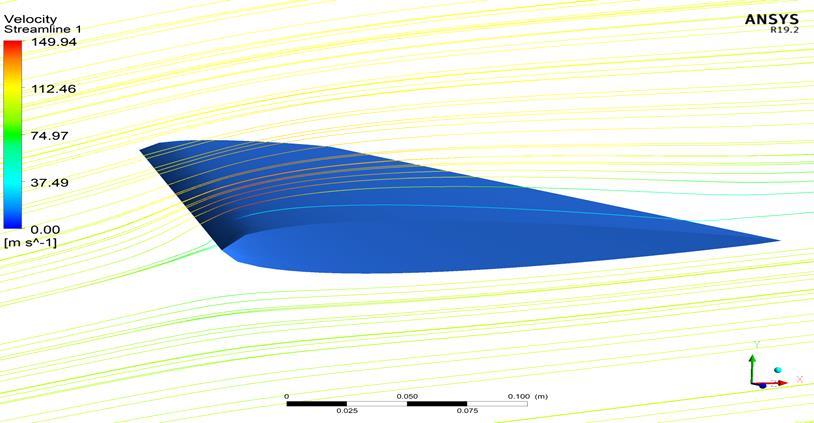
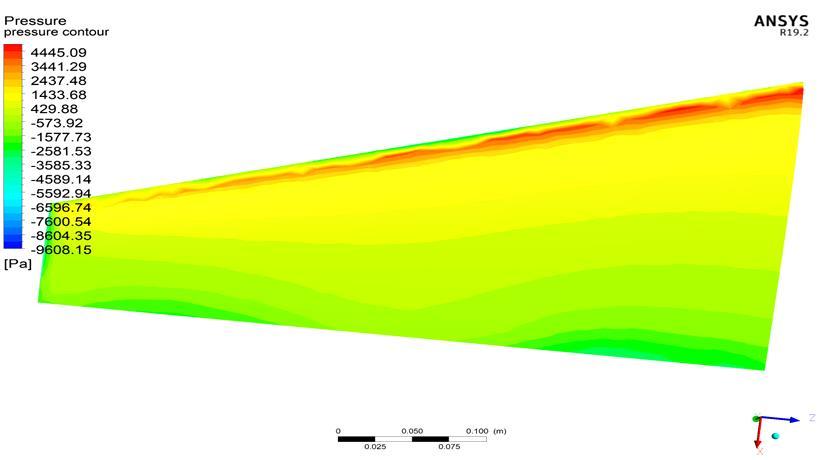
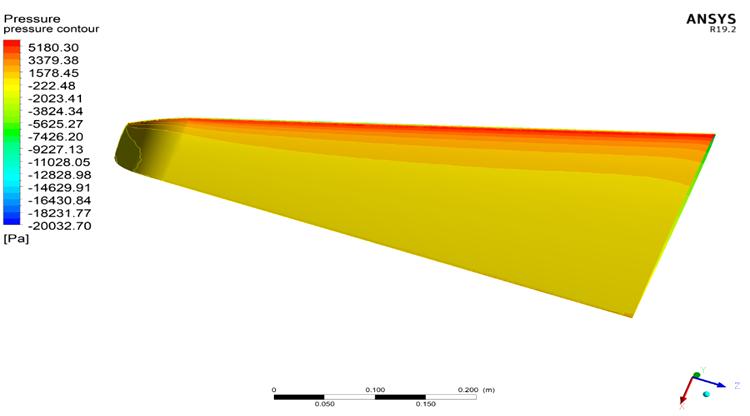
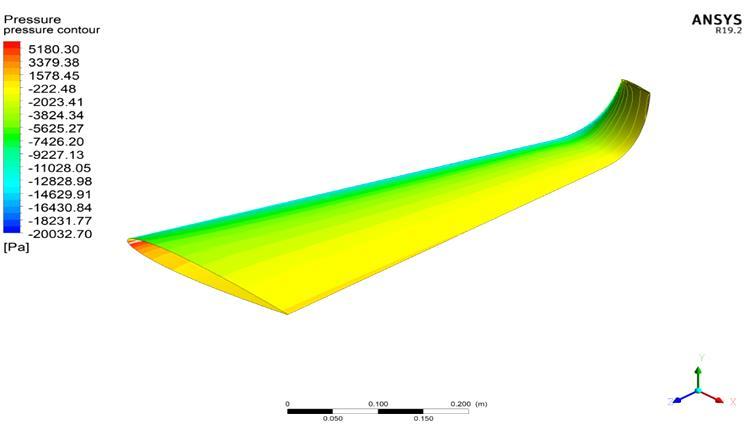
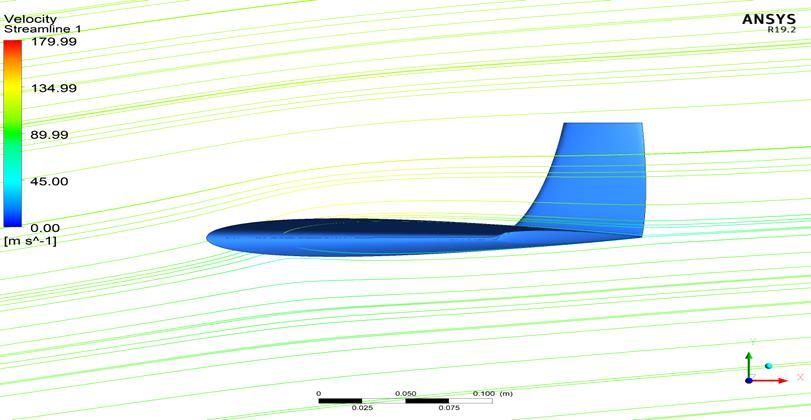
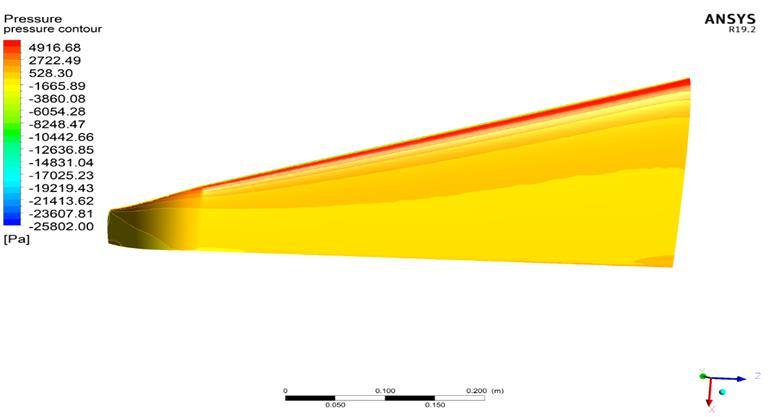
Thepressurecontoursareshownat“ANSYSFluentResult” to observe the pressure distribution and changes of it along the chordwise direction as well as spanwise direction.Alsoavelocitystreamlinecontourisalsodrawn for showing the direction and observation of streamlines offlowaroundthe wing for both non-wingletand winglet type. The flow streamlines are expected to be at changed directionforeachvalueofangleofattack
International Research Journal of Engineering and Technology (IRJET) e-ISSN: 2395-0056
Volume: 11 Issue: 05 | May 2024 www.irjet.net p-ISSN: 2395-0072
International Research Journal of Engineering and Technology (IRJET) e-ISSN: 2395-0056
Volume: 11 Issue: 05 | May 2024 www.irjet.net p-ISSN: 2395-0072
International Research Journal of Engineering and Technology (IRJET) e-ISSN: 2395-0056
Volume: 11 Issue: 05 | May 2024 www.irjet.net p-ISSN: 2395-0072
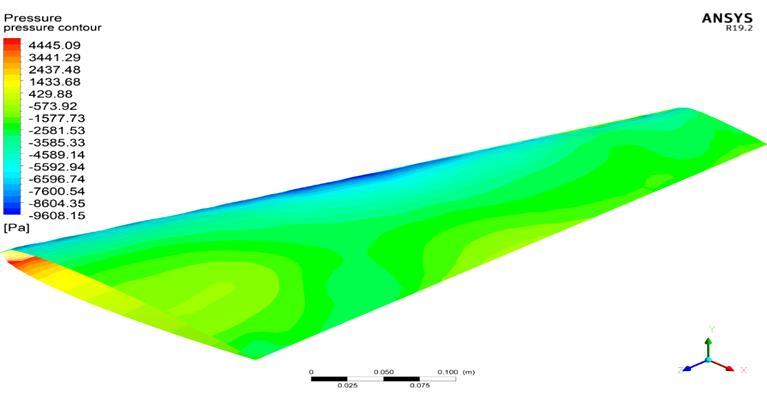
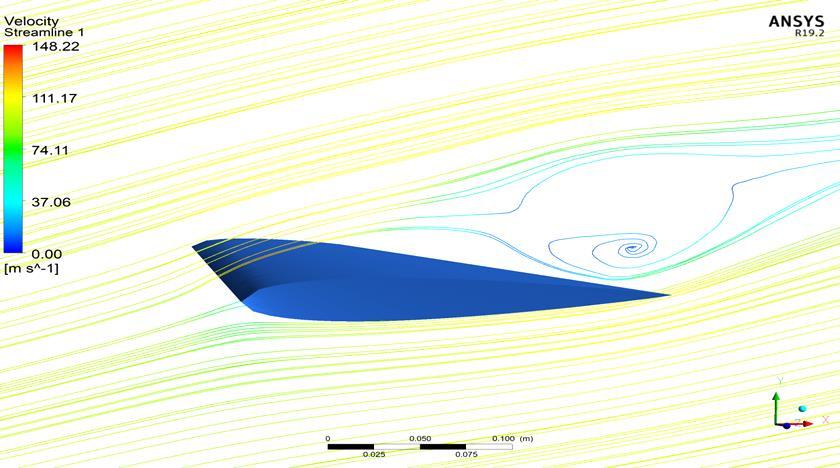
19: Pressuredistributionandvelocitystreamline contoursfor14°angleofattack
5.2 Pressure and Velocity Streamline Contours for Wing with Winglet (90°):
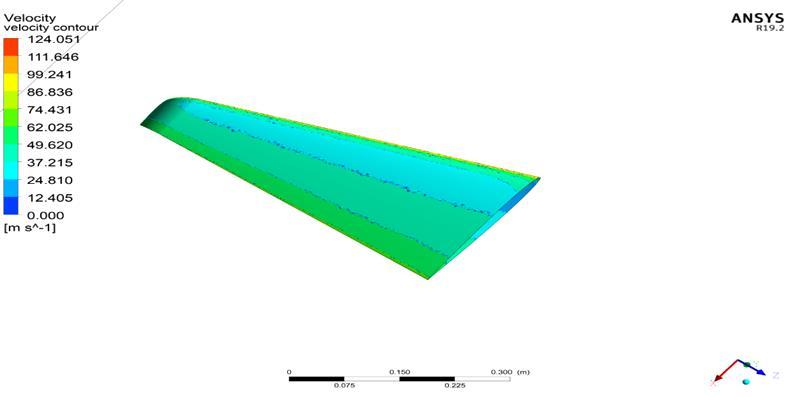
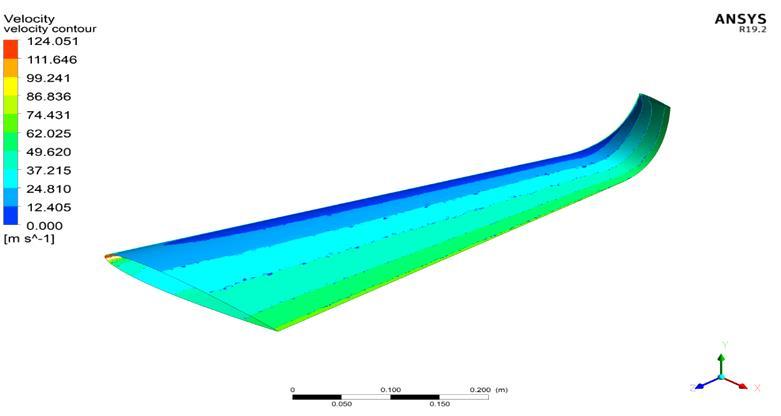
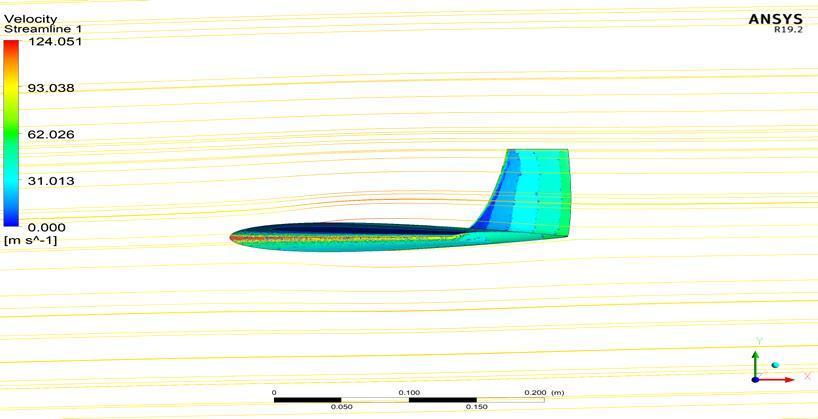
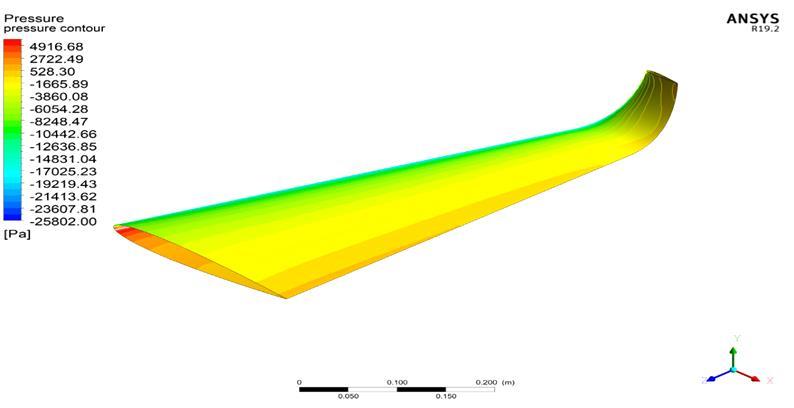
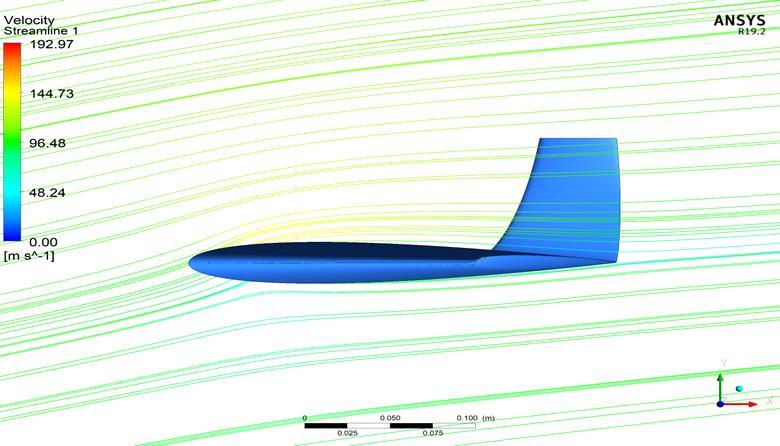
20: Pressuredistributionandvelocitystreamline contoursfor2°angleofattack(winglet)
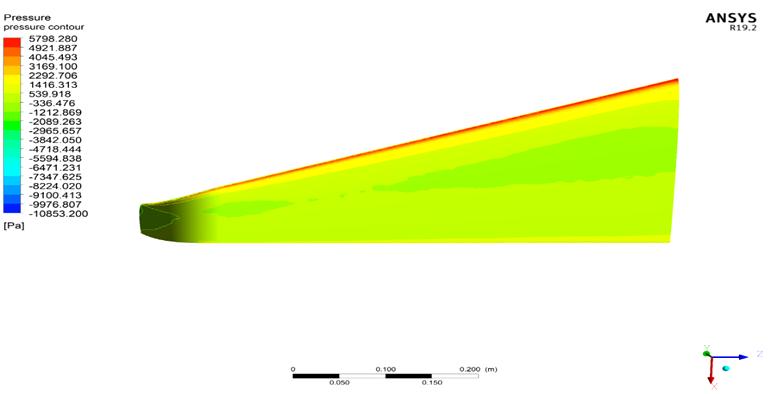
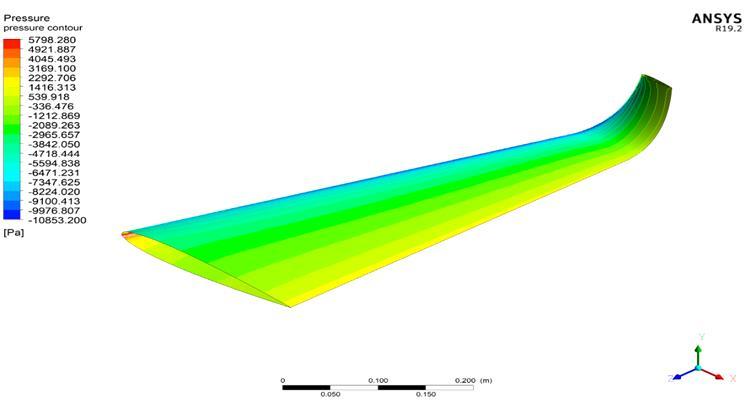
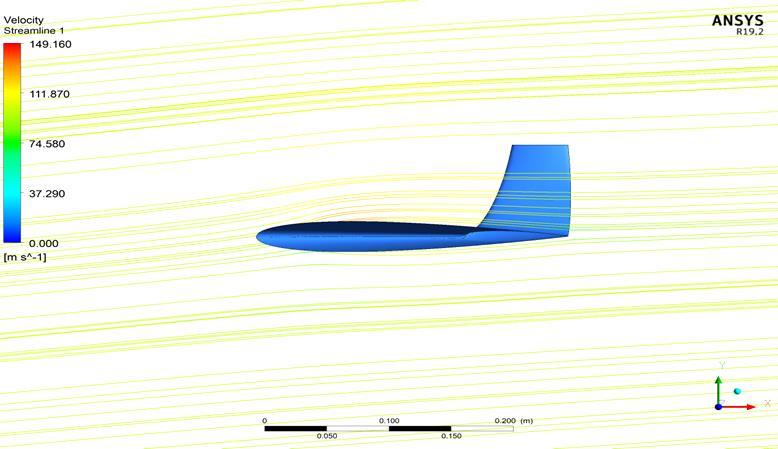
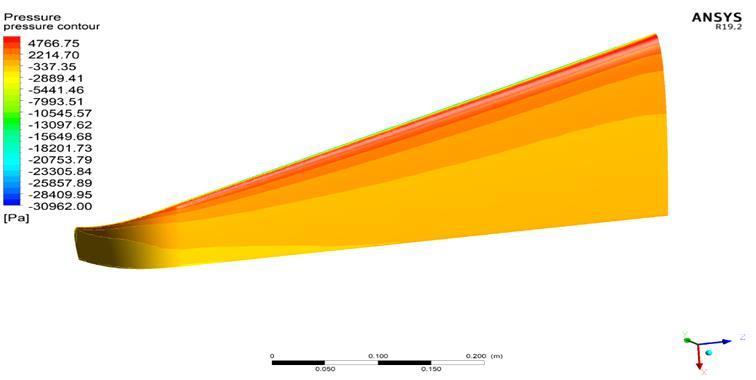
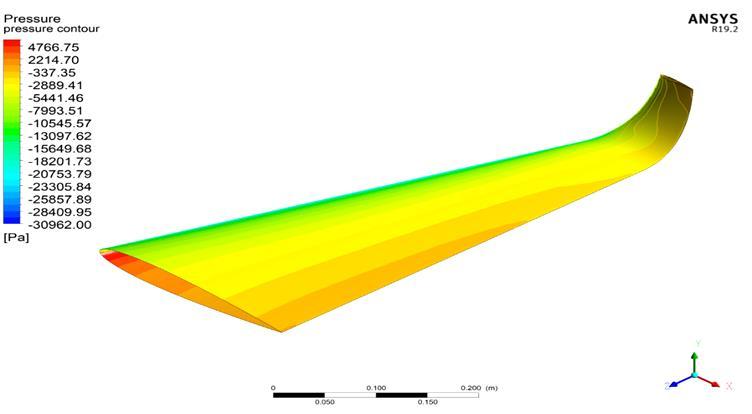
21: Pressuredistributionandvelocitystreamline contoursfor6°angleofattack(winglet)
International Research Journal of Engineering and Technology (IRJET) e-ISSN: 2395-0056
Volume: 11 Issue: 05 | May 2024 www.irjet.net p-ISSN: 2395-0072
International Research Journal of Engineering and Technology (IRJET) e-ISSN: 2395-0056
Volume: 11 Issue: 05 | May 2024 www.irjet.net p-ISSN: 2395-0072
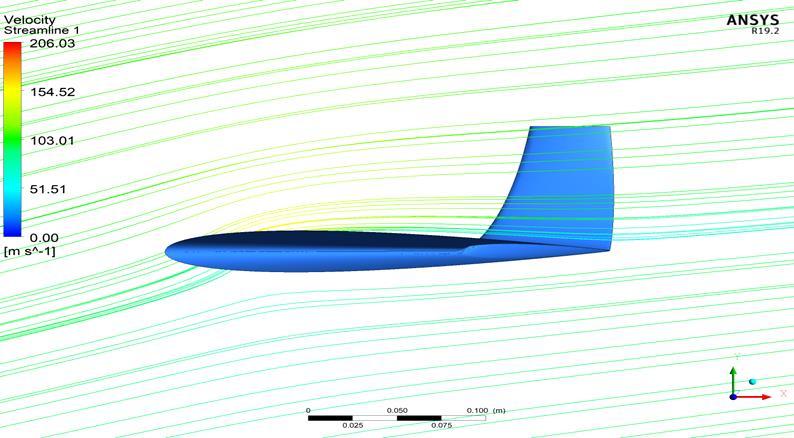
Pressuredistributionandvelocitystreamline contoursfor14°angleofattack(winglet)
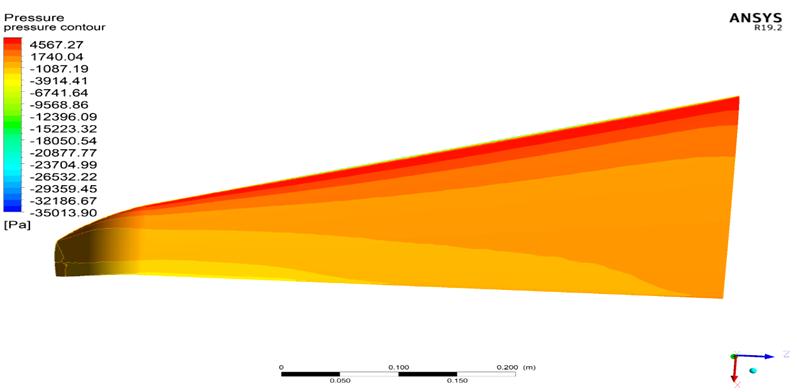
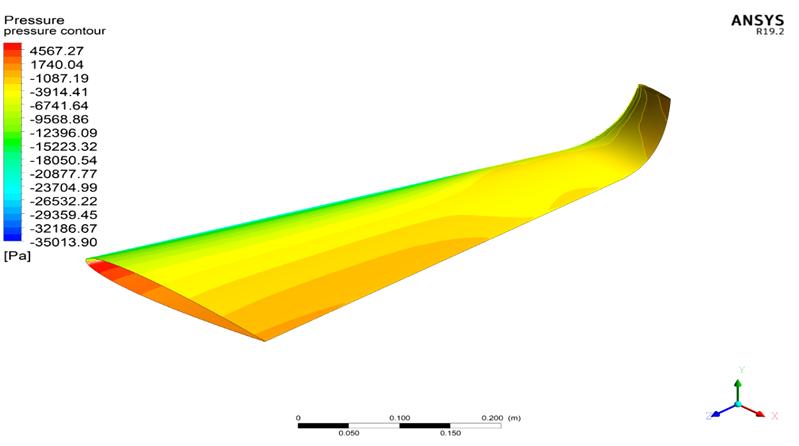
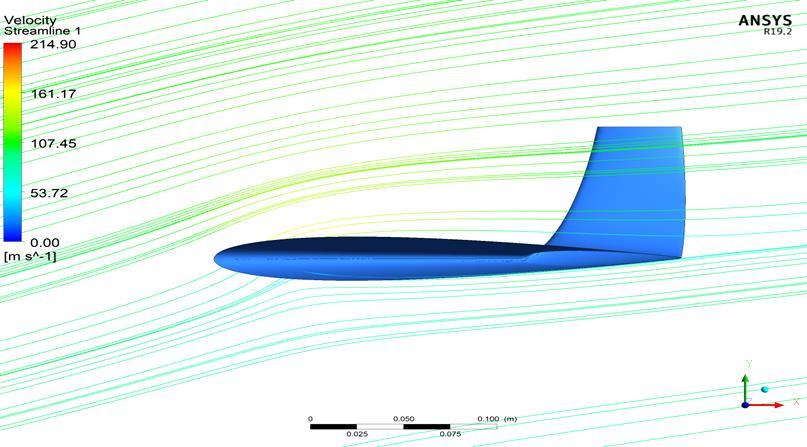
Pressuredistributionandvelocitystreamline contoursfor16°angleofattack(winglet)
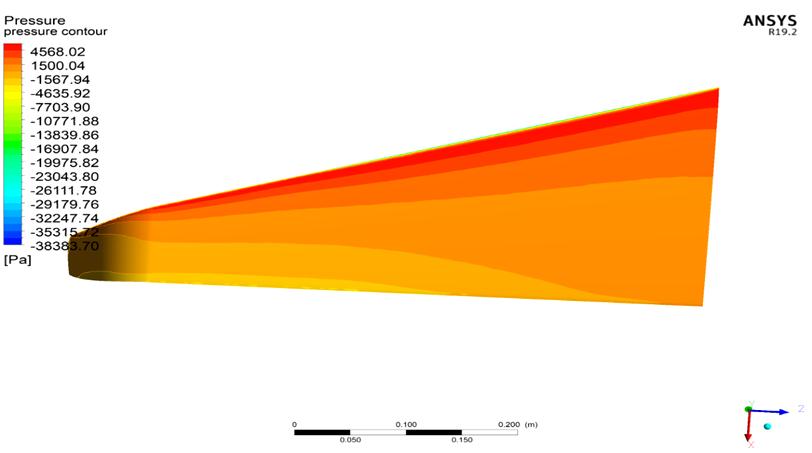
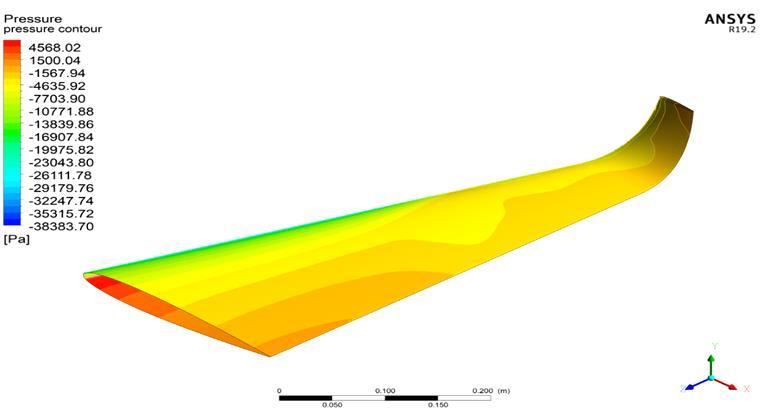
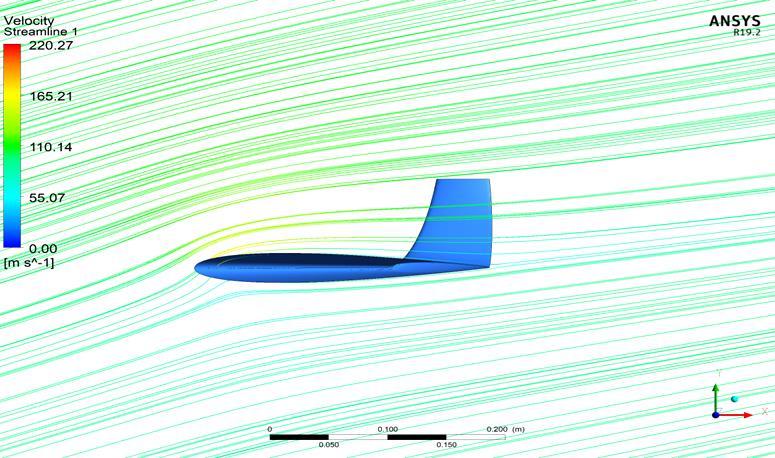
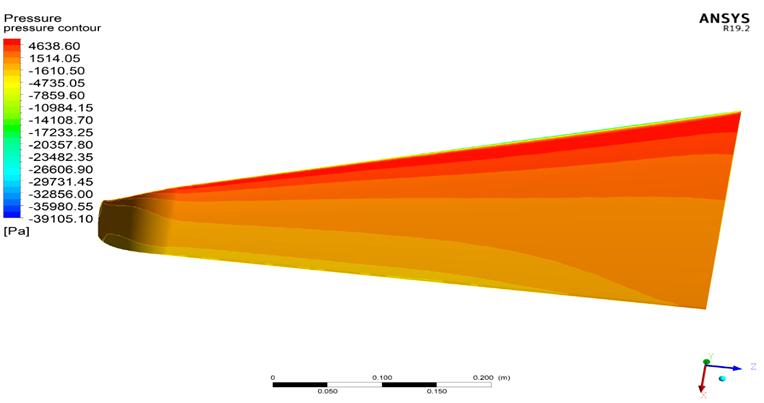
26: Pressuredistributionandvelocitystreamline contoursfor18°angleofattack(winglet)
International Research Journal of Engineering and Technology (IRJET) e-ISSN: 2395-0056
Volume: 11 Issue: 05 | May 2024 www.irjet.net p-ISSN: 2395-0072
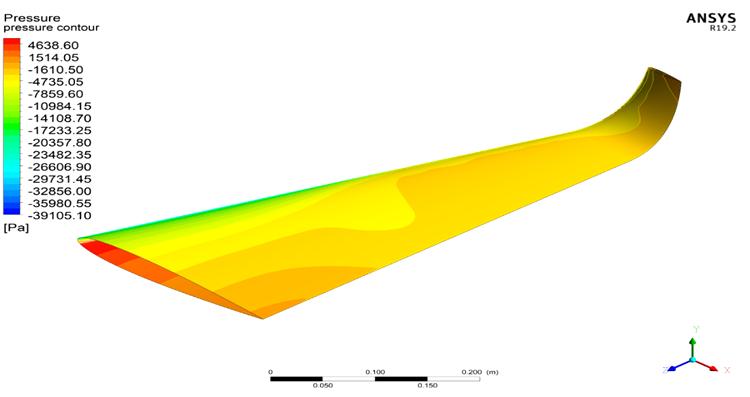
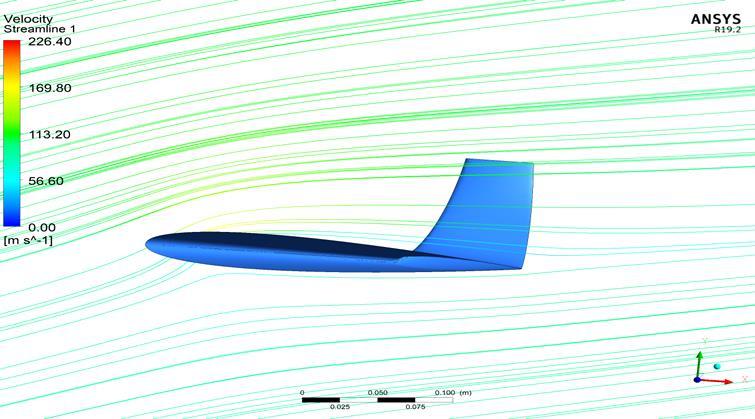
Fig. 27: Pressuredistributionandvelocitystreamline contoursfor20°angleofattack(winglet)
From figure. 13 to figure 27 where showing the pressure distribution contours of upper surface and lower surface of the wing, it can be observed that the pressure distribution at lower surface is increased at a higher rate with the increase of the value of incidence angle or angle ofattack.ForM∞ =0.3whichindicatestheincompressible flowoverthewing,thereareassumedtobepresenceofno local supersonic flow occurred around the 3 dimensional wing. Also, it can be observed from the figures that the pressure distribution on the lower surface increased higher for wing with winglet than for normal wing. This ensures greater lift for wing with winglet as compared to fornormalwingforthesamevalueofangleofattack.Also at figure 13 to figure 27, the contours of velocity streamline has been shown for the observation of flow streamline which direction changes with the angle of attack. The feasible value of angle of attack at which stall of lift coefficient is discussed below which is required for thecalculationofhigherliftofthewing.
5.3 Pressure Coefficient (Cp) Vs. Position (X Coordinate):
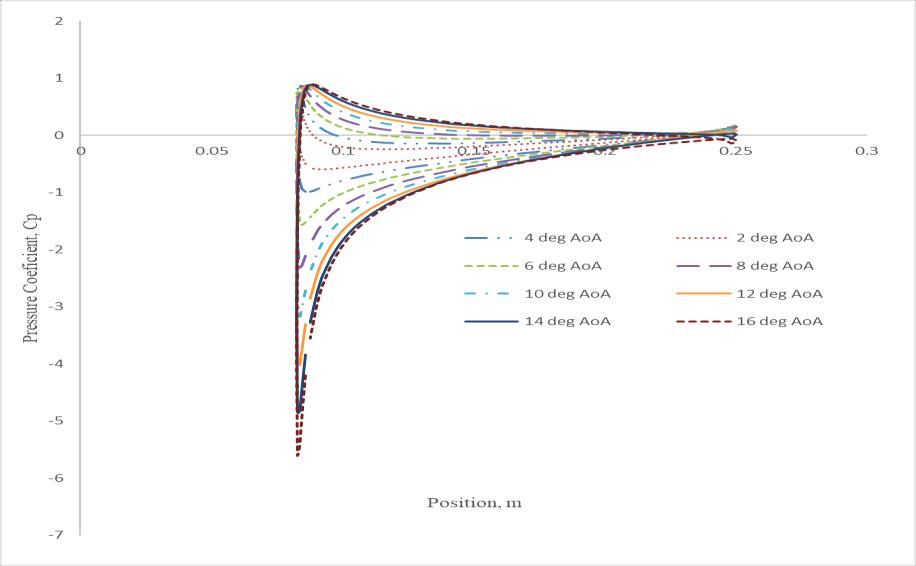
Fig. 28: PressureCoefficientVs.Xcoordinatepositionfor wingwith90°wingletatmidspan(z=250mm)
From above figure, it is evident that with the increase of angleofattackforsameincompressibleflowforwingwith 90°wingletatmidspan, the valueofCpatupper &lower wing surface increases which causes larger pressure difference between the upper and lower surfaces of the wing. From the above figure, it can be observed that for angle of attack 16°, Cp at upper surface will be larger at negative value causing largest pressure difference betweenthewingsurfaces.
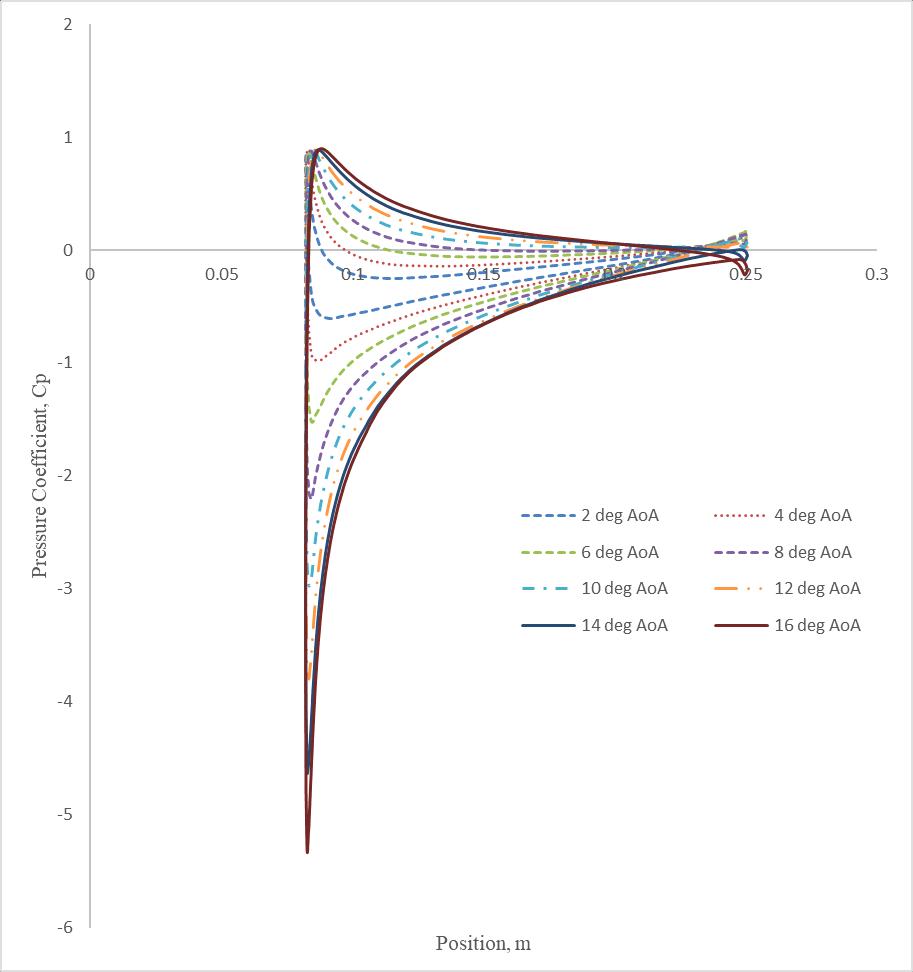
Fig. 29: PressureCoefficientvs.Xcoordinatepositionfor Wingwith30°wingletatmidspan(z=250mm)
International Research Journal of Engineering and Technology (IRJET) e-ISSN: 2395-0056
Volume: 11 Issue: 05 | May 2024 www.irjet.net p-ISSN: 2395-0072
Fromabovefigure,itcanbeobservedthatthevaluesofCp atupperandlowersurfacesincreasesatbothpositiveand negative sides with the increase of angle of attack. This causes comparatively larger pressure differences which causes larger lift and drag forces than before. From the above figure, the value of pressure coefficient at both rangesisgreatestfor16°angleofattack.
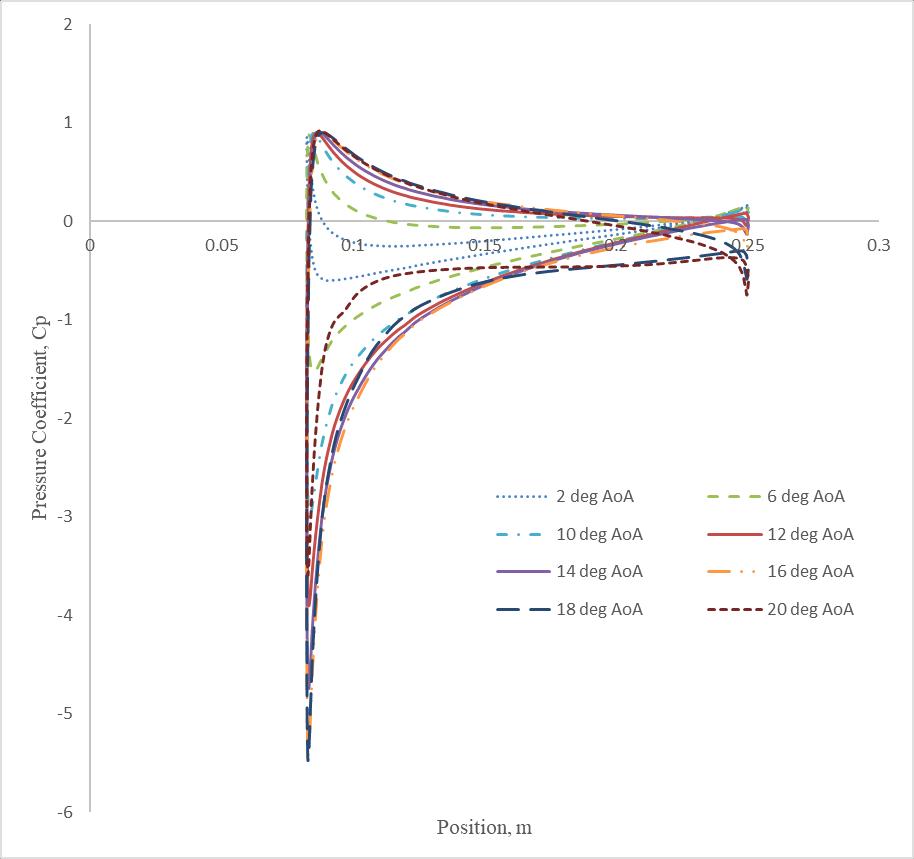
Fig. 30: PressureCoefficientVs.Xcoordinatepositionfor Wingwith45°wingletatmidspan(z=250mm)
Fromabovefigure,itcanbeobservedthatthevaluesofCp atupperandlowersurfacesincreasesatbothpositiveand negative sides with the increase of angle of attack. This causes comparatively larger pressure differences which causes larger lift and drag forces than before. From the above figure, the value of pressure coefficient at both ranges is largest for 16° angle of attack. But for 20° angle of attack, the values of Cp at wing surfaces changes than before as stall of lift coefficient occurs. This figure indicatestheCpvaluesimprovementsasthevalueofangle ofattackchangesincrementally.
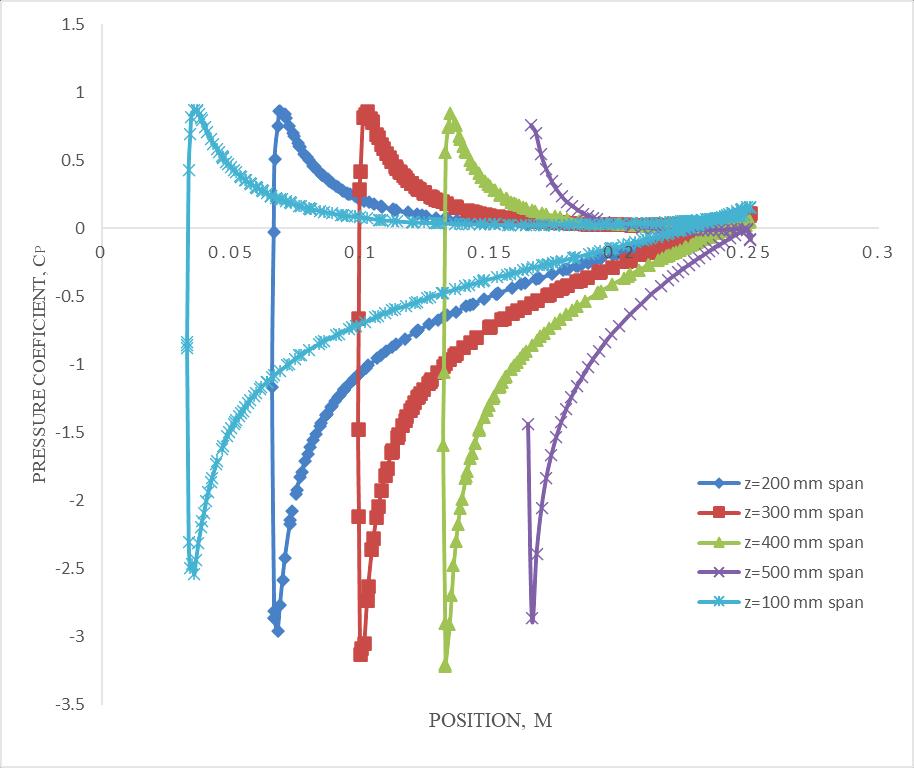
Fig. 31: PressurecoefficientVsXcoordinatepositionfor differentspanwisepositionforwingwith90°wingletat 10°AoA
Thiscurveillustratesthepressurecoefficientsvaluesvs.X coordinatepositionsatdifferentchordsectionofthewing along Z-axis or spanwise direction for wing with 90° winglet for 10° AoA. Here, 5 iso-surfaces have been created forming 5 airfoils of NACA 0012 series of the 3 dimensionalwinghavingdifferentchordlengths.Fromthe figure, it can be seen that the values for pressure coefficients at upper surface of the airfoils slightly increasesat spanwise direction. At z = 400 mm, the value of Cp at upper surface is maximum but the value of Cp at lower surface remains constant along the spanwise direction. At z= 500 mm where the winglet is stalled, the Cpvaluesagaindecreasesasforreducingvorticityofflow duetotheinstallmentofwingletensuringbettervaluesof liftcoefficient.
International Research Journal of Engineering and Technology (IRJET) e-ISSN: 2395-0056
Volume: 11 Issue: 05 | May 2024 www.irjet.net p-ISSN: 2395-0072
5.4 Pressure Coefficient (Cp) Vs. Position (Y Coordinate):
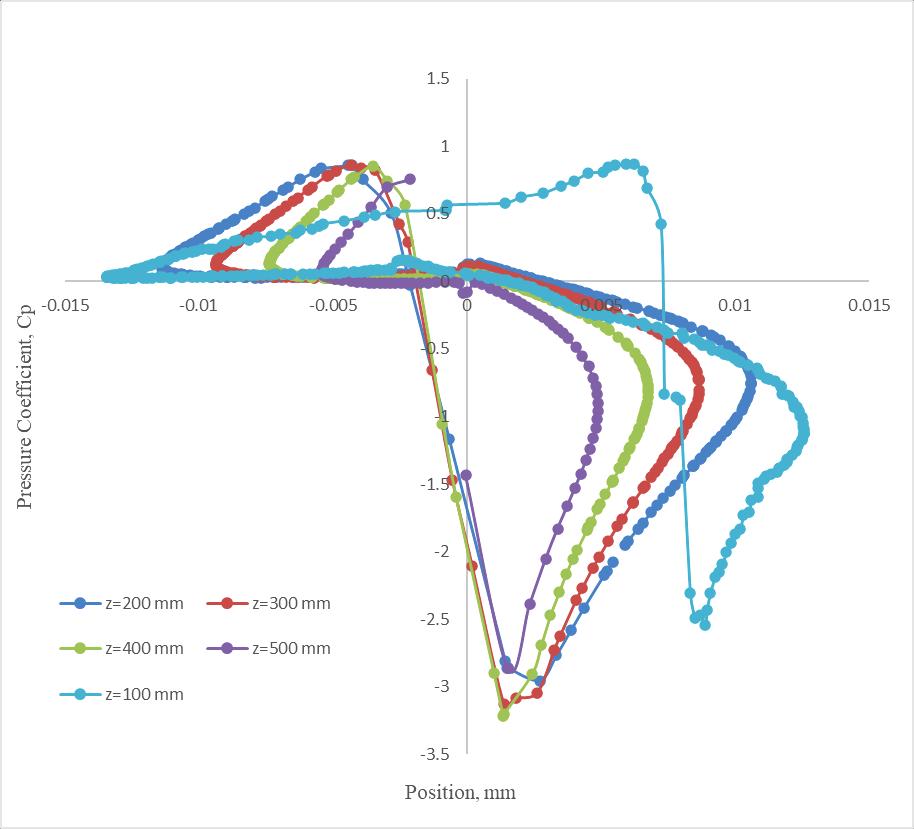
Fig. 32: PressurecoefficientVs.Ycoordinatepositionsfor differentspanwisepositionforwingwith90°wingletat 10°AoA
This figure illustrates the variation of Cp values vs. position at Y-coordinate at different spanwise chord sectionsforwingwith90°wingletat10°AoA.Itisevident that, the thickness of airfoils decreases with decreasing chord length along spanwise direction of the wing. From above figure, it is observed the ranges of Cp decreases as the span of the wing increases. So, it can be said that the pressure distribution gradually decreases along the thickness of the airfoils sections as the span of the wing increases. For z = 100 mm span, the ranges for Cp is maximum where the ranges of Cp is minimum at z= 500 mmwherethewingletisstalled.
5.5 Lift Coefficients (CL) and Drag Coefficients (CD) for Normal Wing:
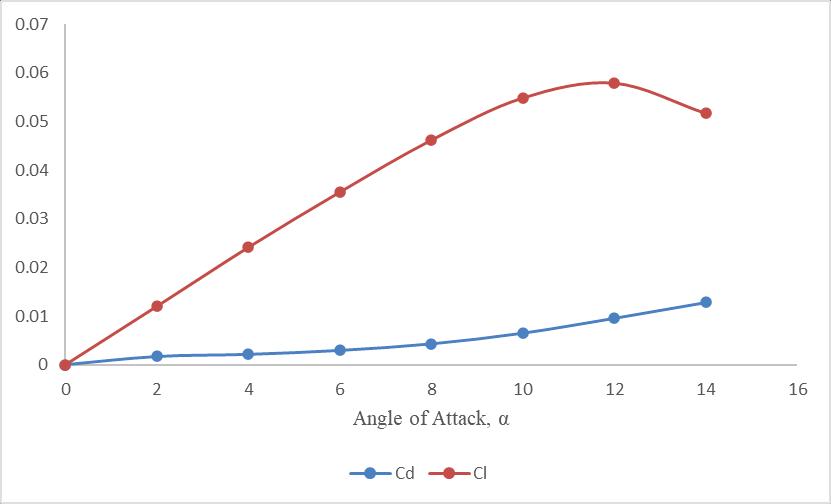
33: CL andCD valuesVsAngleofattackforNormal Wing
5.6 Lift Coefficients (CL) and Drag Coefficients (CD) for Wing with Winglets:
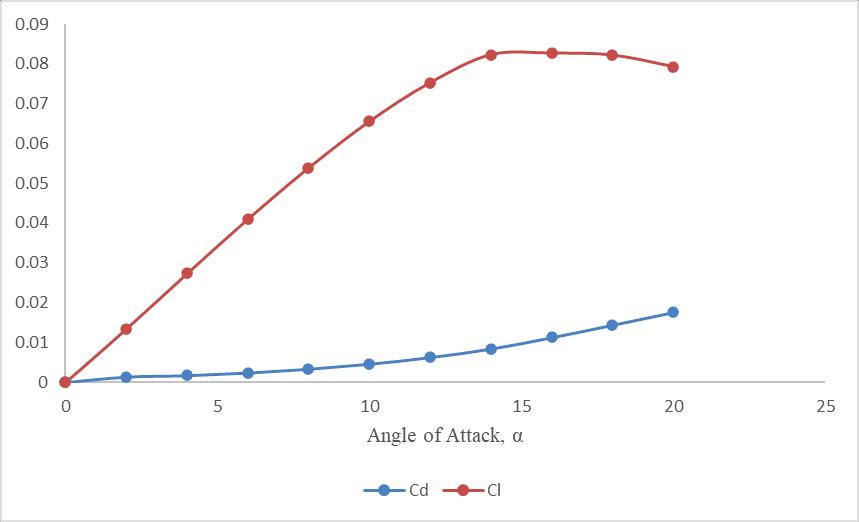
34: CL andCD valuesVsAngleofattackforWingwith 90°winglet
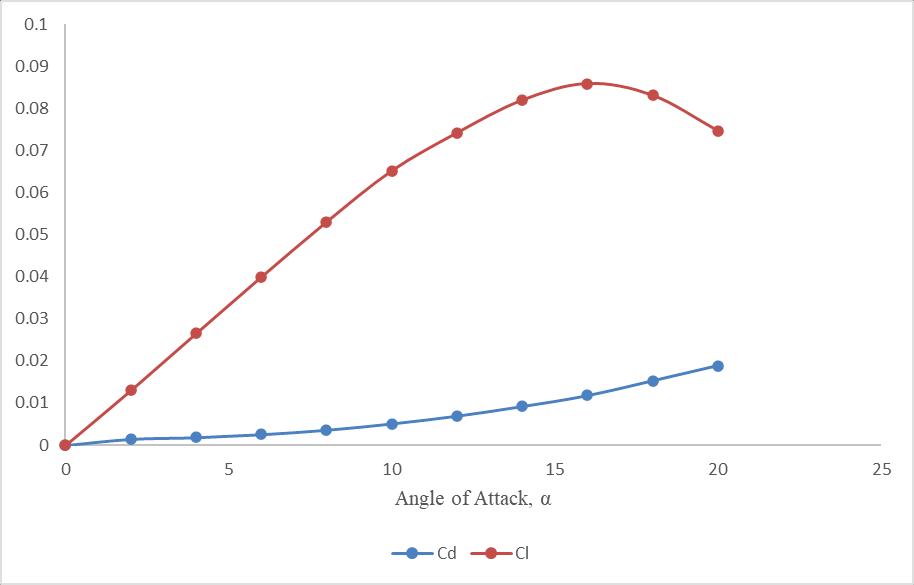
Fig. 35: CL andCD valuesVsAngleofattackforWingwith 45°winglet
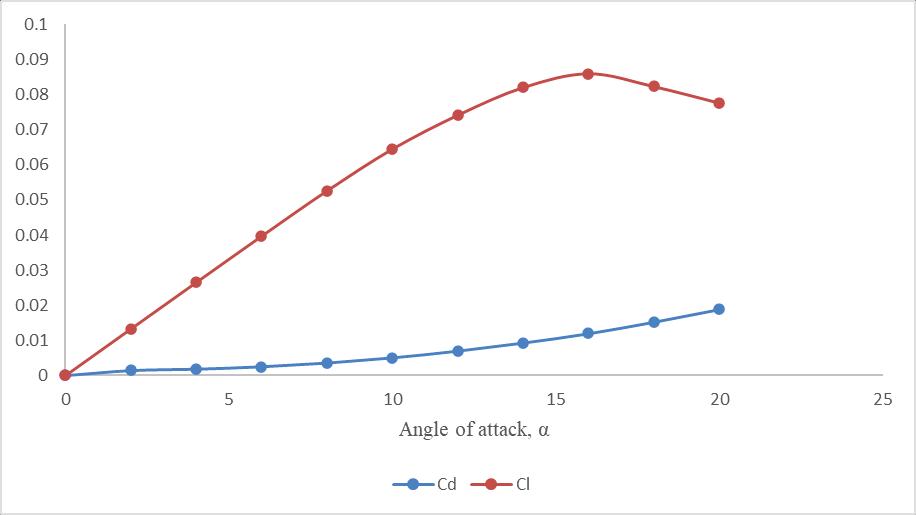
Fig. 36: CL andCD valuesVsAngleofattackforWingwith 30°winglet
International Research Journal of Engineering and Technology (IRJET) e-ISSN: 2395-0056
Volume: 11 Issue: 05 | May 2024 www.irjet.net p-ISSN: 2395-0072
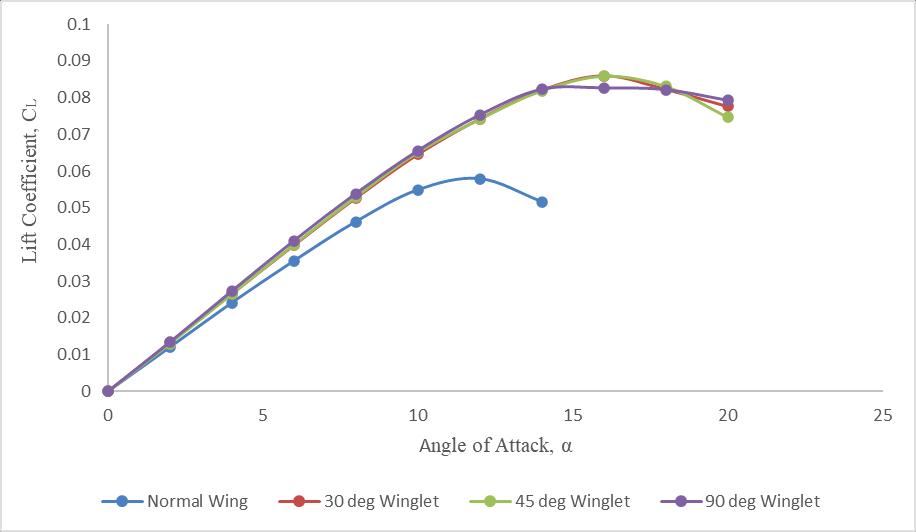
peak point, CLmax ; corresponding to the related value of AoA. As the AoA values increases, the lift coefficient increasesuntilstalloccurs.ThevalueofAoAatwhichstall ofliftcoefficientoccursisknownasαstall.Fromfig.34,it canbeobservedthatfornormalwing,thevalueofαstallis 12°. From fig. 35, the value of α stall for wing with is 14° AoA.Fromfig.36andfig.37,thevaluesofαstallis16°for both wing with 45° winglet and wing with 30° winglet respectively. The drag coefficient values gradually increases with the increase of AoA values for all cases. As NACA 0012 series symmetric airfoil is used as cross sectionofalltypesofwing,soitisknownthatthezerolift of the wing will be at the zero angle of attack for the consideredincompressibleflowoverthe3Dwing.Sohere, αlift=0=0.
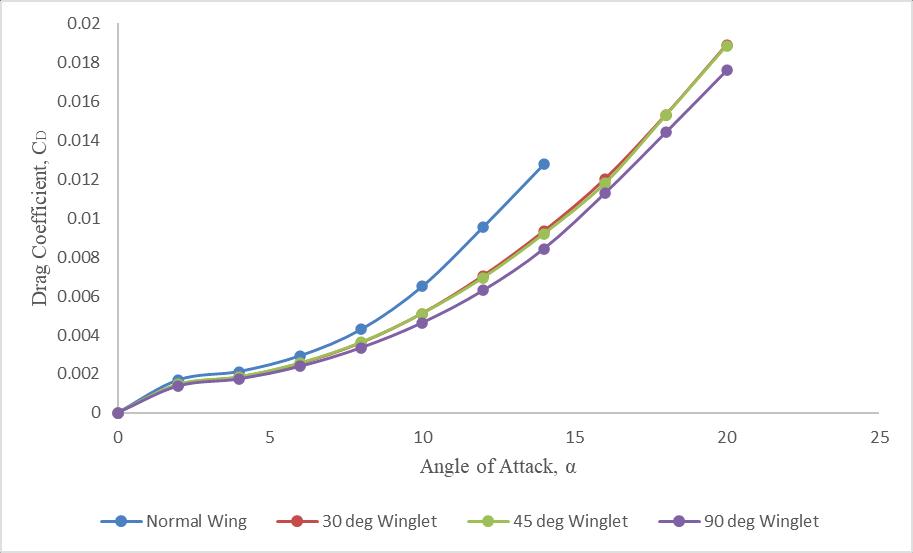
Thephenomenonofairfoilstallisofcriticalimportancein airplane design. It is caused by flow separation on the upper surface of the airfoil. When separation occurs, the lift decreases drastically and the drag increases suddenly. Figure4.25showsthecomparisonofCLvaluesamongthe types of wings. From the figure, CL values increases linearly with the increasing AoA when the flow attached relativetothewing.Whenthestallofairfoilatsectionsof wingsoccurred,stallofairfoilsoccurred.Fromfigure37,it canbeseenthatthemaximumpeakpointvalueofCL,max is for wing for 30° winglet and 45° winglet around 0.085. Theliftcurvesofwingfor90°,30°and45° wingletshows almost similar values with respect to the corresponding values of angle of attack. Figure 37 shows the greater values of CL of wing with winglets as compared to the normal wing which proves greater lift takes place if wingletsareattachedwithnormalwing.Wingletshelpsof reducing tip vortices at wing tip which causes higher values of CL. Fig. 38 shows the variation of CD values among the types of wings. From the figure, it is evident that the drag is reduced for wing with winglets as compared to normal wing. Drag line for wing with 90° wingletshowsthelowestvaluesofCDwhichisdesired.As the values of AoA is increased, the values of CD is also increasedbothfornormalwingandwingwithwinglets.
Above figures indicate the variations of lift and drag coefficients for normal wing, wing with 90° winglet, wing with45°wingletandwingwith30°winglet.Thevaluesof CDexhibitssmallervaluesascomparedtoliftcoefficients. From these figure, the value of CL reaches a maximum
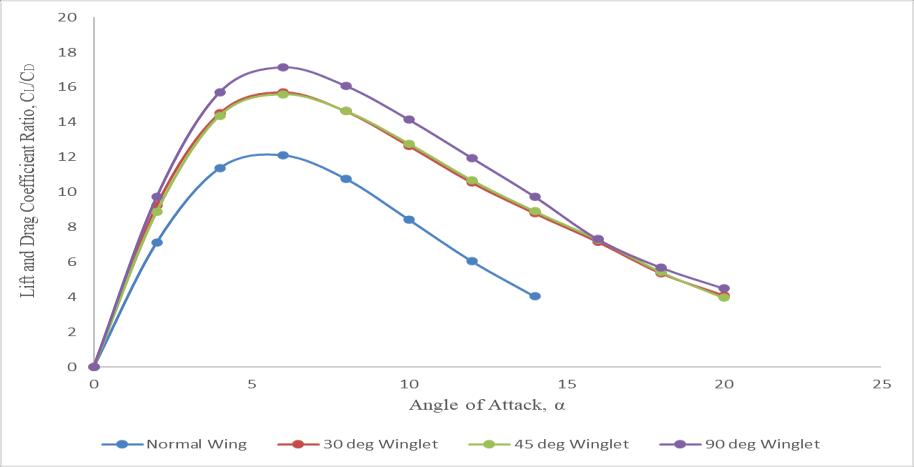
In fig. 39, the ratio of lift coefficient to drag coefficient valuesisrepresentedwithrespectedtothecorresponding values of angle of attack. From the figure, it is observed that the lift to drag coefficient ratio exhibits maximum values for wing with 90° winglet. The values of CL/CD shows lowest values for normal wing. In the case of wing with 30° and 45° winglet, the values or curves seem similar with each other. So it can be said that the variations of results is negligible for wings with 30° and 45° winglets. For higher efficiency of aircraft engine and ensuringbetterfueleconomyitisdesiredbyimprovinglift force by increasing attached flow at wing tips reducing vorticityoffreestreamflow.Alsoitisdesiredthatthedrag force is as minimum as possible. From the above results and discussions, it is proved that the wing with 90°
International Research Journal of Engineering and
Volume: 11 Issue: 05 | May 2024 www.irjet.net
winglet shows better results regarding the requirements ofaerodynamicscharacteristics.
Table 4.1(a): CL and CD values of 4 types of wings SI
Table 4.2(b): CL and CD values of 4 types of wings
From the above table, for normal wing at αstall, CL = 0.0578
Andforwingwith90°wingletatαstall,CL=0.08214

Therefore, percentage of increased lift by using 90° winglet, =42.11%
Forwingwith45°wingletatαstall,CL,max=0.08586
Therefore, percentage of increased lift by using 45° winglet,

=48.55%
Forwingwith30°wingletatαstall,CL,max=0.086
Therefore, percentage of increased lift by using 30° winglet,

=48.79%
So, considering the improvement of lift coefficient, usage of 30° winglet shows most lift coefficient increment. But also as compared to reduced drag coefficient, wing with 90°wingletshowsbetterperformance.
6.
6.1 Conclusion:
This study involves with numerical analysis of the performanceofaerodynamicscharacteristicsofaeroplane wing with and without winglets. The present work shows that winglets are one of the important device to achieve betteraerodynamicperformanceoftheaircraft.
This work proposes alternatives in the cant angles of the wingletsfromtheconventionalwingwithoutwinglets.An improved winglet design with at a certain cant angle will significantly yield a better performance of an aircraft by lowering the induced drag which causes tip vortices. The overall improved aerodynamic efficiency will result in reducedfuelconsumption.
Results clearly shown that using blended winglet lift coefficient is increased approximately 42% to 49% and dragcoefficientisreduced.
Thiswingletdesignsarecapableoftoreduceinduceddrag force and convert wing tip vortices to additional thrust which will save cost by reducing the usage of fuel, noise level reduction and increase the efficiency of the aircraft engine.
The analysis can be done experimentally constructing a modelofnormalwingandwingwithoutwingletsandthen acomparisoncanbeestablishedbetweenthevariationsof theresult.
The work can be extended for different Reynolds number and flow types of free stream to investigate the lift and drag coefficients with respect to the types of flow accordingly.
International Research Journal of Engineering and Technology (IRJET) e-ISSN: 2395-0056
Volume: 11 Issue: 05 | May 2024 www.irjet.net p-ISSN: 2395-0072
The analysis can be done for asymmetric airfoil sections wingstoinvestigatewhetheritshowsbetteraerodynamic resultsthanbeforeornot.
The work can be extended for a larger range of angle of attackandalsofordifferentviscousmodels.
ACKNOWLEDGEMENT
We would like to thank Almighty Allah for His kindness upon us without which it would be impossible to finish this paper. We would like to pay our sincere gratitude to Dr. Abdullah Al-Faruk, Professor, Department of MechanicalEngineering,KhulnaUniversityofEngineering & Technology (KUET) for his guidance, support and concern throughout this paper. We are indebted to him. We express our cordial gratefulness to Dr. Mohammad Ariful Islam, Professor Department of Mechanical Engineering, Khulna University of Engineering & Technology (KUET), for providing a great opportunity to enhance presentation and study based skills which will later help flourishing in different sectors. We also highly appreciatethelabfacilitieswegotfromCUET.
[1] F. Culick, ""The Wright Brothers: First Aeronautical EngineersandTestPilots","AIAAJournal,vol.41,pp. 985-1006,2003.
[2] R. Whitcomb, ""A Design Approach & Selected Wind TunnelResultsatHighSubsonicSpeedsforWing-Tip MountedWinglets","NASATND-8260,June1976.
[3] P.Bourdin,A.GattoandM.Friswell,""AircraftControl Via Variable Cant-Angle Winglets"," Journal of Aircraft,vol.45,March-April2008.
[4] E. Houghton and P. Carpenter, Aerodynamics for Engineering Students, 4th ed., Edward Arnold Publisher.
[5] J.-J. Chattot, ""Analysis and Design of Wings and Wing/Winglet Combinations at Low Speeds"," 42nd AIAA Aerospace Sciences Meeting and Exhibit, 5-8 January2004.
[6] P. D. Gall and H. C. Smith, ""Aerodynamic CharacteristicsofBiplaneswithWinglets”,"Journalof Aircraft,vol.24,no.8.
[7] I. Kroo, J. McMasters and S. C. Smith, ""Highly Nonplanar Lifting Systems, Presented at: Transportation Beyond 2000: Technologies Needed for Engineering Design"," NASA Langley Research Center,26-28September1995.
[8] M. Smith, N. Komerath, R. Ames, O. Wong and J. Pearson, "“Performance analysis of a wing with multiple winglets"," AIAA Applied Aerodynamics, 2001.
[9] J.SpillmanandM.McVitie,""WingtipSailswhichgive lowerdragatallnormalflightspeeds","Aeronautical Journal,vol.88,pp.362-369,1984.
[10] A. Hossain, A. Rahman, A. P. Iqbal, M. Ariffin and M. Mazian, ""Drag Analysis of an Aircraft Wing Model with and without Bird Feather like Winglet"," International Journal of Science, Engineering and Technology,vol.5,no.9,2011.
[11] A. Beechook and J. Wang, ""Aerodynamic Analysis of Variable Cant Angle Winglets for Improved Aircraft Performance"," 19th International Conference on Automation & Computing, pp. 13-14, September 2013.
[12] C.R.andF.Catalano,""AerodynamicAnalysisofMulti Winglets for Low Speed Aircrafts"," 27th InternationalCongressofAeronauticalSciences.
[13] B. S. .. Mattos, A. P. Macedo and D. H. d. S. Filho, ""Considerations about Winglet Design"," 21st Applied Aerodynamic Conference, AIAA 2003-3502, 23-26June2003.
[14] N. J. Pfeiffer, ""Numerical Winglet Optimization"," "42ndAIAAAerospaceSciencesMeetingandExhibit", 5-8January2004.
[15] J. Himisch, ""Winglet Shape and Load Optimization with a numerically supported Lifting Line Method"," 12th AIAA/ISSMO Multidisciplinary Analysis and OptimizationConference,10-12September2008.
[16] D. Mylisamy and P. P. S, ""Performance Investigation ofanAircraftWingatVariousCantAnglesofWinglets usingCFDSimulation","July2015.
[17] J.D.Anderson,"FundamentalsofAerodynamics",5th ed., McGraw Hill Education Private Limited Publication.
[18] [Online]. Available: https://www.researchgate.net/figure/TheDevelopment-of-Wingtip-Vortices-Scott2005_fig1_284027599.
[19] [Online]. Available: http://www.airfoiltools.com/plotter/index.
International Research Journal of Engineering and Technology (IRJET) e-ISSN: 2395-0056
Volume: 11 Issue: 05 | May 2024 www.irjet.net p-ISSN: 2395-0072



Md. Shahadat Hossan Sayem, graduate student in the department of Mechanical Engineering from Khulna University Of Engineering & Technology, (KUET), Khulna, Bangladesh.
Md. Mainuddin Sagar, graduate student in the department of Mechanical Engineering from Chittagong University Of Engineering & Technology, (CUET),Chittagong, Bangladesh.
Md. Rezwan Alam, graduate student in the department of Mechanical Engineering from Khulna University OfEngineering & Technology, (KUET), Khulna, Bangladesh.

Dr. Abdullah Al- Faruk, Professor in the department of Mechanical Engineering from Khulna University OfEngineering & Technology, (KUET), Khulna, Bangladesh.