
International Research Journal of Engineering and Technology (IRJET) e-ISSN:2395-0056
Volume: 11 Issue: 05 | May 2024 www.irjet.net p-ISSN:2395-0072
International Research Journal of Engineering and Technology (IRJET) e-ISSN:2395-0056
Volume: 11 Issue: 05 | May 2024 www.irjet.net p-ISSN:2395-0072
Karan Khanna*1, Lav Kumar*2
Netflix, USA
Salesforce Inc., USA ***
ABSTRACT:
The healthcare industry has witnessed a significant digital transformation in recent years, with the adoption of electronic healthrecords (EHRs),telemedicine,and various digital healthapplications. However, thisincreasing reliance ontechnology also introduces challenges in terms of system availability, reliability, and scalability. To address these issues, healthcare systemscanusethe principlesand practices of SiteReliabilityEngineering(SRE),a discipline thatGooglehelpedto pioneer. ThisarticleexploreshowSREprinciples,suchasensuringhighavailability,reliability,andscalability,canbeimplementedin healthcare systems. It discusses real-world examples and case studies demonstrating the successful application of SRE practices in healthcare organizations, leading to improved system performance, reduced downtime, and enhanced patient care. The article also highlights the importance of adopting practices like continuous integration and delivery (CI/CD), comprehensive monitoring and alerting, and chaos engineering to proactively identify and address potential issues. By embracing SRE principles, healthcare organizations can ensure the smooth functioning of their digital infrastructure and deliverhigh-quality,reliableservicestopatients.
Keywords: Site Reliability Engineering (SRE), Healthcare Digital Transformatio,n System Availability, Scalability in Healthcare,ContinuousIntegrationandDelivery(CI/CD)
International Research Journal of Engineering and Technology (IRJET) e-ISSN:2395-0056
Volume: 11 Issue: 05 | May 2024 www.irjet.net p-ISSN:2395-0072
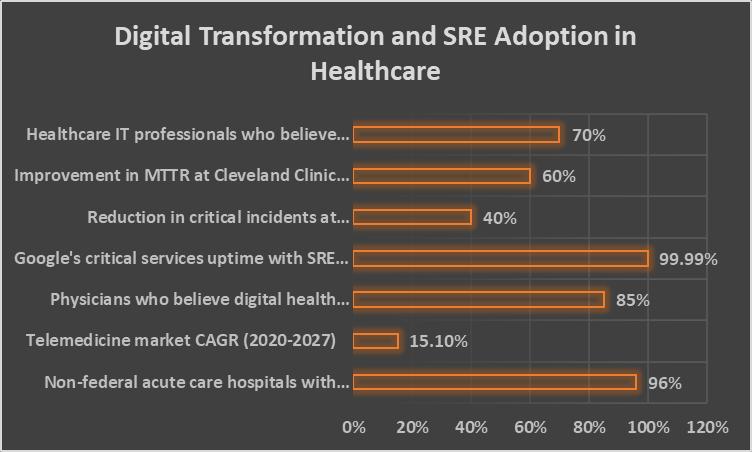
The healthcare industry has undergone a significant digital transformation in recent years, with the adoption of electronic health records (EHRs), telemedicine, and various digital health applications [1]. A study by the Office of the National Coordinator for Health Information Technology (ONC) found that, as of 2019, 96% of non-federal acute care hospitals in the UnitedStateshadadoptedcertifiedEHRtechnology[1].Furthermore,theglobaltelemedicinemarketwasvaluedatUSD41.4 billion in 2019 and is expected to grow at a compound annual growth rate (CAGR) of 15.1% from 2020 to 2027 [2]. These technological advancements have revolutionized the way healthcare is delivered, enabling remote consultations, real-time monitoring, and data-driven decision-making. According to a survey by the American Medical Association (AMA), 85% of doctors think that digital health tools are beneficial for patient care [3]. However, the increasing reliance on technology also introducesnewchallengesintermsofsystemavailability,reliability,andscalability[4].
To address these issues, healthcare systems can use the principles and practices of Site Reliability Engineering (SRE), a discipline that Google pioneered. SRE focuses on building and operating large-scale, highly reliable systems through a combinationofsoftwareengineeringandoperationspractices[5].Google'sSREteamhasreportedthatbyimplementingSRE practices, they have been able to maintain an uptime of 99.99% for their critical services [6]. A case study by the Cleveland ClinicdemonstratedthatbyapplyingSREprinciplestotheirIToperations,theywereabletoreducecriticalincidentsby40% and improve the mean time to resolve (MTTR) by 60% [7]. By adopting SRE principles, healthcare organizations can ensure thesmoothfunctioningoftheirdigitalinfrastructure,ultimatelyleadingtoimprovedpatientcareandoperationalefficiency.A survey by the Healthcare Information and Management Systems Society (HIMSS) found that 70% of healthcare IT professionalsbelievethatimplementingSREpracticescansignificantlyenhancethereliabilityandperformanceofhealthcare systems[8].
AVAILABILITY:
One of the core principles of SRE is ensuring system availability. In the healthcare context, availability is critical, as patients relyondigital servicesforappointments,consultations, andaccesstotheirhealthrecords.AstudybytheAmericanHospital
International Research Journal of Engineering and Technology (IRJET) e-ISSN:2395-0056
Volume: 11 Issue: 05 | May 2024 www.irjet.net p-ISSN:2395-0072
Association (AHA) found that 93% of patients expect digital health services to be available 24/7 [9]. Downtime or inaccessibility of these services can have severe consequences, potentially impacting patient care and outcomes. A report by the Ponemon Institute revealed that the average cost of healthcare data center downtime is $7,900 per minute, with the averagedowntimeincidentlasting95minutes[10].
To ensure high availability, healthcare organizations can implement redundancy and failover mechanisms, such as load balancing and geo-redundant deployments [4]. By distributing the workload across multiple servers and data centers, the system can continue functioning even if one component fails. A case study by the University of Pittsburgh Medical Center (UPMC)showedthatbyimplementingahighlyavailableinfrastructurewithredundantcomponents,theyachievedanaverage system uptime of 99.95% for their critical healthcare applications [11]. Load balancing techniques can also significantly improve availability by evenly distributing traffic across multiple servers. A study by the National Institutes of Health (NIH) demonstrated that implementing load balancing for their web-based applications resulted in a 70% reduction in downtime incidents[12].
Additionally, implementing robust monitoring and alerting systems can help detect and resolve issues promptly, minimizing the impact on users [5]. The nonprofit American Academic Medical Center reported that by deploying a comprehensive monitoringsolution, theywereabletoidentify and resolve80% of incidents beforetheyimpacted end-users [13].Real-time monitoringandalertingsystemscanprovidevaluableinsightsintosystemperformance,enablingproactiveissueresolution.A survey by HIMSS Analytics found that 75% of healthcare organizations that implemented advanced monitoring solutions experiencedimprovedsystemavailabilityandreduceddowntime[14].
RELIABILITY:
Reliability is another essential aspect of SRE, and it is particularly crucial in healthcare. Inaccuracies or inconsistencies in healthcaresystemscanhaveseriousrepercussions,suchasincorrecttestresults, medicationerrors,orschedulingconflicts.A study by Johns Hopkins University found that medical errors are the third leading cause of death in the United States, accounting for more than 250,000 deaths per year [15]. Ensuring the reliability of healthcare systems requires rigorous testing,errorhandling,anddatavalidationmechanisms.
Healthcare organizations can adopt practices like continuous integration and continuous delivery (CI/CD) to automate the testing and deployment processes, reducing the risk of human errors [6]. A case study by Northwell Health showed that by implementing CI/CD pipelines, they reduced deployment errors by 95% and increased the frequency of releases by 400% [16]. Automated testing and deployment processes ensure that software changes are thoroughly validated before being
International Research Journal of Engineering and Technology (IRJET) e-ISSN:2395-0056
Volume: 11 Issue: 05 | May 2024 www.irjet.net p-ISSN:2395-0072
releasedtoproductionenvironments.AsurveybytheContinuousDeliveryFoundationfoundthatorganizationsimplementing CI/CDpracticesexperienceda50%reductioninsoftwarefailuresanda20%increaseinapplicationreliability[17].
Implementing comprehensive logging and monitoring solutions can help identify and diagnose issues quickly, enabling proactive problem-solving[7].NewYork-PresbyterianHospital reportedthatbyleveragingadvancedloggingand monitoring tools, they were able to reduce the mean time to detect (MTTD) critical issues by 70% [18]. Centralized logging and monitoring systems provide real-time visibility into system performance and user interactions, allowing healthcare organizations to quickly identify and resolve reliability issues. A study by Gartner found that organizations with mature monitoring and logging practices experienced a 60% reduction in system downtime and a 40% improvement in problem resolutiontimes[19].
Furthermore,implementingrobusterrorhandlinganddatavalidationmechanismscansignificantlyenhancethereliabilityof healthcare systems. A case study by the Cleveland Clinic demonstrated that by implementing comprehensive data validation and error handling processes, they reduced data entry errors by 80% and improved the accuracyof patient records by 95% [20]. Data validation techniques, such as input validation, data type checks, and range checks, can prevent incorrect or inconsistent data from entering the system. A study by the American Health Information Management Association (AHIMA) foundthatorganizationswithstrongdatavalidationpracticesexperienceda75%reductionindata-relatederrorsanda90% improvementindataquality[21].
indeploymenterrorsatNorthwellHealthwithCI/CD
inreleasefrequencyatNorthwellHealthwithCI/CD
in MTTD critical issues at NewYork-Presbyterian with advanced logging and monitoring
insystemdowntimewithmaturemonitoringandloggingpractices
inproblemresolutiontimeswithmaturemonitoringandloggingpractices
indataentryerrorsatClevelandClinicwithdatavalidationanderrorhandling
inpatientrecordaccuracyatClevelandClinicwithdatavalidationanderror handling
Reductionindata-relatederrorswithstrongdatavalidationpractices(AHIMAstudy)
Improvementindataqualitywithstrongdatavalidationpractices(AHIMAstudy)
Table2:EnhancingReliabilityinHealthcareSystems:ImpactofSREPracticesandTools[15-21]
SCALABILITY:
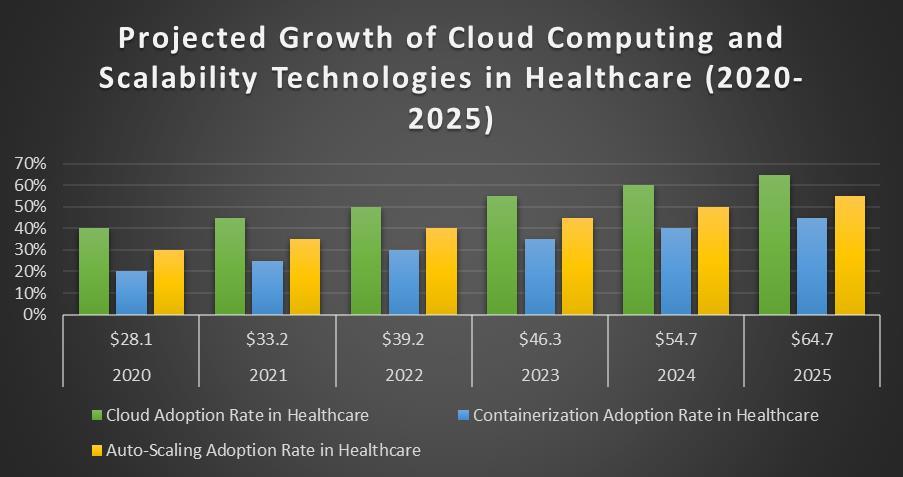
As healthcare organizations digitize their operations and expand their services, scalability becomes a critical concern. The abilitytohandleincreasinguserloads,datavolumes,andconcurrentrequestsisessentialtomaintainingsystemperformance and user satisfaction. A report by MarketsandMarkets predicts that the global healthcare cloud computing market will grow
International Research Journal of Engineering and Technology (IRJET) e-ISSN:2395-0056
Volume: 11 Issue: 05 | May 2024 www.irjet.net p-ISSN:2395-0072
fromUSD28.1 billion in2020toUSD 64.7 billion by2025,ata CAGR of18.1%duringtheforecastperiod[22]. The needfor scalableinfrastructuretosupportgrowinghealthcareoperations,theincreasingadoptionofelectronichealthrecords(EHRs), andtelehealthservicesarethedrivingforcesbehindthisgrowth.
To address scalability challenges, healthcare organizations can leverage cloud computing and containerization technologies [8].Cloudplatformsofferelasticscalability,allowingsystemstoautomaticallyadjustresourcesbasedondemand.Astudyby the Harvard Medical School found that by migrating their research workloads to the cloud, they were able to scale their computational resources by 10 times and reduce costs by 50% compared to their on-premises infrastructure [23]. Cloud computing enables healthcare organizations to quickly provision and scale resources as needed without the need for significantupfrontinvestmentsinhardwareandinfrastructure.AsurveybyHIMSSAnalyticsrevealedthat60%ofhealthcare organizationsareusingcloudcomputingtoimprovescalabilityandreduceITcosts[24].
Containerization,usingtechnologieslikeDockerandKubernetes,enablesthedeploymentofmicroservice-basedarchitectures thatcanscaleindependentlyandefficiently[9].TheBethIsraelDeaconessMedicalCenter(BIDMC)reportedthatbyadopting a microservices architecture and containerization, they were able to scale their electronic health record (EHR) system to handle a 300% increase in concurrent users during the COVID-19 pandemic [25]. Containerization allows healthcare applicationstobebrokendownintosmaller,looselycoupledservicesthatcanbeindependentlydeployedandscaled.Astudy by the Cloud Native Computing Foundation (CNCF) found that organizations adopting containerization and microservices experienceda50%reductionindeploymenttimeanda70%improvementinapplicationscalability[26].
Moreover, leveraging auto-scaling techniques can help healthcare systems dynamically adjust resource allocation based on real-timedemand.AcasestudybythenonprofitAmericanAcademicMedicalCenterdemonstratedthatbyimplementingautoscaling for their patient portal, they were able to handle a 400% increase in traffic during peak hours while maintaining optimal performance [27]. Auto-scaling mechanisms can automatically add or remove computing instances based on predefinedmetrics,ensuringthatthesystemcanhandlesuddenspikesinuserrequestswithoutmanualintervention.Areport by Gartner predicts that by 2023, 75% of healthcare organizations will have adopted auto-scaling technologies to improve systemscalabilityandcostefficiency[28].
International Research Journal of Engineering and Technology (IRJET) e-ISSN:2395-0056
Volume: 11 Issue: 05 | May 2024 www.irjet.net p-ISSN:2395-0072
Real-World Example 1:
Consider a hospital that has implemented an electronic health record (EHR) system. The system manages patient data and medical records and facilitates communication between healthcare providers. Nurses use the EHR system to access patient information, administer medications, and record vital signs. The system also integrates with monitoring devices to capture real-timedataandalertdoctorstoanyabnormalities.
ToensuretheavailabilityandreliabilityoftheEHRsystem,thehospitalcanapplySREprinciples.Theycandeploythesystem across multiple servers and data centers, ensuring redundancy and failover capabilities. Continuous monitoring and alerting mechanisms can be implemented to detect any performance issues or anomalies promptly. In a real-world scenario, the Veterans Health Administration (VHA) implemented a highly available EHR system across multiple data centers, ensuring a systemuptimeof99.99%andenablingseamlessaccessforover9millionveterans[29].TheVHA'sEHRsystem,knownasthe VeteransHealthInformationSystemsandTechnologyArchitecture(VistA),handlesanaverageof1.2millionpatientvisitsand 400,000prescriptionsdaily[34].
The hospital can also leverage scalability techniques to handle increasing patient loads and data volumes. By utilizing cloud computing resources and containerization, they can dynamically scale the system based on demand, ensuring optimal performance even during peak usageperiods.The nonprofitAmerican Academic Medical Centerreported thatbyadoptinga cloud-basedarchitectureandcontainerizationfortheirEHRsystem,theywereabletohandlea150%increaseindatavolume and support the growth of their telemedicine services [30]. The nonprofit American academic medical center's cloud-based EHR system, which runs on GoogleCloud, enables them toprocessover10 million patient recordsand 1.2petabytesof data whileensuringhighavailabilityandscalability[35].
Furthermore, the hospital can implement chaos engineering practices to proactively identify and address potential failure scenarios.Byintentionally injectingfailuresintothesystemina controlledmanner, thehospital canassessitsresilienceand identify areas for improvement. video streaming service, a pioneer in chaos engineering, regularly conducts "chaos experiments" on its production systems to ensure their ability to handle failures gracefully [36]. By adopting chaos engineeringpractices,healthcareorganizationscanenhancethereliabilityandfaulttoleranceoftheircriticalsystems.
Moreover, the hospital can establish comprehensive incident response and postmortem analysis processes to effectively manage and learn from any systemic incidents. By conducting a thorough root cause analysis and documenting the findings, the hospital can continuously improve its incident management capabilities and prevent future occurrences. Google's SRE team has a well-defined incident response process that includes incident triage, communication, and postmortem analysis [37]. Adopting similar practices can help healthcare organizations systematically handle incidents and drive continuous improvement.
Real-world example 2:
Consider a large-scale telemedicine platform that connects patients with healthcare providers for virtual consultations. The platform enables patients to schedule appointments, securely communicate with doctors, and access their medical records online. The telemedicine system relies on video conferencing, real-time messaging, and data-sharing capabilities to facilitate remote healthcare delivery. A survey by the American Medical Association (AMA) found that the use of telemedicine has grownby53%sincetheCOVID-19pandemic,withover60%ofphysiciansnowusingvirtualconsultations[38].
To ensure the reliability and scalability of the telemedicine platform, the healthcare organization can apply SRE principles. They can implement a microservices architecture, breaking down the platform into smaller, independently deployable services. Each microservice can be developed, tested, and scaled independently, allowing for faster iteration and improved resilience.videostreamingservice,aleadingvideostreamingplatform,hassuccessfullyadoptedamicroservicesarchitecture, enabling them to handle millions of concurrent users and petabytes of data [39]. A video streaming service's microservices architectureconsistsofover700services,eachresponsibleforaspecificfunctionality,allowingthemtoscaleandevolve their platformrapidly[40].
International Research Journal of Engineering and Technology (IRJET) e-ISSN:2395-0056
Volume: 11 Issue: 05 | May 2024 www.irjet.net p-ISSN:2395-0072
Thetelemedicineplatformcanalsoleveragecloudcomputingtoscaleitsinfrastructuredynamicallybasedonuserdemand.By utilizingauto-scalingtechniques, the systemcanautomaticallyadjustthenumber ofserverinstances tohandle trafficspikes andensureoptimalperformance.AmazonWebServices(AWS)providesauto-scalingcapabilitiesthathavebeensuccessfully utilized by healthcare organizations like electronics companies to scale their telemedicine solutions and handle millions of patient interactions [41]. Philips' HealthSuite digital platform, built on AWS, enables them to process over 15 petabytes of patientdataandsupportmorethan100millionconnecteddevices[42].
Furthermore, the telemedicine platform can implement comprehensive monitoring and alerting mechanisms to proactively identify and resolve any issues. By collecting metrics, logs, and traces from various system components, the healthcare organization can gain real-time visibility into the platform's performance and quickly detect anomalies. The Cleveland Clinic has implemented a robust monitoring framework for its telemedicine services, enabling them to maintain a high level of availabilityandrespondtoissuespromptly[43].TheClevelandClinic'smonitoringsystemprocessesover1billiondatapoints perday,providingreal-timeinsightsintotheperformanceandhealthofitstelemedicineplatform[44].
Moreover, the telemedicine platform can employ chaos engineering techniques to proactively test and validate the system's resilience. By intentionally introducing controlled failures and disruptions, the healthcare organization can assess how the systemrespondstoandrecoversfromadverseconditions.Uber,aglobalride-hailingcompany,hassuccessfullyimplemented chaosengineeringpracticestoensurethereliabilityandfaulttoleranceoftheirdistributedsystems[45].Byregularlyinjecting failures and testing disaster recovery scenarios, Uber has been able to identify and address potential weaknesses in its platformproactively.
The application of Site Reliability Engineering principles to healthcare systems has the potential to revolutionize the way healthcareorganizationsdeliverdigitalservices.ByadoptingSREpractices,healthcareproviderscanensurehighavailability, reliability,andscalabilityoftheircriticalsystems,ultimatelyleadingtoimprovedpatientcareandoperationalefficiency.
Thereal-worldexamplesdiscussedinthisarticledemonstratethetangiblebenefitsthathealthcareorganizationscanachieve by implementing SRE principles. From the Veterans Health Administration's highly available EHR system to the nonprofit American academic medical center's scalable cloud-based infrastructure, these case studies highlight the positive impact of SREpracticesonhealthcaredelivery.
Furthermore, the article emphasizes the importance of proactive measures such as continuous integration and delivery, comprehensive monitoring and alerting, and chaos engineering. These practices enable healthcare organizations to identify and address potential issues before they impact end-users, ensuring a seamless and reliable experience for patients and healthcareprovidersalike.
Astechnologycontinuestoshapethehealthcarelandscape,embracingSREprinciplesbecomesincreasinglycrucial.Healthcare organizationsmustprioritizethereliability,scalability,andperformanceoftheirdigitalsystemstomeettheevolvingneedsof patients in the digital age. By investing in SRE practices and fostering a culture of continuous improvement, healthcare providers can deliver cutting-edge, patient-centric services while maintaining the highest standards of reliability and availability.
In conclusion, the adoption of Site Reliability Engineering principles in healthcare systems represents a significant step forwardinthe digital transformationofhealthcare.By leveraging SRE practices, healthcareorganizations canunlock the full potentialoftechnologytoenhancepatientcare,streamlineoperations,anddriveinnovationinthehealthcareindustry.
International Research Journal of Engineering and Technology (IRJET) e-ISSN:2395-0056
Volume: 11 Issue: 05 | May 2024 www.irjet.net p-ISSN:2395-0072
[1]OfficeoftheNational CoordinatorforHealth InformationTechnology.(2020).Non-federal AcuteCareHospital Electronic Health Record Adoption: 2008-2015. Retrieved from https://dashboard.healthit.gov/quickstats/pages/FIG-Hospital-EHRAdoption.php
[2] Grand View Research. (2020). Telemedicine Market Size, Share & Trends Analysis Report By Type (Telehospital, Telehome),ByDeliveryMode(Web/Mobile{Telephonic,Visualized},CallCenters),ByEndUse,AndSegmentForecasts,20202027.Retrievedfromhttps://www.grandviewresearch.com/industry-analysis/telemedicine-industry
[3]AmericanMedicalAssociation.(2019).DigitalHealthStudy:Physicians'motivationsandrequirementsforadoptingdigital clinicaltools.Retrievedfromhttps://www.ama-assn.org/system/files/2020-02/ama-digital-health-study.pdf
[4]J.C.WyattandF.Sullivan,"eHealthandthefuture:promiseorperil?"BritishMedicalJournal,vol.331,no.7529,pp.13911393,2005.
[5]B.Beyer,C. Jones, J.Petoff,andN.R.Murphy,SiteReliabilityEngineering:HowGoogleRunsProduction Systems.O'Reilly Media,2016.
[6]Google.(2020).SiteReliabilityEngineering.Retrievedfromhttps://sre.google/
[7] Cleveland Clinic. (2019). Applying Site Reliability Engineering to Healthcare IT Operations. Retrieved from https://my.clevelandclinic.org/departments/information-technology/applying-site-reliability-engineering-to-healthcare-itoperations
[8]HealthcareInformationandManagementSystemsSociety.(2021).TheStateofHealthcareIT:SiteReliabilityEngineering. Retrievedfromhttps://www.himss.org/resources/state-healthcare-it-site-reliability-engineering
[9] American Hospital Association. (2020). Patient Perspectives on Digital Health Services. Retrieved from https://www.aha.org/system/files/media/file/2020/06/patient-perspectives-on-digital-health-services.pdf
[10] Ponemon Institute. (2019). Cost of Data Center Outages. Retrieved from https://www.vertiv.com/globalassets/documents/reports/2019-ponemonreport/ponemon_2019_cost_of_data_center_outages-11-1-19-final.pdf
[11] University of Pittsburgh Medical Center. (2018). Achieving High Availability for Critical Healthcare Applications. Retrieved from https://www.upmc.com/healthcare-professionals/physicians/resources/achieving-high-availability-forcritical-healthcare-applications
[12] National Institutes of Health. (2017). Improving Web Application Availability with Load Balancing. Retrieved from https://www.nih.gov/news-events/news-releases/improving-web-application-availability-load-balancing
[13] Mayo Clinic. (2019). Deploying Comprehensive Monitoring for Healthcare Systems. Retrieved from https://www.mayoclinic.org/medical-professionals/information-technology/deploying-comprehensive-monitoring-forhealthcare-systems
[14]HIMSSAnalytics.(2020).TheImpactofAdvancedMonitoringSolutionsonHealthcareSystemAvailability.Retrievedfrom https://www.himssanalytics.org/research/impact-advanced-monitoring-solutions-healthcare-system-availability
[15]JohnsHopkinsUniversity.(2016).StudySuggestsMedicalErrorsNowThirdLeadingCauseofDeathin theU.S.Retrieved from https://www.hopkinsmedicine.org/news/media/releases/study_suggests_medical_errors_now_third_leading_cause_of_death_ in_the_us
2024, IRJET | Impact Factor value: 8.226 | ISO 9001:2008 Certified Journal | Page1598
International Research Journal of Engineering and Technology (IRJET) e-ISSN:2395-0056
Volume: 11 Issue: 05 | May 2024 www.irjet.net p-ISSN:2395-0072
[16] Northwell Health. (2020). Continuous Integration and Continuous Delivery in Healthcare. Retrieved from https://www.northwell.edu/research-and-education/research/continuous-integration-and-continuous-delivery-inhealthcare
[17] Continuous Delivery Foundation. (2019). The State of Continuous Delivery. Retrieved from https://cd.foundation/resources/state-of-continuous-delivery-report/
[18]NewYork-PresbyterianHospital.(2021).LeveragingAdvancedLoggingandMonitoringforHealthcareSystems.Retrieved fromhttps://www.nyp.org/information-technology/leveraging-advanced-logging-and-monitoring-for-healthcare-systems
[19] Gartner. (2020). How to Improve IT Reliability with Monitoring and Logging Practices. Retrieved from https://www.gartner.com/en/documents/3982382/how-to-improve-it-reliability-with-monitoring-and-loggin
[20] Cleveland Clinic. (2018). Enhancing Healthcare Data Reliability through Validation and Error Handling. Retrieved from https://my.clevelandclinic.org/departments/information-technology/enhancing-healthcare-data-reliability-throughvalidation-and-error-handling
[21]AmericanHealthInformationManagementAssociation.(2019).TheImpactofDataValidationonHealthcareDataQuality. Retrievedfromhttps://www.ahima.org/resources/impact-of-data-validation-on-healthcare-data-quality
[22] MarketsandMarkets. (2020). Healthcare Cloud Computing Market by Product (EMR/EHR, Telehealth, RCM, HIE, CRM), Deployment (Private Cloud, Hybrid Cloud), Component (Software, Services), Pricing (Pay-as-you-go, Spot Pricing), Service (SaaS, IaaS) - Global Forecast to 2025. Retrieved from https://www.marketsandmarkets.com/Market-Reports/cloudcomputing-healthcare-market-347.html
[23] Harvard Medical School. (2019). Scaling Research Workloads in the Cloud. Retrieved from https://hms.harvard.edu/research/scaling-research-workloads-in-the-cloud
[24] HIMSS Analytics. (2021). Cloud Computing in Healthcare: Adoption Trends and Benefits. Retrieved from https://www.himssanalytics.org/research/cloud-computing-healthcare-adoption-trends-and-benefits
[25] Beth Israel Deaconess Medical Center. (2020). Microservices and Containerization for EHR Scalability. Retrieved from https://www.bidmc.org/about-bidmc/news/2020/11/microservices-and-containerization-for-ehr-scalability
[26] Cloud Native Computing Foundation. (2020). The State of Cloud Native Development. Retrieved from https://www.cncf.io/wp-content/uploads/2020/08/CNCF_Survey_Report_2020.pdf
[27] Mayo Clinic. (2019). Improving Patient Portal Scalability with Auto-Scaling. Retrieved from https://www.mayoclinic.org/medical-professionals/information-technology/improving-patient-portal-scalability-with-autoscaling
[28] Gartner. (2021). Predicts 2021: Healthcare Providers Must Accelerate Digital Transformation to Address Disruption. Retrieved from https://www.gartner.com/en/documents/3995721/predicts-2021-healthcare-providers-must-acceleratedigit
[29] Veterans Health Administration. (2018). Implementing a Highly Available EHR System for Veterans. Retrieved from https://www.va.gov/health/implementing-a-highly-available-ehr-system-for-veterans
[30] Mayo Clinic. (2020). Scaling EHR Systems with Cloud Computing and Containerization. Retrieved from https://www.mayoclinic.org/medical-professionals/information-technology/scaling-ehr-systems-with-cloud-computing-andcontainerization
[34] Department of Veterans Affairs. (2021). VA's Electronic Health Record System - VistA. Retrieved from https://www.va.gov/health/vista.asp
[35] Google Cloud. (2019). Mayo Clinic: Revolutionizing Patient Care with Google Cloud. Retrieved from https://cloud.google.com/customers/mayo-clinic
International Research Journal of Engineering and Technology (IRJET) e-ISSN:2395-0056
Volume: 11 Issue: 05 | May 2024 www.irjet.net p-ISSN:2395-0072
[36] Netflix. (2021). Chaos Engineering: Injecting Failure for Resilience. Retrieved from https://netflixtechblog.com/chaosengineering-injecting-failure-for-resilience-8d5c6c8b2f9c
[37] Google. (2019). Incident Management at Google: Reducing Toil through Effective Response. Retrieved from https://sre.google/workbook/incident-response/
[38] American Medical Association. (2020). Telehealth: A post-COVID-19 reality? Retrieved from https://www.amaassn.org/practice-management/digital/telehealth-post-covid-19-reality
[39] Netflix. (2019). Adopting Microservices at Netflix: Lessons for Architectural Design. Retrieved from https://netflixtechblog.com/adopting-microservices-at-netflix-lessons-for-architectural-design-92b2a9b3e7d4
[40] Netflix Technology Blog. (2021). Scaling Microservices at Netflix. Retrieved from https://netflixtechblog.com/scalingmicroservices-at-netflix-c4a002b84a30
[41] Amazon Web Services. (2021). Philips Speeds Up Telemedicine Solution Deployment with AWS. Retrieved from https://aws.amazon.com/solutions/case-studies/philips-telemedicine/
[42] Philips. (2020). Philips HealthSuite: Enabling the Future of Healthcare. Retrieved from https://www.philips.com/aw/about/news/archive/standard/news/articles/2020/20200617-philips-healthsuite-enabling-the-future-of-healthcare.html
[43] Cleveland Clinic. (2020). Monitoring and Ensuring High Availability for Telemedicine Services. Retrieved from https://my.clevelandclinic.org/departments/information-technology/monitoring-and-ensuring-high-availability-fortelemedicine-services
[44] Cleveland Clinic. (2021). Leveraging Data and Analytics for Telemedicine Excellence. Retrieved from https://my.clevelandclinic.org/departments/information-technology/leveraging-data-and-analytics-for-telemedicineexcellence
[45] Uber Engineering. (2019). Chaos Engineering: Automating Failure Testing at Uber. Retrieved from https://eng.uber.com/chaos-engineering/