
International Research Journal of Engineering and Technology (IRJET) e-ISSN: 2395-0056
Volume: 11 Issue: 05 | May 2024 www.irjet.net p-ISSN: 2395-0072
International Research Journal of Engineering and Technology (IRJET) e-ISSN: 2395-0056
Volume: 11 Issue: 05 | May 2024 www.irjet.net p-ISSN: 2395-0072
Abhang Mali*1 , Amol Dhawale*2 , Sumit Rokade*3 , Shraddha Ashtekar*4 , Prof. R. H. Borhade*5
1-4Students, Computer Engineering
5Head of Department of Computer Engineering Smt. Kashibai Navale College of Engineering Pune, Maharashtra, India ***
Abstract - Acompanyororganizationanalyzestheirproductstoincreasetheproduct’sdeploymentsubstantially.They also dive deep into knowing customer behaviour. In the same way, Market Basket Analysis involves the analysis of products to extract their relationship with each other. This aids the retailers to know which items or itemsets would be more frequently purchased. The paper includes the implementation of Market Basket Analysis technique on various grocery datasets. It includes different methodologies/tools used, Market Basket Analysis technique system architecture, dataflowdiagrams,andtestcases.ItdistinctlyexplainstheworkingoftheApriorialgorithm.Thedeploymentmodelhere, represents working of the dynamic web application. It signifies how the Apriori algorithm helps to predict frequent itemsets. The performance metrics’ outcomes exhibit the assurance of the model to be used in grocery shops to predict frequentlypurchaseditems.
Key Words: Association Rule Mining (ARM), Data Mining, Frequently purchased items, FP Growth Tree algorithm, Market Basket Analysis, Shopkeepers
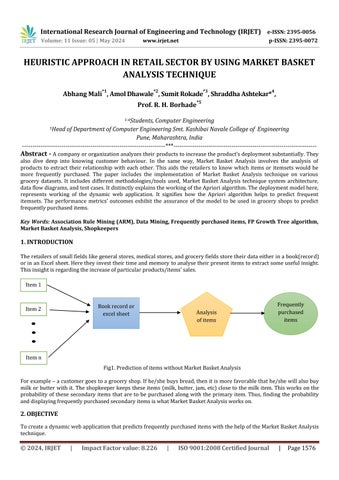
Theretailersofsmallfieldslikegeneralstores,medicalstores,andgroceryfieldsstoretheirdataeitherinabook(record) orinanExcelsheet.Heretheyinvesttheirtimeandmemory toanalysetheirpresentitemstoextractsomeusefulinsight. Thisinsightisregardingtheincreaseofparticularproducts/items’sales.





Forexample–acustomergoestoagroceryshop.Ifhe/shebuysbread,thenitismorefavorablethathe/shewillalsobuy milkorbutterwithit.Theshopkeeperkeepstheseitems (milk,butter,jam,etc)closetothemilkitem.Thisworksonthe probability of these secondary items that are to be purchased along with the primary item. Thus, finding the probability anddisplayingfrequentlypurchasedsecondaryitemsiswhatMarketBasketAnalysisworkson.
TocreateadynamicwebapplicationthatpredictsfrequentlypurchaseditemswiththehelpoftheMarketBasketAnalysis technique.
International Research Journal of Engineering and Technology (IRJET) e-ISSN: 2395-0056
Volume: 11 Issue: 05 | May 2024 www.irjet.net p-ISSN: 2395-0072
References
Description
I The Market Basket Analysis concept is explained at the foundationallevel.
2 Basic working of Apriori and FP Growth algorithm is discussed.
3. Apriori algorithm is explained and collaborative filtering concept is discussed in order to create a recommender system.
4. Describes market share between different brands of sanitarynapkinsinacertainsupermarketchain.
5. Two algorithms namely Apriori and FP Growth are exlusivelyexplained.
6. Terminologies and working of the Apriori algorithm are clearlydiscussed.
7. An exclusive correlation is developed between data, informationsupport,andconfidence.
8. MBA technique uses innovative technologies to help retailers maintain their customer retention and satisfaction.
9. New market basket analysis technique i.e., Logical Rule Mining(LRM)isexplainedhere.
10. Anewmethodknownartificialneuralnetworktechnique isimplementedinplaceofApriori
GapFound
Absenceofbriefexplanationoftheconcept.
Absenceofotheralgorithms
Drawbacks of Apriori algorithm are not discussed.
Lackofusageatlargescale
Applications of these algorithms are discussed.
The drawbacks of Apriori algorithm are not discussed.
Absenceofimplementationofthisconceptat largescale.
Since the Apriori algorithm has some drawbacks, it prevents the technique from beingfullyacceptable.
Since it is not in use at large, requires more awareness.
It has more complexity as compared to Apriorialgorithm.
11. One of the applications of Market Basket analysis i.e., ImageBasedProductRecommendationisdiscussedhere. Facesoverfittingissue.
12. Market Basket Analysis is done on water resources in ordertopredictfrequentlyoccurringissues.
13. MarketBasketAnalysistechniqueisusedisinhealthcare. the technique is used to find frequently occurring diseases.
14. Market Basket Analysis concept in sports field is thoroughlydiscussedhere.
15. Data mining and Market Basket Analysis are used to recognisepatternsandthenpredicttheoutcomeinorder toincreasesalesofpaperindustry.
Itisatime-consumingprocess.
Since,Apriorialgorithmisusedhere,itleads tosomedrawbacks.
Algorithm used is not good enough for large datasets.
Need of an efficient algorithm for implementationlikeFPGrowthTree
ThepaperincludesbasicintroductionofMarketBasketAnalysistechnique.Theyalsoincludebasicterminologiesofthe technique,needofthetechnique.Atlast,applicationsofMarketBasketAnalysisarediscussed.Theseinclude-
MarketBasketAnalysisinImageBasedProductRecommendation
MarketBasketAnalysisinwaterresources.
MarketBasketAnalysisinhealthcare
MarketBasketAnalysisinsportsfield.
International Research Journal of Engineering and Technology (IRJET) e-ISSN: 2395-0056
Volume: 11 Issue: 05 | May 2024 www.irjet.net p-ISSN: 2395-0072
MarketBasketAnalysisisamethodthathelpsretailers/organizationsincreaseproductsales/deployment.Itperformstwo importantfunctionswhichareasfollows-
1.Findsthefrequentitemsfromthegiventransactions
2.Findrelationshipsamongvariousfrequentlyoccurringitems.
The Market Basket Analysis is based on one important concept called Association Rule Mining (ARM). The ARM is an unsupervisedtechnique.Inotherwords,unlabelleddataisprovidedasinputtothemodelandthenthemodellearnsfrom this data to find the required useful insights. The association rule mining technique finds the hidden relationship among theproducts/items.






4.1 Terminologies of Association Rule Mining(ARM) –
1.Support
Itdeterminesthenumberofoccurrencesofaniteminoveralltransactions.

2.Confidence
3.Lift
ItdeterminestheprobabilityofpurchasingbreadalongwithMilk.


It determines the probability of purchasing the primary item along with its related item. Consider two items Milk and Bread.HereAistheprimaryitemwhichisrelatedtoitemB.
International Research Journal of Engineering and Technology (IRJET) e-ISSN: 2395-0056
Volume: 11 Issue: 05 | May 2024 www.irjet.net p-ISSN: 2395-0072
TheApriorialgorithmisastraightforwardprocess.Thismeansitiseasytounderstandtheworkingofthisalgorithm.But theApriorialgorithmhassomedrawbacks–
1.Cannotortakesaconsiderableamountoftimetoprocesslargetransactions.
2.Facescomputationalcomplexityproblemsinhandlinglargedatasets.
3.Slowprocess
FP(FrequentPattern)GrowthalgorithmisusedinthisprojecttoimplementtheMarketBasketAnalysistechnique.TheFP GrowthTreealgorithmovercomesallthedrawbacksoftheApriorialgorithm.ThetimecomplexityofFPgrowthalgorithm isO(n).Thisdepictsthatithaslineartimecomplexity.IncontrasttoApriorialgorithm,FPgrowthalgorithmworksinthe followingsteps:-





Step1->Calculatethesupportcountsofallitemspresentinthegiventransactions.
Step2->Itcreatesatablethatstoresthesupportcountofthesefrequentitemsinascendingorder.
Step3->ASeparateattribute/columniscreatedfortheconditionalpatternbase.
Step4->Withthehelpofconditionalpatternbasedata,afrequentpatterntreeisgenerated.
Step5->Thusthistreewillrepresentthefrequentlypurchaseditems.
6. WORKING
Infig4,therearemultiplecustomersinoneshopkeeper.Aloginsystemisprovidedforeachandeveryshopkeeper sothat theycanaccomplishtheirdata.Alldataarestoredinsidethedatabasesothereisnoneedpen andpaper.Itdecreasesthe timebetweenitemsstoredintheshopandtheshopkeeper.
International Research Journal of Engineering and Technology (IRJET) e-ISSN: 2395-0056
Volume: 11 Issue: 05 | May 2024 www.irjet.net












Database














Thedatabaseprovidesthefacilityofsaving,deleting,updating,andreadingtheitemsfromdifferentcustomers.Italsohelps toorganizetheitemsintheshopwhichhelpstoincreasethesalesofshopkeepers.
2.PeriodicCustomization
Periodic customization is defined as a period between some months (one to four) in which the web application is again monitoredandcustomized.
3.FormulationofData
Formulation means a collection of data that can be achieved by the information of the customer purchased from the shopkeeper. Datacontains theinformationofthecustomeralong withitems purchasedby him orherand alsoitcontains theinformationthatisfrequentlypurchased.
4.AssociationRules:
This concept helps to generate the frequent items purchased by the customer. Information Gain gives the purity of an attribute that helps to understand the item's pattern. Entropy helps to understand the randomness or impurities of an attribute.
Volume: 11 Issue: 05 | May 2024 www.irjet.net p-ISSN: 2395-0072
Customerchurnmeansitisacollectionofitemsthatarenotpurchasedbycustomersoncertainperiodoftime.Ithelpsto removeunnecessaryitemsfromtheshopandrequireditemsarestoredintheshop.Customerchurncanhelptounderstand thecustomeranditspurchasingpattern.
6.AlertSystem
It helps the shopkeeper understand how much stock remaining in his/her shop and understand. The user requirement accordingtocustomertocustomer.Alertsystemprovidesthefacilitythatwhichitemsarestoredintheshopandwhichitem removesfromtheshop.
7.Output:
Output report contains the items/itemsets that are frequently purchased by the customer in addition. The itemsets are processedbyusingtheFPGrowthTreealgorithm.Understandingthecustomerbetterhelpscustomerbehavior.
Firstlyshopkeeperneedstosignupbycreatingtheusernameandpassword.Thesecredentialsarestoredinthedatabase.If shopkeeperslogin with authorizedcredentialsthen theycanaccessto theservicesavailable tothem.Ithelpstoavoid the attackfromdifferentunauthorizeduserinoursystem.Aftersuccessfulloginintothesystem,appwillprovidetheservicesto theendusersothattheycanusethisservicesandaccomplishedtheresultofit.
Shopkeeper


Loginwiththerequired credentials
Monitorallactivities


Sevices

Periodic customization


Allappactivitiesaremonitoredby theadmin.Admin providesthesupportto theappsothattheycanhandlethe query of shopkeeper. Adminalsohelps in periodiccustomization oftheapp. In every date admin available for solving query of the shopkeeperandprovidesupporttoit.
Inthefig6,datagenerationtakesplacesbyshopkeeperandcustomerpurchasingitems.Credentialscontaintheshopkeeper's name, password,username,email address and mobile number. After successful creation of theaccount ofshopkeeper the appneedstofillthedataaboutproductpresentinthestore.Thisdataisstoredinsidethedatabaseusingdifferentmethods likeMySQLorPLSQL.Thenfromthedatabase,data issent foranalysis and operation block.These data is observed by the adminandmonitoredbytheshopkeeper.
International Research Journal of Engineering and Technology (IRJET) e-ISSN: 2395-0056
Volume: 11 Issue: 05 | May 2024 www.irjet.net p-ISSN: 2395-0072
Observethestoreddata


Createaccount

Enter his/her credentials

Shopkeeper


DataStorage

Sendsdatafor analysisand operations block


AdditionalStorage


Dataanalysisand operations
Monitorsallactivities performedbythemodelin theanalysisphase

Sendsdatafor analysisand operations block
Thedata-relatedqueriesanddefectsaresenttotheadminsothattheycanabletofixedit.Additional storagecontainsthe informationofthephonenumberallcustomersIDsetc.Inanalysisphasedataisorganizedandmonitoringareimportantthis canbedonebyadmin.Finalreportofthedataissentbacktotheshopkeepersothattheycananalysethereporttheperform thecertainactiononit.Actionperformanceisdependuponworkingcapacityofthedata.
Fig7,thesystemhastwoactorsoneisshopkeeperandanotheris admin. These two actorsare responsiblefor datagenerationandperformingorusingtheapplication.Tousetheapplicationfirstlyforshopkeeperandadmin need to logininto thesystembyusingcredentials thatis username password email address there are multiple shopkeeperbutonlyoneadminthesystem.
Aftersuccessfullyloginintothesystemshopkeepercanperformdifferentoperationslikeadd,delete,updatethe customerinformationlikesitemspurchasedbythecustomer.Togeneratedatashopkeeperisresponsible.
International Research Journal of Engineering and Technology (IRJET) e-ISSN: 2395-0056
Volume: 11 Issue: 05 | May 2024 www.irjet.net p-ISSN: 2395-0072
Register

Login

Shopkeeper



View recommendati

Add–Delete items
Manage users Monitor useraction and feedback

Admin


Provide feedback
Manage Alert

View transaction data


Input transaction data
ShopkeepercanviewtherecommendationprovidedbytheAppsandalongwithperformthe certainoperationonthedata. IthavethefacilitytoprovidethefeedbackabouttheworkingofappsaccordingtofeedbackprovidedbytheshopkeeperThe useractionperformbyshopkeeperthatmanageandcontrolbyadmin.
8.1 Class Diagram
Class Diagram gives the relationship between the different actors in the system. In addition it provide the facility of the understanding the attributes and method of the specific actors or class. It provides the facility of the abstraction and encapsulationso that the data is secureand robust. It cannotaccessed by unauthorized person. Fig7.hasdifferentclasses likecustomer,order,shopkeeper,adminanditemetc.
Customer

+id:Int
+name:String
+readItem(int):String
+returnItem():Boolean
+feedback():void
+purchaseItem():String
Order

+id:Int
+Items:List<Items>
+getId():int
+setId(intid):void
+getItem():List<items>
Shopkeeper

+id:Int
+name:String
+address:String
+contactNo:Long
+addItem():void
+deleteItem(params):void
+updateItem(params):void
International Research Journal of Engineering and Technology (IRJET) e-ISSN: 2395-0056
Volume: 11 Issue: 05 | May 2024 www.irjet.net p-ISSN: 2395-0072
Item

+id:Int
+price:int
+description:String
+readItemDescription(int):String
+getPrice(id):int
+id:Int
+name:String
Admin

+contactNo:Long
+showShop(id):Shopkeeper
+generateAlert():String
+generateReport():List<String>
+seeReview():String
Customerisresponsibleforthegenerationofthedata.Customerhashis/herid and name as an attribute.He/She can able to read the item in the store. If any item is not the favouriteofanycustomerheorshecanreturntheitembacktothe shopkeeper.Theanotherclassisorderitcontainbasicallytwoattributeidanditems.
Theitemsofthetypelistcontainlistofitemsthatarepurchasedbythecustomer.He/She can able to read the item in the store. If any item is not the favouriteofanycustomerheorshecanreturntheitembacktotheshopkeeper.Theanother classisorderitcontainbasicallytwoattributeidanditems.Theitemsofthetypelistcontainlistofitemsthatarepurchased by the customer. Order class have the different method like setId and getId which is responsible for setting the id of the orderandgettheorderid.
There is a main class called as shopkeeper that have the attribute id, name, string, address and contact number. This attribute have its own setter and getter method. It have methodlike for adding thethe item have addItem method which takes the order id asa parameter. Another important character is the admin. It is responsible for generatingthefeedback andgeneratingthereportofthesystem.Italsohasid,nameandcontactnumberasaattribute.
Thesequencediagramgivestheflowofthesystemhowexactlyworksandwhichphaseisgoingtobeimplementedinorder to get the desired outcome. It shows the sequence of implementation of the data. In sequence diagram contains the informationofdifferentphaseslikeactors,flowofdata,applicationserver,etc.
Infig8,therearedifferentactorslikeshopkeeperanddifferentcustomer.Customerisresponsibleforgenerationofthedata. Intheshopmultiplecustomerspurchasethedifferenttypesofitems.
Shopkeeper requests for new login credentials. Shopkeeper performs the certain operation on the data like add the transaction data that contain the itemsets that are purchased by different customer. In addition of the analysis of data is donebytheadminthatoperateandgivesthefinalreporttotheapplicationthatisshopkeeper.
International Research Journal of Engineering and Technology (IRJET) e-ISSN: 2395-0056
Volume: 11 Issue: 05 | May 2024 www.irjet.net p-ISSN: 2395-0072
Application Server

Shopkeeper

Requestfor login


FinalReport
Giveaccess
Add Transactions

Sendreport
Analysisofall items

Analysis
DEPLOYMENT MODEL
Allthedataofuserandtherespectiveproducts/itemsisstoredinclouddatabase.ForthisFirebaseplatformisused.Code of storing the data includes Firebase libraries. These are properly imported along with the initialize key of the web application.Ifanychangesarerequiredinthestoringofthedatalikeattributesnamesornumber,thenproperupdationis donehere.
International Research Journal of Engineering and Technology (IRJET) e-ISSN: 2395-0056
Volume: 11 Issue: 05 | May 2024 www.irjet.net p-ISSN: 2395-0072

CreateProjectandaddUser


Build Changes are build
ChangesFixes Monitoring Applicationand infrastructure Deployment Codeisdeployed Commit
Update
Thewebapplicationisfirstdeployedinthestagingenvironmentwhererequiredcustomizationorupdation isperformed. Theresultsarethentakenintoconsiderationandthenthewebapplicationisdeployed.
Fig10representsafrontviewofthewebapplication. Thisincludesthesignupandloginoptionsfortheshopkeeper.The sidebar on the top left contains selection-boxes that include boxes as Storage, Account, Prediction, About, Sample respectively.
International Research Journal of Engineering and Technology (IRJET) e-ISSN: 2395-0056

Fig11representsthestoragepage.Userwhenclicksonthe“Storage”selection-box,thenhe/shewillstoretheirdatahere. The data can be in .csv, .exe, etc formats respectively. The data then will be stored in clouddata store of the Firebase platform.
Volume: 11 Issue: 05 | May 2024 www.irjet.net p-ISSN: 2395-0072 © 2024, IRJET | Impact Factor value: 8.226 | ISO 9001:2008
International Research Journal of Engineering and Technology (IRJET) e-ISSN: 2395-0056
Volume: 11 Issue: 05 | May 2024 www.irjet.net p-ISSN: 2395-0072
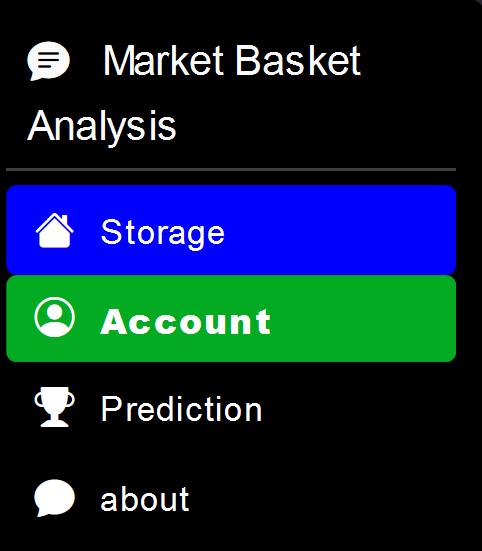
Fig12representsthepredictionpage.Aftersuccessfullystoringthedata,userwillgoontothepredictionpagebyclicking onthe“Prediction”selection-box.
Fig13representsadummydatasetbeingstoredintheFirebaseandthendisplayedonthepredictionpage.
International Research Journal of Engineering and Technology (IRJET) e-ISSN: 2395-0056
Volume: 11 Issue: 05 | May 2024 www.irjet.net p-ISSN: 2395-0072
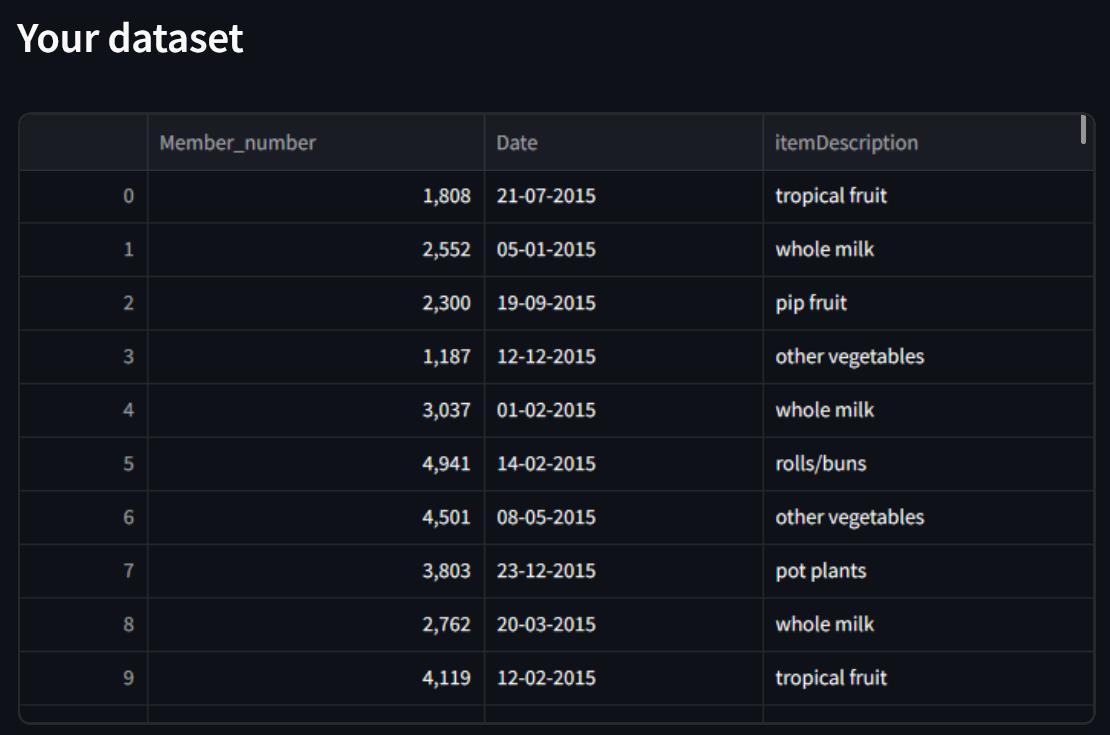
Fig14representsthegraph.Thegraphshowsfrequentlypurchaseditems.Itemnamesaredisplayedbeloweachbarofthe graph.Thesizeofthegraphcanbeincreasedtorepresentmorenumberoffrequentlypurchaseditems.Withthehelpof thisgraph,user(shopkeeper)willeasily.
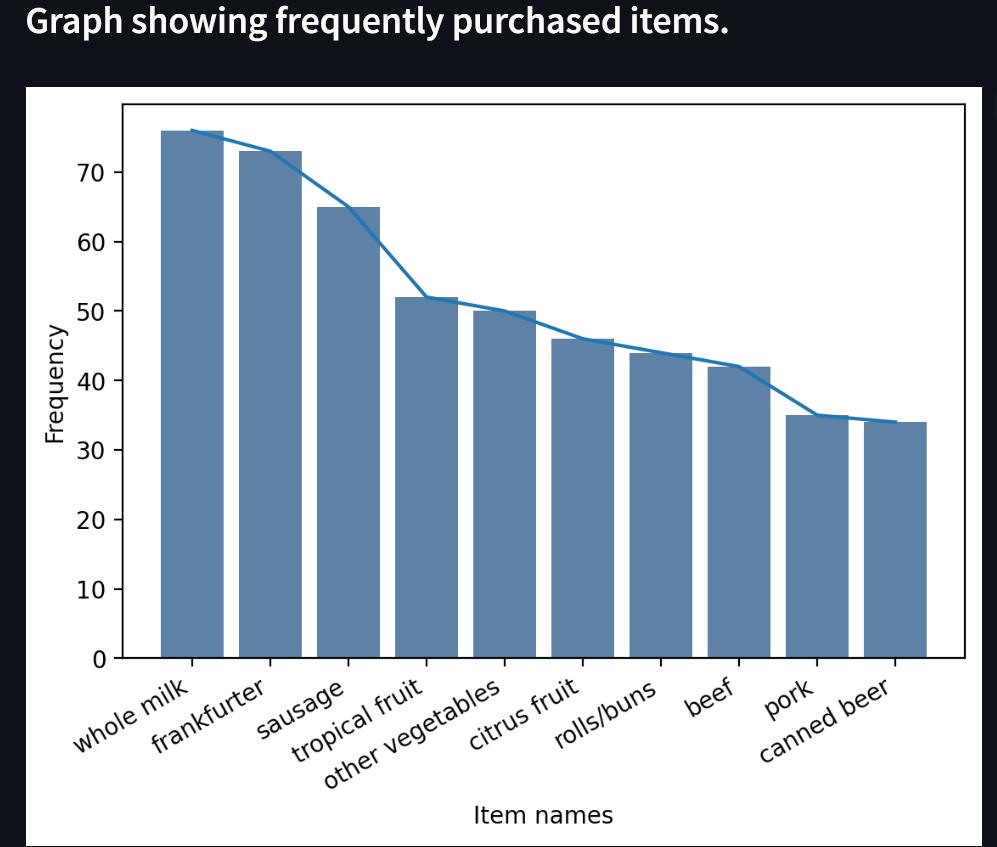
14.Graphshowingfrequentlypurchaseditems
11. CONCLUSION
TheresearchinvolvesdeepanalysisofMarketBasketAnalysisandthedevelopedwebapplication.Cametoknowdifferent reviewsofresearchersontheMarketBasketAnalysistechnique.MarketBasketAnalysis(MBA)isapowerfuldataanalysis method with several significant benefits and drawbacks. Successfully created a dynamic web application called “Market Basket Analysis WebApp” that accepts customers’ data and efficiently predicts frequently purchased items. By analyzing deepintotheconcept,manynewaspectsofthetechniquewerediscovered.AlsocametoknowtheproblemsoftheApriori algorithm that were solved by FP Growth Tree algorithm. When applied correctly and in combination with other data
© 2024, IRJET | Impact Factor value: 8.226 | ISO 9001:2008 Certified Journal | Page1589
International Research Journal of Engineering and Technology (IRJET) e-ISSN: 2395-0056
Volume: 11 Issue: 05 | May 2024 www.irjet.net p-ISSN: 2395-0072
analysis techniques, market basket analysis is a useful technique. Thus, the Market Basket Analysis technique helps to increasethedeploymentrateofproductsatasubstantialrate.
[1] Abhang Mali, Amol Dhawale, Sumit Rokade, Shraddha Ashtekar, Prof. R. H. Borhade, “HEURISTIC APPROACH IN RETAIL SECTOR BY USING MARKET BASKET ANALYSIS TECHNIQUE”, International Research Journal of ModernizationinEngineeringTechnologyandScience,Vol5,No.11,1615-1619.2023.
[2] Vippala Nagendra Reddy, Panta Sai Sathvik Reddy, “Market Basket Analysis Using Machine Learning Algorithms”,2021.
[3] YükselAkayÜnvan,“Marketbasketanalysiswithassociationrules”,2020.
[4] ShishKumarDubey,SonuMittal,SeemaChattani,VinodKumarShukla,“ComparativeAnalysisofMarket Basket AnalysisthroughDataMiningTechniques”,2021.
[5] Jiangping Chen, Xiaoxian Yang, Lihua Chen, Li Dong, Yuanyan Fu, “An Analysis of Shopping Basket in a Supermarket”,2010.
[6] MalihaHossain,AHMSarowarSattar,Mahit KumarPaul,“MarketBasketAnalysisUsingAprioriandFPGrowth Algorithm”,2019.
[7] WarniaNengsih,“AComparativeStudyonMarketBasketAnalysisandAprioriAssociationTechnique”,2015.
[8] Djoni Haryadi Setiabudi, Gregorius Satia Budhi, Mining Market Basket Analysis’ Using Hybrid-Dimension AssociationRules,CaseStudyin MinimarketX”,2011.
[9] AhmadM.A.Zamila,AhmadAlAdwanb,T.G.Vasista,“EnhancingCustomerLoyaltywithMarketBasket Analysis UsingInnovativeMethods:“APythonImplementationApproach”,2020.
[10] DamlaOguz,FatihSoygazi,“Aninterestingnessmeasureforknowledgebases”,2023.
[11] Anshul Bhargav, Robin Prakash Mathur, Munish Bhargav, “Market Basket Analysis using Artificial Neural Network”,2014.
[12] Premanand Ghadekar, Anay Dombe, “Image-Based Product Recommendations Using Market Basket Analysis”, 2019.
[13] Tiyasha Tiyasha,SurajKumarBhagat,Firaol Fituma,Tran Minh Tung,Shamsuddin Shahid,And ZaherMundher Yaseen, “Dual Water Choices: The Assessment of the Influential Factors on Water Sources Choices Using UnsupervisedMachineLearningMarketBasketAnalysis”,2021.
[14] Abishek B. Rao, Jammula Surya Kiran, Poornalatha G, “Application of market–basket analysis on healthcare”, 2021.
[15] WanFaezahAbbas,NorDianaAhmad,NurlinaBintiZaini,“DiscoveringPurchasingPatternofSportsItemsUsing MarketBasketAnalysis”,201
[16] M.J.ZakiandW.J.Meira,DataMiningandMachineLearningFundamentalConceptsandAlgorithms,vol.53,no.9. 2020.