
International Research Journal of Engineering and Technology (IRJET) e-ISSN: 2395-0056
Volume: 11 Issue: 05 | May 2024 www.irjet.net p-ISSN: 2395-0072
International Research Journal of Engineering and Technology (IRJET) e-ISSN: 2395-0056
Volume: 11 Issue: 05 | May 2024 www.irjet.net p-ISSN: 2395-0072
1Sajjan Kumar, Dr. Shankar Kumar2 , Dr. Jitendra Raghuwanshi3
1M.Tech Scholar Department of Mechanical Engineering, LNCT Bhopal
2Professor, Department of Mechanical Engineering, LNCT Bhopal
3AssociateProfessor, Department of Mechanical Engineering, LNCT Bhopal
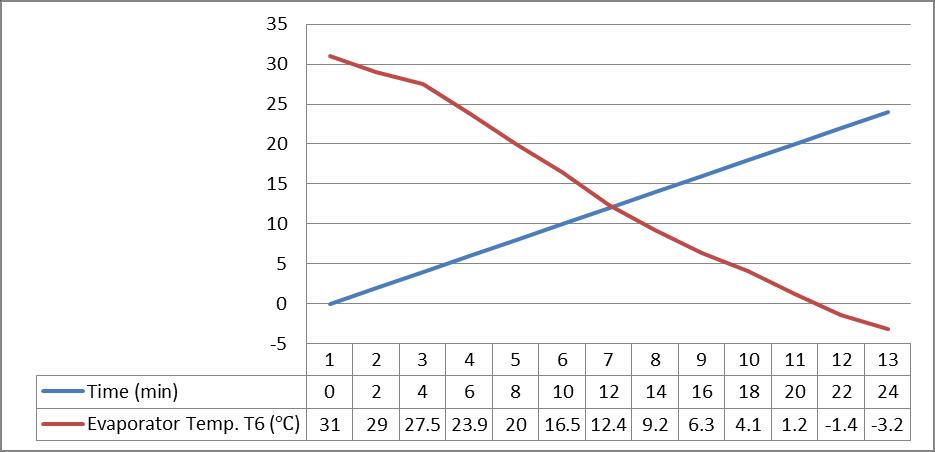
Abstract - Refrigeration systems are essential for a wide range of applications, including industrial, commercial, and residential cooling needs. However, concerns about the environmental impact of traditional refrigerants have prompted research into alternative solutions with lower global warming potential (GWP). Propane (R290) has emerged as a promising refrigerant due to its favorable thermodynamic properties, but its flammability poses safety challenges.Thisthesisfocusesonstudyingtheperformanceof R290 and explores the potential of blending it with R600a to reduceflammabilityrisksinrefrigerationsystems.Whenusing R290 alone, it takes approximately 30 minutes for the evaporatortemperaturetoreach2.9degrees.However,when R290 is blended with anequalratio of R600a, the evaporator temperature can reach -3.2 degrees within 24 minutes at a surrounding temperature. The results of this research contribute to the understanding of the performance and flammability characteristics of R290 blended with R600a in refrigeration systems. The findings provide valuable insights intothe feasibilityofutilizing suchblendsasenvironmentally friendly alternatives to conventional refrigerants, while ensuring safety measures are implemented effectively. Practical recommendations are presented for reducing flammabilityrisksassociatedwithR290blends,enablingtheir wider adoption in diverse refrigeration applications.
Key Words: R290, propane, R600a, refrigeration system, performance, flammability, safety, blend, environmental impact.
AccordingtodatafromtheChinaStatisticalYearbook(20002010), China is currently the world's largest producer; In 2010,airconditioningproductuseinhomesexceeded100. Millionpieces.Hydrochlorofluorocarbons(HCFC)suchasR22 and hydrofluorocarbons (HFC) suchas R-410A are the mainrefrigerantsusedindomesticairconditioninginChina. ChinaremainsthelargestconsumerofHCFCs,accountingfor approximately 70% of global consumption in 2010 and approximately50%in2007.Therapidphase-outofHCFCsis creatinghugecompetitionforChina.HFCandhydrocarbon (HC)refrigerantsaretworefrigerantsavailable.Another[5]. However,themostcommonrefrigerantintheworld,HFCR410A,hasahighglobalwarmingpotential(GWP)andisin danger of being phased out in the medium to long term.
Therefore,companiesneedtoconsiderbotheconomicissues and GWP standards when replacing HCFCs in air conditioning systems [1]. HC refrigerants have the advantagesofHCFCsandHFCs,suchaszeroozonedepletion potential(ODP)andzeroglobalwarmingpotential(global warming).Theyalsohavehighperformance,lowcost,good miscibilitywithmineraloil(noneedforsyntheticoil),lower compressoroutlettemperatureandrefrigerantinelectronic equipment.AlthoughR-290isaviablealternativetoR-22,its flammabilitymakesitdifficulttoaccept.Thepurposeofthis studyistoevaluatethehazardsassociatedwiththeuseofR290inairconditioning.Table1listssomecharacteristicdata forR-22andotherrefrigerants[2].
Table1:SelectedCharacteristicsofSeveralRefrigerants.
Refrigerantsusedinairconditioningandrefrigeration,such as (HCFCs) and hydrofluorocarbons (HFCs), are generally nontoxic and nontoxic. Although HFCs do not harm the ozonelayer,theyareclassifiedasgreenhousegases(GHG) undertheKyotoProtocolduetotheirhighglobalwarming potential (GWP). Although HCFCs also emit greenhouse gases, they do not fall under the Kyoto Protocol and are plannedtobephasedoutundertheMontrealProtocol.
International Research Journal of Engineering and Technology (IRJET) e-ISSN: 2395-0056
Volume: 11 Issue: 05 | May 2024 www.irjet.net p-ISSN: 2395-0072
Variousstudieshavebeenconductedtoexplorealternatives to environmentally harmful refrigerants like R22, which contribute to ozone depletion and global warming. These studiesinvestigatetheperformanceofalternativessuchas R290 (propane), hydrocarbon mixtures, and other lowimpactrefrigerants.Researchfindingshighlightthepotential of these alternatives in terms of efficiency, energy consumption,andenvironmentalimpact.Forinstance,R290 shows promise as a replacement for R22, with studies demonstrating improved efficiency and reduced environmental impact. Hydrocarbon mixtures, including combinationsofR290andR600a,havealsoshownpositive results in terms of energy consumption and performance. Additionally, experiments involving various refrigerant mixtureshaveindicatedpotentialimprovementsincooling systems'efficiencyandenvironmentalsustainability.Overall, thesestudiesunderscoretheimportanceoftransitioningto environmentallyfriendlyrefrigerantstomitigatetheadverse effects of traditional refrigerants on the ozone layer and climatechangewhilemaintainingefficientcoolingsystems.
Theexistingbodyofliteraturehighlightsthepotentialrisks associatedwiththeuseofflammablerefrigerants.Onesuch riskisthepossibilityofflammableconcentrationsforming due to refrigerant leakage, which can lead to ignition and subsequentfires.Additionally,theimpactofexternalfireson systemsutilizingflammablerefrigerantsisanotherconcern. To address these hazards specifically with comparative performance associated with R-290 (propane) as a refrigerantinrefrigerationsystems,severalsub-studieshave beenconducted,eachfocusingonaspecificvulnerabilitythat hasbeenidentified.OnesignificantdrawbackofusingR-290 as a refrigerant in refrigeration systems is its inherent flammability. Despite its advantageous properties such as high efficiency and low environmental impact, the flammabilityofR-290posessafetyconcernsthatneedtobe carefully addressed. It is crucial to implement additional precautionstopreventleaksandensurethesafehandlingof therefrigerant.Inadditiontothesafetyconcernsassociated with its flammability, another limitation of R290 as a refrigerant is that it requires specialized equipment and expertise for safe handling. Due to its flammable nature, specifictrainingandspecializedequipmentarenecessaryto ensureproperproceduresarefollowedduringinstallation, maintenance,andrepairs.Thisrequirementforspecialized resourcesaddscomplexityandcosttotheuseofR290asa refrigerant. Despite these limitations, R290 still offers several advantages, such as its high efficiency and low environmentalimpact.However,carefulconsiderationmust begiventothenecessaryequipment,training,andsystem design when opting to use R290 as a refrigerant. By addressingtheselimitationsandimplementingappropriate measures, the potential benefits of R290 can be realized
whileensuringthesafeandefficientoperationofthecooling system.
To investigate the feasibility of R290 as a refrigerant, extensive literature research was conducted to gather relevantinformationandopinions.Theresultsofthisstudy showedthatR290,commonlyknownaspropane,ishighly flammable,raisingconcernsaboutitssafeuseinrefrigeration withoutproperprecautions.
However, subsequent studies that looked deeper into the issuefoundsolutionstoreducetheriskofharmassociated withR290.StudieshaveshownthatmixingR290withother chemicalscan reduce the flammability of refrigerants. The additives act as diluents, effectively reducing the propane concentrationinthecoolingsystem.Asaresult,theriskof fireandassociatedsafetyisreduced,makingtheuseofR290 as a refrigerant safer and more efficient. By reducing the flammability of the refrigerant mixture, R290 has a wider range of applications while still meeting stringent safety standards. The discovery paves the way for R290 as an alternative to refrigerants known to be harmful to the environment. By using R290 in combination with other reagentsitispossibletoachieveagoodeffectonthestability oftheprocess.
However, it is important to realize that more research is needed to fully understand the benefits and risks of using R290 in the environment. Cooling system. These studies should focus on evaluating the quality, effectiveness, and long-termeffectsofR290inspecificcombinations.Itisalso important to develop strategies and guidelines for the securityandstabilityofthistechnology.
Byresearchingandexpandingourknowledgeinthisarea,we canunlockthefullpotentialofR290asarefrigerant,whilst ensuring maximum safety and liability in a round-robin manner.Tocreateahealthierandsafersysteminthefuture, scientists, industry experts and regulators must work togethertopavethewayforthewidespreaduseofR290in refrigeration systems. Here is a table showing the refrigerants you mentioned, along with their RF number (kJ/g)andASHRAEflammabilitygroup:
Table2.ASHRAEFlammabilityCategories
International Research Journal of Engineering and Technology (IRJET) e-ISSN: 2395-0056
Volume: 11 Issue: 05 | May 2024 www.irjet.net p-ISSN: 2395-0072
It is worth noting that the specific options and details of additiveswillvarydependingontheapplication,regulations and controls. Manufacturers and industry experts often conduct numerous tests and evaluations to determine the bestadditivesforpropanecoolingsystems.
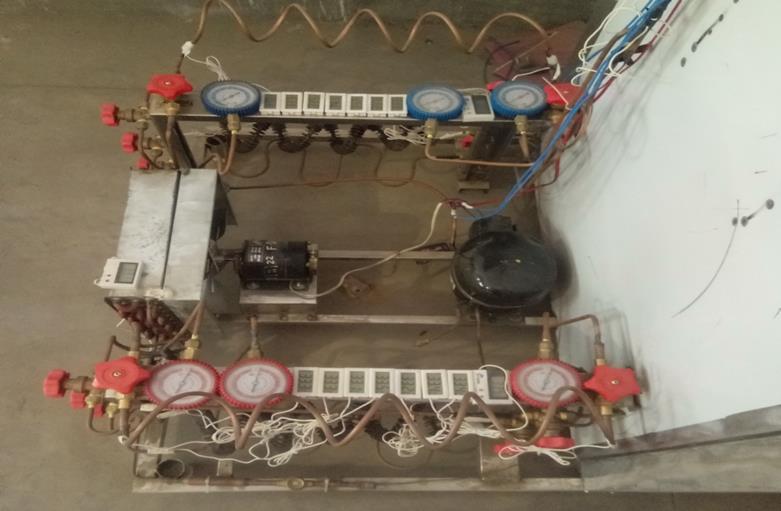
OnewaytoreducetheflameofR290(propane)istoadda smallamounttoanequalpercentageofanotherrefrigerant calledR600a(isobutene).R600aisalsoahydrocarbonbut has a higher molecular weight and different flammability thanR290.WhenR600aisaddedtoR290,ithelpstoincrease theheatcapacityandreducetheoverallflammabilityofthe mixture.TheadditionofR600aimprovesthesafetyaspects while maintaining good refrigeration properties. In this study, the vapor compression refrigeration system was analyzedwithemphasisontheuseofR290anditsmixture with R600a. The aim is to evaluate the efficiency of the refrigerator and draw conclusions based on the results obtained.
ExperimentalresultsshowthatthecombinationofR290and R600a has a very good effect on system performance. Performanceparameterssuchascoolingcapacity,coefficient ofperformance(COP)andenergyconsumptionofthesystem wereevaluatedandcomparedwithothercoolingproducts. More importantly, the R290 and R600a blends deliver excellent performance that exceeds expectations. Cooling systems using this mixture show better performance and efficiencyinmanagingtherequiredcooling.
ThesefindingsdemonstratethepotentialforR290andR600a blends to be good choices for air conditioning systems. Further research and research is needed to determine the suitability of the mixture on a larger scale and to address safetyconcernsregardingitsuse.
International Research Journal of Engineering and Technology (IRJET) e-ISSN: 2395-0056
Volume: 11 Issue: 05 | May 2024 www.irjet.net p-ISSN: 2395-0072
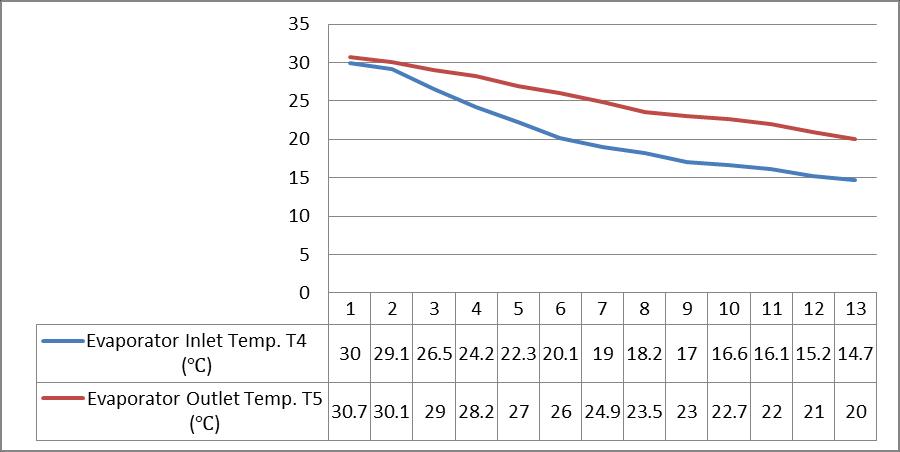
Observation-
1.Evaporatoroverheated.T6(α)graduallydecreasedfrom 31αatbaselineto-3.2αat24minutes.
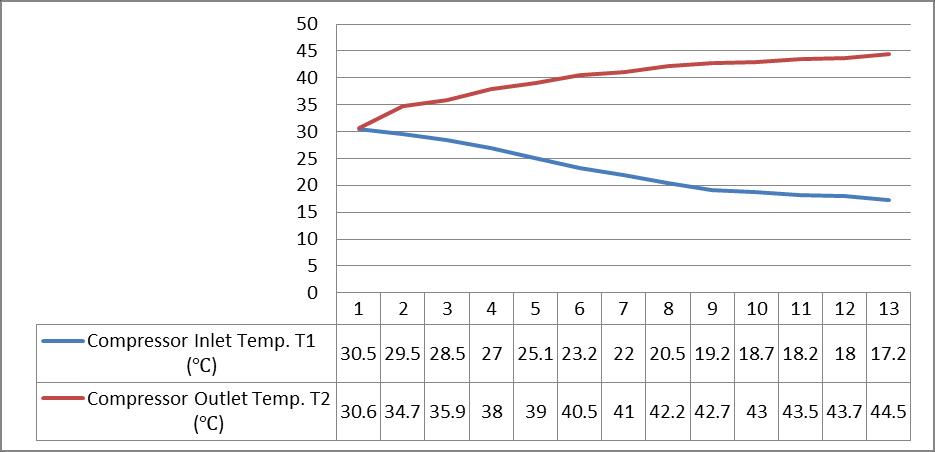
2.Compressorinlettemperaturevariesbetween30.5-17.217.2°duringtheT1(-)period.
3. The compressor outlet temperature T2 (α) initially increasesandstabilizesatapproximately44.5°to44.7°over thenext10minutes.
4.CondenseroutlettemperatureT3(a)continuedfrom30.2a atthebeginningto35.2aat24minutes.
5.EvaporatorinlettemperatureT4(α)showeda decrease rangingfrom30αto14.7α.6.Evaporatoroutlettemperature T5()showsa decreasingpatternstartingat30.7minutes andreaching20minutesat24minutes
REFERENCES
[1]. Ma, Yitai, Wang, Wei, 2010. Substitution and post ponabletechnologyofrefrigerants.J.Refrigeration5(31), 11e17. National Bureau of Statistics of China, 2000e2010. China Statistical Yearbook. China Statistics Press, Beijing, China
[2].Corbera´n,J.M.,etal.,2008.Reviewofstandardsforthe use of hydrocarbon refrigerants in A/C, heat pump and refrigerationequipment.Int.J.Refrigeration31,748e756.
[3]. R. S. Powade, A. A.Rane et al, 2018, Performance Investigation of Refrigerants R290 and R134a as an Alternative to R22, International Journal for Research in Applied Science & Engineering Technology (IJRASET), Volume6IssueIV.
[4].N.Austin,“DifferentRefrigeraantsandtheirimpacton Vapour Compression Refrigeration System”. Journal of
AdvancesinMechanicalEngineeringandSciences,Vol2(3) 2016,pp.29-39.
[5]. Wang Zhang a,b,*, Zhao Yang et al, Research on the flammabilityhazardsofanairconditionerusingrefrigerant R-290, International Journal of Refrigeration,36(2013), 1483-1494.
[[6]. Takizawa, K., et al., 2005. Burning velocity measurementoffluorinatedcompoundsbyspherical-vessel method.Combust.Flame141,298e307.
[7].Wu,Yingwen,etal.,2012.StudyofR161refrigerantfor residential air-conditioning applications. In: International Refrigeration and Air Conditioning Conference at Purdue, Purdue,USA.
[8]. Moo-Yeon Lee, “The performance of a small capacity directly cooled refrigerator by using the mixture of R600a/R290 mass fraction of 45:55 as an alternative to R134a”,InternationalJournalofRefrigeration–June2008.
[9]NeerajaUpodhya,“TostudytheeffectofSub-coolingand Diffuser on the Coefficient of Performance of Vapor CompressionRefrigerationSystem”,InternationalJournalof ResearchinAeronauticalandMechanicalEngineeringISSN: 2321-3051June2014.
[10].R.T.Saudagar,Dr.U.S.Wankhede,“Vapourcompression refrigeration system with diffuser at condenser inlet”, International Journal of Engineering Research and Development ISSN: 2278-0673, Volume 1, Issue 11 (July 2012),PP.67-70.
[11].MYari,andMSirousazar,“Performanceanalysisofthe ejector-vapour compression refrigeration cycle”, Part A: JournalofPowerandEnergy,Vol.221,No.8,December2007, pp.1089-1098.
[12]. Selvaraju, and A. Mani, “Analysis of an ejector with environment friendly refrigerants, Applied Thermal Engineering”,2004,pp.1-12.
[13].JianlinYu,HuaZhaoandYanzhongLi,“Applicationof an ejector in auto cascade refrigeration cycle for the performance improvement”, International journal of refrigeration,vol.31,2008,pp.279-286.
[14].Tingting,Wan,etal.,2011.Environmentalbenefitsfor phase-outHCFC-22intheresidentialair-conditionersector inChina.Adv.Clim.ChangeRes.2(2),86e92.
[15]. PDCEN/TR14739, 2004.Scheme for Carrying Out a Risk Assessment for Flammable Refrigerants in Case of HouseholdRefrigeratorsandFreezers.BSI,London,UK.