
International Research Journal of Engineering and Technology (IRJET) e-ISSN:2395-0056
Volume: 11 Issue: 05 | May 2024 www.irjet.net p-ISSN:2395-0072
International Research Journal of Engineering and Technology (IRJET) e-ISSN:2395-0056
Volume: 11 Issue: 05 | May 2024 www.irjet.net p-ISSN:2395-0072
1SIDRAL ROJA, 2N CHANDANA, 3A AKHILA, 4ASMA BEGUM
1,2,3B.E., Department of ADCE, SCETW, OU Hyderabad, Telangana, India
4Assistant Professor, ADCE, SCETW, OU Hyderabad, Telangana, India
Abstract: Using automated image generation from textual descriptions, this work introduces a novel way to text-toimagesynthesis.Our approachleverages sophisticatedneural networks, such as Generative Adversarial Networks (GAN’s), to overcome multi-modal learning issues. It does this by improving visual realism, handling many scenes, guaranteeing semantic consistency, and facilitating style transfer. The architecture combines a sophisticated text encoder, flexible generator network, larger datasets , conditional discriminator, and painstaking detail-oriented design. Its potential significance is highlighted by rigorous evaluationmeasuresandavarietyofapplications,whichpave the way for further improvements and signal a paradigm changeinthecapabilitiesoftext-to-imagesynthesis.
Keywords: Text-to-image synthesis, Generator network, Enhanced text encoder, Conditional discriminator, Generative models.
Text-to-image synthesis is an exciting and rapidly evolving field within the realm of artificial intelligence. Its primary objective is to develop automated models that possess the ability to understand and interpret detailed textual descriptions, subsequently generating corresponding visual representations. This task is inherently intricate due to the necessity of seamlessly merging the realms of natural language processing and computer vision, thereby demandingasophisticatedlevelofcreativityandingenuity.
Despite its immense potential, text-to-image synthesis remains relatively underexplored compared to other wellestablisheddomainswithinmachinelearning,suchasobject recognition. The complexity of this field stems from its inherentrequirementtointegrateandreconcilemultimodal information, effectively combining textual cues with visual inputs.
GenerativeAdversarialNetworks(GANs)haveemergedasa powerful and versatile architecture for text-to-image synthesis. GANs consist of two primary components: a generator network tasked with producing images, and a
discriminator network responsible for assessing the authenticityofthesegeneratedimages.
One of the significant advancements in text-to-image synthesishasbeentheintroductionofconditionalvariations within GANs, known as conditional GANs (cGANs). These models have the capability to incorporate additional inputs, suchasclasslabelsortextualdescriptions,enablingthemto generate images that align more closely with the semantics oftheprovidedtextualinput.
Despite these advancements, several challenges persist within the realm of cGAN-based approaches. These challenges include the imperative of maintaining semantic coherence between textual descriptions and generated images, preserving fine detailsduring thesynthesisprocess, and effectively handling diverse object classes and scenes withinasingleimage.
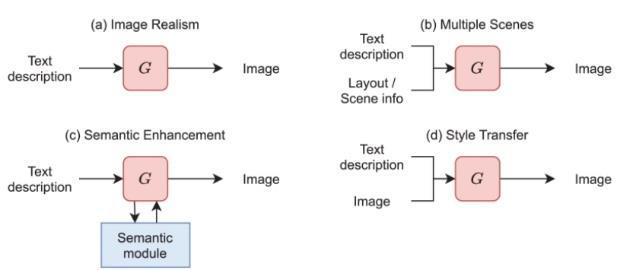
Insummary,whilesignificantprogresshasbeenmadeinthe field of text-to-image synthesis, there still exist numerous opportunities for further research and development aimed at addressing these challenges and Unleashing the complete capabilitiesofthisrevolutionarytechnology.
[1] Scaling Up GANs for Text-to-Image Synthesis (2023) by MingukKangandcrewpresentsGigaGAN,anadaptabletextto-image synthesis model based on StyleGAN. The results show competitiveness, though it falls short of achieving photorealism compared to some counterparts. Summary: This work focuses on scaling GANs and demonstrates the
International Research Journal of Engineering and Technology (IRJET) e-ISSN:2395-0056
Volume: 11 Issue: 05 | May 2024 www.irjet.net p-ISSN:2395-0072
ability to generate high-resolution images but highlights limitationsinachievingphotorealisticquality.
[2] TextControlGAN: Image Synthesis with Controllable GenerativeAdversarialNetworks(2023)byHyeeunKuand Minhyeok Lee leverages the ControlGAN framework to enhance synthesis on the Caltech-UCSD Birds-200 dataset. Summary: This method introduces control mechanisms to improve synthesis quality, resulting in improved Inception ScoreandreducedFID.
[3] CapGAN: Text-to-Image Synthesis Using Capsule GANs (2023)byMaryamOmarandcrew employs CapGAN,based on capsule networks. Summary: CapGAN shows superior performance on complex datasets like Oxford-102 Flowers, Caltech-UCSD Birds 200, and ImageNet Dogs by leveraging capsulenetworksforbetterfeaturerepresentation.
[4] StyleGAN-T: Unlocking the Power of GANs for Fast Large-Scale Text-to-Image Synthesis (2023) by Axel Sauer andothersintroducesStyleGAN-T,whichallowsforsmooth interpolationsandvariousstyleswithoutadditionaltraining, specifically using the MSCOCO dataset. Summary: This model is noted for its efficiency and flexibility in style transfer,offeringsignificantimprovementsintrainingspeed anddiversity.
[5] DF-GAN: A Simple and Effective Baseline for Text-toImage Synthesis (2022) by Ming Tao and associates proposes DF-GAN, which outperforms newer rivals on the CUBbirdandCOCOdatasets.Summary:DF-GANestablishes a strong baseline with simplified architecture, achieving highperformanceonbenchmarkdatasets.
[6] Vector Quantized Diffusion Model for Text-to-Image Synthesis (2022) by Shuyang Gu and others presents VQDiffusion, a non-autoregressive text-to-image model that excelsincomplexsettingsacrossCUB-200,Oxford-102,and MSCOCO datasets. Summary: This work highlights the advantages of non-autoregressive models in handling diverseandintricatetext-to-imagetasks.
[7] Improving Text-to-Image Synthesis Using Contrastive Learning (2021) by Hui Ye and others investigates the impact of various techniques, achieving superior performance overAttnGAN andDM-GAN onCUB andCOCO datasets. Summary: The paper demonstrates how contrastive learning can enhance the quality of synthesized images.
[8] DAE-GAN: Dynamic Aspect-aware GAN for Text-toImage Synthesis (2021) by Shulan Ruan and colleagues focuses on enhancing realism by incorporating aspect knowledge,excellingintext-to-imagesynthesisauthenticity
2024, IRJET | Impact Factor value: 8.226 |
on CUB and COCO datasets. Summary: DAE-GAN introduces dynamic aspect modeling, significantly improving image authenticity.
[9] Cycle-Consistent Inverse GAN for Text-to-Image Synthesis (2021) by Hao Wang and others presents CI-GAN, which integrates text-to-image synthesis and guidance, performing exceptionally well on Recipe1M and CUB datasets.Summary:CI-GANusescycle-consistencyforbetter alignmentbetweentextandimagedomains.
[10] Unsupervised Text-to-Image Synthesis (2021) by YanlongDongandothersadoptsvisualconceptsinAttnGAN, showing superiorperformanceina single background using the MSCOCO dataset. Summary: This work explores unsupervised learning techniques to improve text-to-image synthesis.
[11]TexttoImageSynthesisforImprovedImageCaptioning (2021) by MD. ZAKIR HOSSAIN and others examines the intersectionoftext-to-imagesynthesisandimagecaptioning, demonstrating artificial figures surpassing conventional methods on the MSCOCO dataset. Summary: This paper highlights the benefits of integrating synthesis techniques intoimagecaptioningtasks.
[12] A Survey and Taxonomy of Adversarial Neural Networks for Text-to-Image Synthesis (2020) by Jorge Agneseandothersreviewsandcategorizesvariousmethods, includingConditionalGAN,DC-GAN,MC-GAN,StackGAN,and AttnGAN. Summary: This comprehensive survey provides a detailed taxonomy of existing GAN-based methods for textto-imagesynthesis.
[13] KT-GAN: Knowledge-Transfer Generative Adversarial Network for Text-to-Image Synthesis (2020) by Hongchen Tan and associates features AATM and SDM, achieving superior synthesis on CUB Bird and MS-COCO datasets. Summary:KT-GANleveragesknowledgetransfertoenhance synthesisquality.
[14] Efficient Neural Architecture for Text-to-Image Synthesis (2020) by Douglas M. Souza and others presents novel approaches like GAN-INT-CLS, GAWWN, StackGAN, and HDGAN, exploring various enhancements with singlestage training on Caltech-UCSD Birds (CUB) and Oxford-102 datasets. Summary: This paper explores efficient architectures and training methods to improve synthesis performance.
[15] Generative Adversarial Text to Image Synthesis (2016) by Scott Reed and others significantly contributed by enhancing CUB text-to-image synthesis, with applications extending to MS-COCO, targeting higher resolutions.
International Research Journal of Engineering and Technology (IRJET) e-ISSN:2395-0056
Volume: 11 Issue: 05 | May 2024 www.irjet.net
Summary: This foundational work laid the groundwork for modern text-to-image synthesis methods, demonstrating thepotentialofGANsinthisdomain.
Comparison of Methods:
Performance: DF-GAN and VQ-Diffusion demonstrate superior performance on standard datasets like CUB andMSCOCO.
Innovation: GigaGAN and StyleGAN-T introduce scalabilityandstylisticflexibility,respectively.
Complexity: CapGAN and DAE-GAN address complex representation tasks with capsule networks and dynamicaspectmodeling.
Challenges and Future Directions:
Photorealism:Achievingphotorealisticqualityremains achallengeformodelslikeGigaGAN.
Efficiency: Improving training efficiency and reducing computationalcostsareongoingconcerns.
Generalization: Enhancing model generalization to handlediverseandunseentextdescriptions.
Visualization and Results:
DF-GAN:Notableforclearandhigh-qualitybirdimages.
VQ-Diffusion: Excels in generating detailed images in complexscenarios.
StyleGAN-T:Demonstrates smooth style interpolations withminimaltraining.
Technical Details:
GigaGAN:BasedonStyleGANwithenhancedscalability.
TextControlGAN: Utilizes ControlGAN framework for bettersynthesiscontrol.
CapGAN: Integrates capsule networks for improved featurerepresentation.
p-ISSN:2395-0072
International Research Journal of Engineering and Technology (IRJET) e-ISSN:2395-0056
Volume: 11 Issue: 05 | May 2024 www.irjet.net p-ISSN:2395-0072
S.NO.
1
AxelSauer,Tero Karras,SamuliLaine, AndreasGeiger,Timo Aila
HyeeunKuand MinhyeokLee
2
3
4
5
6
Methodology
MSCOCO dataset StyleGAN-T
CaltechUCSDBirds200(CUB) dataset
Conditional GANs(cGANs), Auxiliary ClassifierGAN (ACGAN), AttnGAN,DMGAN
Result
"StyleGAN-Tdemonstratessmooth interpolationsanddiversestyleswithoutextra training."
"TextControlGANenhancestext-to-image synthesis,improvingInceptionScore,reducing FID."
7
MaryamOmar,Hafeez UrRehman,OmarBin Samin,MoutazAlazab, GianfrancoPolitano andAlfredoBenso Oxford-102 Flower, CaltechUCSDBirds 200, ImageNet Dogs datasets CapGAN "CapGAN,basedoncapsules,excelsincomplex imagesynthesistasks."
MingukKang,Jun-Yan Zhu,RichardZhang, JaesikPark,Eli ShechtmanSylvain Paris,TaesungPark
MingTao,HaoTang, FeiWu1Xiaoyuan Jing,Bing-KunBao ChangshengXu
ShuyangGu,Dong Chen,Jianmin Bao,FangWen,Bo Zhang,Dongdog Chen,LuYuan,Baining Guo
HuiYe,XiulongYang, MartinTakac, Rajshekhar Sunderraman,Shihao Ji
MSCOCO dataset StyleGAN "GigaGAN:Scalabletext-to-imagesynthesis, competitivebutnotasphotorealistic"
CUBbird andCOCO
DeepFusionGAN (DF-GAN)
CUB-200, Oxford-102, and MSCOCO datasets
StackGAN, AttnGAN
CUBand COCO datasets DM-GAN
"ProposedDF-GANforsuperiortext-to-image synthesis,outperformingstate-of-the-arton CUBandCOCOdatasets."
"VQ-Diffusion:Non-autoregressivetext-toimagemodelforcomplexscenes,surpassing GANs."
"Improvedtext-to-imagemodelswith contrastivelearning,outperformingAttnGAN andDM-GAN."
8
ShulanRuan,Yong Zhang,KunZhang, YanboFan,FanTang, QiLiu,EnhongChen
CUB-200 andCOCO datasets DAE-GAN
"DAE-GANleveragesaspectinfo,excellingin text-to-imagesynthesisrealism."
International Research Journal of Engineering and Technology (IRJET) e-ISSN:2395-0056
Volume: 11 Issue: 05 | May 2024 www.irjet.net p-ISSN:2395-0072
9
10
11
HaoWang,Guosheng Lin,StevenC.H.Hoi, ChunyanMiao
YanlongDonga,Ying Zhang,LinMac,Zhi Wang,JieboLuo
Md.ZakirHossain, (StudentMember, IEEE),
FerdousSohel,(Senior Member,IEEE),Mohd FairuzShiratuddin, HamidLaga,and Mohammed Bennamoun,(Senior Member,IEEE)
Recipe1M andCUB datasets Cycle-consistent InverseGAN(CIGAN)
MSCOCO dataset AttnGAN
"CI-GANunifiestext-to-imageand manipulation,excellingindiversesynthesis."
"Unsupervisedtext-to-imagesynthesisusing visualconcepts,outperformingsupervised models."
12
13
JorgeAgnese, JonathanHerrera, HaichengTao, XingquanZhu
MSCOCO dataset AttnGAN
14
HongchenTan, XiupingLiu,MengLiu, BaocaiYinandXinLi, SeniorMember,IEEE
DouglasM.Souza, JonatasWehrmann, DuncanD.Ruiz
MNIST, Oxford-102, COCO,CUB, CIFAR-10
ConditionalGAN, DC-GAN, MCGAN, Resolution Enhancement GANs,StackGAN, AttnGAN, HDGAN,ACGAN, TAC-GAN,TextSeGAN
CUBBird datasetMSCOCO dataset AttnGAN
CUBand Oxford-102 datasets
GAN-INT-CLS, GAWWN, StackGAN, StackGAN++, TAC-GAN, HDGAN
"Syntheticimagesenhanceimagecaptioning, outperformingbaselineandstate-of-the-art methods."
"Surveyedadvancedtext-to-imagesynthesis methods,proposingtaxonomyandevaluating architectures"
"KT-GANemploysAATMandSDM,excellingin text-to-imagesynthesisquality."
"Noveltext-to-imageapproachwithsinglestagetraining,exploringdiverse enhancements."
15
ScottReed,Zeynep Akata,XinchenYan, Lajanugen LogeswaranBernt Schiele,HonglakLee
Oxford-102 Flowers dataset,MS COCO dataset,MSCOCO dataset
GAN-CLS
"EnhancedCUBtext-to-image,generalizedto MS-COCO,targetinghigherresolution."
International Research Journal of Engineering and Technology (IRJET) e-ISSN:2395-0056
Volume: 11 Issue: 05 | May 2024 www.irjet.net p-ISSN:2395-0072
In our project, we employ a sophisticated deep learning model, specifically a deep convolutional generative adversarial network (DC-GAN), to combine textual descriptionswith image synthesis.This model istrained on a dataset of handwritten documents and utilizes a combination of character-level convolutional and recurrent neural networks. This section outlines the methodology employed, detailing the network architecture and the techniquesusedtoenhancethetrainingprocess.
The generator network (G), defined as G:RZ×RT →RD, is designed to generate images from text inputs. Conversely, the discriminator network (D), defined as D:RD×RT→{0,1}, differentiatesbetweenrealandgeneratedimages.
Here, T represents the length of the text input, D is the dimensionofthegeneratedimage,andZisthedimensionof the noise input to G.The architecture begins by sampling noise z from a standard normal distribution z∈RZ∼N(0,1).The text input t is encoded using a text encoder ϕ. The encoded text ϕ(t) is then compressed and concatenated with the noise vector ��z. The generator uses this combined input to produce an artificial representation ��^
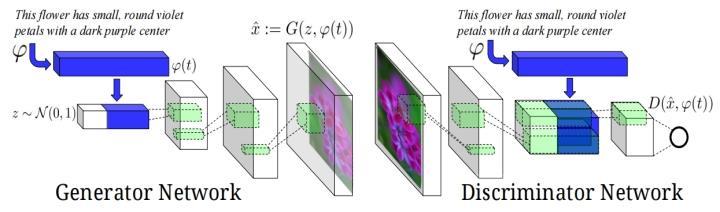
The Matching-Knowledgeable Discriminator (GAN-CLS) enhances traditional GAN training by incorporating real images paired with different text descriptions. Unlike conventionalGANs,whichtreat(quote,expression)pairsas joint observations, GAN-CLS introduces a secondary reference type, using real images corresponding to varied text passages. This method helps distinguish unrealistic expressions from realistic images of the wrong class, refiningtheconditioninginformation'saccuracy.
The GAN-CLS training algorithm involves multiple steps to boostperformance:
1. Encoding the text and its alternatives to produce representationsthatcapturethetextualessence.
2. Sampling random noise and combining it with the encodedtexttogeneratefakeimages.
3. Calculatingscoresforrealandfakeinputs,allowingthe discriminator to learn and improve face/passage matching.
4. Updating the discriminator andgenerator based on the discriminator loss (LD) and generator loss (LG), respectively.
GAN-INTusesthecharacteristicsofdeepnetworkstocreate additional text embeddings by interpolating between training set captions. This method enhances the model's ability to interpolate between various textual descriptions, thusimprovingthegenerationofrealisticimages.
For style transfer, a convolutional network is trained to invert the generator, regressing from generated samples back to the latent space. A squared loss function trains the style encoder, allowing the model to predict the style and generate images accordingly. This technique enables the transfer of styles from one image to another while maintainingcontentintegrity.
The proposed system represents a significant advancement inthefieldoftext-to-imagesynthesis,aimingtoredefinethe capacities and outlook of existing models. It addresses the limitationsoftraditionalapproachesthatoftenstrugglewith producing images confined to specific classifications. Our goal is to create a more adaptable and comprehensive system capable of generating concepts across a wide spectrum, including mammals and human subjects. This innovative system is underpinned by an advanced GAN design, attention mechanisms, and an improved dataset, eachcontributingtoitspioneeringproficiencies.
Ourproposedsystemincorporatesanadvancedtextencoder, serving as the intelligent nucleus of the architecture. Unlike traditional encoders, our enhancedvariant boastsa broader understanding of textual inputs, achieved through
International Research Journal of Engineering and Technology (IRJET) e-ISSN:2395-0056
Volume: 11 Issue: 05 | May 2024 www.irjet.net
progressivetechniquesinnaturallanguageprocessing.This nuancedunderstandingguaranteesaccuraterepresentation of complex textual descriptions, facilitating faithful image synthesis.
At the heart of our system lies the versatile generator network, designed for flexibility and equipped with advanceddeconvolutionallayersandattentionmechanisms. These architectural innovations enable seamless transition between generating images across diverse subjects based on textual input. The flexibility of the generator ensures adaptation toa wide range oftextual inputs, facilitating the production of contextually appropriate and realistic concepts.
Oursystemincludesa conditional discriminator,critical for evaluating the authenticity and coherence of generated images within diverse contexts. Unlike traditional discriminators, which may struggle with heterogeneous inputs, our conditional discriminator is adept at handling a broadspectrumofsubjects.Thiscriticalcomponentensures that generated images seamlessly align with the intended textual descriptions across various categories, enhancing thefidelityandrealismofthesynthesizedimages.
Attention mechanisms play a crucial role in our system, emphasizing the importance of capturing fine-grained details and accurate representations in generated images. Thesemechanismsguidethesynthesisprocess,enablingthe model to focus on relevant features mentioned in textual descriptions.Thismeticulousattentiontodetailelevatesthe quality of the generated images, imbuing them with a heightenedsenseofrealismandauthenticity.
The performance of our proposed method is rigorously evaluated using a versatile approach that includes both quantitative and qualitative metrics. Quantitative assessments, including Inception Score and Frechet Inception Distance (FID), offer valuable insights into the model's quantitative performance, shedding light on its fidelityanddiversity.Qualitativeevaluationsinvolvehuman annotators, providing feedback on the realism and coherenceofthegeneratedimages,ensuringalignmentwith humanperceptualstandards.
The Microsoft Common Objects in Context (MS-COCO) dataset is a widely-used resource in the field of computer vision, particularly in tasks such as text-to-image synthesis usinggenerativeadversarialnetworks(GANs).Itconsistsof over 200,000 images, each annotated with detailed descriptions and labels for objects within the scene. This rich and diverse dataset serves as a foundational resource
p-ISSN:2395-0072
for training GAN models to generate realistic images from textual descriptions. By leveraging the MS-COCO dataset, researchers and developers can create sophisticated AI systems capable of understanding and generating complex visualcontent.
4.2.1 Hardware Requirements:
1) Processor:IntelCorei7orhigher
2) GPU:NVIDIAGTX1080Tiorhigher
3) RAM:16GBormore
4) Storage:1TBSSDforfastread/writeoperations
5) Internet Connection: High-speed for downloading datasets
4.2.2 Software Requirements
1) Operating System: Windows 10, macOS, or Linux (Ubuntu18.04orhigher)
2) PythonVersion:Python3.7orhigher
3) DeepLearningFrameworks:TensorFlow2.x,Keras
4) Other Libraries: NumPy, Matplotlib, Pillow, Flask, Requests,TQDM,PyCOCOTools
4.2.3 System Specifications
Development Environment: Jupyter Notebook or any preferredPythonIDE
VersionControl:Gitfortrackingchangesandcollaboration
4.3 ADVANTAGES
1. High-Quality Image Synthesis: The use of DC-GAN allows for the generation of high-quality, realistic images from text descriptions.
2. Flexibility: The architecture can be adapted to various datasetsandtextinputs,improvinggeneralizability.
3.AdvancedTechniques:IncorporationofmethodslikeGANCLS and GAN-INT enhances the model’s robustness and interpolationcapabilities.
4.4 DISADVANTAGES
1.Computationally Intensive: Training GANs, especially with advanced techniques, requires significant computational resourcesandtime.
International Research Journal of Engineering and Technology (IRJET) e-ISSN:2395-0056
Volume: 11 Issue: 05 | May 2024 www.irjet.net
2.Complexity: The architecture and training algorithms are complex, requiring deep understanding and expertise in deeplearning.
3. Overfitting Risk: Without adequate data and regularization, the model may overfit, reducing its generalizability.
In this work, we have developed a fundamental and practical model for generating images based on detailed visual descriptions. Our model successfully synthesizes various possible visual interpretations of given textual captions,demonstratingitscapabilitytohandlediverseand complexcontentdescriptions.
One of the key enhancements in our approach is the manifold expansion regularizer, which significantly improved the text-to-image synthesis performance on the CUBdataset.Thisregularizerallowsthemodeltogeneratea widerangeofvisualoutputs,capturingthedetailednuances and variations described in the text. Our experiments showed that the model could effectively disentangle design and content, enabling features such as bird pose and background transfer from reference images onto text descriptions. Thishighlights the model'sability to maintain coherence and accuracy in generating contextually appropriateimages.
Furthermore, we demonstrated the generalizability of our approach by generating images containing multiple objects and varying backgrounds using the MS-COCO dataset. This shows the model's robustness and versatility in handling complex scenes and multiple object scenarios, making it suitable for a wide range of applications in visual content creation.
OurresultsontheMS-COCOdataset,whichincludesdiverse objects and scenes, underscore the model's potential for real-world applications.The model maintained high-quality visual outputs across different scenarios, demonstrating its adaptability and effectiveness in generating images from complextextualinputs.
In future work, we aim to scale up the model to generate higher resolution images. This will involve refining the currentarchitectureandincorporatingadvancedtechniques to manage increased computational demands while maintaining image quality. Additionally, we plan to extend the model's capabilities to include a broader range of content types, ensuring it can handle even more diverse textual descriptions and generate corresponding visual outputswithgreaterdetailandaccuracy.
p-ISSN:2395-0072
We also intend to explore the integration of more sophisticated context-aware mechanisms to improve the coherence and relevance of generated images in complex scenes. Leveraging advancements in natural language processing and computer vision, we aim to enhance the model's understanding of context and semantics, leading to more meaningful and contextually appropriate visual outputs.
Furthermore, we will investigate the potential of incorporating user feedback mechanisms to fine-tune and personalize the image generation process. This will enable userstoguideandrefinetheoutputs basedontheirspecific preferences and requirements, making the model more interactiveanduser-friendly.
Overall, our work lays a solid foundation for future advancementsintext-to-imagesynthesis,pavingthewayfor more sophisticated, high-resolution, and context-aware imagegenerationmodels.Thepromisingresultsachievedin this study demonstrate the potential of our approach to revolutionizethewayvisualcontentiscreated,offeringnew possibilities for creative expression and practical applicationsinvariousdomains.
[1] Rameen Abdal, Yipeng Qin, and Peter Wonka. Image2stylegan: How to implant concepts into the stylegan hidden scope? In IEEE International Conference on ComputerVision(ICCV),2019.3
[2] Martin Arjovsky, Soumith Chintala, and Leon Bottou.´Wasserstein Generative Adversarial Networks. In InternationalConferenceonMachineLearning(ICML),2017. 4
[3] Th Brandt, Johannes Dichgans, and Ellen Koenig. Differential belongings of principal against visual field on individualistic and exocentric motion understanding. Experimentalintellectresearch,16(5):476–491,1973.2
[4] Kevin Chen, Christopher B Choy, Manolis Savva, Angel X Chang,ThomasFunkhouser,andSilvioSavarese.Text2shape: Generatingshapesfromhumanlanguagebyknowledgejoint embeddings. In Asian Confernce on Computer Vision, pages 100-116.Springer,2018-1
[5] Jun Cheng, Fuxiang Wu, Yanling Tian, Lei Wang, and Dapeng Tao. 2020. RiFeGAN: Rich Feature Generation for Text-to-Image Synthesis From Prior Knowledge. In Proceedings of the IEEE/CVF Conference on Computer VisionandPatternRecognition.
International Research Journal of Engineering and Technology (IRJET) e-ISSN:2395-0056
Volume: 11 Issue: 05 | May 2024 www.irjet.net p-ISSN:2395-0072
[6] Jacob Devlin, Ming-Wei Chang, Kenton Lee, and Kristina Toutanova. 2018. Bert: Pre-preparation of deep bidirectional transformers for terminology understanding. arXivpublisheddocumentarXiv:1810.04805(2018).
[7] Samek, W.; Wiegand, T.; Müller, K.-R. Explainable machine intelligence: Understanding, visualizing and defining deep education models. arXiv 2017, arXiv:1708.08296.
[8]Lee,Y.-L.;Tsung,P.-K.;Wu,M.Techologyflowofedgeai. In Proceedings of the 2018 International Symposium on VLSI Design, Automation and Test (VLSI-DAT), Hsinchu, Taiwan,16–19April2018;pp.1–2.
[9] Ongsulee, P. Artificial intelligence, machine intelligence and deep education. In Proceedings of the 2017 15th International Conference on ICT and Knowledge Engineering(ICT&KE),Bangkok,Thailand,22–24November 2017;pp.1–6.
[10] RoyChowdhury Aruni, Chakrabarty Prithvijit, Singh Ashish, Jin SouYoung, Jiang Huaizu, Cao Liangliang, and Learned-Miller Erik. Automatic acclimatization of object detectors to new rules utilizing self-preparation. In CVPR, 2019.
[11] Munjal Bharti, Galasso Fabio, and Amin Sikandar. Knowledge distillate for end-to-end man search. In BMVC, 2019.
[12] Li Bowen, Qi Xiaojuan, Lukasiewicz Thomas, and H. S. Torr Philip. Controllable textbook-to-countenance creation. InNeurIPS,2019.
[13]W.Li,P.Zhang,L.Zhang,Q.Huang,X.He,S.Lyu,J.Gao, Object-compelled quotation– to-concept combining by way ofopposingpreparation,in:CVPR,2019,pp.12174–12182.
[14]T.Xu,P.Zhang,Q.Huang,H.Zhang,Z.Gan,X.Huang,X. He, Attngan: Fine– grained document to representation creation accompanying attentional fruitful opposing networks,in:CVPR,2018,pp.1316–1324.
[15]N.Zhou,J.Fan,Automaticfigure–themeadjustmentfor big netting representation indexing and recovery, Pattern Recognit.48(1)(2015)205–219.
[16]Y.Liu,Y.Guo,L.Liu,E.M.Bakker,M.S.Lew,Cyclematch: a phase-constant implanting network for representationparagraphcorresponding,PatternRecognit.93(2019)365–379.
[17]Abdal,R.,Zhu, P.,Mitra,N.J., and Wonka,P. StyleFlow: Attribute-trained survey of StyleGANgenerated concepts
utilizing dependent constant normative flows. ACM Trans. Graph.,40(3),2021.1
[18] Amir, S., Gandelsman, Y., Bagon, S., and Dekel, T. Deep VIT visage as thick able to be seen with eyes descriptors. CoRR,antilockbrakingsystem/2112.05814,2021.5
[19]Balaji,Y.,Nah,S.,Huang,X.,Vahdat,A.,Song,J.,Kreis,K., Aittala,M.,Aila,T.,Laine,S.,Catanzaro,B.,andothers.eDiff-I: Text-to-representation spread models accompanying an ensemble of expert denoisers. CoRR, antilock braking system/2211.01324,2022.2,7,8
[20] Wenbo Li, Pengchuan Zhang, Lei Zhang, Qiuyuan Huang,Xiaodong He, Siwei Lyu, and Jianfeng Gao. Objectcompelledquotation-to-countenance combination by way of opposingpreparation.InProceedingsoftheIEEEConference on Computer Vision and PatternRecognition, pages 12174–12182,2019.1,6