
International Research Journal of Engineering and Technology (IRJET) e-ISSN: 2395-0056
Volume: 11 Issue: 05 | May 2024 www.irjet.net p-ISSN: 2395-0072
International Research Journal of Engineering and Technology (IRJET) e-ISSN: 2395-0056
Volume: 11 Issue: 05 | May 2024 www.irjet.net p-ISSN: 2395-0072
Sateja
Pawar1
1Student, Department of Microbiology
ADT’s, Shardabai Pawar Mahila Arts, Commerce And Science College, Shardanagar Malegaon (Bk) Tal: Baramati, Dist: Pune, 413115, Maharashtra India
Abstract - Probiotics are live microorganisms, such bacteria or yeast, that sustain a balanced microbial environment, especially in the digestive tract, and hence contribute significantly to the promotion of host health. Probiotic bacteria, such as lactobacillus and Bifidobacterium strains, are frequently found in foods like pickles, idli batter, and cow milk. These bacteria may have health advantages. These advantages include better immunity, better digestion, and better gut health. But not every product made with these sources has live, active probiotic cultures, so it's important to read the labels carefully.
The purpose of this study is to evaluate an isolated probiotic strain in comparison to a reference probiotic strain. The strain that was isolated was found to be a Gram-positive, rod-shaped lactic acid bacterium (LAB), and it was obtained from samples of pickles, idli batter, and cow milk. After characterizing the isolate to assess its probiotic potential, a side-by-side comparisonwith a reference probiotic strainwas performed.
Key Words: Probiotics, Microorganisms, Bacteria, Yeast, IoT, Digestive tract, Balanced microbial environment, Host health.
Theword"probiotic,"whichcomesfromtheGreek "pro bios," which means "for life," describes live microorganismsthatarebeneficialtohumansandanimals alike, such bacteria or yeast. By fostering a balanced microbialhabitat,especiallyinthegut,thesemicrobesare essential to preserving health. Although yeasts and enterococcihavealsobeenused,probioticstrainsfromthe genera Lactobacillus,Streptococcus,andBifidobacteriumare amongthemostoftenused.Thesestrains'selectioncriteria frequently give priority to characteristics thought to be criticaltotheirefficacy,suchasorigin,invitroadherenceto intestinal cells, and survival throughout gastrointestinal tract(GIT)transit.
Probioticbacteriacanbefoundinbothdairyandnon-dairy foods.Thethreeprimarytypeslinkedtodairyproductsare Lactobacillus acidophilus, Lactobacillus casei, and Bifidobacteria.Thecreationofnewitemssupplementedwith probioticbacteria,suchaspickles,idlibatter,andcow'smilk, hasthepotentialtogrowtheindustryandsatisfyconsumer demand.
Reducing the indiscriminate use of antibiotics, especiallyinanimalagriculture,hasbecomemoreimportant as a result of worries about antibiotic resistance among human infections. This has prompted legislative actions, such as Europe's 2006 full prohibition of antibiotics that promote growth in animal feed. Probiotics, sometimes referred to as direct-fed microbials, are becoming more widelyacknowledgedinagricultureasviablesubstitutesfor antibiotics in terms of promoting growth and managing particularentericinfections.
The study has garnered interest because to the quest for new probiotics that can be utilized in medical, industrial,andagricultural contexts. Withanemphasison probioticsfromcow'smilk,idlibatter,andpickles,thisstudy seekstocloseknowledgegapsandofferinsightsthatwillbe helpfultotheagriculturalindustry.Theabilityofprobiotic strainstowithstandgastrointestinalconditions,suchaslow pH and bile tolerance, as well as the generation of antimicrobialchemicals,areselectioncriteria.
Four primary goals serve as the foundation for this research:1)isolatingprobioticstrainsfromspecificsamples; 2) characterizing the biochemical makeup of the isolated probioticstrains;3)evaluatingtheinvitrosurvivaltraitsof thegastrointestinaltract;and4)conductingacomparative analysiswithprobioticsthataresoldcommercially.
Theword"probiotic"wasfirstusedbyNobelPrizelaureate Ellie Metchnikoff, who connected Bulgarians' long life expectancytotheirconsumptionoffermentedmilkproducts
International Research Journal of Engineering and Technology (IRJET) e-ISSN: 2395-0056
Volume: 11 Issue: 05 | May 2024 www.irjet.net p-ISSN: 2395-0072
thatincludedrod-shapedbacteria.Thenameisderivedfrom theGreekword"probios,"whichmeans"forlife."Lillyand Stillwell formally invented the term "probiotic" in 1965. Overtime,several interpretationsofprobioticshavebeen put forth; Parker (1974) defined them as "organisms and substanceswhichcontributetointestinalmicrobialbalance." Probiotics are living bacteria that, when consumed in appropriateamounts,offerhealthadvantagesbeyondthose ofbasicdiet,accordingtoGuarnerandSchaafsma(1998).
Later, Sanders (2003) clarified the term, defining probiotics as live bacteria that offer the host health advantages when given in sufficient quantities. A wide varietyoforganismsareincludedinprobiotics,includingas lactobacilli, Bifidobacterium, Bacillus, Saccharomyces, and Enterococcus. Supplemental meals, dairy products, and fermentedfoodsaremajorsourcesofthesebacteria.
Lactobacillus is a genus of bacteria that produce lacticacid(LAB).Itcontainsmorethan100species,manyof whichareemployedasprobioticsindiversefoodproducts. Initially identified by Tissier between 1899 and 1900, bifidobacteriarepresentasignificantcategoryofprobiotics frequentlypresentinthegastrointestinaltract,especiallyin breastfed infants. Enterococci, which are members of the LABgroup,arealsousedinprobioticapplications.Themost frequentlyassociatedspecieswithprobioticsare E. faecalis and E. faecium
Numeroushealthadvantagesofprobioticsinclude the prevention of intestinal infections, immune system modulation,possiblepreventionofsomemalignancies,and adjustmentofbloodcholesterollevels.Theyachievethese effectsbymodulatingimmunologicalresponses,producing organic acids and antimicrobial peptides, and engaging in competitivecolonization.
Probioticsareusedinthefoodsector,pharmaceuticals, agriculture, and human health. Probiotics are being investigatedmoreandmoreinthefieldofhumanhealthfor theirpotentialtherapeuticbenefitsaswellaspreventative measuresagainstarangeofillnesses.Probioticsareaddedto feedassupplementsinagriculturetoenhanceanimalhealth andfoodsafety.Probioticsarebeingdevelopedasbiological medications in the pharmaceutical sector, with particular propertiesanddosages.
In conclusion, probiotics offer a viable approach to enhancinghealthandwellbeinginbothpeopleandanimals. Theirwiderangeofusesemphasizetheirsignificanceacross industriesandtheneedformorestudytorealizetheirfull potential.
3.1 Assembling of Instances
Threesamplesofrawcow'smilk,twosamplesofidlibatter, and one sample of pickles were gathered in a hygienic
mannerfromvariouspartsofBaramati.Withinthreehours, aliquotsofthematerialsweregatheredintosterilevialsand brought to the lab for examination. The Post-Graduation Research Centre (PGRC) of Shardabai Pawar Mahila Arts, Commerce, and Science College, located in Shardanagar, Malegaon Bk., Tal-Baramati, Dist. - Pune, 413115, Maharashtra, India, is the location of the probiotic strain study.
3.2 Media and Chemicals
Thefollowingmediumandsubstanceswereused:
Peptonewater
Brothmadeofglucosephosphate
Simonscitrateagar
Minimalmedia
MHApress
3.3 Media
Selectiveisolationoflacticacidbacteria(LAB)wasachieved using modified De Man, Rogosa, and Sharpe agar (MRS) medium. To improve the media's specificity for LAB isolation,L-cysteinewasaddedandthepHwasincreasedto 6.5.
3.4 Separation of Probiotic LAB from the Gathered Material
Thefollowingprocedureswerefollowedinordertoisolate probioticLAB:
1. Onemilliliterofeachsampleisasepticallyaddedto ninemillilitersofsterilesalinesolution.
2. Thesamplesweredilutedinseries(10^-1to10^7).
3. usethespreadplatemethodtoplating1mlaliquots from the dilutions onto MRS agar enriched with 0.05g/Lcysteine(MRS-cys)intriplicate.
4. MRS-cysagarplateswereincubatedanaerobically for48hoursat37°C.
5. choosing lone colonies from plates with high dilution.
6. UsingMRS-cysagarforstreaking,verifypurity.
7. Purifiedcoloniesarekeptat-20°CinMRS-cysbroth thathasbeensupplementedwith10%glycerol.
3.5 Determining the Probiotic LAB Genus
+ +3.5.1 Identification of Morphology and Features of Colonies
International Research Journal of Engineering and Technology (IRJET) e-ISSN: 2395-0056
Volume: 11 Issue: 05 | May 2024 www.irjet.net p-ISSN: 2395-0072
AfterchoosingisolatedcoloniesonMRS-cysmediumplates, thefollowingmorphologicaltraitswerenoted:
1. Gram Staining: To ascertain the isolates' gram response.
2. Using endospore staining, one can identify endospores.
3. Swarming Motility Test: To evaluate the isolates' motility.
3.5.2IdentificationbyBiochemistry
Forgenus-levelidentification,thefollowingtechniqueswere usedinbiochemicalidentificationtests:
1. TestforCatalase
2. TestsforIndole,MethylRed,VogesProskauer,and CitrateareincludedintheOxidaseIMViCtest
3. TestforArginineHydrolysis
4. Carbon Dioxide Production through the FermentationofGlucose
3.6DescriptionoftheIsolatedStrain
Thefollowingcriteriawereusedtocharacterizetheisolated strains:
1. AcidResistance
2. TolerancetoBileSalts
3. ToleranceforPhenols
4. NaClTolerance
5. Intoleranttolactose
6. SusceptibilitytoantibioticsExamineAntimicrobial Properties
4. RESULT
4.1 Isolation of Probiotic Strain
UsingmodifiedMRSmedia,probioticbacterialstrainswere effectivelyextractedfromsamplesofpickles,idlibatter,and cowmilk.
4.2 Determining the Isolated Strain
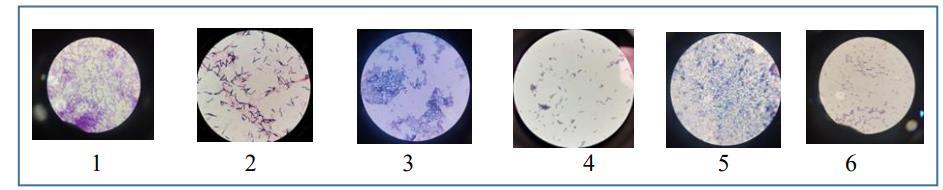
Theisolatedisolateswerenon-motileandshowedsignsof gram-positive status. Indole, methyl red, Voges-Proskauer,
citrate, catalase, oxidase, arginine hydrolysis, and CO2 generation were all shown to have negative findings in biochemical testing. Tests on the fermentation of carbohydratesrevealedheterofermentativetraits,whichmay haveledtothestrains'identificationasLactobacillussp.
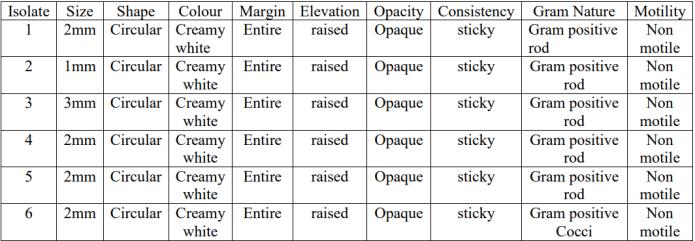
Table1:ColonyCharacteristics
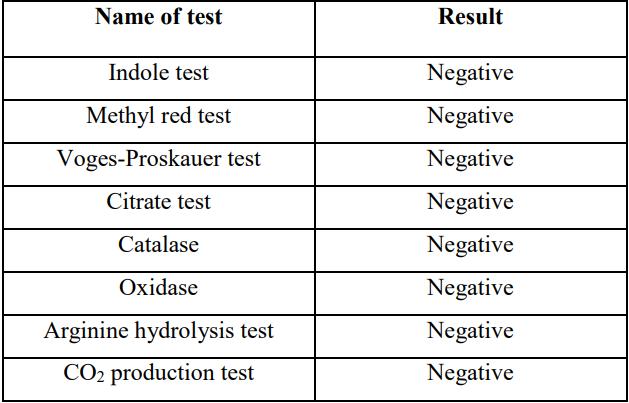
Table2:IMViCTest
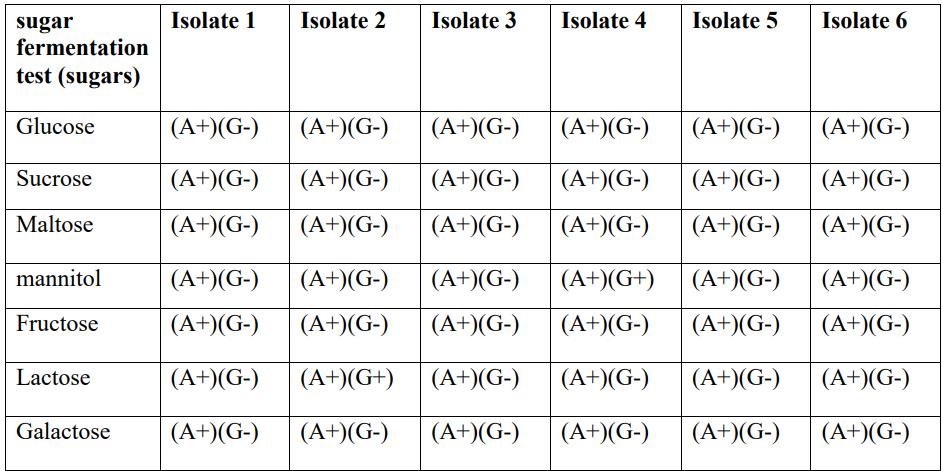
A+ = Acid production G+ = Gas production A-= No acid productionG-=nogasproduction
Table3:CarbohydarteFermentationTest
4.3 Probiotic Strain Characterization
Theisolatedisolatesexhibitedtolerancetophenol,bilesalts, andNaClconcentrationsaswellasoptimaldevelopmentat acidic pH values. They displayed resistance to both streptopenicillinandstreptomycin.Furthermore,isolates1, 2,and6showedanotablereductioninE.Coligrowth.
International Research Journal of Engineering and Technology (IRJET) e-ISSN: 2395-0056
Volume: 11 Issue: 05 | May 2024 www.irjet.net p-ISSN: 2395-0072
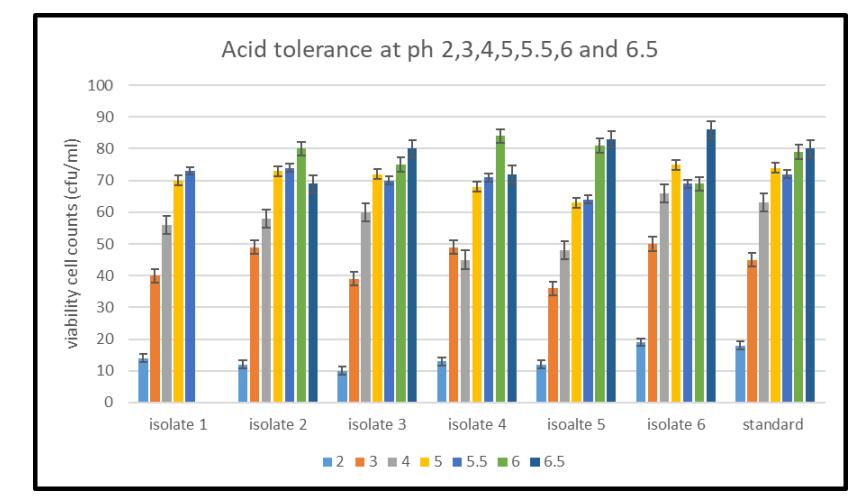
1:SurvivalofLABisolatesduring3hoursofincubation atpH2,3,4,5,5.5,6,6.5
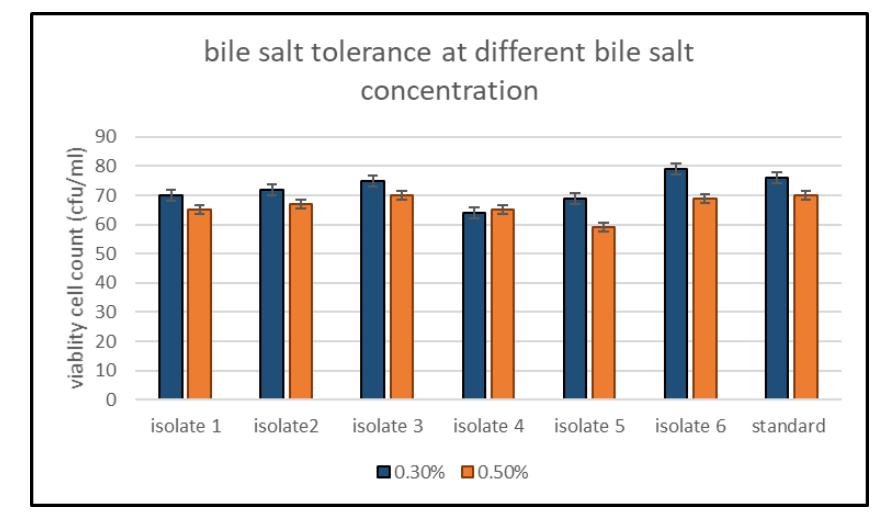
Graph2:BileSaltToleranceTest
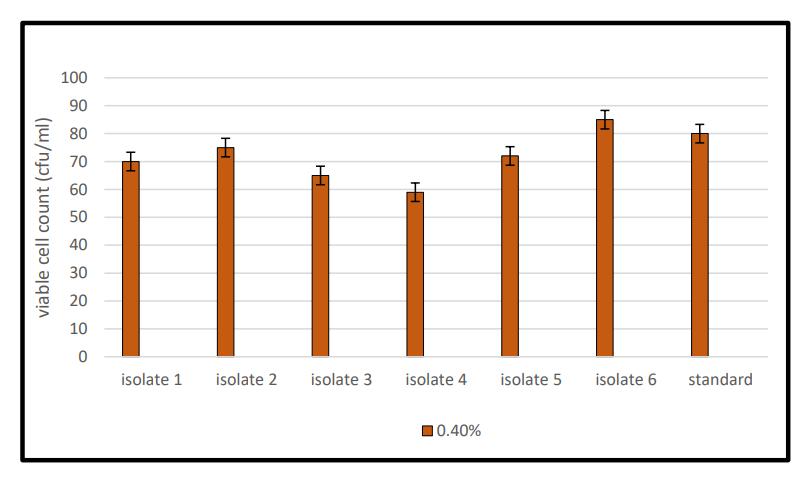
Graph3:PhenolToleranceTest
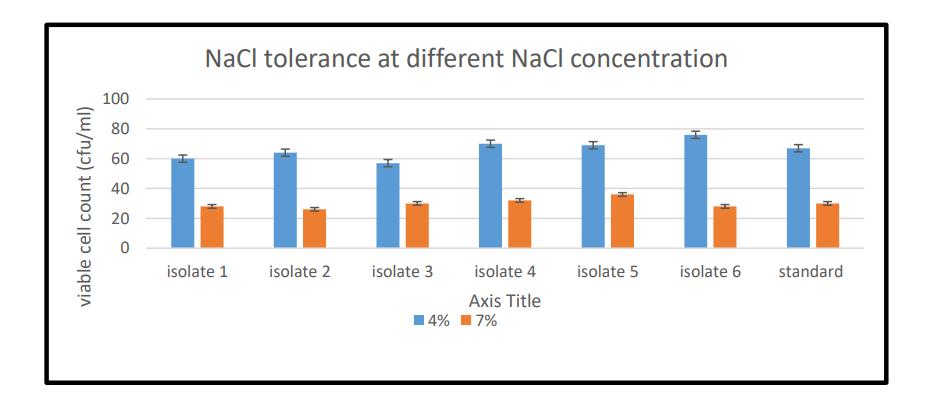
Graph4:NaClToleranceTest
It was determined that the lactic acid bacteria strainsobtainedfromsamplesofpickles,idlibatter,andcow milkweremostlikelymembersoftheLactobacillusgenus. Theircharacterizationshowedpromiseasprobioticbacteria, exhibiting resistance to bile salt, phenol, and NaCl, among other inhibitory chemicals, and acidic stressors. Antimicrobialactivitystudiesdemonstratedthemedications' capacitytosuppresstestmicroorganisms,whereastestsfor antibiotic susceptibility revealed resistance to specific antibiotics.
In vitro, the experimental strains of Lactobacillus showed encouraging probiotic properties, such as high tolerancetobileandpHandthecapacitytostopthegrowth ofpathogens.Theseresultsvalidatetheiruseinthefoodand medicalindustriesandpointtotheirpotentialasantibiotic substitutes.Nevertheless,additionalresearch,likeasinvivo studies, is required to completely comprehend their effectivenessinpromotinghuman
I'mlookingatwaystousetheseisolatesrightnow. ToisolateanddiscoverLactobacillusspp.strainsandother probiotic bacteria with potential health advantages, however,furtherresearchisneeded.Furtherinvestigationin thisfieldmayleadtothecreationofprobioticproductswith improvedabilitytopreventinfections.
[1] Lilly, D.M., & Stillwell, R.H. (1965). Probiotics: Growth-promoting factors produced by microorganisms.Science,147(3659),747-748.
[2] Parker,R.B.(1974).Probiotics,theotherhalfofthe antibioticstory.AnimalNutritionandHealth,19(4), 8-16.
[3] Guarner, F., & Schaafsma, G.J. (1998). Probiotics. InternationalJournalofFoodMicrobiology,39(3), 237-238.
[4] Abdallah, M., Mustapha, T., Gambo, A., & Ishaq, S. (2014). Biochemical identification and cultural characterization of some Gram-negative bacteria obtainedfromfaecal.Diarrhoealsamples
[5] Bergey, D. H. (1994). Bergey's manual of determinativebacteriology.LippincottWilliams& Wilkins.
[6] Cheriguene, A., Chougrani, F., Bekada, A.M.A., El Soda,MandBensoltane,A(2007).Enumerationand identificationoflacticmicroflorainAlgeriangoat’s milk.AfricanJournalofBiotechnology6(15):18541861
International Research Journal of Engineering and Technology (IRJET) e-ISSN: 2395-0056
Volume: 11 Issue: 05 | May 2024 www.irjet.net p-ISSN: 2395-0072 © 2024, IRJET | Impact Factor value: 8.226 | ISO 9001:2008
[7] Taye, Y., Degu, T., Fesseha, H., & Mathewos, M. (2021).Isolationofprobioticmicroorganismsfrom cowmilk.TheScientificWorldJournal.
[8] Holzapfel,W.H.,Haberer,P.,Snel,J.,Schillinger,U.,& Huisin'tVeld,J.H.(2001).Overviewofgutfloraand probiotics. International Journal of Food Microbiology,41(2),85-101.