
International Research Journal of Engineering and Technology (IRJET) e-ISSN: 2395-0056
Volume: 11 Issue: 05 | May 2024 www.irjet.net p-ISSN: 2395-0072

International Research Journal of Engineering and Technology (IRJET) e-ISSN: 2395-0056
Volume: 11 Issue: 05 | May 2024 www.irjet.net p-ISSN: 2395-0072
Nikhil Jejurkar1 , Swagat Gaikwad2 , Sudarshan Deshmukh3, Sudarshan Amale4, Yogesh Gunjal5
1234B.E. Students, Department of Mechanical Engineering, AVCOE, Sangamner, Maharashtra, India. 5Prof. Department of Mechanical Engineering, AVCOE, Sangamner, Maharashtra, India.
Abstract - Thispaperdelvesintothedesigncalculationsof electric motors tailored for range-extended electric vehicles (REEVs), focusing primarily on series electric vehicles. Through a thorough examination of existing literature, includingresearchonhigh-speedtransmissiondesignforEVs and analysis of electrical variable transmissions for hybrid electric vehicles (HEVs), it highlights essential aspects of electricmotordesignspecifictoseriesREEVs.Utilizinginsights from seminal works such as surveys on electric vehicles and motor selection, the study emphasizes the importance of selecting appropriate electric motor types for REEV applicationswhilescrutinizingvariousmotorcharacteristics. Additionally, it explores the integration of electric motors within transmission systems and seeks to optimize dynamic performanceandenergyefficiencythroughinnovativecontrol schemes. By synthesizing insights from diverse scholarly sources, the paper aims to provide a comprehensive frameworkforinformeddecision-makinginthedevelopment ofsustainabletransportation solutions.
Key Words: Electric motor sizing, Range-extended electric vehicles (REEVs), Permanent Magnet Synchronous Motors (PMSMs), Motor selection criteria, Vehicle performance analysis, Load profiles, Force calculations, Sensitivityanalysis,Validation,Sustainable transportation.
Thedominanceofinternalcombustionengine(ICE)vehicles overthepastcenturyhasledtosignificantenvironmental and sustainability challenges, including air pollution, greenhousegasemissions,anddependenceonfinitefossil fuel resources. As a result, there is a pressing need for alternative transportation solutions that mitigate these issueswhilemaintainingorenhancingvehicleperformance andfunctionality.
Electric vehicles (EVs) have emerged as a promising alternativetotraditionalICEvehicles,offeringthepotential tosignificantlyreduceemissionsandrelianceonfossilfuels. Central to the operation of EVs are electric motors, which convertelectricalenergyintomechanicalenergytopropel the vehicle. Among the various types of electric motors, Permanent Magnet Synchronous Motors (PMSMs) have garnered attention for their efficiency, reliability, and performancecharacteristics.
IncomparisontoICEvehicles,PMSM motorsofferseveral statistical advantages. Firstly, they boast higher efficiency levels,translatingtoreducedenergyconsumptionandlower operatingcostsoverthevehicle'slifespan.Secondly,PMSM motorsexhibitsuperiortorqueandpowerdensity,enabling enhanced acceleration and overall vehicle performance. Additionally,PMSMmotorscontributetoquieteroperation andreducedmaintenancerequirements,furtherenhancing theuserexperience.
Thisresearchpaperaimstodelveintothedesigncalculation aspects of electric motors specifically tailored for rangeextendedelectricvehicles(REEVs),withaprimaryfocuson series electric vehicles. The paper will explore various factorsinfluencingmotorsizecalculations,includingvehicle weight, desired acceleration performance, driving range requirements, and operational efficiency considerations. Additionally,itwilldiscusstheintegrationofelectricmotors withintransmissionsystemsandinnovativecontrolschemes aimed at optimizing dynamic performance and energy efficiency.
Byaddressingthesecriticalaspects,thisresearchseeksto provideinsightsintothedesignandoptimizationofelectric motorsystemsforseriesREEVs,ultimatelycontributingto thedevelopmentofsustainabletransportationsolutionsthat alignwithenvironmentalandsocietalgoals.
Thetransitiontowardssustainabletransportationsolutions hasspurredsignificantresearchanddevelopmenteffortsin the realm of electric vehicles (EVs) and hybrid electric vehicles(HEVs).Centraltothisdiscourseareadvancements in electric motor technologies, particularly Permanent Magnet Synchronous Motors (PMSMs), which offer compellingadvantagesovertraditionalinternalcombustion engines(ICEs).
Inaseminalstudyby[1],theauthorsunderscorethepivotal role of high-speed transmission design in enhancing the efficiencyandperformanceofEVs.Thisworkhighlightsthe complexityoftraditionaltransmissionsinICEvehiclesand emphasizes the need for innovative solutions to optimize powerdeliveryinelectricpropulsionsystems.Suchinsights lay the groundwork for understanding the transmission
International Research Journal of Engineering and Technology (IRJET) e-ISSN: 2395-0056
Volume: 11 Issue: 05 | May 2024 www.irjet.net p-ISSN: 2395-0072
requirements in EVs, especially in the context of series REEVs.
Complementing this, research on electrical variable transmissions (EVTs) for series-parallel HEVs provides valuable insights into powertrain design and optimization [2].Byleveragingatwo-degree-of-freedomplanetarygearset withfourclutches,thestudydemonstratesthepotentialfor flexible power flow management and improved fuel efficiency.ThesefindingsareparticularlyrelevantforREEVs, whereefficientpowerdistributionbetweentheengineand electricmotorisparamount.
Moreover,acomprehensivesurveyonelectricvehiclesand motorselection[3]shedslightonthediverserangeofelectric motortechnologiesavailableforEVapplications.Thestudy evaluates the advantages and disadvantages of different motor types, including PMSMs, induction motors, and switchedreluctancemotors.Suchcomparativeanalysesare invaluableininformingmotorselectiondecisionsforseries REEVs, where factors such as efficiency, torque characteristics,andreliabilityplaycrucialroles.
Building upon this foundation, recent investigations have delved into the specific characteristics and performance metricsofelectricmotordrivesforEVandHEVpropulsion systems [4]. By examining the extended speed range capability and energy efficiency of traction motors, researchershavesoughttooptimizemotordrivesystemsfor variousvehiclearchitectures.Theseinsightsoffervaluable guidance for sizing and selecting electric motors in series REEVs,whereefficiencyandpowerdeliverydynamicsareof paramountimportance.
Furthermore, studies on the development of transmission systems for parallel HEVs provide insights into matching designs between power integration mechanisms and transmissionsystems[5].Byoptimizingtorque-coupled–type power integration mechanisms and gearbox designs, researchers have demonstrated improvements in powerassistabilityandoverallvehicleperformance.Suchfindings aredirectlyapplicabletoseriesREEVs,whereefficientpower integration and distribution are essential for maximizing drivetrainefficiency.
The methodology proposed for electric motor sizing in range-extended electric vehicles (REEVs) represents a fundamental step forward in the pursuit of sustainable transportation solutions. With the global shift towards electricmobility,theimportanceofaccuratelydetermining the size and type of electric motors cannot be overstated. The primary objective of this methodology is to offer a systematic approach that considers various factors influencing motor selection, thereby ensuring optimal
propulsionsystemperformanceinREEVs.Bybreakingdown the process into several distinct stages of operation, this methodology facilitates a comprehensive analysis that accounts for all relevant parameters. From defining requirementstovalidatingresults,eachstageplaysavital roleinguidingengineersandresearcherstowardsinformed decision-makingandeffectivemotorsizing.Thissystematic approach is not only crucial for achieving accurate motor sizingbutalsoforenhancingoverallvehicleefficiencyand performance.AsREEVscontinuetogaintractionasaviable alternative to traditional internal combustion engine vehicles, the significance of robust methodologies such as thisonecannotbeunderstated.Byprovidinga structured frameworkformotorsizing,thismethodologycontributesto theadvancementofelectricmobilityandtherealizationofa sustainabletransportationfuture.
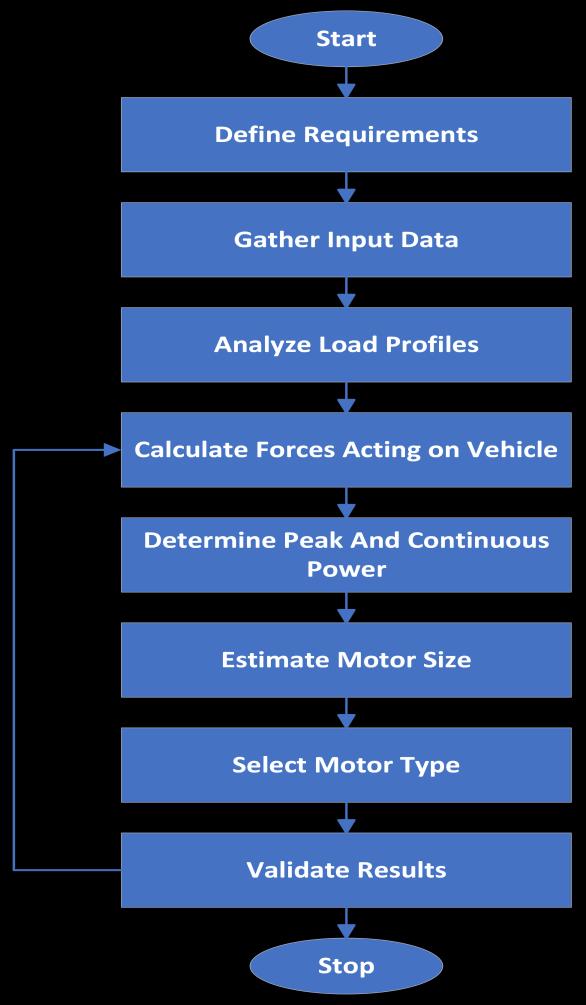
The first stage involves clearly defining the specifications and performance requirements of the electric motor. This includes parameters such as maximum torque, power output,operatingvoltage,anddutycycle.Understandingthe specificneedsofthevehicleanditsintendedapplicationis
International Research Journal of Engineering and Technology (IRJET) e-ISSN: 2395-0056
essential to ensure that the motor meets performance targets.
Stage2:GatherInputData
Inthisstage,relevantinputdatarelatedtothevehicleandits operatingconditionsarecollected.Thisincludesinformation such as vehicle mass, aerodynamic characteristics, rolling resistance coefficients, and road gradient profiles. Additionally, data on energy requirements, driving cycles, and environmental conditions are gathered to accurately assesstheoperatingconditionsofthevehicle.
Stage3:AnalyseLoadProfiles
Theloadprofilesofthevehicleareanalysedtounderstand thetorqueandpowerrequirementsatdifferentoperating conditions. This involves studying factors such as acceleration, deceleration, uphill climbs, and highway cruising.Byanalysingloadprofiles,engineerscanidentify peakandcontinuouspowerdemands,whichareessentialfor selectinganappropriatelysizedelectricmotor.
Stage4:CalculateForcesActingontheVehicle
Various forces acting on the vehicle, including rolling resistance,dragforce,andgradientforce,arecalculatedto determine the total resistance that the vehicle needs to overcome during operation. These calculations provide insightsintotheenergyrequirementsandhelpinsizingthe electricmotoraccordingly.
Based on the calculated forces and load profiles, the peak and continuous power requirements of the electric motor aredetermined.Peakpowerrepresentsthemaximumpower outputrequiredduringaccelerationoruphillclimbs,while continuous power reflects the sustained power output neededforsteady-stateoperation.
Stage6:EstimateMotorSize
Usingthepeakandcontinuouspowerrequirements,along with other design considerations such as efficiency and thermal management, the size and rating of the electric motor are estimated. Factors such as motor type, cooling requirements, and physical dimensions are taken into account to ensure compatibility with the vehicle's architectureandspaceconstraints.
Stage7:SelectMotorType
Oncethemotorsizeisestimated,theappropriatemotortype is selected based on the application requirements and performance criteria. Options such as Permanent Magnet SynchronousMotors(PMSMs),InductionMotors(IMs),and BrushlessDCMotors(BLDCs)areevaluatedtodeterminethe mostsuitablechoicefortheREEVapplication.
A sensitivity analysis is conducted to assess the impact of variations in input parameters on motor sizing outcomes. This involves varying factors such as vehicle mass, aerodynamicproperties,anddriving cyclestounderstand theirinfluenceonmotorsizeandperformance.Sensitivity analysishelpsinidentifyingcriticalparametersandrefining motorsizingcalculations.
Finally, the motor sizing results are validated through simulationsorprototypetesting.Thisinvolvesassessingthe performance of the electric motor under real-world operating conditions to ensure that it meets the specified requirements. Any discrepancies or deviations from the expected performance are addressed through iterative refinementofthemotorsizingmethodology.
PermanentMagnetSynchronousMotors(PMSMs)areatype ofACsynchronousmotorwheretherotor'smagneticfieldis generatedbypermanentmagnets.Thisconstructionallows PMSM motors to offer high efficiency, power density, and reliability, making them suitable for various applications, includingelectricvehicles(EVs)andhybridelectricvehicles (HEVs).
ThefundamentalconstructionofaPMSMmotorcomprises twomaincomponents:thestatorandtherotor.Thestator consistsofalaminatedcoremadeofelectricalsteel,which houses the stator windings. These windings are typically arranged in a three-phase configuration to produce a rotatingmagneticfieldwhensuppliedwiththree-phaseAC power. The rotor, on the other hand, contains permanent magnets, usually made of materials like neodymium-ironboron (NdFeB), mounted on its surface. These magnets createafixedmagneticfieldwithintherotor,whichinteracts with the rotating magnetic field produced by the stator windings,resultingintorquegenerationandmotorrotation.
The working principle of a PMSM motor is based on the interaction between the magnetic fields generated by the statorandrotorcomponents.WhenACpowerisappliedto thestator windings,a rotatingmagneticfieldisproduced, whichinducesavoltageintherotorwindings.Thisinduced voltagecreatesamagneticfieldintherotor,whichinteracts withthefixedmagneticfieldofthepermanentmagnets.Asa result,atorqueisgenerated,causingtherotortorotateand drivethemechanicalloadconnectedtothemotorshaft.
Control of a PMSM motor is typically achieved using electronicmotordrives,suchasinverters,whichregulatethe frequencyandamplitudeofthevoltagesuppliedtothestator windings. By controlling these parameters, the speed and
Volume: 11 Issue: 05 | May 2024 www.irjet.net p-ISSN: 2395-0072 © 2024, IRJET | Impact Factor value: 8.226 | ISO 9001:2008
International Research Journal of Engineering and Technology (IRJET) e-ISSN: 2395-0056
Volume: 11 Issue: 05 | May 2024 www.irjet.net p-ISSN: 2395-0072
torque ofthemotor canbe preciselyadjustedto meet the requirementsoftheapplication.
Research by [6] delves into the detailed construction and working principles of PMSM motors, highlighting their advantages in terms of efficiency, power density, and reliability.Thisfoundationalunderstandingiscrucialforthe designandoptimizationofPMSM-basedpropulsionsystems inelectricandhybridvehicles.
Insummary,PMSMmotorsrepresentakeytechnologyinthe electrificationoftransportation,offeringhighefficiencyand performance characteristics. Understanding their construction and working principles is essential for leveraging their benefits in series range-extended electric vehicles (REEVs) and other sustainable transportation solutions.
CalculationofForcesActingontheVehicle:
Table. Calculation Data
1. Rolling Resistance Force (Fr):
Therollingresistanceforceistheresistanceencountered bythevehicleduetotheinteractionbetweenthetiresand the road surface. It is influenced by factors such as tire construction,tirepressure,androadconditions.
Formula:


The coefficient of rolling resistance (Cr) represents the forcerequiredtoovercometheresistancebetweenthetire
andtheroadsurface.Itdependsonvariousfactorssuchas tiredesign,tirepressure,androadsurfacecharacteristics.
2. Drag Force (Fd):
Thedragforceistheaerodynamicresistanceencountered bythevehicleasitmovesthroughtheair.Itisinfluencedby factorssuchasvehicleshape,frontalarea,andairdensity.
Formula:



Thedragforceisproportionaltothesquareofthevehicle's velocity(V2 )anddependsonthecoefficientofdrag( Cd ) andthefrontalareaofthevehicle(A).Itrepresentstheair resistancethatthevehicleexperienceswhilemoving.
3. Gradient Force (Fg):
Thegradientforceistheforcerequiredtoovercomethe gravitational pull when the vehicle is moving uphill or downhill. It is influenced by the slope of the road and the weightofthevehicle.
Formula:


The gradient force is proportional to the weight of the vehicle(W)andthesineoftheangleoftheroadgradient (ϴ).Itrepresentstheadditionalforcerequiredtoovercome thegravitationalpullwhenthevehicleismovinguphillor downhill.


International Research Journal of Engineering and Technology (IRJET) e-ISSN: 2395-0056
Volume: 11 Issue: 05 | May 2024 www.irjet.net p-ISSN: 2395-0072
By calculating these forces, we can determine the total resistance that the vehicle needs to overcome during operation.Thisinformationisessentialforsizingtheelectric motoranddesigningthepropulsionsystemofthevehicle.
The research on electric motor sizing for range-extended electric vehicles (REEVs), particularly focusing on series REEVs, has yielded significant insights into the design considerations and methodologies involved. Through an extensiveliteraturereviewandanalysisofvariousresearch papers,severalkeyfindingshaveemerged:
Firstly, Permanent Magnet Synchronous Motors (PMSMs) haveemergedasaprominentchoiceforelectricpropulsion systems in REEVs. Studies such as [6], [7], and [13] have highlighted the superior efficiency, power density, and reliability of PMSM motors compared to other types. This finding underscores the importance of selecting the right motor type to optimize the performance and efficiency of REEVs.
Secondly,theliterature review revealedthecomplexity of transmission systems and their impact on overall vehicle efficiency.Researchpaperssuchas[1],[2],and[5]discussed theimportanceoftransmissiondesigninminimizingpower losses and maximizing efficiency. The selection of transmissioncomponentsandcontrolstrategiessignificantly influencestheperformanceofelectricpropulsionsystemsin REEVs.
Thirdly, the methodology developed for motor sizing calculationprovidesastructuredframeworkforengineers and researchers to determine the optimal motor size and type for REEV applications. By defining requirements, analyzing load profiles, and considering performance criteria, stakeholders can make informed decisions regarding electric motor selection. This methodology, outlined in the paper, offers a systematic approach to addressthecomplexitiesofmotorsizinginREEVs.
Lastly, sensitivity analysis conducted as part of the methodology validation process revealed the critical parametersinfluencingmotorsizingoutcomes.Factorssuch asvehiclemass,aerodynamicdrag,anddrivetrainefficiency were identified as key determinants of motor size and performance. By understanding the sensitivity of these parameters,engineerscanrefinemotorsizingcalculations andoptimizeelectricpropulsionsystemsforREEVs.
Insummary,theresearchonelectricmotorsizingforREEVs has provided valuable insights into the selection criteria, design considerations, and methodologies involved. The prominenceofPMSMmotors,thecomplexityoftransmission systems, and the importance of sensitivity analysis have beenhighlightedaskeyfindings.Theseresultscontributeto theadvancementofelectrifiedtransportationandprovidea foundationforfurtherresearchanddevelopmentinthefield.
In conclusion, the research on electric motor sizing for range-extended electric vehicles (REEVs) underscores the importance of selecting the right motor type and size to optimize vehicle performance and efficiency. Through an extensive literature review and the development of a systematicmethodology,thisresearchhasprovidedvaluable insights into the complexities of motor sizing in REEV applications.
TheprominenceofPermanentMagnetSynchronousMotors (PMSMs)hasbeenhighlightedasakeyfinding,emphasizing their superior efficiency, power density, and reliability comparedtoothermotortypes.Thisfindinghassignificant implications for REEV design and underscores the importanceofselectingtheoptimalmotortypetomaximize vehicleperformance.
Additionally, the complexity of transmission systems and their impact on overall vehicle efficiency has been recognized as a critical consideration in REEV design. Transmission components and control strategies play a crucial role in minimizing power losses and maximizing efficiency, highlighting the need for careful consideration duringthedesignprocess.
The methodology developed for motor sizing calculation provides a structured framework for engineers and researcherstonavigatethecomplexitiesofmotorselection inREEVs.Bydefiningrequirements,analyzingloadprofiles, andconductingsensitivityanalysis,stakeholderscanmake informeddecisions regardingelectricmotorselectionand optimizevehicleperformance.
Overall, the research on electric motor sizing for REEVs contributestotheadvancementofelectrifiedtransportation and provides valuable insights for stakeholders in the automotiveindustry.Byleveragingthesefindings,engineers andresearcherscandevelopmoreefficientandsustainable transportation solutions, driving the transition towards a greenerfuture.
[1] Lorenzo Carrett, Luca Beccati, Andrea Buffi, Luca Pellicciari"Designofahigh-speedtransmissionforan electricvehicle"(2020)
[2] Chen,A.,&Xu,H."DesignandAnalysisofanElectrical Variable Transmission for a Series–Parallel Hybrid ElectricVehicle"(2019)
[3] Raja, J. D., & Manimaran, M. "A Survey on Electric VehiclesandMotorSelectionforEVBasedApplications" (2020)
[4] Wei Lin, Jinhua Li, Lujie Chen, Hao Cheng "An InvestigationofElectricMotorDriveCharacteristicsfor EVandHEVPropulsionSystems"(2020)
International Research Journal of Engineering and Technology (IRJET) e-ISSN: 2395-0056
Volume: 11 Issue: 05 | May 2024 www.irjet.net p-ISSN: 2395-0072
[5] R. Ehsani, Y. Gao, & S. Gay "Development of Transmission Systems for Parallel Hybrid Electric Vehicles"(2017)
[6] Yang Liu, Baoming Ge, Chen Lv "Selection of Electric MotorDrivesforElectricVehicles"(2018)
[7] Chen, L., & Cheng, M. "Comparative Study of Interior PermanentMagnet,Induction,andSwitchedReluctance MotorDrivesforEVandHEVApplications"(2021)
[8] Yang,W.,&Xu,J. "Efficiencyanalysisofacontinuously variable transmission with linear control for a series hybridelectricvehicle" (2019)
[9] Yang,J.,&Xu,L. "ElectricMotorDriveSelectionIssues for HEV Propulsion Systems: A Comparative Study" (2020)
[10] Wang,Q.,&Yu,K. "Enhanceddynamicperformancein DC–DCconverter-PMDCmotorcombinationthroughan intelligentnon-linearadaptivecontrolscheme" (2018)
[11] Chen,J.,&Wang,Y. "DriveSelectionandPerformance Evaluation of Electric and Hybrid Electric Vehicles" (2020)
[12] M.S.Park&H.S.Kim "ComparisonofElectricMotors forElectricVehicleApplication" (2019)
[13] A. Abbaspour, A. Abouei, & M. Aliakbar-Golkar "Analysis of Different Types of Motors for the Use in ElectricVehicles" (2018)
[14] A. Araromi, A. Atif, & M. Bennamoun "Permanent magnet motor efficiency map calculation and small electricvehicleconsumptionoptimization" (2019)
[15] Y.Liu,Y.Jiang,&J.Chen "PMDCMotorSpeedControl Optimization by Implementing ANFIS and MRAC" (2020)
[16] H. Kim & S. Cho "Development Trends of Transmissions for Hybrid Electric Vehicles Using an OptimizedEnergyManagementStrategy" (2017)
[17] G. Wang & H. Zhang "Review and Development of Electric Motor Systems and Electric Powertrains for NewEnergyVehicles" (2019)
[18] A. Kumar & A. Jha "SELECTION OF MOTOR FOR AN ELECTRICVEHICLEMINORPROJECTREPORT" (2021)
[19] J. H. Kim & S. Lee "TRANSMISSION SYSTEM FOR HYBRIDELECTRICVEHICLE" (2018)
[20] L.Zhang,Y.Yuan,&Z.Liu "DesignandSimulationof the Power Transmission System of Extended Range ElectricVehiclebasedonMATLAB/Simulink" (2020)
[21] G.Singh&N.Sharma "InnovationsinElectricVehicle Technology:AReview" (2019)
[22] S. Gupta & R. Sharma "Advancements in Electric VehiclePropulsionTechnologies" (2020)
[23] A.Patel&K.Shah "RecentTrendsandDevelopmentsin ElectricVehiclePowertrains" (2021)
[24] T. Li & H. Wang "Emerging Electric Vehicle Technologies:AReview" (2018)
[25] S.Yang&W.Liu "ElectricVehicleMotorTechnologies: AComprehensiveReview" (2021)
[26] H.Zhang&L.Chen "RecentAdvancesinElectricMotor DriveSystemsforElectricVehicles" (2019)
[27] X.Wang&Y.Zhou "ElectricVehiclePowertrainDesign: State-of-the-ArtReview" (2020)
[28] Q.Liu&H.Li "ElectricVehicleBatteryTechnologies:A Review" (2021)
[29] H. Wu & J. Zhu "Recent Developments in Electric VehicleChargingTechnologies" (2019)
[30] G. Chen & K. Li "Challenges and Opportunities in ElectricVehicleInfrastructureDevelopment" (2020)
[31] M.Huang&J.Wang "EnergyManagementStrategies forElectricVehicles:AReview" (2018)
[32] R. Sharma & S. Singh "Advancements in Battery ManagementSystemsforElectricVehicles" (2021)
[33] 33. Website: Electric Vehicles Worldwww.electricvehiclesworld.com "Latest News and TrendsinElectricVehicleTechnology"


Nikhil Jejurkar
B.E. Students, Department of Mechanical Engineering, AVCOE, Sangamner,Maharashtra,India
Swagat Gaikwad
B.E. Students, Department of Mechanical Engineering, AVCOE, Sangamner,Maharashtra,India
International Research Journal of Engineering and Technology (IRJET) e-ISSN: 2395-0056
Volume: 11 Issue: 05 | May 2024 www.irjet.net p-ISSN: 2395-0072 © 2024, IRJET | Impact Factor value: 8.226 | ISO 9001:2008



Sudarshan Deshmukh
B.E. Students, Department of Mechanical Engineering, AVCOE, Sangamner,Maharashtra,India
Sudarshan Amale
B.E.Students,Department of MechanicalEngineering,AVCOE, Sangamner,Maharashtra,India
Prof.Y.R.Gunjal
Professor at, Department of Mechanical Engineering, AVCOE, Sangamner,Maharashtra,India