
International Research Journal of Engineering and Technology (IRJET) e-ISSN: 2395-0056
Volume: 11 Issue: 05 | May 2024 www.irjet.net p-ISSN: 2395-0072
International Research Journal of Engineering and Technology (IRJET) e-ISSN: 2395-0056
Volume: 11 Issue: 05 | May 2024 www.irjet.net p-ISSN: 2395-0072
Chaithrashree. A 1 , Mritunjay Shukla 2 , Rohit Kumar Thakur 3, Shagun Dhurandhar 4, Sudipto Chakraborty 5
1 Assistant Professor, Department of CSE, Brindavan College of Engineering, Bengaluru, India 2345 B.E. Student, Department of CSE, Brindavan College of Engineering, Bengaluru, India
Abstract - Sign language is used by the deaf community to communicate with non-deaf individuals. The gestures used in sign language can be difficult for the general population to understand. However, thissignlanguagecanbeconvertedinto a form that is easy for the general public to understand. This research is based on various image and video capturing techniques, preprocessing, classifying of hand gestures and landmarks extraction, and classification techniques. To identify the most promising methods for future research, this paper examines the techniques used to generatedatasets, sign language recognition systems, and classification algorithms. Many of the currently available studies contribute to classification approaches in combination with deep learning due to the growth of classification methods. Thispaperfocuses on the methods and techniques used or applied in earlier years.
Key Words: SLRS- Sign language Recognition System, CNN- Convolutional Neural Networks, LSTM- Long ShortTerm Memory, SL - Sign Language, NN – Neural Network, LCBCr- Luminance, Chrominance Blue, Chrominance Redcolor.
Thegoalofasignlanguagerecognitionsystemistoidentify andtranslatehandgestures,bodylanguage,andothernonverbalcuesutilizedinsignlanguage.Thispaperdiscussesa widerangeofalgorithmsandtechniquesthatcanbeusedto collect, process, and comprehend hand gestures and sign languageusedbythedeaf.Itisclaimedthatthesystemfor hand gesture recognition is a method or a strategy for productivehuman-computerinteraction.Signlanguagesare those that express meaning through the visual-manual modality[1].Staticsignidentificationfromphotosorvideos recordedinsomewhatcontrolledenvironmentshasbeenthe focusofalotofrecentresearch.
The foundation of computer vision techniques is the way humans interpret information about their surroundings. Since sign language movements might vary, it can be challenging to create a vision-based interface that is understoodbypeopleworldwide.However,developingsuch an interface for a specific set of people or nations is conceivable.Thedetectionofhandgesturesandtheirmotion when in motion depends on area selection since hand motions have distinct shape variations, textures, and
movements.Itiseasytoidentifyastatichand,skintone,and handshapeusingcharacteristicssuchasfingerdirections, fingertips,andhandposture.Thepicture'sbackgroundand lighting make these aspects not always reliable and accessible.Itishardtoexpressfeaturesexactlyastheyare, hencetheentirevideoframeorimageisusedastheinput. The goal of this work is to examine and evaluate the methodologies employed in previous studies and approaches. This report also aims to determine and recommend the optimal research direction for future research.
AccordingtoProf.T.HikmetKarakoc,SLiscomparable to thewordlanguageinthatbotharewidelyusedaroundthe world [2]. Since sign language has evolved, its vocabulary and syntax have been recognized as real languages. The reasonsignlanguage(SL)isthelanguageofchoiceforthe deaf is that it can be constructed by combining facial emotions, hand gestures and movements, and palm movementstoconveyaspeaker'sthoughtswithouttheneed foravoice.
Deep learning can be very effective in sign language recognition and translation tasks. Sign translation is the processofconvertingsignedlanguageintospokenlanguage or text, whereas sign recognition is the analysis and interpretation of sign language gestures. Deep Learning methodologies that can be used to train models that can understand and translate sign language include convolutional neural networks (CNNs), recurrent neural networks (RNNs), and long short-term memory (LSTM) networks.Onepopularmethodisusingacameratorecord thegesturesandthenapplyingcomputervisiontechniques to process the video frames to extract characteristics that canbe inputintoa deeplearningmodel fortranslation or classification.
Becausedeeplearningcanautomaticallydiscoverintricate patternsandrelationshipsinlargedatasets,itisagoodfit forsignlanguagerecognitionapplications.Signlanguageisa visuallanguagethatrequiresintricatehand,facial,andbody motions.Byexaminingavastquantityofsignlanguagedata, including videos of people speaking the language, deep learning models may be trained to identify these gestures and patterns. This process allows the models to automaticallyidentifythekeyelementsandpatternsneeded forprecisesignlanguageidentification.
International Research Journal of Engineering and Technology (IRJET) e-ISSN: 2395-0056
Volume: 11 Issue: 05 | May 2024 www.irjet.net p-ISSN: 2395-0072
A well-liked machine learning method for sign language recognitionsystemsisneuralnetworks(NN).Analgorithm knownasaneuralnetwork(NN)ismadetoidentifyintricate relationshipsandpatternsindata.Neuralnetworks'capacity to discover intricate connections between input data and predicted outputs is what gives them their effectiveness. Iteratively fine-tuning the weights and biases of the connectionsamongthenodesinthehiddenlayersallowsthe model to become more accurate and more capable of generalizing to new data. SLRS uses a dataset of presegmentedsignlanguagegesturesandsignstotrainneural networks.
CNNsareusedtorecognizeimages,includingthoseinsign language. They work very well at distinguishing spatial characteristics in photos, which helps recognize hand motions and movements. CNNs have been used in several research to categorize individual signs or complete sentencesinsignlanguage.
SequentialdatamodelingisakeyfunctionofRNNsinsign language recognition, given that sequential language includes sign language. RNNs can identify temporal dependencies.throughthesequentialprocessingofthesigns insignlanguage.RNNshavebeenusedincertainstudiesto identify words and sentences in sign language (source: Starostenkoetal.,2018;Iwanaetal.,2020).
LongShort-TermMemoryNetworksareakindofrecurrent neural network that can manage the vanishing gradient problem that might occur while training RNNs on long sequences. Long-term dependencies in sign language sequences have been found using LSTMs in sign language recognition. LSTMs have been used in certain research to identify continuous sign language utterances (source: Cui andCo.,2019;Chenetal.,2021).
CRNNscombinethesequentialmodelingofRNNswiththe spatialfeaturedetectionofCNNs.
Theyhavebeenappliedtotherecognitionofsignlanguage to record the temporal and geographical information includedinsignlanguagevideos.CRNNshavebeenutilized in certain research to identify continuous sign language wordsandgestures(source:Zhouetal.,2018;Camgozetal., 2018).
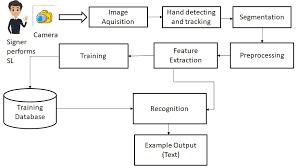
RecordingthesignsisnecessaryfortheSLRStofunction.To collecttheseindicationsasinput,avarietyofstrategiesand tacticsareemployed.Amongthesetechniquesistheuseof Microsoft Kinect sensors to collect multimodal data. MicrosoftcreatedtheseMicrosoftKinectsensors,akindof motion-sensing input device. The Kinect sensor tracks humanmotions
Year:Pre-ComputerEra
Authors:WilliamStokoe
Title:ManualCodingSystem.
Methodology: Stokoe's manual coding systems aimed to representsignlanguageslinguisticallybyusingsymbolsto denotehandshapes,movements,andlocations,providinga structurednotationsystem.
Advantages: It provides a foundational understanding of linguistic structures in sign languages, facilitating crossculturalcomparisonsandcontributingtobroaderlinguistic studies.
Disadvantage: Limited set of symbols, which couldn't capture the richness and nuances of sign languages comprehensively,potentiallyleadingtooversimplificationor lossoflinguisticdetail.
Year:1980s-1990
Authors:RalphK.Potter
Title:ComputerVisionTechnologies
Methodology: Potter's approach emphasizes leveraging computer vision for sign language recognition, using algorithms to interpret visual data of hand gestures, movements,andfacialexpressions
Advantages: Focus on computer vision for sign language recognition is the potential to enhance accessibility by enabling real-time interpretation, aiding in bridging communication gaps between the Deaf and hearing communities.
Disadvantage:Computervisionsystemsmightstrugglewith recognizingnuancesandvariationsinsignlanguagegestures due to the intricate nature of hand movements and facial expressions.
International Research Journal of Engineering and Technology (IRJET) e-ISSN: 2395-0056
Volume: 11 Issue: 05 | May 2024 www.irjet.net p-ISSN: 2395-0072
Year:1990s-2000
Authors:TakeoKanade
Title:Glove-BasedSystem
Methodology:Itinvolvesdevelopingsensor-equippedgloves to capture hand movements and gestures, and translating these inputs into recognizable sign language through computationalanalysis.
Advantages: Allows for a more natural and intuitive interaction by directly capturing hand movements, enhancingcommunicationfluidityforsignlanguageusers.
Disadvantage: The system might face constraints in accuratelycapturingthefullrangeofsignlanguagegestures and nuances, potentially leading to incomplete or misunderstoodinterpretationsduetothelimitedsensors' capabilities.
Year:2000s-2010
Authors:RajaKushalnagar
Title:Video-BasedRecognition
Methodology:Itinvolvesemployingadvancedvideoanalysis algorithms to interpret sign language gestures, leveraging machinelearningandcomputervisiontechniquestoprocess visualdatafromvideos.
Advantages: Video-based recognition allows for a more comprehensiveanalysisofsignlanguage,capturingsubtle nuances in hand movements, facial expressions, and body language,enhancingaccuracyininterpretation.
Disadvantage: Processing video data in real-time for sign language recognition can be computationally demanding, requiringsignificantresources,andpotentiallylimitingits practicality in some settings due to computational constraints.
Feature Description
HandShape Describestheshapeofthe handduringthesigning
HandMovement Indicatesthemovementof thehandduringthesigning
HandOrientation Specifiestheorientationof thehandrelativetothe signerorviewer
HandConfiguration Describethearrangement offingersandthumbduring thesigning
Step 1: Data Collection Strategy
Designacomprehensiveplantocollectdiversesignlanguage data, considering regional variations, gestures, and expressions.Utilizemultiplesourcessuchasvideos,motion capture,andcrowd-sourcingtoensureawiderangeofsigns.
Step 2: Annotation and Labeling
Developrobustannotationprotocolstolabelcollecteddata accurately. Include information on hand gestures, facial expressions,bodymovements,andcontextualcuestoenrich thedatasetforbetterrecognition.
Step 3: Data Augmentation Technique
Implement techniques such as mirroring, rotation, and translation to increase the diversity and volume of the dataset.Syntheticdatagenerationandaugmentationcanhelp addresslimitationsduetolimitedoriginaldata.
Step 4: Preprocessing and Feature Extraction
Utilizeimageandsignalprocessingtechniquestopreprocess therawdata.Extractrelevantfeatureslikehandtrajectories, keypoints,andfacialexpressions.
Apply dimensionality reduction and normalization to enhancemodelperformance.
Step 5: Model Development and Training
EmploydeeplearningarchitectureslikeConvolutionalNeural Networks(CNNs)orRecurrentNeuralNetworks(RNNs)for signlanguagerecognition.Trainmodelsusingtheannotated dataset and fine-tune them to capture intricate sign variations.
International Research Journal of Engineering and Technology (IRJET) e-ISSN: 2395-0056
Volume: 11 Issue: 05 | May 2024 www.irjet.net p-ISSN: 2395-0072
Regularlyassessmodelperformanceusingvariousmetrics, including accuracy, precision, and recall. Incorporate user feedbackandadjustthemodeltoaddresserrorsandimprove recognitioncapabilitiescontinually.
Step 7: Integration with Assistive Technologies
Integratethesignlanguagerecognitionsystemintoassistive technologiessuchassmartglasses,mobileapplications,or communicationdevices.Ensurecompatibilityandusability forreal-time.
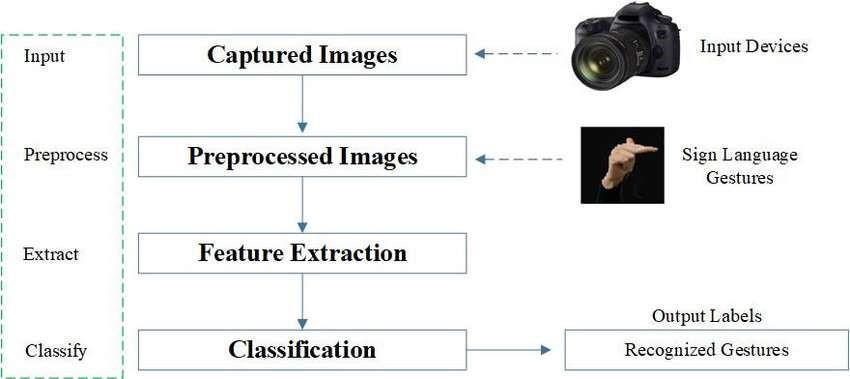
Anoverviewofearliersurveysonthetechniquesappliedin different gesture and sign language recognition studies is given in this section. Both standard cameras and Kinect cameras are widely used to capture data in sign language. DatacollectionandsubmissiontotheSLRsystemarecrucial because,oncedataisgathered,pre-processingisneededto guaranteecorrectness.
Gaussianfiltersremovenoisefromtheinputdata.Itiseasyto discernthebackdropcolorandskintonefromtheRGBcolor spaces.Thereviewdemonstrateshowthedivisionoutcomeis builtbybreakingupskintonewithadditionallimitssuchas edgeandrecognizableproof.
The vision-based approach extracts elements from images usinggesturecategorization.Thetwomostusedclassification algorithmsareSVMandANN.WhencomparedtoANN,SVM outputwassuperior.Mostmodelsemploysensorstogather informationabouttheirsurroundingswhenexaminingthe dataathand.Invision-basedapplications,brainnetworksare typicallyusedtoprocessimagesandvideos;inorder,Geeand SVMsareused.Thisisaresultoftheincreasedavailabilityof data sources. The classification of motions, which quickly pullsinformationfromimages,isthelaststepinthevisionbased technique. ANN and SVM are the two most used methods for data classification. When analyzing the given data, most models get environmental information from sensors. In vision-based methods for images and videos, neural networks are commonly used, whereas HMMs and SVMs are used for classification. This is a result of the increasedaccessibilityofdatasources.
Neuralnetworkmodelsareanotherkeyprocessingapproach for deciphering sign language The CNN processing image passesthroughconvolution,pooling,activationfunctions,and fully linked layers to understand sign language. To extract motion information from depth changes in frames and features,3D-CNNsareimplemented.LSTM-basedalgorithms canbeutilizedtoextractsimulationtemporalsequencedata from videos of sign language [13]. A step ahead in LSTM, BLSTM-3DResNet[14],canrestricthandsandpalmsfrom video progressions. HMM and SVM are two crucial
classification methods in vision-based systems. In recent studies,convolutional neural networkshavebecomemore and more prominent in vision-based sign language recognition. Pre-trained models can be used right away without requiring any data to be provided or training. Becauseofthetremendouspotentialofpre-preparedmodels, scientistshaverecentlygiventhemagreatdealofthought. Additionally, it lowers the cost of building and training datasets.Manyanalystshaveusedpre-preparedmodelslike signal-basedVGG16,GoogleNet,andAlexNettoreducethe preparation costs. To lower loss errors when training datasets, cross-entropy, and other loss functions are used. The cross-entropy multiclass category is the most widely usedlossfunction.ThewidelyusedSGD,ADAM,andanalyzer enhancersneedtosupporttheunfortunatecapacity.
Becauseitcanlearnandassociateonitsown,thedeepneural network(DNN)yieldshigherresultsbutrequiresthegreatest trainingsample. As of rightnow, it can register to execute programs on large datasets. Better program execution is takenintoaccountwhileperformingnewcomputationsand makingimprovementstoexistingones.
In conclusion, A system that was designed to recognize alphabets and static gestures has developed into one that canalsorecognizedynamicmotionsthatareinmotion.
Inpublishedresearch,resultsfromvision-basedapproaches are frequently better than those from static-based approaches.Thedevelopmentoflargevocabulariesforsign language recognition systemsiscurrentlyattracting more study interest. Improvements in computer speed and the availabilityofdatasetsmakeitpossibletoaccessadditional trainingforcertainsamples.
A lot of people are building their datasets to aid in the improvement of their recognition of sign language. The grammarandpresentationofeachphrasedeterminethesort ofsignlanguageemployedinvariousnations.
Deep learning techniques like CNN and LSTM Models can identify the sequence of photos and video streams with a highdegreeofaccuracy.Ifindthatwhenworkingwithvideo frames, LSTM models get more accurate results. They are quitegoodatextractingfeaturesandcapturing3Dgestures. GiventhatLSTMcanbeusedforvideosandCNNcanbeused for static images, merging the two can result in a sign languagerecognitionsystemthatisbothmorepotentand accurate
The project team would like to express their heartfelt gratitude to our alma mater Brindavan College of Engineeringforgivingustheopportunityandtoourproject mentor Prof. Chaithrashree A for her guidance,
International Research Journal of Engineering and Technology (IRJET) e-ISSN: 2395-0056
Volume: 11 Issue: 05 | May 2024 www.irjet.net p-ISSN: 2395-0072
encouragement, and input which led us to undertake this project.
[1] Sandler and Lillo-Martin's book explores the universality of language through the study of sign languages.
[2] Huangetal.'sarticleprovidesareviewofthesynthesis, properties,andapplicationsofcarbondots.
[3] KhoshelhamandElberink'sarticleexaminescomputer visiontechniquesusedwithRGB-Dsensorssuchasthe Kinectandtheirapplications.
[4] Morales-Sánchezetal.'sarticleprovidesanoverviewof the innate and adaptive immune responses to SARSCoV-2infectioninhumans.
[5] Rujana's American Sign Language Image Dataset is a collection of images used for research and training in signlanguagerecognition.
[6] Guan et al.'s article presents an IoT-based system for energy-efficient regulation of indoor environments in buildings.
[7] Hassan et al.'s review article provides an overview of blockchain technology, including its architecture, consensus,andfuturetrends.
[8] Makridakis et al.'s article reviews recent research on timeseriesforecasting.
[9] Wangetal.'sarticleprovidesacomprehensivereviewof blockchain technology, from fundamentals to applications.
[10] Gaoetal.'sarticleprovidesareviewofdeeplearningbased image analysis techniques for agricultural applications.
[11] Zhang et al.'s article reviews recent advances in precisionirrigationtechnologiesbasedonIoT.
[12] Jietal.'ssurveyarticleexaminesedgecomputingforIoT.
[13] Alsheikhetal.'ssurveyarticleprovidesanoverviewof machinelearningtechniquesforresourcemanagement inedgecomputing.
[14] Al-Fuqaha et al.'s article is a survey of enabling technologies,protocols,andapplicationsforIoT.