
International Research Journal of Engineering and Technology (IRJET) e-ISSN:2395-0056
Volume: 11 Issue: 05 | May 2024 www.irjet.net p-ISSN:2395-0072
International Research Journal of Engineering and Technology (IRJET) e-ISSN:2395-0056
Volume: 11 Issue: 05 | May 2024 www.irjet.net p-ISSN:2395-0072
Palak Tiwari1, Vibhuti Sharma2, Dr. Sudha Tiwari3 , Priyanka Devi4
1,2 BTech Student, Dept of Information Technology, Government Engineering College Bilaspur, Chhattisgarh, India
3,4 Assistant Professor, Dept of Information Technology, Government Engineering College Bilaspur, Chhattisgarh, India
Abstract - Search engines play a crucial role in accessing and retrieving information from vast digital repositories. However, existing search technologies often face challenges in efficiently indexing and searching diverse data types, including text documents and images. In this research paper, we introduce SearchEase, a novel search engine that integrates inverted index search and vector search techniques to enhance information retrieval capabilities. We present the architecture, methodology, implementation details, and experimental results of the SearchEase system. Our findings demonstrate the effectiveness of SearchEase in improving search speed, accuracy, and relevance, offering a promising solution for efficient information retrieval in various domains.
Key Words: InformationRetrieval,SearchEngines,InvertedIndex,VectorSearch,NaturalLanguageProcessing
1.INTRODUCTION
Intheeraofbigdata,efficientinformationretrievalisessentialforaccessingandanalyzingvastamountsofdigitalcontent. Traditional search engines rely on inverted index search algorithms, which map terms to documents, enabling fast keyword-basedsearches.However,thesemethodsmaystrugglewithunstructureddataandsemanticunderstanding.The SearchEase project addresses these challenges by integrating inverted index search with vector search techniques to provideacomprehensivesolutionforefficientinformationretrieval.
Previous research in information retrieval has explored various indexing and searching techniques, including inverted index search, vector space models, and neural network-based approaches. Introduction to Information Retrieval (Manning, Raghavan, & Schütze, 2008) provides a comprehensive overview of fundamental IR principles, including indexing, retrieval models,and evaluation metrics. The book emphasizestheimportanceofinvertedindexstructures for enabling fast keyword-based searches, laying the groundwork for subsequent research in the field.[1].Speech and Language Processing (Jurafsky & Martin, 2019) delves into the intersection of natural language processing (NLP) and informationretrieval.Itdiscussestechniquesfortextprocessing,syntacticanalysis,andsemanticunderstanding,offering insights into the challenges and opportunities in building intelligent IR systems.[2]. Mining of Massive Datasets (Rajaraman & Ullman, 2011) explores scalable algorithms and techniques for processing large-scale data. The book discusses distributed computing frameworks and data mining approaches relevant to IR, highlighting the importance of scalability and efficiency in handling massive datasets.[3]. Text Mining: Approaches and Applications (Choudhury et al., 2020) presents a comprehensive overview of text mining techniques and their applications across various domains. The bookdiscussesmethodsforinformationextraction,topicmodeling,andsentimentanalysis,offeringvaluableinsightsinto the diverse applications of IR in real-world scenarios.[4]. Inverted index search algorithms, such as those used in traditional search engines like Google, rely on indexing terms to documents, facilitating fast keyword-based queries. However,thesemethodsmaystrugglewithsemanticunderstandingandrelevanceranking.
Vectorsearchtechniques,ontheotherhand,representdocumentsandqueriesashigh-dimensionalvectorsinasemantic space, enabling similarity-based searches. Recent advancements in vector search, including word embeddings and deep learningmodels,haveshownpromisingresultsinimprovingsearchaccuracyandrelevance.Bycombininginvertedindex searchwithvectorsearch,SearchEaseaimstoleveragethestrengthsofbothapproachestoenhanceinformationretrieval capabilities.
The SearchEase system comprises several key components, including data ingestion, preprocessing, indexing, and searching.Dataingestioninvolvesextractingtextandmultimediacontentfromvarioussources,followedbypreprocessing
International Research Journal of Engineering and Technology (IRJET) e-ISSN:2395-0056
Volume: 11 Issue: 05 | May 2024 www.irjet.net p-ISSN:2395-0072
to enhance searchability and relevance. Inverted index search enables fast keyword-based searches, while vector search techniquessupportsimilarity-basedsearchesandsemanticunderstanding.
Belowisanoverviewofthemethodologyemployed:
3.1.RequirementsGatheringandAnalysis:
The development process begins with a comprehensive analysisof user requirements, business objectives, and technical constraints. Stakeholder consultations, user surveys, and market research help identify key features, functionalities, and performancebenchmarksforSearchEase.
3.2.ArchitectureDesign:
Based on the requirements analysis, the system architecture for SearchEase is designed, considering scalability, modularity, and extensibility. The architecture encompasses data ingestion, preprocessing, indexing, searching, and user interfacecomponents,ensuringseamlessintegrationandefficientoperation.
3.3.TechnologySelection:
CarefulselectionoftechnologiesandframeworksiscrucialforthesuccessofSearchEase.Pythonischosenastheprimary programming language for its versatility and rich ecosystem of libraries. Additional technologies such as NLTK, spaCy, TensorFlow,andothersareselectedfornaturallanguageprocessing,machinelearning,anddatavisualizationcapabilities.
3.4.AgileDevelopmentMethodology:
An agile development methodology, such as Scrum or Kanban, is adopted to iteratively build and refine SearchEase. The development process is divided into sprints, with each sprint focused on delivering specific features or enhancements. Regularfeedbackfromstakeholdersandusersensuresalignmentwithevolvingrequirements.
3.5.DataAcquisitionandPreprocessing:
Data acquisition involves sourcing text and multimedia content from various repositories, including databases, websites, and external sources. Preprocessing techniques such as text normalization, tokenization, and stemming are applied to enhancedataquality,consistency,andsearchability.
3.6.IndexingandSearching:
Inverted index and vector search techniques are implemented to enable fast and accurate information retrieval in SearchEase. Inverted index structures map terms to documents, facilitating keyword-based searches, while vector representationsofdocumentsenablesimilarity-basedsearchesandsemanticunderstanding.
3.7.UserInterfaceDesign:
Theuser interfacedesignfocusesonsimplicity,intuitiveness,andusability.User personasand journeymapsareusedto designuserinterfacesthatcatertodiverseuserneedsandpreferences.Iterativeprototypingandusabilitytestingensure anoptimaluserexperience.
3.8.TestingandQualityAssurance:
Comprehensivetestingandqualityassuranceprocessesareintegraltoensuringthereliability,performance,andsecurity of SearchEase. Unit tests, integration tests, and end-to-end tests validate the functionality and correctness of each component.Securityauditsandpenetrationtestingareconductedtoidentifyandmitigatepotentialvulnerabilities.
4. SYSTEM ARCHITECTURE
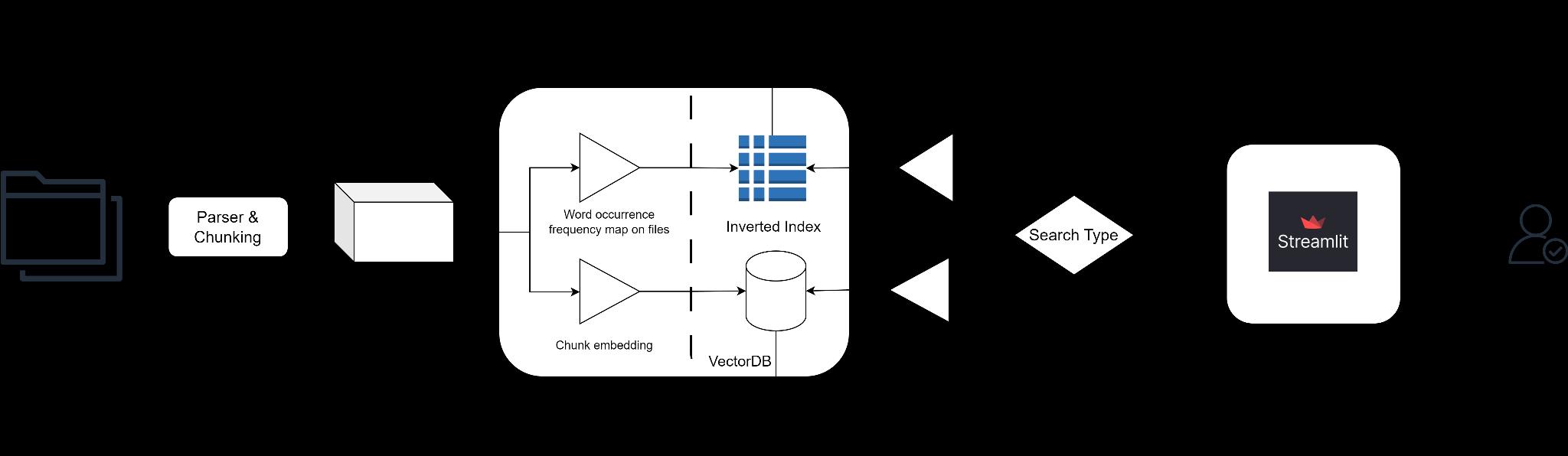
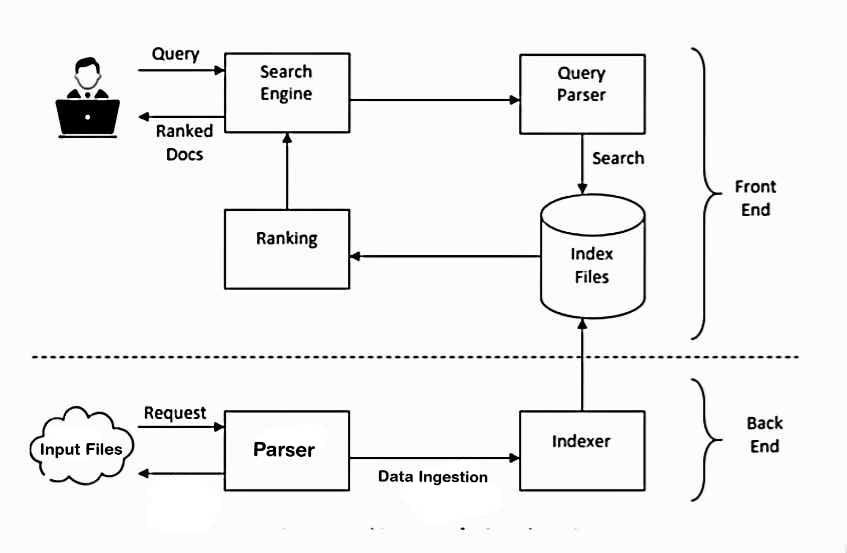
The architecture of SearchEase is designed to provide efficient and intelligent information retrieval capabilities across various data types. The system architecture consists of multiple interconnected components working together to enable seamlessdataingestion,preprocessing,indexing,andsearching.
International Research Journal of Engineering and Technology (IRJET) e-ISSN:2395-0056
Volume: 11 Issue: 05 | May 2024 www.irjet.net p-ISSN:2395-0072
4.1.DataIngestionLayer:
The data ingestion layer is responsible for collecting and extracting data from diverse sources such as files, databases, APIs,andwebscraping.Itincludesconnectorsandadaptersforinteractingwithdifferentdatasourcesandformats.Datais ingestedinreal-timeorbatchmode,dependingonthesourceandrequirements.
4.2.PreprocessingLayer:
Once the data is ingested, it goes through the preprocessing layer for cleaning, transformation, and enrichment. Text preprocessing tasks include tokenization, stemming, lemmatization, stop word removal, and entity recognition using natural language processing (NLP) techniques. Multimedia data may undergo preprocessing steps such as feature extraction,normalization,andmetadataenrichment.
4.3.IndexingLayer:
Theindexinglayergeneratesinvertedindexesandvectorrepresentationsofdocumentstofacilitateefficientstorageand retrieval. Inverted indexes map terms to documents, enabling fast keyword-based searches. Vector representations capturethesemanticsimilaritybetweendocuments,supportingsimilarity-basedsearchesandrelevanceranking.Indexes are optimized for quick retrieval and scalability, using indexing algorithms and data structures tailored to the search requirements.
4.4.SearchEngineLayer:
The search engine layer provides the interface for users to submit queries and retrieve relevant search results. It implements search algorithms that leverage the indexes generated in the indexing layer to find documents matching the user's query. Search functionalities include keyword-based searches, phrase searches, wildcard queries, and advanced searchfeatureslikefacetedsearchandrelevanceranking.
4.5.UserInterfaceLayer:
The user interface layer comprises web-based interfaces, APIs, and other client applications that allow users to interact withthesystem.Itprovidesauser-friendlyinterfaceforsubmittingqueries,browsingsearchresults,andrefiningsearch criteria.Interfacesmayincludedashboards,searchbars,filters,andvisualizationtoolstoenhancetheuserexperience.
International Research Journal of Engineering and Technology (IRJET) e-ISSN:2395-0056
Volume: 11 Issue: 05 | May 2024 www.irjet.net p-ISSN:2395-0072
SearchEaseisimplementedusingacombinationofprogramminglanguagesandlibraries,includingPython,NLTK,spaCy, and TensorFlow. The system architecture consists of modular components that handle specific tasks, such as data ingestion, text preprocessing, and indexing. Advanced natural language processing (NLP) techniques are employed to extractkeywordsandentitiesfromtextdata,enhancingsearchaccuracyandrelevance.
Theindexingprocessinvolvesbuildinginvertedindexesforkeyword-basedsearchesandcreatingvectorrepresentations of documents for similarity-based searches. The system is designed to scale efficiently with large datasets, utilizing distributedcomputingframeworksandoptimizeddata structures.Additionally,user-friendlyinterfacesaredevelopedto enableseamlessinteractionwiththeSearchEasesystem.
EntityRelationship diagramsisa specializedgraphicsthatillustratethe interrelationship between entitiesina database. Herediagramsalwaysusesymbolstorepresentdifferenttypesofinformation.
6. RESULTS
ExperimentalevaluationdemonstratestheeffectivenessofSearchEaseinimprovingsearchspeed,accuracy,andrelevance comparedtotraditional searchengines.Performancemetrics,including queryresponsetimeandprecision-recall curves, illustrate the system's capabilities in handling diverse data types and search queries. Case studies and user feedback furthervalidatethepracticalutilityofSearchEaseinreal-worldscenarios.
International Research Journal of Engineering and Technology (IRJET) e-ISSN:2395-0056
Volume: 11 Issue: 05 | May 2024 www.irjet.net p-ISSN:2395-0072
Initialpagewhenyoulaunchtheapp.

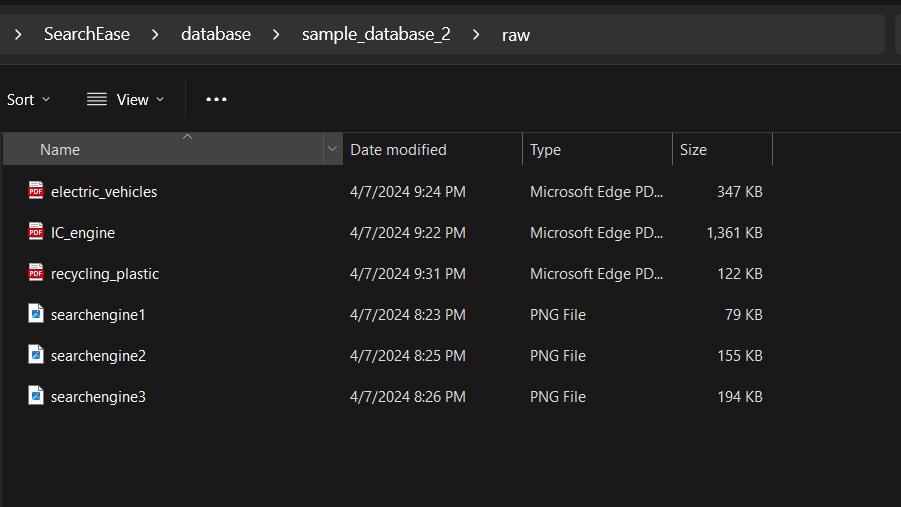
Addyourdatabasenamesay`DB2`,&datapathsay`database\sample_database_2`.
Ensurethedatapathcontainsafolder`raw`withallthefiles.
International Research Journal of Engineering and Technology (IRJET) e-ISSN:2395-0056
Volume: 11 Issue: 05 | May 2024 www.irjet.net p-ISSN:2395-0072
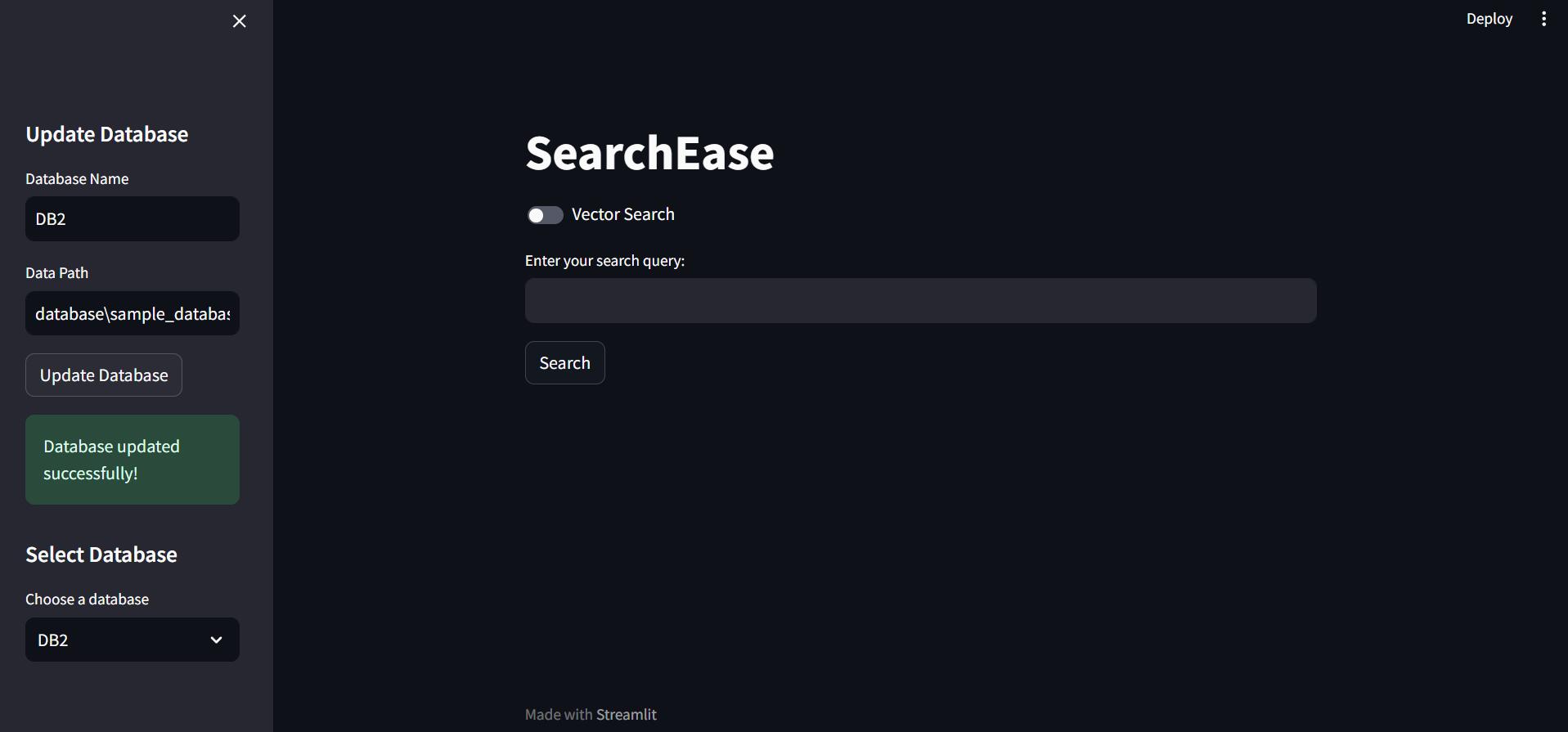
Hitthe`UpdateDatabase`buttonafterfillingthevariables,youshouldseea`RUNNING`icononthetopright.

Afterthedatabaseiscreatedyoushouldseeagreenconfirmationbanneronsidebar
International Research Journal of Engineering and Technology (IRJET) e-ISSN:2395-0056
Volume: 11 Issue: 05 | May 2024 www.irjet.net p-ISSN:2395-0072
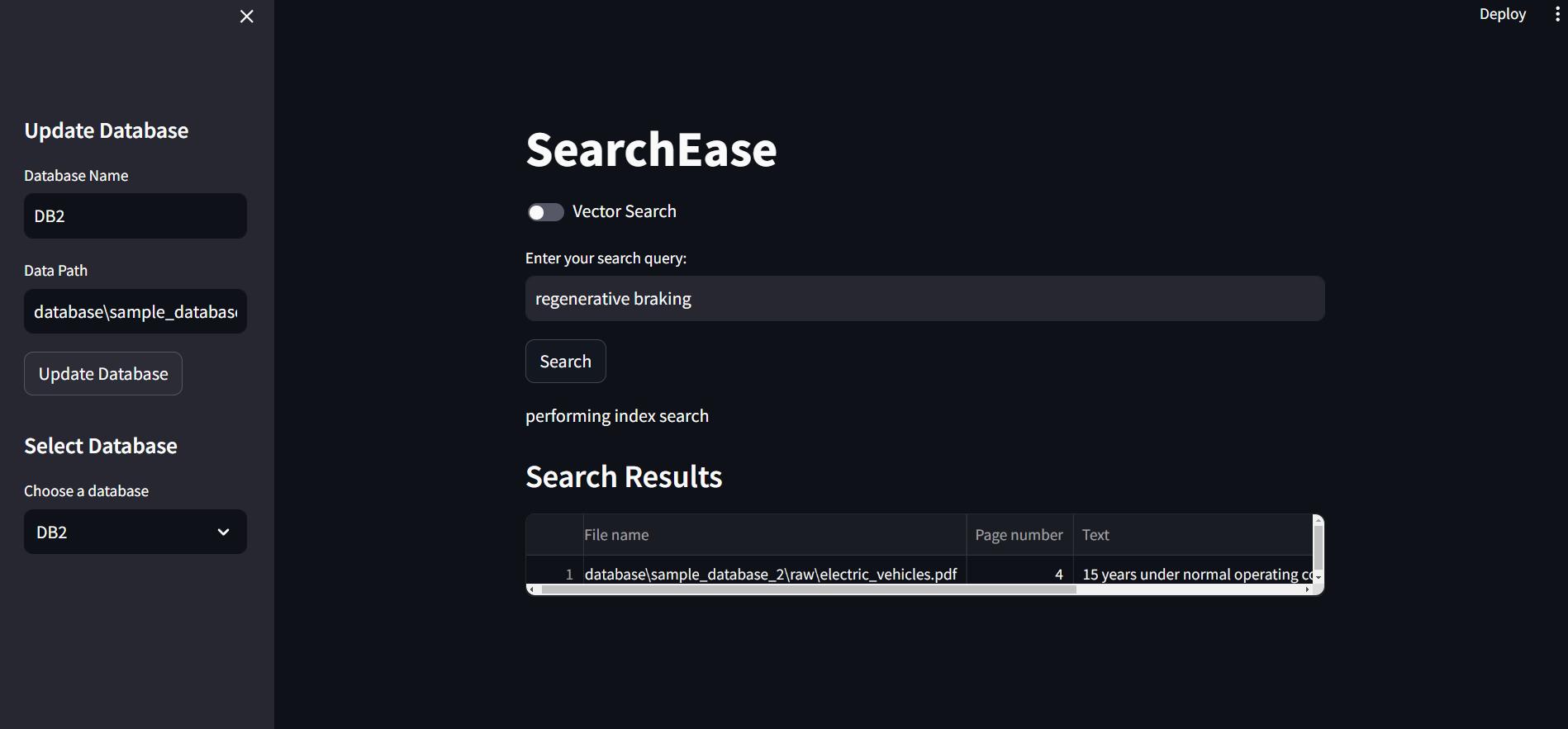
Defaultsearchisusing`InvertedIndex`,the`VectorSearch`toggleoffatthetopsignifiesinvertedindexsearch
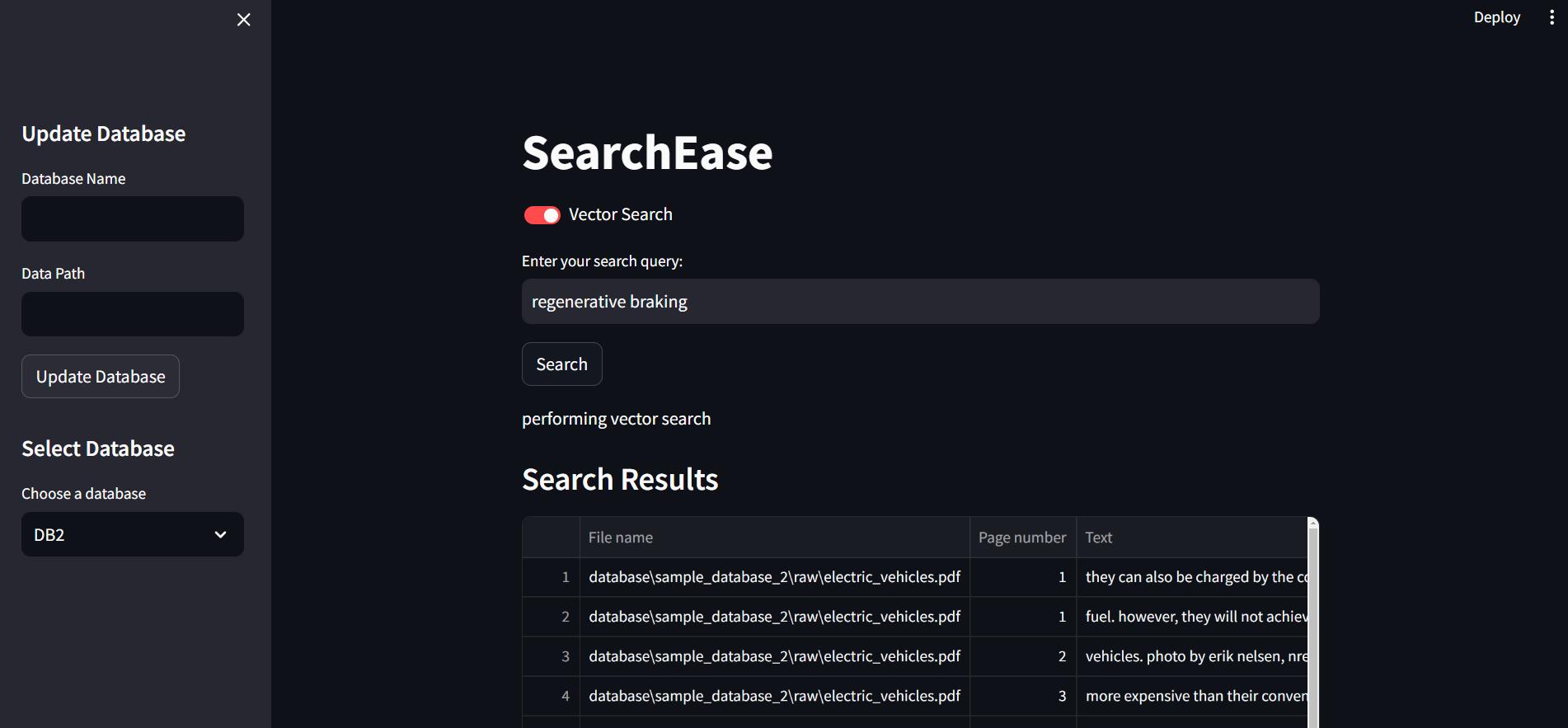
Toenablevectorsearchtoggleonthe`VectorSearch`atthetop
7. CONCLUSION
Inconclusion,theSearchEaseprojectrepresentsasignificantadvancementininformationretrievaltechnology,providing a comprehensive solution for efficient search across diverse data types. By leveraging both inverted index search and vector search techniques, SearchEase addresses the limitations of traditional search engines and offers enhanced capabilitiesforsemanticunderstandingandrelevanceranking.
By embracing emerging trends such as voice-activated search, federated search, explainable AI, augmented reality integration, blockchain-based search, quantum search algorithms, personalized knowledge graphs, and ethical AI practices, SearchEase can anticipate the future of information retrieval and stay ahead of evolving user needs and
International Research Journal of Engineering and Technology (IRJET) e-ISSN:2395-0056
technological advancements. Continuously innovating and adapting to emerging trends ensures that SearchEase remains attheforefrontofinformationretrievaltechnology,deliveringunparalleledsearchexperiencestousersworldwide.
8. REFERENCES
[1] Manning,C.D.,Raghavan,P.,&Schütze,H.(2008).IntroductiontoInformationRetrieval.CambridgeUniversityPress.
[2] Jurafsky,D.,&Martin,J.H.(2019).SpeechandLanguageProcessing.Pearson.
[3] Rajaraman,V.,&Ullman,J.D.(2011).MiningofMassiveDatasets.CambridgeUniversityPress.
[4] Choudhury, M., Mukherjee, A., Basu, A., Ganguly, D., & Boriah, S. (2020). Text Mining: Approaches and Applications. CRCPress.
[5] Katti,S.K.,&Gupta,S.(2019).DeepLearningforNaturalLanguageProcessing:AHands-OnTutorial.Springer.
[6] Pennington, J., Socher, R., & Manning, C. (2014). GloVe: Global Vectors for Word Representation. In Proceedings of EMNLP.
[7] Mikolov,T.,Sutskever,I.,Chen,K.,Corrado,G.S.,&Dean,J.(2013).DistributedRepresentationsofWordsandPhrases andtheirCompositionality.InProceedingsofNIPS.
Volume: 11 Issue: 05 | May 2024 www.irjet.net p-ISSN:2395-0072 © 2024, IRJET | Impact Factor value: 8.226 | ISO 9001:2008 Certified