
Design, Analysis & Optimization of Heatsink
Mr. Aniket Dnyaneshwar Gaikwad
Mr. Shubhankar Suhas Ghosalkar 3
Mr. Prasad Dilip Ingole 4
Prof. Amol Zope
Dr. Mridul Malakar
Mr. Amit More
1-3BE Mechanical Students, Mechanical Engineering Department, Pune Vidyarthi Griha’s College of Engineering and Technology and G.K. Pate (Wani) Institute of Management, Pune – 411009
4Project Guide & Assistant Prof. Mechanical Engineering Department, PVG’s COET & GKPIOM, Pune – 411009
5EV-Manager (R &D), Belrise Industries Ltd. Pune 411005
6Design and Development Manager, Belrise Industries Ltd. Pune 411005 Maharashtra, India ***
Abstract - This project focuses on the optimization of a heatsink designed for application in electric vehicles (EVs) manufactured by Belrise Industries Private Limited. Utilizing ANSYS simulation software, comprehensive analyses were conducted to evaluate the heatsink thermal performance, including its capacity and maximum operating temperature under varying conditions. Through iterative simulations and analysis,areasforenhancementwereidentified,leadingtothe development of an optimized heatsink design. This report outlines the methodology, findings, and recommendations derived from the simulation-based optimization process, aimed at enhancing the thermal efficiency and overall performance of the heatsink for EV applications.
Key Words: Optimizationofheatsink,thermalperformance Increases.
1. INTRODUCTION
BelriseIndustriesLtd.recognizedthecriticalimportanceof optimizingtheirheatsinktomitigatetheriskofoverheating intheirsystem.Hightemperaturesposedasignificantthreat to the reliability and performance of their equipment, necessitatingaproactiveapproachtothermalmanagement. Theneedforimprovedheatdissipationarosefromconcerns over system stability, potential component failures, and associated maintenance costs. Addressing this need was essential to maintain competitiveness, ensure product quality,andmeetcustomerexpectationsforreliabilityand durability
2. PROBLEM STATEMENT
BelriseIndustriesLtdfacedapressingchallengeofeffectively dissipating heat generated by their system components, particularlyunderhighloadconditions.Suboptimalthermal managementledtoelevatedtemperatureswithinthesystem, compromising performance, reliability, and operational lifespan. Inadequate heat dissipation exacerbated thermal stresses on critical components, increasing the risk of premature failure and downtime. The problem extended beyondimmediateoperationalconcernstoencompasslongterm sustainability, regulatory compliance, and customer satisfactionobjectives.
3. DEFINITION OF PROBLEM
Theprimaryissuecanteredontheinefficiencyoftheexisting heat sink design in transferring heat away from critical components to the surrounding environment. Thermal resistance within the system hindered the effective dissipationofheat,resultingintemperaturegradientsand localizedhotspots. Consequencesoftheproblemincluded reduced system efficiency, impaired functionality, and potentialsafetyhazardsinextremecases.Failuretoaddress these thermal management challenges could jeopardize BelriseIndustriesPvtLtd.marketposition,brandreputation, andprofitability.
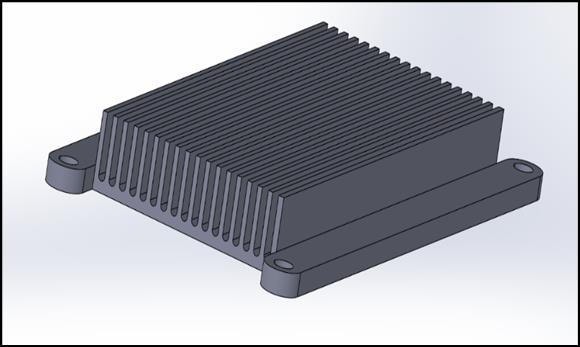
4. COMPANY GIVEN HEATSINK DETAILS
Material : Aluminium6061
Length : 225mm
Width : 145mm
Mass : 449.84Grams
TypeOfFin : RectangularFin
International Research Journal of Engineering and Technology (IRJET) e-ISSN: 2395-0056
Volume: 11 Issue: 05 | May 2024 www.irjet.net p-ISSN: 2395-0072
SurfaceArea : 270291.24mm2
Working-Load : 115Watts
5. STEADY STATE THERMAL ANALYSIS OF COMPANY GIVEN HEATSINK
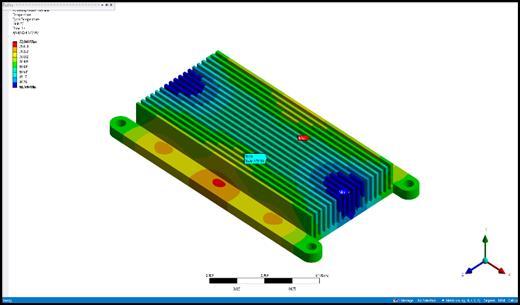
Steady-statethermalanalysisisamethodusedtoevaluate the temperature distribution within a system when it has reachedthermalequilibrium,meaningtemperaturesremain constantovertime.Thisanalysisiscrucialinunderstanding theeffectivenessofheatdissipationincomponentssuchas heatsinks. By applying the principles of heat transfer, specifically conduction, convection, and radiation, steadystatethermalanalysisallowsengineerstopredicthowheat willspreadthroughamaterialorassemblyunderconsistent operatingconditions.UtilizingtoolslikeANSYS,thistypeof analysisprovidesinsightsintothethermalperformanceof designs, helping to optimize configurations for improved coolingefficiencyandreliabilityinelectronicdevices.
6. TRANSIENT THERMAL ANALYSIS OF COMPANY GIVEN HEATSINK
Transientthermalanalysisisamethodusedtoevaluatethe temperaturedistributionandheatflowwithinasystemover time, capturing how temperatures change dynamically in response to varying thermal loads. Unlike steady-state analysis, which assumes a constant thermal condition, transientanalysisconsidersthetemporalevolutionofheat transfer, accounting for the effects of time-dependent sources, sinks, and boundary conditions. This analysis is essentialforunderstandinghowsystemsrespondtothermal transients, such as startup, shutdown, or fluctuating operationalconditions.ByusingsimulationtoolslikeANSYS, engineerscanmodelthethermalbehaviorofmaterialsand components under varying conditions, providing critical insightsintotheirthermalmanagementstrategies,ensuring reliability, and preventing thermal fatigue or failure in electronicdevices.

6.1 Temperature Vs Time Graph
Thetemperaturevs.timegraphrevealshowquicklytheheat sink can respond to thermal loads, which is crucial for maintainingoptimaloperatingtemperatures.
Therapidinitialriseintemperaturehighlightstheneedfor efficientheatdissipationmechanismsintheearlystagesof operation.
Initial Phase:Thetemperaturerapidlyincreasedastheheat load was applied, indicating the system's initial thermal response.
Intermediate Phase: The rate of temperature increase begantoslowastheheatsinkstarteddissipatingheattothe surroundings.
Final Phase:Thetemperaturecurveflattened,approaching a steady-state temperature of approximately 72°C after a certainperiod.
The graph is obtained from transient thermal analysis (Showing achievement of steady temperature in nearly 5000seconds).
Thegiveninputfortimeis14,400swhichisroughly4hrs.
Fig -1:HeatsinkGeometry
Fig -2:SteadyStateThermalAnalysisofHeatsink
Fig -3:TransientThermalAnalysisofHeatsink
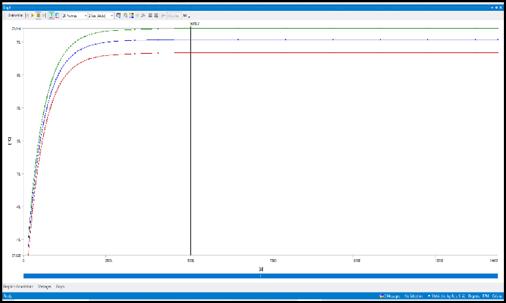
Chart -1:TemperaturevsTimeGraph
7. OPTIMIZED HEAT SINK
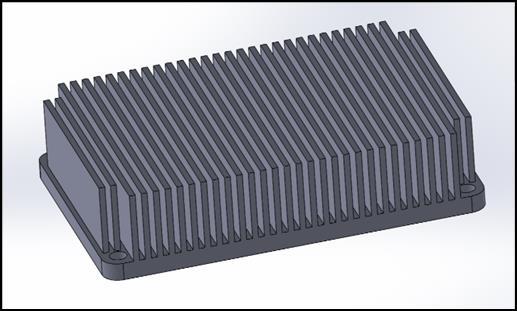
Fig -4 OptimizedHeatSinkGeometry
Material : Aluminium6061
Length : 225mm
Width : 145mm
Mass : 953.93grams
Typeoffin : Rectangularfin
Surfacearea : 442854.9mm2
Workingload : 115Watts
7.1 Steady state analysis ofOptimizedHeatsink

Fig -5 :SteadystateanalysisofOptimizedHeatsink
Theoptimizedheatsinkachievedamaximumtemperature of56.2°C,asubstantialreductionfromthebaselinedesign’s 72°C.
Thetemperaturedistributionacrosstheheatsinkwasmore uniform, indicating improved heat spread due to the increasedsurfaceareaandoptimizedfinorientation.
8.COMPARATIVE STUDY OF COMPANY GIVEN HEATSINK AND OPTIMIZED HEATSINK PARAMETER
Number Of Fins 18 32
Manufacturability Easy Complex Power Rating 115Watts 115Watts International Research Journal of Engineering and Technology (IRJET) e-ISSN: 2395-0056 Volume: 11 Issue: 05 |
9. CONCLUSION
Our optimization of the heat sink for a 115-watt power rating,usingANSYSsimulations,significantlyimprovedits thermalperformance.Bydoublingthesurfaceareathrough strategic fin reorientation, we reduced the maximum temperaturefrom71.6°Cto56.2°C.Althoughtheheatsink’s mass increased from 449.8 grams to 953.9 grams, the enhancementsinthermalefficiencyjustifythischange.This project highlights our effective use of simulation-driven designtoachievesuperiorthermalmanagement
ACKNOWLEDGEMENT
We are acknowledging Dr. Mridul Malakar (EVManager,BelriseIndustriesLtd.Pune), Mr.AmitMore (DesignandDevelopmentManager,BelriseIndustries Ltd. Pune), Prof. Amol Zope (Project Guide, MechanicalDepartment,PVG’sCOET,Pune),Prof.Dr. M. M. Bhoomkar (HODMechanicalDepartment,PVG’s COET,Pune)forkindguidanceandsupport.
International Research Journal of Engineering and Technology (IRJET) e-ISSN:
Volume: 11 Issue: 05 | May 2024 www.irjet.net
REFERENCES
[1] Rajput,R.K.(2015).HeatandMassTransfer(6thed.).S. ChandPublishing.
[2] Çengel, Y. A., & Ghajar, A. J. (2015). Heat and Mass Transfer: Fundamentals and Applications (5th ed.). McGraw-HillEducation.
[3] Elenbaas,W.(1942)."HeatDissipationofParallelPlates byFreeConvection."Physica,9(1),1-28.
[4] Zhang,L.,&Lee,H.P.(2011)."OptimizationofHeatSink Design for Electronics Cooling Using Computational Fluid Dynamics and Response Surface Methodology." JournalofElectronicPackaging,133(4),041008.
[5] A.kumarandK.Londhe,“Heatsinkdesignforoptimal performance of compact electronic appliances-a review,”Researchgate,October2017
BIOGRAPHIES



AniketDnyaneshwarGaikwad
BEMechanicalstudentatPVG’sCOET, Pune.
ShubhankarSuhasGhosalkar
BEMechanicalstudentatPVG’sCOET, Pune.
PrasadDilipIngole
BEMechanicalstudentatPVG’sCOET, Pune