
Human Activity from Surveillance Camera Using Deep Learning
K Sahadevaiah1, Chellaboyina Yaswanth2 ,
1Professor, Computer Science and Engineering Dept, Jawaharlal Nehru Technological University, Kakinada, AP, India.
2Post Graduate Student, Master of Technology (IT), Jawaharlal Nehru Technological University, Kakinada, AP, India.
Abstract: In recent years, skeleton-based action recognition has drawn a lot of attention. Because deep learning can extract pertinent information and achieve high recognition accuracy, it has been widely used in picturerecognition.Deeplearning'sultimategoalistogive machines the same capabilities as the human brain for data analysis and learning by helping them recognise patternsandprinciplesintestdata.Thegoalofthisproject is to use Media Pipe and deep learning techniques to accomplishrobustandaccuratehumanactionrecognition. The Media Pipe offers pre-trained models that eliminate theneedforongoingtrainingandareusefulforaccurately identifying important locations on hands, faces, and human bodies. By monitoring their changes over time, these salient points can be utilised as characteristics for action recognition. The convolution and pooling layers of the convolutional neural network get the important information, resulting in an effective action prediction. Basedontheinput,themodelpredicts12distinctactions. Pythonisusedtoimplementthedeeplearningalgorithms andmediapipeforhumanactionrecognition.
Keywords: Human Activity Recognition, Deep Learning, mediapipe,ComputerVision.
INTRODUCTION
With the rising of crime rates become an issue if they are not promptly recognised and the appropriate safety measuresare notimplemented. The majority ofcitiesand metropolitan areas have deployed surveillance systems that continuously gather data. The enormous amount of surveillance data means that there is a greater likelihood ofsuspiciousactivity.However,becausethesejobsaretoo complex and resource-intensive for artificial intelligence to undertake, human monitoring is necessary to detect such behaviours. One method to simplify an activity for automation is to break it down into smaller components and identify subtasks that could lead to potential crimes. We use our models to try and identify two primary pathwaysthatcouldleadtocrimes.
OBJECTIVE:
The primary goal is to use deep learning to construct the model for human action recognition. Probably demonstrating that artificial shallow neural networks are
not the optimal method for classification; instead, deep learning.
In the modern world, the most fundamental & effective securitymeasureabuildingcanhaveisCCTVsurveillance. Hospitals, shopping centres, universities, and other establishments use it as the most well-known means of identifying and stopping undesired activity. However, pictureanacademiccampuswithover100CCTVcameras spreadoverseveralstructures,suchasdorms,classrooms, canteens, sports areas, auditoriums, etc. It is not possible to manually watch every incident captured by the CCTV camera. It takes a lot of time to manually look for the identical incident in the recorded video, even if it has alreadyhappened.Allthingsconsidered,weplantocreate asingledeeplearningmodelthatusesmediapipemodule data to forecast human behaviour. Lastly, we are contrastingtheaccuracyusingthecurrentANNtechnique system.
DOMAIN OVERVIEW:
Thesedays, deep neural networksare extensivelyused in both academia and business as the cutting edge of machine learning models in a range of fields, including naturallanguageprocessingandimageanalysis.
Slowlybutsurely,theseadvancementsholdgreatpromise for medical imaging technologies, medical data analysis, medical diagnostics, and healthcare overall. We give a brief summary of current developments in machine learning as they relate to medical image processing and analysis,alongwithsomerelateddifficulties.Conventional machine learning techniques were the norm long before deep learning was employed. Like SVM, Logistic Regression,DecisionTrees,andNaiveBayesClassifiers.
Anothernameforthesealgorithmsisflatalgorithms.Here, "flat" refers to the fact that these techniques are typically not able to be applied directly to the raw data (text, images,.csv files, etc.). A preprocessing procedure known asfeatureextractionisrequired.
These traditional machine learning algorithms can now employtherepresentationoftheprovidedrawdataasthe outcome of feature extraction to complete a task. As an illustration,consider thedivisionofthedata intomultiple classesorcategories.
International Research Journal of Engineering and Technology (IRJET) e-ISSN:2395-0056
Volume: 11 Issue: 05 | May 2024 www.irjet.net p-ISSN:2395-0072
Feature extraction typically involves a great deal of complexity and in-depth understanding of the issue domain. For best results, this pre-processing layer needs to be adjusted, tested, and improved across a number of rounds.
DL based ANN are on the opposite side. The Feature Extraction phase is not necessary for these. The layers have the ability to independently and directly learn an implicit representation of the raw data. Here, multiple layers of artificial neural networks are used to create an increasingly abstract and compressed representation of the original input. The outcome is then generated using this condensed representation of the input data. One possible outcome is the input data being divided into variousclasses.
LITERATURE SURVEY
Themostcrucialstageinthesoftwaredevelopment process is the literature review. Determining the time factor, economics, and company strength is required beforebuildingthetool.Thenextstageistodecidewhich operating system and language can be used for tool development once these requirements are met. The programmers require a great deal of outside assistance once they begin developing the tool. This support can be obtained from senior programmers, from book or from websites. The aforementioned factors are taken into accountbeforeconstructingthesuggestedsystem.
A literature review is a corpus of work that tries to review the important aspects of current knowledge, such as significant discoveries and theoretical and methodologicaladvancementsrelatedtoaspecificsubject. Sinceliterature reviewsare secondarysources,theydon't present any brand-new or unique experimental research. A literature review can also be thought of as an assessmentofanintangibleachievement.
PROPOSED SYSTEM:
● Inputvideo
● Pre-processing
● Featureextraction
● CNN(convolutionalneuralnetwork)
ADVANTAGE:
Highaccuracy
Itwillidentifythesuspectwithvideos
Implementation Steps:
1.ImportthenecessarymodulesinPython.
2. Loading the dataset of human action photos and utilisingthemediapipemoduleforanalysis.
3. Data augmentation, which divides the visual data into trainandtestsets,increasestheappropriateinformation.
4. Create the framework needed to save the model and trainthedataset.
5.Determiningthemaximumaccuracymodelandcarrying outthevalidationprocesswithtestdata.
6. Using the sample image information and the model to identifythehumanaction.
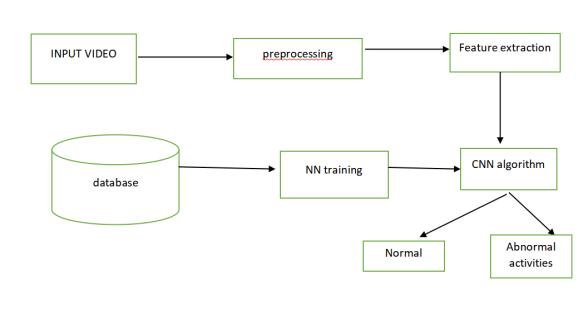
Figure1:BlockDiagram
Load Data: Extracting 15 labelled human activity photos from a collection of 15,000 images. It will be easier to extract the features if media outlets use their channels to clearlyshowhumanlandmarks.
Prior to processing: The processes done to format images before to their usage in model training and inference are known as image pre-processing. This covers resizing, aligning,andcolouradjustments,amongotherthings.
Practice and assess: Two subsets are created from the datasets. The first subset, known as the training data, contains a piece of our real dataset, which is used to help the machine learning model recognise and learn patterns fromit.Inthisway,ittrainsourmodel.Theothersubsetis thetestingdata.
Feature analysis:- According to feature analysis, we may see distinctqualitiesin everyobjectandpattern wecome across. According to the recognition-by-components theory, we identify objects by breaking them down into theirconstituentelements.Theseelementsarerecognised asgeons,whicharethree-dimensionalforms.Comparedto directly applying machine learning to the raw data, it producesbetteroutcomes.
CONVOLUTION NEURAL NETWORK (CNN)
CNN CNN though it may sound like a strange mash-up of math and biology with a dash of computer science, these networks have been among the most important developments in computer vision. Neural nets gained popularityforthefirsttimein2012whenAlexKrizhevsky usedthemtowintheImageNetcompetition,whichisakin totheyearlyOlympicsofcomputervision.Atthetime,this achievement was remarkable since it reduced the
International Research Journal of Engineering and Technology (IRJET) e-ISSN:2395-0056
classification error record from 26% to 15%. Since then, deep learning has been the foundation of many businesses' offerings. Neural nets are used by Facebook for its automatic tagging algorithms, by Google for photo search, by Amazon for product suggestions, by Pinterest for personalised home feeds, and by Instagram for search infrastructure
The Problem Space
Theprocessoftakinganinputimageandproducingaclass (a dog, cat, etc.) or a probability of classes that best describes the image is known as image classification. One ofthe firstabilities weacquire ashumans isthe ability to recognise,whichisaskillthatcomeseasilyandreadilyto adults. We can rapidly and easily recognise the objects aroundusandthesurroundingsweareinwithoutgivingit asecondthought.Mostofthetime,withoutevenrealising it, we are able to describe a scene and assign a label to eachthingwhenweseeanimageorsimplywhenwegaze at the world around us. We do not share these abilities with other machines: the ability to swiftly identify patterns, generalise from past knowledge, and adapt to variousvisualsettings.
Inputs and Outputs
When When a computer views (or receives) an image, it perceivesanarrayofpixelvalues.Thedisplayofa32×32 x3arrayofintegerswilldependonthesizeandresolution of the image (the 3 stands for RGB values). To emphasise theconcept,let'stakean examplewhere wehavea 480 × 480 colour JPG image. The 480 × 480 x 3 representative arraywill beused.Avaluebetween0and255isassigned toeachofthesevalues,denotingthepixelintensityatthat particular location. The only inputs available to the computerforimageclassificationarethesenumbers,even iftheyhavenomeaningforus.
What We Want the Computer to Do
Now that we are aware of the issue and its sources and results, let's consider our options for solving it. The computer is supposed to be able to distinguish between each image it is shown and identify the distinctive
Volume: 11 Issue: 05 | May 2024 www.irjet.net p-ISSN:2395-0072 © 2024, IRJET | Impact Factor value: 8.226 | ISO 9001:2008
characteristicsthat define a dog asa dogora cat asa cat. This is also the process that occurs subliminally in our minds. If an image of a dog contains distinguishable characteristics,likefourlegsorpaws,wecancategoriseit as such. Similar to this, the computer can classify images byfirstsearchingforbasicfeatureslike edgesandcurves, and then using a sequence of convolutional layers to advance to more complex ideas. This is a broad summary ofwhataCNNperforms.Nowlet'stalkaboutthedetails.
Biological Connection
First, though, some background. You might have associated CNN with neuroscience or biology when you first heard the word, and you would be correct. Kind of. CNNs are inspired biologically by the visual cortex. Differentregionsofthevisualfieldelicitdistinctresponses from small cell areas in the visual cortex. Hubel and Wiesel's seminal 1962 experiment (Video) advanced this hypothesis further by showing that certain individual brain neuronal cells only fired, or responded, in the presenceofedgesorientedinaspecificway.Forexample, certain neurons responded when they observeda vertical edge, while other neurons fired when they observed a horizontalordiagonaledge.ResearchersHubelandWiesel found that these neurons may work together to create visual perception. The arrangement of these neurons was columnar. CNNs are predicated on the idea that specific components of a system have discrete roles (for example, the neurons in the visual cortex searching for particular traits).Thisconceptisalsousedbycomputers.
Structure
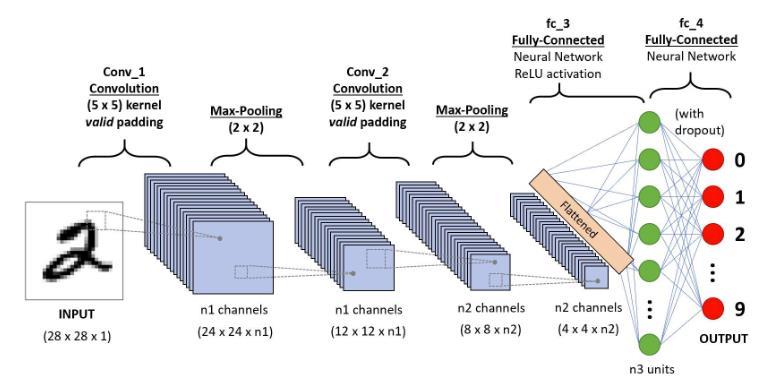
Now let's return to the specifics. To provide a more comprehensive understanding, consider the following: a CNN processes an image by applying various fully connected, convolutional, nonlinear, pooling (down sampling), and other layers before producing the desired result. As we mentioned earlier, the result can be a single class or a probability of classes that best describe the image. Right now, figuring out what each of these levels does is the difficult part. Let's talk about the most importantonenow.
First Layer – Math Part
ACNN'sconvolutional layer isalways itsinitial layer. The first thing you should keep in mind is what this conv (I'll beusingthatacronymalot)layer'sinputis.Aspreviously stated, the input consists of a 32 × 32 x 3 array of pixel values. Currently, the best approach to visualise a convolution layer is to see the upper left portion of the image illuminated by a torch. Assume that a 5 5 area is illuminated by the light this torch emits. Let's now visualise this torch moving across every section of the input image. This torch is known as a filter in machine learning terminology (it is also sometimes termed a neuron orkernel).Thearea itilluminatesisknownasthe
Figure2:CNNArchitecture
International Research Journal of Engineering and Technology (IRJET) e-ISSN:2395-0056
Volume: 11 Issue: 05 | May 2024 www.irjet.net p-ISSN:2395-0072
receptive field. Currently, this filter also consists of an array of numbers, which are referred to as weights or parameters. The dimensions of this filter are 5 x 5 x 3, which is a very significant detail since the depth of the filter must match the depth of the input in order for the math to work. Let's now use the filter's initial location as an example. That is the upper left corner. The filter multiplies its values by the original pixel values of the input image while it slides, or convolves, around it (also known as computing element-wise multiplications). All of these multiplications are added together, or 75 multiplicationsoverallinmathematics.Youarenowdown toonenumber.Recallthatthisfiguremerelyindicatesthe moment in the picture when the filter is at the upper left corner. We now carry out this procedure one again for each place on the input volume. The filter would then be moved one unit to the right, one unit to the right again, and so forth. A number is produced at each distinct positionontheinputvolume.Allthat'sleftwhenyouslide thefilterover eacharea is anarrayof integers measuring 28by28by1,whichisreferredtoasanactivationmapor featuremap.A5×5filtercanfitin784distinctspotsona 32x32inputimage,whichiswhyyougeta28x28array. A28×28arrayismappedtothese784numbers.
First Layer – High Level Perspective
Let's take a high-level look at what this convolution is truly doing, though. You can think of each of these filters as a feature identifier. When I refer to features, I mean characteristics like curves, plain colours, and straight edges. Consider the most basic qualities that all photographssharewithoneanother.Assumethatourfirst filter,a7x7x3curvedetector,willfunctionassuch.(For thesakeofsimplicity,let'signorethefilter'sthreeunitsof depth in this part and just focus on the image's top depth slice.) The filter functions as a curve detector by having a pixel structure with larger numerical values along the areasthatformcurves(keepinmindthatthesefiltersare justnumbers!).
Convolution Neural Network Creation Steps
1. Specify the Input Layer: To begin, specify the input layer'sdimensions(suchastheimage'sheight,width,and numberofchannels).
2.IncorporateConvolutionLayers:
Useaconvolutionallayerorlayerstoextractfeaturesfrom theinputdata.Foreverylayer,specifycharacteristicssuch theactivationfunction,kernelsize,andnumberoffilters.
3. use Pooling Layers: To downsample the feature maps produced by the convolutional layers, use pooling layers (such as max pooling). Pooling facilitates the reduction of spatialdimensionsandthemanagementofoverfitting.
4.FlattentheOutput:Convolutionalorpoolinglayer'sfinal output should be flattened into a 1D vector. In order to feedthedataintothefullyconnectedlayers,thisprepares it.
5. Add Fully Connected Layers: To process the flattened characteristics, add one or more fully connected (dense) layers.Indicatetheactivationfunctionsandthequantityof units(neurons)foreachoftheselayers.
6.DefinetheOutputLayer: Depending on the typeof task you're doing (binary classification, multi-class classification, etc.), choose an appropriate activation function (like SoftMax for classification) in the output layer.
7. Assemble the Model: Assemble the CNN model by indicating the optimizer, loss function, and metrics that willbeappliedtotraining.
8. Train the Model: A training dataset is used to train the CNN model. To maximise performance, modify hyperparameters(suchasbatchsizeandlearningrate)as necessary.
9. Assess the Model: To determine the model's performance (e.g., accuracy, loss), evaluate the trained modelusingadifferentvalidationdataset.
Forecasts: Apply the learned CNN model to forecast fresh or unobserved data. Consider the task when interpreting the model outputs (e.g., class probabilities for classification).
Parameters Calculations
Initially, the confusion matrix was used to assess the outcomes of binomial classification. Therefore, the first step is to designate the positive class one of the two classes as the class of interest. In the target column, we have to select (randomly) one value to represent the affirmative class. The other value is then automatically allocated the negative class. Although this assignment is entirely random, keep in mind that some class statistics will show different values based on the selected positive class. In this example, we utilised the regular e as the negativeclassandthepositiveclass.

International Research Journal of Engineering and Technology (IRJET) e-ISSN:2395-0056
Volume: 11 Issue: 05 | May 2024 www.irjet.net p-ISSN:2395-0072
Results:
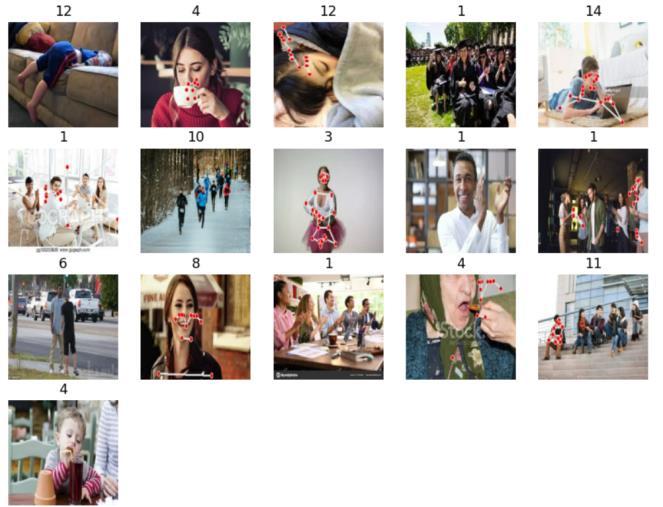


5:Finalresultofmodellabelpredictionforthe inputimage.

Figure6:Comparisonresultfortheexistingsystemand ourproposedsystem
Note that this is a experimental result for comparison of CNNmodelswithANNmodel,whereweareimplementing theANNbasemodelinourproject.
CONCLUSION
Using Media Pipe and Deep Learning, a Human Action Recognition system was successfully constructed for this project. A dataset including 20,000 annotated skeletal photos of 15 distinct human activities was used to train the machine. The ResNet-18 architectural model is used, which was found to provide effective training. The model proved its efficacy in identifying human motions from skeletal photos by achieving accuracy on the testing set. MediaPipe was used to derive the skeleton pictures from the original photographs, which supplied essential position information for action recognition. Applications in the actual world, including action recognition in surveillance, are possible. In the end, our project's use of convolution neural networks allows us to create models withupto85%accuracy.
FUTURE SCOPE:
The potential uses of DL with surveillance cameras for monitoring human behaviour appear to be extensive and span a wide range of fields. To guarantee the proper deploymentanduseofthesetechnologies,itisimperative toaddressprivacy,security,andethicalissues.
REFERENCE:
[1] S. Ren, K. He, R. Girshick, and J. Sun, “[Faster R-CNN: TowardsReal-TimeObjectDetectionwithRegionProposal Networks](https://papers.nips.cc/paper/5638-faster-rcnn-towards-real-time-object-detection-with-regionproposal-networks),” in NIPS 2015 - Advances in Neural Information Processing Systems 28. Neural Information ProcessingSystemsFoundation,2015
[2] Pierre Sermanet David Eigen Xiang Zhang Michael Mathieu Rob Fergus Yann LeCun “[OverFeat: Integrated Recognition, Localization and Detection using Convolutional Networks](https://arxiv.org/pdf/1312.6229.pdf),”
Figure3:Mediapipevisualizationresultofthesample data
Figure4:Dataaugmentationmediapiperesultforthe inputdata
Figure
International Research Journal of Engineering and Technology (IRJET) e-ISSN:2395-0056
Volume: 11 Issue: 05 | May 2024 www.irjet.net p-ISSN:2395-0072
Courant Institute of Mathematical Sciences, New York University.
[3]TheIMFDBInternetMovieFirearmsDatabase,[Online] Available: [http://www.imfdb.org/wiki/Main_Page](http://www.im fdb.org/wiki/Main_Page)[AccessedMar20,2019]
[4] Soft Computing and Intelligence Information Systems, [Online] Available: [https://sci2s.ugr.es/weaponsdetection](https://sci2s.ugr.es/weapons-detection) [AccessedMar27,2019]
[5] C. Szegedy, V. Vanhoucke, S. Ioffe, J. Shlens, and Z. Wojna, “[Rethinking the Inception Architecture for Computer Vision](https://arxiv.org/abs/1512.00567),” in arXiv,vol.abs/1512.00567,2015
[6] Rohit Kumar Tiwari and Gyanendra K. Verma, “[A Computer Vision based Framework for Visual Gun Detection using Harris Interest Point Detector](https://www.sciencedirect.com/science/article /pii/S1877050915002010),” Procedia Computer Science, vol54,p.703-712,2015
[7]Samir K. Bandyopadhyay,Biswajita Datta,and Sudipta Roy “[Identifications of concealed weapon in a Human Body](https://www.sciencedirect.com/science/article/pii /S1877050911020673),” Department of Computer ScienceandEngineer,UniversityofCalcutta,2012
[8]Claire-HlneDemarty,et.al“[TheMediaEval2012affect task: violent scenes detection](https://hal.inria.fr/hal00731568/document),”WorkingNotesProceedingsofthe MediaEval2012Workshop.2012.
[9] Roberto Olmos, Siham Tabik, and Francisco Herrera “[Automatic Handgun Detection Alarm in Videos Using Deep Learning](https://www.mdpi.com/20763417/7/4/385),” Soft Computing and Intelligent Information Systems research group, Department of Computer Science and Artificial Intelligence, University of Granada,2017
[10] Lisa Torrey and Jude Shavlik, “[Transfer Learning](http://ftp.cs.wisc.edu/machinelearning/shavlikgroup/torrey.handbook09.pdf),” UniversityofWisconsin,MadisonWI,USA.
About Authors

Mr. Chellaboyina Yaswanth, Post Graduate Student (M.Tech -IT), Computer Science and Engineering Dept, Jawaharlal Nehru Technological University, Kakinada. His Area of Interest includes Internet of Things, Deep Learning, and Computer Networks.

Dr.K.Sahadevaiah, Professor, Computer Science and Engineering Dept, Jawaharlal Nehru Technological University, Kakinada His areas of interest include Ad Hoc Wireless Networks, Vehicular Ad Hoc Networks, Wireless Sensor Networks, and Wireless Mesh Networks.
2024, IRJET | Impact Factor value: 8.226 | ISO