
International Research Journal of Engineering and Technology (IRJET) e-ISSN: 2395-0056
Volume: 11 Issue: 05 | May 2024 www.irjet.net p-ISSN: 2395-0072
International Research Journal of Engineering and Technology (IRJET) e-ISSN: 2395-0056
Volume: 11 Issue: 05 | May 2024 www.irjet.net p-ISSN: 2395-0072
A.Karthik1* & N. Phani Raja Rao2
*1M.Tech Student (Production Engineering), Department of Mechanical Engineering, Sri Venkateswara Institute of Technology, Ananthapuram. India- 515722.
2Associate Professor&HOD, Department of Mechanical Engineering, Sri Venkateswara Institute of Technology, Ananthapuram. India- 515722.
Abstract - The demand for sustainable manufacturing has been increasing in the present scenario due to many reforms in the environmental conscious regulation. Therefore, current study focused on sustainable machining techniques that textured tools and Minimum Quantity Lubrication (MQL) to meet the demand in the metal cutting industries. In the present work, surface textured tools were fabricatedand same tools was used to assess the turning process performance during machining of EN8 material. The obtained results were compared with untextured tools under MQLcoolingcondition. Results indicated that while turning EN8 material, the largest decreases in cutting temperature, rake wear, flank wear, and surface roughness were reported to be 14%, 22%, 29%, and 38%, respectively, while using textured tools as opposed to untextured tools. Further, noticed that under MQL cooling conditions, the textured tools showed a micro pooling effect with microgrooves.
Key Words: MQL;EN8;TexturedTool;surfaceroughness; toolwear
1.INTRODUCTION
En8materialisfrequentlyusedintheautomobilesectorto manufactureshaftsandaxles.Therefore,itisimperativeto improvethismaterial'smachinability.Usingstandardtools, Thangarasu et al. (2020) performed experiments on EN8 steelinadrystate.TheyusedANNtoevaluatetheturning performance characteristics and found that there was minimal inaccuracy in the correlation between the experimentalandanticipatedoutcomes.Intheir2008study, Vamsi Krishna and Nageswara Rao examined the turning capabilitiesoftraditionaltoolswhenmachiningEN8steelin three different lubrication conditions: dry, wet, and developed solid. Compared to alternative cutting. Using Taguchi analysis, Gugulothu et al. (2020) conducted tests basedontheL9orthogonalarraydesigntodiscovertheideal cutting condition for converting EN8 steel. When turning EN8steelmaterial,MurugappanandArul(2017)observeda considerabledropinthechipreductioncoefficientunderdry icechillingconditionsasopposedtodryconditions.
Thetool-chipcontactareahasbeenpositivelyimpactedby surface-textured tools. As covered in the literature below, therehavebeena fewrecentattemptstotransformusing
textured tools. Palanisamy and colleagues (2019) created textured tools and then subjected them to cryogenic treatment.Afterthat,turningtestswerecarriedouton17–4 PHmaterialusingcryo-treatedtexturedtools,andRSMwas usedtoidentifytheidealcuttingparameters.Furthermore,it was shown that there was a good match between the anticipatedandexperimentalfindingswhenmachinability indices were evaluated using RSM. Dinesh et al. (2016) createdlinearmicrogroovesatvariousanglesonthetool's rake face and evaluated how well the designed tool performed during the turning of ZK60 alloy in dry and cryogenicconditions,incomparisontountexturedtools.In bothcuttingsettings,machinabilitywithtexturedtoolswas shown to be much better than that of untextured tools. Furthermore, because of the micro pool lubricating effect overdryconditions,exceptionalresultswereseenwithboth toolsundercryogenicchillingconditions.Manikandanetal. (2018) examined the differences in turning performance betweenuntexturedandcreatedtexturedtoolsforturning Ti–6Al–4V alloy under conditions of infused solid lubrication. A small layer of lubricant at the cutting zone whileusingtexturedtoolsundersolidlubricationconditions has been shown to significantly enhance turning performance. In their 2016 study, Sharma and Pandey assessedthemachiningperformanceofAISI4340material using single, dual pattern textured, and untextured tools withsolidlubrication.Theydiscoveredthat,incomparison to untextured tools, textured tools' reduced friction was responsibleforbetterturningperformance.However,itwas discoveredthatdualpatterntexturedtoolsperformedbetter than single pattern textured tools. When using linear texturedtoolstomillVSM13steelindryturning,Bertoleteet al. (2018) found that the textured tools performed better thantheuntexturedonesintermsofturningperformance. Differentcircularpittexturedtoolgeometrieswerestudied byDurairajetal.(2018)forturningaluminummaterial.The diameter of the dimple hole was discovered to be a componentthataffectedturningperformance.Furthermore, as compared to untextured tools, textured tools perform better due to their lower stickiness. Using newly created dualtexturedtools,Haoetal.(2018)conductedturningtests ontitaniumalloy.UnderMQL,drycircumstances,theresults werecomparedwithuntexturedandsinglepatterntextured tools.Becausetherewasgreatercoolantcapacityinthetwo
Volume: 11 Issue: 05 | May 2024 www.irjet.net p-ISSN: 2395-0072
microgrooves,itsawsuperiorperformancewiththedualtexturedtoolsthanwiththeothertools.Inordertocompare the outcomes with untextured tools, Kang et al. (2018) performeddryturningtestsonaluminiumalloy5038using variouscreatedlinearandpitholepatterntexturedtools.It was discovered that turning performance is better with texturedtoolsthanuntexturedoneswhenthereislessBUE. Pang et al. (2018) created textured tools with linear and conicalshapesandassessedhowwelltheyturnedAISI1045 steel.Whenusingtexturedtoolsasopposedtountextured ones, they saw better performance. Additionally, conical texturedtoolsworkbetterthanlinearmicrogroovetextured toolsduetofastercoolantflowingtowardsthecuttingzone, respectively. Sun et al. (2016) examined the outcomes of applyingsolidlubricationtoAISI1045thatwastexturedin bothsingleanddualpatternsduringturning.Duetosuperior coolingoversinglepatterntexturedtools,hybridtextured toolswereseentohavegreaterturningperformance.Liuet al. (2017) created linear microgroove textured tools and assessedhowwelltheyturnedgreenaluminaceramicina dryenvironment.Moreturningperformancewasseenwhile using textured tools as opposed to untextured ones. They came to the conclusion that the derivative cutting mechanismproducedusefuloutcomesfortexturedtools.In turning trials on hardened steel, Xing et al. (2014) used a variety of textured tools that had been produced. They discovered that, in dry and solid lubrication conditions, texturedtoolsperformedbetterthanuntexturedtools. Low tool-chipcontactdurationwasshowntobeassociatedwith improvedperformancewithtexturedtoolsinbothcutting conditions.UnderMQL,wet,anddrycuttingcircumstances, respectively, Sivaiah et al. recently conducted a thorough analysis on single pattern textured tools, dual pattern texturedtools,anduntexturedtools.Becausetexturedtools effectivelycoolfasterthanuntexturedtoolsinwelldesigned cutting conditions, they achieved greater turning performance using textured tools. Furthermore, under examinedconditions,dualpatterntexturedtoolsproduced superior outcomes than single pattern textured tools. Kawasegi etal.(2017)createdseveral linear microgroove toolswithvariousgeometriesandexaminedtheefficiencyof frictionwhileturningmaterialsmadeofnickelphosphorus andaluminum. Theyclaimedthatthetextureshapehasa majorimpactonthefrictioncoefficient.Whendryturning aluminumalloy,Durairajetal.(2018)observedthattextured toolswithcirculardimplepatternshadawidershearangle andalowercuttingforcethanuntexturedtools.Accordingto aresearch,controllingtheworkpiece'sadherencetothetool producesgoodoutcomesfortexturedtools.Afterdoingan ANOVA,itwasdiscoveredthat,outofalltheparameters which also included depth, pitch, and distance from the cutting edge the circular dimple dimension is the most notable.Additionally,Taguchianalysiswasusedtofindthe idealturningprocessparameters,whichincludedtextured tooldesign.Usingsingletexturedtoolswithlineargrooves, hybridtexturedtools,anduntexturedtoolsunderdryand MQL cutting conditions, respectively, Hao et al. (2018)
conductedstudiesontitaniumalloy.Lowfrictioncoefficients in both cutting environments were found to result in low cutting force and reduced tool wear in textured tools, respectively. Furthermore,ascomparedtosingletextured toolsunderMQLcuttingsettings,hybridtexturedtooltools dramaticallyshortenedthe tool-chipcontactdurationand provided a capacity for coolant storage, which resulted in enhancedturningperformance. Duetothelowcoefficientof friction at the cutting zone, Sharma and Pandey (2016) observed exceptional turning performance with various textured tools, including hybrid texture design tools, in comparison to the untextured tools, when conducting turningexperimentson4340hardenedsteelmaterialunder solid lubricant conditions. Because the fluid had a higher heat conductivity than MQL, dry, and textured tools filled withgrapheneparticles,Singhetal.(2019)observedbetter turning performance when machining titanium with texturedtoolsthathadcirculardimplesontherakefaceof the tool under graphene nano particle based MQL cutting conditions.Researchsuggeststhattherakefaceofthetools' texture geometry and design have a major effect on the turning performance characteristics while machining a varietyoftough-to-cutmaterials.Thus,thepurposeofthis workistocomparetheperformanceoftexturedtoolswith untexturedtoolsunderMQLconditionswhenturningEN8 steel.
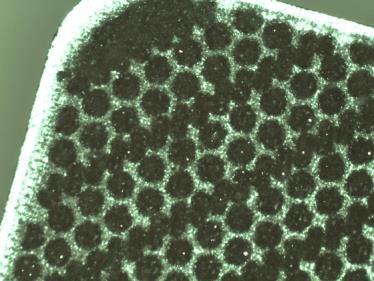
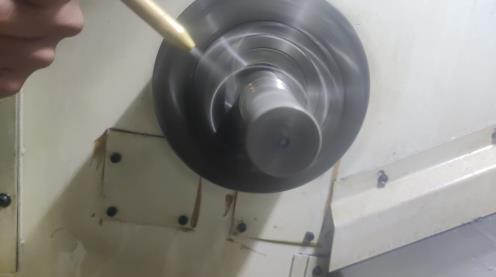
EN8materialischosenandmanufacturedusinganNClathe machineequippedwithproducedtexturedanduntextured toolswhilethemachineiscooledbyMQL.Thetexturedtools weremadewithalasermachine.Fabricatedtexturedtools are shown in Figure 1. Studies were carried out using the Taguchi L9 design. After cutting each experiment, a new cuttingedgewasused.A200mmlengthwasusedforeach experiment.Everyexperimentalrunisconductedthreetimes toensureoutputdataaccuracy. Aninfraredthermalimaging camera was utilized to capture the temperatures at the cuttingzone.Therakeandflankwearofthemachinedtools were measured using an optical microscope. The average surfaceroughnesstestermeasuredusingtheTalysurftester. Tool wear processes and surface defect analysis were performedusingascanningelectronmicroscope(SEM).MQL setupusedinthemachiningoperationareshowninFigure2.
International Research Journal of Engineering and Technology (IRJET) e-ISSN: 2395-0056
Volume: 11 Issue: 05 | May 2024 www.irjet.net
3.1 Influence of textured tool on cutting temperature
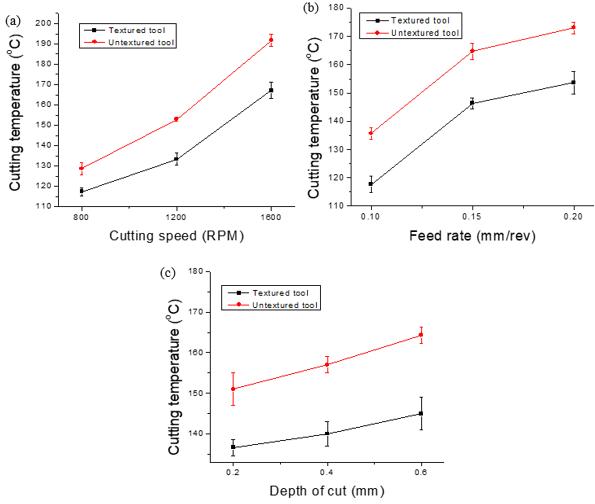
Figure3Impactoftexturedtoolandprocessvariableson cuttingtemperature.
Thisstudyexaminedtheimpactofprocessfactors andtooltypeoncuttingtemperature;thefindingsareshown inFigure3.Whenwetcooling,itisdiscoveredthattextured tools have a lower cutting temperature than untextured tools. At a low cutting speed of 800 RPM, the observed temperatures for textured and untextured materials are 117.3 oC and 128.7 oC, respectively. In this case, textured toolsshowa13%temperaturedropoveruntexturedtools. Similarly, as Figure 3(a) illustrates, when cutting speed is changed from 800 RPM to 1600 RPM, the textured tool's temperaturedropsby8–13%relativetotheuntexturedtool under MQL cooling conditions. Overall, when feed rate increases from 0.1 to 0.2 mm/rev, the temperature range discoveredintexturedtoolsis11–14%greaterthanthatof untexturedtools,asseeninFigure3(b).AccordingtoFigure 3(c),asthedepthofcutincreasesfrom0.2mmto0.6mm, thetexturedtoolexperiencesatemperaturereductionof9–12% more than the untextured tool under MQL cooling conditions.Lowtoolchipcontactlengthcauseslowfriction in the cutting zone, which is addressed by the derivative cuttingmechanism.Anotherreasonisthatthepresenceof microgroovesontherakefaceofthetool,wherecuttingfluid is sprayed in the form of MQL mist, helps to store cutting
p-ISSN: 2395-0072
fluid.Additionally,aconstantsupplyofcuttingfluidtothe cutting zone promotes efficient cooling and lubrication, whichreducesheatgenerationthere.
3.2 Influence of textured tool on tool rake wear
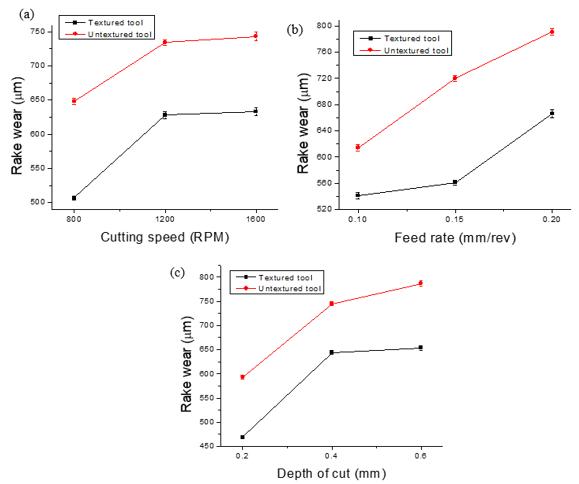
Figure4Impactoftexturedtoolandprocessvariableson toolrakewear.
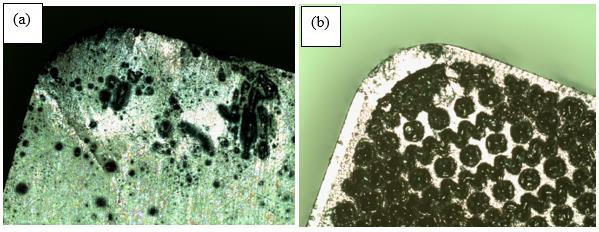
Thekindoftoolandprocessfactorsonrakewear duringwetcoolingareshowninFigure 4.Figure 4shows that under all process variable conditions, textured tools greatly decreased the rake wear compared to untextured tools.Rakewearis648µminuntexturedtoolsand507µmin texturedtoolsatalowcuttingvelocityof800RPM.Inthis case, textured tools have a 22% lower rake wear than untextured tools. It makes sense that, as Figure 4(a) illustrates,thetoolrakewearreductionrangefortextured toolsis19–22%whencomparedtountexturedtoolswhen cuttingspeedsurgesfrom800RPMto1600RPM.Overall, therakewearreductionrangenoticedintexturedtoolis1222%comparedtountexturedtoolswhenfeedrateincreases from0.1to0.2mm/revasshowninFigure4(b).Asseenin Figure 4(c), the range of rake wear reduction in textured toolsasthedepthofcutincreasesfrom0.2mmto0.6mmis 13-21%morethanthatofuntexturedtools.Ascanbeseenin Figure 4, under MQL conditions at all process variables, texturedtoolsgeneratedlesstoolrakewearthanuntextured tools.Therationaleisthatminimalrakewearresultsfrom textured tools' substantial reduction of the cutting zone's temperature. Figure 5 makes it clear that textured tools resultedinlessrakewearthanuntexturedtools.
International Research Journal of Engineering and Technology (IRJET) e-ISSN: 2395-0056
Volume: 11 Issue: 05 | May 2024 www.irjet.net
5
3.3 Influence of textured tool on tool flank wear
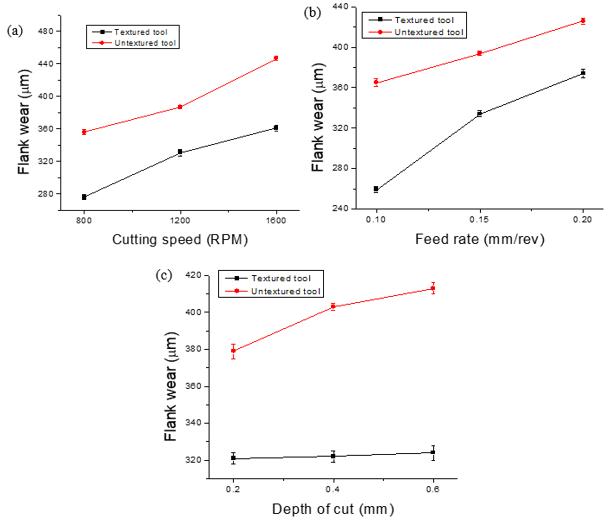
Figure6Impactoftexturedtoolandprocessvariableson toolflankwear.
Figure 6 illustrates the type of tool and process variables that affect flank wear during MQL cooling. In comparisontountexturedtools,Figure6demonstratesthat texturedtoolssignificantlyreducedtherakewearunderall process variable situations. At a low cutting speed of 800 RPM,flankwearis358µmforuntexturedtoolsand276µm fortexturedtools.Inthisscenario,texturedtoolshave22% lessflankwearthanuntexturedtools.Itmakeslogicalthat, asshowninFigure6(a),texturedtoolsreducetoolrakewear by14-22%whencuttingspeedrisesfrom800RPMto1600 RPM.Figure6(b)showsthatwhenthefeedrateisincreased from0.1 to0.2mm/rev,the rakewearreductionrange in textured tools is 12-29% more than in untextured tools. Figure6(c)showsthatasthedepthofcutrisesfrom0.2mm to 0.6mm, textured tools reduce rake wear 15-22% more than untextured tools. Figure 3 shows that under MQL settingsatallprocessvariables,texturedtoolsproducedless toolrakewearthanuntexturedtools.Thetool'srakefacehas microgrooves that allow cutting fluid to be continuously supplied.Thiseffectivelylubricatesthetool'sflankfaceand machined surface, resulting in little flank wear. Figure 7
p-ISSN: 2395-0072
demonstratesthattexturedtoolscausedlessflankwearthan untexturedtools.
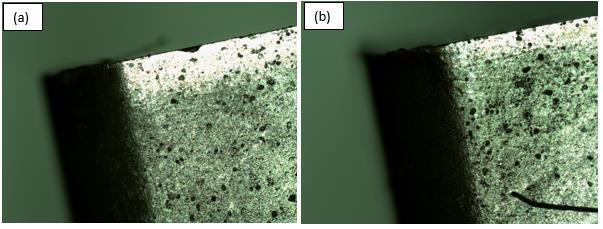
Figure7CapturedSEMimagesfortoolwearat V =1600 RPM, f = 0.15mm/revand ap = 0.6mm(a)Untexturedtool (b)Texturedtool.
3.4
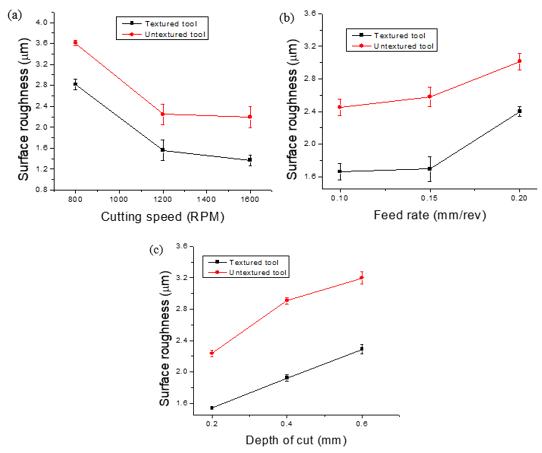
Figure8Impactoftexturedtoolandprocessvariableson surfaceroughness.
Surfaceroughnesshasasubstantialimpactonanyproduct's functional performance. As a result, research into surface roughness is crucial, and it is now being studied. Figure 8 demonstrates the influence of textured tools and MQL on surface roughness under various process conditions. As cutting velocity increases, Figure 8(a) shows that surface roughnessdecreasesduetoadecreaseintool-chipcontact length. As shown in Figures 8(b) and 8(c), roughness increases at high feed rates and depth of cut situations becauseoftheincreasedcuttingtemperatureasopposedto low feed rates and depth of cut settings. The surface roughnessvaluesoftexturedanduntexturedtoolsatalow cuttingspeedof800RPMm/minare2.821µmand3.606µm, respectively, as seen in Figure 8(a). Under these circumstances, textured tools show a 22% decrease in surface roughness compared to untextured tools. When cutting speed increases from 800 RPM to 1600 RPM, the overall surface roughness reduction range discovered in texturedtoolsis22-38%overuntexturedtools,asillustrated
International Research Journal of Engineering and Technology (IRJET) e-ISSN: 2395-0056
Volume: 11 Issue: 05 | May 2024 www.irjet.net p-ISSN: 2395-0072
inFigure8(a).Figure8(b)showsthatthereisareductionin surfaceroughnessof20-34%intexturedtoolscomparedto untexturedtoolswhenthefeedrateisincreasedfrom0.1to 0.2mm/rev.AsshowninFigure8(c),thesurfacereductions observedwithtexturedtoolsareintherangeof28-34%as compared to untextured tools when the depth of cut increasesfrom0.2mmto0.6mm.Ineveryprocessvariable circumstance,texturedtoolsperformedbetteroverallthan untexturedtoolsinreducingsurfaceroughness.Thesource ofthelowsurfaceroughnessisbecausetexturedtoolshave lesstoolwear, whichleavesfewer tool marksand surface imperfectionsonthemachinedsurface.Anotherexplanation isthatthetexturedtools'efficientlubricationcausedbythe MQLmistapplicationresultsinasmoothcuttingactionat thetool-workpieceinterfaceandreducedsurfaceroughness. AsshowninFigure9,itisclearthatthetexturedtoolhasless material side flow, adherence of micro-chip particles, and microgroovesassurfacedefectsthantheuntexturedtool.
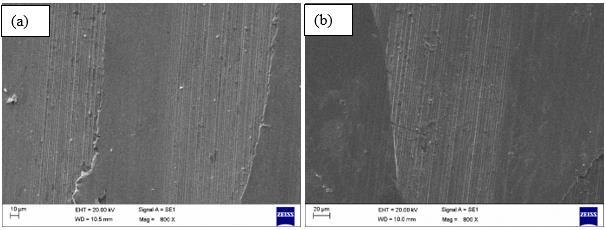
Figure9CapturedSEMimagesfortoolwearat V =1600 RPM, f = 0.15mm/revand ap = 0.6mm(a)Untexturedtool (b)Texturedtool.
3. CONCLUSIONS
Inthepresentwork,surfacetexturedtoolswerefabricated and same tools was used to assess the turning process performance. The obtained results were compared with untexturedtoolsunderMQLcoolingcondition.
•whileturningEN8material,thelargestdecreasesincutting temperature,rakewear,flankwear,andsurfaceroughness werereportedtobe14%,22%,29%,and38%,respectively, whileusingtexturedtoolsasopposedtountexturedtools.
•Whencuttingvelocityrises,surfaceroughnessdecreases, butwhenfeedrateincreases,itincreases.
•Cuttingtemperature,rakewear,andflankwearvaluesrose whencuttingvelocityandfeedrateincreasedfromlow to highvalues.
•UnderMQLcoolingconditions,thetexturedtoolsshoweda micropoolingeffectwithmicrogrooves.
• By using the textured tools that have been created, the metal cutting industries may increase productivity when turningEN8materialwhileitisMQLcooling.
[1] Bertolete,M.P.A.B.,Barbosa,P.A.,Machado,Á.R.,Samad, R.E.,Vieira,N.D.,Vilar,R.,&deRossi,W.(2018)Effects of texturing the rake surfaces of cemented tungsten carbidetoolsbyultrashortlaserpulsesinmachiningof martensiticstainlesssteel.TheInternationalJournalof AdvancedManufacturingTechnology,98(9),2653-2664.
[2] Dinesh, S., Senthilkumar, V., & Asokan, P. (2017) Experimental studies on the cryogenic machining of biodegradable ZK60 Mg alloy using micro-textured tools. Materials and Manufacturing Processes, 32(9), 979-987.doi:10.1080/10426914.2016.1221096.
[3] Durairaj, S., Guo, J., Aramcharoen, A., & Castagne, S. (2018)Anexperimentalstudyintotheeffectofmicrotextures on the performance of cutting tool. The International Journal of Advanced Manufacturing Technology,98(1),1011-1030.
[4] Gajrani,K.K.,PavanKumarReddy,R.,&RaviSankar,M. (2019) Tribo-mechanical and surface morphological comparisonofuntextured,mechanicalmicro-textured (MμT),andcoated-MμTcuttingtoolsduringmachining. ProceedingsoftheInstitutionofMechanicalEngineers, PartJ:JournalofEngineeringTribology,233(1),95–111. doi:10.1177/1350650118764975.
[5] Gugulothu,B.,Kumsa,D.K.,&Kassa,M.B.(2020)Effectof process parameters on centre lathe of EN8 steel in turningprocess.MaterialsToday:Proceedings,1-6.doi: 10.1016/j.matpr.2020.07.611.
[6] Hao,X.,Chen,X.,Xiao,S.,Li,L.,&He,N.(2018)Cutting performanceofcarbidetoolswithhybridtexture.The International Journal of Advanced Manufacturing Technology,97(9),3547-3556.
[7] Kang, Z., Fu, Y., Chen, Y., Ji, J., Fu, H., Wang, S., & Li, R. (2018) Experimental investigation of concave and convex micro-textures for improving anti-adhesion property of cutting tool in dry finish cutting. International Journal of Precision Engineering and Manufacturing-Green Technology, 5(5), 583-591. doi: 10.1007/s40684-018-0060-3.
[8] Kawasegi, N., Ozaki, K., Morita, N., Nishimura, K., &Yamaguchi, M. (2017) Development and machining performance of a textured diamond cutting tool fabricatedwithafocusedionbeamandheattreatment. Precision Engineering, 47, 311-320. doi: 10.1016/j.precisioneng.2016.09.005.
[9] Liu, Y., Deng, J., Wu, F., Duan, R., Zhang, X., & Hou, Y. (2017)Wearresistanceofcarbidetoolswithtextured flank-face in dry cutting of green alumina ceramics. Wear,372,91-103.doi:10.1016/j.wear.2016.12.001.
International Research Journal of Engineering and Technology (IRJET) e-ISSN: 2395-0056
Volume: 11 Issue: 05 | May 2024 www.irjet.net p-ISSN: 2395-0072
[10] Manikandan,N.,Arulkirubakaran,D.,Palanisamy,D., & Raju, R. (2019) Influence of wire-EDM textured conventionaltungstencarbideinsertsinmachiningof aerospace materials (Ti–6Al–4V alloy). Materials and Manufacturing Processes, 34(1), 103-111. doi: 10.1080/10426914.2018.1544712.
[11] Murugappan,S.,&Arul,S.(2017)EffectofCryogenic Pre cooling on Chip Reduction Co-efficient during TurningofEN8SteelRod.MaterialsToday:Proceedings, 4(8),8848–8855.doi:10.1016/j.matpr.2017.07.235.
[12] Palanisamy,D.,Balasubramanian,K.,Manikandan, N., Arulkirubakaran, D.,& Ramesh, R. (2019) Machinabilityanalysisofhighstrengthmaterialswith Cryo-Treated textured tungsten carbide inserts. MaterialsandManufacturingProcesses,34(5),502-510. doi:10.1080/10426914.2019.1566612.
[13] Pang, M., Nie, Y., & Ma, L. (2018) Effect of symmetricalconicalmicro-groovedtextureontool–chip frictionpropertyofWC-TiC/Cocementedcarbidetools. The International Journal of Advanced Manufacturing Technology,99(1),737-746.doi:10.1007/s00170-0182498-4.
[14] Rajbongshi,S.K.,&Sarma,D.K.,2019.Performance parametersstudiesinmachiningofAISID2steelwith dot-textured, groove-textured & non-textured cutting toolattheflankface.InternationalJournalofRefractory Metals and Hard Materials, 83, 104970. doi: 10.1016/j.ijrmhm.2019.104970.
[15] Sharma, V., & Pandey, P.M. (2016) Comparative study of turning of 4340 hardened steel with hybrid texturedself-lubricatingcuttinginserts.Materialsand Manufacturing Processes, 31(14), 1904-1916. doi: 10.1080/10426914.2015.1127951.
[16] Sugihara,T.&Enomoto,T.(2013)Craterandflank wearresistanceofcuttingtoolshavingmicrotextured surfaces. Precision Engineering, 37(4), 888–896. doi: 10.1016/j.precisioneng.2013.05.007.
[17] Sun,J.,Zhou,Y.,Deng,J.,&Zhao,J.(2016)Effectof hybridtexturecombiningmicro-pitsandmicro-grooves on cutting performance of WC/Co-based tools. The International Journal of Advanced Manufacturing Technology, 86(9), 3383-3394. doi: 10.1007/s00170016-8452-4.
[18] Thangarasu, SK., & Shankar, S. (2020) Tool wear prediction in hard turning of EN8 steel using cutting force and surface roughness with artificial neural network. Proceedings of the Institution of Mechanical Engineers, Part C: Journal of Mechanical Engineering Science, 234(1), 329-342. doi: 10.1177/0954406219873932.
[19] Vamsi Krishna, P., & Nageswara Rao, D. (2008) Performanceevaluationofsolidlubricantsintermsof machiningparametersinturning.InternationalJournal ofMachineToolsandManufacture,48(10),1131–1137. doi:10.1016/j.ijmachtools.2008.01.012.
[20] Vasumathy,D.,Meena,A.,&Duraiselvam,M.(2017) Experimental Study on Evaluating the Effect of Micro TexturedToolsinTurningAISI316AusteniticStainless Steel. Procedia Engineering, 184, 50–57. doi: 10.1016/j.proeng.2017.04.070.
[21] Xing, Y., Deng, J., Zhao, J., Zhang, G., & Zhang, K. (2014) Cutting performance and wear mechanism of nanoscaleandmicroscaletexturedAl2O3/TiCceramic tools in dry cutting of hardened steel. International JournalofRefractoryMetalsandHardMaterials,43,4658.doi:10.1016/j.ijrmhm.2013.10.019.
[22] S.Durairaj,J.Guo,A.Aramcharoen,andS.Castagne, “Anexperimentalstudyintotheeffectofmicro-textures ontheperformanceofcuttingtool,”Int.J.Adv.Manuf. Technol.,vol.98,no.1–4,pp.1011–1030,2018.
[23] X. Hao, X. Chen, S. Xiao, L. Li, and N. He, “Cutting performanceofcarbidetoolswithhybridtexture,”Int.J. Adv.Manuf.Technol.,vol.97,no.9–12,pp.3547–3556, 2018.
[24] Sharma, V. and Pandey, P.M., 2016. Comparative study of turning of 4340 hardened steel with hybrid texturedself-lubricatingcuttinginserts.Materialsand ManufacturingProcesses,31(14),pp.1904-1916.
[25] Singh,R.,Dureja,J.S.,Dogra,M.,Gupta,M.K.andMia, M.,2019.Influenceofgraphene-enrichednanofluidsand texturedtoolonmachiningbehaviorofTi-6Al-4Valloy. The International Journal of Advanced Manufacturing Technology,105(1-4),pp.1685-1697.
2024, IRJET | Impact Factor value: 8.226 | ISO 9001:2008