
International Research Journal of Engineering and Technology (IRJET) e-ISSN:2395-0056 p-ISSN:2395-0072
Volume: 11 Issue: 05 | May 2024 www.irjet.net
International Research Journal of Engineering and Technology (IRJET) e-ISSN:2395-0056 p-ISSN:2395-0072
Volume: 11 Issue: 05 | May 2024 www.irjet.net
Narendra Singh
PG Scholar Department of Civil Engineering Mewar University, Gangrar,312901
TherapidurbanizationinIndiahassignificantlyincreasedthedemandformaterialsusedinbuildingconstruction,especially for high-rise buildings. Traditional brick-making processes have led to environmental and health issues, necessitating the explorationofalternativematerialssuchasaeratedconcrete.ThisstudyfocusesonNon-AutoclavedAeratedConcrete(NAAC), a lightweight, porous material known for its high acoustic and thermal insulation properties. NAAC is manufactured using aluminiumpowderasanair-entrainingagent,eliminatingtheenergy-intensiveautoclavingprocess.Thisresearchthoroughly examines the properties of NAAC blocks, incorporating rice husk ash (RHA) and marble powder as partial cement replacements. The comprehensive experimental methodology encompasses the material collection, batching, mixing, moulding,curing,andtestingforpropertiessuchasdensity,waterabsorption,compressivestrength,andsplittensilestrength. The results indicate that NAAC blocks with RHA and marble powder exhibit satisfactory water absorption and density performancewhileprovidingadequatecompressiveandtensilestrength.Thecompellingfindingsfromourresearchstrongly indicatethatNon-AutoclavedAeratedConcrete(NAAC)blockshavethepotentialtobeapracticalandsustainablealternative to traditional bricks in construction. This suggests that the use of NAAC blocks could lead to a significant reduction in environmentalimpactandimproveoverallconstructionefficiency.
Keywords: AeratedConcrete,construction,density,waterabsorption,compressivestrength,andsplittensilestrength.
Indiaisadevelopingcountryduetowhichtherapidurbanizationhasincreasedthedemand forhouseconstructionresulting intheincreaseddemandforconstructionmaterials.However,duetospaceconstraints,thedemandforhigh-risebuildingshas increased. The increased demand for high-rise buildings has led to an increase in demand for better-performing materials such as high-strength materials, low-density etc. Bricks are widely used as one of the most essential and versatile building materials in construction. Their durability, insulation properties, and availability in various sizes and colours make them a popularchoiceforbuildingprojectsaroundtheworld.
Additionally, bricks are known for their ability to withstand diverse weather conditions and provide structural support in a wide range of architectural designs. The brick-making process directly or indirectly caused a series of environmental and healthproblemsforthepeopleliving nearthe brickkilnandpeopleworkinginthekiln.Theenvironmental pollutioncaused by brick-making operations endangers human health, animals, and plant life. Nowadays aerated concrete is an innovative construction material used in the construction industry 60% to 80% of its volume contains pore space. Properties like strength,durability,toughness,heattransferandwetnessareaffectedbytheporedimensionandmicrostructure.Thisporous material will provide high acoustic insulation and thermal insulation functions. However, due to increased pores, the compressive strength of cubes reduces. It is lower weight than the conventional clay bricks with a dry density ranging between 600 kg/m3 to 1600 kg/m3. Based on the method of curing, aerated concrete can be of two types which are autoclavedaeratedconcrete(AAC)andnon-autoclavedaeratedconcrete(NAAC).Inthisstudy,thefocusisonnon-autoclaved concrete (NAAC) in which water curing of blocks has been done. Non-autoclaved aerated concrete can be created either by usingafoamingagentorbyanentrainingmediator.
In this research, aluminium powder has been used as an air-entraining agent. Various chemical reactions are involved in aeratingconcretetomake blockslighterinweightfrom freshmortar. The effectof aluminiumpowder withthe hydroxideof calcium and alkali from cement and lime releases hydrogen, which causes bubbles in the mixture. The bubbles enlarge the mixtureandconcreteaugments.Aeratedconcreteblocks(AC)maybeoneofthesolutionstoreplacebricks.Aeratedconcrete
International Research Journal of Engineering and Technology (IRJET) e-ISSN:2395-0056 p-ISSN:2395-0072
Volume: 11 Issue: 05 | May 2024 www.irjet.net
is lightweight concrete. Lightweight concrete can be divided into two main types based on the method of curing such as. Autoclavedaeratedconcrete(AAC)andNon-autoclavedaeratedconcrete(NAAC).CuringofAACblockundergoesinautoclave whereas in case of NAAC curing of sample is conducted in water. Non-autoclaved aerated concrete (NAAC) has two main benefits one is efficient material usage due to a porous structure and the second one is less energy consumption due to the eliminationofautoclaving.TheaerationofNAACismainlyduetotheresultofthechemicalreactionofaluminiumwithwater to produce hydrogen gas, which becomes entrapped in the concrete slurry and forms voids in NAAC. The reaction that will takeplaceisasfollows:(Hamad,2014)
2Al+3Ca(OH)2+6H2O 3CaO.Al2O3.6H2O+3H2
Aeratedconcreteislightweightcomparedtoordinaryconcreteduetothelargenumberofvoidspresentinit.Theseporeswill affectthepropertiessuchasstrength,durability,density,waterabsorptionetc.inconcrete.Porousconcreteisagoodthermal insulationandacousticinsulation.Sinceaeratedconcreteconsists ofvoidsitis less densethan traditional concreteanduses less material. Thus, the project goal is to develop a form of concrete block with optimum compressive strength and the eliminationofautoclaving.
Nowadays, the demand for construction materials is continuously increasing with the increase in buildings for housing and commercial purposes in both urban and rural areas. The resources used to manufacture large amounts of construction materials have adverse effects on the environment and human health by depleting natural resources, using energy, and creatingpollution.
The methodology used for producing Non-Autoclaved Aerated Concrete is illustrated in Figure 1. The first step involved collectingallthematerialsneededfortheexperimentalwork.Aftercollectingthematerials,batchingwasperformed.Batching isacriticalprocess,asevenslightvariationscanaffectthestrengthofthesamplesobtained.Followingbatching,thematerials weremixed,andthemouldswerefilledtotherequired height.After24hours,the demouldingprocesswascarriedout,and thesamplesweretakenoutforcuring.Finally,thecuredsamplesweretakenfortesting.
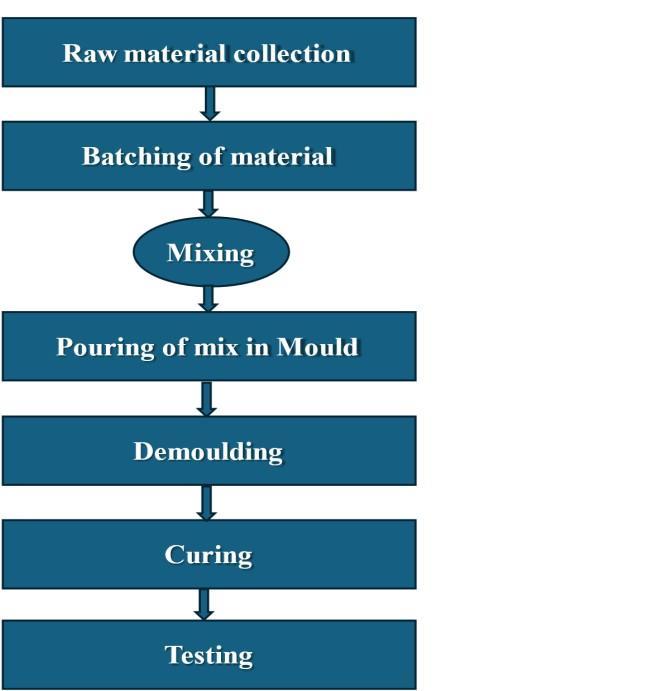
Figure 1: ResearchMethodology.
International Research Journal of Engineering and Technology (IRJET) e-ISSN:2395-0056 p-ISSN:2395-0072
Volume: 11 Issue: 05 | May 2024 www.irjet.net
3.1. Material used.
Toconducttheexperimental work variousmaterialsare requiredsuchascement,fineaggregate,and waterprovided bythe university rice husk ash was collected from the locality, and marble powder id collected from the local marble industry of Chittorgarh.Marblepowderisavailableinlargequantitiesbecauseitisawasteproductofthemarbleindustry.Utilization of this waste in construction will help to reduce the impact of waste on the environment and prevent contamination of groundwater.
Aluminium Powder: The addition of aluminium powder in concrete helps in increasing strength as well as increasing the volumetomakeconcretelightweight Aluminiumpowderhasbeenorderedfromthelocalmarket.Thesizeoftheparticlesis 250mesh,andthepriceis290/kg.
Cement: The cement used for the experiment was Ordinary Portland Cement (UltraTech) Grade-43. Cement had been collectedfromthelocalmarket.Withaspecificgravityof3.11andadensityof1440kg/m3
Marble powder: Marblepowderwastakenfromthelocalmarbleindustry.
Rice husk ash: Rice husk ash (RHA) obtained from local sources was naturally incinerated and utilized in the experimental procedure.RHAthathadbeensievedthrougha90-micronmeshwasemployedasapartialsubstituteforcementinNAAC.
Fine aggregates: We have conducted a sieve analysison the fine aggregates used in this experiment. All the fine aggregates havepassedthrougha4.75mmsieve.
Water: NormaltapwaterisusedforthisexperimentasperthespecificationgiveninIS456:2000.
All materials are weighed properly as per the requirement of the mixed design. Materials such as Cement, rice husk ash, marblepowderandAluminiumpowderareproperlymixedindryform.Thenwaterisaddedtothedrymaterialsandmixedto getaconsistentmixture.
International Research Journal of Engineering and Technology (IRJET) e-ISSN:2395-0056
Volume: 11 Issue: 05 | May 2024 www.irjet.net p-ISSN:2395-0072
Table 2 MixproportionforRHAandmarblepowder
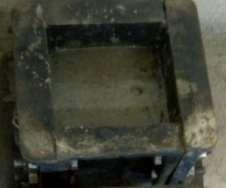
The experimental moulds, eachmeasuring 70.6mmx70.6mmx 70.6mm,were meticulouslypreparedfortheconcrete work. Before assembly, each part of the mould was meticulously cleaned to ensure no residue of hardened concrete or dirt on the inner surfaces. After thorough cleaning, all the parts were assembled and securely tightened to prevent any slurry from leakingout. Furthermore,theinner surface ofthe mouldwascarefullyoiled before pouring the mix,ensuring thatthegreen cakemixturewouldnotadheretothesurface,allowingforeasyremovalofthecubesoncetheyhadhardened.
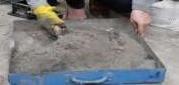
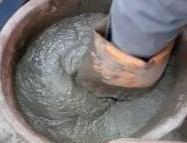
To prepare the specimens, precise amounts of all the ingredients were gathered. The mixing process involved three distinct steps:drymixing,wetmixing,andcombinedmixing.Duringthedrymixingstage,thesand,cement,andricehuskash/marble powder were meticulously blended. Separately, the aluminium powder was mixed with water. These two mixes were then merged and thoroughly mixed to form a slurry. The slurry was mixed for 2 minutes to ensure the prevention of lumps formation.
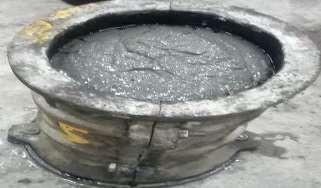
Concretewasfilledinmouldsupto2/3rdht.ofmouldi.e.47mmforcubes.After30min.wecouldseetheformationofbubbles inthespecimenwhichwereformedduetothepresenceofaluminiumpowder.Twohourslaterswellinginconcretecouldbe seenandmouldwasfilled.Theextraportionwasremovedatthattimeonly andthespecimenwaslevelleduptotherequired height. Then the specimen was kept at room temperature for 24 hours. After 24hrs concrete moulds were opened carefully andcubeswereremoved.
International Research Journal of Engineering and Technology (IRJET) e-ISSN:2395-0056
Volume: 11 Issue: 05 | May 2024 www.irjet.net p-ISSN:2395-0072
3.6.
After 24hrs.moulds wereopened, and cubeswere takenout then eachspecimen wasmarkedaccording toitsspecifications. Aftermarkingspecimensweredippedinacuringtankfor7days,14daysand28daysofcuring.Thequalityofwaterinwhich cubesweredippedwascleanedandfreefromimpuritiesbecausethequalityofwaterusedforcuringalsoaffectsthestrength ofconcrete.
After curing samples were taken out from the water and kept in a dry place for 3-4 hrs. to remove extra moisture from the specimen.Afterthatsampleswerereadyfortesting.Differenttestswereperformedonsamplessuchascompressivestrength test,splittensilestrengthwaterabsorptiontestetc. 4. RESULTS
WaterabsorptionmustbecalculatedtocheckthepercentageofmoistureinNAACblocks.Forthat,wehadtocarryoutawater absorption test. Max. The permissible limit for water absorption should not be more than 20% as per IS 1077:1992. (BIS, 1992)
International Research Journal of Engineering and Technology (IRJET) e-ISSN:2395-0056
Volume: 11 Issue: 05 | May 2024 www.irjet.net p-ISSN:2395-0072
Table 4 Waterabsorption(RHAandmarblepowder)
Concrete density is a crucial parameter that influences its structural performance, insulation properties, and suitability for differentconstructionapplications.ThedensityofNon-AutoclavedAeratedConcrete(NAAC)issignificantlylowerthanthatof conventionalconcreteduetoitsporousnature,makingitalightweightalternative.
As per IS code IS 2185 (part1): 2005 concrete blocks of grade B have a density between 1100 kg/m3 and 1500 kg/m3(BIS:2185,2005)
Table 5 DensityofNAAC(RHA)
6 DensityofNAAC(RHA+marblepowder)
International Research Journal of Engineering and Technology (IRJET) e-ISSN:2395-0056
Volume: 11 Issue: 05 | May 2024 www.irjet.net p-ISSN:2395-0072
The compressive strength of the NAAC block can be determined by taking the maximum load value which is applied to the specimen at the time of testing divided by the cross-sectional area of the specimen. Three specimens of the concrete block were tested and an average of three values was taken. Compressive strength of C-class common burnt clay brick is takenas perIScodei.e.IS1077:1976(ANNEXUREIII)(No,1976)
Table 7 CompressivestrengthofNAAC(RHA) Sample
Table 8 CompressivestrengthofNAAC(RHA+marblepowder)
SplittensilestrengthforNon-AutoclavedAeratedConcrete(NAAC)withvaryingproportionsofricehuskash(RHA)replacing cementrevealsimportantinsightsintothematerial'sperformance.Thecontrolsample(S0)exhibitedthehighestsplittensile strengthof1.68N/mm²at28days.TheintroductionofRHAasapartialcementreplacementledtoareductioninsplittensile strengthacrossalltestedsamples.ThefindingssuggestthatwhiletheinclusionofRHAdoesdecreasethesplittensilestrength ofNAAC,a 3%replacement representsanoptimal balance,offeringa sustainablealternativewithminimal performanceloss. HigherpercentagesofRHAleadtofurther reductionsin tensilestrength,whichshouldbeconsideredwhendesigningNAAC forstructuralapplications.Theseresultssupportthepotentialforincorporatingindustrialby-productslikeRHAintoconcrete formulationstoenhancesustainabilityintheconstructionindustry.AccordingtoIS:5816:1999tensilestrengthis8%to12% ofthecompressivestrength.
International Research Journal of Engineering and Technology (IRJET) e-ISSN:2395-0056
Volume: 11 Issue: 05 | May 2024 www.irjet.net p-ISSN:2395-0072
Table 9 Splittensilestrength Sample
RHA
It is concluded that as the percentage of RHA increases in NAAC, the water absorption capacity also increases. Similarly, the increase in the percentage of RHA while adding marble powder in NAAC showed only a slight variation in water absorption. The density of lightweight concrete should be between 1100 kg/m3 to 1500 kg/m3 as per IS 2185(part 1):2005, and the resultsshowed thatthe densityofNAACblocksiswithinthisrange.Thedrydensityobtained forNAACblocksislowerthan thatofbricks,withthelowestdensityobtainedforsampleS4.TheoptimumvalueofcompressivestrengthofNAACwithRHA is found for sample S1, which is 8.42N/mm2 (5% Replacement of cement with RHA). The optimum value of compressive strength of NAAC (RHA+ marble powder) is obtained for S1.2, which is 6.93 N/mm2 and lies between the compressive strengthofC-classbricks.Lastly,3%replacementofcementwithRHAgavetheoptimumvalueofsplittensilestrength,which is0.98N/mm2.
[1] BIS:2185.(2005).IndianStandardConcretemasonryunits,Part1:Hollowandsolidconcreteblocks. Bureau of Indian Standards, New Delhi,17.
[2] BIS.(1992).IS1077(1992)CommonBurntClayBuildingBricks-Specification. Bureau of Indian Standard (BIS)
[3] He,T.,Xu,R.,Da,Y.,Yang,R.,Chen,C.andLiu,Y.,2019.Experimentalstudyofhigh-performanceautoclavedaerated concreteproducedwithrecycledwoodfibreandrubberpowder. Journal of Cleaner Production
[4] Il’ina,L.V.andRakov,M.A.,2016,January.Non-autoclavedaeratedconcretewithmineraladditives.In AIP Conference Proceedings (Vol.1698,No.1,p.070007).AIPPublishing.
[5] Karolina, R. and Muhammad, F., 2018, February. The analysis of mechanical properties ofnon-autoclaved aerated concretewiththesubstitutionofflyashandbottomash.In IOP Conference Series: Materials Science and Engineering (Vol. 309,No.1,p.012133).IOPPublishing.
[6] Kunchariyakun,K.,Asavapisit,S.andSinyoung,S.,2018.Influenceofpartialsandreplacementbyblackricehuskash andbagasseashonpropertiesofautoclavedaeratedconcreteunderdifferenttemperaturesandtimes. Construction and Building Materials, 173,pp.220-227.
[7] Kunchariyakun,K.,Asavapisit,S.andSombatsompop,K.,2015.Propertiesofautoclaved aeratedconcrete incorporatingricehuskashaspartialreplacementforfineaggregate. Cement and Concrete Composites, 55,pp.11-16.
International Research Journal of Engineering and Technology (IRJET) e-ISSN:2395-0056
Volume: 11 Issue: 05 | May 2024 www.irjet.net p-ISSN:2395-0072
[8] Li, F.X., Chen, Y.Z., Yu, Q.J. and Wei, J.X., 2011. Utilization of Desulfuration Residues in Non-Autoclaved Aerated Concrete.In Advanced Materials Research (Vol.250,pp.707-710).TransTechPublications.
[9] No,S.(1976). (A) Internal Grading of Aggregates (B) Classes of Common Burnt Clay Bricks Is 1077-1976. 35(mm),125.
[10] Shrivastava,A.,andTiwari,A.,Non-AutoclavedAeratedConcrete(NAAC)Blocks:AnAlternativeBuildingConstruction Material.
[11] Shuisky,A.,Stelmakh,S.,Shcherban,E.andTorlina,E.,2017.Recipe-technologicalaspectsofimprovingtheproperties ofnon-autoclavedaeratedconcrete.In MATEC Web of Conferences (Vol.129,p.05011).EDPSciences.
[12] Sukmana, N.C., Khifdillah, M.I., Nurkholil, A.S. and Anggarini, U., 2019, April. Optimization of non-autoclaved aerated concrete using phosphogypsum of industrial waste based on the Taguchi method. In IOP Conference Series: Materials Science and Engineering,(Vol.509,No.1,p.012095).IOPPublishing.
[13] Wahane, A.,2017. Manufacturing process of AAC block. International Journal of Advance Research in Science and Engineering, 06,pp.4-11
[14] Xia, Y., Yan, Y. and Hu, Z., 2013. Utilization of circulating fluidized bed fly ash in preparing non-autoclaved aerated concreteproduction. Construction and Building Materials, 47,pp.1461-1467.
[15] Yang, L., Yan, Y. and Hu, Z., 2013. Utilization of phosphogypsum for the preparation of non- autoclaved aerated concrete. Construction and building materials, 44,pp.600-606.
[16] Guglielmi P. O., W. R. L. Silva, et al, “Porosity and Mechanical Strength of an Autoclaved Clayey Cellular Concrete”, AdvancesinCivilEngineeringVolume2010,ArticleID194102,6pages,2010.
[17] Hamad Ali J. “Materials, Production, Properties and Application of Aerated Lightweight Concrete: Review” InternationalJournalofMaterialsScienceandEngineeringVol.2,No.2December2014.
[18] Jani Sohani n., Shah Darshan s., Analysis of microstructure and properties of AAC block with its manufacturing process,JournalofInternationalAcademicResearchforMultidisciplinary,Volume2,Issue7,August2014.
[19] KhandviP.V.,ApplicationsofAACinConstructionIndustry,2016.
[20] [7]KumarNitin,DrNetulaOmPrakash,“ApplicationofAACblocksinresidentialbuildings”,InternationalJournalof EngineeringSciences&ResearchTechnology,March2017.